Spandidos Publications Logo
  • About
    • About Spandidos
    • Aims and Scopes
    • Abstracting and Indexing
    • Editorial Policies
    • Reprints and Permissions
    • Job Opportunities
    • Terms and Conditions
    • Contact
  • Journals
    • All Journals
    • Oncology Letters
      • Oncology Letters
      • Information for Authors
      • Editorial Policies
      • Editorial Board
      • Aims and Scope
      • Abstracting and Indexing
      • Bibliographic Information
      • Archive
    • International Journal of Oncology
      • International Journal of Oncology
      • Information for Authors
      • Editorial Policies
      • Editorial Board
      • Aims and Scope
      • Abstracting and Indexing
      • Bibliographic Information
      • Archive
    • Molecular and Clinical Oncology
      • Molecular and Clinical Oncology
      • Information for Authors
      • Editorial Policies
      • Editorial Board
      • Aims and Scope
      • Abstracting and Indexing
      • Bibliographic Information
      • Archive
    • Experimental and Therapeutic Medicine
      • Experimental and Therapeutic Medicine
      • Information for Authors
      • Editorial Policies
      • Editorial Board
      • Aims and Scope
      • Abstracting and Indexing
      • Bibliographic Information
      • Archive
    • International Journal of Molecular Medicine
      • International Journal of Molecular Medicine
      • Information for Authors
      • Editorial Policies
      • Editorial Board
      • Aims and Scope
      • Abstracting and Indexing
      • Bibliographic Information
      • Archive
    • Biomedical Reports
      • Biomedical Reports
      • Information for Authors
      • Editorial Policies
      • Editorial Board
      • Aims and Scope
      • Abstracting and Indexing
      • Bibliographic Information
      • Archive
    • Oncology Reports
      • Oncology Reports
      • Information for Authors
      • Editorial Policies
      • Editorial Board
      • Aims and Scope
      • Abstracting and Indexing
      • Bibliographic Information
      • Archive
    • Molecular Medicine Reports
      • Molecular Medicine Reports
      • Information for Authors
      • Editorial Policies
      • Editorial Board
      • Aims and Scope
      • Abstracting and Indexing
      • Bibliographic Information
      • Archive
    • World Academy of Sciences Journal
      • World Academy of Sciences Journal
      • Information for Authors
      • Editorial Policies
      • Editorial Board
      • Aims and Scope
      • Abstracting and Indexing
      • Bibliographic Information
      • Archive
    • International Journal of Functional Nutrition
      • International Journal of Functional Nutrition
      • Information for Authors
      • Editorial Policies
      • Editorial Board
      • Aims and Scope
      • Abstracting and Indexing
      • Bibliographic Information
      • Archive
    • International Journal of Epigenetics
      • International Journal of Epigenetics
      • Information for Authors
      • Editorial Policies
      • Editorial Board
      • Aims and Scope
      • Abstracting and Indexing
      • Bibliographic Information
      • Archive
    • Medicine International
      • Medicine International
      • Information for Authors
      • Editorial Policies
      • Editorial Board
      • Aims and Scope
      • Abstracting and Indexing
      • Bibliographic Information
      • Archive
  • Articles
  • Information
    • Information for Authors
    • Information for Reviewers
    • Information for Librarians
    • Information for Advertisers
    • Conferences
  • Language Editing
Spandidos Publications Logo
  • About
    • About Spandidos
    • Aims and Scopes
    • Abstracting and Indexing
    • Editorial Policies
    • Reprints and Permissions
    • Job Opportunities
    • Terms and Conditions
    • Contact
  • Journals
    • All Journals
    • Biomedical Reports
      • Information for Authors
      • Editorial Policies
      • Editorial Board
      • Aims and Scope
      • Abstracting and Indexing
      • Bibliographic Information
      • Archive
    • Experimental and Therapeutic Medicine
      • Information for Authors
      • Editorial Policies
      • Editorial Board
      • Aims and Scope
      • Abstracting and Indexing
      • Bibliographic Information
      • Archive
    • International Journal of Epigenetics
      • Information for Authors
      • Editorial Policies
      • Editorial Board
      • Aims and Scope
      • Abstracting and Indexing
      • Bibliographic Information
      • Archive
    • International Journal of Functional Nutrition
      • Information for Authors
      • Editorial Policies
      • Editorial Board
      • Aims and Scope
      • Abstracting and Indexing
      • Bibliographic Information
      • Archive
    • International Journal of Molecular Medicine
      • Information for Authors
      • Editorial Policies
      • Editorial Board
      • Aims and Scope
      • Abstracting and Indexing
      • Bibliographic Information
      • Archive
    • International Journal of Oncology
      • Information for Authors
      • Editorial Policies
      • Editorial Board
      • Aims and Scope
      • Abstracting and Indexing
      • Bibliographic Information
      • Archive
    • Medicine International
      • Information for Authors
      • Editorial Policies
      • Editorial Board
      • Aims and Scope
      • Abstracting and Indexing
      • Bibliographic Information
      • Archive
    • Molecular and Clinical Oncology
      • Information for Authors
      • Editorial Policies
      • Editorial Board
      • Aims and Scope
      • Abstracting and Indexing
      • Bibliographic Information
      • Archive
    • Molecular Medicine Reports
      • Information for Authors
      • Editorial Policies
      • Editorial Board
      • Aims and Scope
      • Abstracting and Indexing
      • Bibliographic Information
      • Archive
    • Oncology Letters
      • Information for Authors
      • Editorial Policies
      • Editorial Board
      • Aims and Scope
      • Abstracting and Indexing
      • Bibliographic Information
      • Archive
    • Oncology Reports
      • Information for Authors
      • Editorial Policies
      • Editorial Board
      • Aims and Scope
      • Abstracting and Indexing
      • Bibliographic Information
      • Archive
    • World Academy of Sciences Journal
      • Information for Authors
      • Editorial Policies
      • Editorial Board
      • Aims and Scope
      • Abstracting and Indexing
      • Bibliographic Information
      • Archive
  • Articles
  • Information
    • For Authors
    • For Reviewers
    • For Librarians
    • For Advertisers
    • Conferences
  • Language Editing
Login Register Submit
  • This site uses cookies
  • You can change your cookie settings at any time by following the instructions in our Cookie Policy. To find out more, you may read our Privacy Policy.

    I agree
Search articles by DOI, keyword, author or affiliation
Search
Advanced Search
presentation
Molecular and Clinical Oncology
Join Editorial Board Propose a Special Issue
Print ISSN: 2049-9450 Online ISSN: 2049-9469
Journal Cover
April-2016 Volume 4 Issue 4

Full Size Image

Sign up for eToc alerts
Recommend to Library

Journals

International Journal of Molecular Medicine

International Journal of Molecular Medicine

International Journal of Molecular Medicine is an international journal devoted to molecular mechanisms of human disease.

International Journal of Oncology

International Journal of Oncology

International Journal of Oncology is an international journal devoted to oncology research and cancer treatment.

Molecular Medicine Reports

Molecular Medicine Reports

Covers molecular medicine topics such as pharmacology, pathology, genetics, neuroscience, infectious diseases, molecular cardiology, and molecular surgery.

Oncology Reports

Oncology Reports

Oncology Reports is an international journal devoted to fundamental and applied research in Oncology.

Experimental and Therapeutic Medicine

Experimental and Therapeutic Medicine

Experimental and Therapeutic Medicine is an international journal devoted to laboratory and clinical medicine.

Oncology Letters

Oncology Letters

Oncology Letters is an international journal devoted to Experimental and Clinical Oncology.

Biomedical Reports

Biomedical Reports

Explores a wide range of biological and medical fields, including pharmacology, genetics, microbiology, neuroscience, and molecular cardiology.

Molecular and Clinical Oncology

Molecular and Clinical Oncology

International journal addressing all aspects of oncology research, from tumorigenesis and oncogenes to chemotherapy and metastasis.

World Academy of Sciences Journal

World Academy of Sciences Journal

Multidisciplinary open-access journal spanning biochemistry, genetics, neuroscience, environmental health, and synthetic biology.

International Journal of Functional Nutrition

International Journal of Functional Nutrition

Open-access journal combining biochemistry, pharmacology, immunology, and genetics to advance health through functional nutrition.

International Journal of Epigenetics

International Journal of Epigenetics

Publishes open-access research on using epigenetics to advance understanding and treatment of human disease.

Medicine International

Medicine International

An International Open Access Journal Devoted to General Medicine.

Journal Cover
April-2016 Volume 4 Issue 4

Full Size Image

Sign up for eToc alerts
Recommend to Library

  • Article
  • Citations
    • Cite This Article
    • Download Citation
    • Create Citation Alert
    • Remove Citation Alert
    • Cited By
  • Similar Articles
    • Related Articles (in Spandidos Publications)
    • Similar Articles (Google Scholar)
    • Similar Articles (PubMed)
  • Download PDF
  • Download XML
  • View XML
Article Open Access

Replicative random mutations as an unproven cause of cancer: A technical comment

  • Authors:
    • Dominique Belpomme
    • Philippe Irigaray
  • View Affiliations / Copyright

    Affiliations: Cancer Research Center, Association for Research and Treatments Against Cancer (ARTAC), F‑75015 Paris, France
    Copyright: © Belpomme et al. This is an open access article distributed under the terms of Creative Commons Attribution License.
  • Pages: 497-499
    |
    Published online on: January 25, 2016
       https://doi.org/10.3892/mco.2016.737
  • Expand metrics +
Metrics: Total Views: 0 (Spandidos Publications: | PMC Statistics: )
Metrics: Total PDF Downloads: 0 (Spandidos Publications: | PMC Statistics: )
Cited By (CrossRef): 0 citations Loading Articles...

This article is mentioned in:


Abstract

A careful molecular biology, epidemiological and mathematical modelling reanalysis of the recently published study titled ‘Cancer etiology. Variation in cancer risk among tissues can be explained by the number of stem cell divisions’ by Cristian Tomasetti and Bert Vogelstein, which was published on January 2, 2015 in the distinguished journal Science, led to the conclusion that, contrary to the authors' claim, many cancer types are not caused by replicative random mutations. Rather than the authors' two arbitrarily individualized groups of cancer, a three‑group model is herein proposed in the framework of this technical comment, considerably reducing the fraction of cancer cases hypothetically attributable to random mutations.

Technical comment

After reading the paper by Cristian Tomasetti and Bert Vogelstein (1) and the following comments, including those from the World Health Organization International Agency for Cancer Research (Lyon, France) and the Collegium Ramazzini in Italy (2–10), we herein present a molecular biology, epidemiological and mathematical modeling reanalysis that strongly disagrees with their conclusion, stating that several cancer types may be caused by random somatic mutations arising during DNA replication of normal stem cells. Instead of the author's two-group individualized model, a three-group model is proposed, considerably reducing the fraction of cancer hypothetically attributable to random mutations.

The hypothesis that the lifetime risk of cancer differs according to tissue type due to the different total number of divisions of stem cells in normal tissues, is coherent with our knowledge on carcinogenesis, since, according to the somatic mutation theory, cancer is associated with mutations (11,12) and cell divisions are required for mutations to occur (13).

However, carcinogenesis is a multistep, multifactorial process, with etiological factors other than the natural proliferative rate of normal tissue (14). While random mutations, which may occur in addition to deterministic events during the whole process of carcinogenesis, are well known, this is more problematic when applied to cancer initiation.

Cancer may result from gene-environment interactions mediated by epigenetic mechanisms (15); thus, in addition to innate or acquired hereditary susceptibility factors, clearly exogenous factors such as chemicals, radiation and/or microorganisms, play a key role in carcinogenesis directly, by interfering with DNA, and/or indirectly, through epigenetic pathways (16–18).

Moreover, it has been estimated that stochastic mutations, referred to as spontaneous somatic point mutations, may be in the order of 10−5 to 10−3 per sexual generation for the entire genome of eukaryotic cells (19), and these mutations are not randomly distributed within the eukaryotic genome, but mainly in its non-coding nucleosome-depleted part (20). It is unlikely that random mutations at this rate may cause cancer initiation and account for cancer occurrence that is at present significantly more frequent than 1 case out of 1,000. In fact, as random mutations mainly encompass somatic point mutations rather than cancer-causing (clonogenic) driver mutations, and cancer results from several driver mutations (15), random mutation-related cancer should be much less frequent yet.

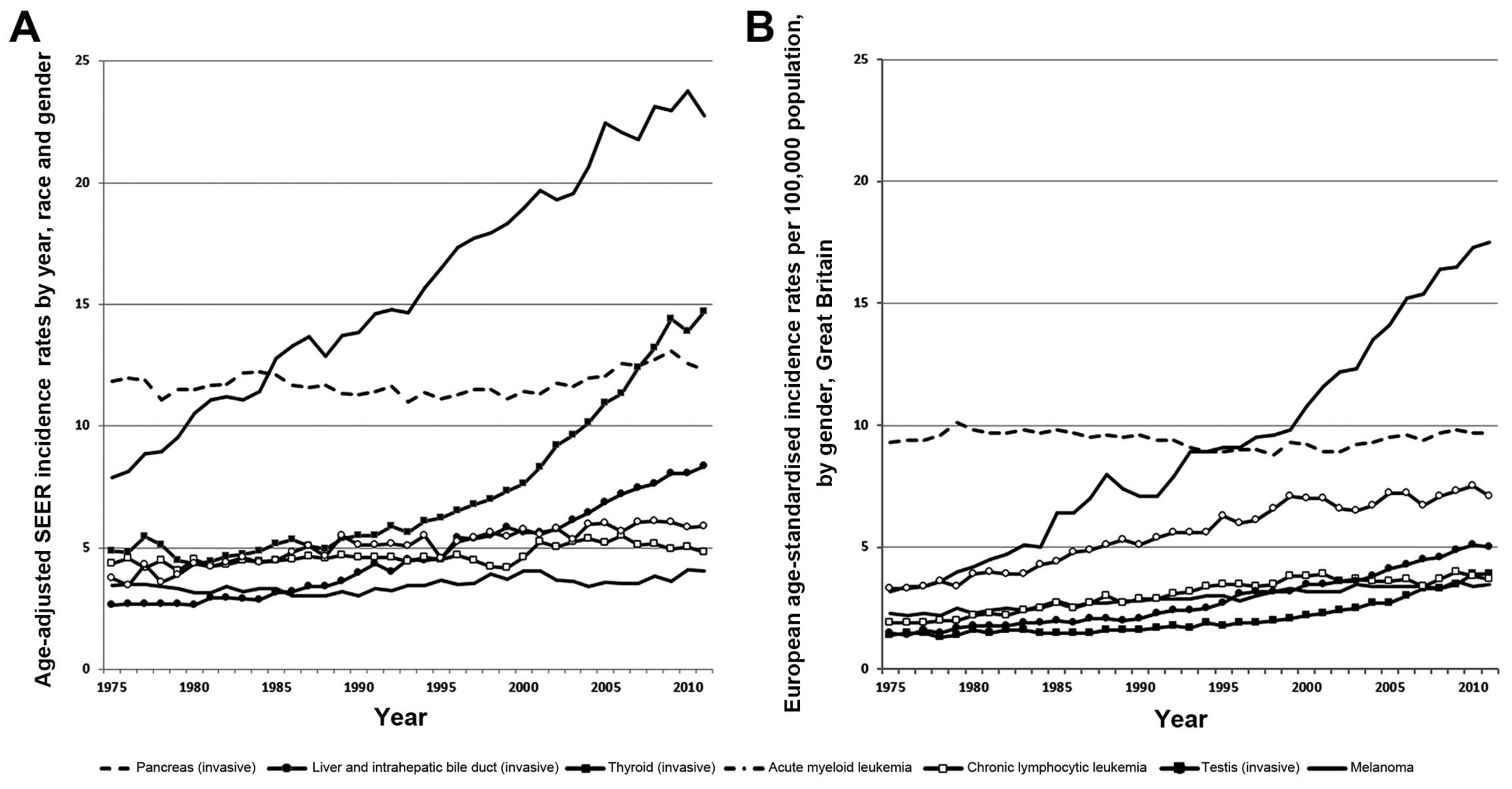
We therefore analyzed from the standpoint of epidemiology the authors' different cancer types in the so called replicative (R) stochastic group. As depicted in Fig. 1, apart from pancreatic cancer, all R group cancers have been shown to be associated with an increased incidence over the last 3 or 4 decades in the USA (21), as well as in Europe (22). We disagree with Tomasetti's response to our question, that ‘the fact that cancer incidence has increased over the last 3–4 decades may be explained in part as a consequence of random replicative mutations, given the longer lifespan of the population’ and that ‘an increase in screening and awareness certainly played a role in the increase in the observed incidence of melanoma, as well as that of many other cancers’. These arguments are not convincing, since cancer may be initiated at the fetal stage (23), increased cancer incidence concerns all age categories, and screening by itself cannot account for the ‘continuous’ increased incidence of several cancer types, including those which cannot be screened (24,25). We therefore concluded that the stochastic interpretation attributed to the author's R group is not consistent with current epidemiological and biological data.

Figure 1.

Cancer incidence for cancers of the R group in (A) the USA and (B) Europe. SEER, Surveillance, Epidemiology and End Results Program.

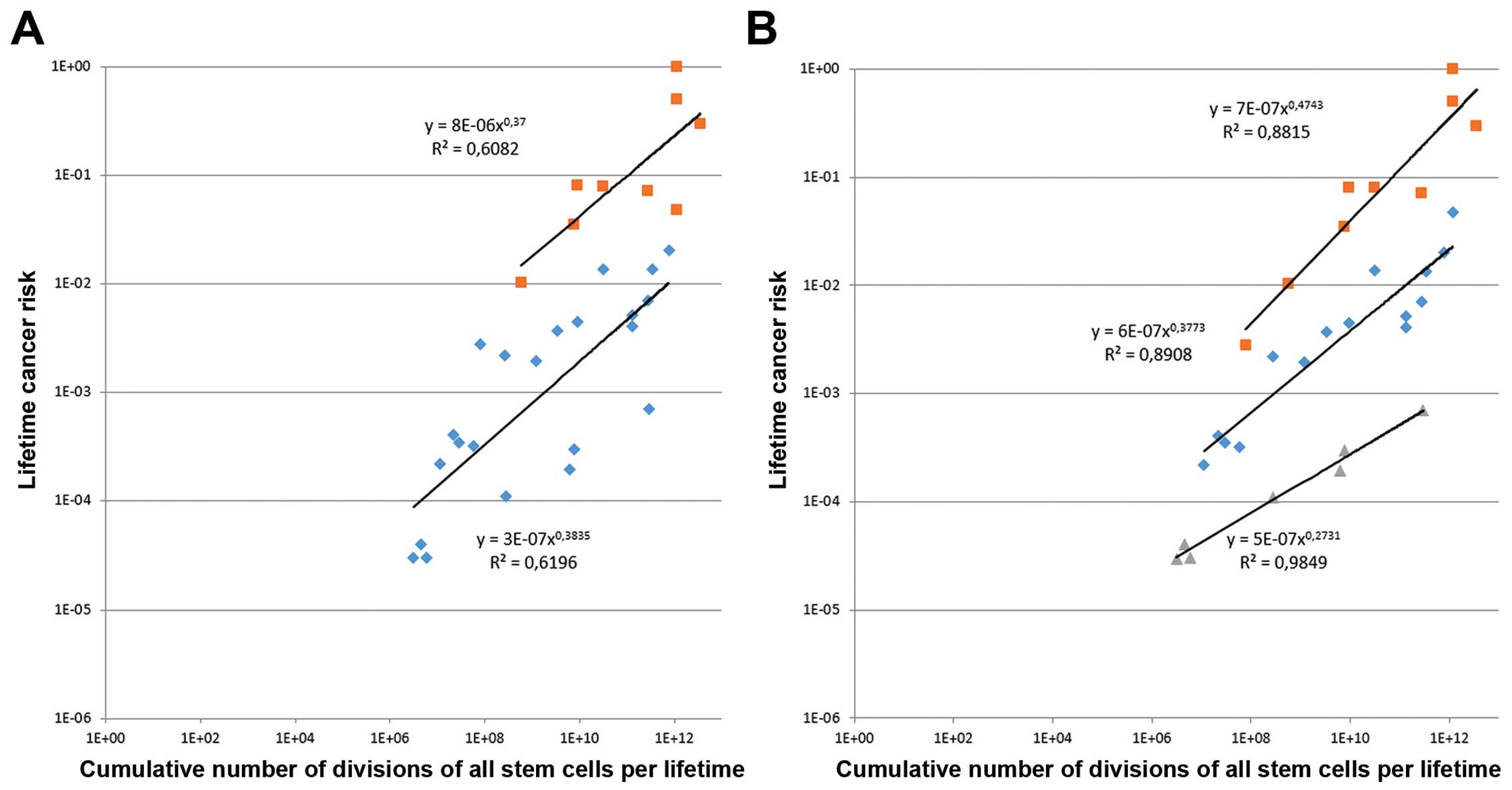
Taking into account the supplementary material of the article, we investigated the mathematical method that Tomasetti and Vogelstein used to define their two groups, R and deterministic (D), the basis of their claim. Considering the association between the lifetime cancer risk and the total number of stem cell divisions (Fig. 1A), a strong correlation at 0.804 was demonstrated statistically by using the Pearson's Chi-square test. However, applying a linear regression test, we obtained a coefficient of determination, denoted R2, of only 0.6463, indicating that a soundly established linear relation is unlikely. Moreover, we combined Figs. 1 and 2 of the authors article in a single figure for the purpose of simplification and better understanding, and estimated R2 for each of the arbitrarily individualized R and D groups. Again, we found the same order of R2 (Fig. 2A), confirming that linearity is not clearly established. We therefore tentatively individualized a third group from the R and D initial groups. As indicated in Fig. 2B, we observed a significantly improved linear regression, with R2 of 0.88, 0.89 and 0.98 for the newly individualized D, intermediate and R groups, respectively. This suggests that, when restricting the R group to a significantly smaller number of cancer types, the intermediate group may in fact include both stochastic and deterministic events, a hypothesis which appears to be more coherent with what we previously discussed. Although a very small proportion of cancers may be caused by spontaneous random mutations, we strongly suggest that the scientific message of Tomasetti and Vogelstein does not agree with the currently available biological, epidemiological and toxicological data. The process of carcinogenesis has not been sufficiently taken into consideration, so the interpretation of Tomasetti's and Vogelstein's results may be hazardous, as it de-emphasizes highly needed primary prevention and limits it to for a small proportion of cancer types.

Figure 2.

Calculation of the linear regression coefficient (R2) for the two (R and D) groups as determined from (A) Figs. 1 and 2 of Tomasetti and Vogelstein, and (B) our proposal for a three-group model.

Glossary

Abbreviations

Abbreviations:

D

deterministic

R

replicative

R2

coefficient of determination

References

1 

Tomasetti C and Vogelstein B: Cancer etiology. Variation in cancer risk among tissues can be explained by the number of stem cell divisions. Science. 347:78–81. 2015. View Article : Google Scholar : PubMed/NCBI

2 

Couzin-Frankel J: Biomedicine. The bad luck of cancer. Science. 347:122015. View Article : Google Scholar : PubMed/NCBI

3 

Ashford NA, Bauman P, Brown HS, Clapp RW, Finkel AM, Gee D, Hattis DB, Martuzzi M, Sasco AJ and Sass JB: Cancer risk: Role of environment. Science. 347:7272015. View Article : Google Scholar : PubMed/NCBI

4 

Potter JD and Prentice RL: Cancer risk: Tumors excluded. Science. 347:7272015. View Article : Google Scholar : PubMed/NCBI

5 

Wild C, Brennan P, Plummer M, Bray F, Straif K and Zavadil J: Cancer risk: Role of chance overstated. Science. 347:7282015. View Article : Google Scholar : PubMed/NCBI

6 

Gotay C, Dummer T and Spinelli J: Cancer risk: Prevention is crucial. Science. 347:7282015. View Article : Google Scholar : PubMed/NCBI

7 

Song M and Giovannucci EL: Cancer risk: Many factors contribute. Science. 347:728–729. 2015. View Article : Google Scholar : PubMed/NCBI

8 

O'Callaghan M: Cancer risk: Accuracy of literature. Science. 347:7292015. View Article : Google Scholar

9 

Tomasetti C and Vogelstein B: Cancer risk: Role of environment-response. Science. 347:729–731. 2015. View Article : Google Scholar : PubMed/NCBI

10 

Collegium Ramazzini. 17th position statement: Most types of cancer are cot due to bad luck. http://www.collegiumramazzini.org/download/17_SeventeenthCRStatement(2015).pdfAccessed. March 10–2015

11 

Sjöblom T, Jones S, Wood LD, Parsons DW, Lin J, Barber TD, Mandelker D, Leary RJ, Ptak J, Silliman N, et al: The consensus coding sequences of human breast and colorectal cancers. Science. 314:268–274. 2006. View Article : Google Scholar : PubMed/NCBI

12 

Greenman C, Stephens P, Smith R, Dalgliesh GL, Hunter C, Bignell G, Davies H, Teague J, Butler A, Stevens C, et al: Patterns of somatic mutation in human cancer genomes. Nature. 446:153–158. 2007. View Article : Google Scholar : PubMed/NCBI

13 

Weinstein IB: Mitogenesis is only one factor in carcinogenesis. Science. 251:387–388. 1991. View Article : Google Scholar : PubMed/NCBI

14 

Skinner MK, Manikkam M and Guerrero-Bosagna C: Epigenetic transgenerational actions of environmental factors in disease etiology. Trends Endocrinol Metab. 21:214–222. 2010. View Article : Google Scholar : PubMed/NCBI

15 

Weinberg RA: The Biology of Cancer. (2nd). Garland Science (New York, NY). 2013.

16 

Irigaray P and Belpomme D: Basic properties and molecular mechanisms of exogenous chemical carcinogens. Carcinogenesis. 31:135–148. 2010. View Article : Google Scholar : PubMed/NCBI

17 

Elmore SA, Boyle MC, Boyle MH, Cora MC, Crabbs TA, Cummings CA, Gruebbel MM, Johnson CL, Malarkey DE, McInnes EF, et al: Proceedings of the 2013 National Toxicology Program Satellite Symposium. Toxicol Pathol. 42:12–44. 2014. View Article : Google Scholar : PubMed/NCBI

18 

National Toxicology Program. 13th report on Carcinogens (2014). http://ntp.niehs.nih.gov/pubhealth/roc/roc13/index.htmlAccessed. January 12–2015

19 

Drake JW, Charlesworth B, Charlesworth D and Crow JF: Rates of spontaneous mutation. Genetics. 148:1667–1686. 1998.PubMed/NCBI

20 

Chen X, Chen Z, Chen H, Su Z, Yang J, Lin F, Shi S and He X: Nucleosomes suppress spontaneous mutations base-specifically in eukaryotes. Science. 333:1235–1238. 2012. View Article : Google Scholar

21 

National Cancer Institute, Surveillance, Epidemiology, and End Results Program. https://seer.cancer.govAccessed. January 12–2015

22 

Cancer Research UK. http://www.cancerresearchuk.orgAccessed. January 12–2015

23 

Marshall GM, Carter DR, Cheung BB, Liu T, Mateos MK, Meyerowitz JG and Weiss WA: The prenatal origins of cancer. Nat Rev Cancer. 14:277–1689. 2014. View Article : Google Scholar : PubMed/NCBI

24 

Belpomme D, Irigaray P, Hardell L, Clapp R, Montagnier L, Epstein S and Sasco AJ: The multitude and diversity of environmental carcinogens. Environ Res. 105:414–429. 2007. View Article : Google Scholar : PubMed/NCBI

25 

Belpomme D, Irigaray P, Sasco AJ, Newby JA, Howard V, Clapp R and Hardell L: The growing incidence of cancer: Role of lifestyle and screening detection. Int J Oncol. 30:1037–1044. 2007.PubMed/NCBI

Related Articles

  • Abstract
  • View
  • Download
  • Twitter
Copy and paste a formatted citation
Spandidos Publications style
Belpomme D and Irigaray P: Replicative random mutations as an unproven cause of cancer: A technical comment. Mol Clin Oncol 4: 497-499, 2016.
APA
Belpomme, D., & Irigaray, P. (2016). Replicative random mutations as an unproven cause of cancer: A technical comment. Molecular and Clinical Oncology, 4, 497-499. https://doi.org/10.3892/mco.2016.737
MLA
Belpomme, D., Irigaray, P."Replicative random mutations as an unproven cause of cancer: A technical comment". Molecular and Clinical Oncology 4.4 (2016): 497-499.
Chicago
Belpomme, D., Irigaray, P."Replicative random mutations as an unproven cause of cancer: A technical comment". Molecular and Clinical Oncology 4, no. 4 (2016): 497-499. https://doi.org/10.3892/mco.2016.737
Copy and paste a formatted citation
x
Spandidos Publications style
Belpomme D and Irigaray P: Replicative random mutations as an unproven cause of cancer: A technical comment. Mol Clin Oncol 4: 497-499, 2016.
APA
Belpomme, D., & Irigaray, P. (2016). Replicative random mutations as an unproven cause of cancer: A technical comment. Molecular and Clinical Oncology, 4, 497-499. https://doi.org/10.3892/mco.2016.737
MLA
Belpomme, D., Irigaray, P."Replicative random mutations as an unproven cause of cancer: A technical comment". Molecular and Clinical Oncology 4.4 (2016): 497-499.
Chicago
Belpomme, D., Irigaray, P."Replicative random mutations as an unproven cause of cancer: A technical comment". Molecular and Clinical Oncology 4, no. 4 (2016): 497-499. https://doi.org/10.3892/mco.2016.737
Follow us
  • Twitter
  • LinkedIn
  • Facebook
About
  • Spandidos Publications
  • Careers
  • Cookie Policy
  • Privacy Policy
How can we help?
  • Help
  • Live Chat
  • Contact
  • Email to our Support Team