Spandidos Publications Logo
  • About
    • About Spandidos
    • Aims and Scopes
    • Abstracting and Indexing
    • Editorial Policies
    • Reprints and Permissions
    • Job Opportunities
    • Terms and Conditions
    • Contact
  • Journals
    • All Journals
    • Oncology Letters
      • Oncology Letters
      • Information for Authors
      • Editorial Policies
      • Editorial Board
      • Aims and Scope
      • Abstracting and Indexing
      • Bibliographic Information
      • Archive
    • International Journal of Oncology
      • International Journal of Oncology
      • Information for Authors
      • Editorial Policies
      • Editorial Board
      • Aims and Scope
      • Abstracting and Indexing
      • Bibliographic Information
      • Archive
    • Molecular and Clinical Oncology
      • Molecular and Clinical Oncology
      • Information for Authors
      • Editorial Policies
      • Editorial Board
      • Aims and Scope
      • Abstracting and Indexing
      • Bibliographic Information
      • Archive
    • Experimental and Therapeutic Medicine
      • Experimental and Therapeutic Medicine
      • Information for Authors
      • Editorial Policies
      • Editorial Board
      • Aims and Scope
      • Abstracting and Indexing
      • Bibliographic Information
      • Archive
    • International Journal of Molecular Medicine
      • International Journal of Molecular Medicine
      • Information for Authors
      • Editorial Policies
      • Editorial Board
      • Aims and Scope
      • Abstracting and Indexing
      • Bibliographic Information
      • Archive
    • Biomedical Reports
      • Biomedical Reports
      • Information for Authors
      • Editorial Policies
      • Editorial Board
      • Aims and Scope
      • Abstracting and Indexing
      • Bibliographic Information
      • Archive
    • Oncology Reports
      • Oncology Reports
      • Information for Authors
      • Editorial Policies
      • Editorial Board
      • Aims and Scope
      • Abstracting and Indexing
      • Bibliographic Information
      • Archive
    • Molecular Medicine Reports
      • Molecular Medicine Reports
      • Information for Authors
      • Editorial Policies
      • Editorial Board
      • Aims and Scope
      • Abstracting and Indexing
      • Bibliographic Information
      • Archive
    • World Academy of Sciences Journal
      • World Academy of Sciences Journal
      • Information for Authors
      • Editorial Policies
      • Editorial Board
      • Aims and Scope
      • Abstracting and Indexing
      • Bibliographic Information
      • Archive
    • International Journal of Functional Nutrition
      • International Journal of Functional Nutrition
      • Information for Authors
      • Editorial Policies
      • Editorial Board
      • Aims and Scope
      • Abstracting and Indexing
      • Bibliographic Information
      • Archive
    • International Journal of Epigenetics
      • International Journal of Epigenetics
      • Information for Authors
      • Editorial Policies
      • Editorial Board
      • Aims and Scope
      • Abstracting and Indexing
      • Bibliographic Information
      • Archive
    • Medicine International
      • Medicine International
      • Information for Authors
      • Editorial Policies
      • Editorial Board
      • Aims and Scope
      • Abstracting and Indexing
      • Bibliographic Information
      • Archive
  • Articles
  • Information
    • Information for Authors
    • Information for Reviewers
    • Information for Librarians
    • Information for Advertisers
    • Conferences
  • Language Editing
Spandidos Publications Logo
  • About
    • About Spandidos
    • Aims and Scopes
    • Abstracting and Indexing
    • Editorial Policies
    • Reprints and Permissions
    • Job Opportunities
    • Terms and Conditions
    • Contact
  • Journals
    • All Journals
    • Biomedical Reports
      • Information for Authors
      • Editorial Policies
      • Editorial Board
      • Aims and Scope
      • Abstracting and Indexing
      • Bibliographic Information
      • Archive
    • Experimental and Therapeutic Medicine
      • Information for Authors
      • Editorial Policies
      • Editorial Board
      • Aims and Scope
      • Abstracting and Indexing
      • Bibliographic Information
      • Archive
    • International Journal of Epigenetics
      • Information for Authors
      • Editorial Policies
      • Editorial Board
      • Aims and Scope
      • Abstracting and Indexing
      • Bibliographic Information
      • Archive
    • International Journal of Functional Nutrition
      • Information for Authors
      • Editorial Policies
      • Editorial Board
      • Aims and Scope
      • Abstracting and Indexing
      • Bibliographic Information
      • Archive
    • International Journal of Molecular Medicine
      • Information for Authors
      • Editorial Policies
      • Editorial Board
      • Aims and Scope
      • Abstracting and Indexing
      • Bibliographic Information
      • Archive
    • International Journal of Oncology
      • Information for Authors
      • Editorial Policies
      • Editorial Board
      • Aims and Scope
      • Abstracting and Indexing
      • Bibliographic Information
      • Archive
    • Medicine International
      • Information for Authors
      • Editorial Policies
      • Editorial Board
      • Aims and Scope
      • Abstracting and Indexing
      • Bibliographic Information
      • Archive
    • Molecular and Clinical Oncology
      • Information for Authors
      • Editorial Policies
      • Editorial Board
      • Aims and Scope
      • Abstracting and Indexing
      • Bibliographic Information
      • Archive
    • Molecular Medicine Reports
      • Information for Authors
      • Editorial Policies
      • Editorial Board
      • Aims and Scope
      • Abstracting and Indexing
      • Bibliographic Information
      • Archive
    • Oncology Letters
      • Information for Authors
      • Editorial Policies
      • Editorial Board
      • Aims and Scope
      • Abstracting and Indexing
      • Bibliographic Information
      • Archive
    • Oncology Reports
      • Information for Authors
      • Editorial Policies
      • Editorial Board
      • Aims and Scope
      • Abstracting and Indexing
      • Bibliographic Information
      • Archive
    • World Academy of Sciences Journal
      • Information for Authors
      • Editorial Policies
      • Editorial Board
      • Aims and Scope
      • Abstracting and Indexing
      • Bibliographic Information
      • Archive
  • Articles
  • Information
    • For Authors
    • For Reviewers
    • For Librarians
    • For Advertisers
    • Conferences
  • Language Editing
Login Register Submit
  • This site uses cookies
  • You can change your cookie settings at any time by following the instructions in our Cookie Policy. To find out more, you may read our Privacy Policy.

    I agree
Search articles by DOI, keyword, author or affiliation
Search
Advanced Search
presentation
Molecular and Clinical Oncology
Join Editorial Board Propose a Special Issue
Print ISSN: 2049-9450 Online ISSN: 2049-9469
Journal Cover
April-2024 Volume 20 Issue 4

Full Size Image

Sign up for eToc alerts
Recommend to Library

Journals

International Journal of Molecular Medicine

International Journal of Molecular Medicine

International Journal of Molecular Medicine is an international journal devoted to molecular mechanisms of human disease.

International Journal of Oncology

International Journal of Oncology

International Journal of Oncology is an international journal devoted to oncology research and cancer treatment.

Molecular Medicine Reports

Molecular Medicine Reports

Covers molecular medicine topics such as pharmacology, pathology, genetics, neuroscience, infectious diseases, molecular cardiology, and molecular surgery.

Oncology Reports

Oncology Reports

Oncology Reports is an international journal devoted to fundamental and applied research in Oncology.

Experimental and Therapeutic Medicine

Experimental and Therapeutic Medicine

Experimental and Therapeutic Medicine is an international journal devoted to laboratory and clinical medicine.

Oncology Letters

Oncology Letters

Oncology Letters is an international journal devoted to Experimental and Clinical Oncology.

Biomedical Reports

Biomedical Reports

Explores a wide range of biological and medical fields, including pharmacology, genetics, microbiology, neuroscience, and molecular cardiology.

Molecular and Clinical Oncology

Molecular and Clinical Oncology

International journal addressing all aspects of oncology research, from tumorigenesis and oncogenes to chemotherapy and metastasis.

World Academy of Sciences Journal

World Academy of Sciences Journal

Multidisciplinary open-access journal spanning biochemistry, genetics, neuroscience, environmental health, and synthetic biology.

International Journal of Functional Nutrition

International Journal of Functional Nutrition

Open-access journal combining biochemistry, pharmacology, immunology, and genetics to advance health through functional nutrition.

International Journal of Epigenetics

International Journal of Epigenetics

Publishes open-access research on using epigenetics to advance understanding and treatment of human disease.

Medicine International

Medicine International

An International Open Access Journal Devoted to General Medicine.

Journal Cover
April-2024 Volume 20 Issue 4

Full Size Image

Sign up for eToc alerts
Recommend to Library

  • Article
  • Citations
    • Cite This Article
    • Download Citation
    • Create Citation Alert
    • Remove Citation Alert
    • Cited By
  • Similar Articles
    • Related Articles (in Spandidos Publications)
    • Similar Articles (Google Scholar)
    • Similar Articles (PubMed)
  • Download PDF
  • Download XML
  • View XML
Case Report

Secondary trigeminal neuralgia caused by lung adenocarcinoma metastasis on trigeminal nerve roots successfully relieved by opioids: A case report

  • Authors:
    • Takafumi Minato
    • Kirio Kawai
    • Tatsuma Edamura
    • Hiroaki Abe
    • Masahiko Sumitani
  • View Affiliations / Copyright

    Affiliations: Department of Pain and Palliative Medicine, The University of Tokyo Hospital, Tokyo 113‑0033, Japan
  • Article Number: 26
    |
    Published online on: February 8, 2024
       https://doi.org/10.3892/mco.2024.2724
  • Expand metrics +
Metrics: Total Views: 0 (Spandidos Publications: | PMC Statistics: )
Metrics: Total PDF Downloads: 0 (Spandidos Publications: | PMC Statistics: )
Cited By (CrossRef): 0 citations Loading Articles...

This article is mentioned in:


Abstract

Secondary trigeminal neuralgia (TN) is caused by identifiable diseases or lesions of the trigeminal nerve root, Gasserian ganglion and/or pons. TN is a neuropathic pain disorder characterized by electric shock‑like or stabbing pain in the facial region, which can lead to impaired health‑related quality of life. The present case report describes a rare case of secondary TN caused by trigeminal nerve metastases from lung adenocarcinoma, in which opioids provided symptomatic relief. The patient was a 46‑year‑old man with stage IV lung adenocarcinoma. They were admitted to hospital for the introduction of fifth‑line chemotherapy because of previous chemotherapy‑refractory disease progression. Electric shock‑like or stabbing pain in the left facial area and bilateral auditory disturbances coincided with intracranial peri‑brainstem metastases. Facial pain was triggered by mastication, making it difficult for the patient to eat. A fentanyl transdermal patch (25 mcg/h) was initiated following a diagnosis of TN secondary to lung adenocarcinoma metastases on the trigeminal nerves by magnetic resonance imaging. Subsequently, the facial pain improved rapidly. In conclusion, unlike classic and idiopathic TN, which is usually treated with carbamazepine as a first‑line drug, oncologic secondary TN can be treated with opioids.

Introduction

Trigeminal neuralgia (TN) is typically a sudden, severe, and very brief attack of unilateral pain confined to one or more segmental areas of the trigeminal nerve (1-4). TN can be classified into three types: Classic, secondary, and idiopathic. The classical type, which accounts for 75% of TN cases, is caused by intracranial vascular compression of the trigeminal nerve root, typically due to morphological changes in the superior cerebellar artery relative to the adjacent trigeminal nerve root. Secondary TN, which accounts for ~15% of TN cases, is caused by diseases or lesions such as multiple sclerosis and meningioma, which lead to changes in the trigeminal nerve root entry zone or compression. Idiopathic TN is diagnosed when no obvious cause of neuropathy can be found (1). Symptomatically, classic or idiopathic TN is rarely associated with somatosensory hypoesthesia. The treatment of classic or idiopathic TN is established, with carbamazepine as the first-line treatment (1,5). However, a standard treatment for secondary TN has not been established, especially in the case of metastatic carcinoma of the trigeminal nerve roots. Here, we report a case of TN secondary to brain metastases from lung cancer, accompanied by bilateral auditory disturbances. Opioids provided symptomatic relief from facial pain.

Case report

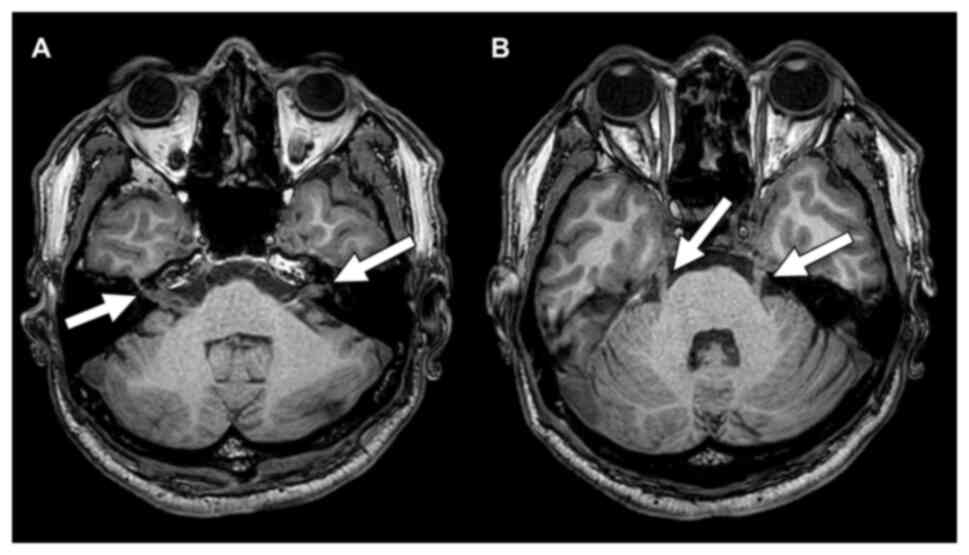
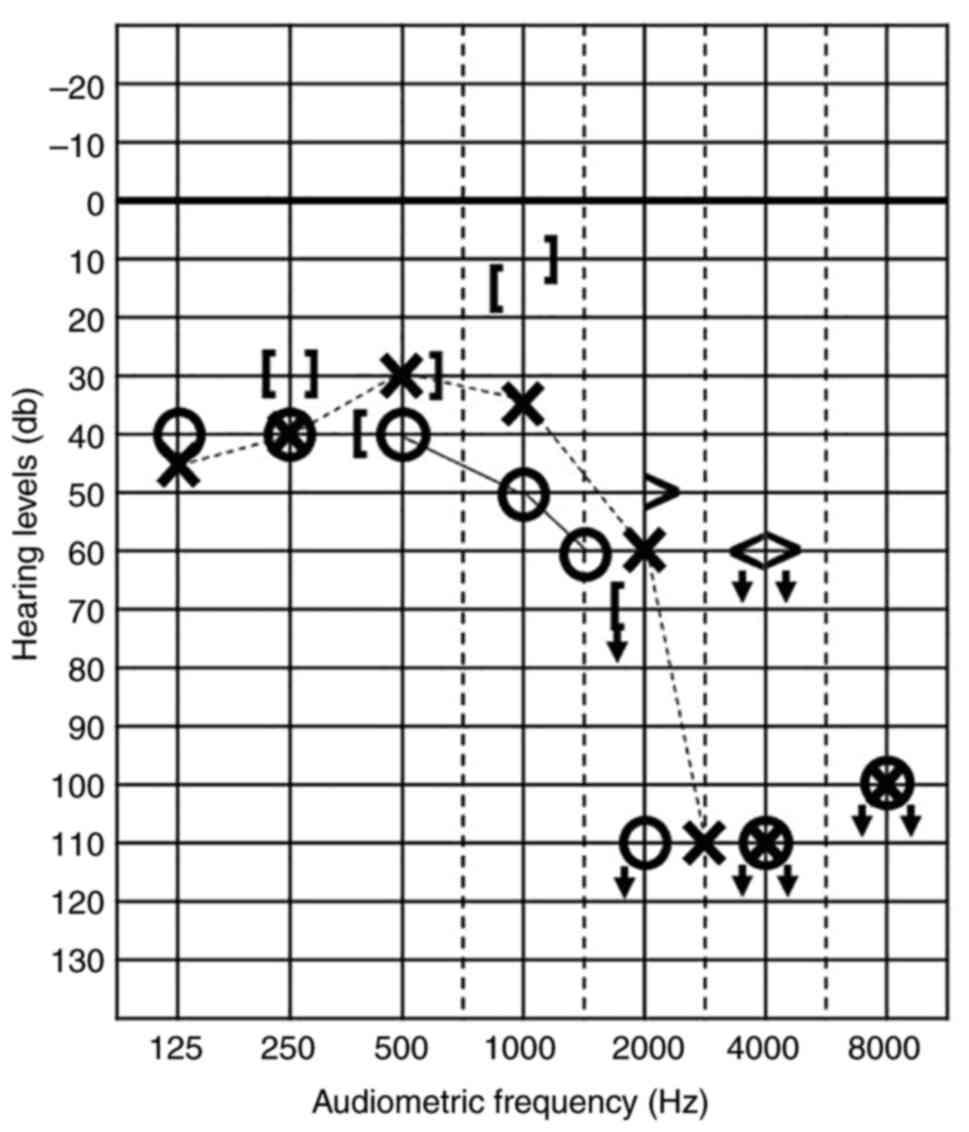
The patient was a 46-year-old man, who was admitted to The University of Tokyo Hospital (Tokyo, Japan) in July 2022, with no medical history and was an ex-smoker of two packs per day from the age of 10 to 38 years (56 pack-years). They underwent left upper lobectomy and was diagnosed with pStage IIIA, pT1bN2M0 adenocarcinoma of the lung, which displayed an EGFR mutation of exon 19 (deletion), and was anaplastic lymphoma kinase immunohistochemistry and fluorescence in situ hybridization (ALK-IHC/FISH) positive. After post-lobectomy adjuvant chemotherapy, the patient was treated with four cycles of cisplatin and vinorelbine. After 5 years of recurrence-free survival, computed tomography (CT)-guided lung needle biopsy revealed lung cancer metastasis in the left chest wall. The patient received afatinib as first-line chemotherapy for recurrent unresectable lung carcinoma, and alectinib as second-line treatment. The adenocarcinoma was refractory to alectinib, and brain metastasis developed, with no clinical symptoms. The patient further received osimertinib as third-line chemotherapy, cisplatin and pemetrexed as fourth-line, and docetaxel and ramcirumab as fifth-line treatment. However, the tumor slowly progressed, with no obvious clinical symptoms. Contrast-enhanced magnetic resonance imaging (MRI) and head CT showed multiple brain metastases (i.e., a mass in the left Sylvian fissure and significant thickening of the left trigeminal nerve root). Osimertinib re-challenge was used as the sixth-line treatment, and Gamma Knife was used to manage the brain metastases. However, a follow-up contrast-enhanced MRI revealed tumor aggravation in the cerebellar vermis and bilateral cerebellar hemispheres. Tumor dissemination along the cerebral surface of the cerebrum, the brainstem, and the cerebellum, as well as along the right oculomotor nerve roots (III), bilateral trigeminal nerve roots (V), bilateral facial (VII) and auditory (VIII) nerve roots, and lower cranial nerve roots (IX-XII) was also found (Fig. 1). Because of disseminated carcinomatous meningitis, radiation therapy and other chemotherapies were not administered, and a policy of best supportive care was adopted 9 years after the surgery. Around the same time, the patient began to experience bilateral auditory disturbances that were particularly prominent in the high-tone range (Fig. 2). They simultaneously developed somatosensory hypoesthesia in the left facial V1, V2, and V3 regions, explosive pain in the left V1 region, and paresthesia in the tongue. No other neurological deficits due to cranial nerve root lesions were observed, except for a slight taste disturbance. Mastication triggered electroshock-like or stabbing pain in the left facial area, which made eating difficult. A fentanyl transdermal patch (25 mcg/h) was initiated following a diagnosis of TN secondary to lung adenocarcinoma metastasis on the trigeminal nerves. The facial pain improved rapidly and markedly. Facial pain was not exacerbated after starting opioids, and the patient was discharged from our hospital.

Figure 1

Head contrast-enhanced MRI. (A) Bilateral auditory nerve roots (VIII) and (B) bilateral trigeminal nerve roots (V), both of which were thickened on head contrast-enhanced MRI. The white arrows indicate the nerve roots. MRI, magnetic resonance imaging.

Figure 2

Bilateral auditory disturbance prominent in the high-tone range on audiometry. Audiometry shows conductive and sensorineural auditory disturbances in the high-tone range; sensorineural auditory disturbances are particularly prominent. Symbols: O, right air conduction hearing; [, right bone conduction hearing with the masking noise on left ear; <, right bone conduction hearing without the masking noise on left ear; X, left air conduction hearing with the masking noise on left ear; ], left bone conduction hearing with the masking noise on right ear; >, left bone conduction hearing without the masking noise on right ear, ↓, lower limit of the hearing level for the measurable audiometry frequency.

Discussion

The most common presentation of TN is the classic form, with secondary forms occurring less frequently (~15%) (1). Common causes of secondary TN include neurological diseases, such as multiple sclerosis and compression of the trigeminal nerve root by brain tumors (1). Such brain tumors include auditory schwannomas, meningiomas, epidermoid cysts and pearly tumors (6). Compression of the trigeminal nerve by a tumor could result in local demyelination of the trigeminal nerve root. Similar to the vascular compression of the root in classic TN, high-frequency discharges in the degenerated axon can induce persistent pain in the facial region. In the literature, cases of TN secondary to a metastatic brain tumor, as in this case, are rare (7). In contrast to solid brain tumors, the present case did not demonstrate obvious compression of the trigeminal nerve root by a brain metastatic tumor, but rather demonstrated significant thickening of the root. Considering the intracranial cerebrospinal fluid dissemination in this case, metastatic tumor cells might infiltrate to the relevant cranial nerve roots. Such thickening was also observed in the bilateral auditory nerve roots, which were not obviously compressed, and therefore resulted in bilateral auditory disturbances.

TN is characterized by sudden, intense, and very brief attacks of pain confined to the trigeminal region (1). Along with this typical pain expression, the present case presented with concurrent somatosensory hypoesthesia in the facial region. Very few cases of TN itself present with somatosensory loss, which is characterized by explosive pain (8). While some types of trigeminal neuropathy secondary to brain tumor compression and post-herpetic neuralgia occasionally show somatosensory loss, their pain is continuous, burning, and tingling. Therefore, the present case, which demonstrated the typical pain characteristics of TN but was accompanied by somatosensory loss, was considered atypical. Furthermore, this case was accompanied by slight taste disturbances and profound bilateral auditory disturbances, both of which were caused by facial and auditory nerve root thickening and disseminated brain metastasis. A giant auditory schwannoma can compress the trigeminal nerve root and secondarily induce TN; however, in this case the auditory disturbance would be unilateral. Therefore, the patient's symptoms were considered atypical. If clinicians encounter such an atypical presentation of TN accompanied by other cranial nerve impairment(s), imaging studies such as contrast-enhanced MRI and/or CT should be promptly considered.

The treatment of TN generally includes pharmacotherapy in addition to other invasive procedures. Among the pharmacotherapy options, carbamazepine is the first-line drug of choice and is usually associated with good pain control. In case of trigeminal neuropathy, tricyclic antidepressants such as amitriptyline and gabapentinoids might have additional analgesic effects (5,9,10). Opioids are not generally applied for TN despite the fact that even a small amount of opioids can provide significant symptomatic relief in the setting of brain metastases from a malignant tumor. The present case was an atypical example of TN caused by disseminated brain metastasis. We treated the facial pain with opioids which rapidly improved as a result. Therefore, this case suggests that opioids are a possible treatment option for secondary TN caused by malignancy.

In conclusion, we report a case of secondary TN with bilateral auditory disturbances secondary to brain metastases from lung cancer. Pain symptoms were rapidly and markedly improved with small doses of opioids. Although opioids are not generally used for TN, this case suggests the importance of considering the use of opioids as a possible option to treat secondary oncologic TN.

Acknowledgements

Not applicable.

Funding

Funding: No funding was received.

Availability of data and materials

The datasets used and/or analyzed during the current study are available from the corresponding author on reasonable request.

Authors' contributions

KK, HA and MS diagnosed and treated the patient. TM contributed to the acquisition of data. TM, KK and MS interpreted the data and wrote the manuscript. TE and HA interpreted data and performed critical reviewing. TM, KK and MS confirm the authenticity of all the raw data. All authors read and approved the final manuscript.

Ethics approval and consent to participate

The University of Tokyo Clinical Research Review Board approved the report of this case (approval no. 3678).

Patient consent for publication

Written consent was obtained for the publication of this case report. All accompanying images were anonymized.

Competing interests

The authors declare that they have no competing interests.

References

1 

Cruccu G, Di Stefano G and Truini A: Trigeminal Neuralgia. N Engl J Med. 383:754–762. 2020.PubMed/NCBI View Article : Google Scholar

2 

Di Stefano G, Maarbjerg S, Nurmikko T, Truini A and Cruccu G: Triggering trigem-inal neuralgia. Cephalalgia. 38:1049–1056. 2018.PubMed/NCBI View Article : Google Scholar

3 

Cruccu G, Finnerup NB, Jensen TS, Scholz J, Sindou M, Svensson P, Treede RD, Zakrzewska JM and Nurmikko T: Trigeminal neuralgia: New classification and diagnostic grading for practice and research. Neurology. 87:220–228. 2016.PubMed/NCBI View Article : Google Scholar

4 

Maarbjerg S, Gozalov A, Olesen J and Bendtsen L: Trigeminal neuralgia-a prospective systematic study of clinical characteristics in 158 patients. Headache. 54:1574–1582. 2014.PubMed/NCBI View Article : Google Scholar

5 

Szok D, Tajti J, Nyári A and Vécsei L: Therapeutic approaches for peripheral and central neuropathic pain. Behav Neurol. 2019(8685954)2019.PubMed/NCBI View Article : Google Scholar

6 

Mohammad-Mohammadi A, Recinos PF, Lee JH, Elson P and Barnett GH: Surgical outcomes of trigeminal neuralgia in patients with multiple sclerosis. Neurosurgery. 73:941–950; discussion 950. 2013.PubMed/NCBI View Article : Google Scholar

7 

Viviano M, Donati D and Lorenzini G: Metastatic carcinoma presenting as neuralgia involving the trigeminal nerve. J Can Dent Assoc. 77(c32)2012.PubMed/NCBI

8 

Luo F, Wang T, Shen Y, Meng L, Lu J and Ji N: High voltage pulsed radiofrequency for the treatment of refractory neuralgia of the infraorbital nerve: A prospective double-blinded randomized controlled study. Pain Physician. 20:271–279. 2017.PubMed/NCBI

9 

Bendtsen L, Zakrzewska JM, Abbott J, Braschinsky M, Di Stefano G, Donnet A, Eide PK, Leal PRL, Maarbjerg S, May A, et al: European Academy Of Neurology guideline on trigeminal neuralgia. Eur J Neurol. 26:831–849. 2019.PubMed/NCBI View Article : Google Scholar

10 

Truini A, Barbanti P, Pozzilli C and Cruccu G: A mechanism-based classification of pain in multiple sclerosis. J Neurol. 260:351–367. 2013.PubMed/NCBI View Article : Google Scholar

Related Articles

  • Abstract
  • View
  • Download
  • Twitter
Copy and paste a formatted citation
Spandidos Publications style
Minato T, Kawai K, Edamura T, Abe H and Sumitani M: Secondary trigeminal neuralgia caused by lung adenocarcinoma metastasis on trigeminal nerve roots successfully relieved by opioids: A case report. Mol Clin Oncol 20: 26, 2024.
APA
Minato, T., Kawai, K., Edamura, T., Abe, H., & Sumitani, M. (2024). Secondary trigeminal neuralgia caused by lung adenocarcinoma metastasis on trigeminal nerve roots successfully relieved by opioids: A case report. Molecular and Clinical Oncology, 20, 26. https://doi.org/10.3892/mco.2024.2724
MLA
Minato, T., Kawai, K., Edamura, T., Abe, H., Sumitani, M."Secondary trigeminal neuralgia caused by lung adenocarcinoma metastasis on trigeminal nerve roots successfully relieved by opioids: A case report". Molecular and Clinical Oncology 20.4 (2024): 26.
Chicago
Minato, T., Kawai, K., Edamura, T., Abe, H., Sumitani, M."Secondary trigeminal neuralgia caused by lung adenocarcinoma metastasis on trigeminal nerve roots successfully relieved by opioids: A case report". Molecular and Clinical Oncology 20, no. 4 (2024): 26. https://doi.org/10.3892/mco.2024.2724
Copy and paste a formatted citation
x
Spandidos Publications style
Minato T, Kawai K, Edamura T, Abe H and Sumitani M: Secondary trigeminal neuralgia caused by lung adenocarcinoma metastasis on trigeminal nerve roots successfully relieved by opioids: A case report. Mol Clin Oncol 20: 26, 2024.
APA
Minato, T., Kawai, K., Edamura, T., Abe, H., & Sumitani, M. (2024). Secondary trigeminal neuralgia caused by lung adenocarcinoma metastasis on trigeminal nerve roots successfully relieved by opioids: A case report. Molecular and Clinical Oncology, 20, 26. https://doi.org/10.3892/mco.2024.2724
MLA
Minato, T., Kawai, K., Edamura, T., Abe, H., Sumitani, M."Secondary trigeminal neuralgia caused by lung adenocarcinoma metastasis on trigeminal nerve roots successfully relieved by opioids: A case report". Molecular and Clinical Oncology 20.4 (2024): 26.
Chicago
Minato, T., Kawai, K., Edamura, T., Abe, H., Sumitani, M."Secondary trigeminal neuralgia caused by lung adenocarcinoma metastasis on trigeminal nerve roots successfully relieved by opioids: A case report". Molecular and Clinical Oncology 20, no. 4 (2024): 26. https://doi.org/10.3892/mco.2024.2724
Follow us
  • Twitter
  • LinkedIn
  • Facebook
About
  • Spandidos Publications
  • Careers
  • Cookie Policy
  • Privacy Policy
How can we help?
  • Help
  • Live Chat
  • Contact
  • Email to our Support Team