Spandidos Publications Logo
  • About
    • About Spandidos
    • Aims and Scopes
    • Abstracting and Indexing
    • Editorial Policies
    • Reprints and Permissions
    • Job Opportunities
    • Terms and Conditions
    • Contact
  • Journals
    • All Journals
    • Oncology Letters
      • Oncology Letters
      • Information for Authors
      • Editorial Policies
      • Editorial Board
      • Aims and Scope
      • Abstracting and Indexing
      • Bibliographic Information
      • Archive
    • International Journal of Oncology
      • International Journal of Oncology
      • Information for Authors
      • Editorial Policies
      • Editorial Board
      • Aims and Scope
      • Abstracting and Indexing
      • Bibliographic Information
      • Archive
    • Molecular and Clinical Oncology
      • Molecular and Clinical Oncology
      • Information for Authors
      • Editorial Policies
      • Editorial Board
      • Aims and Scope
      • Abstracting and Indexing
      • Bibliographic Information
      • Archive
    • Experimental and Therapeutic Medicine
      • Experimental and Therapeutic Medicine
      • Information for Authors
      • Editorial Policies
      • Editorial Board
      • Aims and Scope
      • Abstracting and Indexing
      • Bibliographic Information
      • Archive
    • International Journal of Molecular Medicine
      • International Journal of Molecular Medicine
      • Information for Authors
      • Editorial Policies
      • Editorial Board
      • Aims and Scope
      • Abstracting and Indexing
      • Bibliographic Information
      • Archive
    • Biomedical Reports
      • Biomedical Reports
      • Information for Authors
      • Editorial Policies
      • Editorial Board
      • Aims and Scope
      • Abstracting and Indexing
      • Bibliographic Information
      • Archive
    • Oncology Reports
      • Oncology Reports
      • Information for Authors
      • Editorial Policies
      • Editorial Board
      • Aims and Scope
      • Abstracting and Indexing
      • Bibliographic Information
      • Archive
    • Molecular Medicine Reports
      • Molecular Medicine Reports
      • Information for Authors
      • Editorial Policies
      • Editorial Board
      • Aims and Scope
      • Abstracting and Indexing
      • Bibliographic Information
      • Archive
    • World Academy of Sciences Journal
      • World Academy of Sciences Journal
      • Information for Authors
      • Editorial Policies
      • Editorial Board
      • Aims and Scope
      • Abstracting and Indexing
      • Bibliographic Information
      • Archive
    • International Journal of Functional Nutrition
      • International Journal of Functional Nutrition
      • Information for Authors
      • Editorial Policies
      • Editorial Board
      • Aims and Scope
      • Abstracting and Indexing
      • Bibliographic Information
      • Archive
    • International Journal of Epigenetics
      • International Journal of Epigenetics
      • Information for Authors
      • Editorial Policies
      • Editorial Board
      • Aims and Scope
      • Abstracting and Indexing
      • Bibliographic Information
      • Archive
    • Medicine International
      • Medicine International
      • Information for Authors
      • Editorial Policies
      • Editorial Board
      • Aims and Scope
      • Abstracting and Indexing
      • Bibliographic Information
      • Archive
  • Articles
  • Information
    • Information for Authors
    • Information for Reviewers
    • Information for Librarians
    • Information for Advertisers
    • Conferences
  • Language Editing
Spandidos Publications Logo
  • About
    • About Spandidos
    • Aims and Scopes
    • Abstracting and Indexing
    • Editorial Policies
    • Reprints and Permissions
    • Job Opportunities
    • Terms and Conditions
    • Contact
  • Journals
    • All Journals
    • Biomedical Reports
      • Information for Authors
      • Editorial Policies
      • Editorial Board
      • Aims and Scope
      • Abstracting and Indexing
      • Bibliographic Information
      • Archive
    • Experimental and Therapeutic Medicine
      • Information for Authors
      • Editorial Policies
      • Editorial Board
      • Aims and Scope
      • Abstracting and Indexing
      • Bibliographic Information
      • Archive
    • International Journal of Epigenetics
      • Information for Authors
      • Editorial Policies
      • Editorial Board
      • Aims and Scope
      • Abstracting and Indexing
      • Bibliographic Information
      • Archive
    • International Journal of Functional Nutrition
      • Information for Authors
      • Editorial Policies
      • Editorial Board
      • Aims and Scope
      • Abstracting and Indexing
      • Bibliographic Information
      • Archive
    • International Journal of Molecular Medicine
      • Information for Authors
      • Editorial Policies
      • Editorial Board
      • Aims and Scope
      • Abstracting and Indexing
      • Bibliographic Information
      • Archive
    • International Journal of Oncology
      • Information for Authors
      • Editorial Policies
      • Editorial Board
      • Aims and Scope
      • Abstracting and Indexing
      • Bibliographic Information
      • Archive
    • Medicine International
      • Information for Authors
      • Editorial Policies
      • Editorial Board
      • Aims and Scope
      • Abstracting and Indexing
      • Bibliographic Information
      • Archive
    • Molecular and Clinical Oncology
      • Information for Authors
      • Editorial Policies
      • Editorial Board
      • Aims and Scope
      • Abstracting and Indexing
      • Bibliographic Information
      • Archive
    • Molecular Medicine Reports
      • Information for Authors
      • Editorial Policies
      • Editorial Board
      • Aims and Scope
      • Abstracting and Indexing
      • Bibliographic Information
      • Archive
    • Oncology Letters
      • Information for Authors
      • Editorial Policies
      • Editorial Board
      • Aims and Scope
      • Abstracting and Indexing
      • Bibliographic Information
      • Archive
    • Oncology Reports
      • Information for Authors
      • Editorial Policies
      • Editorial Board
      • Aims and Scope
      • Abstracting and Indexing
      • Bibliographic Information
      • Archive
    • World Academy of Sciences Journal
      • Information for Authors
      • Editorial Policies
      • Editorial Board
      • Aims and Scope
      • Abstracting and Indexing
      • Bibliographic Information
      • Archive
  • Articles
  • Information
    • For Authors
    • For Reviewers
    • For Librarians
    • For Advertisers
    • Conferences
  • Language Editing
Login Register Submit
  • This site uses cookies
  • You can change your cookie settings at any time by following the instructions in our Cookie Policy. To find out more, you may read our Privacy Policy.

    I agree
Search articles by DOI, keyword, author or affiliation
Search
Advanced Search
presentation
Molecular and Clinical Oncology
Join Editorial Board Propose a Special Issue
Print ISSN: 2049-9450 Online ISSN: 2049-9469
Journal Cover
November-2015 Volume 3 Issue 6

Full Size Image

Sign up for eToc alerts
Recommend to Library

Journals

International Journal of Molecular Medicine

International Journal of Molecular Medicine

International Journal of Molecular Medicine is an international journal devoted to molecular mechanisms of human disease.

International Journal of Oncology

International Journal of Oncology

International Journal of Oncology is an international journal devoted to oncology research and cancer treatment.

Molecular Medicine Reports

Molecular Medicine Reports

Covers molecular medicine topics such as pharmacology, pathology, genetics, neuroscience, infectious diseases, molecular cardiology, and molecular surgery.

Oncology Reports

Oncology Reports

Oncology Reports is an international journal devoted to fundamental and applied research in Oncology.

Experimental and Therapeutic Medicine

Experimental and Therapeutic Medicine

Experimental and Therapeutic Medicine is an international journal devoted to laboratory and clinical medicine.

Oncology Letters

Oncology Letters

Oncology Letters is an international journal devoted to Experimental and Clinical Oncology.

Biomedical Reports

Biomedical Reports

Explores a wide range of biological and medical fields, including pharmacology, genetics, microbiology, neuroscience, and molecular cardiology.

Molecular and Clinical Oncology

Molecular and Clinical Oncology

International journal addressing all aspects of oncology research, from tumorigenesis and oncogenes to chemotherapy and metastasis.

World Academy of Sciences Journal

World Academy of Sciences Journal

Multidisciplinary open-access journal spanning biochemistry, genetics, neuroscience, environmental health, and synthetic biology.

International Journal of Functional Nutrition

International Journal of Functional Nutrition

Open-access journal combining biochemistry, pharmacology, immunology, and genetics to advance health through functional nutrition.

International Journal of Epigenetics

International Journal of Epigenetics

Publishes open-access research on using epigenetics to advance understanding and treatment of human disease.

Medicine International

Medicine International

An International Open Access Journal Devoted to General Medicine.

Journal Cover
November-2015 Volume 3 Issue 6

Full Size Image

Sign up for eToc alerts
Recommend to Library

  • Article
  • Citations
    • Cite This Article
    • Download Citation
    • Create Citation Alert
    • Remove Citation Alert
    • Cited By
  • Similar Articles
    • Related Articles (in Spandidos Publications)
    • Similar Articles (Google Scholar)
    • Similar Articles (PubMed)
  • Download PDF
  • Download XML
  • View XML
Case Report

Severe ileitis associated with capecitabine: Two case reports and review of the literature

  • Authors:
    • Shing Fung Lee
    • Chi Leung Chiang
    • Ann Shing Lee
    • Frank Chi Shing Wong
    • Stewart Yuk Tung
  • View Affiliations / Copyright

    Affiliations: Department of Clinical Oncology, Tuen Mun Hospital, Tuen Mun, Hong Kong, SAR, P.R. China
  • Pages: 1398-1400
    |
    Published online on: September 2, 2015
       https://doi.org/10.3892/mco.2015.635
  • Expand metrics +
Metrics: Total Views: 0 (Spandidos Publications: | PMC Statistics: )
Metrics: Total PDF Downloads: 0 (Spandidos Publications: | PMC Statistics: )
Cited By (CrossRef): 0 citations Loading Articles...

This article is mentioned in:


Abstract

Capecitabine is a commonly used anticancer drug, which has been associated with adverse events, including skin and gastrointestinal symptoms, such as vomiting and diarrhea. We herein present treated two rare cases of capecitabine‑associated ileitis. In one of the patients, ileitis occurred during combination chemotherapy for metastatic colon cancer, despite previous good tolerance to this drug; the other patient developed ileitis following adjuvant single‑agent treatment. The first case is unlike previously reported cases, in which patients had no past exposure to capecitabine. Ileitis may be severe but reversible with early diagnosis and proper supportive treatment, and patients may resume chemotherapy following capecitabine discontinuation.

Introduction

Capecitabine is an oral fluorouracil (FU) prodrug commonly used in patients with colorectal cancer, particularly as adjuvant and palliative chemotherapy in colon cancer (1). The most common gastrointestinal adverse events include nausea, vomiting and diarrhea. Capecitabine may also cause serious gastrointestinal adverse events, such as intestinal perforation or obstruction (1).

We treated 2 patients with ileitis associated with capecitabine administration. In one of the patients, ileitis occurred during palliative second-line combination chemotherapy for metastatic colon cancer, despite good tolerance to capecitabine during previous chemotherapy. A literature search identified no previous reported cases among Chinese adults who had received capecitabine as second-line chemotherapy. The other patient developed ileitis while on single-agent adjuvant therapy with capecitabine for sigmoid colon cancer. The purpose of this study was to present the case histories, pathophysiology, imaging findings and literature review for this uncommon condition.

Case reports

Case 1

A 61-year-old Chinese woman underwent laparoscopic right hemicolectomy for cancer of the ascending colon. On pathological examination, the tumor was diagnosed as moderately differentiated adenocarcinoma, stage pT4aN1aM0, KRAS wild-type. The patient completed 6 months of adjuvant capecitabine and oxaliplatin treatment, with good tolerance.

The carcinoembryonic antigen (CEA) levels increased, and a positron emission tomography/computed tomography (PET/CT) scan at 4 months after treatment revealed lung and liver metastases. The patient was treated with capecitabine and irinotecan (CAPIRI) and cetuximab (every 2 weeks). After 5 cycles, treatment was changed to CAPIRI and bevacizumab (every 2 weeks), as a follow-up PET/CT scan revealed disease progression. The patient exhibited a good clinical response, with a decrease in abdominal pain; the CEA level decreased from 82.1 to 18.4 ng/ml. However, on day 9 of cycle 4 of CAPIRI and bevacizumab, the patient was admitted with right lower quadrant abdominal pain, watery diarrhea and vomiting. The patient also developed fever and the blood tests revealed neutropenia (nadir neutrophil count, 0.3×10⁹/1) and hypokalemia. The liver function tests were within normal limits. The differential diagnosis included infectious gastroenteritis aggravated by neutropenia and bevacizumab-related bowel perforation. The patient was treated conservatively with intravenous fluids, broad-spectrum antibiotics and granulocyte colony-stimulating factor (G-CSF). The fever subsided 1 day later and the neutrophil count increased to >0.5×10⁹/1.

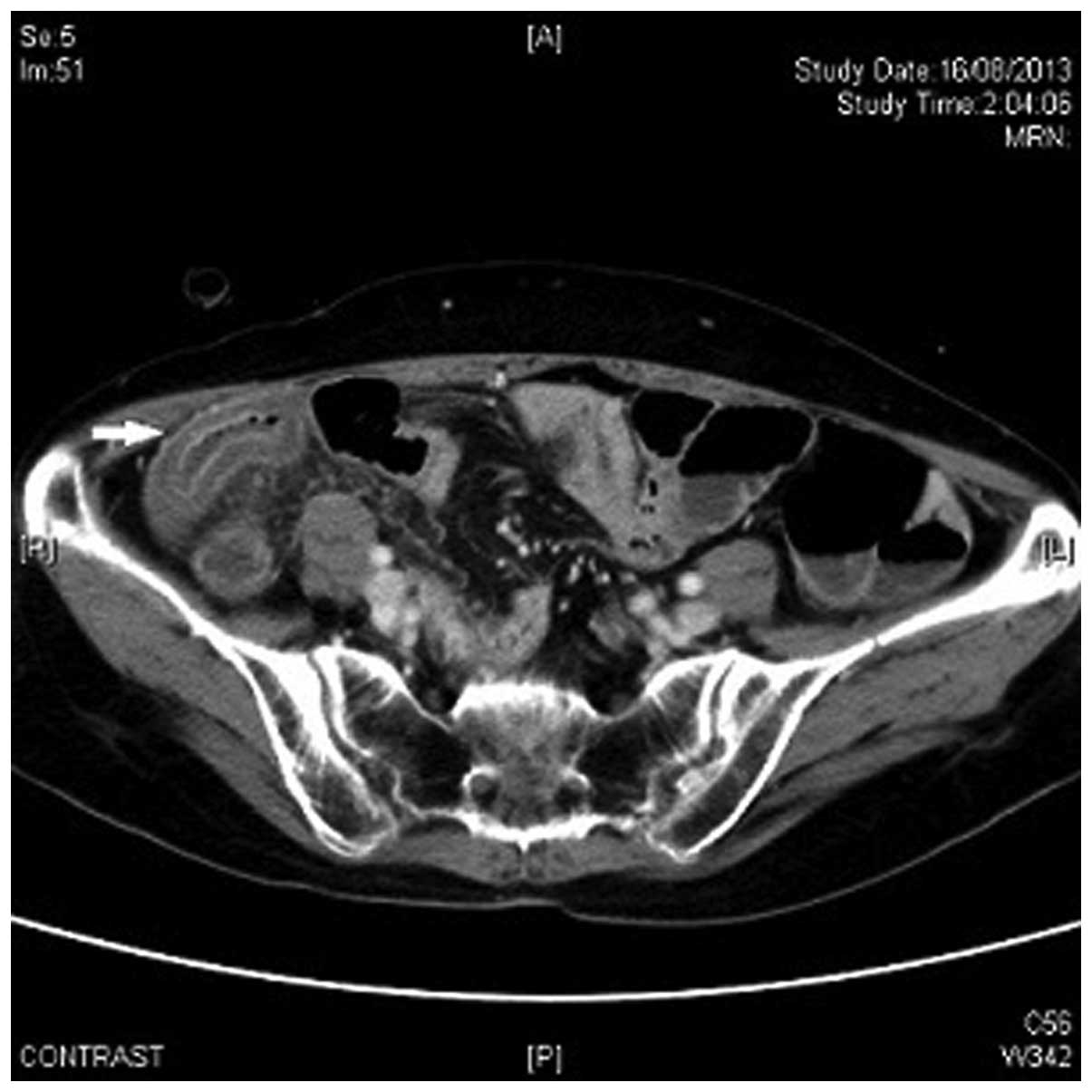
A CT scan of the abdomen and pelvis revealed extensive submucosal edema at the terminal and middle part of the ileum, associated with adjacent increase in fat stranding (Fig. 1). There was no pneumoperitoneum or bowel dilation. Evaluation was negative for sepsis, including blood, stool and urine cultures.

Figure 1.

Case 1. Computed tomography scan. Axial view showing submucosal edema associated with adjacent increase in fat stranding. The bowel loops were not dilated.

Hypokalemia persisted for 1 week and was managed with intravenous fluids and dietary modifications. The patient's condition gradually improved with conservative treatment, with improvement in oral intake and decreased vomiting and diarrhea. The patient remained in the hospital for a total of 12 days. The final diagnosis was terminal ileitis associated with capecitabine.

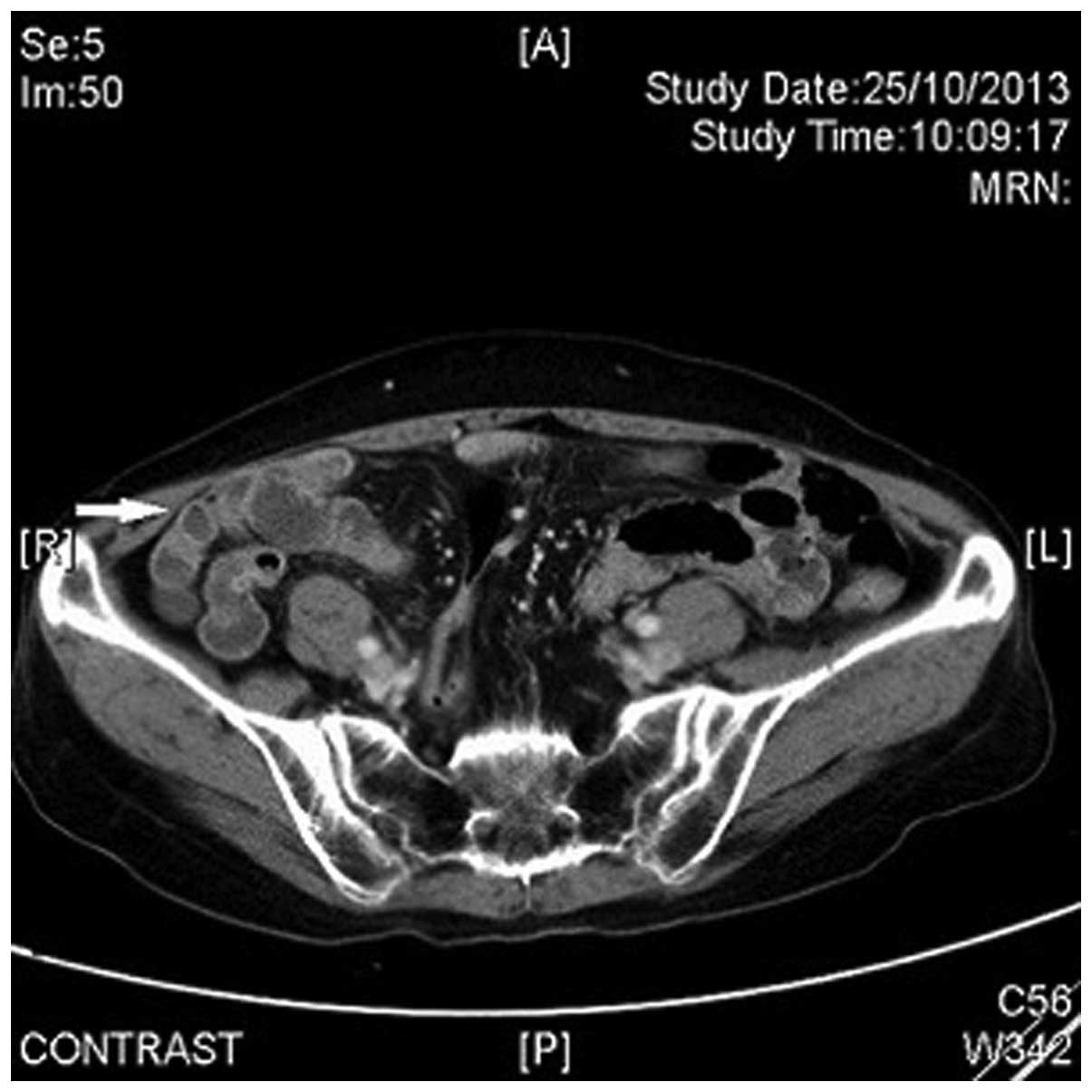
Chemotherapy with irinotecan and bevacizumab was resumed 1 week after hospital discharge, with no recurrence of ileitis. A CT scan performed 2 months later revealed complete resolution of the small bowel wall submucosal edema (Fig. 2).

Figure 2.

Case 1. Computed tomography scan. Axial view showing complete resolution of small bowel wall submucosal edema.

Case 2

A 59-year-old Chinese woman underwent laparoscopic sigmoidectomy for sigmoid colon cancer. On pathological examination, the tumor was diagnosed as pT3N0 adenocarcinoma with extramural vascular invasion. The patient was started on adjuvant capecitabine (2,500 mg/m2/day orally on days 1–14 every 3 weeks) and exhibited good tolerance to chemotherapy during the first 2 cycles; however, she developed grade 1 diarrhea, hand-foot-skin reaction and stomatitis.

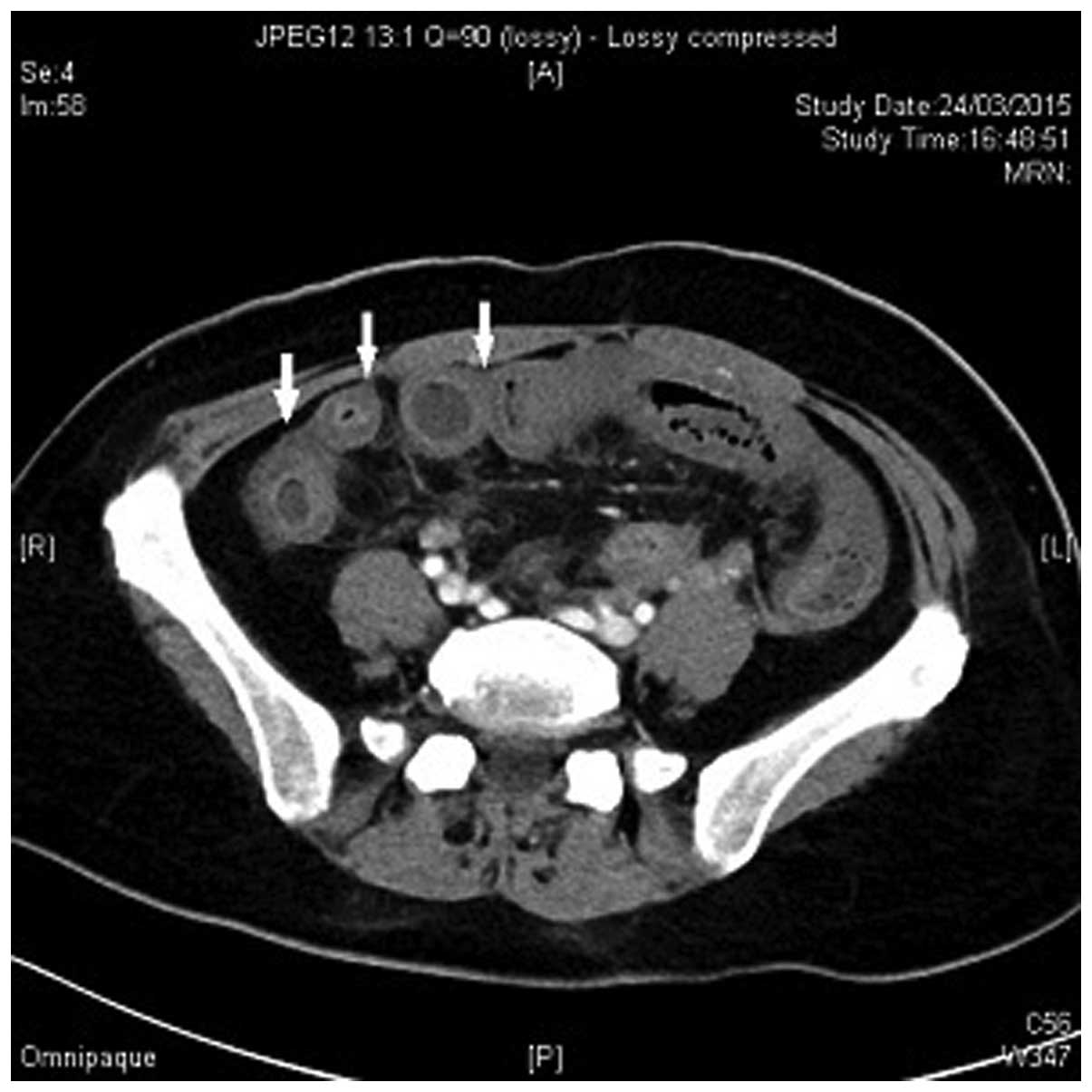
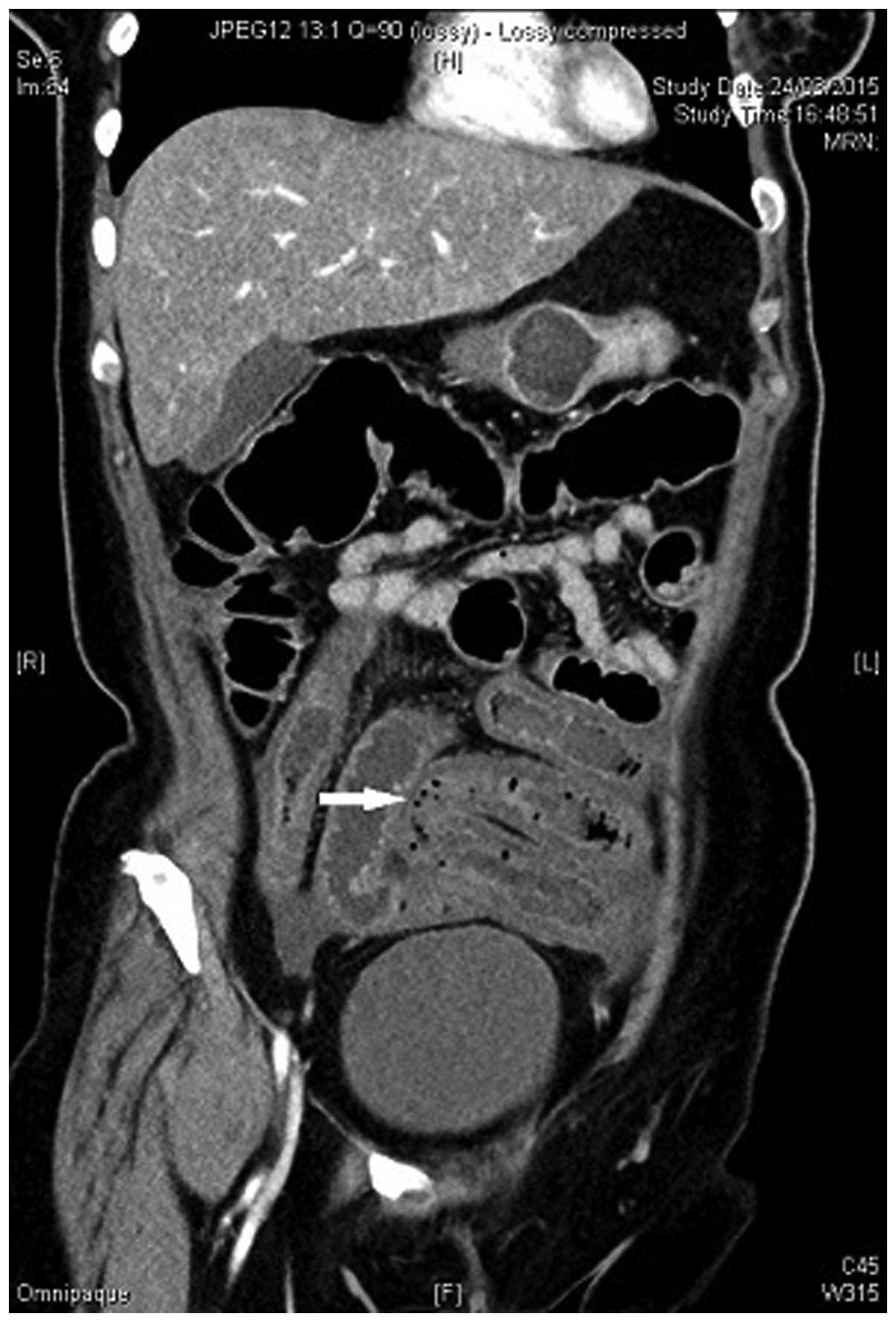
After day 14 of cycle 3, the patient exhibited worsening diarrhea, and was admitted to the hospital on day 19 after chemotherapy initiation; she had grade 3 mucositis, hand-foot-skin reaction, grade 4 diarrhea and severe generalized abdominal pain. A contrast-enhanced CT scan of the abdomen revealed diffuse submucosal edema with surrounding fat stranding, suggestive of ileitis in a long segment of the distal ileum to the terminal ileum. Multiple small gas bubbles were observed along the wall of the edematous distal ileum, consistent with pneumatosis intestinalis (Figs. 3 and 4).

Figure 3.

Case 2. Computed tomography scan. Axial view showing submucosal edema involving the distal to terminal ileum, with surrounding fat stranding, consistent with ileitis. Mucosal enhancement was preserved.

Figure 4.

Case 2. Computed tomography scan. Coronal view showing multiple small gas bubbles along the edematous distal ileum, consistent with pneumatosis intestinalis.

The patient was admitted to the intensive care unit for close monitoring and received total parenteral nutrition due to diarrhea, hypoalbuminemia and decreased oral intake. Inotropic support and electrolyte replacement were given to maintain hemodynamic stability and avoid electrolyte disturbances.

The patient exhibited a decreased neutrophil count (minimum, 0.7×10⁹/1 on day 20) and developed fever on day 21. Evaluation was negative for sepsis, including blood, stool and urine cultures. The patient was treated with broad-spectrum antibiotics for a total of 10 days and G-CSF. The neutrophil count increased to 1.39×10⁹/1 after 2 days.

The patient's condition gradually improved and diarrhea subsided on day 29 after chemotherapy initiation. The mucositis and skin reaction resolved and parenteral nutrition was discontinued after 16 days.

Discussion

The two patients developed ileitis associated with capecitabine. Previously reported cases of capecitabine-associated ileitis included 1 patient who had received adjuvant capecitabine monotherapy for colon cancer, 1 patient who had received capecitabine, oxaliplatin and bevacizumab for metastatic rectal cancer, and 1 patient who had received capecitabine and oxaliplatin for metastatic rectal cancer (2–4). In these previous cases, the ileitis dveloped early, between the first and third cycle of chemotherapy, and none of the patients in these reports had previous exposure to capecitabine. Case 1 highlights the fact that small bowel complications may occur during later cycles of chemotherapy, despite previous good tolerance to capecitabine.

In both presented cases, it was difficult to confirm the diagnosis, as the initial clinical findings were non-specific, the patients were on combination chemotherapy plus targeted therapy, and this type of toxicity is rare. The CT scan was an important tool for diagnosis and monitoring. The radiographic findings were comparable in the two cases, and ileitis was observed as diffuse submucosal edema of the small bowel wall, which was consistent with previous case reports and confirmed the diagnosis.

It was important to closely monitor serum electrolyte levels during the acute phase of the ileitis. Adequate hydration was also important, as capecitabine is excreted primarily by the kidneys.

Capecitabine is administered as an oral prodrug; it is metabolized in successive enzymatic steps to 5-FU, which is metabolized into two active metabolites that exert the cytotoxic effect. The step of conversion to 5-FU preferentially occurs in tumor tissues (1). 5-FU may cause vasospasm in the coronary vessels and cardiotoxicity (5). Furthermore, the vascular endothelium is susceptible to 5-FU via the generation of free radicals. The endothelial damage may cause a procoagulant state and thrombosis (6,7). These vascular effects of 5-FU may also affect intestinal vessels. A previous case of 5-FU-associated small bowel vasculitis due to arterial ischemia has been reported (8). Another study demonstrated that proinflammatory cytokines may contribute to 5-FU-associated intestinal mucosal injury (9).

In our cases, the contribution of bevacizumab and irinotecan to ileitis was unlikely. According to a previous case series, the most common clinical findings in bevacizumab-associated bowel perforation include abdominal pain and tenderness, vomiting, fever and leukocytosis. Diarrhea has been less frequently reported in most bevacizumab studies and is not a typical symptom of bowel perforation (10). A literature search identified no reported cases of small bowel ileitis associated with bevacizumab and irinotecan administration. The patient in case 1 did not have another episode of ileitis during subsequent cycles of irinotecan and bevacizumab treatment following discontinuation of capecitabine.

In summary, we presented two cases of adult Chinese patients who developed ileitis associated with capecitabine treatment. Ileitis may occur despite previous good tolerance to capecitabine. A high index of suspicion is crucial for prompt diagnosis. Ileitis may be reversible with early recognition, close monitoring and proper supportive treatment.

References

1 

Saif MW, Katirtzoglou NA and Syrigos KN: Capecitabine: An overview of the side effects and their management. Anticancer Drugs. 19:447–464. 2008.PubMed/NCBI

2 

Radwan R, Namelo WC, Robinson M, Brewster AE and Williams GL: Ileitis secondary to oral capecitabine treatment? Case Rep Med. 154981(2012)2012.

3 

Bouma G and Imholz AL: Ileitis following capecitabine use. Ned Tijdschr Geneeskd. 155:A30642011.([In Dutch]). PubMed/NCBI

4 

Al-Gahmi AM, Kerr IG, Zekri JM and Zagnoon AA: Capecitabine-induced terminal ileitis. Ann Saudi Med. 32:661–662. 2012.PubMed/NCBI

5 

Shoemaker LK, Arora U and Rocha Lima CM: 5-fluorouracil-induced coronary vasospasm. Cancer Contr. 11:46–49. 2004.

6 

Jensen SA and Sørensen JB: 5-fluorouracil-based therapy induces endovascular injury having potential significance to development of clinically overt cardiotoxicity. Cancer Chemother Pharmacol. 69:57–64. 2012. View Article : Google Scholar : PubMed/NCBI

7 

Kuzel T, Esparaz B, Green D and Kies M: Thrombogenicity of intravenous 5-fluorouracil alone or in combination with cisplatin. Cancer. 65:885–889. 1990. View Article : Google Scholar : PubMed/NCBI

8 

Bucaloiu ID, Dubagunta S, Pachipala KK, Kamal N and Fata F: Small-cell cancers, and an unusual reaction to chemotherapy: Case 4. Fluorouracil-related small bowel vasculitis. J Clin Oncol. 21:2442–2443. 2003.PubMed/NCBI

9 

Soares PM, Mota JM, Souza EP, Justino PF, Franco AX, Cunha FQ, Ribeiro RA and Souza MH: Inflammatory intestinal damage induced by 5-fluorouracil requires IL-4. Cytokine. 61:46–49. 2013. View Article : Google Scholar : PubMed/NCBI

10 

Badgwell BD, Camp ER, Feig B, Wolff RA, Eng C, Ellis LM and Cormier JN: Management of bevacizumab-associated bowel perforation: A case series and review of the literature. Ann Oncol. 19:577–582. 2008. View Article : Google Scholar : PubMed/NCBI

Related Articles

  • Abstract
  • View
  • Download
  • Twitter
Copy and paste a formatted citation
Spandidos Publications style
Lee SF, Chiang CL, Lee AS, Wong FC and Tung SY: Severe ileitis associated with capecitabine: Two case reports and review of the literature. Mol Clin Oncol 3: 1398-1400, 2015.
APA
Lee, S.F., Chiang, C.L., Lee, A.S., Wong, F.C., & Tung, S.Y. (2015). Severe ileitis associated with capecitabine: Two case reports and review of the literature. Molecular and Clinical Oncology, 3, 1398-1400. https://doi.org/10.3892/mco.2015.635
MLA
Lee, S. F., Chiang, C. L., Lee, A. S., Wong, F. C., Tung, S. Y."Severe ileitis associated with capecitabine: Two case reports and review of the literature". Molecular and Clinical Oncology 3.6 (2015): 1398-1400.
Chicago
Lee, S. F., Chiang, C. L., Lee, A. S., Wong, F. C., Tung, S. Y."Severe ileitis associated with capecitabine: Two case reports and review of the literature". Molecular and Clinical Oncology 3, no. 6 (2015): 1398-1400. https://doi.org/10.3892/mco.2015.635
Copy and paste a formatted citation
x
Spandidos Publications style
Lee SF, Chiang CL, Lee AS, Wong FC and Tung SY: Severe ileitis associated with capecitabine: Two case reports and review of the literature. Mol Clin Oncol 3: 1398-1400, 2015.
APA
Lee, S.F., Chiang, C.L., Lee, A.S., Wong, F.C., & Tung, S.Y. (2015). Severe ileitis associated with capecitabine: Two case reports and review of the literature. Molecular and Clinical Oncology, 3, 1398-1400. https://doi.org/10.3892/mco.2015.635
MLA
Lee, S. F., Chiang, C. L., Lee, A. S., Wong, F. C., Tung, S. Y."Severe ileitis associated with capecitabine: Two case reports and review of the literature". Molecular and Clinical Oncology 3.6 (2015): 1398-1400.
Chicago
Lee, S. F., Chiang, C. L., Lee, A. S., Wong, F. C., Tung, S. Y."Severe ileitis associated with capecitabine: Two case reports and review of the literature". Molecular and Clinical Oncology 3, no. 6 (2015): 1398-1400. https://doi.org/10.3892/mco.2015.635
Follow us
  • Twitter
  • LinkedIn
  • Facebook
About
  • Spandidos Publications
  • Careers
  • Cookie Policy
  • Privacy Policy
How can we help?
  • Help
  • Live Chat
  • Contact
  • Email to our Support Team