Spandidos Publications Logo
  • About
    • About Spandidos
    • Aims and Scopes
    • Abstracting and Indexing
    • Editorial Policies
    • Reprints and Permissions
    • Job Opportunities
    • Terms and Conditions
    • Contact
  • Journals
    • All Journals
    • Oncology Letters
      • Oncology Letters
      • Information for Authors
      • Editorial Policies
      • Editorial Board
      • Aims and Scope
      • Abstracting and Indexing
      • Bibliographic Information
      • Archive
    • International Journal of Oncology
      • International Journal of Oncology
      • Information for Authors
      • Editorial Policies
      • Editorial Board
      • Aims and Scope
      • Abstracting and Indexing
      • Bibliographic Information
      • Archive
    • Molecular and Clinical Oncology
      • Molecular and Clinical Oncology
      • Information for Authors
      • Editorial Policies
      • Editorial Board
      • Aims and Scope
      • Abstracting and Indexing
      • Bibliographic Information
      • Archive
    • Experimental and Therapeutic Medicine
      • Experimental and Therapeutic Medicine
      • Information for Authors
      • Editorial Policies
      • Editorial Board
      • Aims and Scope
      • Abstracting and Indexing
      • Bibliographic Information
      • Archive
    • International Journal of Molecular Medicine
      • International Journal of Molecular Medicine
      • Information for Authors
      • Editorial Policies
      • Editorial Board
      • Aims and Scope
      • Abstracting and Indexing
      • Bibliographic Information
      • Archive
    • Biomedical Reports
      • Biomedical Reports
      • Information for Authors
      • Editorial Policies
      • Editorial Board
      • Aims and Scope
      • Abstracting and Indexing
      • Bibliographic Information
      • Archive
    • Oncology Reports
      • Oncology Reports
      • Information for Authors
      • Editorial Policies
      • Editorial Board
      • Aims and Scope
      • Abstracting and Indexing
      • Bibliographic Information
      • Archive
    • Molecular Medicine Reports
      • Molecular Medicine Reports
      • Information for Authors
      • Editorial Policies
      • Editorial Board
      • Aims and Scope
      • Abstracting and Indexing
      • Bibliographic Information
      • Archive
    • World Academy of Sciences Journal
      • World Academy of Sciences Journal
      • Information for Authors
      • Editorial Policies
      • Editorial Board
      • Aims and Scope
      • Abstracting and Indexing
      • Bibliographic Information
      • Archive
    • International Journal of Functional Nutrition
      • International Journal of Functional Nutrition
      • Information for Authors
      • Editorial Policies
      • Editorial Board
      • Aims and Scope
      • Abstracting and Indexing
      • Bibliographic Information
      • Archive
    • International Journal of Epigenetics
      • International Journal of Epigenetics
      • Information for Authors
      • Editorial Policies
      • Editorial Board
      • Aims and Scope
      • Abstracting and Indexing
      • Bibliographic Information
      • Archive
    • Medicine International
      • Medicine International
      • Information for Authors
      • Editorial Policies
      • Editorial Board
      • Aims and Scope
      • Abstracting and Indexing
      • Bibliographic Information
      • Archive
  • Articles
  • Information
    • Information for Authors
    • Information for Reviewers
    • Information for Librarians
    • Information for Advertisers
    • Conferences
  • Language Editing
Spandidos Publications Logo
  • About
    • About Spandidos
    • Aims and Scopes
    • Abstracting and Indexing
    • Editorial Policies
    • Reprints and Permissions
    • Job Opportunities
    • Terms and Conditions
    • Contact
  • Journals
    • All Journals
    • Biomedical Reports
      • Information for Authors
      • Editorial Policies
      • Editorial Board
      • Aims and Scope
      • Abstracting and Indexing
      • Bibliographic Information
      • Archive
    • Experimental and Therapeutic Medicine
      • Information for Authors
      • Editorial Policies
      • Editorial Board
      • Aims and Scope
      • Abstracting and Indexing
      • Bibliographic Information
      • Archive
    • International Journal of Epigenetics
      • Information for Authors
      • Editorial Policies
      • Editorial Board
      • Aims and Scope
      • Abstracting and Indexing
      • Bibliographic Information
      • Archive
    • International Journal of Functional Nutrition
      • Information for Authors
      • Editorial Policies
      • Editorial Board
      • Aims and Scope
      • Abstracting and Indexing
      • Bibliographic Information
      • Archive
    • International Journal of Molecular Medicine
      • Information for Authors
      • Editorial Policies
      • Editorial Board
      • Aims and Scope
      • Abstracting and Indexing
      • Bibliographic Information
      • Archive
    • International Journal of Oncology
      • Information for Authors
      • Editorial Policies
      • Editorial Board
      • Aims and Scope
      • Abstracting and Indexing
      • Bibliographic Information
      • Archive
    • Medicine International
      • Information for Authors
      • Editorial Policies
      • Editorial Board
      • Aims and Scope
      • Abstracting and Indexing
      • Bibliographic Information
      • Archive
    • Molecular and Clinical Oncology
      • Information for Authors
      • Editorial Policies
      • Editorial Board
      • Aims and Scope
      • Abstracting and Indexing
      • Bibliographic Information
      • Archive
    • Molecular Medicine Reports
      • Information for Authors
      • Editorial Policies
      • Editorial Board
      • Aims and Scope
      • Abstracting and Indexing
      • Bibliographic Information
      • Archive
    • Oncology Letters
      • Information for Authors
      • Editorial Policies
      • Editorial Board
      • Aims and Scope
      • Abstracting and Indexing
      • Bibliographic Information
      • Archive
    • Oncology Reports
      • Information for Authors
      • Editorial Policies
      • Editorial Board
      • Aims and Scope
      • Abstracting and Indexing
      • Bibliographic Information
      • Archive
    • World Academy of Sciences Journal
      • Information for Authors
      • Editorial Policies
      • Editorial Board
      • Aims and Scope
      • Abstracting and Indexing
      • Bibliographic Information
      • Archive
  • Articles
  • Information
    • For Authors
    • For Reviewers
    • For Librarians
    • For Advertisers
    • Conferences
  • Language Editing
Login Register Submit
  • This site uses cookies
  • You can change your cookie settings at any time by following the instructions in our Cookie Policy. To find out more, you may read our Privacy Policy.

    I agree
Search articles by DOI, keyword, author or affiliation
Search
Advanced Search
presentation
Biomedical Reports
Join Editorial Board Propose a Special Issue
Print ISSN: 2049-9434 Online ISSN: 2049-9442
Journal Cover
March-April 2013 Volume 1 Issue 2

Full Size Image

Sign up for eToc alerts
Recommend to Library

Journals

International Journal of Molecular Medicine

International Journal of Molecular Medicine

International Journal of Molecular Medicine is an international journal devoted to molecular mechanisms of human disease.

International Journal of Oncology

International Journal of Oncology

International Journal of Oncology is an international journal devoted to oncology research and cancer treatment.

Molecular Medicine Reports

Molecular Medicine Reports

Covers molecular medicine topics such as pharmacology, pathology, genetics, neuroscience, infectious diseases, molecular cardiology, and molecular surgery.

Oncology Reports

Oncology Reports

Oncology Reports is an international journal devoted to fundamental and applied research in Oncology.

Experimental and Therapeutic Medicine

Experimental and Therapeutic Medicine

Experimental and Therapeutic Medicine is an international journal devoted to laboratory and clinical medicine.

Oncology Letters

Oncology Letters

Oncology Letters is an international journal devoted to Experimental and Clinical Oncology.

Biomedical Reports

Biomedical Reports

Explores a wide range of biological and medical fields, including pharmacology, genetics, microbiology, neuroscience, and molecular cardiology.

Molecular and Clinical Oncology

Molecular and Clinical Oncology

International journal addressing all aspects of oncology research, from tumorigenesis and oncogenes to chemotherapy and metastasis.

World Academy of Sciences Journal

World Academy of Sciences Journal

Multidisciplinary open-access journal spanning biochemistry, genetics, neuroscience, environmental health, and synthetic biology.

International Journal of Functional Nutrition

International Journal of Functional Nutrition

Open-access journal combining biochemistry, pharmacology, immunology, and genetics to advance health through functional nutrition.

International Journal of Epigenetics

International Journal of Epigenetics

Publishes open-access research on using epigenetics to advance understanding and treatment of human disease.

Medicine International

Medicine International

An International Open Access Journal Devoted to General Medicine.

Journal Cover
March-April 2013 Volume 1 Issue 2

Full Size Image

Sign up for eToc alerts
Recommend to Library

  • Article
  • Citations
    • Cite This Article
    • Download Citation
    • Create Citation Alert
    • Remove Citation Alert
    • Cited By
  • Similar Articles
    • Related Articles (in Spandidos Publications)
    • Similar Articles (Google Scholar)
    • Similar Articles (PubMed)
  • Download PDF
  • Download XML
  • View XML
Article

Hypoxia-inducible factor-1α as a predictive marker in pre-eclampsia

  • Authors:
    • Meenakshi Akhilesh
    • Vivekananda Mahalingam
    • Sivalingam Nalliah
    • Rosalina Mohd Ali
    • Murali Ganesalingam
    • Nagaraja Haleagrahara
  • View Affiliations / Copyright

    Affiliations: Faculty of Medicine, Newcastle University Medicine Malaysia, Johor, Malaysia, International Medical University, Kuala Lumpur, Malaysia, Hospital Ampang, Kuala Lumpur, Malaysia, Faculty of Medicine, Health and Molecular Sciences, James Cook University, Townsville 4811, Australia
  • Pages: 257-258
    |
    Published online on: November 30, 2012
       https://doi.org/10.3892/br.2012.44
  • Expand metrics +
Metrics: Total Views: 0 (Spandidos Publications: | PMC Statistics: )
Metrics: Total PDF Downloads: 0 (Spandidos Publications: | PMC Statistics: )
Cited By (CrossRef): 0 citations Loading Articles...

This article is mentioned in:


Abstract

The aim of this study was to determine whether or not the increased levels of hypoxia‑inducible factor‑1α (HIF-1α) could be used to demonstrate failed placentation in pre‑eclamptic mothers. Twenty pregnant females with (pre‑eclampsia group) or without pre‑eclampsia (control group) were included in the present study. Antenatal and post‑delivery HIF-1α transcription factor levels were measured. A significant increase was observed in the HIF-1α levels in the pre‑ and postnatal pre‑eclampsia mothers. The findings suggest that the levels of HIF-1α in the blood of mothers with pre‑eclampsia decrease after delivery of the placenta. The results confirm that there is increased HIF-1α in pre‑eclampsia and a steady increase in the levels of HIF-1α could be commensurate with the possibility of a patient developing pre‑eclampsia at a later trimester.

Introduction

Pre-eclampsia is a pregnancy-specific disorder of variable severity displaying a characteristic presentation with well-defined diagnostic criteria in place solely based on physical signs, such as hypertension and proteinuria, although some aspects of its pathophysiology have yet to be ascertained and described. The placenta being placed at a strategic location successfully interfaces the maternal and foetal circulation during pregnancy and exits its location immediately after delivery when it has fulfilled its function. As a result of a physiological process termed ‘pseudovasculogenesis’, the spiral arterioles increase in diameter and reduce in musculature thus increasing the amount of blood supplied to the foetus, a process that is absent in pre-eclampsia.

Pre-eclampsia has been a major cause of maternal and foetal mortality worldwide despite its predictable presentation. The need for a predictive marker for pre-eclampsia is understated but has been a subject for discussion throughout the scientific community. The search for a consistently expressed and easily measurable ‘substance’ that can act as a marker for pre-eclampsia is still underway and therefore defines the purpose of this study.

Hypoxia-inducible factor-1α (HIF-1α) is a transcription factor transiently expressed as a protein (1,2), also binding to hypoxia-response elements (HREs) in the promoters of several genes involved in the adaptation to an environment of hypoxia. Its consistent presence in hypoxic milieus renders it a notable candidate for pre-eclampsia-related research. Previous studies have demonstrated the presence of HIF-1α in pre-eclamptic placentas (1,2), but whether escalating levels of the protein parallel aberrant pseudovasculogenesis has yet to be evaluated. This study aimed to determine whether or not the increased levels of HIF-1α can be used to demonstrate failed placentation in pre-eclamptic mothers, thereby establishing its credibility as a blood marker for pre-eclampsia.

Materials and methods

A case-control pilot study involving two groups of ten mothers with and without pre-eclampsia, respectively, was initiated by the authors from the International Medical University, Kuala Lumpur, Malaysia, in collaboration with the co-authors from Hospital Ampang, Kuala Lumpur, Malaysia. Consenting mothers (age, <45 years), with newly diagnosed pre-eclampsia and devoid of co-morbidities such as diabetes mellitus and essential hypertension, formed the study group, while consenting mothers within the same age group with normal pregnancies constituted the control group. The study was approved by the ethics committee of International Medical University, Kuala Lumpur, Malaysia. HIF-1α transcription factor levels were measured in venous blood drawn antenatally at diagnosis, and thereafter immediately after delivery of the placenta by enzyme-linked immunosorbent assay (ELISA). Additional characteristics such as placental weight and urinary protein levels were included. Data are expressed as the means ± standard error of the mean (SEM). Data were analyzed using analysis of variance coupled with a post hoc Tukey’s test for multiple pairwise comparisons. P<0.05 was considered to indicate a statistically significant difference.

Results

The age of the pre-eclamptic mothers included in the study ranged from 20 to 35 years, while that of the normal mothers ranged from 23 to 35 years.

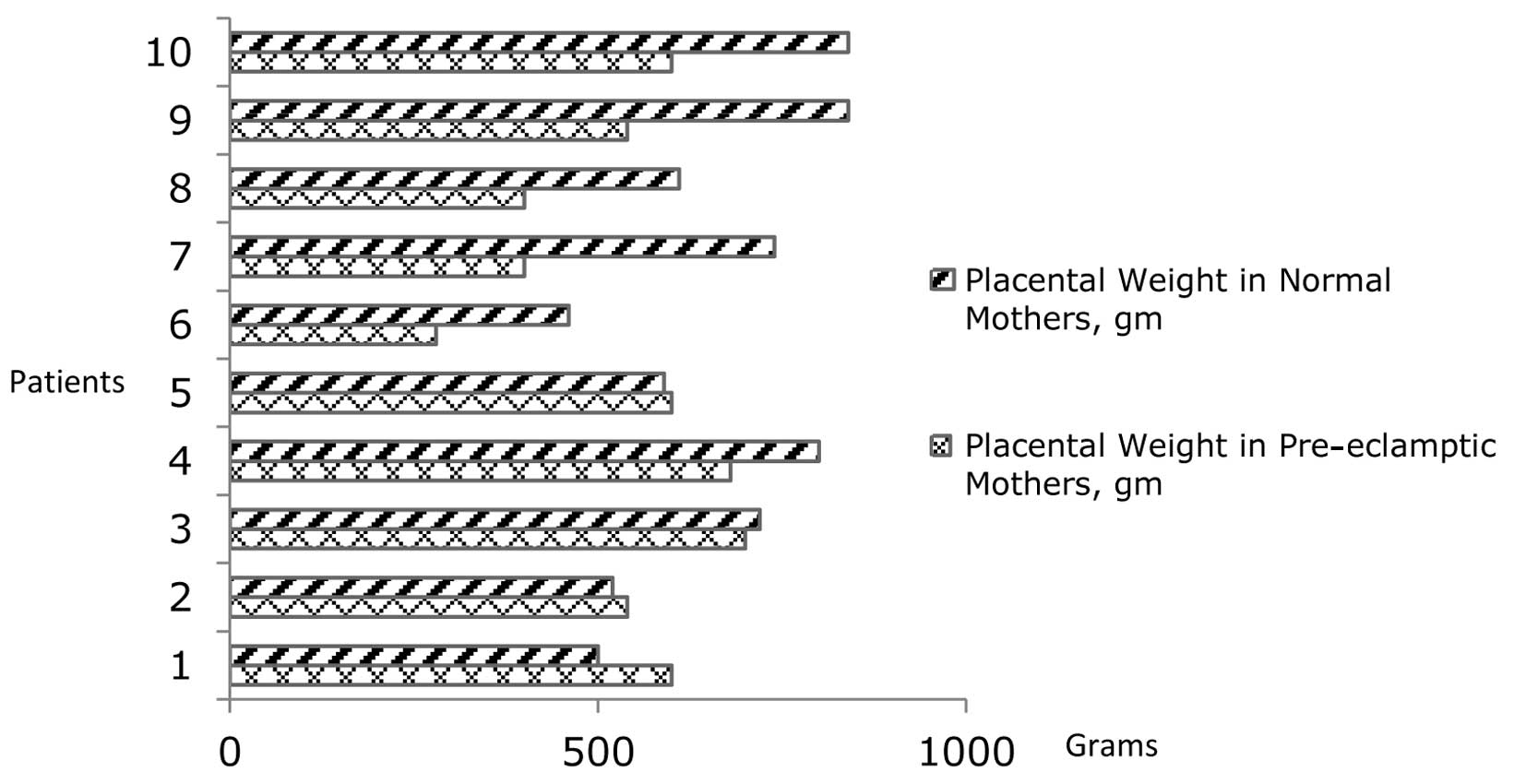
The placental weights in normal mothers were greater when compared to the pre-eclamptic mothers (Fig. 1). Twenty-four-hour urine protein levels in pre-eclampsia patients measured up to a maximum of 6 g. Notably, the blood pressure measurement in the patient with maximal proteinuria was the highest reading recorded at diagnosis.

Figure 1

The placental weights of normal mothers and mothers with pre-eclampsia.

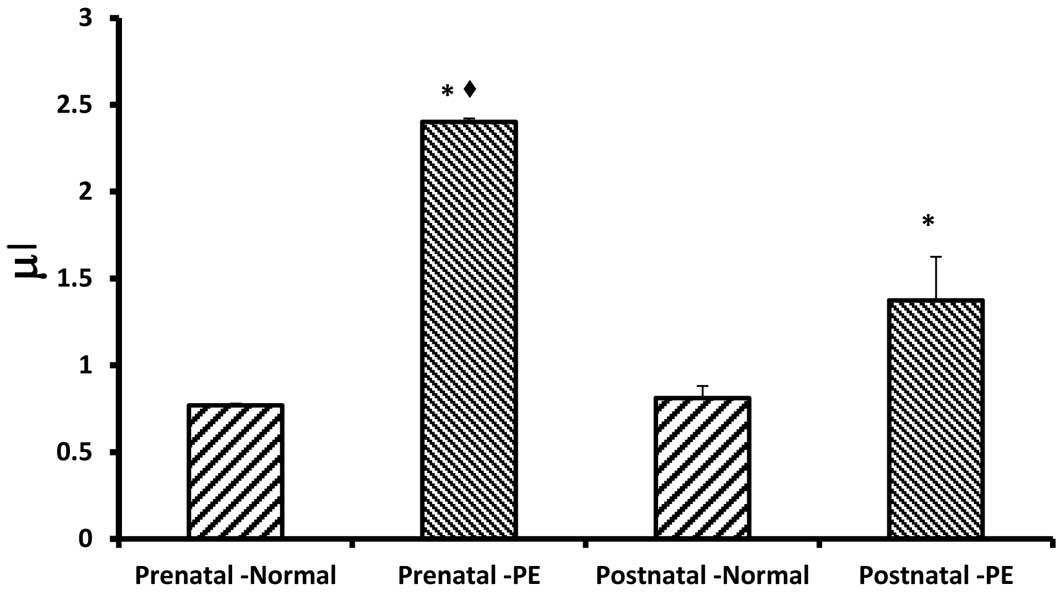
Levels of HIF-1α transcription factor were observed to reflect failed pseudovasculogenesis in mothers with pre-eclampsia. The HIF-1α levels in prenatal blood samples of the mothers with pre-eclampsia were higher compared to levels in postnatal blood samples, achieving a 100% correlation. The percentage reduction of mean HIF-1α levels postnatally in mothers with pre-eclampsia was 42.81% (Fig. 2).

Figure 2

Hypoxia-inducible factor-1α (HIF-1α) transcription factor levels in pre- and postnatal blood samples in normal mothers and mothers with pre-eclampsia (PE). *P<0.05, compared to prenatal normal group; ♦P<0.05, compared with postnatal PE.

The values attained suggest that the levels of HIF-1α transcription factor in the blood of mothers with pre-eclampsia decreased following delivery of the placenta, supporting the assumption that the placenta could be responsible for this particular disease (1,4). In normal mothers the HIF-1α levels were comparatively low in pre- as well as postnatal blood samples, demonstrating similar mean values (0.77 and 0.81, respectively).

Discussion

Placental weights of the pre-eclamptic mothers were lower compared to placental weights of normal mothers. This may be attributable to placental ischaemia due to aberrant pseudovasculogenesis. This finding correlated with those of Pandit et al (3) in their study on placental weights in 100 cases of pre-eclamptic placentae (3).

The presence of HIF-1α in ischaemic environments and its increased levels in the blood of mothers with pre-eclampsia are compelling features to study this transcription factor as well as its role as a predictor of pre-eclampsia.

The presence of HIF-1α transcription factors, albeit in extremely low quantities, may present a debate regarding the utility of this transcription factor as a predictor for pre-eclampsia if measured in early pregnancy. However, it suggests that should the levels of this transcription factor be measured more frequently, a steady increase of HIF-1α levels could still be commensurate with a potential development of pre-eclampsia at a later trimester. Further research should be conducted as a population-based study on a larger research cohort.

Abbreviations:

HIF

hypoxia-inducible factor

HRE

hypoxia-response elements

ELISA

enzyme-linked immunosorbent assay

References

1 

James JL, Stone PR and Chamley LW: The regulation of trophoblast differentiation by oxygen in the first trimester of pregnancy. Hum Reprod Update. 12:137–144. 2005. View Article : Google Scholar : PubMed/NCBI

2 

Rajakumar A and Conrad KP: Expression, ontogeny, and regulation of hypoxia-inducible transcription factors in the human placenta. Biol Reprod. 63:559–569. 2000. View Article : Google Scholar : PubMed/NCBI

3 

Pandit A, Kamlesh R and Niranjan M: Foeto-placental weight relationship in normal pregnancy and pre-eclampsia-eclampsia-A comparative study. Bombay Hosp J. 53:2011

4 

Tan KH, Kwek K and Yeo GSH: Epidemiology of pre-eclampsia and eclampsia at the KK women’s and children’s hospital, Singapore. Sg Med J. 47:482006.PubMed/NCBI

Related Articles

  • Abstract
  • View
  • Download
  • Twitter
Copy and paste a formatted citation
Spandidos Publications style
Akhilesh M, Mahalingam V, Nalliah S, Ali RM, Ganesalingam M and Haleagrahara N: Hypoxia-inducible factor-1α as a predictive marker in pre-eclampsia. Biomed Rep 1: 257-258, 2013.
APA
Akhilesh, M., Mahalingam, V., Nalliah, S., Ali, R.M., Ganesalingam, M., & Haleagrahara, N. (2013). Hypoxia-inducible factor-1α as a predictive marker in pre-eclampsia. Biomedical Reports, 1, 257-258. https://doi.org/10.3892/br.2012.44
MLA
Akhilesh, M., Mahalingam, V., Nalliah, S., Ali, R. M., Ganesalingam, M., Haleagrahara, N."Hypoxia-inducible factor-1α as a predictive marker in pre-eclampsia". Biomedical Reports 1.2 (2013): 257-258.
Chicago
Akhilesh, M., Mahalingam, V., Nalliah, S., Ali, R. M., Ganesalingam, M., Haleagrahara, N."Hypoxia-inducible factor-1α as a predictive marker in pre-eclampsia". Biomedical Reports 1, no. 2 (2013): 257-258. https://doi.org/10.3892/br.2012.44
Copy and paste a formatted citation
x
Spandidos Publications style
Akhilesh M, Mahalingam V, Nalliah S, Ali RM, Ganesalingam M and Haleagrahara N: Hypoxia-inducible factor-1α as a predictive marker in pre-eclampsia. Biomed Rep 1: 257-258, 2013.
APA
Akhilesh, M., Mahalingam, V., Nalliah, S., Ali, R.M., Ganesalingam, M., & Haleagrahara, N. (2013). Hypoxia-inducible factor-1α as a predictive marker in pre-eclampsia. Biomedical Reports, 1, 257-258. https://doi.org/10.3892/br.2012.44
MLA
Akhilesh, M., Mahalingam, V., Nalliah, S., Ali, R. M., Ganesalingam, M., Haleagrahara, N."Hypoxia-inducible factor-1α as a predictive marker in pre-eclampsia". Biomedical Reports 1.2 (2013): 257-258.
Chicago
Akhilesh, M., Mahalingam, V., Nalliah, S., Ali, R. M., Ganesalingam, M., Haleagrahara, N."Hypoxia-inducible factor-1α as a predictive marker in pre-eclampsia". Biomedical Reports 1, no. 2 (2013): 257-258. https://doi.org/10.3892/br.2012.44
Follow us
  • Twitter
  • LinkedIn
  • Facebook
About
  • Spandidos Publications
  • Careers
  • Cookie Policy
  • Privacy Policy
How can we help?
  • Help
  • Live Chat
  • Contact
  • Email to our Support Team