Spandidos Publications Logo
  • About
    • About Spandidos
    • Aims and Scopes
    • Abstracting and Indexing
    • Editorial Policies
    • Reprints and Permissions
    • Job Opportunities
    • Terms and Conditions
    • Contact
  • Journals
    • All Journals
    • Oncology Letters
      • Oncology Letters
      • Information for Authors
      • Editorial Policies
      • Editorial Board
      • Aims and Scope
      • Abstracting and Indexing
      • Bibliographic Information
      • Archive
    • International Journal of Oncology
      • International Journal of Oncology
      • Information for Authors
      • Editorial Policies
      • Editorial Board
      • Aims and Scope
      • Abstracting and Indexing
      • Bibliographic Information
      • Archive
    • Molecular and Clinical Oncology
      • Molecular and Clinical Oncology
      • Information for Authors
      • Editorial Policies
      • Editorial Board
      • Aims and Scope
      • Abstracting and Indexing
      • Bibliographic Information
      • Archive
    • Experimental and Therapeutic Medicine
      • Experimental and Therapeutic Medicine
      • Information for Authors
      • Editorial Policies
      • Editorial Board
      • Aims and Scope
      • Abstracting and Indexing
      • Bibliographic Information
      • Archive
    • International Journal of Molecular Medicine
      • International Journal of Molecular Medicine
      • Information for Authors
      • Editorial Policies
      • Editorial Board
      • Aims and Scope
      • Abstracting and Indexing
      • Bibliographic Information
      • Archive
    • Biomedical Reports
      • Biomedical Reports
      • Information for Authors
      • Editorial Policies
      • Editorial Board
      • Aims and Scope
      • Abstracting and Indexing
      • Bibliographic Information
      • Archive
    • Oncology Reports
      • Oncology Reports
      • Information for Authors
      • Editorial Policies
      • Editorial Board
      • Aims and Scope
      • Abstracting and Indexing
      • Bibliographic Information
      • Archive
    • Molecular Medicine Reports
      • Molecular Medicine Reports
      • Information for Authors
      • Editorial Policies
      • Editorial Board
      • Aims and Scope
      • Abstracting and Indexing
      • Bibliographic Information
      • Archive
    • World Academy of Sciences Journal
      • World Academy of Sciences Journal
      • Information for Authors
      • Editorial Policies
      • Editorial Board
      • Aims and Scope
      • Abstracting and Indexing
      • Bibliographic Information
      • Archive
    • International Journal of Functional Nutrition
      • International Journal of Functional Nutrition
      • Information for Authors
      • Editorial Policies
      • Editorial Board
      • Aims and Scope
      • Abstracting and Indexing
      • Bibliographic Information
      • Archive
    • International Journal of Epigenetics
      • International Journal of Epigenetics
      • Information for Authors
      • Editorial Policies
      • Editorial Board
      • Aims and Scope
      • Abstracting and Indexing
      • Bibliographic Information
      • Archive
    • Medicine International
      • Medicine International
      • Information for Authors
      • Editorial Policies
      • Editorial Board
      • Aims and Scope
      • Abstracting and Indexing
      • Bibliographic Information
      • Archive
  • Articles
  • Information
    • Information for Authors
    • Information for Reviewers
    • Information for Librarians
    • Information for Advertisers
    • Conferences
  • Language Editing
Spandidos Publications Logo
  • About
    • About Spandidos
    • Aims and Scopes
    • Abstracting and Indexing
    • Editorial Policies
    • Reprints and Permissions
    • Job Opportunities
    • Terms and Conditions
    • Contact
  • Journals
    • All Journals
    • Biomedical Reports
      • Information for Authors
      • Editorial Policies
      • Editorial Board
      • Aims and Scope
      • Abstracting and Indexing
      • Bibliographic Information
      • Archive
    • Experimental and Therapeutic Medicine
      • Information for Authors
      • Editorial Policies
      • Editorial Board
      • Aims and Scope
      • Abstracting and Indexing
      • Bibliographic Information
      • Archive
    • International Journal of Epigenetics
      • Information for Authors
      • Editorial Policies
      • Editorial Board
      • Aims and Scope
      • Abstracting and Indexing
      • Bibliographic Information
      • Archive
    • International Journal of Functional Nutrition
      • Information for Authors
      • Editorial Policies
      • Editorial Board
      • Aims and Scope
      • Abstracting and Indexing
      • Bibliographic Information
      • Archive
    • International Journal of Molecular Medicine
      • Information for Authors
      • Editorial Policies
      • Editorial Board
      • Aims and Scope
      • Abstracting and Indexing
      • Bibliographic Information
      • Archive
    • International Journal of Oncology
      • Information for Authors
      • Editorial Policies
      • Editorial Board
      • Aims and Scope
      • Abstracting and Indexing
      • Bibliographic Information
      • Archive
    • Medicine International
      • Information for Authors
      • Editorial Policies
      • Editorial Board
      • Aims and Scope
      • Abstracting and Indexing
      • Bibliographic Information
      • Archive
    • Molecular and Clinical Oncology
      • Information for Authors
      • Editorial Policies
      • Editorial Board
      • Aims and Scope
      • Abstracting and Indexing
      • Bibliographic Information
      • Archive
    • Molecular Medicine Reports
      • Information for Authors
      • Editorial Policies
      • Editorial Board
      • Aims and Scope
      • Abstracting and Indexing
      • Bibliographic Information
      • Archive
    • Oncology Letters
      • Information for Authors
      • Editorial Policies
      • Editorial Board
      • Aims and Scope
      • Abstracting and Indexing
      • Bibliographic Information
      • Archive
    • Oncology Reports
      • Information for Authors
      • Editorial Policies
      • Editorial Board
      • Aims and Scope
      • Abstracting and Indexing
      • Bibliographic Information
      • Archive
    • World Academy of Sciences Journal
      • Information for Authors
      • Editorial Policies
      • Editorial Board
      • Aims and Scope
      • Abstracting and Indexing
      • Bibliographic Information
      • Archive
  • Articles
  • Information
    • For Authors
    • For Reviewers
    • For Librarians
    • For Advertisers
    • Conferences
  • Language Editing
Login Register Submit
  • This site uses cookies
  • You can change your cookie settings at any time by following the instructions in our Cookie Policy. To find out more, you may read our Privacy Policy.

    I agree
Search articles by DOI, keyword, author or affiliation
Search
Advanced Search
presentation
Biomedical Reports
Join Editorial Board Propose a Special Issue
Print ISSN: 2049-9434 Online ISSN: 2049-9442
Journal Cover
November-December 2014 Volume 2 Issue 6

Full Size Image

Sign up for eToc alerts
Recommend to Library

Journals

International Journal of Molecular Medicine

International Journal of Molecular Medicine

International Journal of Molecular Medicine is an international journal devoted to molecular mechanisms of human disease.

International Journal of Oncology

International Journal of Oncology

International Journal of Oncology is an international journal devoted to oncology research and cancer treatment.

Molecular Medicine Reports

Molecular Medicine Reports

Covers molecular medicine topics such as pharmacology, pathology, genetics, neuroscience, infectious diseases, molecular cardiology, and molecular surgery.

Oncology Reports

Oncology Reports

Oncology Reports is an international journal devoted to fundamental and applied research in Oncology.

Experimental and Therapeutic Medicine

Experimental and Therapeutic Medicine

Experimental and Therapeutic Medicine is an international journal devoted to laboratory and clinical medicine.

Oncology Letters

Oncology Letters

Oncology Letters is an international journal devoted to Experimental and Clinical Oncology.

Biomedical Reports

Biomedical Reports

Explores a wide range of biological and medical fields, including pharmacology, genetics, microbiology, neuroscience, and molecular cardiology.

Molecular and Clinical Oncology

Molecular and Clinical Oncology

International journal addressing all aspects of oncology research, from tumorigenesis and oncogenes to chemotherapy and metastasis.

World Academy of Sciences Journal

World Academy of Sciences Journal

Multidisciplinary open-access journal spanning biochemistry, genetics, neuroscience, environmental health, and synthetic biology.

International Journal of Functional Nutrition

International Journal of Functional Nutrition

Open-access journal combining biochemistry, pharmacology, immunology, and genetics to advance health through functional nutrition.

International Journal of Epigenetics

International Journal of Epigenetics

Publishes open-access research on using epigenetics to advance understanding and treatment of human disease.

Medicine International

Medicine International

An International Open Access Journal Devoted to General Medicine.

Journal Cover
November-December 2014 Volume 2 Issue 6

Full Size Image

Sign up for eToc alerts
Recommend to Library

  • Article
  • Citations
    • Cite This Article
    • Download Citation
    • Create Citation Alert
    • Remove Citation Alert
    • Cited By
  • Similar Articles
    • Related Articles (in Spandidos Publications)
    • Similar Articles (Google Scholar)
    • Similar Articles (PubMed)
  • Download PDF
  • Download XML
  • View XML
Article

Cathepsin K in treatment monitoring following intravenous zoledronic acid

  • Authors:
    • Oliver Jahn
    • Thomas Wex
    • Silke Klose
    • Siegfried Kropf
    • Daniela Adolf
    • Stefan Piatek
  • View Affiliations / Copyright

    Affiliations: Department of Trauma Surgery, Otto von Guericke University, D‑39120 Magdeburg, Germany, Department of Gastroenterology, Hepatology and Infectious Diseases, Otto von Guericke University, D‑39120 Magdeburg, Germany, Department of Nephrology, Hypertension, Endocrinology and Metabolic Diseases, Otto von Guericke University, D‑39120 Magdeburg, Germany, Department of Biometry and Medical Informatics, Otto von Guericke University, D‑39120 Magdeburg, Germany
  • Pages: 915-917
    |
    Published online on: September 10, 2014
       https://doi.org/10.3892/br.2014.360
  • Expand metrics +
Metrics: Total Views: 0 (Spandidos Publications: | PMC Statistics: )
Metrics: Total PDF Downloads: 0 (Spandidos Publications: | PMC Statistics: )
Cited By (CrossRef): 0 citations Loading Articles...

This article is mentioned in:


Abstract

Cathepsin K (CatK) is mainly expressed by osteoclasts and plays an important role in bone resorption. As CatK is expressed and secreted by osteoclasts during active bone resorption, it may be a useful and specific biochemical marker of osteoclastic activity. Therefore, CatK serum levels were studied for monitoring the treatment of females with postmenopausal osteoporosis by zoledronic acid. The serum CatK levels were determined in nine postmenopausal females before and after 3, 6 and 12 months of treatment. The levels were significantly reduced after 3 and 6 months (P<0.05), whereas they returned to baseline after 1 year. Taken together, the serum level of CatK may be suitable for monitoring anti‑osteoporotic therapy in association with treatment response.

Introduction

Osteoporosis is a systemic skeletal disease characterized by low bone mass and a deterioration of trabecular microarchitecture, resulting in an increase in bone fragility and a tendency to fractures (1). Osteoporosis is standardly diagnosed via the measurement of bone mineral density (BMD) by dual-energy X-ray absorptiometry (DXA). The operational World Health Organization definition of osteoporosis is based on a T-score of ≤-2.5 (2). Bone turnover markers (BTM) do not establish the diagnosis of osteoporosis. While DXA reflects changes in BMD 1–2 years after anti-osteoporotic treatment, BTM levels were altered after 3–6 months of therapy so they may provide earlier information on the response to treatment (3–7). In the present study, the clinical potential of cathepsin K (CatK) serum levels for monitoring the treatment of osteoporosis with zoledronic acid is studied.

The prevalence of osteoporosis in Germany among persons aged ≥50, as revealed by diagnoses of osteoporosis or osteoporotic fractures, or by the prescription of medication for osteoporosis, was found to be 14% in the year 2009. The gender-specific prevalence was 24% in women and 6% in men (8).

CatK is mainly expressed in mature osteoclasts, cleaves both helical and telopeptide regions of collagen I and is therefore essential for bone resorption (9). This cysteine protease was first described by Inaoka et al (10). Deficiency of CatK results in pyknodysostosis (Toulouse Lautrec syndrome), an autosomal recessive osteosclerotic skeletal dysplasia with impaired bone resorption, which is characterized by decreased bone turnover and an accumulation of undigested collagen fibrils (11). Saftig et al (12) showed that in CatK-deficient mice impaired osteoclastic bone resorption leads to osteopetrosis. Due to the fact that CatK is expressed and secreted by osteoclasts during active bone resorption, it may be a useful and specific biochemical marker of osteoclastic activity. Henriksen et al (13) postulated that circulating levels of CatK are proportional to the number of osteoclasts, and thus can be used as a surrogate marker of osteoclast number.

Materials and methods

Study subjects

In total, nine postmenopausal females aged 62–75 years were included. Of these, seven females could be monitored completely with DXA before and 1 year after anti-osteoporotic therapy with intravenous infusion of zoledronic acid, and furthermore, the levels of serum CatK before and 3, 6 and 12 months after therapy could be assessed. Two individuals had missing observations after 1 year. The indication for anti-osteoporotic treatment was according to the guidelines of the Dachverband Osteologie (DVO) by the lowest T-score in DXA and associated risk factors (14). Surgery or fracture ≤12 months, malignant tumor, ovariectomy and the intake of drugs prior to the beginning of treatment, including cortisone, strontium, fluorides, bisphosphonates, selective estrogen receptor modulators, estrogens and steroids, were exclusion criteria.

Ethical approval

The study was conducted according to the ethical guidelines of the Declaration of Helsinki as revised in 1989 and approved by the Ethical Committee of the Otto von Guericke University (91/08) and the German Office of Radiation Protection in Salzgitter (no. Z5-22462/2-2009-022).

BMD measurements

All the female patients underwent bone density measurements before and 1 year after treatment. Radiographs of the spine were not performed, as there were no references for vertebral fractures, such as back pain and loss of height, in the medical history or examination. The measurement of BMD was performed at the lumbar spine (L1-L4), femoral neck and total hip with DXA as described previously (15).

Laboratory

Serum parameters, according to the DVO guidelines, were examined to exclude secondary osteoporosis, and furthermore, 25-(OH)-vitamin D. The serum samples were aliquoted and stored at −80°C until analysis. The measurement of CatK was performed before and 3, 6 and 12 months after the beginning of treatment [ELISA; Biomedica, Wien, Austria; intra-assay coefficient of variance (CV) 4–6%, inter-assay CV 6–8%, detection level 1.1 pmol/l] as described previously (15).

Anti-osteoporotic therapy

A total of 100 ml (5 mg) zoledronic acid (Aclasta®; Novartis, Basel, Switzerland) was infused intravenously within 15 min. In all females, calcium-supplementing was completed with 500 mg daily. Individually, a daily supplementation of 400–2,000 U of vitamin D3 was carried out.

Statistical analysis

The statistical analyses were performed with SPSS (version 21; SPSS, Inc., Chicago, IL, USA) using non-parametric tests, as graphical inspection indicated deviations from the normal distribution. Data for the BMD were evaluated with the Wilcoxon signed rank test due to the small random sample. The serum parameters with four time measurements were analysed by Friedman test. The individual time points were compared to the baseline value with the Wilcoxon matched-pairs signed rank test. A two-sided P-value of 0.05 was set to be the level of significance and was considered to indicate a statistically significant difference. Bonferroni adjustment was performed to control for family-wise error rate. The results are illustrated in median, minimum and maximum.

Results

CatK serum levels

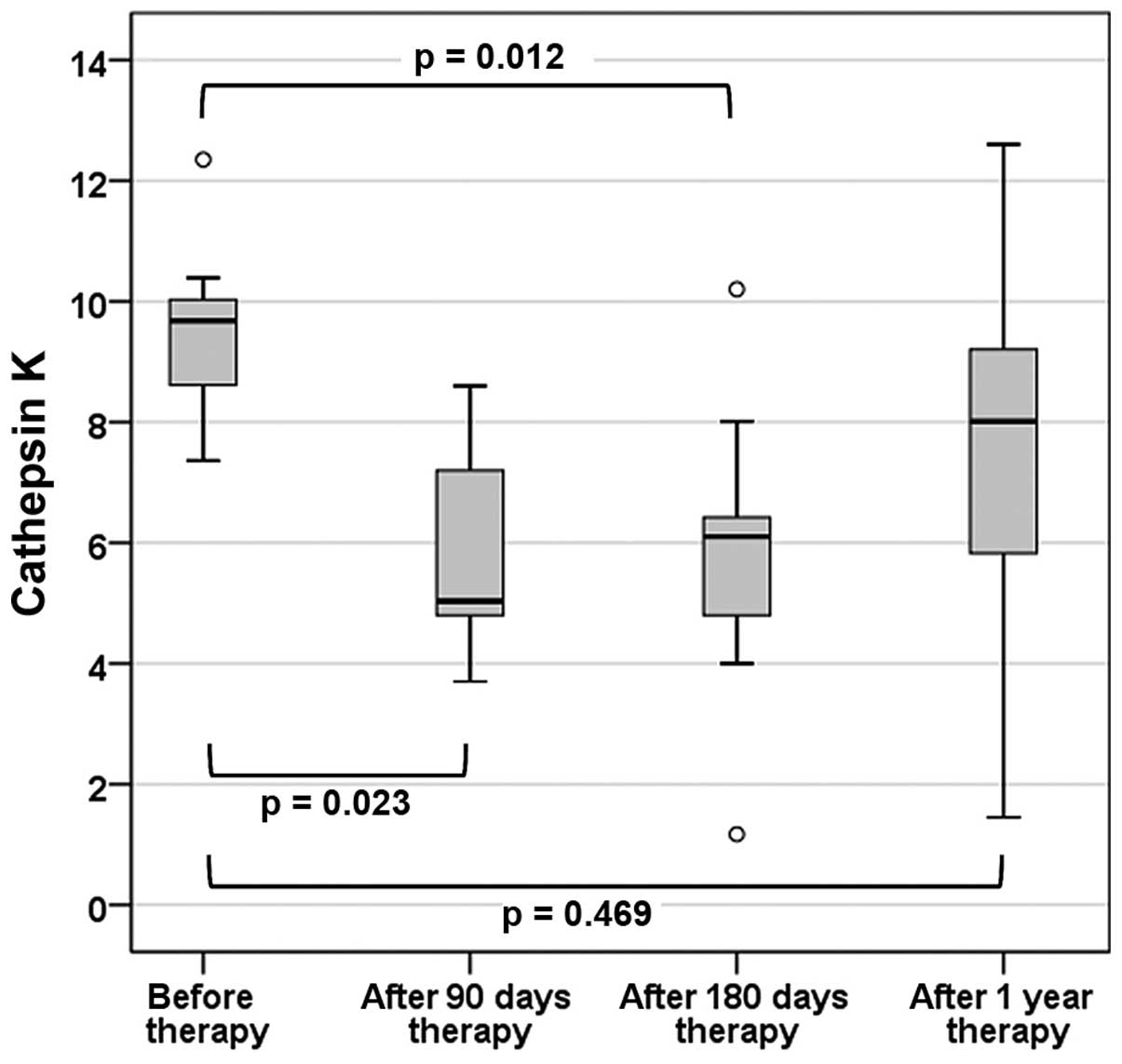
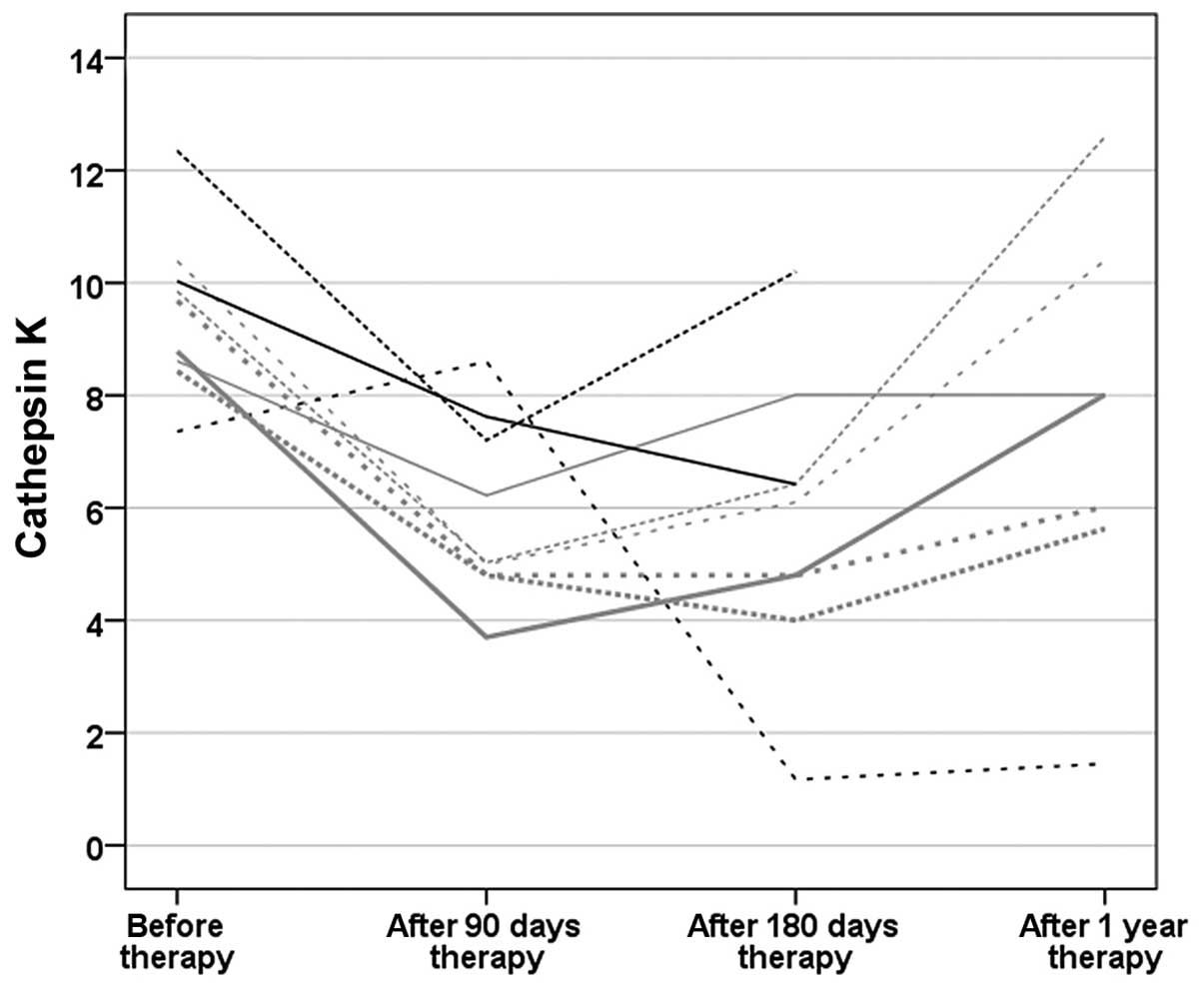
Overall, no significant changes in the lowest T-Score were observed 1 year after anti-osteoporotic treatment (P=0.523). A significant improvement was only observed in the lumbar spine (P=0.008). Serum CatK presented a significant change over the four visits (P=0.003). In particular, there was a significant decrease in the first 3 (P=0.023) and 6 months (P=0.012) after the start of therapy. One year after the initiation of treatment, the CatK levels almost reached the base level (P=0.469) (Fig. 1). Individual serum CatK levels at 3, 6 and 12 months after antiresorptive therapy are shown in Fig. 2. The strongest decrease in the majority of cases was observed after 3 months. In one case, the decrease set on 6 months after therapy was started, with low residual values. In the other females the CatK serum levels increased after 1 year following intravenous zoledronic acid.

Figure 1

Cathepsin K (pmol/l) levels in the course of one year for all females (n=9). Boxplot representation for whole group (○ circles representing outliers).

Figure 2

Individual courses of therapy and cathepsin K levels (pmol/l).

Discussion

The study by Holzer et al (16) monitored serum CatK concentrations of 18 patients for 14.25±11.57 months (range, 1–48 months) after the start of osteoporosis treatment (oral bisphosphonate plus a combination of calcium and vitamin D). Serum CatK concentrations clearly decreased (mean at initial examination, 7.10±3.8 pmol/l; after treatment, 5.9±3.4 pmol/l), but did not demonstrate significance (t=1.362, df=17, P=0.191). Meier et al (17) examined longitudinally 21 females with postmenopausal osteoporosis and 10 patients with Paget’s disease of bone. All the patients started on oral (alendronate or risedronate) or intravenous bisphosphonate (pamidronate or zoledronate) treatment and were followed prospectively over 6 months. In postmenopausal osteoporotic females, oral and intravenous bisphosphonate treatment resulted in a significant reduction in serum CatK levels (P=0.03) with the majority of the effect occurring after 1 month (mean % change, −33%). In patients with mild Paget’s disease, serum CatK levels decreased during bisphosphonate treatment. The study by Munoz-Torres et al (18) included 46 postmenopausal females with osteoporosis, which were treated with oral bisphosphonate (alendronat) plus calcium and vitamin D. The serum CatK levels gradually decreased after alendronate treatment (17, 22 and 41% at 3, 6 and 12 months, respectively; P<0.01). According to the current literature and the data of the present explorative analysis, serum CatK appears to be a putative marker for monitoring and controlling anti-osteoporotic treatment. The fast decrease of serum levels in the majority of the study subjects, already after 3 months, may provide early information on the response to treatment. Future studies are required to explore whether this information can be used for early allocation of patients to different treatments.

Acknowledgements

The present study was supported by the ‘LOM program’ of the Otto von Guericke University.

References

1 

No authors listed. Consensus Development Conference on Osteoporosis. Hong Kong, April 1–2, 1993. Am J Med. 95:S1–S78. 1993.PubMed/NCBI

2 

No authors listed. Assessment of fracture risk and its application to screening for postmenopausal osteoporosis. Report of a WHO Study Group. World Health Organ Tech Rep Ser. 843:1–129. 1994.PubMed/NCBI

3 

Delmas PD: Markers of bone turnover for monitoring treatment of osteoporosis with antiresorptive drugs. Osteoporos Int. 11(Suppl 6): S66–S76. 2000. View Article : Google Scholar : PubMed/NCBI

4 

Delmas PD, Eastell R, Garnero P, Seibel MJ and Stepan J; Committee of Scientific Advisors of the International Osteoporosis Foundation. The use of biochemical markers of bone turnover in osteoporosis. Committee of Scientific Advisors of the International Osteoporosis Foundation. Osteoporos Int. 11(Suppl 6): S2–S17. 2000. View Article : Google Scholar : PubMed/NCBI

5 

Delmas PD, Hardy P, Garnero P and Dain M: Monitoring individual response to hormone replacement therapy with bone markers. Bone. 26:553–560. 2000. View Article : Google Scholar : PubMed/NCBI

6 

Seibel MJ: Biochemical markers of bone remodeling. Endocrinol Metab Clin North Am. 32:83–113. 2003. View Article : Google Scholar : PubMed/NCBI

7 

Szulc P: The role of bone turnover markers in monitoring treatment in postmenopausal osteoporosis. Clin Biochem. 45:907–919. 2012. View Article : Google Scholar : PubMed/NCBI

8 

Hadji P, Klein S, Gothe H, Häussler B, Kless T, Schmidt T, Steinle T, Verheyen F and Linder R: The epidemiology of osteoporosis - Bone Evaluation Study (BEST): an analysis of routine health insurance data. Dtsch Arztebl Int. 110:52–57. 2013.PubMed/NCBI

9 

Troen BR: The role of cathepsin K in normal bone resorption. Drug News Perspect. 17:19–28. 2004. View Article : Google Scholar

10 

Inaoka T, Bilbe G, Ishibashi O, Tezuka K, Kumegawa M and Kokubo T: Molecular cloning of human cDNA for cathepsin K: novel cystein protease predominantly expressed in bone. Biochem Biophys Res Commun. 206:89–96. 1995. View Article : Google Scholar : PubMed/NCBI

11 

Gelb BD, Shi G, Chapman HA and Desnick RJ: Pycnodysostosis, a lysosomal disease caused by cathepsin K deficiency. Science. 273:1236–1238. 1996. View Article : Google Scholar : PubMed/NCBI

12 

Saftig P, Hunziker E, Wehmeyer O, Jones S, Boyde A, Rommerskirch W, Moritz JD, Schu P and von Figura K: Impaired osteoclastic bone resorption leads to osteopetrosis in cathepsin-K-deficient mice. Proc Natl Acad Sci USA. 95:13453–13458. 1988. View Article : Google Scholar : PubMed/NCBI

13 

Henriksen K, Tanko LB, Qvist P, Delmas PD, Christiansen C and Karsdal MA: Assessment of osteoclast number and function: application in the development of new and impoved treatment modalities for bone diseases. Osteoporos Int. 18:681–685. 2007. View Article : Google Scholar : PubMed/NCBI

14 

Dachverband Osteologie e.v. DVO-Leitlinie 2009 zur Prophylaxe, Diagnostik und Therapie der Osteoporose bei Erwachsenen. Osteologie. 18:304–328. 2009.

15 

Adolf D, Wex T, Jahn O, Riebau C, Halangk W, Klose S, Westphal S, Amthauer H, Winckler S and Piatek S: Serum cathepsin K levels are not suitable to differentiate women with chronic bone disorders such as osteopenia and osteoporosis from healthy pre- and postmenopausal women. Maturitas. 71:169–172. 2012. View Article : Google Scholar : PubMed/NCBI

16 

Holzer G, Noske H, Lang T, Holzer L and Willinger U: Soluble cathepsin K: a novel marker for the prediction of nontraumatic fractures? J Lab Clin Med. 146:13–17. 2005. View Article : Google Scholar : PubMed/NCBI

17 

Meier C, Meinhard U, Greenfield JR, De Winter J, Nguyen TV, Dunstan CR and Seibel MJ: Serum cathepsin K concentrations reflect osteoclastic activity in women with postmenopausal osteoporosis and patients with Paget’s disease. Clin Lab. 52:1–10. 2006.PubMed/NCBI

18 

Munoz-Torres M, Reyes-Garcia R, Mezquita-Raya P, Fernandes-Garcia D, Alonso G, de Luna JD, Ruiz-Requena ME and Escobar-Jimenez F: Serum cathepsin K as a marker of bone metabolism in postmenopausal women treated with alendronate. Maturitas. 64:188–192. 2009. View Article : Google Scholar : PubMed/NCBI

Related Articles

  • Abstract
  • View
  • Download
  • Twitter
Copy and paste a formatted citation
Spandidos Publications style
Jahn O, Wex T, Klose S, Kropf S, Adolf D and Piatek S: Cathepsin K in treatment monitoring following intravenous zoledronic acid. Biomed Rep 2: 915-917, 2014.
APA
Jahn, O., Wex, T., Klose, S., Kropf, S., Adolf, D., & Piatek, S. (2014). Cathepsin K in treatment monitoring following intravenous zoledronic acid. Biomedical Reports, 2, 915-917. https://doi.org/10.3892/br.2014.360
MLA
Jahn, O., Wex, T., Klose, S., Kropf, S., Adolf, D., Piatek, S."Cathepsin K in treatment monitoring following intravenous zoledronic acid". Biomedical Reports 2.6 (2014): 915-917.
Chicago
Jahn, O., Wex, T., Klose, S., Kropf, S., Adolf, D., Piatek, S."Cathepsin K in treatment monitoring following intravenous zoledronic acid". Biomedical Reports 2, no. 6 (2014): 915-917. https://doi.org/10.3892/br.2014.360
Copy and paste a formatted citation
x
Spandidos Publications style
Jahn O, Wex T, Klose S, Kropf S, Adolf D and Piatek S: Cathepsin K in treatment monitoring following intravenous zoledronic acid. Biomed Rep 2: 915-917, 2014.
APA
Jahn, O., Wex, T., Klose, S., Kropf, S., Adolf, D., & Piatek, S. (2014). Cathepsin K in treatment monitoring following intravenous zoledronic acid. Biomedical Reports, 2, 915-917. https://doi.org/10.3892/br.2014.360
MLA
Jahn, O., Wex, T., Klose, S., Kropf, S., Adolf, D., Piatek, S."Cathepsin K in treatment monitoring following intravenous zoledronic acid". Biomedical Reports 2.6 (2014): 915-917.
Chicago
Jahn, O., Wex, T., Klose, S., Kropf, S., Adolf, D., Piatek, S."Cathepsin K in treatment monitoring following intravenous zoledronic acid". Biomedical Reports 2, no. 6 (2014): 915-917. https://doi.org/10.3892/br.2014.360
Follow us
  • Twitter
  • LinkedIn
  • Facebook
About
  • Spandidos Publications
  • Careers
  • Cookie Policy
  • Privacy Policy
How can we help?
  • Help
  • Live Chat
  • Contact
  • Email to our Support Team