Introduction
Behçet's disease (BD) was first reported by Behçet
in 1937. BD is a multi-system inflammatory disease with unknown
cause, characterized by a triple-symptom complex of recurrent oral
aphthous ulcers, genital ulcers, and uveitis and skin lesions
(1). BD predominantly affects people
living around the Mediterranean basin and in Japan (2). The etiology and pathogenesis of BD is
complex, as it is a polygenic disease with multiple genetic factors
linked to the pathogenesis of the disease. A number of previous
studies have indicated that BD is associated with environmental
risk factors such as infectious agents, which are likely involved
in the susceptibility to the disease (3). The HLA-B51 allele polymorphism has been
associated with the pathogenesis of BD (4). Furthermore, major histocompatibility
complex (MHC) class I chain related A (MICA) is a functional gene
located between the HLA-B and tumor necrosis factor genes on the
short arm of human chromosome (5).
MICA is associated with autoimmune diseases, such as Ankylosing
spondylitis, and is predominantly expressed in epithelial cells,
keratinocytes, endothelial cells, and monocytes (6).
The MICA gene is composed of six exons, and the
polymorphism located in exon 5 has at least five alleles (A4, A5,
A5.1, A6 and A9) presenting 4, 5, 6 and 9 triplet repeats of
(GCT/AGC) in the transmembrane (TM) region (7). The incidence of Behçet's disease is known
to have a strong association with the presence of the MICA-A6
allele in Japanese patients (7).
Similar results demonstrating this association were reviewed by
Park et al (8). However,
another previous study has shown the connection between the MICA-A6
allele and the incidence of BD is unclear (9). The reasons for these contradictory
results may be caused by the sample size, which was relatively
small. In order to better understand the association between the
MICA-A6 gene and the incidence of BD, the present study aimed to
conduct a meta-analysis. This was achieved by combining all
published and unpublished work, using epidemic principles and
methods to evaluate the literature and to draw conclusions about
the association between the MICA-A6 gene and the incidence of
BD.
Materials and methods
Search strategies
The current systemic literature review was performed
by searching for literature and articles published before February
2015 in the PubMed, EMBASE and Web of Science databases. The most
relevant articles were identified using medical subject headings
and keywords, and search terms including MICA, polymorphism and
Behçet's disease. Additional related publications were identified
by a manual search of the bibliographies of the included studies to
ensure that all relevant studies and recent reviews were
included.
Inclusion and exclusion criteria
For inclusion in the present meta-analysis, the
studies had to meet the following inclusion criteria: i) Study
design (case-control or cohort studies; ii) subjects were diagnosed
with DB; iii) studies confirmed the association between MICA gene
polymorphism and the pathogenesis of Behçet's disease.
Exclusion criteria were as follows: i) Key
words/search term/reviews, and abstract scanning criteria; ii)
unrelated to each of BD and MICA gene; iii) research does not
involve human subjects; iv) and duplication articles, unable to
obtain complete full information or statistical data.
Two authors independently screened all titles and
abstracts, and then applied the inclusion and exclusion criteria to
the articles and evaluated their quality. Any disagreement between
the authors was resolved through discussion. This process
established an information extraction table, which includes the
first author's name, year of publication, the study population,
ethnicity, the age and gender of participants, the number of cases
and controls and the method for determination of genotype.
Statistical analysis
All analyses were conducted using STATA version 12.0
software (StataCorp, College Station, TX, USA). The statistical
significance of odds ratio (OR) with the corresponding 95%
confidence intervals (CIs) was determined by Z-test, and P<0.05
was considered to indicate a statistically significant difference.
Since potential causes of heterogeneity among studies include
genetic differences between races, stratification analyses were
conducted on ethnicity (Asian and Caucasian). The stability of the
summary risk estimate was assessed using a sensitivity analysis in
which each study was individually removed, and the OR was
recomputed. Funnel plot, Egger's test and Begg's test were used to
assess the publication bias. We estimated heterogeneity between
studies using Cochran's Q and the I2 statistic (10,11). We
selected fixed-effects model when I2 <50% and used
random-effects size while I2 ≥50%. The pooled OR was
calculated by fixed effects model across studies according to the
heterogeneity score.
Results
Characteristics of studies included in
the meta-analysis
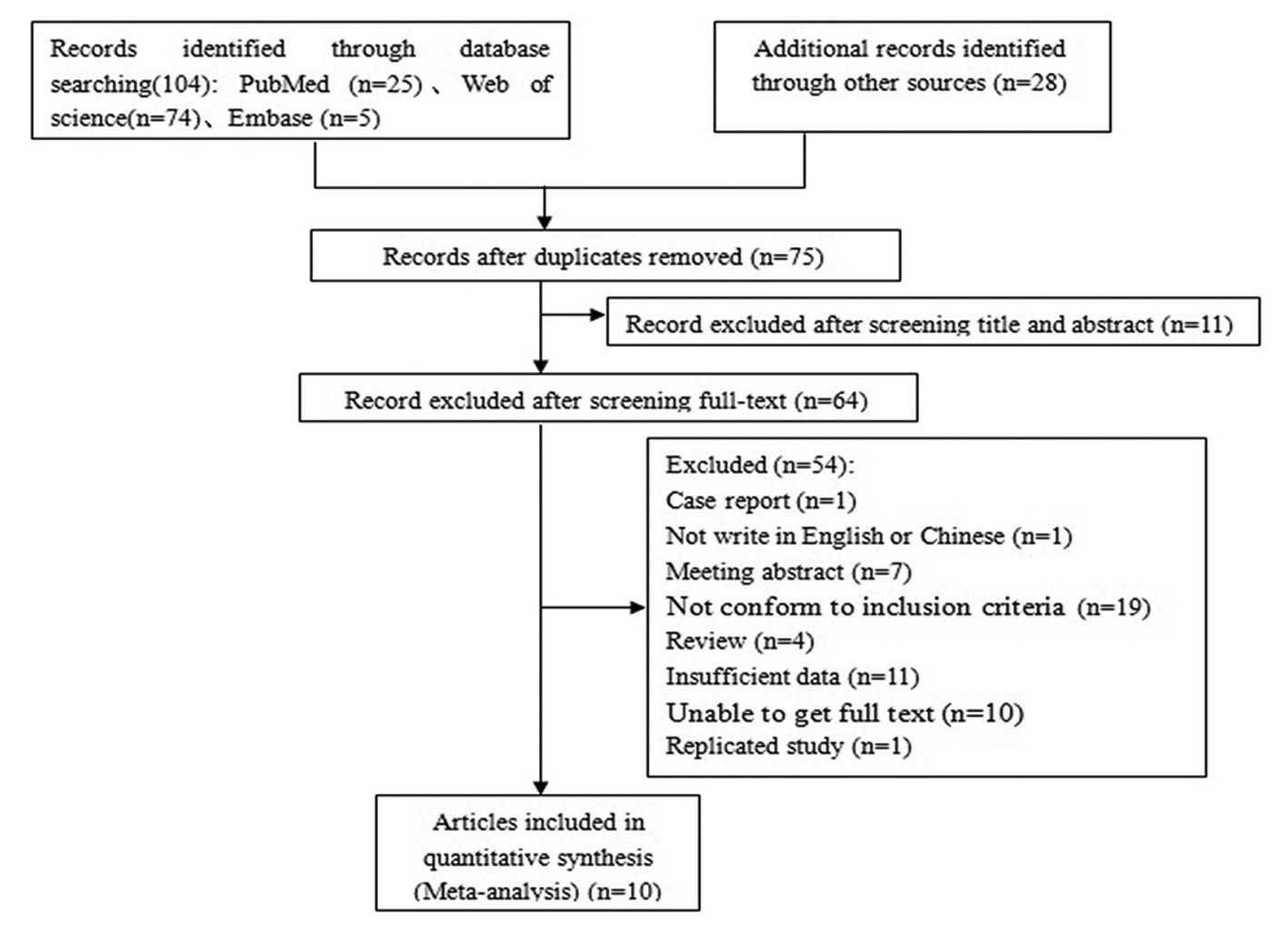
A total of 104 English-language articles were
filtered, and in the end, 12 case-control studies in 10 articles
were included in the meta-analysis (3,7–9,12–17). A flowchart of the study selection
process and its results is presented in Fig. 1. A total of 10 studies were included in
the article containing 752 cases and 1,175 controls. One of these
articles included studies from three countries (15). Seven of the twelve studies contained
patients of Asian ethnicity, and the remaining five consisted of
Caucasian subjects. Data on the MICA-A6 allele was integral to
these studies, and basic characteristics and quality evaluation are
presented in Table I.
 | Table I.Main characteristics of the studies
included in the meta-analysis. |
Table I.
Main characteristics of the studies
included in the meta-analysis.
|
|
|
|
| Gender (M/F) | MICA-TM A6 |
|
|
|---|
|
|
|
|
|
|
|
|
|
|---|
| Author, year | Country | Ethnicity | Case/Control | Case | Control | Case | Control | NOS | Refs. |
|---|
| Nishiyama et
al, 2006 | Japan | Asian | 23/23 | 18/5 | 16/7 | 13 | 11 | 8 | (9) |
| Mizuki et al,
2002a | Iran | Asian | 84/87 |
|
| 64 | 53 | 8 | (17) |
| Park et al,
2002 | Korea | Asian | 108/204 |
|
| 69 | 92 | 7 | (8) |
| Salvarani et
al, 2001 | Italy | Caucasian | 69/130 | 41/28 |
| 42 | 66 | 7 | (3) |
| Gonzalez et
al, 1999 | Spain | Caucasian | 58/194 |
|
| 41 | 119 | 6 | (12) |
| Yabuki et al,
1999 | Greece | Caucasian | 38/40 | 27/11 |
| 33 | 20 | 8 | (14) |
| Mizuki et al,
1997 | Japan | Asian | 77/103 |
|
| 57 | 47 | 8 | (7) |
| Muzuki et al,
2001 | Jordan | Asian | 49/50 | 35/14 |
| 43 | 31 | 7 | (16) |
| Muzuki et al,
2000 | Japan | Asian | 95/132 |
|
| 67 | 62 | 8 | (15) |
| Muzuki et al,
2000 | Greece | Caucasian | 55/52 |
|
| 44 | 30 | 8 | (15) |
| Muzuki et al,
2000 | Italy | Caucasian | 22/28 |
|
| 17 | 16 | 7 | (15) |
| Ota et al,
1999 | Japan | Asian | 74/132 |
|
| 56 | 62 | 7 | (13) |
Meta-analysis results
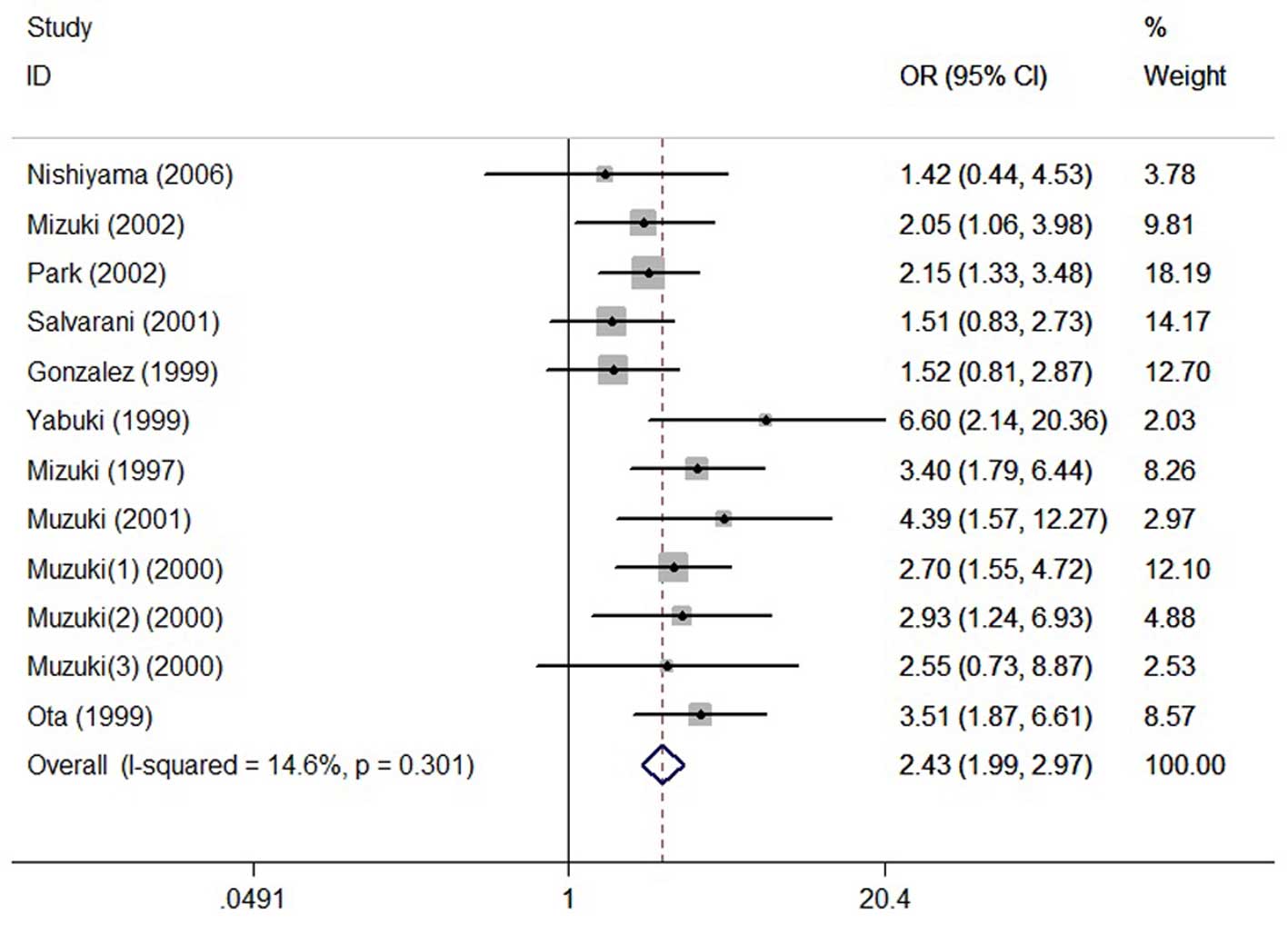
In total, 12 studies reporting the relationship
between MICA A6 and BD were included in the meta-analysis, with a
total of 546 cases with the A6 allele in the case group and 609
patients in the control group. Cases with the allele A6 are
observed as an exposure factor and those without A6 as an
non-exposure factor. The result shows that there is an obvious
difference between the case group and control group in the
distribution of alleles A6 (χ2=82.43, P<0.001). The
fixed-effects model shows the frequency of MICA-A6 gene in case
group was higher than that in the control group [OR=2.43
(1.99–2.97)] (Fig. 2).
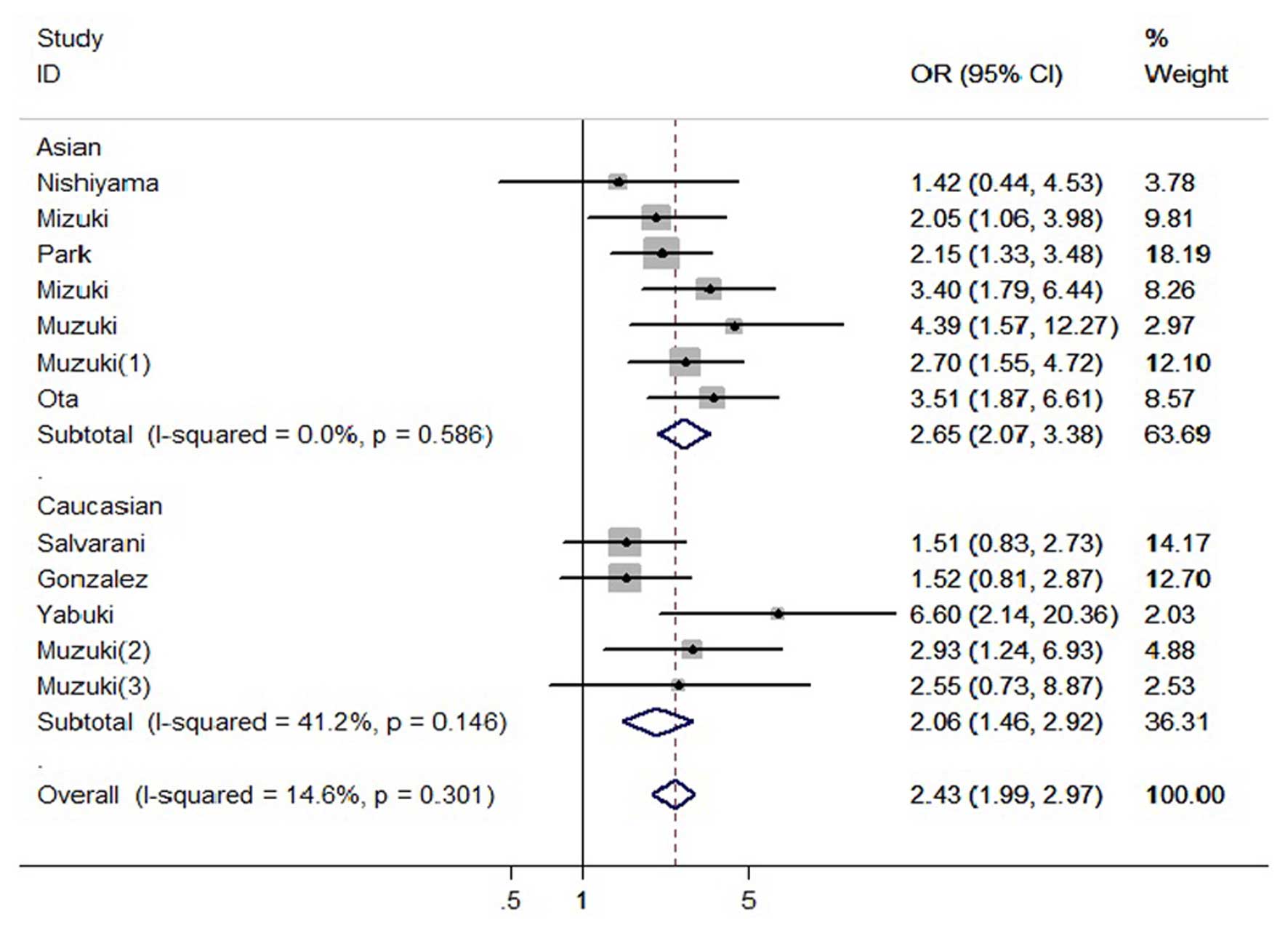
MICA-A6 gene subgroup analysis was stratified by
ethnicity. The seven studies among Asian populations included 510
cases and 731 controls. Subgroup analysis was used to calculate the
odds ratio of A6 allele carriers vs. non-carriers (OR=2.65, 95% CI:
2.07–3.38). European populations were obtained from a total of five
studies, including 242 cases, 444 controls. Subgroup analysis was
used to calculate the OR of A6 allele carriers vs. non-carriers
(OR=2.23, 95% CI: 1.37–3.62) (Fig.
3).
Sensitivity analysis and publication
bias
Using fixed effects and random effects models for a
data-merge, the merging of two models OR and 95%CI is comparable.
The results of meta-analysis indicated the best stabilities. The
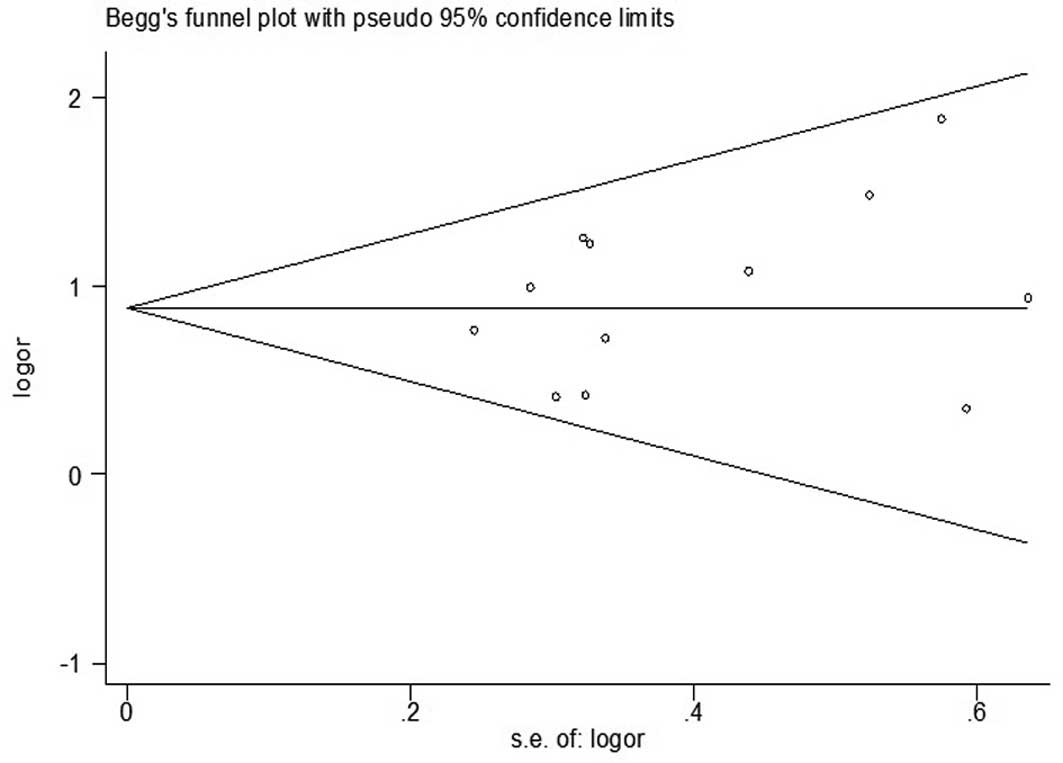
analysis included 12 studies, and quantitative detection of the
Egger's Funnel plot indicated no relevant publication bias. The Z
Begg test was <1.96, and P>0.05. The Egger's test results
demonstrated t=1.09 and P=0.303, consistent with the funnel chart
results, showing no significant publication bias (Fig. 4).
Discussion
BD is a multi-system inflammatory disease of unknown
cause. It is characterized by recurrent oral aphthous ulcers,
genital ulcers, uveitis, and skin lesions, and multiple genetic
factors in combination with undefined environmental risk factors
such as infectious agents, are important determinants of
susceptibility to the disease. Studies have shown that there is a
high correlation between HLA-B51 and Behcet's disease. The
frequency of HLA-B51 allele in BD patients was significant higher
than that of the control group (18).
The MICA gene is considered as a strong candidate gene in
controlling susceptibility to BD, based on its chromosomal
localization, its predicted immunologic function as a ligand of Vd1
gd T cells, its restricted and heat shock-induced expression in
epithelial cells, and a strong association of this particular
MICA-TM allele, MICA-A6, with BD (14). Mizuki et al (7) identified 6 microsatellite alleles repeat
units composed of GCT/AGC (MICA-A6) with a strong association to
BD. However Nishiyama et al (9)
did not identify an association between MIC-A6 and BD. The use of
different size and sample size, environmental factors and genetic
variation of races may explain these findings. The present study
used published case-control studies, and increased power to clarify
whether the MIC-A6 allele was associated with susceptibility to BD.
The present meta-analysis demonstrates a significant association
between the BD and the MICA-A6 allele, individual carriers of this
allele had a 2.43-fold higher risk of having BD than those
individuals not carrying the allele. Stratified analysis shows this
association remained significant in both the Caucasian and Asian
study populations. It has been reported previously that MICA-A6 may
tend to activate Vδ1γδT cells more effectively via
specific interaction with γδT cells, because of either the presence
of specific amino acids in the a1/a2 domains linked to MICA-A6 or
that of a particular Vδ1γδT cells repertoire tcan
recognize the MICA molecule with MICA-A6 in an efficient way
(14,19). A sensitivity analysis of the present
study's results following the removal of the largest studies
displayed an association between the MICA-A6 allele and
susceptibility to BD, giving further credibility to the findings.
No significant publication bias was detected.
The present study used meta analysis to eliminate
deficiencies such as the small sample size or the regional
differences, however, some limitations still remain. For example
the the OR value came from the data without additional checking. If
we had access to the original information, more accurate results
may have been obtained. In addition, there is a significant linkage
disequilibrium between MICA-A6 alleles and HLA-B. In the present
study, the effect on the pathogenesis of BD was ignored. Moreover,
our research only searched several representative databases, and
only used English as the retrieval language, which may influence
our results.
In conclusion, the present meta-analysis
demonstrates an association between the MICA-A6 allele and genetic
predisposition to Behcet's disease, with individuals carrying this
allele having an increased risk of BD. Therefore, the MICA-A6
allele may serve as an early diagnostic marker for clinical
diagnosis. Future studies with larger sample size are required to
confirm the conclusions presented in the present study.
Acknowledgements
The current study was supported by the National
Natural Science Foundation of China (grant no. 81273143).
References
|
1
|
McGonagle D and McDermott MF: A proposed
classification of the immunological diseases. PLoS Med. 3:e2972006.
View Article : Google Scholar : PubMed/NCBI
|
|
2
|
Günaydin I, Ustündağ C, Kaner G, Pazarli
H, Yurdakul S, Hamuryudan V, Yazici Y and Yazici H: The prevalence
of Sjögren's syndrome in Behçet's syndrome. J Rheumatol.
21:1662–1664. 1994.PubMed/NCBI
|
|
3
|
Salvarani C, Boiardi L, Mantovani V,
Olivieri I, Ciancio G, Cantini F, Salvi F, Malatesta R, Molinotti
C, Govoni M, et al: Association of MICA alleles and HLA-B51 in
Italian patients with Behçet's disease. J Rheumatol. 28:1867–1870.
2001.PubMed/NCBI
|
|
4
|
de Menthon M, Lavalley MP, Maldini C,
Guillevin L and Mahr A: HLA-B51/B5 and the risk of Behçet's
disease: A systematic review and meta-analysis of case-control
genetic association studies. Arthritis Rheum. 61:1287–1296. 2009.
View Article : Google Scholar : PubMed/NCBI
|
|
5
|
Bahram S, Bresnahan M, Geraghty DE and
Spies T: A second lineage of mammalian major histocompatibility
complex class I genes. Proc Natl Acad Sci USA. 91:6259–6263. 1994.
View Article : Google Scholar : PubMed/NCBI
|
|
6
|
Zwirner NW, Fernández-Viña MA and Stastny
P: MICA, a new polymorphic HLA-related antigen, is expressed mainly
by keratinocytes, endothelial cells and monocytes. Immunogenetics.
47:139–148. 1998. View Article : Google Scholar : PubMed/NCBI
|
|
7
|
Mizuki N, Ota M, Kimura M, Ohno S, Ando H,
Katsuyama Y, Yamazaki M, Watanabe K, Goto K, Nakamura S, et al:
Triplet repeat polymorphism in the transmembrane region of the MICA
gene: A strong association of six GCT repetitions with Behçet
disease. Proc Natl Acad Sci USA. 94:1298–1303. 1997. View Article : Google Scholar : PubMed/NCBI
|
|
8
|
Park SH, Park KS, Seo YI, Min DJ, Kim WU,
Kim TG, Cho CS, Mok JW, Park KS and Kim HY: Association of MICA
polymorphism with HLA-B51 and disease severity in Korean patients
with Behcet's disease. J Korean Med Sci. 17:366–370. 2002.
View Article : Google Scholar : PubMed/NCBI
|
|
9
|
Nishiyama M, Takahashi M, Manaka K, Suzuki
S, Saito M and Nakae K: Microsatellite polymorphisms of the MICA
gene among Japanese patients with Behçet's disease. Can J
Ophthalmol. 41:210–215. 2006. View
Article : Google Scholar : PubMed/NCBI
|
|
10
|
Jackson D, White IR and Riley RD:
Quantifying the impact of between-study heterogeneity in
multivariate meta-analyses. Stat Med. 31:3805–3820. 2012.
View Article : Google Scholar : PubMed/NCBI
|
|
11
|
Higgins JP, Thompson SG, Deeks JJ and
Altman DG: Measuring inconsistency in meta-analyses. BMJ.
327:557–560. 2003. View Article : Google Scholar : PubMed/NCBI
|
|
12
|
González-Escribano MF, Rodríguez MR,
Aguilar F, Alvarez A, Sanchez-Roman J and Núñez-Roldán A: Lack of
association of MICA transmembrane region polymorphism and Behçet's
disease in Spain. Tissue Antigens. 54:278–281. 1999. View Article : Google Scholar : PubMed/NCBI
|
|
13
|
Ota M, Mizuki N, Katsuyama Y, Tamiya G,
Shiina T, Oka A, Ando H, Kimura M, Goto K, Ohno S and Inoko H: The
critical region for Behçet disease in the human major
histocompatibility complex is reduced to a 46-kb segment
centromeric of HLA-B, by association analysis using refined
microsatellite mapping. Am J Hum Genet. 64:1406–1410. 1999.
View Article : Google Scholar : PubMed/NCBI
|
|
14
|
Yabuki K, Mizuki N, Ota M, Katsuyama Y,
Palimeris G, Stavropoulos C, Koumantaki Y, Spyropoulou M, Giziaki
E, Kaklamani V, et al: Association of MICA gene and HLA-B*5101 with
Behçet's disease in Greece. Invest Ophthalmol Vis Sci.
40:1921–1926. 1999.PubMed/NCBI
|
|
15
|
Mizuki N, Ota M, Yabuki K, Katsuyama Y,
Ando H, Palimeris GD, Kaklamani E, Accorinti M, Pivetti-Pezzi P,
Ohno S and Inoko H: Localization of the pathogenic gene of Behçet's
disease by microsatellite analysis of three different populations.
Invest Ophthalmol Vis Sci. 41:3702–3708. 2000.PubMed/NCBI
|
|
16
|
Mizuki N, Yabuki K, Ota M, Verity D,
Katsuyama Y, Ando H, Onari K, Goto K, Imagawa Y, Mandanat W, et al:
Microsatellite mapping of a susceptible locus within the HLA region
for Behçet's disease using Jordanian patients. Hum Immunol.
62:186–190. 2001. View Article : Google Scholar : PubMed/NCBI
|
|
17
|
Mizuki N, Yabuki K, Ota M, Katsuyama Y,
Ando H, Nomura E, Funakoshi K, Davatchi F, Chams H, Nikbin B, et
al: Analysis of microsatellite polymorphism around the HLA-B locus
in Iranian patients with Behçet's disease. Tissue Antigens.
60:396–399. 2002. View Article : Google Scholar : PubMed/NCBI
|
|
18
|
Mizuki N, Ohno S, Ando H, Chen L,
Palimeris GD, et al: A strong association between HLA-B*5101 and
Behçet's disease in Greek patients. Tissue Antigens. 50:57–60.
1997. View Article : Google Scholar : PubMed/NCBI
|
|
19
|
Yamashita N, Kaneoka H, Kaneko S, Takeno
M, Oneda K, Koizumi H, Kogure M, Inaba G and Sakane T: Role of
gammadelta T lymphocytes in the development of Behçet's disease.
Clin Exp Immunol. 107:241–247. 1997. View Article : Google Scholar : PubMed/NCBI
|