Spandidos Publications Logo
  • About
    • About Spandidos
    • Aims and Scopes
    • Abstracting and Indexing
    • Editorial Policies
    • Reprints and Permissions
    • Job Opportunities
    • Terms and Conditions
    • Contact
  • Journals
    • All Journals
    • Oncology Letters
      • Oncology Letters
      • Information for Authors
      • Editorial Policies
      • Editorial Board
      • Aims and Scope
      • Abstracting and Indexing
      • Bibliographic Information
      • Archive
    • International Journal of Oncology
      • International Journal of Oncology
      • Information for Authors
      • Editorial Policies
      • Editorial Board
      • Aims and Scope
      • Abstracting and Indexing
      • Bibliographic Information
      • Archive
    • Molecular and Clinical Oncology
      • Molecular and Clinical Oncology
      • Information for Authors
      • Editorial Policies
      • Editorial Board
      • Aims and Scope
      • Abstracting and Indexing
      • Bibliographic Information
      • Archive
    • Experimental and Therapeutic Medicine
      • Experimental and Therapeutic Medicine
      • Information for Authors
      • Editorial Policies
      • Editorial Board
      • Aims and Scope
      • Abstracting and Indexing
      • Bibliographic Information
      • Archive
    • International Journal of Molecular Medicine
      • International Journal of Molecular Medicine
      • Information for Authors
      • Editorial Policies
      • Editorial Board
      • Aims and Scope
      • Abstracting and Indexing
      • Bibliographic Information
      • Archive
    • Biomedical Reports
      • Biomedical Reports
      • Information for Authors
      • Editorial Policies
      • Editorial Board
      • Aims and Scope
      • Abstracting and Indexing
      • Bibliographic Information
      • Archive
    • Oncology Reports
      • Oncology Reports
      • Information for Authors
      • Editorial Policies
      • Editorial Board
      • Aims and Scope
      • Abstracting and Indexing
      • Bibliographic Information
      • Archive
    • Molecular Medicine Reports
      • Molecular Medicine Reports
      • Information for Authors
      • Editorial Policies
      • Editorial Board
      • Aims and Scope
      • Abstracting and Indexing
      • Bibliographic Information
      • Archive
    • World Academy of Sciences Journal
      • World Academy of Sciences Journal
      • Information for Authors
      • Editorial Policies
      • Editorial Board
      • Aims and Scope
      • Abstracting and Indexing
      • Bibliographic Information
      • Archive
    • International Journal of Functional Nutrition
      • International Journal of Functional Nutrition
      • Information for Authors
      • Editorial Policies
      • Editorial Board
      • Aims and Scope
      • Abstracting and Indexing
      • Bibliographic Information
      • Archive
    • International Journal of Epigenetics
      • International Journal of Epigenetics
      • Information for Authors
      • Editorial Policies
      • Editorial Board
      • Aims and Scope
      • Abstracting and Indexing
      • Bibliographic Information
      • Archive
    • Medicine International
      • Medicine International
      • Information for Authors
      • Editorial Policies
      • Editorial Board
      • Aims and Scope
      • Abstracting and Indexing
      • Bibliographic Information
      • Archive
  • Articles
  • Information
    • Information for Authors
    • Information for Reviewers
    • Information for Librarians
    • Information for Advertisers
    • Conferences
  • Language Editing
Spandidos Publications Logo
  • About
    • About Spandidos
    • Aims and Scopes
    • Abstracting and Indexing
    • Editorial Policies
    • Reprints and Permissions
    • Job Opportunities
    • Terms and Conditions
    • Contact
  • Journals
    • All Journals
    • Biomedical Reports
      • Information for Authors
      • Editorial Policies
      • Editorial Board
      • Aims and Scope
      • Abstracting and Indexing
      • Bibliographic Information
      • Archive
    • Experimental and Therapeutic Medicine
      • Information for Authors
      • Editorial Policies
      • Editorial Board
      • Aims and Scope
      • Abstracting and Indexing
      • Bibliographic Information
      • Archive
    • International Journal of Epigenetics
      • Information for Authors
      • Editorial Policies
      • Editorial Board
      • Aims and Scope
      • Abstracting and Indexing
      • Bibliographic Information
      • Archive
    • International Journal of Functional Nutrition
      • Information for Authors
      • Editorial Policies
      • Editorial Board
      • Aims and Scope
      • Abstracting and Indexing
      • Bibliographic Information
      • Archive
    • International Journal of Molecular Medicine
      • Information for Authors
      • Editorial Policies
      • Editorial Board
      • Aims and Scope
      • Abstracting and Indexing
      • Bibliographic Information
      • Archive
    • International Journal of Oncology
      • Information for Authors
      • Editorial Policies
      • Editorial Board
      • Aims and Scope
      • Abstracting and Indexing
      • Bibliographic Information
      • Archive
    • Medicine International
      • Information for Authors
      • Editorial Policies
      • Editorial Board
      • Aims and Scope
      • Abstracting and Indexing
      • Bibliographic Information
      • Archive
    • Molecular and Clinical Oncology
      • Information for Authors
      • Editorial Policies
      • Editorial Board
      • Aims and Scope
      • Abstracting and Indexing
      • Bibliographic Information
      • Archive
    • Molecular Medicine Reports
      • Information for Authors
      • Editorial Policies
      • Editorial Board
      • Aims and Scope
      • Abstracting and Indexing
      • Bibliographic Information
      • Archive
    • Oncology Letters
      • Information for Authors
      • Editorial Policies
      • Editorial Board
      • Aims and Scope
      • Abstracting and Indexing
      • Bibliographic Information
      • Archive
    • Oncology Reports
      • Information for Authors
      • Editorial Policies
      • Editorial Board
      • Aims and Scope
      • Abstracting and Indexing
      • Bibliographic Information
      • Archive
    • World Academy of Sciences Journal
      • Information for Authors
      • Editorial Policies
      • Editorial Board
      • Aims and Scope
      • Abstracting and Indexing
      • Bibliographic Information
      • Archive
  • Articles
  • Information
    • For Authors
    • For Reviewers
    • For Librarians
    • For Advertisers
    • Conferences
  • Language Editing
Login Register Submit
  • This site uses cookies
  • You can change your cookie settings at any time by following the instructions in our Cookie Policy. To find out more, you may read our Privacy Policy.

    I agree
Search articles by DOI, keyword, author or affiliation
Search
Advanced Search
presentation
Biomedical Reports
Join Editorial Board Propose a Special Issue
Print ISSN: 2049-9434 Online ISSN: 2049-9442
Journal Cover
August-2016 Volume 5 Issue 2

Full Size Image

Sign up for eToc alerts
Recommend to Library

Journals

International Journal of Molecular Medicine

International Journal of Molecular Medicine

International Journal of Molecular Medicine is an international journal devoted to molecular mechanisms of human disease.

International Journal of Oncology

International Journal of Oncology

International Journal of Oncology is an international journal devoted to oncology research and cancer treatment.

Molecular Medicine Reports

Molecular Medicine Reports

Covers molecular medicine topics such as pharmacology, pathology, genetics, neuroscience, infectious diseases, molecular cardiology, and molecular surgery.

Oncology Reports

Oncology Reports

Oncology Reports is an international journal devoted to fundamental and applied research in Oncology.

Experimental and Therapeutic Medicine

Experimental and Therapeutic Medicine

Experimental and Therapeutic Medicine is an international journal devoted to laboratory and clinical medicine.

Oncology Letters

Oncology Letters

Oncology Letters is an international journal devoted to Experimental and Clinical Oncology.

Biomedical Reports

Biomedical Reports

Explores a wide range of biological and medical fields, including pharmacology, genetics, microbiology, neuroscience, and molecular cardiology.

Molecular and Clinical Oncology

Molecular and Clinical Oncology

International journal addressing all aspects of oncology research, from tumorigenesis and oncogenes to chemotherapy and metastasis.

World Academy of Sciences Journal

World Academy of Sciences Journal

Multidisciplinary open-access journal spanning biochemistry, genetics, neuroscience, environmental health, and synthetic biology.

International Journal of Functional Nutrition

International Journal of Functional Nutrition

Open-access journal combining biochemistry, pharmacology, immunology, and genetics to advance health through functional nutrition.

International Journal of Epigenetics

International Journal of Epigenetics

Publishes open-access research on using epigenetics to advance understanding and treatment of human disease.

Medicine International

Medicine International

An International Open Access Journal Devoted to General Medicine.

Journal Cover
August-2016 Volume 5 Issue 2

Full Size Image

Sign up for eToc alerts
Recommend to Library

  • Article
  • Citations
    • Cite This Article
    • Download Citation
    • Create Citation Alert
    • Remove Citation Alert
    • Cited By
  • Similar Articles
    • Related Articles (in Spandidos Publications)
    • Similar Articles (Google Scholar)
    • Similar Articles (PubMed)
  • Download PDF
  • Download XML
  • View XML
Article

Novel homozygous PANK2 mutation identified in a consanguineous Chinese pedigree with pantothenate kinase-associated neurodegeneration

  • Authors:
    • Yan‑Fang Li
    • Hong‑Fu Li
    • Yan‑Bin Zhang
    • Ji‑Min Wu
  • View Affiliations / Copyright

    Affiliations: Department of Pediatrics, Second Affiliated Hospital, Zhejiang University School of Medicine, Hangzhou, Zhejiang 310009, P.R. China, Department of Neurology, Second Affiliated Hospital, Zhejiang University School of Medicine, Hangzhou, Zhejiang 310009, P.R. China, Department of Neurology and Institute of Neurology, First Affiliated Hospital, Fujian Medical University, Fuzhou, Fujian 350004, P.R. China
  • Pages: 217-220
    |
    Published online on: July 5, 2016
       https://doi.org/10.3892/br.2016.715
  • Expand metrics +
Metrics: Total Views: 0 (Spandidos Publications: | PMC Statistics: )
Metrics: Total PDF Downloads: 0 (Spandidos Publications: | PMC Statistics: )
Cited By (CrossRef): 0 citations Loading Articles...

This article is mentioned in:


Abstract

Pantothenate kinase‑associated neurodegeneration (PKAN) is a rare autosomal recessive neurodegenerative disorder resulting from pantothenate kinase 2 (PANK2) gene mutations. It is clinically characterized by early onset of extrapyramidal symptoms, with or without pigmentary retinopathy, optic atrophy and acanthocytosis. The specific radiographic appearance of PKAN is the eye‑of‑the‑tiger sign. However, there are few studies regarding PKAN patients of Chinese Han ancestry. In the present study, a Chinese 20‑year‑old female with an 8‑year history of unsteady walking and involuntary movements is described. Brain magnetic resonance imaging revealed eye‑of‑the‑tiger sign. Following sequencing of PANK2, a novel homozygous c.863C>T (p.P288L) mutation was identified in the patient and heterozygous c.863C>T was identified in her consanguineous parents. The absence of this mutation in the 1000 Genomes database, The Exome Aggregation Consortium, and 200 controls demonstrated that this mutation was probably pathogenic for PKAN in this family. In addition, the PANK2 c.863C>T mutation was predicted to be deleterious by SIFT, disease causing by Mutation Taster and probably damaging by PolyPhen2.

Introduction

Pantothenate kinase-associated neurodegeneration (PKAN), also termed Hallervorden-Spatz syndrome (HSS), is a rare autosomal recessive neurodegenerative disorder resulting from mutations of the pantothenate kinase 2 (PANK2) gene (1). It is the most common form of neurodegeneration with brain iron accumulation (NBIA) (2). Clinically, it is characterized by childhood onset of dystonia, dysarthria, rigidity, and choreoathetosis, with or without pigmentary retinopathy, optic atrophy, and acanthocytosis (3). Approximately one-third of the PKAN patients showed cognitive decline or dementia (3). In typical PKAN, symptoms present within the first decade of life and usually rapidly progress, culminating in early mortality. However, in atypical PKAN, the onset of extrapyramidal symptoms is later, and the progression is slower and more variable. The characteristic imaging pattern of PKAN is eye-of-the-tiger sign, which consists of bilateral hyper-intensity within surrounding hypo-intensity in the globus pallidus in T2-weighted images (4).

The prevalence of PKAN is low, particularly in the Chinese population. To the best of our knowledge, no >30 PKAN cases of Chinese ancestry have been documented so far (5–10). The current study describes a PKAN patient of a consanguineous Chinese pedigree who exhibited the novel homozygous PANK2 mutation.

Materials and methods

Subjects

The current study was approved by the ethics committee of the Second Affiliated Hospital, Zhejiang University School of Medicine (Hangzhou, China). A single PKAN patient from a consanguineous Chinese pedigree was recruited. Written informed consent was obtained from the participants prior to blood sample collection. In addition, 200 healthy individuals of Chinese ancestry were recruited as control subjects. The neurological examinations (including consciousness, recognition, gait, cranial nerve, motor, sensory, reflex, pathological signs and coordination) and clinical evaluations (including age at onset, symptoms and signs, disease course and treatment) were performed. Brain magnetic resonance imaging (MRI) was conducted in the PKAN patient. Blood samples (3 ml) were collected for laboratory inspection and gene sequencing.

Mutation analysis

After obtaining informed consent, genomic DNA was extracted from 3 ml peripheral blood using a QIAamp DNA Blood Minikit (Qiagen GmbH, Hilden, Germany). Mutational investigation of PANK2 gene was performed by polymerase chain reaction (PCR) amplification and direct DNA sequencing, according to a previous study (1). Briefly, forward and reverse primers were designed to amplify each of the seven exons of PANK2 and all exons of PANK2 and the respective intron-exon boundaries were amplified by PCR according to a previous study (1). The purified PCR products were sequenced using an ABI 3730 Automated DNA Sequencer (Thermo Fisher Scientific, Inc., Waltham, MA, USA). The sequencing results were aligned to the NCBI human reference DNA sequence of PANK2 (Ensembl gene ID: ENSG00000125779; http://asia.ensembl.org/index.html). Amino acid and nucleotide changes were identified and numbered corresponding to their position within PANK2 mRNA. SIFT (http://sift.jcvi.org), PolyPhen2 (http://genetics.bwh.harvard.edu/pph2/) and Mutation Taster (http://www.mutationtaster.org) were used to predict the pathogenicity of the identified mutation.

Results

Clinical features of the patient

The proband was a 20-year-old female who had an 8-year history of gait difficulties and involuntary movements. Her delivery and postnatal period was unremarkable. The patient had normal acquisition of developmental milestones until the age of 12 years when unstable walk and involuntary movements began to develop. Her upper limbs suffered moderate chorea and ballismus, which became accentuated by anxiety and diminished when she was calm. Clonazepam at dose of 0.5 mg was prescribed and the symptoms were significantly relieved. Two years later, difficulties with walking and the involuntary movements were aggravated and the patient began to exhibit dysarthria. The patient experienced did not completely alleviate the symptoms. Oral administration of benzhexol (2 mg, three times per day) was effective in the first two months. When the patient sought medical care in the Department of Neurology, Second Affiliated Hospital, Zhejiang University School of Medicine (Hangzhou, China) in December 2015, she presented dysarthria, involuntary movements and unsteady gait.

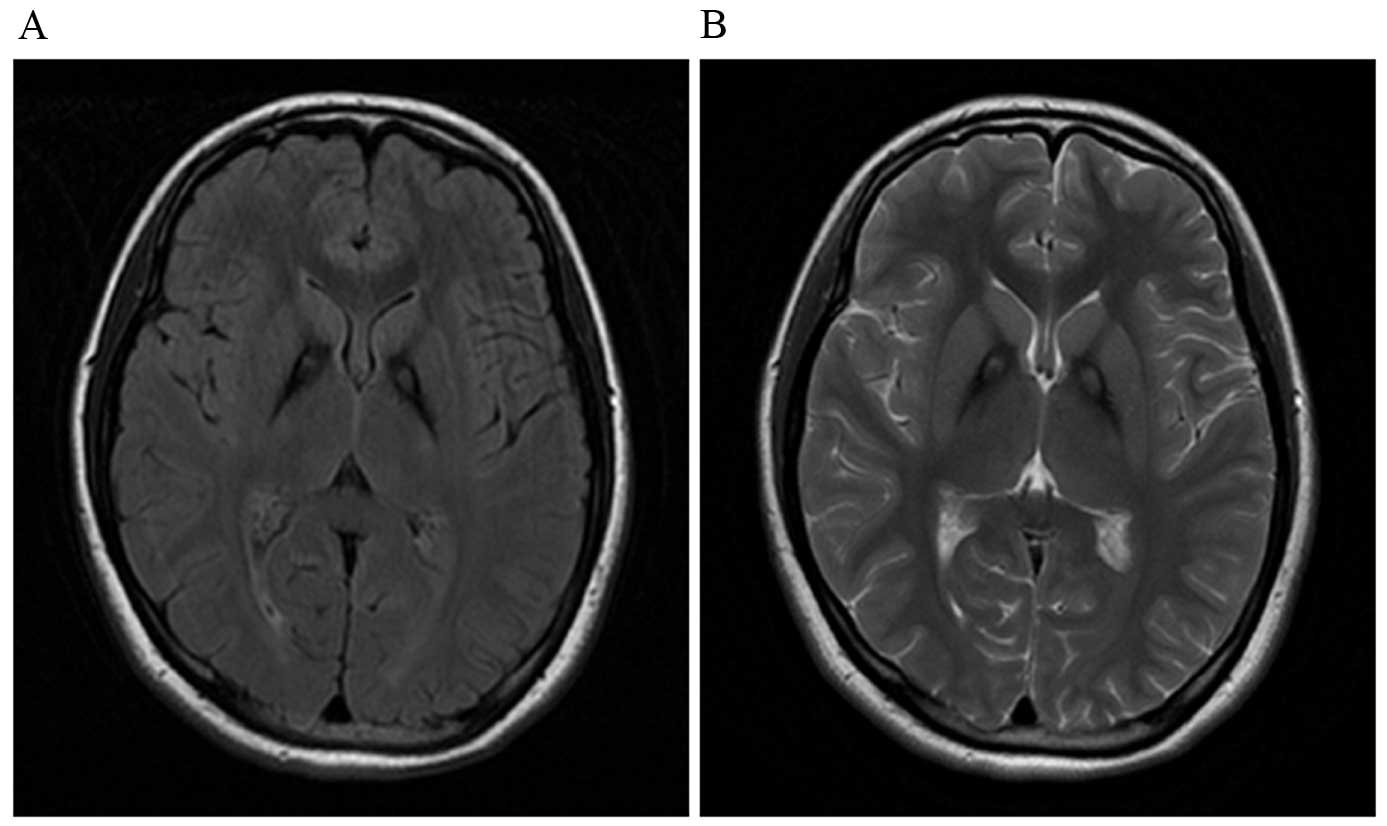
On cranial nerve examination, the extra-ocular movements of the patient were normal without nystagmus and visual field deficits. Choreiform movement was observed in the face. Pronunciation was slurred with mild palilalia, although her tongue and soft palate were at midline. The patient's muscle strength was normal, although muscle tension was decreased in the extremities and trunk. Chorea was obvious in the patient's upper limbs. No sensory abnormalities were observed and tendon reflexes were brisk, while the Babinski sign was bilaterally negative. Finger-nose and heel-knee-shin test results were normal. The patient's gait was unstable although the Romberg's test result was negative. The patient's recognition was not impaired, with a mini-mental state examination score of 29/30. Laboratory findings included normal serum ferritin, ceruloplasmin, albumin and lipoprotein levels. The blood smear was negative for acanthocytes. A brain MRI revealed iron accumulation in the bilateral globus pallidus and putamen (Fig. 1).

Figure 1.

Axial magnetic resonance imaging demonstrates bilateral hyperintense pallidal areas on background areas of T2 shortening, termed eye-of-the-tiger sign. (A) T2-fluid attenuated inversion recovery and (B) T2-weighted.

The patient's father and mother were consanguineous, healthy and did not exhibit gait difficulty or dysarthria.

Identification of the novel PANK2 mutation

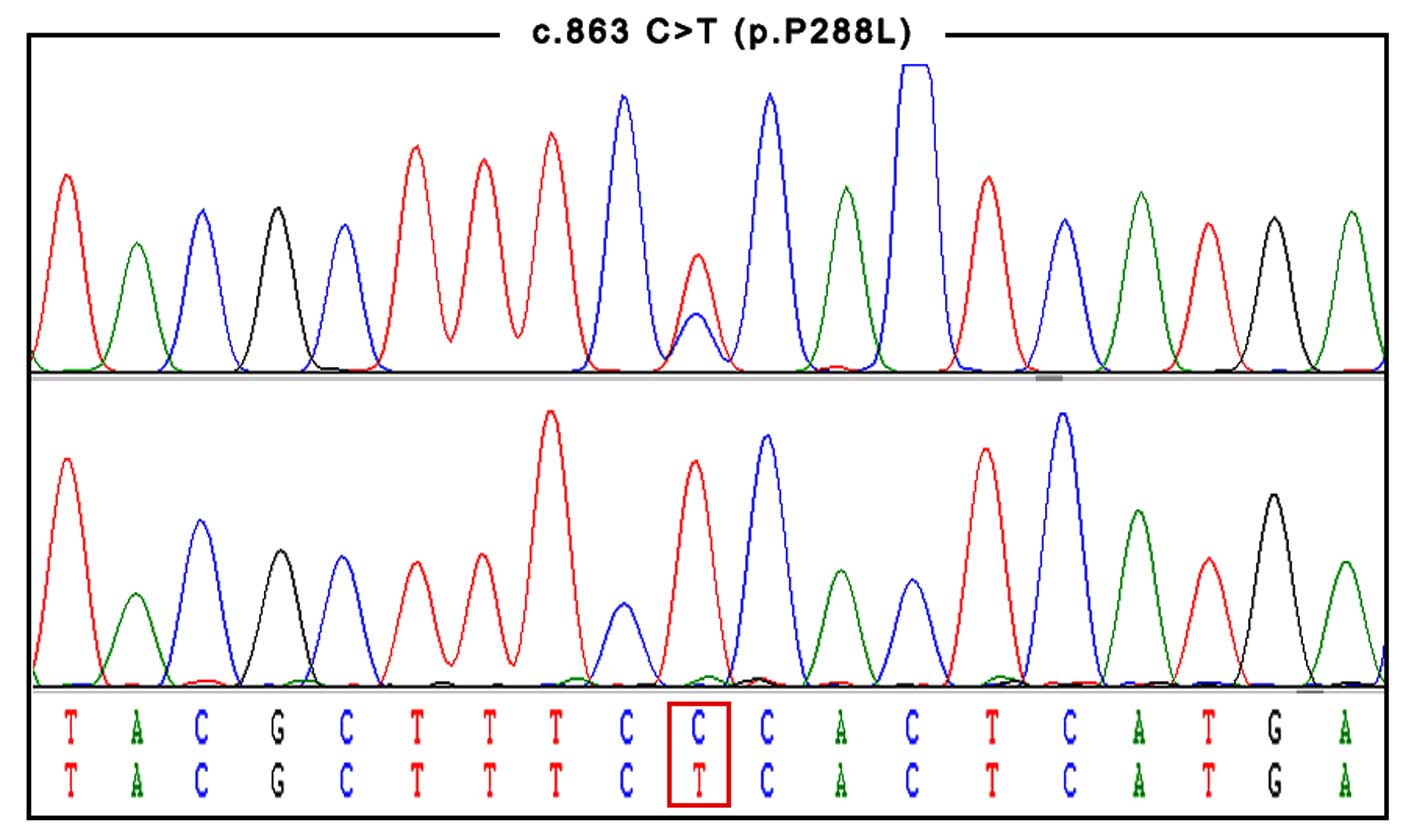
After sequencing of the PANK2 gene, a homozygous c.863C>T mutation was identified in the proband (Fig. 2). This mutation was located in exon 2 of PANK2, causing a proline to leucine substitution at position 288 (p.P288L) of the enzyme. Her consanguineous parents were heterozygous carriers of c.863C>T. The homozygous c.863C>T mutation was absent in the 1000 Genomes database (http://www.1000genomes.org/), The Exome Aggregation Consortium (ExAc; http://exac.broadinstitute.org/) and all 200 control individuals. The homozygous c.863C>T mutation of PANK2 was predicted to be deleterious by SIFT, disease causing by Mutation Taster and probably damaging by PolyPhen2.

Figure 2.

Chromatogram of the novel pantothenate kinase 2 c.863C>T mutation. Upper panel, the heterozygous sequence in the proband's consanguineous parents; lower panel, the homozygous mutation identified in the proband.

Discussion

PKAN is a neurodegenerative disorder associated with excessive iron deposition in the globus pallidus (11). It was first described by German neuropathologists Hallervorden and Spatz in 1922, therefore is also referred to as HSS (12); however, was subsequently renamed PKAN (13). In the present study, a Chinese 20-year-old female with an 8-year history of unsteady walking and involuntary movements is described. A brain MRI revealed typical eye-of-the-tiger sign. After sequencing the PANK2, a homozygous c.863C>T (p.P288L) mutation was identified in her genetic DNA. Further genetic investigations revealed a heterozygous c.863C>T mutation in her consanguineous parents. To the best of our knowledge, this mutation has not previously been reported; therefore it is considered to be a novel mutation. The absence of this mutation in the 1000 Genome database, ExAC, and 200 control individuals demonstrated that this mutation was potentially pathogenic for PKAN in this particular family. In addition, it was predicted to be deleterious by SIFT and Mutation Taster.

The patient described in the current study experienced early onset and presented with an unsteady walk, choreic movements, and dysarthria as primary symptoms. The cognitive impairment was not obvious, although the patient had experienced the disease for 8 years. These observations were consistent with two existing reports of Chinese PKAN patients (5,6). Notably, cognitive impairment was not prominent in Asian PKAN patients (2,14,15). By contrast, the prevalence of pyramidal signs, mental impairment, and Parkinsonism was higher in Caucasian patients (16). This discrepancy is potentially due to the ethnic differences.

To date, >100 mutations within PANK2 have been reported in PKAN cases worldwide (http://www.hgmd.org). The majority of PANK2 mutations are missense mutations, while duplication, deletion, splice-site mutation and exon deletion have also been reported (16). The majority of previously reported Chinese PKAN patients were detected to be carrying compound heterozygous mutations. In the present study, the patient carried a homozygous PANK2 mutation. Due to the Chinese single-child policy that commenced in 1980, this patient did not have any siblings. Therefore, co-segregation could not be conducted in this family. However, the early onset of extrapyramidal symptoms, characteristic eye-of-the-tiger sign in MRI, and identification of the homozygous PANK2 mutation revealed that this was a case of PKAN.

The mechanism by which mutations in the PANK2 gene lead to iron accumulation in the brain remains to be elucidated. PANK2 is an essential regulatory enzyme in coenzyme A biosynthesis (13). In addition, the protein encoded by PANK2 is crucial in the metabolism of pantothenate. A deficiency of PANK2 is reported to result in the accumulation of cysteine-containing substrates, which may undergo rapid auto-oxidation in the presence of iron, leading to free radical generation and cell damage (1). A limitation of the current study was that functional experiments were not performed to verify the pathogenicity of the identified mutation. Thus, further investigations are required.

Acknowledgements

The authors would like to thank the participants for their assistance and willingness to take part in the study. Funding for the present study was granted by the National Natural Science Foundation of China (grant no. 81500973) and Natural Science Foundation of Zhejiang Province (grant no. LY16H090006) to Hong-Fu Li.

References

1 

Zhou B, Westaway SK, Levinson B, Johnson MA, Gitschier J and Hayflick SJ: A novel pantothenate kinase gene (PANK2) is defective in Hallervorden-Spatz syndrome. Nat Genet. 28:345–349. 2001. View Article : Google Scholar : PubMed/NCBI

2 

Hogarth P: Neurodegeneration with brain iron accumulation: Diagnosis and management. J Mov Disord. 8:1–13. 2015. View Article : Google Scholar : PubMed/NCBI

3 

Tonekaboni SH and Mollamohammadi M: Neurodegeneration with brain iron accumulation: An overview. Iran J Child Neurol. 8:1–8. 2014.PubMed/NCBI

4 

Hayflick SJ, Westaway SK, Levinson B, Zhou B, Johnson MA, Ching KH and Gitschier J: Genetic, clinical, and radiographic delineation of Hallervorden-Spatz syndrome. N Engl J Med. 348:33–40. 2003. View Article : Google Scholar : PubMed/NCBI

5 

Song XW, Wang YL, Shi YW, Deng WY, Chen SQ, Lin H, Yi YH and Liao WP: Clinical manifestations and detection of pantothenate kinase 2 gene mutation in a patient with Hallervorden-Spatz syndrome. Zhonghua Yi Xue Za Zhi. 89:3320–3323. 2009.(In Chinese). PubMed/NCBI

6 

Zhang Y, Tang B, Guo J, Long Z, Xia K, Pan Q, Hu Z, Wu D, Tang J, Chen T and Yan X: Studies on PANK2 gene mutations in Chinese patients with Hallervorden-Spatz syndrome. Zhonghua Yi Xue Yi Chuan Xue Za Zhi. 22:189–191. 2005.(In Chinese). PubMed/NCBI

7 

Fung GP and Chan KY: Cervical myelopathy in an adolescent with Hallervorden-Spatz disease. Pediatr Neurol. 29:337–340. 2003. View Article : Google Scholar : PubMed/NCBI

8 

Wu YR, Chen CM, Chao CY, Lyu RK and Lee-Chen GJ: Pantothenate kinase-associated neurodegeneration in two Taiwanese siblings: Identification of a novel PANK2 gene mutation. Mov Disord. 24:940–941. 2009. View Article : Google Scholar : PubMed/NCBI

9 

Zhang YH, Tang BS, Zhao AL, Xia K, Long ZG, Guo JF, Westaway SK and Hayflick SJ: Novel compound heterozygous mutations in the PANK2 gene in a Chinese patient with atypical pantothenate kinase-associated neurodegeneration. Mov Disord. 20:819–821. 2005. View Article : Google Scholar : PubMed/NCBI

10 

Ma LY, Wang L, Yang YM, Lu Y, Cheng FB and Wan XH: Novel gene mutations and clinical features in patients with pantothenate kinase-associated neurodegeneration. Clin Genet. 87:93–95. 2015. View Article : Google Scholar : PubMed/NCBI

11 

Thomas M, Hayflick SJ and Jankovic J: Clinical heterogeneity of neurodegeneration with brain iron accumulation (Hallervorden-Spatz syndrome) and pantothenate kinase-associated neurodegeneration. Mov Disord. 19:36–42. 2004. View Article : Google Scholar : PubMed/NCBI

12 

Hallervorden J and Spatz H: Eigenartige Erkrankung im extrapyramidalen System mit besonderer Beteiligung des Globus pallidus und der Substantia nigra. Z Ges Neurol Psychiatr. 79:254–302. 1922. View Article : Google Scholar

13 

Popławska-Domaszewicz K, Florczak-Wyspiańska J and Kozubski W: Update on neurodegeneration with brain iron accumulation. Neurol Neurochir Pol. 48:206–213. 2014.PubMed/NCBI

14 

Hartig MB, Hörtnagel K, Garavaglia B, Zorzi G, Kmiec T, Klopstock T, Rostasy K, Svetel M, Kostic VS, Schuelke M, et al: Genotypic and phenotypic spectrum of PANK2 mutations in patients with neurodegeneration with brain iron accumulation. Ann Neurol. 59:248–256. 2006. View Article : Google Scholar : PubMed/NCBI

15 

Yamashita S, Maeda Y, Ohmori H, Uchida Y, Hirano T, Yonemura K, Uyama E and Uchino M: Pantothenate kinase-associated neurodegeneration initially presenting as postural tremor alone in a Japanese family with homozygous N245S substitutions in the pantothenate kinase gene. J Neurol Sci. 225:129–133. 2004. View Article : Google Scholar : PubMed/NCBI

16 

Lee CH, Lu CS, Chuang WL, Yeh TH, Jung SM, Huang CL and Lai SC: Phenotypes and genotypes of patients with pantothenate kinase-associated neurodegeneration in Asian and Caucasian populations: 2 cases and literature review. ScientificWorldJournal. 2013:8605392013. View Article : Google Scholar : PubMed/NCBI

Related Articles

  • Abstract
  • View
  • Download
  • Twitter
Copy and paste a formatted citation
Spandidos Publications style
Li YF, Li HF, Zhang YB and Wu JM: Novel homozygous PANK2 mutation identified in a consanguineous Chinese pedigree with pantothenate kinase-associated neurodegeneration. Biomed Rep 5: 217-220, 2016.
APA
Li, Y., Li, H., Zhang, Y., & Wu, J. (2016). Novel homozygous PANK2 mutation identified in a consanguineous Chinese pedigree with pantothenate kinase-associated neurodegeneration. Biomedical Reports, 5, 217-220. https://doi.org/10.3892/br.2016.715
MLA
Li, Y., Li, H., Zhang, Y., Wu, J."Novel homozygous PANK2 mutation identified in a consanguineous Chinese pedigree with pantothenate kinase-associated neurodegeneration". Biomedical Reports 5.2 (2016): 217-220.
Chicago
Li, Y., Li, H., Zhang, Y., Wu, J."Novel homozygous PANK2 mutation identified in a consanguineous Chinese pedigree with pantothenate kinase-associated neurodegeneration". Biomedical Reports 5, no. 2 (2016): 217-220. https://doi.org/10.3892/br.2016.715
Copy and paste a formatted citation
x
Spandidos Publications style
Li YF, Li HF, Zhang YB and Wu JM: Novel homozygous PANK2 mutation identified in a consanguineous Chinese pedigree with pantothenate kinase-associated neurodegeneration. Biomed Rep 5: 217-220, 2016.
APA
Li, Y., Li, H., Zhang, Y., & Wu, J. (2016). Novel homozygous PANK2 mutation identified in a consanguineous Chinese pedigree with pantothenate kinase-associated neurodegeneration. Biomedical Reports, 5, 217-220. https://doi.org/10.3892/br.2016.715
MLA
Li, Y., Li, H., Zhang, Y., Wu, J."Novel homozygous PANK2 mutation identified in a consanguineous Chinese pedigree with pantothenate kinase-associated neurodegeneration". Biomedical Reports 5.2 (2016): 217-220.
Chicago
Li, Y., Li, H., Zhang, Y., Wu, J."Novel homozygous PANK2 mutation identified in a consanguineous Chinese pedigree with pantothenate kinase-associated neurodegeneration". Biomedical Reports 5, no. 2 (2016): 217-220. https://doi.org/10.3892/br.2016.715
Follow us
  • Twitter
  • LinkedIn
  • Facebook
About
  • Spandidos Publications
  • Careers
  • Cookie Policy
  • Privacy Policy
How can we help?
  • Help
  • Live Chat
  • Contact
  • Email to our Support Team