Spandidos Publications Logo
  • About
    • About Spandidos
    • Aims and Scopes
    • Abstracting and Indexing
    • Editorial Policies
    • Reprints and Permissions
    • Job Opportunities
    • Terms and Conditions
    • Contact
  • Journals
    • All Journals
    • Oncology Letters
      • Oncology Letters
      • Information for Authors
      • Editorial Policies
      • Editorial Board
      • Aims and Scope
      • Abstracting and Indexing
      • Bibliographic Information
      • Archive
    • International Journal of Oncology
      • International Journal of Oncology
      • Information for Authors
      • Editorial Policies
      • Editorial Board
      • Aims and Scope
      • Abstracting and Indexing
      • Bibliographic Information
      • Archive
    • Molecular and Clinical Oncology
      • Molecular and Clinical Oncology
      • Information for Authors
      • Editorial Policies
      • Editorial Board
      • Aims and Scope
      • Abstracting and Indexing
      • Bibliographic Information
      • Archive
    • Experimental and Therapeutic Medicine
      • Experimental and Therapeutic Medicine
      • Information for Authors
      • Editorial Policies
      • Editorial Board
      • Aims and Scope
      • Abstracting and Indexing
      • Bibliographic Information
      • Archive
    • International Journal of Molecular Medicine
      • International Journal of Molecular Medicine
      • Information for Authors
      • Editorial Policies
      • Editorial Board
      • Aims and Scope
      • Abstracting and Indexing
      • Bibliographic Information
      • Archive
    • Biomedical Reports
      • Biomedical Reports
      • Information for Authors
      • Editorial Policies
      • Editorial Board
      • Aims and Scope
      • Abstracting and Indexing
      • Bibliographic Information
      • Archive
    • Oncology Reports
      • Oncology Reports
      • Information for Authors
      • Editorial Policies
      • Editorial Board
      • Aims and Scope
      • Abstracting and Indexing
      • Bibliographic Information
      • Archive
    • Molecular Medicine Reports
      • Molecular Medicine Reports
      • Information for Authors
      • Editorial Policies
      • Editorial Board
      • Aims and Scope
      • Abstracting and Indexing
      • Bibliographic Information
      • Archive
    • World Academy of Sciences Journal
      • World Academy of Sciences Journal
      • Information for Authors
      • Editorial Policies
      • Editorial Board
      • Aims and Scope
      • Abstracting and Indexing
      • Bibliographic Information
      • Archive
    • International Journal of Functional Nutrition
      • International Journal of Functional Nutrition
      • Information for Authors
      • Editorial Policies
      • Editorial Board
      • Aims and Scope
      • Abstracting and Indexing
      • Bibliographic Information
      • Archive
    • International Journal of Epigenetics
      • International Journal of Epigenetics
      • Information for Authors
      • Editorial Policies
      • Editorial Board
      • Aims and Scope
      • Abstracting and Indexing
      • Bibliographic Information
      • Archive
    • Medicine International
      • Medicine International
      • Information for Authors
      • Editorial Policies
      • Editorial Board
      • Aims and Scope
      • Abstracting and Indexing
      • Bibliographic Information
      • Archive
  • Articles
  • Information
    • Information for Authors
    • Information for Reviewers
    • Information for Librarians
    • Information for Advertisers
    • Conferences
  • Language Editing
Spandidos Publications Logo
  • About
    • About Spandidos
    • Aims and Scopes
    • Abstracting and Indexing
    • Editorial Policies
    • Reprints and Permissions
    • Job Opportunities
    • Terms and Conditions
    • Contact
  • Journals
    • All Journals
    • Biomedical Reports
      • Information for Authors
      • Editorial Policies
      • Editorial Board
      • Aims and Scope
      • Abstracting and Indexing
      • Bibliographic Information
      • Archive
    • Experimental and Therapeutic Medicine
      • Information for Authors
      • Editorial Policies
      • Editorial Board
      • Aims and Scope
      • Abstracting and Indexing
      • Bibliographic Information
      • Archive
    • International Journal of Epigenetics
      • Information for Authors
      • Editorial Policies
      • Editorial Board
      • Aims and Scope
      • Abstracting and Indexing
      • Bibliographic Information
      • Archive
    • International Journal of Functional Nutrition
      • Information for Authors
      • Editorial Policies
      • Editorial Board
      • Aims and Scope
      • Abstracting and Indexing
      • Bibliographic Information
      • Archive
    • International Journal of Molecular Medicine
      • Information for Authors
      • Editorial Policies
      • Editorial Board
      • Aims and Scope
      • Abstracting and Indexing
      • Bibliographic Information
      • Archive
    • International Journal of Oncology
      • Information for Authors
      • Editorial Policies
      • Editorial Board
      • Aims and Scope
      • Abstracting and Indexing
      • Bibliographic Information
      • Archive
    • Medicine International
      • Information for Authors
      • Editorial Policies
      • Editorial Board
      • Aims and Scope
      • Abstracting and Indexing
      • Bibliographic Information
      • Archive
    • Molecular and Clinical Oncology
      • Information for Authors
      • Editorial Policies
      • Editorial Board
      • Aims and Scope
      • Abstracting and Indexing
      • Bibliographic Information
      • Archive
    • Molecular Medicine Reports
      • Information for Authors
      • Editorial Policies
      • Editorial Board
      • Aims and Scope
      • Abstracting and Indexing
      • Bibliographic Information
      • Archive
    • Oncology Letters
      • Information for Authors
      • Editorial Policies
      • Editorial Board
      • Aims and Scope
      • Abstracting and Indexing
      • Bibliographic Information
      • Archive
    • Oncology Reports
      • Information for Authors
      • Editorial Policies
      • Editorial Board
      • Aims and Scope
      • Abstracting and Indexing
      • Bibliographic Information
      • Archive
    • World Academy of Sciences Journal
      • Information for Authors
      • Editorial Policies
      • Editorial Board
      • Aims and Scope
      • Abstracting and Indexing
      • Bibliographic Information
      • Archive
  • Articles
  • Information
    • For Authors
    • For Reviewers
    • For Librarians
    • For Advertisers
    • Conferences
  • Language Editing
Login Register Submit
  • This site uses cookies
  • You can change your cookie settings at any time by following the instructions in our Cookie Policy. To find out more, you may read our Privacy Policy.

    I agree
Search articles by DOI, keyword, author or affiliation
Search
Advanced Search
presentation
Biomedical Reports
Join Editorial Board Propose a Special Issue
Print ISSN: 2049-9434 Online ISSN: 2049-9442
Journal Cover
April-2022 Volume 16 Issue 4

Full Size Image

Sign up for eToc alerts
Recommend to Library

Journals

International Journal of Molecular Medicine

International Journal of Molecular Medicine

International Journal of Molecular Medicine is an international journal devoted to molecular mechanisms of human disease.

International Journal of Oncology

International Journal of Oncology

International Journal of Oncology is an international journal devoted to oncology research and cancer treatment.

Molecular Medicine Reports

Molecular Medicine Reports

Covers molecular medicine topics such as pharmacology, pathology, genetics, neuroscience, infectious diseases, molecular cardiology, and molecular surgery.

Oncology Reports

Oncology Reports

Oncology Reports is an international journal devoted to fundamental and applied research in Oncology.

Experimental and Therapeutic Medicine

Experimental and Therapeutic Medicine

Experimental and Therapeutic Medicine is an international journal devoted to laboratory and clinical medicine.

Oncology Letters

Oncology Letters

Oncology Letters is an international journal devoted to Experimental and Clinical Oncology.

Biomedical Reports

Biomedical Reports

Explores a wide range of biological and medical fields, including pharmacology, genetics, microbiology, neuroscience, and molecular cardiology.

Molecular and Clinical Oncology

Molecular and Clinical Oncology

International journal addressing all aspects of oncology research, from tumorigenesis and oncogenes to chemotherapy and metastasis.

World Academy of Sciences Journal

World Academy of Sciences Journal

Multidisciplinary open-access journal spanning biochemistry, genetics, neuroscience, environmental health, and synthetic biology.

International Journal of Functional Nutrition

International Journal of Functional Nutrition

Open-access journal combining biochemistry, pharmacology, immunology, and genetics to advance health through functional nutrition.

International Journal of Epigenetics

International Journal of Epigenetics

Publishes open-access research on using epigenetics to advance understanding and treatment of human disease.

Medicine International

Medicine International

An International Open Access Journal Devoted to General Medicine.

Journal Cover
April-2022 Volume 16 Issue 4

Full Size Image

Sign up for eToc alerts
Recommend to Library

  • Article
  • Citations
    • Cite This Article
    • Download Citation
    • Create Citation Alert
    • Remove Citation Alert
    • Cited By
  • Similar Articles
    • Related Articles (in Spandidos Publications)
    • Similar Articles (Google Scholar)
    • Similar Articles (PubMed)
  • Download PDF
  • Download XML
  • View XML
Case Report Open Access

Conjunctival epithelial hyperplasia in a patient with a nodular lesion in the palpebral conjunctiva: A case report

  • Authors:
    • Shigeru Kawabata
    • Yamato Yoshikawa
    • Yoshitaka Kurisu
    • Kensuke Tajiri
    • Teruyo Kida
    • Yoshinobu Hirose
  • View Affiliations / Copyright

    Affiliations: Department of Pathology, Faculty of Medicine, Osaka Medical and Pharmaceutical University, Takatsuki, Osaka 569‑8686, Japan, Department of Ophthalmology, Faculty of Medicine, Osaka Medical and Pharmaceutical University, Takatsuki, Osaka 569‑8686, Japan
    Copyright: © Kawabata et al. This is an open access article distributed under the terms of Creative Commons Attribution License.
  • Article Number: 24
    |
    Published online on: February 14, 2022
       https://doi.org/10.3892/br.2022.1507
  • Expand metrics +
Metrics: Total Views: 0 (Spandidos Publications: | PMC Statistics: )
Metrics: Total PDF Downloads: 0 (Spandidos Publications: | PMC Statistics: )
Cited By (CrossRef): 0 citations Loading Articles...

This article is mentioned in:


Abstract

The conjunctiva is a thin and delicate mucous membrane lining the inner eyelid and the anterior surface of the eyeball. Although hyperplastic changes can occur due to nonspecific chronic inflammation, ‘conjunctival epithelial hyperplasia’ has not been sufficiently established as a pathological entity. Additionally, the immunohistochemical (IHC) features of both the intact conjunctiva epithelium and conjunctival epithelial hyperplasia have not been sufficiently evaluated. The present report describes the case of an 86‑year‑old man who consulted with an ophthalmologist for a 6‑month‑old nodular lesion on his left eye. Located in the medial aspect of the left lower palpebral conjunctiva, the lesion was slightly erythematous and smooth. An excisional biopsy of the lesion was performed to obtain a pathological diagnosis. The hematoxylin and eosin sections revealed a thickened conjunctival epithelium composed of hyperplastic cuboidal epithelial cells and goblet cells, indicating conjunctival epithelial hyperplasia. Atypia, increased mitosis and a papillomatous architecture, indicative of neoplastic changes, were not observed. This resulted in conjunctival squamous intraepithelial neoplasia and squamous cell papilloma being ruled out. IHC analysis was performed to further characterize the lesion as well as the intact conjunctival epithelium. The thick conjunctival epithelium was composed of epithelial cells that stained positive for cytokeratin [AE1/AE3 (intensity: +), CK5/6 (intensity: ++), and CK7 (intensity: +)] and p63‑positive basal cells (intensity: +) whose presence in the conjunctiva has received insufficient recognition. Moreover, squamous metaplasia was found in a segment of the thick conjunctiva, which exhibited IHC features similar to those of hyperplasia. CK5/6 was positive, indicating endogenous squamous differentiation of the conjunctival epithelial hyperplasia. These findings led to the diagnosis of conjunctival epithelial hyperplasia as a pathological entity. Further collection and analysis of several cases of conjunctival epithelial hyperplasia may lead the development of preventative methods and drug treatments for this lesion, and additional prognostic data, such as the recurrence rate.

Introduction

The conjunctiva is a thin and delicate mucous membrane, lining the inner eyelid and the anterior surface of the eyeball. Histologically, the conjunctival epithelium is composed of two to five layers of columnar or cuboidal cells, mucin-secreting goblet cells and melanocytes (1). Since the ocular surface is exposed to numerous infectious and noninfectious agents or allergens, hyperplastic changes can occur due to nonspecific chronic inflammation of the conjunctiva (2). Ohashi et al (3) reported of two cases of conjunctival mucoepithelial hyperplasia amongst elderly patients. Specifically, nodular lesions found on the internal canthus were presented in both patients. Clinically, neoplasms were identified as differential diagnoses in both cases; however the nodular lesions were pathologically characterized by goblet cell hyperplasia and chronic inflammation of the stroma. For neoplasms as differential diagnoses, conjunctival squamous intraepithelial neoplasia (CSIN) and squamous cell papilloma of the conjunctiva were more probable diseases. CSIN shows dysplastic changes of the conjunctiva, located at the limbus within the interpalpebral area, and is the most common form of ocular surface neoplasia (4). Squamous cell papilloma of the conjunctiva is a benign neoplasm characterized by an outgrowth of epithelial and stromal elements of the conjunctiva; it is often associated with human papilloma virus (HPV), and is more frequently found in men and amongst patients aged 20-29 years (5). Although there are some case reports of hyperplastic lesions in the conjunctiva, as a pathological entity, conjunctival epithelial hyperplasia has not been sufficiently established. Additionally, the immunohistochemical (IHC) features of both the intact conjunctiva epithelium and conjunctival epithelial hyperplasia have not been sufficiently evaluated. In the present report, the case of a nodular lesion in the palpebral conjunctiva is described. The component cells in the conjunctival epithelium exhibited hyperplastic changes with minimal inflammation, and showed squamous metaplasia in a segment of thick conjunctiva. IHC analysis was performed to further characterize the immunophenotype of the lesion and rule out differential diagnoses, such as CSIN and squamous cell papilloma of the conjunctiva.

Case report

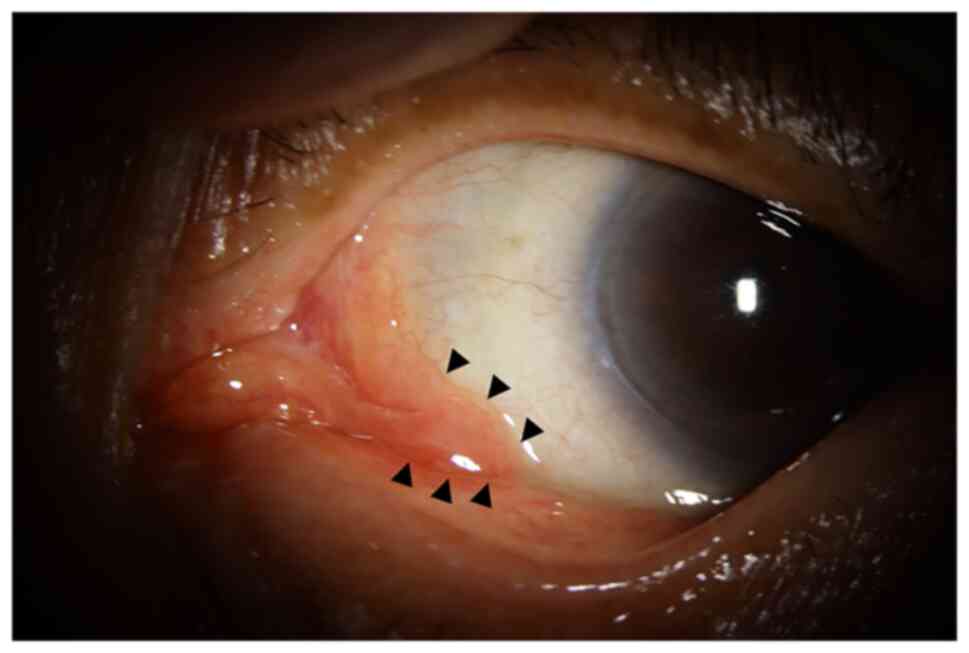
An 86-year-old man consulted with an ophthalmologist for a 6-month-old nodular lesion on his left eye. Although the nodular lesion had not grown during these 6 months, he started feeling uncomfortable due to an increase in discharge from the eye and blurring of vision. There were no other changes, such as failing vision or limited eye movement. His past medical history and family history were unremarkable. He had no allergies, did not smoke and did not drink alcohol. The visual acuities [normal >1.0(6)] of the right and left eye were 0.8 and 1.2, respectively, indicating a mild decline in the acuity of the right eye. Both intraocular pressures were 14 mmHg, which falls within the normal range [10-21 mmHg (7)]. Laboratory tests showed no abnormalities, except for C-reactive protein (CRP) level, which was 0.15 mg/dl [0.00-0.14 mg/dl (8)]. Located in the medial aspect of the left lower palpebral conjunctiva, the lesion was slightly erythematous and smooth (Fig. 1, black arrowhead). Although CRP level was slightly elevated, based on the nodularity of the lesion, hyperplasia rather than inflammation was a more probable differential diagnosis. An excisional biopsy of the lesion was performed to obtain a pathological diagnosis.

Figure 1

A nodular lesion in the medial aspect of the left lower palpebral conjunctiva (black arrowhead).

The tissue specimen was fixed in 10% neutral buffered formalin, and then embedded in paraffin wax for hematoxylin and eosin (H&E) staining. IHC analysis was performed using Vectastain Elite ABC kits from Vector Laboratories, Inc., according to the manufacturer's instructions for blocking, secondary antibody dilution and labeling. The following primary antibodies against cytokeratin (CK) markers were purchased: AE1/AE3 (clone AE1/AE3; Nichirei); CK5/6 (clone D5/16 B4), CK7 (clone OV-TL 12/30), and CK20 (Clone Ks20.8) all from Dako (Agilent Technologies, Inc.); and anti p63 (clone 4A4; Nichirei) antibody, a myoepithelial marker. The anti Ki-67 (clone MIB-1) antibody was used to evaluate cell proliferation using a Dako system (Agilent Technologies, Inc.). DAB (Sigma-Aldrich; Merck KGaA) was freshly prepared from tablets for chromogenic staining at 20˚C for 10 min.

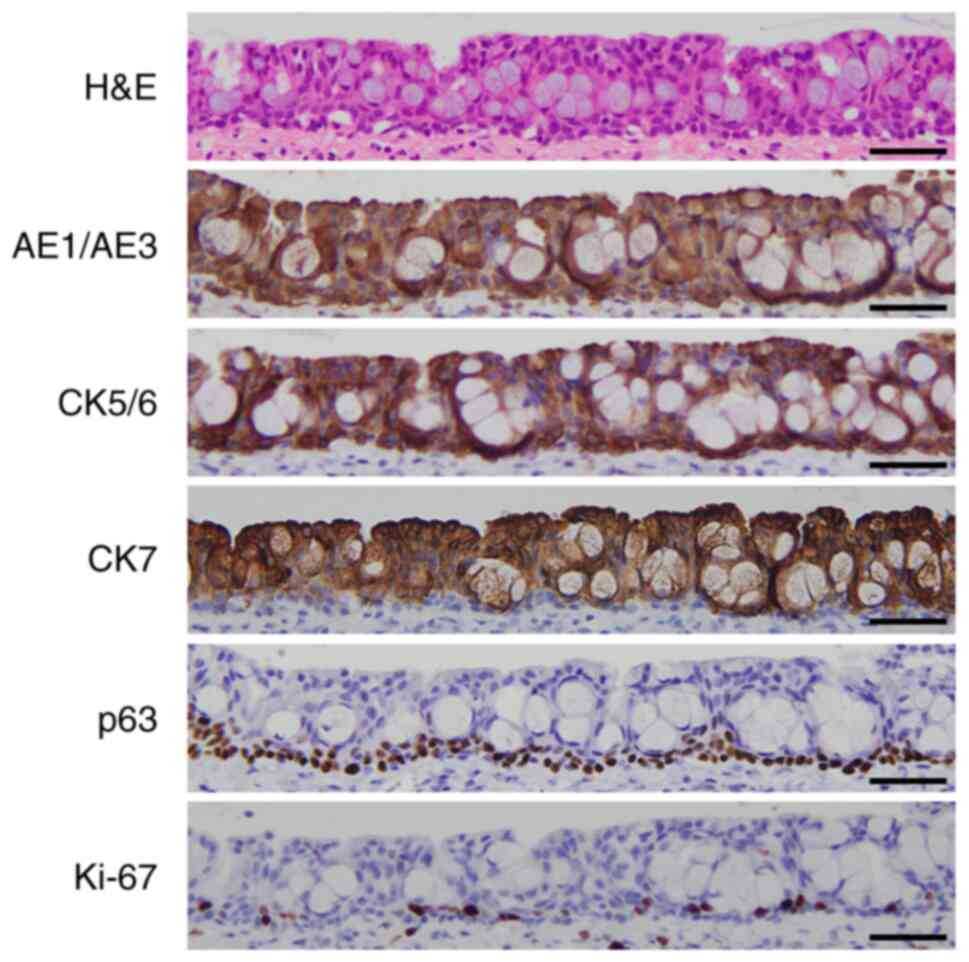
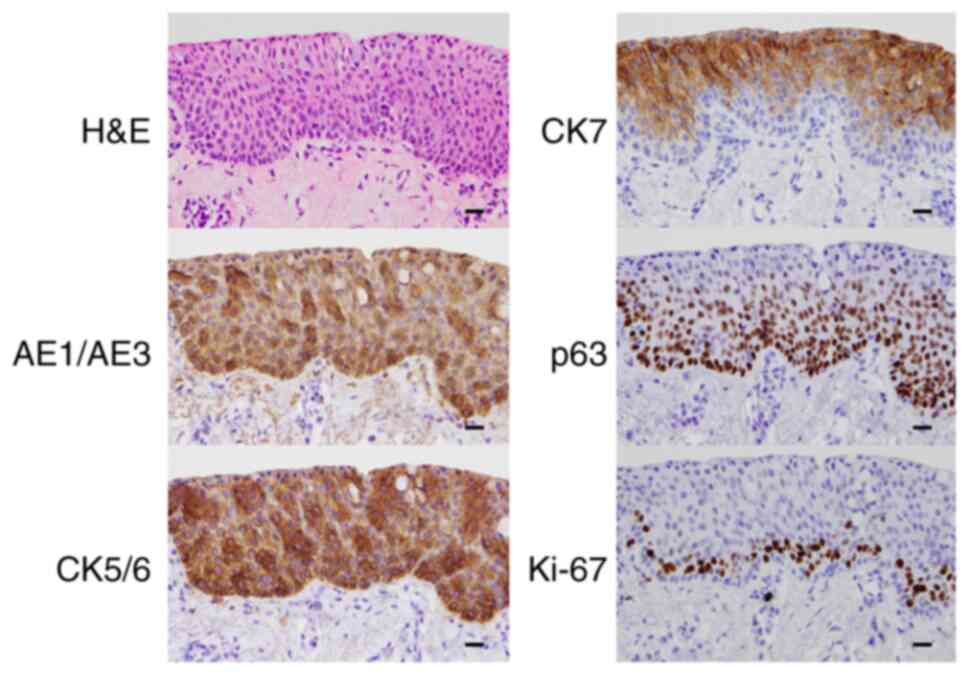
The H&E stained section of the intact part of the palpebral conjunctiva showed a stratified epithelium composed of two to seven layers of cuboidal cells with mucin-producing goblet cells (Fig. 2). AE1/AE3 (intensity: +), CK5/6 (intensity: +) and CK7 (intensity: +) stained positively in the epithelium (Fig. 2), whereas CK20 (intensity: -) was negative (data not shown). p63-positive cells were detected in the basal and parabasal layers (intensity: +). This indicated that the conjunctival epithelium had basal cells similar to that of the respiratory epithelium. Additionally, the proliferative zone of the epithelium was located in the basal and parabasal layers, as indicated by Ki-67-positive staining (Fig. 2).

Figure 2

Intact conjunctival epithelium. The stratified columnar epithelium was composed of two to seven layers of cuboidal cells with mucin-producing goblet cells in hematoxylin and eosin (H&E) section. The indicated markers were assessed by immunohistochemical analyses. Magnification, x200. Scale bar, 50 µm.

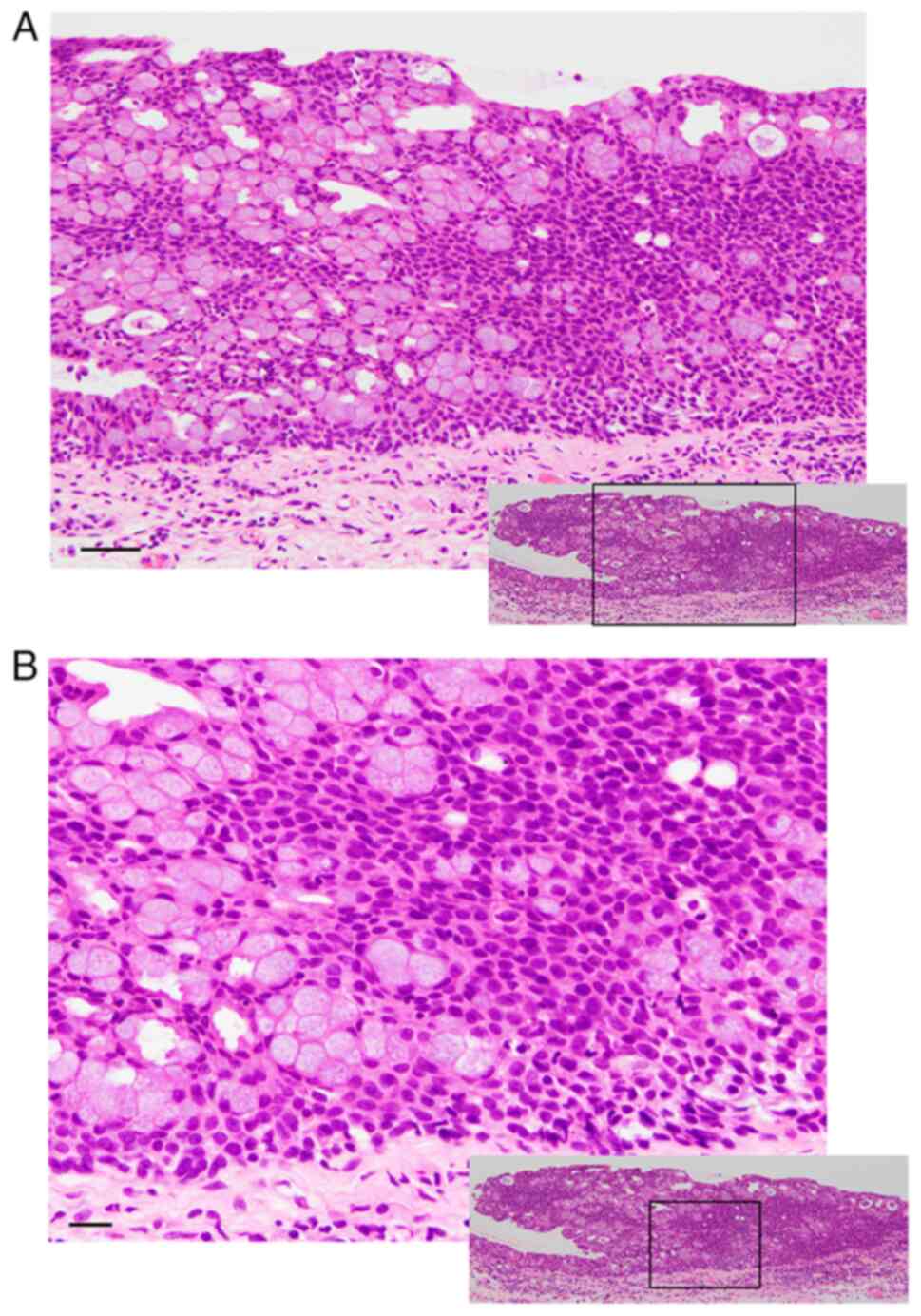
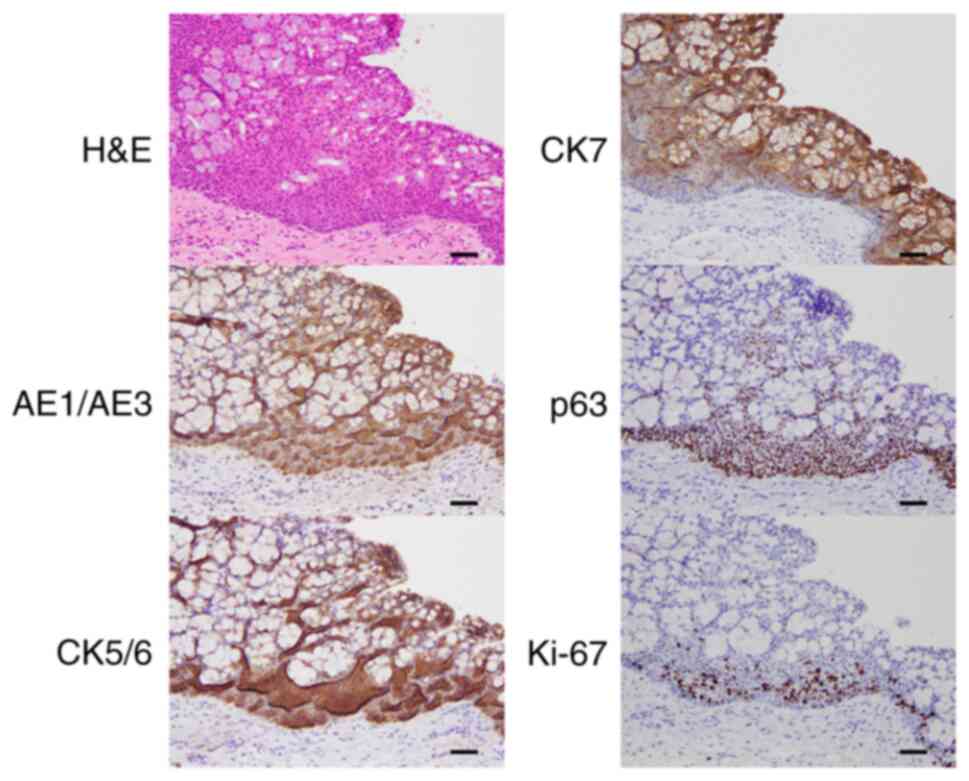
The H&E staining of the nodule revealed a thickened conjunctival epithelium, composed of increased cuboidal epithelial cells and goblet cells (Fig. 3A). Atypia and increased mitosis, indicative of neoplastic changes, were not observed on high-magnification microscopy (Fig. 3B). As shown in Fig. 4, the thick conjunctival epithelium consisted of epithelial cells that stained positive for CK [AE1/AE3 (intensity: +), CK5/6 (intensity: ++), and CK7 (intensity: +)] and p63-positive basal cells (intensity: +). There were no large sections of Ki-67-positive cells in the epithelium, so a tumorous lesion was unlikely. These findings suggested hyperplasia of the thick conjunctival epithelium. In Fig. 5, squamous metaplasia was detected in a segment of the thick conjunctiva, the IHC features of which were similar to those of hyperplasia (Fig. 4).

Figure 3

Conjunctival epithelial hyperplasia. Hematoxylin and eosin section revealed thickened conjunctival epithelium, composed of increased cuboidal epithelial cells and goblet cells: (A) x200 magnification; scale bar, 50 µm. (B) x400 magnification; scale bar, 20 µm. The larger figure shows a magnified version of the black lined insets.

Figure 4

Characterization of conjunctival epithelial hyperplasia. The indicated markers were assessed by immunohistochemical analyses. Magnification, x200. Scale bar, 50 µm. H&E, hematoxylin and eosin.

Figure 5

Characterization of the squamous metaplasia noted in a segment of the conjunctival epithelial hyperplasia. The indicated markers were assessed by immunohistochemical analyses. Magnification, x400. Scale bar, 20 µm. H&E, hematoxylin and eosin.

Discussion

Hyperplastic changes were detected in the cells comprising the nodular lesion of the conjunctival epithelium. IHC analysis was also performed. Ohashi et al (3) reported conjunctival mucoepithelial hyperplasia amongst the elderly. These cases were characterized by goblet cell hyperplasia with nonspecific chronic inflammation that mimicked neoplastic lesions. In the present case, hyperplasia was observed not only in the goblet cells but also in epithelial and basal cells of the nodule. These findings led to the diagnosis of conjunctival epithelial hyperplasia as a pathological entity, which is a diagnosis that has not been sufficiently established yet.

As they are amongst the differential diagnoses for the described lesion, CSIN and squamous cell papilloma of the conjunctiva had to be ruled out. CSIN represents the in situ precursor lesion of squamous cell carcinoma, which shows acanthosis with loss of goblet cells, atypical keratinocytes and suprabasilar mitotic figures. Immunophenotype of CSIN is AE1/AE3 positive, but shows low expression of CK7. Usually, expression of p53 and Ki-67 is increased and appear in suprabasilar cells (4). In this described lesion, loss of goblet cells, atypia, increased mitosis, decreased CK7 expression and a broad distribution of Ki-67-positive cells were absent. Additionally, expression of p53 was not increased, indicating wild-type pattern (data not shown). Based on this data, CSIN was excluded. Squamous cell papilloma of the conjunctiva is a benign lesion caused by HPV and is typically an exophytic growth with papillary proliferation of stratified squamous epithelium. Koilocytosis (nuclear pyknosis and cytoplasmic clearing) is a morphological hallmark of HPV infection (5). This lesion showed neither papillomatous architecture nor koilocytosis, and squamous cell papilloma was ruled out.

On immunohistochemistry, the epithelial cells in both the intact conjunctiva and conjunctival epithelial hyperplasia positively stained for AE1/AE3, CK5/6 and CK7, but not CK20. AE1/AE3 antibody is a CK cocktail, referred to as a ‘pancytokeratin’. It detects both high (CK1-6, 10, 14, 15 and 16) and low (CK7, 8, and 19) molecular weight keratins (9). CK5/6 (high molecular weight keratins) antibody detects stratified and transitional epithelium, proliferating squamous epithelium and mesothelial cells. The CK7 (low molecular weight keratin) antibody detects non-keratinizing epithelia, except for those of the intestine, ectocervix, prostate, and liver. CK20 is a low-molecular-weight keratin that identifies the gastrointestinal and urothelial epithelia (10-12). The IHC features of the intact conjunctiva and conjunctival epithelial hyperplasia are similar to those of respiratory epithelium in that both are CK7-positive and CK20-negative. CK5/6 was also positive in this case, indicating endogenous squamous differentiation of the intact conjunctiva and conjunctival epithelial hyperplasia.

Based on previous literature, the presence of basal cells in the conjunctiva has received insufficient recognition. The presence of p63, which is expressed in the basal epithelia of multiple organs (13), was evaluated in the intact conjunctiva. As shown in Fig. 2, the basal and parabasal layers positively stained for p63. Ramalho et al (14) assessed the relationship between p63 and p16 expression in primary and recurrent pterygia and showed p63 positivity in the basal layer of the normal conjunctiva. The results of the present case support the findings of Ramalho et al (14), indicating the presence of basal cells as well as respiratory epithelium (15).

In conclusion, the results of this investigation suggest that ‘conjunctival epithelial hyperplasia’ should be considered a pathological entity and indicate the presence of basal cells in the conjunctiva. Further collection and analysis of other cases of conjunctival epithelial hyperplasia can help elucidate its characteristics, including prognostic data such as the recurrence rate, and help in the development of prevention methods and therapeutic drugs for this lesion.

Acknowledgements

The authors would like to thank Research Scientist Yusuke Onishi (Department of Pathology, Faculty of Medicine, Osaka Medical and Pharmaceutical University, Osaka, Japan) for technical support with the IHC analyses.

Funding

Funding: No funding was received.

Availability of data and materials

The datasets used and/or analyzed during the present study are available from the corresponding author on reasonable request.

Authors' contributions

SK designed this study, collected and analyzed data, and wrote the manuscript; YY, KT and TK contributed to clinical data acquisition and interpretation; YK and YH evaluated the pathological findings and approved the final pathological diagnosis. All authors have read approved the final manuscript. SK and YK confirm the authenticity of all the raw data.

Ethics approval and consent to participate

Our institute does not require an approval for a case report based on Ethical Guidelines for Medical and Health Research Involving Human Subjects from the Japanese Ministry of Health, Labour and Welfare. The patient provided written informed consent.

Patient consent for publication

Not applicable.

Competing interests

The authors declare that they have no competing interests.

References

1 

Proia AD and Cummings TJ: In: Mills SE (ed). Histology for pathologists, 5th edition. Philadelphia, Wolters Kluwer, pp335-361, 2020.

2 

Eagle RC Jr: Conjunctiva. In: Eye Pathology: An Atlas and Text, 3rd edition. Philadelphia, Wolters Kluwer, pp90-133, 2016. Available from: https://www.proquest.com/legacydocview/EBC/5228949?accountid=38219.

3 

Ohashi A, Elsayed AA, Yasuma T, Iijima T and Nakamura S: Conjunctival mucoepithelial hyperplasia of the elderly. Int Ophthalmol. 35:611–614. 2015.PubMed/NCBI View Article : Google Scholar

4 

Reese A and Margo CE: Conjunctival squamous intraepithelial neoplasia and its differential diagnosis. J Clin Pathol, Feb 22, 2021 (Epub ahead of print).

5 

Kalogeropoulos C, Koumpoulis I, Papadiotis E, Zioga A, Gkrepi K, Pappa C, Paschides C, Malamou-Mitsi V and Aspiotis M: Squamous cell papilloma of the conjunctiva due to human papillomavirus (HPV): Presentation of two cases and review of literature. Clin Ophthalmol. 6:1553–1561. 2012.PubMed/NCBI View Article : Google Scholar

6 

Huang L, Kawasaki H, Yasuda R and Sakai R: Relationship between visual acuity and lifestyle: A cross-sectional study in Japanese children. Hiroshima J Med Sci. 67:105–111. 2018.

7 

Wang YX, Xu L, Wei WB and Jonas JB: Intraocular pressure and its normal range adjusted for ocular and systemic parameters. The Beijing eye study 2011. PLoS One. 13(e0196926)2018.PubMed/NCBI View Article : Google Scholar

8 

Ozaka S, Kodera T, Ariki S, Kobayashi T and Murakami K: Acute pancreatitis soon after COVID-19 vaccination: A case report. Medicine (Baltimore). 101(e28471)2022.PubMed/NCBI View Article : Google Scholar

9 

Badzio A, Czapiewski P, Gorczyński A, Szczepańska-Michalska K, Haybaeck J, Biernat W and Jassem J: Prognostic value of broad-spectrum keratin clones AE1/AE3 and CAM5.2 in small cell lung cancer patients undergoing pulmonary resection. Acta Biochim Pol. 66:111–114. 2019.PubMed/NCBI View Article : Google Scholar

10 

Moll R, Franke WW, Schiller DL, Geiger B and Krepler R: The catalog of human cytokeratins: Patterns of expression in normal epithelia, tumors and cultured cells. Cell. 31:11–24. 1982.PubMed/NCBI View Article : Google Scholar

11 

Bragulla HH and Homberger DG: Structure and functions of keratin proteins in simple, stratified, keratinized and cornified epithelia. J Anat. 214:516–559. 2009.PubMed/NCBI View Article : Google Scholar

12 

Karantza V: Keratins in health and cancer: More than mere epithelial cell markers. Oncogene. 30:127–138. 2011.PubMed/NCBI View Article : Google Scholar

13 

Dewar R, Fadare O, Gilmore H and Gown AM: Best practices in diagnostic immunohistochemistry: Myoepithelial markers in breast pathology. Arch Pathol Lab Med. 135:422–429. 2011.PubMed/NCBI View Article : Google Scholar

14 

Ramalho FS, Maestri C, Ramalho LNZ, Ribeiro-Silva A and Romão E: Expression of p63 and p16 in primary and recurrent pterygia. Graefe's Arch Clin Exp Ophthalmol. 244:1310–1314. 2006.PubMed/NCBI View Article : Google Scholar

15 

Steurer S, Riemann C, Büscheck F, Luebke AM, Kluth M, Hube-Magg C, Hinsch A, Höflmayer D, Weidemann S, Fraune C, et al: p63 expression in human tumors and normal tissues: A tissue microarray study on 10,200 tumors. Biomark Res. 9(7)2021.PubMed/NCBI View Article : Google Scholar

Related Articles

  • Abstract
  • View
  • Download
  • Twitter
Copy and paste a formatted citation
Spandidos Publications style
Kawabata S, Yoshikawa Y, Kurisu Y, Tajiri K, Kida T and Hirose Y: Conjunctival epithelial hyperplasia in a patient with a nodular lesion in the palpebral conjunctiva: A case report. Biomed Rep 16: 24, 2022.
APA
Kawabata, S., Yoshikawa, Y., Kurisu, Y., Tajiri, K., Kida, T., & Hirose, Y. (2022). Conjunctival epithelial hyperplasia in a patient with a nodular lesion in the palpebral conjunctiva: A case report. Biomedical Reports, 16, 24. https://doi.org/10.3892/br.2022.1507
MLA
Kawabata, S., Yoshikawa, Y., Kurisu, Y., Tajiri, K., Kida, T., Hirose, Y."Conjunctival epithelial hyperplasia in a patient with a nodular lesion in the palpebral conjunctiva: A case report". Biomedical Reports 16.4 (2022): 24.
Chicago
Kawabata, S., Yoshikawa, Y., Kurisu, Y., Tajiri, K., Kida, T., Hirose, Y."Conjunctival epithelial hyperplasia in a patient with a nodular lesion in the palpebral conjunctiva: A case report". Biomedical Reports 16, no. 4 (2022): 24. https://doi.org/10.3892/br.2022.1507
Copy and paste a formatted citation
x
Spandidos Publications style
Kawabata S, Yoshikawa Y, Kurisu Y, Tajiri K, Kida T and Hirose Y: Conjunctival epithelial hyperplasia in a patient with a nodular lesion in the palpebral conjunctiva: A case report. Biomed Rep 16: 24, 2022.
APA
Kawabata, S., Yoshikawa, Y., Kurisu, Y., Tajiri, K., Kida, T., & Hirose, Y. (2022). Conjunctival epithelial hyperplasia in a patient with a nodular lesion in the palpebral conjunctiva: A case report. Biomedical Reports, 16, 24. https://doi.org/10.3892/br.2022.1507
MLA
Kawabata, S., Yoshikawa, Y., Kurisu, Y., Tajiri, K., Kida, T., Hirose, Y."Conjunctival epithelial hyperplasia in a patient with a nodular lesion in the palpebral conjunctiva: A case report". Biomedical Reports 16.4 (2022): 24.
Chicago
Kawabata, S., Yoshikawa, Y., Kurisu, Y., Tajiri, K., Kida, T., Hirose, Y."Conjunctival epithelial hyperplasia in a patient with a nodular lesion in the palpebral conjunctiva: A case report". Biomedical Reports 16, no. 4 (2022): 24. https://doi.org/10.3892/br.2022.1507
Follow us
  • Twitter
  • LinkedIn
  • Facebook
About
  • Spandidos Publications
  • Careers
  • Cookie Policy
  • Privacy Policy
How can we help?
  • Help
  • Live Chat
  • Contact
  • Email to our Support Team