Introduction
Allergic diseases such as bronchial asthma and
atopic dermatitis develop as a result of the interaction of genetic
and environmental factors (1).
Several causative candidate genes for allergic diseases have been
reported (2–6). Recently, treatment guidelines for
bronchial asthma have been published and are utilized in clinical
practice. Although antiasthmatic drugs are often effective in many
patients with bronchial asthma, some patients may experience
adverse effects on non-target organs and may exhibit lack of
improvement due to the use of drugs inappropriate for their
individual condition.
Although studies have shown that the effects of
β2-adrenergic agonists (7), leukotriene receptor antagonists
(8,9), and inhaled corticosteroids (10) are closely associated with gene
polymorphisms, no reports have been made concerning the
relationships between the effects of Th2 cytokine inhibitors and
gene polymorphisms. In the present study, we investigated the
relationships between the effects of suplatast tosilate, a Th2
cytokine inhibitor, and specific genetic polymorphisms and
cytokines that are significantly associated with the
presence/absence of effects of this drug.
Subjects and methods
A total of 20 children aged 3 to 17 years (14 boys
and 6 girls) were enrolled in the study. After obtaining informed
consent for participation in the study from the children or their
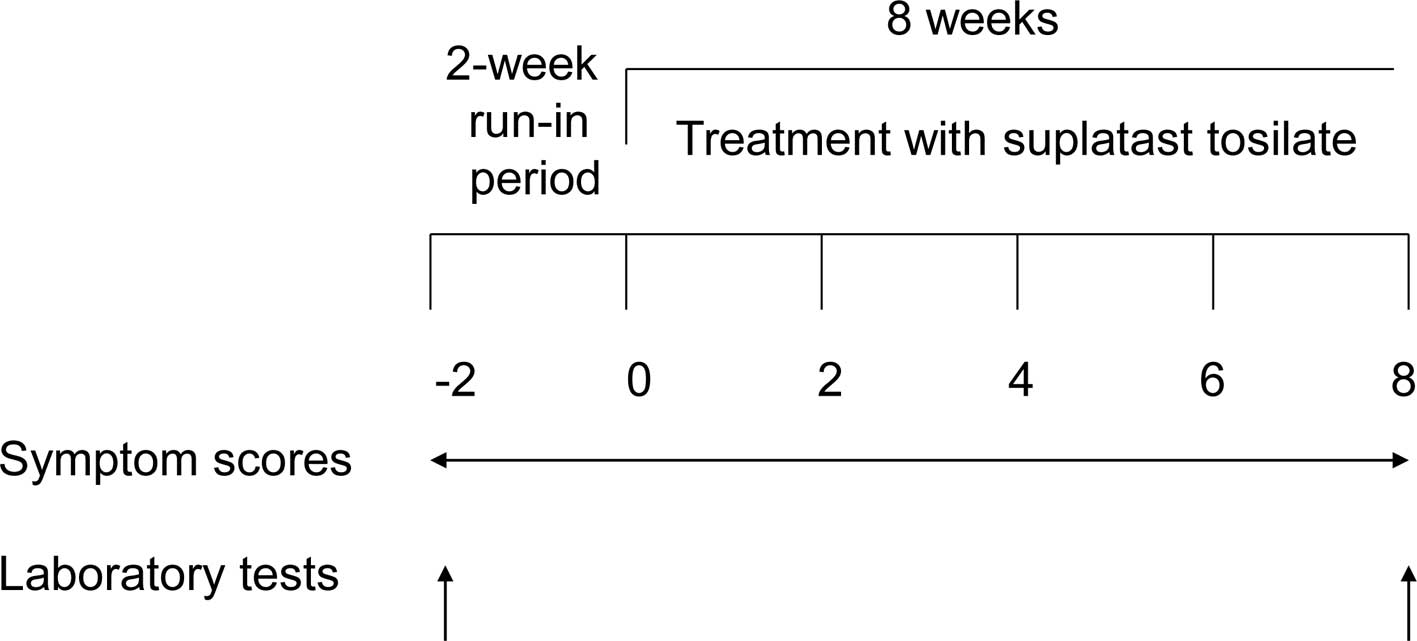
parents, the children were enrolled in a run-in period of 2 weeks,
after which blood samples were obtained. The children then took
suplatast tosilate orally (6 mg/kg/day) for 8 weeks, and blood
samples were taken at the end of the treatment period. Fig. 1 illustrates the study protocol.
Before blood collection, the children or their parents received a
full explanation of the design, methods, and expected results of
the study and consented to blood sampling.
Evaluation of improvement of clinical
signs/symptoms of bronchial asthma
The children or their parents were instructed to
keep an asthma diary to record changes in signs/symptoms of
bronchial asthma before and after treatment. Major, moderate, and
minor asthmatic attacks were scored as 9, 6, and 3 points,
respectively, and cough as 1 point. Total symptom scores during the
2-week run-in period and the last two weeks of the 8-week treatment
period were calculated and compared. Responders and non-responders
were defined as children with and without a decrease in symptom
score after treatment, respectively. No antiasthmatic drugs other
than the study drug were administered during the run-in and
observation periods.
Determination of eosinophil count and
serum IgE level
Using aliquots of the blood samples obtained before
and after treatment, the eosinophil count and serum IgE level were
determined.
Determination of production of cytokines
by peripheral blood mononuclear cells (PBMCs)
PBMCs were isolated from heparinized blood samples
using gradient centrifugation in Ficoll-Paque (Pharmacia, Uppsala,
Sweden) and suspended at a density of 106 cells/ml in
RPMI-1640 medium supplemented with 10% heat-inactivated fetal calf
serum, 2 mmol L-glutamine, 100 U/ml penicillin and 100 μg/ml
streptomycin. PBMCs were cultured with 10 μg/ml phytohemagglutinin
(PHA) (Gibco BRL, Grand Island, NY, USA) for 24 h at 37°C in the
presence of 5% CO2. After incubation, the concentrations
of interferon (IFN)-γ and interleukin (IL)-4 in the supernatant
were determined using enzyme-linked immunosorbent assay (ELISA)
methods. IFN-γ concentrations were measured with a human IFN-γ
ELISA kit (Ohtsuka, Tokyo, Japan); the limit of detection of which
was 15.6–1000 pg/ml. IL-4 concentrations were measured with a human
IL-4 US ELISA kit (BioSource International, Camarillo, CA, USA);
the limit of detection of which was 0.39–25.0 pg/ml.
DNA isolation evaluation of gene
polymorphisms
Genomic DNA was extracted from neutrophils with a
SepaGene kit (Sankyo Junyaku Co., Ltd., Tokyo, Japan). Using the
invader assay method, the genotypes of polymorphisms of genes known
to affect the production of IgE and proinflammatory mediators were
determined (Table I).
 | Table I.Genotype and allele frequencies. |
Table I.
Genotype and allele frequencies.
| SNP ID | Frequency | % | HWE test |
|---|
| IL-12Rβ1
(c.365T>C) | | | |
| Genotype | | | |
| T/T | 7 | 35.0 | p=0.852 |
| T/C | 10 | 50.0 | |
| C/C | 3 | 15.0 | |
| Allele | | | |
| T | 24 | 60.0 | |
| C | 16 | 40.0 | |
| IL-12B
(c.3757T>C) | | | |
| Genotype | | | |
| T/T | 6 | 30.0 | p=0.964 |
| T/C | 10 | 50.0 | |
| C/C | 4 | 20.0 | |
| Allele | | | |
| T | 22 | 55.0 | |
| C | 18 | 45.0 | |
| IL-12B
(c.16078C>T) | | | |
| Genotype | | | |
| C/C | 18 | 90.0 | p=0.004 |
| C/T | 1 | 5.0 | |
| T/T | 1 | 5.0 | |
| Allele | | | |
| C | 37 | 92.5 | |
| T | 3 | 7.5 | |
| IL-4Rα
(Ile50Val) | | | |
| Genotype | | | |
| G/G | 7 | 35.0 | p=0.154 |
| G/A | 12 | 60.0 | |
| A/A | 1 | 5.0 | |
| Allele | | | |
| G | 26 | 65.0 | |
| A | 14 | 35.0 | |
| LTC4S (Glu4Lys) | | | |
| Genotype | | | |
| G/G | 19 | 95.0 | p=0.909 |
| G/A | 1 | 5.0 | |
| A/A | 0 | 0.0 | |
| Allele | | | |
| G | 39 | 97.5 | |
| A | 1 | 2.5 | |
| LTC4S
(−444A>C) | | | |
| Genotype | | | |
| A/A | 11 | 55.0 | p=0.194 |
| A/C | 9 | 45.0 | |
| C/C | 0 | 0.0 | |
| Allele | | | |
| A | 31 | 77.5 | |
| C | 9 | 22.5 | |
| IL-13
(Arg110Gln) | | | |
| Genotype | | | |
| G/G | 9 | 45.0 | p=0.909 |
| G/A | 9 | 45.0 | |
| A/A | 2 | 10.0 | |
| Allele | | | |
| G | 27 | 67.5 | |
| A | 13 | 32.5 | |
Statistical analysis
Relationships of symptom scores with eosinophil
count, serum IgE level, cytokine concentrations, and genotypes of
SNPs tested were examined using the Chi-square test or t-test.
Results
Evaluation of improvement in clinical
symptoms of bronchial asthma
Responses to treatment with suplatast tosilate were
assessed based on the descriptions in the asthma diary kept by the
participants or their parents during the 2-week run-in period and
the 8-week treatment period (Table
II). The symptom score during treatment was decreased from
baseline in 13 patients (8 boys and 5 girls, mean age of 7.8±3.8
years, referred to as the ‘responders’) and was unchanged or
increased in 7 patients (6 boys and 1 girl, mean age of 6.9±3.2
years, referred to as the ‘non-responders’). No significant
differences in age, severity of asthma, or prevalence of
complications were observed between the responders and
non-responders (Table III).
| Table II.Asthma symptom scores before and after
treatment with suplatast tosilate. |
Table II.
Asthma symptom scores before and after
treatment with suplatast tosilate.
| Responders
(n=13) | Non-responders
(n=7) | p-value |
|---|
| Asthma scores
(pre) | 13.0±7.5 | 7.2±12.9 | 0.1980 |
| Asthma scores
(post) | 1.8±2.4 | 9.5±12.9 | 0.0580 |
| Asthma scores (Δ
change) | −11.8±6.7 | 2.3±3.7 | 0.0002 |
| Table III.Clinical characteristics of the
patients. |
Table III.
Clinical characteristics of the
patients.
| Responders
(n=13) | Non-responders
(n=7) | p-value |
|---|
| Gender
(male/female) | 8/5 | 6/1 | 0.261 |
| Age (years) | 7.8±3.8 | 6.9±3.2 | 0.563 |
| Range | 3–17 | 3–12 | |
| Duration of asthma
(years) | 4.1±2.4 | 4.6±3.7 | 0.718 |
| Range | 1–8 | 1–10 | |
| Asthma
severity | | | |
| Mild | 8 | 5 | 0.658 |
| Moderate | 5 | 2 | |
| Atopic
dermatitis | | | |
| + | 6 | 2 | 0.444 |
| − | 7 | 5 | |
| Rhinitis | | | |
| + | 5 | 2 | 0.658 |
| − | 8 | 5 | |
| Asthma type | | | |
| Atopic
asthma | 13 | 5 | 0.127 |
| Infectious
asthma | 0 | 1 | |
| Mixed asthma | 0 | 1 | |
| Asthma scores
(pre) | 13.6±7.5 | 7.2±12.9 | 0.198 |
Relationships of the efficacy of
treatment with the eosinophil count and serum IgE level
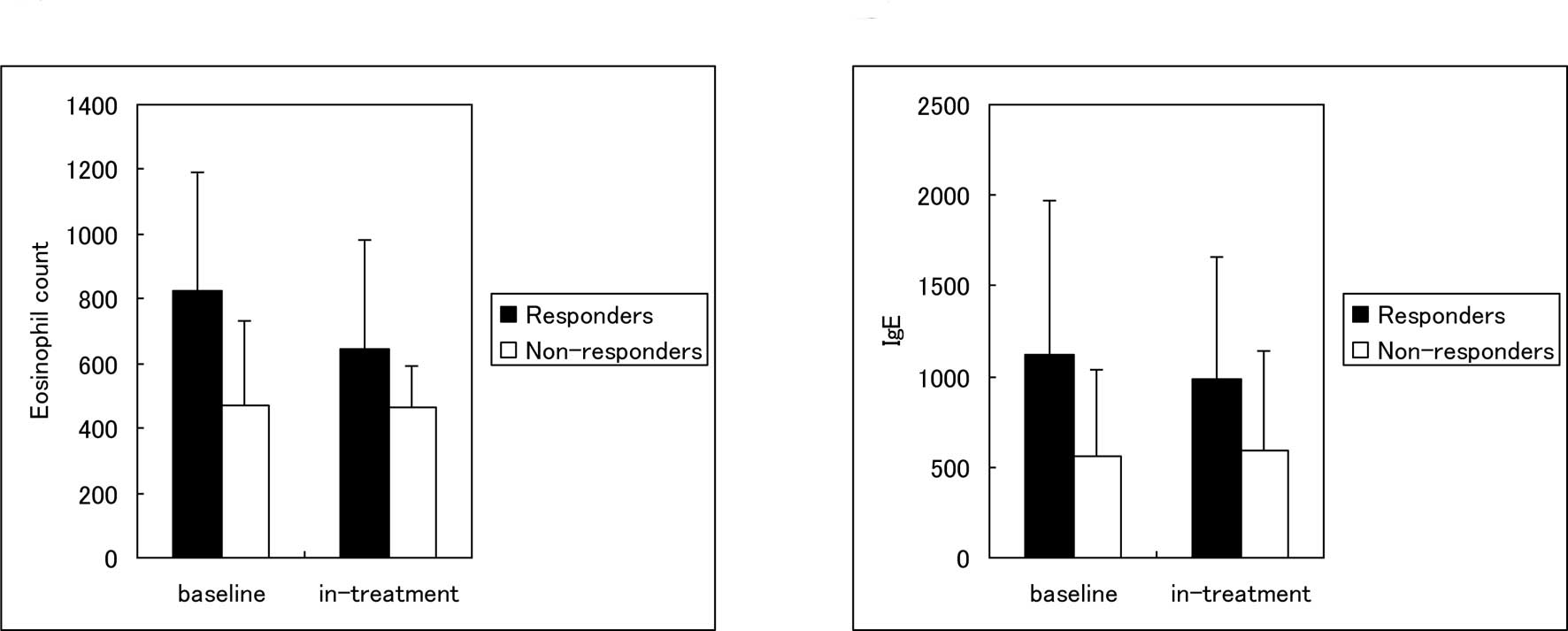
Comparisons of the eosinophil count and serum IgE
level were carried out between the responders and non-responders to
evaluate the relationships of these parameters with treatment
efficacy. As shown in Fig. 2A and
B, no significant differences were observed in baseline or
in-treatment values or the change in these values between the
baseline and the treatment period between the responders and
non-responders.
Relationships between cytokine production
and efficacy of treatment
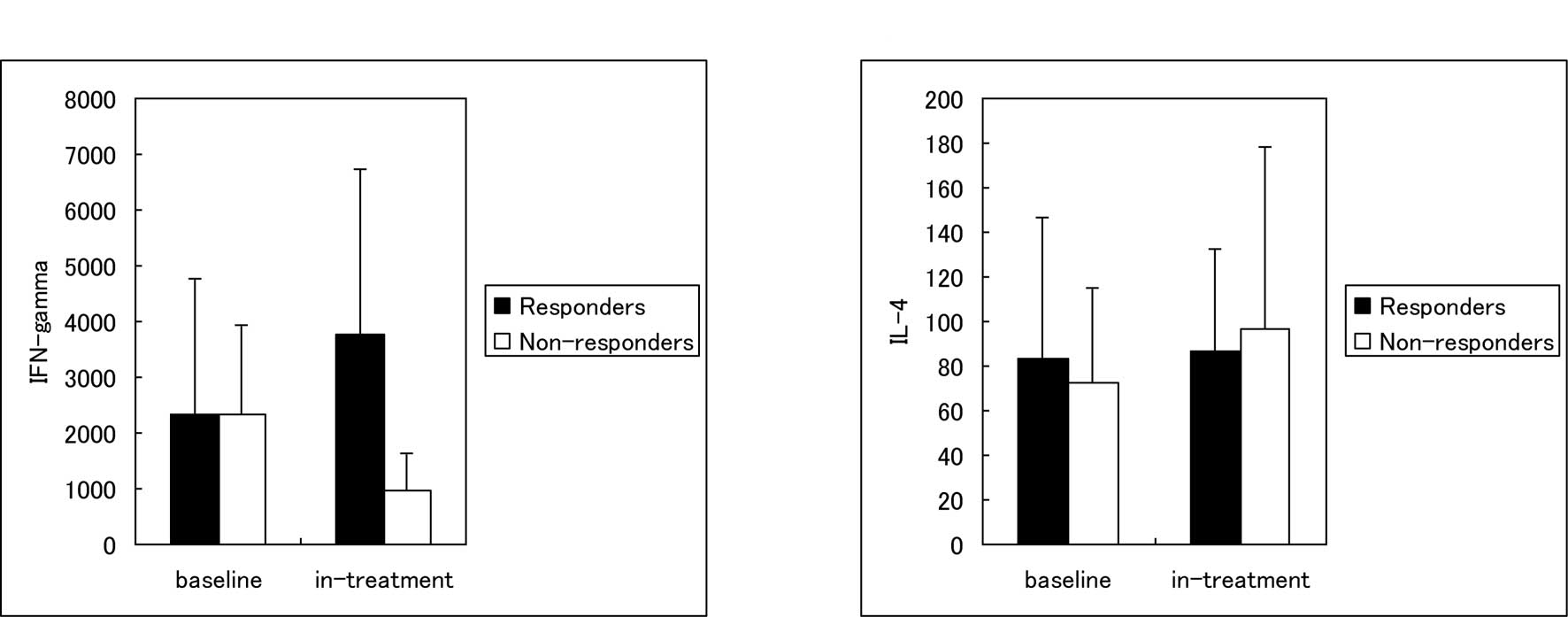
Relationships of treatment efficacy with the amounts
of INF-γ and IL-4 produced by peripheral blood mononuclear cells
before and after treatment were investigated (Fig. 3A and B). The change in IFN-γ
production between the baseline and treatment periods was
significantly larger in the responders than in the non-responders
(p=0.011). Production of IL-4 did not differ significantly between
the responders and non-responders.
Relationships between SNPs and treatment
efficacy
Using the invader assay method (11), the genotypes of SNPs of genes known
to affect the production of IgE [interleukin (IL)-12, IL-12
receptor (IL-12R)β1, IFN-γR1, IL-4Rα and IL-13 genes] and mediators
(LTC4 synthase gene) were determined in the children enrolled in
the study. Notably, the prevalence of the wild-type (A/A) genotype
of the LTC4S −444 A/C polymorphism was significantly higher in the
responders than in the non-responders (p=0.024 for allele
prevalence, Table IV). Comparisons
of the prevalence of genotype combinations revealed that the
prevalence of the wild-type (G/G) genotype of the IL-13 R110Q
polymorphism, compared with the G/A and A/A genotypes, was
associated with favorable effects of treatment (p=0.043, Table V).
| Table IV.Association between genotype and
response to treatment with suplatast tosilate. |
Table IV.
Association between genotype and
response to treatment with suplatast tosilate.
| | Genotype
| Allele
|
|---|
| Total no. | n (%) | n (%) | n (%) | p-value | n (%) | n (%) | p-value |
|---|
|
IL12Rβ1(c.365T>C) | | T/T | T/C | C/C | 0.384 | T | C | 0.279 |
| Responders | 13 | 4 (30.8) | 6 (46.2) | 3 (23.0) | | 14 (53.9) | 12 (46.1) | |
| Non-responders | 7 | 3 (42.9) | 4 (57.1) | 0 (0.0) | | 10 (71.4) | 4 (28.6) | |
| IL-12B
(c.3757T>C) | | T/T | T/C | C/C | 0.207 | T | C | 0.386 |
| Responders | 13 | 4 (30.8) | 5 (38.4) | 4 (30.8) | | 13 (50.0) | 13 (50.0) | |
| Non-responders | 7 | 2 (28.6) | 5 (71.4) | 0 (0.0) | | 9 (64.3) | 5 (35.7) | |
| IL-12B
(c.16078C>T) | | C/C | C/T | T/T | 0.299 | C | T | 0.950 |
| Responders | 13 | 12 (92.3) | 0 (0.0) | 1 (7.7) | | 24 (92.3) | 2 (7.7) | |
| Non-responders | 7 | 6 (85.7) | 1 (14.3) | 0 (0.0) | | 13 (92.9) | 1 (7.1) | |
| IL-4Rα
(Ile50Val) | | G/G | G/A | A/A | 0.690 | G | A | 0.532 |
| Responders | 13 | 4 (30.8) | 8 (61.5) | 1 (7.7) | | 16 (61.5) | 10 (38.5) | |
| Non-responders | 7 | 3 (42.9) | 4 (57.1) | 0 (0.0) | | 10 (71.4) | 4 (28.6) | |
| LTC4S
(Glu4Lys) | | G/G | G/A | A/A | 0.452 | G | A | 0.457 |
| Responders | 13 | 12 (92.3) | 1 (7.7) | 0 (0.0) | | 25 (96.2) | 1 (3.8) | |
| Non-responders | 7 | 7 (100) | 0 (0.0) | 0 (0.0) | | 14 (100) | 0 (0.0) | |
| LTC4S
(-444A>C) | | A/A | A/C | C/C | 0.007 | A | C | 0.024 |
| Responders | 13 | 10 (76.9) | 3 (23.1) | 0 (0.0) | | 23 (88.5) | 3 (11.5) | |
| Non-responders | 7 | 1 (14.3) | 6 (85.7) | 0 (0.0) | | 8 (57.1) | 6 (42.9) | |
| IL-13
(Arg110Gln) | | G/G | G/A | A/A | 0.127 | G | A | 0.083 |
| Responders | 13 | 8 (61.5) | 4 (30.8) | 1 (7.7) | | 6 (23.1) | 20 (76.9) | |
| Non-responders | 7 | 1 (14.3) | 5 (71.4) | 1 (14.3) | | 7 (50.0) | 7 (50.0) | |
| Table V.Association between genotype
combination and response to treatment with suplatast tosilate. |
Table V.
Association between genotype
combination and response to treatment with suplatast tosilate.
| | Genotype
combination (1)
| Genotype
combination (2)
|
|---|
| Total no. | n (%) | n (%) | p-value | n (%) | n (%) | p-value |
|---|
| IL12Rβ1
(c.365T>C) | | T/T | T/C, C/C | 0.589 | T/T, T/C | C/C | 0.168 |
| Responders | 13 | 4 (30.8) | 9 (69.2) | | 10 (76.9) | 3 (23.1) | |
| Non-responders | 7 | 3 (42.9) | 4 (57.1) | | 7 (100.0) | 0 (0.0) | |
| IL-12B
(c.3757T>C) | | T/T | T/C, C/C | 0.919 | T/T, T/C | C/C | 0.101 |
| Responders | 13 | 4 (30.8) | 9 (69.2) | | 9 (69.2) | 4 (30.8) | |
| Non-responders | 7 | 2 (28.6) | 5 (71.4) | | 7 (100.0) | 0 (0.0) | |
| IL-12B
(c.16078C>T) | | C/C | C/T, T/T | 0.639 | C/C, C/T | T/T | 0.452 |
| Responders | 13 | 12 (92.3) | 1 (7.7) | | 12 (92.3) | 1 (7.7) | |
| Non-responders | 7 | 6 (85.7) | 1 (14.3) | | 7 (100.0) | 0 (0.0) | |
| IL-4Rα
(Ile50Val) | | G/G | G/A, A/A | 0.589 | G/G, G/A | A/A | 0.452 |
| Responders | 13 | 4 (30.8) | 9 (69.2) | | 12 (92.3) | 1 (7.7) | |
| Non-responders | 7 | 3 (42.9) | 4 (57.1) | | 7 (100.0) | 0 (0.0) | |
| LTC4S
(Glu4Lys) | | G/G | G/A, A/A | 0.452 | G/G, G/A | A/A | - |
| Responders | 13 | 12 (92.3) | 1 (7.7) | | 13 (100.0) | 0 (0.0) | |
| Non-responders | 7 | 7 (100) | 0 (0.0) | | 7 (100.0) | 0 (0.0) | |
| LTC4S
(−444A>C) | | A/A | A/C, C/C | 0.007 | A/A, A/C | C/C | - |
| Responders | 13 | 10 (76.9) | 3 (23.1) | | 13 (100.0) | 0 (0.0) | |
| Non-responders | 7 | 1 (14.3) | 6 (85.7) | | 7 (100.0) | 0 (0.0) | |
| IL-13
(Arg110Gln) | | G/G | G/A, A/A | 0.043 | G/G, G/A | A/A | 0.639 |
| Responders | 13 | 8 (61.5) | 5 (38.5) | | 12 (92.3) | 1 (7.7) | |
| Non-responders | 7 | 1 (14.3) | 6 (85.7) | | 6 (85.7) | 1 (14.3) | |
Discussion
Studies of genetic factors in patients with
bronchial asthma have been conducted since the late 1980s (2–6). In
the present study on the relationships between genetic
polymorphisms and the efficacy of a Th2 cytokine inhibitor in
children with bronchial asthma, we investigated the SNP profiles of
the IL-12, IL-12Rβ1, IFN-γR1, IL-4Rα and IL-13 genes, which affect
IgE production, and LTC4 synthase, which affects the production of
proinflammatory mediators, in order to evaluate the relationships
between SNP profiles and response to treatment. In the present
study, the LTC4S −444 A/C polymorphism was associated with
favorable effects of suplatast tosilate. In 2000, Sampson et
al reported that asthmatic patients with a variant allele in
the LTC4S −444 A/C polymorphism exhibited increased improvement in
respiratory function after treatment with leukotriene receptor
antagonists (8). In the present
study, treatment with the Th2 cytokine inhibitor, suplatast
tosilate, (12,13) was more effective in patients with
the wild-type −444 A/C polymorphism in the LTC4S gene than in
patients with the variant LTC4S gene. It has also been reported
that the expression of cysteinyl leukotriene 1 receptors is
modified by IFN-γ and IL-13 (14).
Evaluation of the relationship between genotype combination and
treatment efficacy revealed a relationship between the presence of
the wild-type IL-13 gene and efficacy of the Th2 cytokine
inhibitor. In addition, the change in IFN-γ production between the
baseline and treatment periods was significantly associated with
efficacy of treatment. These findings suggest that the relationship
between the LTC4S −444 A/C polymorphism and treatment efficacy may
be explained by a change in the expression of cysteinyl leukotriene
1 receptors in responders. Further pharmacogenetic studies on gene
polymorphism and expression should be performed in order to refine
individually tailored treatment for asthmatic patients.
Acknowledgements
This study was supported by Health and
Labour Science Research Grants for Research on Allergic Disease and
Immunology from the Ministry of Health, Labour and Welfare of
Japan.
References
|
1.
|
Kondo N, Matsui E, Kaneko H, Kato Z, Fukao
T, Teramoto T, Shikano H, Aoki M, Onishi H, Tatebayashi K, Omoya K,
Kondo M, Matsukuma E, Kasahara K and Morimoto N: Genetic defects in
downregulation of IgE production and a new genetic classification
of atopy. Allergol Int. 53:77–85. 2004. View Article : Google Scholar
|
|
2.
|
Mitsuyasu H, Izuhara K, Mao XQ, Gao PS,
Arinobu Y, Enomoto T, Kawai M, Sasaki S, Dake Y, Hamasaki N,
Shirakawa T and Hopkin JM: Ile50Val variant of IL4R alpha
upregulates IgE synthesis and associates with atopic asthma. Nat
Genet. 19:119–120. 1998. View
Article : Google Scholar : PubMed/NCBI
|
|
3.
|
Heinzmann A, Mao XQ, Akaiwa M, Kreomer RT,
Gao PS, Ohshima K, Umeshita R, Abe Y, Braun S, Yamashita T, Roberts
MH, Sugimoto R, Arima K, Arinobu Y, Yu B, Kruse S, Enomoto T, Dake
Y, Kawai M, Shimazu S, Sasaki S, Adra CN, Kitaichi M, Inoue H,
Yamauchi K, Tomichi N, Kurimoto F, Hamasaki N, Hopkin JM, Izuhara
K, Shirakawa T and Deichmann KA: Genetic variants of IL-13
signalling and human asthma and atopy. Hum Mol Genet. 9:549–559.
2000. View Article : Google Scholar : PubMed/NCBI
|
|
4.
|
Tatebayashi K, Matsui E, Kaneko H, Fukao
T, Kasahara K and Kondo N: IL-12B promoter polymorphism associated
with asthma and IL-12B transcriptional activity. Allergol Int.
54:451–459. 2005. View Article : Google Scholar
|
|
5.
|
Yoshikawa K, Matsui E, Kaneko H, Fukao T,
Inoue R, Teramoto T, Shinoda S, Fukutomi O, Aoki M, Kasahara K and
Kondo N: A novel single-nucleotide substitution, Glu 4 Lys, in the
leukotriene C4 synthase gene associated with allergic diseases. Int
J Mol Med. 16:827–831. 2005.PubMed/NCBI
|
|
6.
|
Aoki M, Matsui E, Kaneko H, Inoue R, Fukao
T, Watanabe M, Teramoto T, Kato Z, Suzuki K, Suzuki Y, Kasahara K
and Kondo N: A novel single-nucleotide substitution, Leu 467 Pro,
in the interferon-γ receptor 1 gene associated with allergic
diseases. Int J Mol Med. 12:185–191. 2003.PubMed/NCBI
|
|
7.
|
Tan S, Hall IP, Dewar J, Dow E and
Lipworth B: Association between beta 2-adrenoceptor polymorphism
and susceptibility to bronchodilator desensitisation in moderately
severe stable asthmatics. Lancet. 350:995–999. 1997. View Article : Google Scholar : PubMed/NCBI
|
|
8.
|
Sampson AP, Siddiqui S, Buchanan D,
Howarth PH, Holgate ST, Holloway JW and Sayers I: Variant LTC(4)
synthase allele modifies cysteinyl leukotriene synthesis in
eosinophils and predicts clinical response to zafirlukast. Thorax.
55(Suppl 2): 28–31. 2000. View Article : Google Scholar : PubMed/NCBI
|
|
9.
|
Asano K, Shiomi T, Hasegawa N, Nakamura H,
Kudo H, Matsuzaki T, Hakuno H, Fukunaga K, Suzuki Y, Kanazawa M and
Yamaguchi K: Leukotriene C4 synthase gene A(-444)C polymorphism and
clinical response to a CYS-LT(1) antagonist, pranlukast, in
Japanese patients with moderate asthma. Pharmacogenetics.
12:565–570. 2002. View Article : Google Scholar : PubMed/NCBI
|
|
10.
|
Tantisira KG, Hwang ES, Raby BA, Silverman
ES, Lake SL, Richter BG, Peng SL, Drazen JM, Glimcher LH and Weiss
ST: TBX21: a functional variant predicts improvement in asthma with
the use of inhaled corticosteroids. Proc Natl Acad Sci USA.
101:18099–18104. 2004. View Article : Google Scholar : PubMed/NCBI
|
|
11.
|
Hall JG, Eis PS, Law SM, Reynaldo LP,
Prudent JR, Marshall DJ, Allawi HT, Mast AL, Dahlberg JE,
Kwiatkowski RW, de Arruda M, Neri BP and Lyamichev VI: Sensitive
detection of DNA polymorphisms by the serial invasive signal
amplification reaction. Proc Natl Acad Sci USA. 97:8272–8277. 2000.
View Article : Google Scholar : PubMed/NCBI
|
|
12.
|
Shim JJ, Dabbagh K, Takeyama K, Burgel PR,
Dao-Pick TP, Ueki IF and Nadel JA: Suplatast tosilate inhibits
goblet-cell metaplasia of airway epithelium in sensitized mice. J
Allergy Clin Immunol. 105:739–745. 2000. View Article : Google Scholar : PubMed/NCBI
|
|
13.
|
Suwaki T, Agrawal DK and Townley RG:
Modification of eosinophil function by suplatast tosilate (IPD), a
novel antiallergic drug. Int Immunopharmacol. 1:2163–2171. 2001.
View Article : Google Scholar : PubMed/NCBI
|
|
14.
|
Espinosa K, Bossé Y, Stankova J and
Rola-Pleszczynski M: CysLT1 receptor upregulation by TGF-beta and
IL-13 is associated with bronchial smooth muscle cell proliferation
in response to LTD4. J Allergy Clin Immunol. 111:1032–1040. 2003.
View Article : Google Scholar : PubMed/NCBI
|