Introduction
Postpartum depression (PPD) is a mood disorder in
females that usually presents within the first 4–6 weeks after
childbirth; the condition is clinically characterized by
depression, sadness, frustration, crying, irritability,
restlessness and even suicidal tendencies (1). According to a previous meta-analysis,
PPD is prevalent worldwide, and 10–15% of females may be affected
(2). In addition to the general
symptoms of depression, PPD can, in certain cases, be associated
with a disturbance of consciousness, psychotic symptoms and
Schneider’s symptoms, which can only be alleviated by regular
treatments (3,4). It has been acknowledged that PPD is
induced by biological, psychological and/or social factors;
bio-genetics in particular is closely linked with the mental
illnesses (5,6).
Recent genetic studies have shown that dysfunction
of the 5-hydroxytryptamine (5-HT) system is the key factor in the
development of depression (7,8).
Accordingly, genes associated with the synthesis, release, uptake
and metabolism of 5-HT could become candidates for studies on the
pathogenesis of depression. The serotonin transporter (5-HTT) plays
an important role in the re-uptake of 5-HT following release, and
therefore is the target for the majority of antidepressants
(9,10). A recent study indicated that the
transcriptional activity of the human 5-HTT gene is regulated by
the 5-HTT gene-linked polymorphic region (5-HTTLPR)
(11), with long (L) and short (S)
alleles. The L allele in 5-HTTLPR is associated with higher
transcriptional efficiency of the promoter compared with the S
allele. The mRNA transcription and protein expression levels of
5-HTT are higher in individuals with a homozygous L/L genotype than
those with S/S genotypes (12).
To date, the association between 5-HTTLPR
gene polymorphism and PPD has not been fully established, and there
are few studies focusing on the association between the genetic
polymorphism and the clinical characteristics. In the present
study, the 5-HTTLPR status in the 5-HTT gene was evaluated
in order to establish whether it had an association with PPD
pathogenesis in Han female patients.
Materials and methods
Patients
A total of 120 Han female patients with PPD, aged
20–35 years (mean age, 28.57±6.8 years), with a course of disease
ranging between six weeks and six months, were enrolled in the
present study. The patients had all been admitted to the Zhongnan
Hospital of Wuhan University (Wuhan, China) between 2008 and 2012.
The patients had been diagnosed with PPD according to the
diagnostic criteria for depression (for PPD, occurring within 6
months after delivery) from the Chinese Classification of Mental
Disorders (13), as well as the
Hamilton Depression Rating Scale (HAMD) score (24-item version). An
additional 140 Han females with similar social background were
included as normal controls, aged 20–35 years (mean age, 26.18±7.2
years). None of the subjects or their parents were involved in drug
abuse and/or addiction, nor had a history of mental illness,
serious physical illness or organic brain diseases. Prior written
and informed consent was obtained from every patient and the study
was approved by the Ethics Review Board of the Zhongnan Hospital of
Wuhan University.
Blood sample collection
Peripheral blood samples from the subjects in the
PPD and control groups were collected under fasting conditions in
the morning. A total of 100 μl EDTA (0.5 mol/l; pH 8.0) was added
for anticoagulation, and these blood samples were stored at −80°C
until use.
DNA extraction and polymerase chain
reaction (PCR) analysis
Genomic DNA was extracted using a whole blood
genomic DNA extraction kit (Qiagen GmbH, Hilden, Germany),
according to the manufacturer’s instructions, and then analyzed
with 0.8% agarose gel electrophoresis. Amplification primers for
the promoter region of the 5-HTT gene were as follows: Forward
primer, 5′-GCGCTCCTGCATCCCCCATTA-3′; and reverse primer,
5′-GGGATGCGGGGGAATACTGGT-3′. 5-HTTLPR polymorphism in the
5-HTT promoter region was assessed using PCR amplification. A total
of 25 μl PCR reaction solution was prepared by mixing 10X PCR
reaction buffer [containing 2.0 mmol/l
(NH4)2SO4 and MgCl2;
Invitrogen Life Technologies, Carlsbad, CA, USA], 0.16 μmol/l each
primer, 1.5 units Taq enzymes and 160 μmol/l deoxyribonucleotide
triphosphates. The PCR conditions were as follows: Denaturation at
95°C for 2 min, followed by 35 cycles of 95°C for 60 sec, 62°C for
60 sec and 72°C for 60 sec, and then extension at 72°C for 10 min.
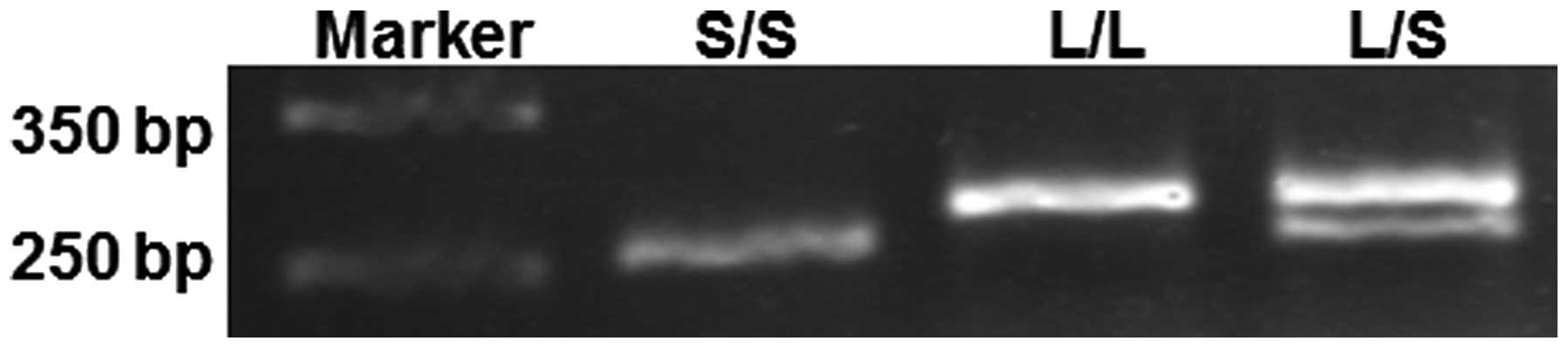
The PCR products were separated by 2% agarose gel electrophoresis,
and the gel was visualized and analyzed by a Bio-Rad image analysis
system (Bio-Rad, Hercules, CA, USA). Two different allelic
fragments with the lengths of 297 bp (L) and 253 bp (S) were
detected among the PCR products, and the genotype was determined
accordingly (Fig. 1) (14).
Statistical analysis
Statistical analysis was performed using SPSS 13.0
software (SPSS, Inc., Chicago, IL, USA). A χ2 test of
goodness of fit was used to test the Hardy-Weinberg (H-W)
equilibrium in the samples. P<0.05 was considered to indicate a
statistically significant difference.
Results
H-W equilibrium test of the 5-HTTLPR
genotype distribution
To investigate the representativeness of the
samples, the H-W equilibrium, with the respect to the
5-HTTLPR polymorphism, was examined in the population of the
PDD and control groups. The results showed that the genotype
frequency distribution of the 5-HTTLPR polymorphism in the
enrolled population was in H-W equilibrium, and no significant
differences were found between the observed and expected values
(P>0.05) (Table I). These
results suggest that the enrolled population was a good
representative sample.
 | Table IHardy-Weinberg equilibrium test of the
5-HTTLPR genotype distribution in the PPD and control
groups. |
Table I
Hardy-Weinberg equilibrium test of the
5-HTTLPR genotype distribution in the PPD and control
groups.
| Group | Genotype | Observed value | Expected value | χ2 | P-value |
|---|
| PPD | L/L | 5 | 6.51 | | |
| L/S | 46 | 42.89 | | |
| S/S | 69 | 70.59 | 0.612 | >0.05 |
| Control | L/L | 19 | 12.90 | | |
| L/S | 47 | 59.09 | | |
| S/S | 74 | 67.90 | 2.884 | >0.05 |
Comparison of 5-HTTLPR polymorphism
genotype distribution between the PPD and control groups
To investigate the association between
5-HTTLPR gene polymorphism and PPD, the genotype frequencies
were examined and compared between the PPD and control groups. The
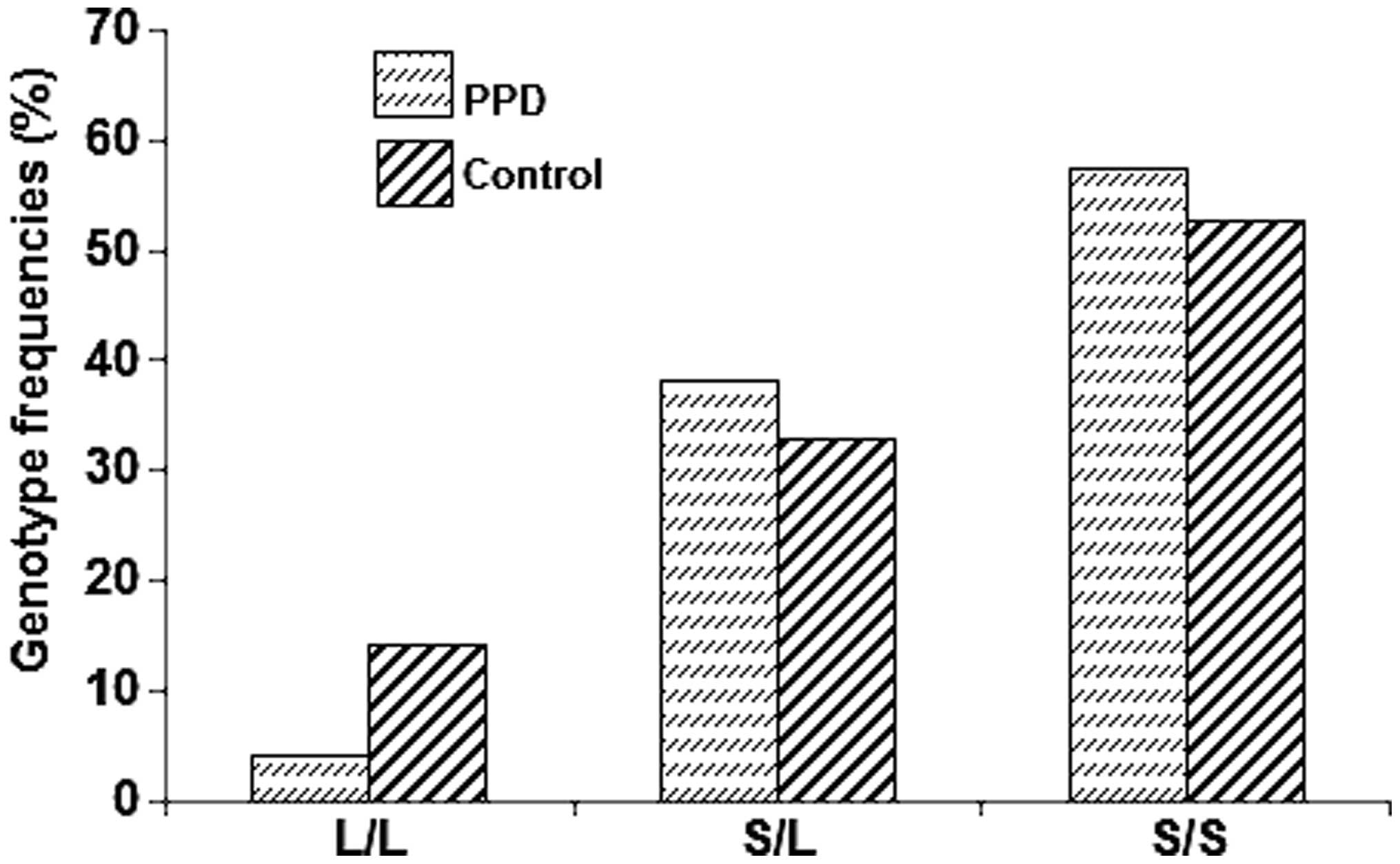
results showed that the frequency of the homozygous L/L genotype
was significantly lower in the PPD group (4.17%) than that in the
control group (15.83%) (χ2, 6.854; P=0.032). By
contrast, the frequencies of the heterozygous L/S and homozygous
S/S genotypes were similar in the two groups, without significant
differences (Table II and
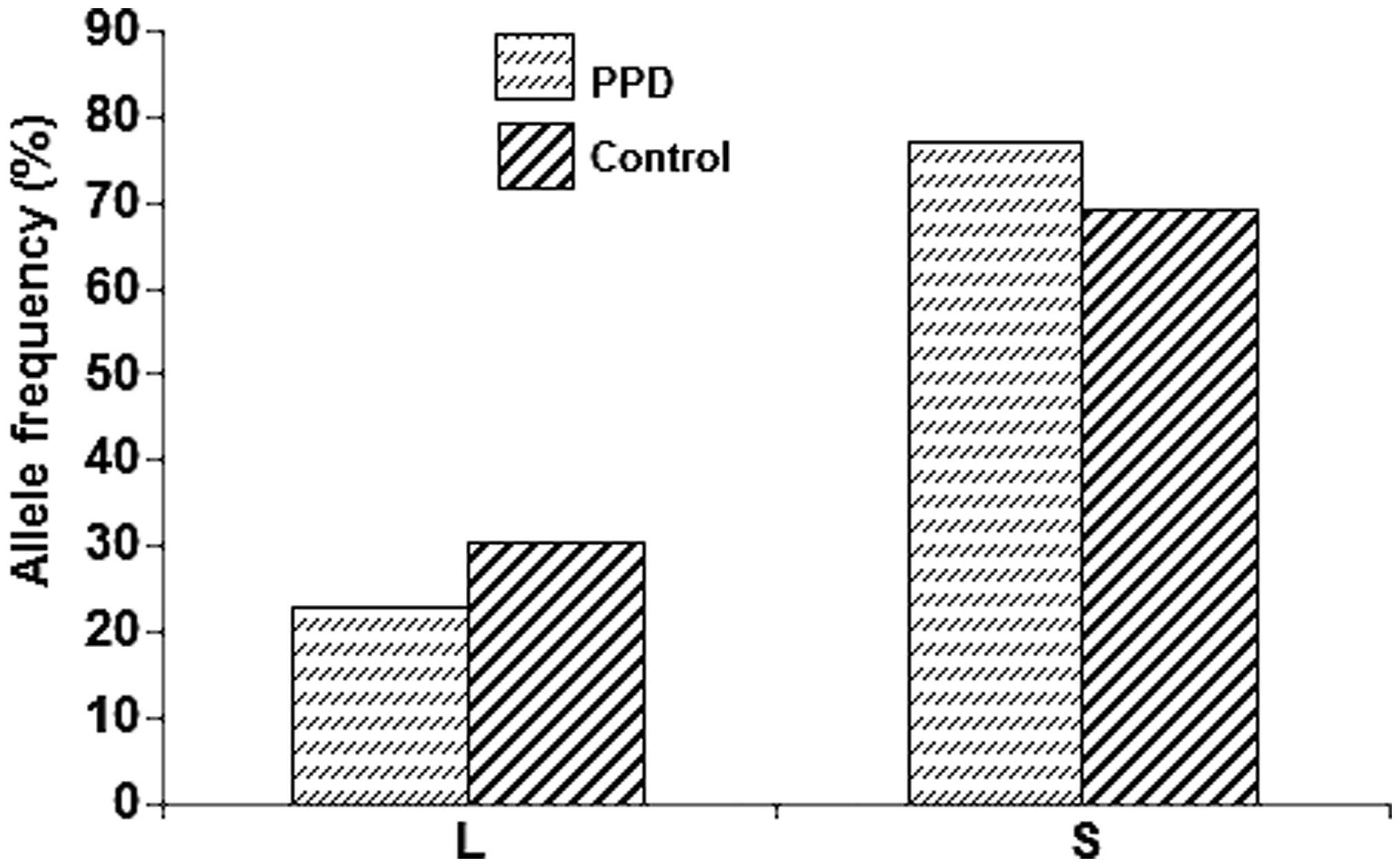
Fig. 2). In addition, no
significant differences in the frequencies of the L and S alleles
were found between the PPD and control groups (χ2,
3.226; P=0.072) (Table III and
Fig. 3). These results suggest
that the L/L homozygous genotype may be associated with the reduced
occurrence of PPD.
| Table IIComparison of the 5-HTTLPR
genotype frequencies between the PPD and control groups. |
Table II
Comparison of the 5-HTTLPR
genotype frequencies between the PPD and control groups.
| | 5-HTTLPR
genotype frequencies |
|---|
| |
|
|---|
| Group | N | L/L, % (n) | L/S, % (n) | S/S, % (n) |
|---|
| PPD | 120 | 4.17 (5)a | 38.33 (46) | 57.50 (69) |
| Control | 140 | 15.83 (19) | 39.17 (47) | 52.86 (74) |
| Total | 260 | 9.23 (24) | 35.77 (93) | 55.00 (143) |
| Table IIIComparison of the 5-HTTLPR
allele frequencies between the PPD and control groups. |
Table III
Comparison of the 5-HTTLPR
allele frequencies between the PPD and control groups.
| | 5-HTTLPR
allele frequencies |
|---|
| |
|
|---|
| Group | N | L, % (n) | S, % (n) |
|---|
| PPD | 240 | 23.33 (56) | 76.67 (184) |
| Control | 280 | 30.36 (85) | 69.64 (195) |
| Total | 520 | 27.12 (141) | 72.88 (379) |
Association between 5-HTTLPR polymorphism
genotype and HAMD score in PPD
To further investigate the role of the
5-HTTLPR polymorphism genotypes in PPD, the disease severity
was evaluated using the HAMD score. The results showed that,
compared with the L/S heterozygous and S/S homozygous genotypes,
patients with PPD carrying the L/L homozygous genotype had a
significantly lower HAMD score (P<0.001) (Table IV). These results suggest that
homozygous L/L carriers with PPD may be less susceptible to the
depressive symptoms.
| Table IVHAMD scores for patients with
postpartum depression with different genotypes. |
Table IV
HAMD scores for patients with
postpartum depression with different genotypes.
| Genotype | N | HAMD score | F | P-value |
|---|
| L/L | 5 | 27.8±2.39 | 78.33 | <0.001 |
| L/S | 46 | 41.4±2.26 | | |
| S/S | 69 | 45.4±3.39 | | |
Discussion
PPD was first described by Pitt in 1968 (15). Epidemiological studies show that
patients with PPD often exhibit seriously depressed mood following
delivery, including various psychotic and mood disorders (16,17.
PPD jeopardizes the physical and mental health of the parturient
females, as well as their infants. Under certain circumstances,
postpartum psychosis can also be induced, causing a substantial
economic burden for families and society. The pathophysiology of
PPD is complex, and the mechanism is still yet to be thoroughly
clarified. It is believed that the pathogenesis and development of
PPD involve a variety of internal and external factors (18).
In recent years, with the rapid development of human
genomics studies, attempts have been made to elucidate the
association between genetic polymorphisms and PPD susceptibility
(19,20). It has been shown that the
neurotransmitter 5-HT is involved in regulating a number of
physical and mental activities, and plays an important role in the
pathogenesis of depression (21–22).
Furthermore, the re-uptake of 5-HT is regulated by the 5-HTT, which
is widely distributed on the presynaptic membranes in the central
nervous system (24). Pre-clinical
and clinical studies have therefore focused on this target for the
treatment of depression (25,26).
The human 5-HTT gene (also known as SLC6A4)
is located on chromosome 17q11.1-q12 and contains 14 exons. The
5-HTT gene-linked polymorphic region (5-HTTLPR) has been
recognized as one of the functional polymorphism sites of the 5-HTT
gene (27). There are three
genotypes, L/L, L/S and S/S, for 5-HTTLPR polymorphism. A
number of studies have shown that the S allele could be the
susceptible factor for depression, while the genotype of L/L would
be protective against depression (28–30).
By contrast, other studies have revealed that the frequency of the
L allele in patients with depression is considerably higher than
that in the control group, indicating an association between the L
allele and the pathogenesis of depression (31,32).
Other studies, however, have speculated that 5-HTTLPR is not
associated with depression, or at least is not the major risk
factor (33–37).
In the present study, it was found that the L and S
allele frequencies in Han female patients with PPD were similar to
those in normal controls. The S allele was predominant in normal
Han females (69.64%), with the S/S genotype accounting for 52.86%
and the L/L genotype for 15.83% of the genotypes in the group. This
was consistent with previous studies concerning the genotype
distribution and allele frequencies in the Han population (38,39).
Notably, the present results indicated that the frequency of the
L/L homozygous genotype was significantly lower in the patients
with PPD (4.17%) than that in the normal control females (15.83%).
In addition, the HAMD score from the patients with PPD with the L/L
homozygous genotype (27.8±2.39) was markedly lower than that either
from the L/S (41.4±2.26) or the S/S (45.4±3.39) carriers,
indicating less severe depressive symptoms. These results suggest
that the L/L homozygous genotype could exert protective effects
against the onset and development of PPD, reducing the
susceptibility of patients to the disease.
In conclusion, the present results revealed the
association between the 5-HTTLPR polymorphism and the
pathogenesis of PPD in the Han population. Specifically, it was
shown that the L allele in 5-HTTLPR was associated with a
reduced susceptibility to PPD. These findings provide a theoretical
basis for the clinical diagnosis and treatment of PPD. Due to the
limited sample size of the present study, further studies with
expanded samples are still required to validate the present results
and to fully address the role of 5-HTTLPR polymorphism in
PPD.
Acknowledgements
This study was supported by the Natural Science
Foundation of Hubei Province (no. 2012FFB04430).
References
|
1
|
O’Hara MW and McCabe JE: Postpartum
depression: current status and future directions. Annu Rev Clin
Psychol. 9:379–407. 2013. View Article : Google Scholar
|
|
2
|
Paulson JF and Bazemore SD: Prenatal and
postpartum depression in fathers and its association with maternal
depression: a meta-analysis. JAMA. 303:1961–1969. 2010. View Article : Google Scholar : PubMed/NCBI
|
|
3
|
Fitelson E, Kim S, Baker AS and Leight K:
Treatment of postpartum depression: clinical, psychological and
pharmacological options. Int J Womens Health. 3:1–14. 2010.
|
|
4
|
O’Keane V, Lightman S, Patrick K, et al:
Changes in the maternal hypothalamic-pituitary-adrenal axis during
the early puerperium may be related to the postpartum ‘blues’. J
Neuroendocrinol. 23:1149–1155. 2011. View Article : Google Scholar
|
|
5
|
Skalkidou A, Hellgren C, Comasco E, Sylvén
S and Sundström Poromaa I: Biological aspects of postpartum
depression. Womens Health (LondEngl). 8:659–672. 2012. View Article : Google Scholar
|
|
6
|
Vliegen N, Casalin S and Luyten P: The
course of postpartum depression: a review of longitudinal studies.
Harv Rev Psychiatry. 22:1–22. 2014. View Article : Google Scholar : PubMed/NCBI
|
|
7
|
Maes M, Ringel K, Kubera M, Berk M and
Rybakowski J: Increased autoimmune activity against 5-HT: a key
component of depression that is associated with inflammation and
activation of cell-mediated immunity, and with severity and staging
of depression. J Affect Disord. 136:386–392. 2012. View Article : Google Scholar
|
|
8
|
Maes M, Leonard BE, Myint AM, Kubera M and
Verkerk R: The new ‘5-HT’ hypothesis of depression: cell-mediated
immune activation induces indoleamine 2,3-dioxygenase, which leads
to lower plasma tryptophan and an increased synthesis of
detrimental tryptophan catabolites (TRYCATs), both of which
contribute to the onset of depression. Prog Neuropsychopharmacol
Biol Psychiatry. 35:702–721. 2011. View Article : Google Scholar
|
|
9
|
Lee S, Jeong J, Kwak Y and Park SK:
Depression research: where are we now? Mol Brain. 3:82010.
View Article : Google Scholar : PubMed/NCBI
|
|
10
|
Pitychoutis PM, Dalla C, Sideris AC,
Tsonis PA and Papadopoulou-Daifoti Z: 5-HT(1A), 5-HT(2A), and
5-HT(2C) receptor mRNA modulation by antidepressant treatment in
the chronic mild stress model of depression: sex differences
exposed. Neuroscience. 210:152–167. 2012. View Article : Google Scholar : PubMed/NCBI
|
|
11
|
Stephens MA, McCaul ME, Weerts EM and Wand
G: Serotonin transporter-linked polymorphic region (5-HTTLPR)
genotype is associated with cortisol responsivity to naloxone
challenge. Psychopharmacology (Berl). 224:223–230. 2012. View Article : Google Scholar
|
|
12
|
Heils A, Teufel A, Petri S, et al: Allelic
variation of human serotonin transporter gene expression. J
Neurochem. 66:2621–2624. 1996. View Article : Google Scholar : PubMed/NCBI
|
|
13
|
Dai Y, Yu X, Xiao Z, et al: Comparison of
Chinese and international psychiatrists’ views on classification of
mental disorders. Asia Pac Psychiatry. 6:267–273. 2014. View Article : Google Scholar : PubMed/NCBI
|
|
14
|
Zimmermann-Peruzatto JM, Almeida S, Lucion
AB, et al: Evaluation of the 5-HTTLPR and 5 -HTTVNTR polymorphisms
in the serotonin transporter gene in women with postpartum
depression. Neurosci Med. 3:275–280. 2012. View Article : Google Scholar
|
|
15
|
Pitt B: “Atypical” depression following
childbirth”. Br J Psychiatry. 114:1325–1335. 1968. View Article : Google Scholar : PubMed/NCBI
|
|
16
|
Mohammed ES, Mosalem FA, Mahfouz EM and
Abd ElHameed MA: Predictors of postpartum depression among rural
women in Minia, Egypt: an epidemiological study. Public Health.
128:817–824. 2014. View Article : Google Scholar : PubMed/NCBI
|
|
17
|
Ayuso-Mateos JL, Vázquez-Barquero JL,
Dowrick C, et al: Depressive disorders in Europe: prevalence
figures from the ODIN study. Br J Psychiatry. 179:308–316. 2001.
View Article : Google Scholar : PubMed/NCBI
|
|
18
|
Bener A, Burgut FT, Ghuloum S and Sheikh
J: A study of postpartum depression in a fast developing country:
prevalence and related factors. Int J Psychiatry. 43:325–337. 2012.
View Article : Google Scholar
|
|
19
|
Mitchell C, Notterman D, Brooks-Gunn J, et
al: Role of mother’s genes and environment in postpartum
depression. Proc Natl Acad Sci USA. 108:8189–8193. 2011. View Article : Google Scholar
|
|
20
|
Pinheiro RT, Coelho FM, Silva RA, et al:
Association of a serotonin transporter gene polymorphism (5-HTTLPR)
and stressful life events with postpartum depressive symptoms: a
population-based study. J Psychosom Obstet Gynaecol. 34:29–33.
2013. View Article : Google Scholar : PubMed/NCBI
|
|
21
|
Kuzelova H, Ptacek R and Macek M: The
serotonin transporter gene (5-HTT) variant and psychiatric
disorders: review of current literature. Neuro Endocrinol Lett.
31:4–10. 2010.PubMed/NCBI
|
|
22
|
Domínguez-López S, Howell R and Gobbi G:
Characterization of serotonin neurotransmission in knockout mice:
implications for major depression. Rev Neurosci. 23:429–443.
2012.PubMed/NCBI
|
|
23
|
Sharp T and Cowen PJ: 5-HT and depression:
is the glass half-full? Curr Opin Pharmacol. 11:45–51. 2011.
View Article : Google Scholar : PubMed/NCBI
|
|
24
|
Landén M and Thase ME: A model to explain
the therapeutic effects of serotonin reuptake inhibitors: the role
of 5-HT2 receptors. Psychopharmacol Bull. 39:147–166.
2006.PubMed/NCBI
|
|
25
|
Smeraldi E, Zanardi R, Benedetti F, et al:
Polymorphism within the promoter of the serotonin transporter gene
and antidepressant efficacy of fluvoxamine. Mol Psychiatry.
3:508–511. 1998. View Article : Google Scholar : PubMed/NCBI
|
|
26
|
Guscott M, Bristow LJ, Hadingham K, et al:
Genetic knockout and pharmacological blockade studies of the 5-HT7
receptor suggest therapeutic potential in depression.
Neuropharmacology. 48:492–502. 2005. View Article : Google Scholar : PubMed/NCBI
|
|
27
|
Watanabe MA, Nunes SO, Amarante MK, et al:
Genetic polymorphism of serotonin transporter 5-HTTLPR: involvement
in smoking behaviour. J Genet. 90:179–185. 2011. View Article : Google Scholar : PubMed/NCBI
|
|
28
|
Hoefgen B, Schulze TG, Ohlraun S, et al:
The power of sample size and homogenous sampling: association
between the 5-HTTLPR serotonin transporter polymorphism and major
depressive disorder. Biological Psychiatry. 57:247–251. 2005.
View Article : Google Scholar : PubMed/NCBI
|
|
29
|
Nobile M, Cataldo MG, Giorda R, et al: A
case-control and family-based association study of the 5-HTTLPR in
pediatric-onset depressive disorders. Biol Psychiatry. 56:292–295.
2004. View Article : Google Scholar : PubMed/NCBI
|
|
30
|
Gonda X, Juhasz G, et al: Subthreshold
depression is linked to the functional polymorphism of the
5HTtransporter gene. J Affect Disord. 87:291–297. 2005. View Article : Google Scholar : PubMed/NCBI
|
|
31
|
Zhang K, Xu Q, Xu Y, et al: The combined
effects of the 5-HTTLPR and 5-HTR1A genes modulates the
relationship between negative life events and major depressive
disorder in a Chinese population. J Affect Disord. 114:224–231.
2009. View Article : Google Scholar
|
|
32
|
Hemmati S, Kahrizi K, Najmabadi H and
Sahrawian S: Analysis of association serotonin transporter gene and
antidepressant response to citalopram in iranian major depressive
population. European Psychiatry. 27:12012. View Article : Google Scholar
|
|
33
|
Cervilla JA, Molina E, Rivera M, et al;
PREDICT Study Core Group. The risk for depression conferred by
stressful life events is modified by variation at the serotonin
transporter 5HTTLPR genotype: evidence from the Spanish
PREDICT-Gene cohort. Mol Psychiatry. 12:748–755. 2007. View Article : Google Scholar : PubMed/NCBI
|
|
34
|
Steffens DC, Svenson I, Marchuk DA, et al:
Allelic differences in the serotonin transporter-linked polymorphic
region in geriatric depression. Am J Geriatr Psychiatry.
10:185–191. 2002. View Article : Google Scholar : PubMed/NCBI
|
|
35
|
Clarke H, Flint J, Attwood AS and Munafò
MR: Association of the 5-HTTLPR genotype and unipolar depression: a
meta-analysis. Psychol Med. 40:1767–1778. 2010. View Article : Google Scholar : PubMed/NCBI
|
|
36
|
Furlong RA, Ho L, Walsh C, et al: Analysis
and meta-analysis of two serotonin transporter gene polymorphisms
in bipolar and unipolar affective disorders. Am J Med Genet.
81:58–63. 1998. View Article : Google Scholar : PubMed/NCBI
|
|
37
|
Minov C, Baghai TC, Schüle C, et al:
Serotonin-2A-receptor and -transporter polymorphisms: lack of
association in patients with major depression. Neurosci Lett.
303:119–122. 2001. View Article : Google Scholar : PubMed/NCBI
|
|
38
|
Xia DS, Guo QY, Liu YQ, et al: Association
of serotonin transporter gene linked polymorphic region
polymorphism with early onset myocardial infarction and platelet
membrane glycoprotein I b. Zhonghua Yi Xue Yi Chuan Xue Za Zhi.
26:31–34. 2009.(In Chinese). PubMed/NCBI
|
|
39
|
Shen Y, Li H, Gu N, et al: Relationship
between suicidal behavior of psychotic inpatients and serotonin
transporter gene in Han Chinese. Neurosci Lett. 372:94–98. 2004.
View Article : Google Scholar : PubMed/NCBI
|