Spandidos Publications Logo
  • About
    • About Spandidos
    • Aims and Scopes
    • Abstracting and Indexing
    • Editorial Policies
    • Reprints and Permissions
    • Job Opportunities
    • Terms and Conditions
    • Contact
  • Journals
    • All Journals
    • Oncology Letters
      • Oncology Letters
      • Information for Authors
      • Editorial Policies
      • Editorial Board
      • Aims and Scope
      • Abstracting and Indexing
      • Bibliographic Information
      • Archive
    • International Journal of Oncology
      • International Journal of Oncology
      • Information for Authors
      • Editorial Policies
      • Editorial Board
      • Aims and Scope
      • Abstracting and Indexing
      • Bibliographic Information
      • Archive
    • Molecular and Clinical Oncology
      • Molecular and Clinical Oncology
      • Information for Authors
      • Editorial Policies
      • Editorial Board
      • Aims and Scope
      • Abstracting and Indexing
      • Bibliographic Information
      • Archive
    • Experimental and Therapeutic Medicine
      • Experimental and Therapeutic Medicine
      • Information for Authors
      • Editorial Policies
      • Editorial Board
      • Aims and Scope
      • Abstracting and Indexing
      • Bibliographic Information
      • Archive
    • International Journal of Molecular Medicine
      • International Journal of Molecular Medicine
      • Information for Authors
      • Editorial Policies
      • Editorial Board
      • Aims and Scope
      • Abstracting and Indexing
      • Bibliographic Information
      • Archive
    • Biomedical Reports
      • Biomedical Reports
      • Information for Authors
      • Editorial Policies
      • Editorial Board
      • Aims and Scope
      • Abstracting and Indexing
      • Bibliographic Information
      • Archive
    • Oncology Reports
      • Oncology Reports
      • Information for Authors
      • Editorial Policies
      • Editorial Board
      • Aims and Scope
      • Abstracting and Indexing
      • Bibliographic Information
      • Archive
    • Molecular Medicine Reports
      • Molecular Medicine Reports
      • Information for Authors
      • Editorial Policies
      • Editorial Board
      • Aims and Scope
      • Abstracting and Indexing
      • Bibliographic Information
      • Archive
    • World Academy of Sciences Journal
      • World Academy of Sciences Journal
      • Information for Authors
      • Editorial Policies
      • Editorial Board
      • Aims and Scope
      • Abstracting and Indexing
      • Bibliographic Information
      • Archive
    • International Journal of Functional Nutrition
      • International Journal of Functional Nutrition
      • Information for Authors
      • Editorial Policies
      • Editorial Board
      • Aims and Scope
      • Abstracting and Indexing
      • Bibliographic Information
      • Archive
    • International Journal of Epigenetics
      • International Journal of Epigenetics
      • Information for Authors
      • Editorial Policies
      • Editorial Board
      • Aims and Scope
      • Abstracting and Indexing
      • Bibliographic Information
      • Archive
    • Medicine International
      • Medicine International
      • Information for Authors
      • Editorial Policies
      • Editorial Board
      • Aims and Scope
      • Abstracting and Indexing
      • Bibliographic Information
      • Archive
  • Articles
  • Information
    • Information for Authors
    • Information for Reviewers
    • Information for Librarians
    • Information for Advertisers
    • Conferences
  • Language Editing
Spandidos Publications Logo
  • About
    • About Spandidos
    • Aims and Scopes
    • Abstracting and Indexing
    • Editorial Policies
    • Reprints and Permissions
    • Job Opportunities
    • Terms and Conditions
    • Contact
  • Journals
    • All Journals
    • Biomedical Reports
      • Information for Authors
      • Editorial Policies
      • Editorial Board
      • Aims and Scope
      • Abstracting and Indexing
      • Bibliographic Information
      • Archive
    • Experimental and Therapeutic Medicine
      • Information for Authors
      • Editorial Policies
      • Editorial Board
      • Aims and Scope
      • Abstracting and Indexing
      • Bibliographic Information
      • Archive
    • International Journal of Epigenetics
      • Information for Authors
      • Editorial Policies
      • Editorial Board
      • Aims and Scope
      • Abstracting and Indexing
      • Bibliographic Information
      • Archive
    • International Journal of Functional Nutrition
      • Information for Authors
      • Editorial Policies
      • Editorial Board
      • Aims and Scope
      • Abstracting and Indexing
      • Bibliographic Information
      • Archive
    • International Journal of Molecular Medicine
      • Information for Authors
      • Editorial Policies
      • Editorial Board
      • Aims and Scope
      • Abstracting and Indexing
      • Bibliographic Information
      • Archive
    • International Journal of Oncology
      • Information for Authors
      • Editorial Policies
      • Editorial Board
      • Aims and Scope
      • Abstracting and Indexing
      • Bibliographic Information
      • Archive
    • Medicine International
      • Information for Authors
      • Editorial Policies
      • Editorial Board
      • Aims and Scope
      • Abstracting and Indexing
      • Bibliographic Information
      • Archive
    • Molecular and Clinical Oncology
      • Information for Authors
      • Editorial Policies
      • Editorial Board
      • Aims and Scope
      • Abstracting and Indexing
      • Bibliographic Information
      • Archive
    • Molecular Medicine Reports
      • Information for Authors
      • Editorial Policies
      • Editorial Board
      • Aims and Scope
      • Abstracting and Indexing
      • Bibliographic Information
      • Archive
    • Oncology Letters
      • Information for Authors
      • Editorial Policies
      • Editorial Board
      • Aims and Scope
      • Abstracting and Indexing
      • Bibliographic Information
      • Archive
    • Oncology Reports
      • Information for Authors
      • Editorial Policies
      • Editorial Board
      • Aims and Scope
      • Abstracting and Indexing
      • Bibliographic Information
      • Archive
    • World Academy of Sciences Journal
      • Information for Authors
      • Editorial Policies
      • Editorial Board
      • Aims and Scope
      • Abstracting and Indexing
      • Bibliographic Information
      • Archive
  • Articles
  • Information
    • For Authors
    • For Reviewers
    • For Librarians
    • For Advertisers
    • Conferences
  • Language Editing
Login Register Submit
  • This site uses cookies
  • You can change your cookie settings at any time by following the instructions in our Cookie Policy. To find out more, you may read our Privacy Policy.

    I agree
Search articles by DOI, keyword, author or affiliation
Search
Advanced Search
presentation
Experimental and Therapeutic Medicine
Join Editorial Board Propose a Special Issue
Print ISSN: 1792-0981 Online ISSN: 1792-1015
Journal Cover
June-2015 Volume 9 Issue 6

Full Size Image

Sign up for eToc alerts
Recommend to Library

Journals

International Journal of Molecular Medicine

International Journal of Molecular Medicine

International Journal of Molecular Medicine is an international journal devoted to molecular mechanisms of human disease.

International Journal of Oncology

International Journal of Oncology

International Journal of Oncology is an international journal devoted to oncology research and cancer treatment.

Molecular Medicine Reports

Molecular Medicine Reports

Covers molecular medicine topics such as pharmacology, pathology, genetics, neuroscience, infectious diseases, molecular cardiology, and molecular surgery.

Oncology Reports

Oncology Reports

Oncology Reports is an international journal devoted to fundamental and applied research in Oncology.

Experimental and Therapeutic Medicine

Experimental and Therapeutic Medicine

Experimental and Therapeutic Medicine is an international journal devoted to laboratory and clinical medicine.

Oncology Letters

Oncology Letters

Oncology Letters is an international journal devoted to Experimental and Clinical Oncology.

Biomedical Reports

Biomedical Reports

Explores a wide range of biological and medical fields, including pharmacology, genetics, microbiology, neuroscience, and molecular cardiology.

Molecular and Clinical Oncology

Molecular and Clinical Oncology

International journal addressing all aspects of oncology research, from tumorigenesis and oncogenes to chemotherapy and metastasis.

World Academy of Sciences Journal

World Academy of Sciences Journal

Multidisciplinary open-access journal spanning biochemistry, genetics, neuroscience, environmental health, and synthetic biology.

International Journal of Functional Nutrition

International Journal of Functional Nutrition

Open-access journal combining biochemistry, pharmacology, immunology, and genetics to advance health through functional nutrition.

International Journal of Epigenetics

International Journal of Epigenetics

Publishes open-access research on using epigenetics to advance understanding and treatment of human disease.

Medicine International

Medicine International

An International Open Access Journal Devoted to General Medicine.

Journal Cover
June-2015 Volume 9 Issue 6

Full Size Image

Sign up for eToc alerts
Recommend to Library

  • Article
  • Citations
    • Cite This Article
    • Download Citation
    • Create Citation Alert
    • Remove Citation Alert
    • Cited By
  • Similar Articles
    • Related Articles (in Spandidos Publications)
    • Similar Articles (Google Scholar)
    • Similar Articles (PubMed)
  • Download PDF
  • Download XML
  • View XML
Article

Effect of the angiotensin II receptor blocker valsartan on cardiac hypertrophy and myocardial histone deacetylase expression in rats with aortic constriction

  • Authors:
    • Wei‑Ping Xu
    • Tong‑Qing Yao
    • Yi‑Bo Jiang
    • Mao‑Zhen Zhang
    • Yue‑Peng Wang
    • Ying Yu
    • Jing‑Xiang Li
    • Yi‑Gang Li
  • View Affiliations / Copyright

    Affiliations: Department of Cardiology, Xin Hua Hospital Affiliated to Shanghai Jiao Tong University School of Medicine, Shanghai 200092, P.R. China, Department of Cardiology, Taixing People's Hospital, Taixing, Jiangsu 225400, P.R. China
  • Pages: 2225-2228
    |
    Published online on: March 20, 2015
       https://doi.org/10.3892/etm.2015.2374
  • Expand metrics +
Metrics: Total Views: 0 (Spandidos Publications: | PMC Statistics: )
Metrics: Total PDF Downloads: 0 (Spandidos Publications: | PMC Statistics: )
Cited By (CrossRef): 0 citations Loading Articles...

This article is mentioned in:


Abstract

The aim of the present study was to observe the myocardial expression of members of the histone deacetylase (HDAC) family (HDAC2, HDAC5 and HDAC9) in rats with or without myocardial hypertrophy (MH) in the presence and absence of the angiotensin II receptor blocker valsartan. Adult male Wistar rats were randomly divided into three groups (n=6/group): Sham‑operated control rats, treated with distilled water (1 ml/day) through gavage; rats with MH (established through aortic constriction), treated with distilled water (1 ml/day) through gavage; and MH + valsartan rats, treated with 20 mg/kg/day valsartan through gavage. Treatments commenced one day after surgery and continued for eight weeks. Body weight (BW), heart weight (HW) and plasma atrial natriuretic peptide (ANP) and brain natriuretic peptide (BNP) levels were determined, and the myocardial expression of HDAC2, HDAC5 and HDAC9 was analyzed through a reverse transcription semi-quantitative polymerase chain reaction. The BWs of the rats in the three groups were similar at baseline; however, after eight weeks the BW of the rats in the MH + valsartan group was significantly reduced compared with that of the MH rats. Furthermore, the HW/BW ratio and plasma ANP and BNP levels were increased, the myocardial HDAC2 expression was significantly upregulated and the HDAC5 and HDAC9 expression was significantly downregulated in the MH rats compared with those in the control rats; however, these changes were significantly attenuated by valsartan. Modulation of myocardial HDAC5, HDAC9 and HDAC2 expression may therefore be one of the anti‑hypertrophic mechanisms of valsartan in this rat MH model.

Introduction

Myocardial hypertrophy (MH) is involved in the pathogenesis of various cardiovascular diseases (1–3); however, the molecular mechanism underlying MH is yet to be fully understood. It has been shown that dysregulation of gene transcription can promote MH and cardiac dysfunction (4). The acetylation and deacetylation of core histones via histone acetyltransferases and histone deacetylases (HDACs) are important regulatory mechanisms in the pathogenesis of MH (5). A previous study reported the presence of 18 different HDACs, divided in two families: The first family includes HDACs belonging to Classes I (HDAC1, HDAC2, HDAC3 and HDAC8), II (HDAC4, HDAC5, HDAC6, HDAC7, HDAC9 and HDAC10) and IV (HDAC11); the second family of HDACs comprises seven members belonging to the Class III HDACs or sirtuins (SIRT1-7) (6).

Among the HDACs, HDAC2, HDAC5 and HDAC9 are the major players actively involved in regulating the processes of MH (7–9). It has been shown that the nonspecific HDAC inhibitors trichostatin A and valproic acid, as well as the HDAC-selective inhibitor SK-7041, can attenuate angiotensin II- and aortic stenosis-induced MH (10). Furthermore, experimental and clinical studies have demonstrated the beneficial effects of certain angiotensin II receptor blockers (ARBs) on inhibiting and attenuating MH (11–13). Despite this, it has yet to be determined whether the anti-hypertrophic effects of ARBs are partially mediated by modulating the myocardial expression of HDAC2, HDAC5 and HDAC9. In the present study, the association between myocardial HDAC2, HDAC5 and HDAC9 expression and MH was observed in rats with aortic constriction (AC) and/or ARB blocker (valsartan) treatment.

Materials and methods

Ethics statement

All animal protocols in this study were approved by the Animal Care and Use Committee of the Research Institute of Medicine, Shanghai Jiao Tong University (Shanghai, China), in accordance with National Institutes of Health guidelines and public law. All surgery was performed under sodium pentobarbital anesthesia, and all efforts were made to minimize suffering.

In vivo hypertrophy models and blood pressure (BP) measurements

Five- to eight-week-old adult male Wistar rats were purchased from the Shanghai SLAC Laboratory Animal Co., Ltd. (Chinese Academy of Sciences, Shanghai, China) and housed individually in plastic cages in a temperature-controlled room. Rats were randomly divided into sham-operated control, MH and MH + valsartan groups (n=6/group). MH was induced by abdominal aortic banding as previously described (14). Briefly, the animals were anesthetized with ketamine (16.65 mg/kg intramuscularly), a 22-gauge needle was placed along the abdominal aorta above the renal arteries and both the aorta and the needle were tied with a 7-0 silk thread. The needle was removed, leaving an aortic lumen determined by the diameter of the needle (60–65% stenosis). The sham-operated animals were subjected to the same procedure without the aortic banding. One day post-surgery, valsartan (20 mg/kg; Beijing Novartis Pharma Co., Ltd., Beijing, China) was administered to rats in the MH + valsartan group through gavage once daily for eight weeks. The sham-operated animals and rats in the MH group received 1 ml distilled water through gavage daily for eight weeks. The heart weight to body weight (HW/BW) ratio was obtained and systolic BP measurements were made using tail-cuff plethysmography (15) prior to surgery and every two weeks after the surgery; mean values from three measurements at each time-point were calculated.

Histology

Cross-sectional areas of cardiomyocytes and myocardial morphological changes were observed under optical microscope on hematoxylin and eosin-stained sections by an investigator blinded to the study design.

Measurements of plasma atrial natriuretic peptide (ANP) and brain natriuretic peptide (BNP) levels and myocardial HDAC2, HDAC5 and HDAC9 mRNA expression

Plasma ANP and BNP levels were determined with immunoradiometric assay as previously described (16). Myocardial HDAC2, HDAC5 and HDAC9 mRNA expression was detected through a reverse transcription semi-quantitative polymerase chain reaction (RT-qPCR) method. Total RNA was extracted from the myocardial tissue with TRIzol® (Invitrogen Life Technologies, Carlsbad, CA, USA). RT was carried out with 1.0 g total RNA using the SuperScript® First-Strand Synthesis System for RT-PCR (Invitrogen Life Technologies), according to manufacturer's instructions. cDNA (10 ng) was subjected to semi-quantitative PCR using TaqMan® gene expression assays (Applied Biosystems, Foster City, CA, USA) to assess the expression level of HDAC2 (cat. no. Mm01193631_m1), HDAC5 (cat. no. Mm00515917_m1), and HDAC9 (cat. no. Mm00458456_m1). The semi-quantitative PCR cycling conditions were as follows: 94°C for 1 min, 55°C for 1 min and 72°C for 1 min for 35 cycles, followed by 72°C for 5 min. Quantity One V4.62 (Bio-Rad, Hercules, CA, USA) software was used to analyse the results of the gray values from the semi-quantitative PCR.

Statistical analysis

Results are expressed as the mean ± standard deviation and analyzed using one-way analysis of variance with Bonferroni post hoc comparison analysis. P<0.05 was considered to indicate a statistically significant difference.

Results

Myocardial hypertrophy

Eight weeks after surgery, the BW of the rats in the MH + valsartan group was significantly reduced compared with that in the MH rats. As expected, the HW and HW/BW were significantly increased in the MH rats compared with those in the control rats, and could be significantly reduced by valsartan treatment (Table I).

Table I.

BW and HW of rats eight weeks after aortic constriction surgery.

Table I.

BW and HW of rats eight weeks after aortic constriction surgery.

Control groupMH groupValsartan group
BW (g) 262.4±8.0 257.3±10.1 241.7±10.1a
HW (mg) 170.2±10.6 260.3±20.1a 200.2±11.7a,b
HW/BW 0.65±0.10 1.09±0.05a 0.83±0.08b

a P<0.05 compared with the control group

b P<0.05 compared with the MH group. MH, myocardial hypertrophy; BW, body weight; HW, heart weight.

Blood pressure

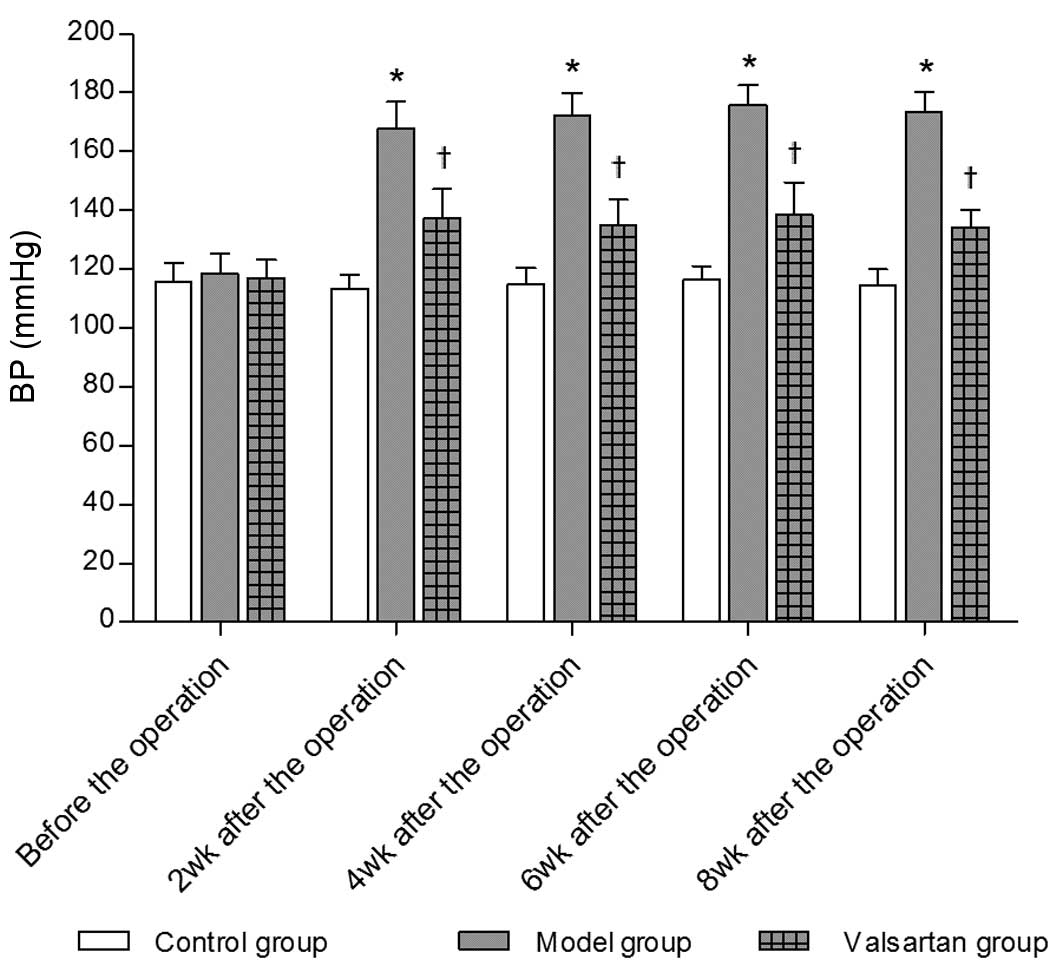
As shown in Fig. 1, systolic BP was significantly increased in the MH rats compared with that in the control rats, but was normalized with valsartan.

Figure 1.

Time course of BP changes in the three groups. Systolic BP increased significantly in the MH rats, and this increase was partly attenuated by valsartan. Results are presented as the mean ± standard deviation.*P<0.05 compared with the control group; †P<0.05 compared with the MH group. BP, blood pressure; MH, myocardial hypertrophy; wk, weeks.

Histology

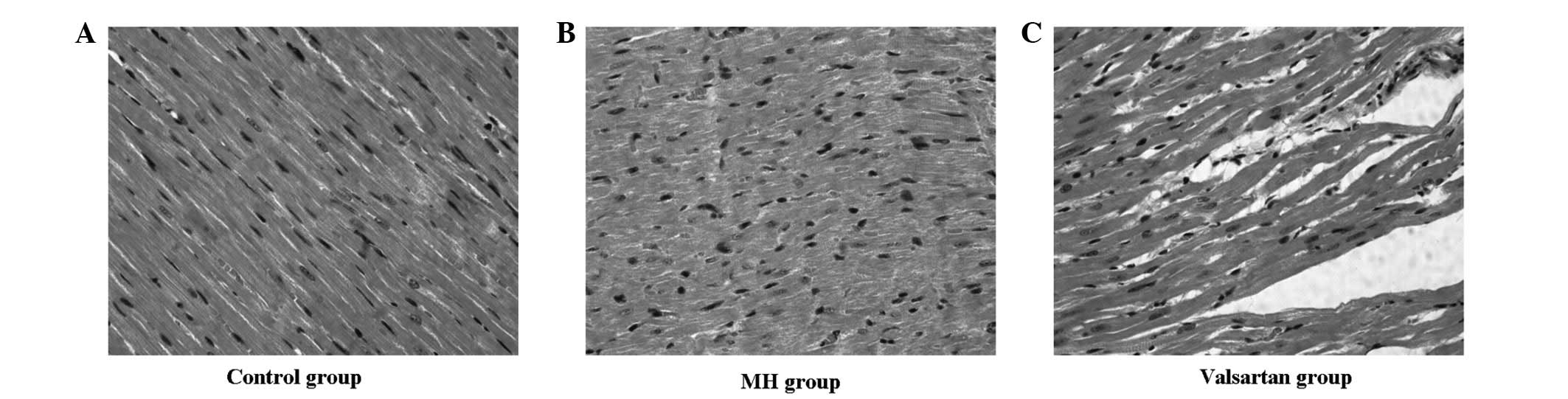
Histological observations were performed eight weeks post-AC. Compared with the control group (Fig. 2A), moderate hypertrophy of the left ventricular cardiomyocytes and enlarged nuclei were observed in MH hearts (Fig. 2B). Only mild hypertrophy of the cardiomyocytes could be observed following valsartan treatment (Fig. 2C).

Figure 2.

Hematoxylin and eosin staining of the myocardium in the (A) control, (B) MH and (C) MH + valsartan groups (magnification, ×400). (A) Eight weeks post-aortic constriction, the left ventricular cardiomyocytes in the control group were observed to form a regular array, with uniform size and non-swollen nuclei. (B) By contrast, cardiomyocytes in the MH rats formed a disorderly, irregular array, with non-uniform sizes and swollen nuclei; (C) these changes were partially reversed by valsartan. MH, myocardial hypertrophy.

Plasma ANP and BNP levels

Plasma ANP and BNP levels were significantly increased in the MH rats compared with those in the sham-operated rats eight weeks after surgery. Valsartan treatment significantly reduced the ANP and BNP levels (Table II).

Table II.

Plasma ANP and BNP levels.

Table II.

Plasma ANP and BNP levels.

Control groupMH groupValsartan group
ANP (pg/ml) 53.1±11.3 90.8±7.8a 60.1±17.7b
BNP (pg/ml) 136.6±11.2 174.4±43.8a 121.5±20.8b

a P<0.05 compared with the control group

b P<0.05 compared with the MH group. MH, myocardial hypertrophy; ANP, atrial natriuretic peptide; BNP, brain natriuretic peptide.

Myocardial mRNA expression of HDAC2, HDAC5 and HDAC9

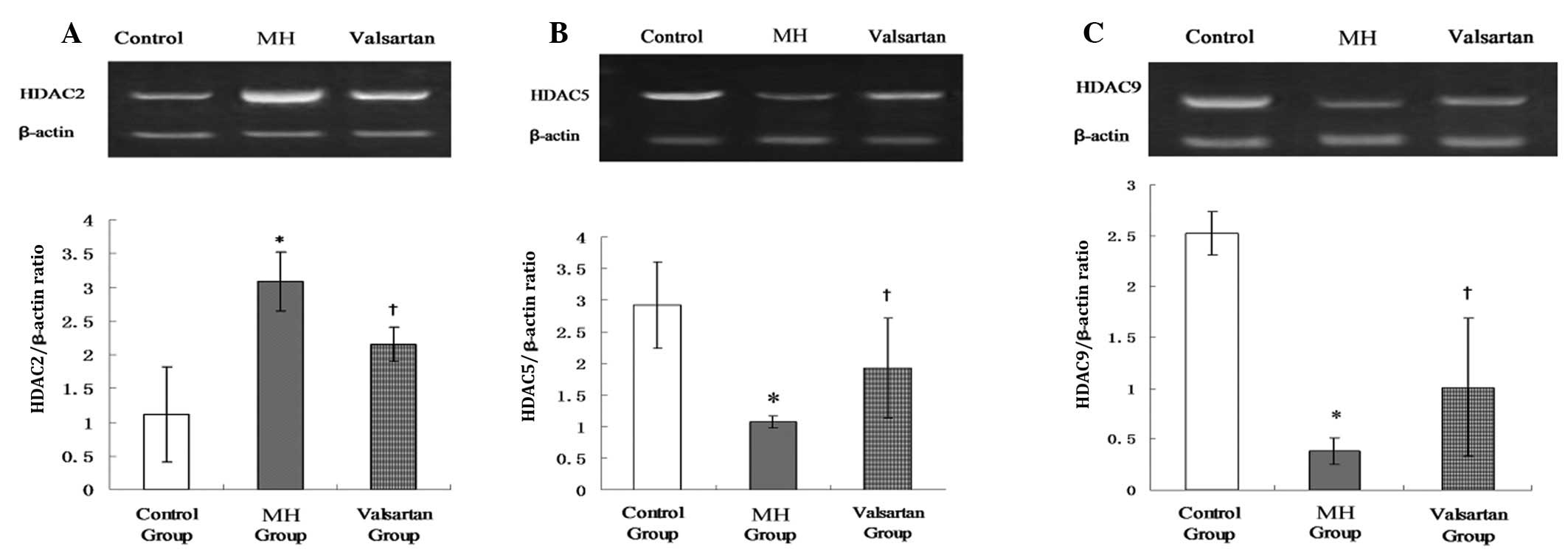
Eight weeks post-AC, the myocardial expression of HDAC2 was significantly upregulated and the myocardial expression of HDAC5 and HDAC9 was significantly downregulated in the MH hearts compared with that in the sham-operated hearts. These changes could be reversed by valsartan (Fig. 3A–C).

Figure 3.

Myocardial (A) HDAC2, (B) HDAC5 and (C) HDAC9 expression in the three groups eight weeks after surgery was detected through a reverse transcription semi-quantitative polymerase chain reaction. The myocardial expression of HDAC2 was significantly upregulated while the myocardial expression of HDAC5 and HDAC9 was significantly downregulated in the MH hearts compared with expression in the control group; however, these changes could be partially reversed by valsartan. Results are presented as the mean ± standard deviation. *P<0.05 compared with the control group; †P<0.05 compared with the MH group. MH, myocardial hypertrophy; HDAC, histone deacetylase.

Discussion

In the present study, it was shown that AC-induced MH was associated with myocardial HDAC expression changes: HDAC2 was upregulated while HDAC5 and HDAC9 were downregulated in MH hearts. These changes could be reversed by valsartan, suggesting that the anti-hypertrophic effects of valsartan could be partly associated with the changes in myocardial HDAC expression. To the best of our knowledge, that is the first report concerning the effects of valsartan on myocardial HDAC expression in an AC-induced model of MH.

It has previously been shown that the dysregulation of gene transcription can promote cardiomyocyte hypertrophy and embryonic gene expression and thus influence cardiac function (17). Furthermore, it has been shown that the enzymes controlling histone acetylation may serve as stress regulators in gene expression in the heart (18), and histone acetylation/deacetylation may be a focal point for the control of cardiac growth and gene expression in response to acute and chronic stress stimuli (19).

The present results have shown that HDAC2 is upregulated in MH rats. It is known that HDAC2 regulates the expression of numerous fetal cardiac isoforms. HDAC2 deficiency or chemical HDAC2 inhibition can prevent the re-expression of fetal genes and attenuate cardiac hypertrophy in hearts exposed to hypertrophic stimuli (20). The present finding that upregulated HDAC2 expression in AC-induced MH hearts can be partly reversed by valsartan is consistent with the above results and suggests that one of the anti-hypertrophic mechanisms of valsartan may be associated with the modulatory effect of valsartan on myocardial HDAC2 expression.

In contrast to HDAC2, HDAC5 and HDAC9 are hypertrophy suppressors, and mice lacking HDAC5 (20) or HDAC9 (21) have been shown to be prone to hypertrophic stimuli. Consistent with the above results, the present study found downregulated HDAC5 and HDAC9 myocardial expression in MH hearts compared with the control hearts; however, the myocardial HDAC5 and HDAC9 expression was significantly upregulated following valsartan treatment.

Increases in BP and plasma ANP and BNP levels are typical findings an AC rat model (22,23). As expected, valsartan reduced the BP and plasma ANP and BNP levels, indicating that BP reduction serves as an important mechanism in the attenuation of AC-induced MH and that reduced plasma ANP and BNP levels may be the consequence of reduced MH following valsartan therapy.

In conclusion, the anti-hypertrophic effects of valsartan may be partially mediated by changes in myocardial HDAC5, HDAC9 and HDAC2 expression in this AC rat model. Further studies in animals with silenced or overexpressed HDAC5, HDAC9 and HDAC2 gene expression are required to establish the role of HDAC5, HDAC9 and HDAC2 in the valsartan-induced effects on MH.

Acknowledgements

This study was supported by grants from the National Natural Science Foundation of China (nos. 30670831 and 30871082).

References

1 

Zhang CL, McKinsey TA, Chang S, et al: Class II histone deacetylases act as signal-responsive repressors of cardiac hypertrophy. Cell. 110:479–488. 2002. View Article : Google Scholar : PubMed/NCBI

2 

Berridge MJ: Remodelling Ca2+ signalling systems and cardiac hypertrophy. Biochem Soc Trans. 34:228–231. 2006. View Article : Google Scholar : PubMed/NCBI

3 

Bisping E, Ikeda S, et al: Transcription factor GATA4 is activated but not required for insulin-like growth factor 1 (IGF1)-induced cardiac hypertrophy. J Biol Chem. 287:9827–9834. 2012. View Article : Google Scholar : PubMed/NCBI

4 

Toko H, Minamino T and Komuro I: Role of heat shock transcriptional factor 1 and heat shock proteins in cardiac hypertrophy. Trends Cardiovasc Med. 18:88–93. 2008. View Article : Google Scholar : PubMed/NCBI

5 

Xie M and Hill JA: HDAC-dependent ventricular remodeling. Trends Cardiovasc Med. 23:229–235. 2013. View Article : Google Scholar : PubMed/NCBI

6 

Di Marcotullio L, Canettieri G, Infante P, et al: Protected from the inside: endogenous histone deacetylase inhibitors and the road to cancer. Biochim Biophys Acta. 1815:241–252. 2011.PubMed/NCBI

7 

Agalioti T, Chen G and Thanos D: Deciphering the transcriptional histone acetylation code for a human gene. Cell. 111:381–392. 2002. View Article : Google Scholar : PubMed/NCBI

8 

Hang CT, Yang J, Han P, et al: Chromatin regulation by Brg1 underlies heart muscle development and disease. Nature. 466:62–67. 2010. View Article : Google Scholar : PubMed/NCBI

9 

Pedram A, Razandi M, Narayanan R, et al: Estrogen regulates histone deacetylases to prevent cardiac hypertrophy. Mol Biol Cell. 24:3805–3818. 2013. View Article : Google Scholar : PubMed/NCBI

10 

Kee HJ, Sohn IS, Nam KI, et al: Inhibition of histone deacetylation blocks cardiac hypertrophy induced by angiotensin II infusion and aortic banding. Circulation. 113:51–59. 2006. View Article : Google Scholar : PubMed/NCBI

11 

Prisant LM: Management of hypertension in patients with cardiac disease: use of renin-angiotensin blocking agents. Am J Med. 121:(8 Suppl). S8–S15. 2008. View Article : Google Scholar : PubMed/NCBI

12 

Shimada YJ, Passeri JJ, Baggish AL, et al: Effects of losartan on left ventricular hypertrophy and fibrosis in patients with nonobstructive hypertrophic cardiomyopathy. JACC Heart Fail. 1:480–487. 2013. View Article : Google Scholar : PubMed/NCBI

13 

Li L, Zhou N, Gong H, et al: Comparison of angiotensin II type 1-receptor blockers to regress pressure overload-induced cardiac hypertrophy in mice. Hypertens Res. 33:1289–1297. 2010. View Article : Google Scholar : PubMed/NCBI

14 

Gao S, Long CL, Wang RH, et al: K(ATP) activation prevents progression of cardiac hypertrophy to failure induced by pressure overload via protecting endothelial function. Cardiovasc Res. 83:444–456. 2009. View Article : Google Scholar : PubMed/NCBI

15 

Lovenberg W: Animal models for hypertension research. Prog Clin Biol Res. 229:225–240. 1987.PubMed/NCBI

16 

Del Ry S, Clerico A, Giannessi D, et al: Measurement of brain natriuretic peptide in plasma samples and cardiac tissue extracts by means of an immunoradiometric assay method. Scand J Clin Lab Invest. 60:81–90. 2000. View Article : Google Scholar : PubMed/NCBI

17 

Wang N, Frank GD, Ding R, et al: Promyelocytic leukemia zinc finger protein activates GATA4 transcription and mediates cardiac hypertrophic signaling from angiotensin II receptor 2. PLoS One. 7:e356322012. View Article : Google Scholar : PubMed/NCBI

18 

Colussi C, Illi B, Rosati J, et al: Histone deacetylase inhibitors: keeping momentum for neuromuscular and cardiovascular diseases treatment. Pharmacol Res. 62:3–10. 2010. View Article : Google Scholar : PubMed/NCBI

19 

Chu CH, Lo JF, Hu WS, et al: Histone acetylation is essential for ANG-II-induced IGF-IIR gene expression in H9c2 cardiomyoblast cells and pathologically hypertensive rat heart. J Cell Physiol. 227:259–268. 2012. View Article : Google Scholar : PubMed/NCBI

20 

Eom GH, Nam YS, Oh JG, et al: Regulation of acetylation of histone deacetylase 2 by p300/CBP-associated factor/histone deacetylase 5 in the development of cardiac hypertrophy. Circ Res. 114:1133–1143. 2014. View Article : Google Scholar : PubMed/NCBI

21 

Greco TM, Yu F, Guise AJ and Cristea IM: Nuclear import of histone deacetylase 5 by requisite nuclear localization signal phosphorylation. Mol Cell Proteomics. 10:M110.0043172011. View Article : Google Scholar : PubMed/NCBI

22 

Nader L, Lahoud L, Chouery E, et al: B-type natriuretic peptide receptors in hypertrophied adult rat cardiomyocytes. Ann Cardiol Angeiol (Paris). 59:20–24. 2010. View Article : Google Scholar : PubMed/NCBI

23 

Ito H, Hiroe M, Hirata Y, et al: Endothelin ETA receptor antagonist blocks cardiac hypertrophy provoked by hemodynamic overload. 89:2198–2203. 1994.PubMed/NCBI

Related Articles

  • Abstract
  • View
  • Download
  • Twitter
Copy and paste a formatted citation
Spandidos Publications style
Xu WP, Yao TQ, Jiang YB, Zhang MZ, Wang YP, Yu Y, Li JX and Li YG: Effect of the angiotensin II receptor blocker valsartan on cardiac hypertrophy and myocardial histone deacetylase expression in rats with aortic constriction. Exp Ther Med 9: 2225-2228, 2015.
APA
Xu, W., Yao, T., Jiang, Y., Zhang, M., Wang, Y., Yu, Y. ... Li, Y. (2015). Effect of the angiotensin II receptor blocker valsartan on cardiac hypertrophy and myocardial histone deacetylase expression in rats with aortic constriction. Experimental and Therapeutic Medicine, 9, 2225-2228. https://doi.org/10.3892/etm.2015.2374
MLA
Xu, W., Yao, T., Jiang, Y., Zhang, M., Wang, Y., Yu, Y., Li, J., Li, Y."Effect of the angiotensin II receptor blocker valsartan on cardiac hypertrophy and myocardial histone deacetylase expression in rats with aortic constriction". Experimental and Therapeutic Medicine 9.6 (2015): 2225-2228.
Chicago
Xu, W., Yao, T., Jiang, Y., Zhang, M., Wang, Y., Yu, Y., Li, J., Li, Y."Effect of the angiotensin II receptor blocker valsartan on cardiac hypertrophy and myocardial histone deacetylase expression in rats with aortic constriction". Experimental and Therapeutic Medicine 9, no. 6 (2015): 2225-2228. https://doi.org/10.3892/etm.2015.2374
Copy and paste a formatted citation
x
Spandidos Publications style
Xu WP, Yao TQ, Jiang YB, Zhang MZ, Wang YP, Yu Y, Li JX and Li YG: Effect of the angiotensin II receptor blocker valsartan on cardiac hypertrophy and myocardial histone deacetylase expression in rats with aortic constriction. Exp Ther Med 9: 2225-2228, 2015.
APA
Xu, W., Yao, T., Jiang, Y., Zhang, M., Wang, Y., Yu, Y. ... Li, Y. (2015). Effect of the angiotensin II receptor blocker valsartan on cardiac hypertrophy and myocardial histone deacetylase expression in rats with aortic constriction. Experimental and Therapeutic Medicine, 9, 2225-2228. https://doi.org/10.3892/etm.2015.2374
MLA
Xu, W., Yao, T., Jiang, Y., Zhang, M., Wang, Y., Yu, Y., Li, J., Li, Y."Effect of the angiotensin II receptor blocker valsartan on cardiac hypertrophy and myocardial histone deacetylase expression in rats with aortic constriction". Experimental and Therapeutic Medicine 9.6 (2015): 2225-2228.
Chicago
Xu, W., Yao, T., Jiang, Y., Zhang, M., Wang, Y., Yu, Y., Li, J., Li, Y."Effect of the angiotensin II receptor blocker valsartan on cardiac hypertrophy and myocardial histone deacetylase expression in rats with aortic constriction". Experimental and Therapeutic Medicine 9, no. 6 (2015): 2225-2228. https://doi.org/10.3892/etm.2015.2374
Follow us
  • Twitter
  • LinkedIn
  • Facebook
About
  • Spandidos Publications
  • Careers
  • Cookie Policy
  • Privacy Policy
How can we help?
  • Help
  • Live Chat
  • Contact
  • Email to our Support Team