Introduction
Brachytherapy is an ideal treatment for clinically
localized prostate cancer. When compared with radical
prostatectomy, brachytherapy is often well-tolerated, with only
mild to moderate urinary morbidity; however, urinary complications
following brachytherapy, such as bladder-outlet obstruction or
urinary retention, have been reported in up to 15% of the men that
have undergone the procedure (1).
Several alternatives for the treatment of post-brachytherapy
retention have been reported in the literature, including prolonged
suprapubic catheterization, intermittent self-catheterization,
urethral endoprosthesis and transurethral resection of the prostate
(TURP) (2,3). The present case report describes the
treatment of the condition with bipolar button-electrode plasma
vaporization of the prostate, which was found to be a considerably
safer procedure than TURP for the management of post-brachytherapy
retention.
Case report
A 70-year-old male patient with a history of
brachytherapy for prostate cancer visited the Department of Urology
of the First Affiliated Hospital of the School of Medicine of
Zhejiang University (Hangzhou, China) due to urinary retention that
had been apparent for 6 months. During those 6 months, the patient
had repeatedly failed 5 voiding trials, despite receiving
concomitant α-blockers and anti-inflammatory medication. TURP was
therefore performed. Written informed consent was obtained from the
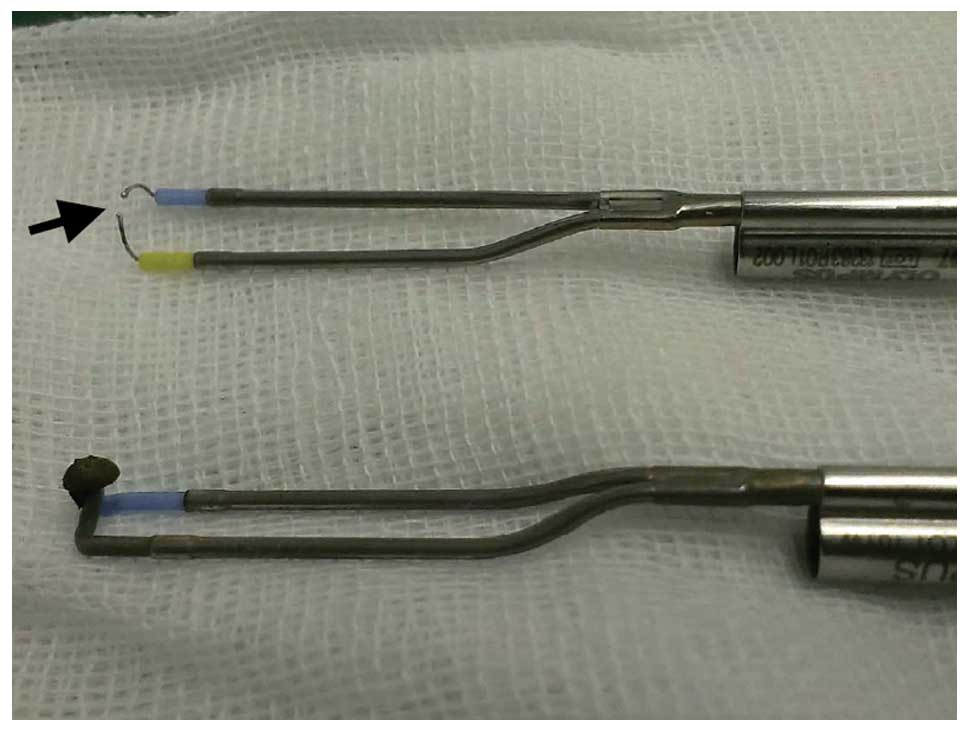
patient for the publication of this case report. During the bipolar
TURP procedure, it was found that the electrical loop generated
high levels of energy when encountering the seeds intraoperatively,
which, in turn, melted and ruptured the loop (Fig. 1). The electrical loop was thus
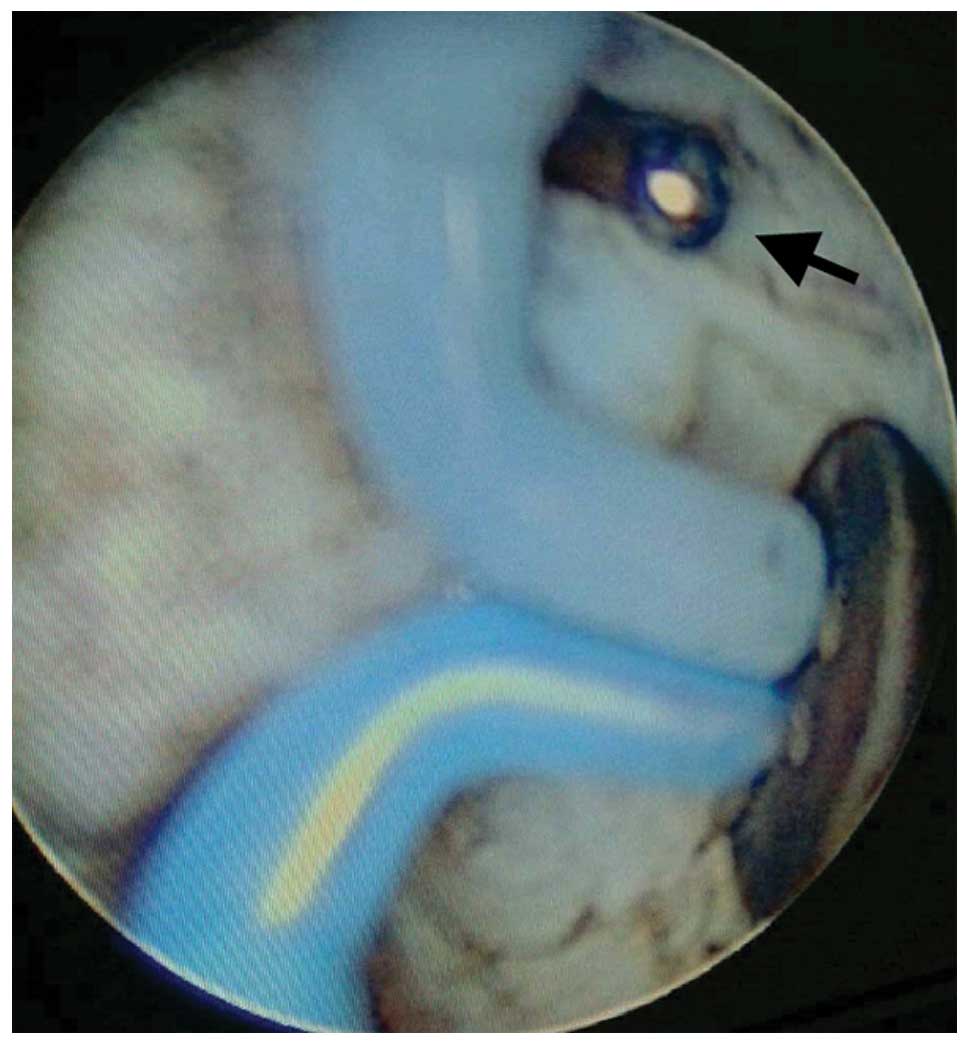
exchanged for a button electrode, which was used for the
vaporization procedure. The ‘button-type’ electrode, which has a
larger contacting surface than the electrical loop, could tolerate
the high levels of energy generated by the electrode-seed contact
well and was firm enough to dislodge the seeds (Fig. 2). The vaporization of the prostate
was successfully performed, and the patient recovered
uneventfully.
Discussion
Various improvements and modifications have been
made to the surgical treatment of benign prostatic hyperplasia over
the last decade. Bipolar technology has gained increasing worldwide
popularity, since it allows for the resection of the prostate gland
in saline solution. With the use of saline as the irrigant, bipolar
TURP reduces the risk of TUR syndrome, which results from
hyponatremia following the absorption of irrigation fluid (4). In addition, bipolar resection improves
hemostasis, resulting in enhanced intraoperative visualization.
Bipolar TURP is therefore preferable as a procedure, due to the
fact that it has a more favorable safety profile (5); however, in rare cases, the implanted
seeds can short-circuit the conventional electrical loop, which
consequently generates high energy levels that can break the
electrical loop and cause spark discharge.
A bipolar plasmakinetic vaporization system with a
novel ‘button-type’ electrode has been described as a safe and
effective alternative for the treatment of patients with lower
urinary tract symptoms from bladder-outlet obstruction (6). Compared with conventional endoscopic
technique, vaporization (7) or
enucleation (8,9) of the prostate with a ‘button-type’
electrode exhibits superior efficacy and safety. In the present
case, the bipolar plasmakinetic vaporization system was found to be
a more effective surgical instrument than the conventional
electrical loop. The button-type electrode has a larger contacting
surface, which can disperse the transient high energy levels
generated by the short circuit. Furthermore, the button-type
electrode is firm enough to dislodge the implanted seeds. We
therefore suggest that bipolar plasma vaporization of the prostate
with a button electrode is an ideal option for patients suffering
from post-brachytherapy retention.
References
|
1
|
No D, Osterberg EC, Otto B, Naftali I and
Choi B: Evaluation of continence following 532 nm laser
prostatectomy for patients previously treated with radiation
therapy or brachytherapy. Lasers Surg Med. 45:358–361. 2013.
View Article : Google Scholar : PubMed/NCBI
|
|
2
|
Kerkeni W, Chahwan C, Lenormand C, Dubray
B, Benyoucef A and Pfister C: Usefulness of urethral endoprosthesis
in the management of urinary retention after brachytherapy for
localized prostate cancer. Prog Urol. 24:164–166. 2014.(In French).
View Article : Google Scholar : PubMed/NCBI
|
|
3
|
Stone NN: Transurethral resection versus
intermittent catheterization in patients with retention after
combined brachytherapy/external beam radiotherapy for prostate
cancer: Transurethral resection. J Urol. 189:800–801. 2013.
View Article : Google Scholar : PubMed/NCBI
|
|
4
|
Tang Y, Li J, Pu C, Bai Y, Yuan H, Wei Q
and Han P: Bipolar transurethral resection versus monopolar
transurethral resection for benign prostatic hypertrophy: A
systematic review and meta-analysis. J Endourol. 28:1107–1114.
2014. View Article : Google Scholar : PubMed/NCBI
|
|
5
|
Mamoulakis C, Ubbink DT and de la Rosette
JJ: Bipolar versus monopolar transurethral resection of the
prostate: A systematic review and meta-analysis of randomized
controlled trials. Eur Urol. 56:798–809. 2009. View Article : Google Scholar : PubMed/NCBI
|
|
6
|
Reich O, Schlenker B, Gratzke C, Tilki D,
Riecken M, Stief C, Seitz M and Bachmann A: Plasma vaporisation of
the prostate: Initial clinical results. Eur Urol. 57:693–697. 2010.
View Article : Google Scholar : PubMed/NCBI
|
|
7
|
Zhang SY, Hu H, Zhang XP, Wang D, Xu KX,
Na YQ, Huang XB and Wang XF: Efficacy and safety of bipolar plasma
vaporization of the prostate with “button-type” electrode compared
with transurethral resection of prostate for benign prostatic
hyperplasia. Chin Med J (Engl). 125:3811–3814. 2012.PubMed/NCBI
|
|
8
|
Xie L, Mao Q, Chen H, Qin J, Zheng X, Lin
Y, Wang X and Liu B: Transurethral vapor enucleation and resection
of the prostate with plasma vaporization button electrode for the
treatment of benign prostatic hyperplasia: A feasibility study. J
Endourol. 26:1264–1266. 2012. View Article : Google Scholar : PubMed/NCBI
|
|
9
|
Zhang K, Sun D, Zhang H, Cao Q and Fu Q:
Plasmakinetic vapor enucleation of the prostate with button
electrode versus plasmakinetic resection of the prostate for benign
prostatic enlargement >90 ml: Perioperative and 3-Month
follow-up results of a prospective, randomized clinical trial. Urol
Int. June 2–2015.(Epub ahead of print). View Article : Google Scholar
|