Introduction
Small-cell lung cancer (SCLC) accounts for ~15% of
all newly diagnosed lung cancers (1). SCLC is characterized by a rapid
doubling time, high growth fraction, and the early development of
distant metastases; ~2/3 of patients with SCLC present with
extensive-stage disease (1).
Systemic chemotherapy is the main treatment for all SCLCs, limited
or extensive (1).
For limited-stage SCLC (LS-SCLC), the addition of
thoracic radiation therapy (RT) to chemotherapy improves local
control and survival, and concurrent chemoradiotherapy is
considered the standard of care (2).
For extensive-stage (ES)-SCLC, the purpose of RT is generally
limited to palliation (2,3). However, a recent multicenter randomized
trial reported that thoracic RT lowered disease progression and
improved survival rates in select patients with ES-SCLC who
responded to initial chemotherapy (4).
Stereotactic body RT (SBRT) uses high-precision
external beam RT to target small, well-defined tumors with a high
radiation dose per fraction and short treatment courses (5). A high target dose is possible in SBRT
without increasing normal tissue toxicity due to the steep dose
gradients outside the target (6).
Compared with conventional RT, SBRT substantially improved local
control and survival in patients with inoperable early-stage
non-SCLC (NSCLC) (5,6). However, the benefits of SBRT have
rarely been examined in SCLC.
The present study reports the long-term outcome of a
patient with ES-SCLC who responded remarkably to chemotherapy and
subsequently received thoracic SBRT for the post-chemotherapy
control of remnant cancer in the lung periphery.
Case report
A 62-year-old female was referred to the
Soonchunhyang University Cheonan Hospital (Cheonan, Korea)
following cancer diagnosis and the completion of 6 cycles of
standard chemotherapy (cisplatin and etoposide) from January to
June 2011 at another hospital. The patient had pathologically
determined SCLC, and the TNM stage was determined by a physical
examination, pulmonary function tests, chest contrast-enhanced
computed tomography (CT), 18F-fluorodeoxyglucose
positron emission tomography (PET)-CT and brain magnetic resonance
imaging, which were performed prior to the patient's admission to
our hospital. The clinical stage was determined to be extensive or
T4N3M0 (IIIB), according to the American Joint Committee on Cancer
staging system, 7th ed (7). The
patient had separate tumor nodules in the right upper and middle
lobes, and multiple metastatic lymph nodes were present in the
mediastinum bilaterally.
The imaging studies were repeated in August 2011 to
evaluate the response to chemotherapy, and a right upper lobe mass
was thought to be a tumor remnant; the mass had a maximum diameter
of 1.5 cm and a maximized standard uptake value of 3.5. After
noting an excellent response to chemotherapy with a small remaining
viable peripheral lung mass, SBRT was used at our hospital to treat
the residual tumor of the patient.
SBRT was performed in August 2011 using a Novalis Tx
system (Varian Medical Systems, Palo Alto, CA, USA; Brainlab,
Feldkirchen, Germany). During the simulation process, the patient
was immobilized in the supine position with her arms above her
head. The simulation was conducted using 4-dimensional CT
(Brilliance CT Big Bore; Philips Medical Systems, Cleveland, OH,
USA) and a real-time position-management system (Varian Medical
Systems). The gross tumor volume was delineated on each respiratory
phase CT image using the ‘lung window’ setting. The clinical target
volume was equivalent to the gross tumor volume. The internal
target volume was created from the sum of the clinical target
volumes during the 10 respiratory phases. The planning target
volume was generated by adding a 0.5-cm isotropic set-up margin
around the internal target volume. Adjacent organs at risk were
outlined, including the lungs, spinal cord, esophagus, trachea,
proximal bronchial tree, heart, great vessels, ribs, and skin. The
SBRT plan was created using the Eclipse treatment planning system
(Varian Medical Systems) and 6 MV photons, with inhomogeneity
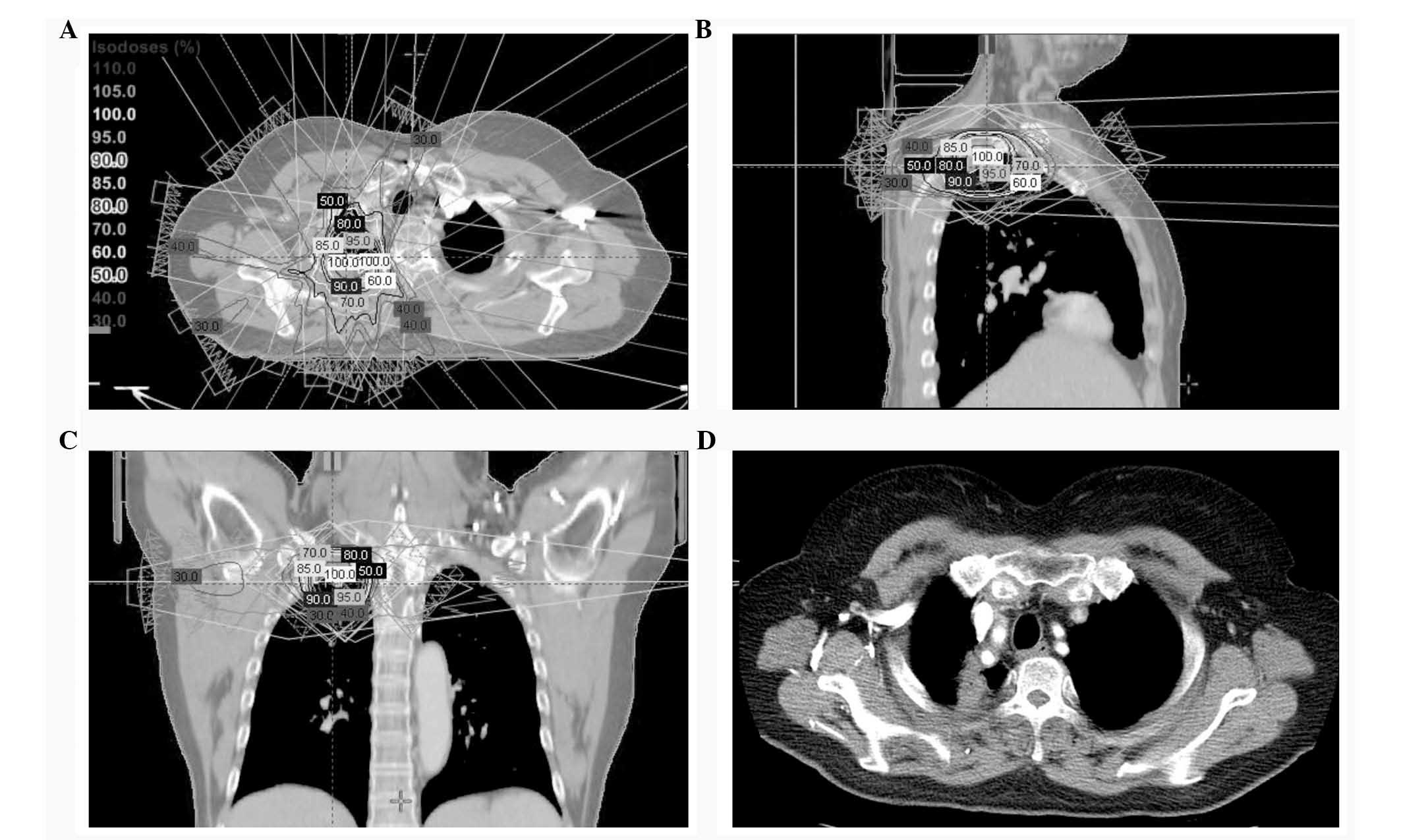
corrections. The fixed-field intensity modulated RT used 7
non-opposing coplanar beams (Fig.
1A–C). The dose fractionation scheme was 48 Gy in 4 fractions
delivered on consecutive days, and the prescribed dose covered 95%
of the planning target volume conformally. Prior to each treatment,
cone beam CT was performed to minimize the set-up error.
Prophylactic cranial irradiation (PCI) (8) was given in September 2011, as 25 Gy in
10 fractions using 6 MV photons and two opposed lateral fields.
The patient was followed-up every 3 months for the
first 2 years and every 6 months thereafter. A physical examination
and chest CT were performed at each visit and PET-CT yearly. A
complete response to SBRT was observed along with signs of
radiation pneumonitis or fibrosis on follow-up imaging (Fig. 1D), although the patient developed no
pulmonary symptoms. The patient is alive with no evidence of
disease 4 years after treatment. The present study was performed in
accordance with the guidelines of the Institutional Review Board
and informed consent was obtained from the patient prior to
commencing SBRT.
Discussion
Currently, the use of thoracic SBRT in primary lung
cancer is restricted to NSCLC (9).
For patients with stage I NSCLC who are medically inoperable or
refuse surgery, conventional RT has disappointing outcomes; the
3-year survival rate is 20–35%, with local control rates of 30–40%
(9). Since SBRT replaced
conventional RT for these patients, there has been a marked
improvement in patient prognosis; the 3-year survival rate is ~60%
and the local control exceeds 85–90%, comparable to the outcomes
after surgery (9,10). The primary reason for poor tumor
control with conventional RT is the insufficient target dose, which
is ~60 Gy (11). Conversely, the
minimum biological effective dose (BED) delivered by SBRT >100
Gy10 (11).
Compared with NSCLC, few studies have investigated
SBRT in SCLC (12–14). One reason is that ~5% of SCLCs are
stage I (15). Surgery can be
considered instead of RT for stage I SCLC (16). For inoperable stage I SCLC, a few
case studies have addressed the use of SBRT. Shioyama et al
(12) reported the SBRT outcomes of
8 cases with stage I SCLC: 6 patients were inoperable and 2 refused
surgery. The SBRT treatment plan was 48 Gy delivered in 4
fractions. Chemotherapy was given to 6 patients, and no PCI was
performed. The 3-year local control and survival rates were 100%
and 72%, respectively. SBRT-associated toxicity of grade 2 or more
was not observed (12). Videtic
et al (13) reported 6 cases
with inoperable stage I SCLC whose primary tumors were managed with
SBRT. The SBRT treatment plan was 60 Gy in 3 fractions, 50 Gy in 5
fractions, or 30 Gy in 1 fraction. A total of 4 patients received
chemotherapy and PCI. The 1-year local control and survival rates
were 100% and 63%, respectively. Only 1 case of grade 2 toxicity
was observed, with no grade ≥3 toxicity (13). Ly et al (14) reported the SBRT outcomes of 8
patients with inoperable stage I SCLC and 3 patients who received
SBRT as a salvage treatment for recurrent stage I SCLC. The
investigators suggested that SBRT is a reasonable approach for
inoperable stage I SCLC, and stressed the importance of post-SBRT
chemotherapy (14). These studies
demonstrated the potential value of SBRT for SCLC, which was
concordant with its recognized value in NSCLC. However, to the best
of our knowledge, to date no study has explored curative effect of
thoracic SBRT for the treatment of ES-SCLC.
Thoracic RT is not an established treatment for
ES-SCLC, except for symptom palliation (2). However, a small number of randomized
trials demonstrated the beneficial effects of conventional thoracic
RT in select ES-SCLC patients (4,17).
Jeremic et al (17)
randomized 109 ES-SCLC patients who showed both a complete response
at distant lesions and at least a partial response at local lesions
following 3 initial chemotherapy cycles. The group that also
received thoracic RT (54 Gy/36 fractions, b.i.d.) showed better
local control and survival compared with the control group
receiving further chemotherapy alone (17). Recently, the results of a
multi-institutional randomized controlled trial were reported
(4). Slotman et al (4) analyzed the outcomes of 495 patients
with ES-SCLC who responded to 4–6 initial cycles of chemotherapy. A
group of 247 patients randomized to receive thoracic RT (30 Gy/10
fractions) and PCI showed improvement in terms of disease
progression and survival compared with the control group, who
received PCI and no thoracic RT (2-year survival, 13% vs. 3%;
P=0.004) (4). There was a 50%
reduction in intrathoracic recurrence when thoracic RT was added,
although >40% of the patients treated in this manner still had
intrathoracic recurrence (4). The
authors suggested that a higher radiation dose using advanced
delivery techniques would be more efficacious (4). In the present study, SBRT with novel RT
technology was used to deliver a high radiation dose precisely and
safely. The BED of 30 Gy/10 fractions was 39.0 Gy10,
whereas that of 48 Gy/4 fractions (the current case) was 105.6
Gy10.
The definition of the appropriate RT target volume
for SCLC has not been fully defined. Regarding the RT target volume
in LS-SCLC, recent studies have recommended that the post-induction
chemotherapy tumor extent be considered and that elective nodal
irradiation is not necessary (18–21). For
ES-SCLC, the RT target volume in two randomized trials included
pre-chemotherapy metastatic mediastinal or hilar lymph nodes
(4,17). Conversely, a phase II trial
investigating thoracic RT for ES-SCLC used an RT target volume
limited to the post-chemotherapy residual tumor (22). SBRT was selected for the present
patient as only the right upper lobe mass was suspected to be
residual tumor. Lung SBRT typically targets small masses located in
the peripheral lung (6,11). Chemotherapy response was evaluated
using both chest CT and PET-CT. van Loon et al (23) compared
18F-fluorodeoxyglucose PET- and CT-based selective nodal
irradiation in SCLC and showed that the former yielded lower rates
of isolated nodal failure and RT-associated toxicities. The results
of the study suggested that PET-CT was the most reliable method for
staging the mediastinum in SCLC, excluding pathological
verification. This post-chemotherapy assessment was deemed to have
been accurate since there has been no disease recurrence inside or
outside the SBRT target volume.
In conclusion, a careful evaluation of the
chemotherapy response is mandatory for the implementation of SBRT
in ES-SCLC, of which the target volume is typically limited. When
this condition is met, SBRT will enable enhanced local tumor
control and patient survival compared with conventional RT
encompassing a wide target volume or further chemotherapy without
any RT. The results of the present case report suggests the
efficacy of SBRT in select ES-SCLC patients who have a small amount
of residual tumor in the peripheral lung following
chemotherapy.
Acknowledgements
The present study was supported by the Soonchunhyang
University Research Fund.
References
|
1
|
Hann CL and Rudin CM: Management of
small-cell lung cancer: Incremental changes but hope for the
future. Oncology (Williston Park). 22:1486–1492. 2008.PubMed/NCBI
|
|
2
|
Kong FM, Lally BE, Chang JY, Chetty IJ,
Decker RH, Ginsburg ME, Kestin LL, Langer CJ, Movsas B, Videtic GM,
et al: ACR appropriateness criteria® radiation therapy
for small-cell lung cancer. Am J Clin Oncol. 36:206–213. 2013.
View Article : Google Scholar : PubMed/NCBI
|
|
3
|
Pignon JP, Arriagada R, Ihde DC, Johnson
DH, Perry MC, Souhami RL, Brodin O, Joss RA, Kies MS, Lebeau B, et
al: A meta-analysis of thoracic radiotherapy for small-cell lung
cancer. N Engl J Med. 327:1618–1624. 1992. View Article : Google Scholar : PubMed/NCBI
|
|
4
|
Slotman BJ, van Tinteren H, Praag JO,
Knegjens JL, El Sharouni SY, Hatton M, Keijser A, Faivre-Finn C and
Senan S: Use of thoracic radiotherapy for extensive stage
small-cell lung cancer: A phase 3 randomised controlled trial.
Lancet. 385:36–42. 2015. View Article : Google Scholar : PubMed/NCBI
|
|
5
|
Soldà F, Lodge M, Ashley S, Whitington A,
Goldstraw P and Brada M: Stereotactic radiotherapy (SABR) for the
treatment of primary non-small cell lung cancer; systematic review
and comparison with a surgical cohort. Radiother Oncol. 109:1–7.
2013. View Article : Google Scholar : PubMed/NCBI
|
|
6
|
Guckenberger M, Andratschke N, Alheit H,
Holy R, Moustakis C, Nestle U and Sauer O: Deutschen Gesellschaft
für Radioonkologie (DEGRO): Definition of stereotactic body
radiotherapy: Principles and practice for the treatment of stage I
non-small cell lung cancer. Strahlenther Onkol. 190:26–33. 2014.
View Article : Google Scholar : PubMed/NCBI
|
|
7
|
Edge S, Byrd DR, Compton CC, Fritz AG,
Greene FL and Trotti A: AJCC Cancer Staging Manual (7th). Springer.
New York, NY: 2010.
|
|
8
|
Slotman B, Faivre-Finn C, Kramer G, Rankin
E, Snee M, Hatton M, Postmus P, Collette L, Musat E and Senan S:
EORTC Radiation Oncology Group and Lung Cancer Group: Prophylactic
cranial irradiation in extensive small-cell lung cancer. N Engl J
Med. 357:664–672. 2007. View Article : Google Scholar : PubMed/NCBI
|
|
9
|
Timmerman R, Paulus R, Galvin J, Michalski
J, Straube W, Bradley J, Fakiris A, Bezjak A, Videtic G, Johnstone
D, et al: Stereotactic body radiation therapy for inoperable early
stage lung cancer. JAMA. 303:1070–1076. 2010. View Article : Google Scholar : PubMed/NCBI
|
|
10
|
Yeo SG and Kim ES: Efficient approach for
determining four-dimensional computed tomography-based internal
target volume in stereotactic radiotherapy of lung cancer. Radiat
Oncol J. 31:247–251. 2013. View Article : Google Scholar : PubMed/NCBI
|
|
11
|
Kim MJ, Yeo SG, Kim ES, Min CK and Se An
P: Intensity-modulated stereotactic body radiotherapy for stage I
non-small cell lung cancer. Oncol Lett. 5:840–844. 2013.PubMed/NCBI
|
|
12
|
Shioyama Y, Nakamura K, Sasaki T, Ohga S,
Yoshitake T, Nonoshita T, Asai K, Terashima K, Matsumoto K, Hirata
H and Honda H: Clinical results of stereotactic body radiotherapy
for Stage I small-cell lung cancer: A single institutional
experience. J Radiat Res. 54:108–112. 2013. View Article : Google Scholar : PubMed/NCBI
|
|
13
|
Videtic GM, Stephans KL, Woody NM, Pennell
NA, Shapiro M, Reddy CA and Djemil T: Stereotactic body radiation
therapy-based treatment model for stage I medically inoperable
small cell lung cancer. Pract Radiat Oncol. 3:301–306. 2013.
View Article : Google Scholar : PubMed/NCBI
|
|
14
|
Ly NB, Allen PK and Lin SH: Stereotactic
body radiation therapy for stage I small cell lung cancer: A single
institutional case series and review of the literature. J Radiat
Oncol. 3:285–291. 2014. View Article : Google Scholar
|
|
15
|
Ignatius Ou SH and Zell JA: The
applicability of the proposed IASLC staging revisions to small cell
lung cancer (SCLC) with comparison to the current UICC 6th TNM
edition. J Thorac Oncol. 4:300–310. 2009. View Article : Google Scholar : PubMed/NCBI
|
|
16
|
de Hoyos A and DeCamp MM: Surgery for
small cell lung cancer. Thorac Surg Clin. 24:399–409. 2014.
View Article : Google Scholar : PubMed/NCBI
|
|
17
|
Jeremic B, Shibamoto Y, Nikolic N, Milicic
B, Milisavljevic S, Dagovic A, Aleksandrovic J and
Radosavljevic-Asic G: Role of radiation therapy in the
combined-modality treatment of patients with extensive disease
small-cell lung cancer: A randomized study. J Clin Oncol.
17:2092–2099. 1999.PubMed/NCBI
|
|
18
|
Hu X, Bao Y, Zhang L, Guo Y, Chen YY, Li
KX, Wang WH, Liu Y, He H and Chen M: Omitting elective nodal
irradiation and irradiating postinduction versus preinduction
chemotherapy tumor extent for limited-stage small cell lung cancer:
Interim analysis of a prospective randomized noninferiority trial.
Cancer. 118:278–287. 2012. View Article : Google Scholar : PubMed/NCBI
|
|
19
|
Colaco R, Sheikh H, Lorigan P, Blackhall
F, Hulse P, Califano R, Ashcroft L, Taylor P, Thatcher N and
Faivre-Finn C: Omitting elective nodal irradiation during thoracic
irradiation in limited-stage small cell lung cancer - evidence from
a phase II trial. Lung Cancer. 76:72–77. 2012. View Article : Google Scholar : PubMed/NCBI
|
|
20
|
Ricardi U, Badellino S and Filippi AR:
Stereotactic radiotherapy for early stage non-small cell lung
cancer. Radiat Oncol J. 33:57–65. 2015. View Article : Google Scholar : PubMed/NCBI
|
|
21
|
Lee J, Lee J, Choi J, Kim JW, Cho J and
Lee CG: Early treatment volume reduction rate as a prognostic
factor in patients treated with chemoradiotherapy for limited stage
small cell lung cancer. Radiat Oncol J. 33:117–125. 2015.
View Article : Google Scholar : PubMed/NCBI
|
|
22
|
Yee D, Butts C, Reiman A, Joy A, Smylie M,
Fenton D, Chu Q, Hanson J and Roa W: Clinical trial of
post-chemotherapy consolidation thoracic radiotherapy for
extensive-stage small cell lung cancer. Radiother Oncol.
102:234–238. 2012. View Article : Google Scholar : PubMed/NCBI
|
|
23
|
van Loon J, De Ruysscher D, Wanders R,
Boersma L, Simons J, Oellers M, Dingemans AM, Hochstenbag M,
Bootsma G, Geraedts W, et al: Selective nodal irradiation on basis
of (18)FDG-PET scans in limited-disease small-cell lung cancer: A
prospective study. Int J Radiat Oncol Biol Phys. 77:329–336. 2010.
View Article : Google Scholar : PubMed/NCBI
|