Introduction
Parkinson's disease, also known as tremor paralysis,
is the second largest neurodegenerative disease, with morbidity
rates second only to Alzheimer's disease (1). The etiology and pathogenesis of
Parkinson's disease are not clear. The most important pathological
changes are degeneration and loss of dopaminergic neurons in the
substantia nigra of the midbrain, and the formation of
α-synuclein-based acidophilic inclusion bodies (lewy bodies)
(2) in the remaining dopaminergic
neurons. In 2010, it was reported that α-synuclein was secreted out
of the cells through exosomes in a calcium-dependent mechanism
(3). The phenomenon was confirmed by
a group of independent researchers (4). The finding of that study emphasized the
importance of exosomes in the transcellular transport of
α-synuclein, and it strengthened the correlation between the amount
of secreted exosomes and the pathogenesis of Parkinson's disease.
It has also laid a theoretical basis for the early diagnosis and
targeted treatment of Parkinson's disease.
In the present study, the therapeutic effects on
Parkinson's disease of the new dopamine receptor agonist
pramipexole and its relationship with serum exosomes and inclusion
bodies were examined. The possible underlying therapeutic
mechanisms were also investigated.
Patients and methods
Patients
Initially, 68 patients diagnosed with primary
Parkinson's disease were selected from Xianyang Central Hospital
during the period October, 2012 to October, 2014. The diagnoses
were confirmed according to the UK Brain Banks Network. The
inclusion criteria for the study were: i) Age, ≥18 and <75
years. ii) First time diagnosis. Absence of history of Parkinson's
disease drug use. iii) Patients with normal intelligence, good
compliance and complete clinical data. The exclusion criteria for
the study were: i) Symptomatic Parkinson's disease or Parkinson's
plus a syndrome with severe peak dose dyskinesia. History of brain
surgery and trauma, or malignant tumor. ii) Patients required to
stay in bed for long periods of time. Patients with severe heart,
liver and kidney dysfunctions. Patients allergic to pramipexole.
iii) Pregnant and lactating women, patients with mental disorders,
and any patients that refused to participate.
Three patients did not complete the study, while the
remaining 65 cases successfully completed the study. There were 38
men and 27 women, with an age range of 57–74 years, and an average
age of 67.8±9.2 years. The course of disease at the time of
diagnosis ranged from 1 week to 3 months, with an average of
1.2±0.3 months.
Methods
After obtaining the approval of the ethics committee
of the Xianyang Central Hospital and the consent of patients and
their relatives, the patients were administered oral pramipexole
using the following dosing schedule: 0.25 mg twice a day for the
1st week, followed by 0.25 mg 3 times daily for the 2nd week. From
the 3rd to 8th week, the doses were increased gradually starting at
0.25 mg 3 times daily and adding 0.25 mg to each dose every 3 days
until 1,5 mg 3 times daily was achieved and until the end of the
8th week. Subsequently, the doses were tapered, and were reduced by
1.125 mg/week, during the course of the following 4 weeks. Liver
and kidney function, and electrocardiograph indices were
periodically checked and the patients' clinical symptoms were
evaluated often.
Observation indices
Total scores of motor examination of the unified
Parkinson's disease rating scale III (UPDRS III) and total scores
of the daily life activity in UPDRS II, before and after treatment,
were compared. To evaluate the result of the treatment, a reduction
of ≥50% in the score of UPDRS II/III was defined as effective.
The exosomes were separated and purified from sera
using an ExoQuick-TC kit (System Biosciences, Mountain View, CA,
USA). The morphology of the exosomes was detected using a
transmission electron microscope (JEOL, Tokyo, Japan). The presence
of α-synuclein in the exosomes was confirmed by western blot
analysis of the relative expressions.
Detection methods
Isolation of serum exosomes
Elbow venous blood (5 ml) was drawn and placed into
a serum separation gel tube (Becton-Dickinson and Company, Franklin
Lakes, NJ, USA). After mixing, the tubes were maintained at at 37°C
for 30 min. Centrifugation was performed at 2,000 × g at 4°C for 15
min to achieve separation of the contents of each tube into three
layers from top to bottom: serum, separation and blood cell layers.
The serum layer was placed on ice and then stored in 500 µl
aliquots in 1.5 ml Eppendorf tubes (Becton-Dickinson and Company)
at −80°C. An ExoQuick-TC kit was used to purify the exosomes
according to the manufacturer's instructions.
Morphology of exosomes under transmission
electron microscope
Serum samples were thawed and mixed with 200 µl
phosphate-buffered saline (PBS) solution. The electron microscope
copper mesh grid was dipped into the suspension and kept there for
≥20 min. Then, 2–3 PBS solution washes (50 µl each) lasting 1 min
were performed. The suspension was fixed to the copper mesh by the
addition of 10 µl 4% glutaraldehyde for 5 min, followed by filter
paper seeping and a PBS solution rinse. After drying at room
temperature, the rinsed copper mesh was placed under a Hitachi-7500
transmission electron microscope (Lincoln, NE, USA) and images were
captured.
Western blot analysis
Total proteins were extracted from exosomes. The
protein concentration was quantified by the bicinchoninic acid
(BCA) method (Bio-Rad, Berkeley, CA, USA). Electrophoresis was run
on SDS-PAGE gels. Western blotting was performed using rabbit
anti-CD63 polyclonal antibody (dilution, 1:1000) (LifeSpan
Biosciences, Seattle, WA, USA; cat. no.: LS-C387289) and rabbit
anti-CD9 polyclonal antibody (dilution, 1:1000) (LifeSpan
Biosciences; cat. no.: LS-C382578), rabbit polyclonal anti-GAPDH
antibody (dilution, 1:2000) (Abcam, Cambridge, MA, USA; cat. no.:
ab8245), rabbit anti-α-synuclein polyclonal antibody (dilution,
1:1000) (Santa Cruz Biotechnology, Inc., Santa Cruz, CA, USA, cat.
no.: sc-10717), and horseradish peroxidase-labeled goat anti-rabbit
secondary antibody (dilution, 1:5000) (Sigma, St. Louis, MO, USA,
cat. no.: A0545).
Statistical analysis
SPSS 20.0 software (IBM SPSS, Armonk, NY, USA) was
used for statistical analysis. Data were presented as mean ±
standard deviation, the t-test was used for inter-group
comparisons, and enumeration data were presented as a percentage
(%), Spearman correlation analysis was used for α-synuclein in
exosomes and curative effects. P<0.05 was considered to indicate
a statistically significant difference.
Results
General data
Of the initial 68 patients, 3 cases did not complete
the study (2 cases had aggravated symptoms and required change of
medication or a combination of several drugs, and 1 case with
severe liver and kidney damage). The remaining 65 cases
successfully completed the study. There were 38 men and 27 women,
with an age range of 57–74 years, and an average of 67.8±9.2 years.
The course of disease at the time of diagnosis ranged from 1 week
to 3 months, with an average of 1.2±0.3 months.
Identification of exosomes
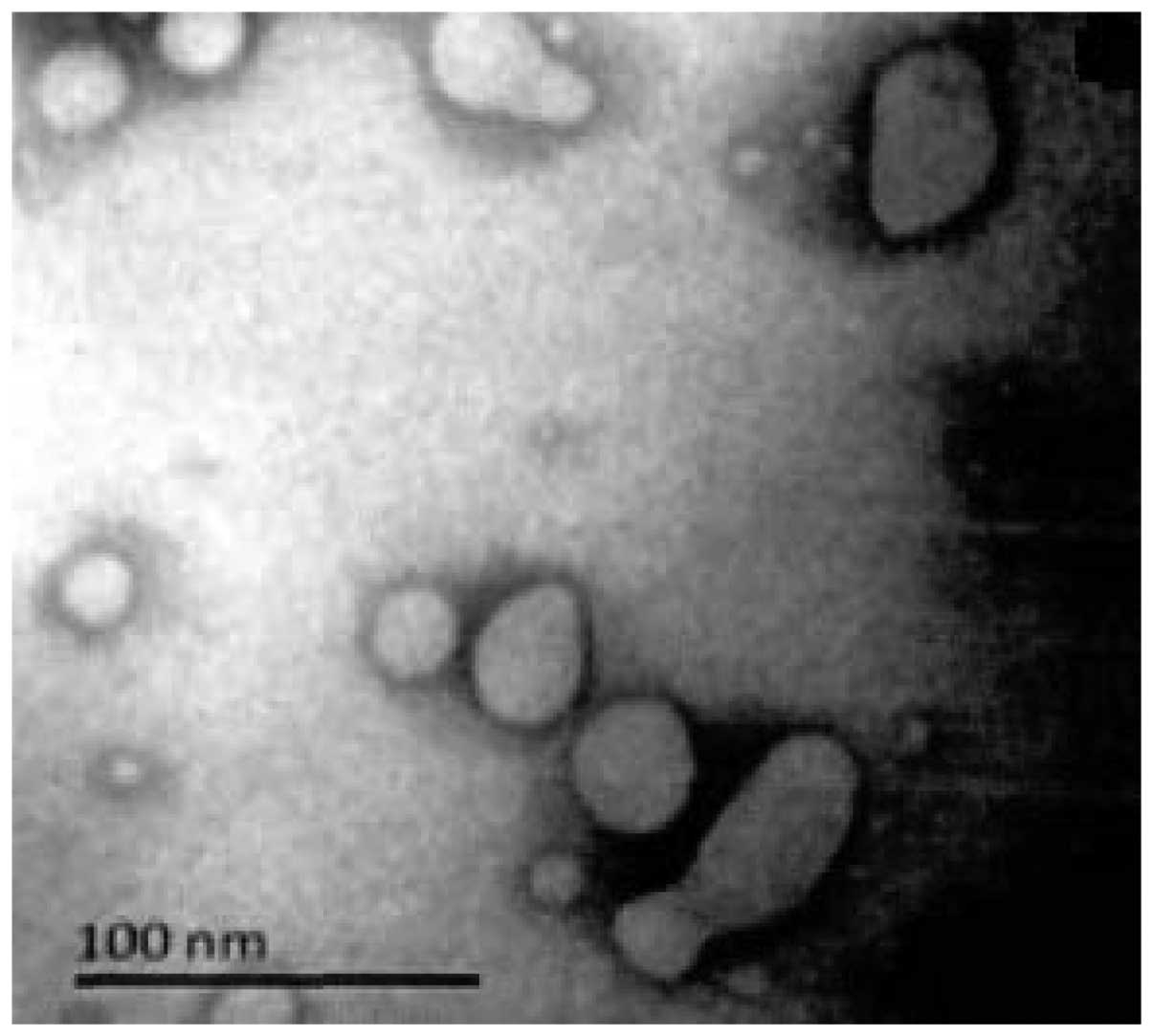
Several vesicle-like structures of uniform size,
with an average diameter of ~50 nm were observed under electron
microscopy (Fig. 1). Exosome-labeled
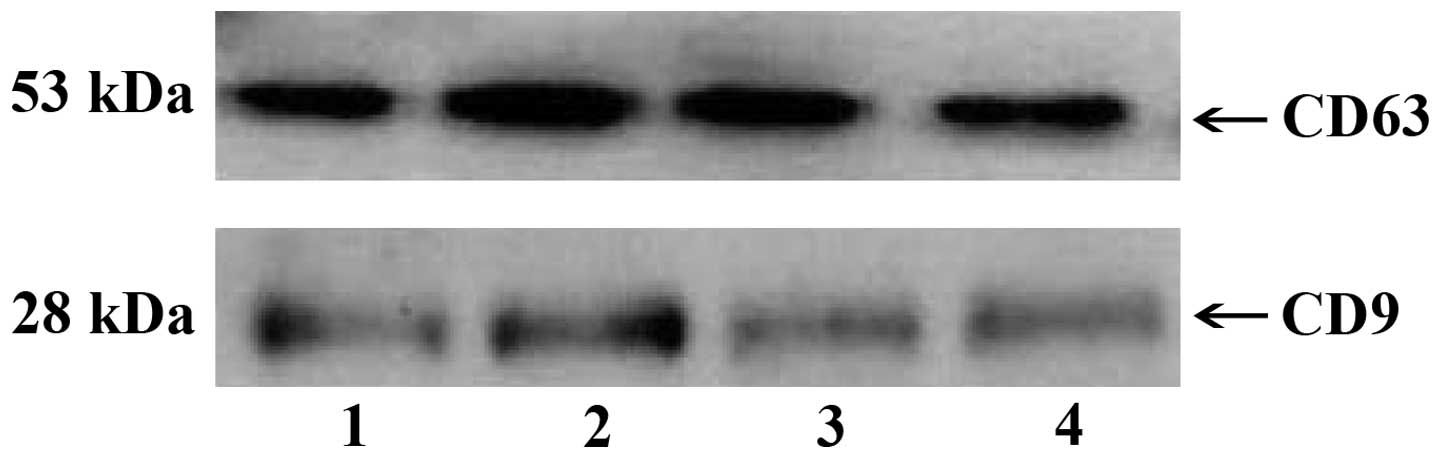
proteins CD63 and CD9 were detected by western blotting in 4
samples (Fig. 2). Furthermore,
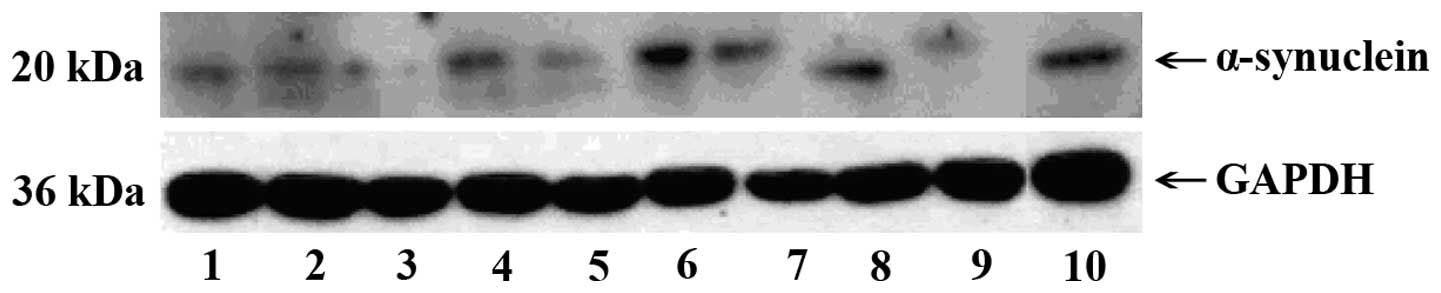
α-synuclein was expressed in exosomes isolated from 10 samples
(Fig. 3).
UPDRS III and UPDRS II scores before
and after treatment
After treatment, UPDRS III and UPDRS II scores were
significantly lower than those before treatment, and the difference
was statistically significant (P<0.05; Table I).
 | Table I.UPDRS III and UPDRS II scores before
and after treatment. |
Table I.
UPDRS III and UPDRS II scores before
and after treatment.
| Items | Pre-treatment | Post-treatment | t | P-value |
|---|
| UPDRS II |
12.6±3.3 |
7.7±1.5 | 5.624 | 0.034 |
| UPDRS III |
30.8±4.4 |
19.5±2.1 | 5.768 | 0.032 |
Relative expression of α-synuclein in
serum exosomes before and after treatment
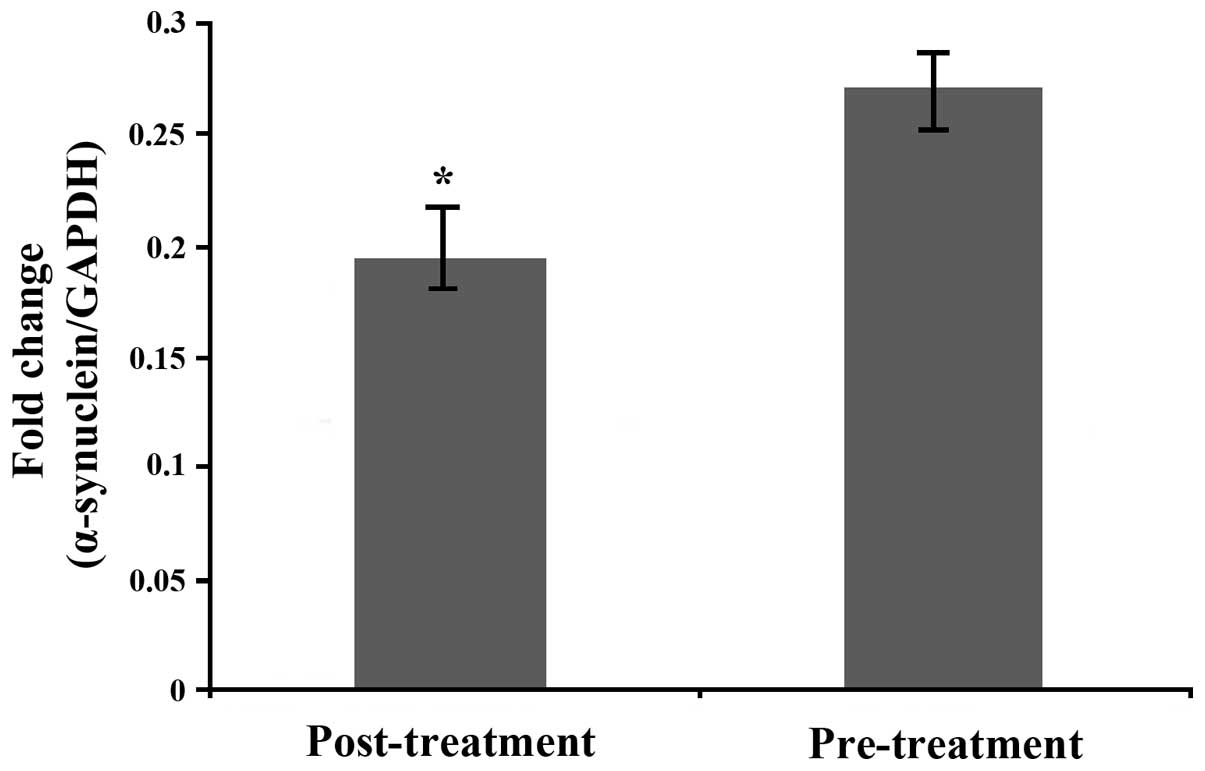
The relative expression of α-synuclein in serum
exosomes after treatment was significantly lower than that before
treatment, and the difference was statistically significant
[(0.27±0.04), t=−0.523, P=0.017] (Fig.
4).
Correlation between the relative
expression of α-synuclein in serum exosomes and therapeutic
effects
From the 65 cases studied, 52 cases had what was
considered effective treatment and 13 cases had an ineffective one.
The relative expression of α-synuclein in the effective treatment
group was significantly lower than that in the ineffective
treatment group, and the difference was statistically significant
[(0.15±0.02 vs. 0.22±0.05), t=−0.603, P<0.01]. The relative
expression of α-synuclein in serum exosomes was significantly
correlated with treatment effects (r=0.426, P=0.029).
Discussion
Exosomes are a membranous microvesicle with a 30–100
nm diameter and 1.13–1.19 g/ml of density (5). They are revealed by a concave disk or
cup mouth shape under the electron microscope (6). As a type of nanomembrane vesicle, it
was firstly identified in the late 1980s in the culture and
differentiation process of sheep reticulocytes (7), In 2005, Caby et al (8) identified the existence of exosomes in
healthy human blood, indicating exosomes could act as a molecular
medium and promote the exchange of information between cells or
organs. Exosomes can be secreted from live cells cultured in
vitro and in vivo (9).
This phenomenon has been observed in neurons (10) and microglia (11) in nerve cells, and lymphocyte and
mononuclear cells in non-neuronal cells. Exosomes also exist in
various body fluid environments, such as serum (12). Detailed information for the
biosynthetic pathway of exosomes has been previously published,
including a useful graph diagram (13).
Exosomes play an important role in nerve development
and regeneration as well as in the deformability of the cortex and
hippocampal neuron synapses (14).
In the case of pathological stimulation or loss, exosomes have
immunostimulatory functions, activating and spreading the
inflammatory response (12). This
inflammatory response has been demonstrated to play an important
role in the pathogenesis of Parkinson's disease. It has been
confirmed to be able to accelerate the degenerative changes of the
substantia nigra (15).
The identification of exosomes requires
morphological observation and protein analysis. In the present
study, the ExoQuick reagent method was used to separate and purify
exosomes. In our experience, compared with the differential
centrifugation method, the output of exosomes obtained from
ExoQuick reagent method was higher and also purer. The
transmembrane 4 superfamily CD63 and CD9 are expressed in exosomes
but not in cytoplasmic membranes; they are, therefore, reliable
exosome markers (16). CD63 and CD9
were abundant in exosome extractions.
α-synuclein is widely expressed in the neuronal
presynaptic membrane and cytoplasm. Mutations on the gene encoding
α-synuclein are closely related to familial Parkinson's disease.
The pathological abnormal aggregation of the protein is thought to
adversely affect synaptic function and signaling, and to promote
neuronal degeneration, playing an important role in the
pathogenesis of Parkinson's disease. At first, α-synuclein was only
thought to be a form of cytoplasmic protein involved in the
dopamine metabolism pathway. However, α-synuclein was also found in
extracellular environments, such as serum (17), cerebrospinal fluid (18) and neuron cell culture (19). In the early onset of Parkinson's
disease, where there is an α-synuclein genic mutation, this protein
was found to play a role in the pathogenesis of the disease. In
2012, it was confirmed (20) that an
α-synuclein oligomer exists in the exosomes of neuron cells and
that the oligomer inside exosomes exhibits higher toxicity than the
sporadic α-synuclein oligomer outside of exosomes. α-synuclein can
be transported outside cells through the exosome channel. Such
discoveries lead to the proposal that exosomes can transmit
potential toxic proteins and cause disease in neighboring cells.
Therefore, exosomes were dubbed the ‘Trojan Horse’ of
neurodegenerative disease (21).
Dopamine receptor agonists are the first choice of
treatment for the early functional decompensation seen in
Parkinson's disease. As the disease progresses and drug doses are
increased, the efficacy of levodopa decreased, and other
medications are needed in the case of motor affectation.
Pramipexole (2,6-diamino-4,5,6,7-tetrahydrobenzothiazole) is a
non-ergotine D2 receptor agonist with unique pharmacological
effects and exhibits high affinity for the D3 receptor sub-type
(22). In the present study, scores
of UPDRS III and UPDRS II after treatment were significantly lower
than the scores prior to treatment, and the relative expression of
α-synuclein in serum exosomes was also significantly lower than
that prior to treatment, and differences were statistically
significant. The effective therapeutic rate was 80% (52/65), and
there were no serious complications of the treatment. The relative
expression of α-synuclein in the effective therapy group was
significantly lower than that in the ineffective therapy group with
statistically significant differences. Furthermore, the relative
expression of α-synuclein in serum exosomes was significantly
correlated with treatment effects.
In conclusion, pramipexole was effective and safe in
treating patients with Parkinson's disease. Results obtained in the
present study indicate that pramipexole reduces the relative
expression level of α-synuclein in serum exosomes.
References
|
1
|
Lees AJ, Hardy J and Revesz T: Parkinson's
disease. Lancet. 373:2055–2066. 2009. View Article : Google Scholar : PubMed/NCBI
|
|
2
|
Shulman JM, De Jager PL and Feany MB:
Parkinson's disease: Genetics and pathogenesis. Annu Rev Pathol.
6:193–222. 2011. View Article : Google Scholar : PubMed/NCBI
|
|
3
|
Emmanouilidou E, Melachroinou K,
Roumeliotis T, Garbis SD, Ntzouni M, Margaritis LH, Stefanis L and
Vekrellis K: Cell-produced alpha-synuclein is secreted in a
calcium-dependent manner by exosomes and impacts neuronal survival.
J Neurosci. 30:6838–6851. 2010. View Article : Google Scholar : PubMed/NCBI
|
|
4
|
Alvarez-Erviti L, Seow Y, Schapira AH,
Gardiner C, Sargent IL, Wood MJ and Cooper JM: Lysosomal
dysfunction increases exosome-mediated alpha-synuclein release and
transmission. Neurobiol Dis. 42:360–367. 2011. View Article : Google Scholar : PubMed/NCBI
|
|
5
|
van Niel G, Raposo G, Candalh C, Boussac
M, Hershberg R, Cerf-Bensussan N and Heyman M: Intestinal
epithelial cells secrete exosome-like vesicles. Gastroenterology.
121:337–349. 2001. View Article : Google Scholar : PubMed/NCBI
|
|
6
|
Théry C, Amigorena S, Raposo G and Clayton
A: Isolation and characterization of exosomes from cell culture
supematants and biological fluids. Curr Protoc Cell Biol Chapter.
3:Unit 3.22. 2006. View Article : Google Scholar
|
|
7
|
Johnstone RM, Adam M, Hammond JR, Orr L
and Turbide C: Vesicle formation during reticulocyte maturation.
Association of plasma membrane activities with released vesicles
(exosomes). J Biol Chem. 262:9412–9420. 1987.PubMed/NCBI
|
|
8
|
Caby MP, Lankar D, Vincendeau-Scherrer C,
Raposo G and Bonnerot C: Exosomal-like vesicles are present in
human blood plasma. Int Immunol. 17:879–887. 2005. View Article : Google Scholar : PubMed/NCBI
|
|
9
|
Théry C, Boussac M, Véron P,
Ricciardi-Castagnoli P, Raposo G, Garin J and Amigorena S:
Proteomic analysis of dendritic cell-derived exosomes: A secreted
subcellular compartment distinct from apoptotic vesicles. J
Immunol. 166:7309–7318. 2001. View Article : Google Scholar : PubMed/NCBI
|
|
10
|
Fauré J, Lachenal G, Court M, Hirrlinger
J, Chatellard-Causse C, Blot B, Grange J, Schoehn G, Goldberg Y,
Boyer V, et al: Exosomes are released by cultured cortical
neurones. Mol Cell Neurosci. 31:642–648. 2006. View Article : Google Scholar : PubMed/NCBI
|
|
11
|
Potolicchio I, Carven GJ, Xu X, Stipp C,
Riese RJ, Stern LJ and Santambrogio L: Proteomic analysis of
microglia-derived exosomes: Metabolic role of the aminopeptidase
CD13 in neuropeptide catabolism. J Immunol. 175:2237–2243. 2005.
View Article : Google Scholar : PubMed/NCBI
|
|
12
|
Théry C, Ostrowski M and Segura E:
Membrane vesicles as conveyors of immune responses. Nat Rev
Immunol. 9:581–593. 2009. View
Article : Google Scholar : PubMed/NCBI
|
|
13
|
Chivet M, Hemming F, Pernet-Gallay K,
Fraboulet S and Sadoul R: Emerging role of neuronal exosomes in the
central nervous system. Front Physiol. 3:1452012. View Article : Google Scholar : PubMed/NCBI
|
|
14
|
Lachenal G, Pernet-Gallay K, Chivet M,
Hemming FJ, Belly A, Bodon G, Blot B, Haase G, Goldberg Y and
Sadoul R: Release of exosomes from differentiated neurons and its
regulation by synaptic glutamatergic activity. Mol Cell Neurosci.
46:409–418. 2011. View Article : Google Scholar : PubMed/NCBI
|
|
15
|
Panaro MA and Cianciulli A: Current
opinions and perspectives on the role of immune system in the
pathogenesis of Parkinson's disease. Curr Pharm Des. 18:200–208.
2012. View Article : Google Scholar : PubMed/NCBI
|
|
16
|
Stoorvogel W, Kleijmeer MJ, Geuze HJ and
Raposo G: The biogenesis and functions of exosomes. Traffic.
3:321–330. 2002. View Article : Google Scholar : PubMed/NCBI
|
|
17
|
El-Agnaf OM, Salem SA, Paleologou KE,
Curran MD, Gibson MJ, Court JA, Schlossmacher MG and Allsop D:
Detection of oligomeric forms of alpha-synuclein protein in human
plasma as a potential biomarker for Parkinson's disease. FASEB J.
20:419–425. 2006. View Article : Google Scholar : PubMed/NCBI
|
|
18
|
Tokuda T, Qureshi MM, Ardah MT, Varghese
S, Shehab SA, Kasai T, Ishigami N, Tamaoka A, Nakagawa M and
El-Agnaf OM: Detection of elevated levels of α-synuclein oligomers
in CSF from patients with Parkinson disease. Neurology.
75:1766–1772. 2010. View Article : Google Scholar : PubMed/NCBI
|
|
19
|
Hansen C, Angot E, Bergström AL, Steiner
JA, Pieri L, Paul G, Outeiro TF, Melki R, Kallunki P, Fog K, et al:
α-Synuclein propagates from mouse brain to grafted dopaminergic
neurons and seeds aggregation in cultured human cells. J Clin
Invest. 121:715–725. 2011. View
Article : Google Scholar : PubMed/NCBI
|
|
20
|
Danzer KM, Kranich LR, Ruf WP,
Cagsal-Getkin O, Winslow AR, Zhu L, Vanderburg CR and McLean PJ:
Exosomal cell-to-cell transmission of alpha synuclein oligomers.
Mol Neurodegener. 7:422012. View Article : Google Scholar : PubMed/NCBI
|
|
21
|
Ghidoni R, Benussi L and Binetti G:
Exosomes: The Trojan horses of neurodegeneration. Med Hypotheses.
70:1226–1227. 2008. View Article : Google Scholar : PubMed/NCBI
|
|
22
|
Mierau J and Schingnitz G: Biochemical and
pharmacological studies on pramipexole, a potent and selective
dopamine D2 receptor agonist. Eur J Pharmacol. 215:161–170. 1992.
View Article : Google Scholar : PubMed/NCBI
|