Spandidos Publications Logo
  • About
    • About Spandidos
    • Aims and Scopes
    • Abstracting and Indexing
    • Editorial Policies
    • Reprints and Permissions
    • Job Opportunities
    • Terms and Conditions
    • Contact
  • Journals
    • All Journals
    • Oncology Letters
      • Oncology Letters
      • Information for Authors
      • Editorial Policies
      • Editorial Board
      • Aims and Scope
      • Abstracting and Indexing
      • Bibliographic Information
      • Archive
    • International Journal of Oncology
      • International Journal of Oncology
      • Information for Authors
      • Editorial Policies
      • Editorial Board
      • Aims and Scope
      • Abstracting and Indexing
      • Bibliographic Information
      • Archive
    • Molecular and Clinical Oncology
      • Molecular and Clinical Oncology
      • Information for Authors
      • Editorial Policies
      • Editorial Board
      • Aims and Scope
      • Abstracting and Indexing
      • Bibliographic Information
      • Archive
    • Experimental and Therapeutic Medicine
      • Experimental and Therapeutic Medicine
      • Information for Authors
      • Editorial Policies
      • Editorial Board
      • Aims and Scope
      • Abstracting and Indexing
      • Bibliographic Information
      • Archive
    • International Journal of Molecular Medicine
      • International Journal of Molecular Medicine
      • Information for Authors
      • Editorial Policies
      • Editorial Board
      • Aims and Scope
      • Abstracting and Indexing
      • Bibliographic Information
      • Archive
    • Biomedical Reports
      • Biomedical Reports
      • Information for Authors
      • Editorial Policies
      • Editorial Board
      • Aims and Scope
      • Abstracting and Indexing
      • Bibliographic Information
      • Archive
    • Oncology Reports
      • Oncology Reports
      • Information for Authors
      • Editorial Policies
      • Editorial Board
      • Aims and Scope
      • Abstracting and Indexing
      • Bibliographic Information
      • Archive
    • Molecular Medicine Reports
      • Molecular Medicine Reports
      • Information for Authors
      • Editorial Policies
      • Editorial Board
      • Aims and Scope
      • Abstracting and Indexing
      • Bibliographic Information
      • Archive
    • World Academy of Sciences Journal
      • World Academy of Sciences Journal
      • Information for Authors
      • Editorial Policies
      • Editorial Board
      • Aims and Scope
      • Abstracting and Indexing
      • Bibliographic Information
      • Archive
    • International Journal of Functional Nutrition
      • International Journal of Functional Nutrition
      • Information for Authors
      • Editorial Policies
      • Editorial Board
      • Aims and Scope
      • Abstracting and Indexing
      • Bibliographic Information
      • Archive
    • International Journal of Epigenetics
      • International Journal of Epigenetics
      • Information for Authors
      • Editorial Policies
      • Editorial Board
      • Aims and Scope
      • Abstracting and Indexing
      • Bibliographic Information
      • Archive
    • Medicine International
      • Medicine International
      • Information for Authors
      • Editorial Policies
      • Editorial Board
      • Aims and Scope
      • Abstracting and Indexing
      • Bibliographic Information
      • Archive
  • Articles
  • Information
    • Information for Authors
    • Information for Reviewers
    • Information for Librarians
    • Information for Advertisers
    • Conferences
  • Language Editing
Spandidos Publications Logo
  • About
    • About Spandidos
    • Aims and Scopes
    • Abstracting and Indexing
    • Editorial Policies
    • Reprints and Permissions
    • Job Opportunities
    • Terms and Conditions
    • Contact
  • Journals
    • All Journals
    • Biomedical Reports
      • Information for Authors
      • Editorial Policies
      • Editorial Board
      • Aims and Scope
      • Abstracting and Indexing
      • Bibliographic Information
      • Archive
    • Experimental and Therapeutic Medicine
      • Information for Authors
      • Editorial Policies
      • Editorial Board
      • Aims and Scope
      • Abstracting and Indexing
      • Bibliographic Information
      • Archive
    • International Journal of Epigenetics
      • Information for Authors
      • Editorial Policies
      • Editorial Board
      • Aims and Scope
      • Abstracting and Indexing
      • Bibliographic Information
      • Archive
    • International Journal of Functional Nutrition
      • Information for Authors
      • Editorial Policies
      • Editorial Board
      • Aims and Scope
      • Abstracting and Indexing
      • Bibliographic Information
      • Archive
    • International Journal of Molecular Medicine
      • Information for Authors
      • Editorial Policies
      • Editorial Board
      • Aims and Scope
      • Abstracting and Indexing
      • Bibliographic Information
      • Archive
    • International Journal of Oncology
      • Information for Authors
      • Editorial Policies
      • Editorial Board
      • Aims and Scope
      • Abstracting and Indexing
      • Bibliographic Information
      • Archive
    • Medicine International
      • Information for Authors
      • Editorial Policies
      • Editorial Board
      • Aims and Scope
      • Abstracting and Indexing
      • Bibliographic Information
      • Archive
    • Molecular and Clinical Oncology
      • Information for Authors
      • Editorial Policies
      • Editorial Board
      • Aims and Scope
      • Abstracting and Indexing
      • Bibliographic Information
      • Archive
    • Molecular Medicine Reports
      • Information for Authors
      • Editorial Policies
      • Editorial Board
      • Aims and Scope
      • Abstracting and Indexing
      • Bibliographic Information
      • Archive
    • Oncology Letters
      • Information for Authors
      • Editorial Policies
      • Editorial Board
      • Aims and Scope
      • Abstracting and Indexing
      • Bibliographic Information
      • Archive
    • Oncology Reports
      • Information for Authors
      • Editorial Policies
      • Editorial Board
      • Aims and Scope
      • Abstracting and Indexing
      • Bibliographic Information
      • Archive
    • World Academy of Sciences Journal
      • Information for Authors
      • Editorial Policies
      • Editorial Board
      • Aims and Scope
      • Abstracting and Indexing
      • Bibliographic Information
      • Archive
  • Articles
  • Information
    • For Authors
    • For Reviewers
    • For Librarians
    • For Advertisers
    • Conferences
  • Language Editing
Login Register Submit
  • This site uses cookies
  • You can change your cookie settings at any time by following the instructions in our Cookie Policy. To find out more, you may read our Privacy Policy.

    I agree
Search articles by DOI, keyword, author or affiliation
Search
Advanced Search
presentation
Experimental and Therapeutic Medicine
Join Editorial Board Propose a Special Issue
Print ISSN: 1792-0981 Online ISSN: 1792-1015
Journal Cover
July-2017 Volume 14 Issue 1

Full Size Image

Sign up for eToc alerts
Recommend to Library

Journals

International Journal of Molecular Medicine

International Journal of Molecular Medicine

International Journal of Molecular Medicine is an international journal devoted to molecular mechanisms of human disease.

International Journal of Oncology

International Journal of Oncology

International Journal of Oncology is an international journal devoted to oncology research and cancer treatment.

Molecular Medicine Reports

Molecular Medicine Reports

Covers molecular medicine topics such as pharmacology, pathology, genetics, neuroscience, infectious diseases, molecular cardiology, and molecular surgery.

Oncology Reports

Oncology Reports

Oncology Reports is an international journal devoted to fundamental and applied research in Oncology.

Experimental and Therapeutic Medicine

Experimental and Therapeutic Medicine

Experimental and Therapeutic Medicine is an international journal devoted to laboratory and clinical medicine.

Oncology Letters

Oncology Letters

Oncology Letters is an international journal devoted to Experimental and Clinical Oncology.

Biomedical Reports

Biomedical Reports

Explores a wide range of biological and medical fields, including pharmacology, genetics, microbiology, neuroscience, and molecular cardiology.

Molecular and Clinical Oncology

Molecular and Clinical Oncology

International journal addressing all aspects of oncology research, from tumorigenesis and oncogenes to chemotherapy and metastasis.

World Academy of Sciences Journal

World Academy of Sciences Journal

Multidisciplinary open-access journal spanning biochemistry, genetics, neuroscience, environmental health, and synthetic biology.

International Journal of Functional Nutrition

International Journal of Functional Nutrition

Open-access journal combining biochemistry, pharmacology, immunology, and genetics to advance health through functional nutrition.

International Journal of Epigenetics

International Journal of Epigenetics

Publishes open-access research on using epigenetics to advance understanding and treatment of human disease.

Medicine International

Medicine International

An International Open Access Journal Devoted to General Medicine.

Journal Cover
July-2017 Volume 14 Issue 1

Full Size Image

Sign up for eToc alerts
Recommend to Library

  • Article
  • Citations
    • Cite This Article
    • Download Citation
    • Create Citation Alert
    • Remove Citation Alert
    • Cited By
  • Similar Articles
    • Related Articles (in Spandidos Publications)
    • Similar Articles (Google Scholar)
    • Similar Articles (PubMed)
  • Download PDF
  • Download XML
  • View XML
Article Open Access

Suncon medical adhesive is a suitable alternative to fibrin glue in the 23G minimally invasive vitrectomy

  • Authors:
    • Sha Liu
    • Suyan Li
    • Zhengpei Zhang
    • Sujuan Ji
    • Haiyang Liu
  • View Affiliations / Copyright

    Affiliations: Department of Ophthalmology, The Municipal Affiliated Hospital of Xuzhou Medical College, Eye Institute of Xuzhou, Xuzhou, Jiangsu 221002, P.R. China
    Copyright: © Liu et al. This is an open access article distributed under the terms of Creative Commons Attribution License.
  • Pages: 623-625
    |
    Published online on: May 29, 2017
       https://doi.org/10.3892/etm.2017.4520
  • Expand metrics +
Metrics: Total Views: 0 (Spandidos Publications: | PMC Statistics: )
Metrics: Total PDF Downloads: 0 (Spandidos Publications: | PMC Statistics: )
Cited By (CrossRef): 0 citations Loading Articles...

This article is mentioned in:


Abstract

Fibrin glue is frequently used to close the incision of the sclera and conjunctiva. However, its use is limited due to its blood‑borne origins. The study evaluated the suitability of Suncon medical adhesive as a replacement for fibrin glue in 23G minimally invasive vitrectomy as an animal study. One eye of Japanese white rabbits (total, 18 rabbits) received an intravitreal injection of 0.05 ml of Suncon medical adhesive, while the other eye was injected with 0.05 ml of saline and served as the control eye. Slit lamp, indirect ophthalmoscope and electroretinogram (ERG) examinations were carried out before and 28 days after the interventions. At the end of the observation period (28 days), ophthalmectomy was performed for the light microscopy examination. ERG measurements included the b‑wave amplitude of rod cell response (Rod‑R), maximum mixing response (Max‑R) and cone cell response (Cone‑R), P2‑wave amplitude of oscillatory potentials (Ops) and mean amplitude of 30 Hz scintillation response. The slit lamp examination showed no abnormal inflammatory reactions in the control or treatment eyes. The difference in ERG measurements was not statistically significant between the control or treatment eyes. Furthermore, the cells in each layer of retinas exposed to Suncon medical adhesive or saline were morphologically normal under light microscopy. In conclusion, Suncon medical adhesive injected at doses of 0.05 ml is well‑tolerated by the retina. Therefore, the Suncon medical adhesive is a suitable alternative to fibrin glue.

Introduction

Scleral tunnel incision is used in the 23G minimally invasive vitrectomy and has the advantage of scar closure. However, surgery may be complicated by low intraocular pressure (IOP), which is caused by intraoperative leakage in scleral incision. Sutureless surgery avoids irritation of ocular tissues and is, therefore, the most popular method to prevent IOP. To close the incision of the sclera and conjunctiva, fibrin glue was used, first in a 20G vitrectomy (1), and subsequently in 23G and 25G vitrectomies (2). No incision leakage, adverse effects, or low IOP were observed during the postoperative follow-up. However, the clinical use of fibrin glue is limited in China due to its blood-borne origins (2).

In the present study, we tested Suncon medical adhesive as a replacement for fibrin glue. Medical adhesive is a new approach for closing surgical incisions. It reduces operation times, requires no postoperative suture removal, and attenuates postoperative foreign body sensation. The Suncon medical adhesive is one of the homologues of α-cyanoacrylate and can be used with some modifications as a rapid medical adhesive. It prevents scar tissue formation, promotes tissue healing, has hemostatic and bactericidal effects, and relieves pain. Adhesion time is 6–14 sec, and protective film forms during 5–7 days elapsing from adhesion to spontaneous detachment. The Suncon medical adhesive has other advantages as well: i) Sufficient time to perform the operation before coagulation, ii) sufficient adhesive force for closing the incision after coagulation, iii) mild post-operative inflammatory reactions, iv) free circulation of fluids which prevents tissue necrosis, v) stable physical and chemical properties, and vi) disappearance of adhered incision site.

The Suncon medical adhesive is effective in eyelid laceration (3) and in patients with corneal perforation of <3 mm (4), and has been usable for transparent corneal notch (5). However, the usefulness of Suncon medical adhesive for 23G minimally invasive vitrectomy (e.g., potentially leaking scleral incision or retinal toxicity) has yet to receive proper attention.

To test its suitability for 23G minimally invasive vitrectomy and exclude potential toxicity to retina, we utilized the Suncon medical adhesive in an animal model of this intervention. The results showed that Suncon medical adhesive is well-tolerated by retina when used at volumes of 0.05 ml and can thus be a suitable alternative to fibrin glue.

Materials and methods

Laboratory animals and reagents

We used 18 healthy male and female Japanese white rabbits that did not have oculopathy. The animals were purchased from the Laboratory Animal Center of Xuzhou Medical College (Xuzhou, China). Conventional housing and diet were provided for one week before the experiment to maintain the body weight at 2.5–3.0 kg. This study was approved by the Animal Ethics Committee of Animal Center of Xuzhou Medical College.

Suncon medical adhesive was purchased from the Beijing Suncon Science and Technology Development Co., Ltd. (Beijing, China). The Retiscan Electrophysiology Examination System was from Roland Inc. (Waiblingen, Germany), while contact lens and needle electrodes were obtained from the Beijing Gaoshi Yuanwang Science and Technology Co., Ltd. (Beijing, China).

Interventions

The rabbits were anaesthesized by intravenous (auricular vein) injection of 3% pentobarbital sodium at a dose of 1 ml/kg. In each rabbit, one eye was chosen as a treatment eye, and this eye received an intravitreal injection of 0.05 ml of the Suncon medical adhesive. Another eye served as the control eye. The Suncon medical adhesive was aspirated with a 1-ml sterile syringe and injected intravitreally in the treatment eye at 3 mm behind the upper limbus of the sclera. The depth of insertion was 0.7 cm in the vertical direction of the eye center. Suncon medical adhesive was slowly injected into the vitreous body, after which the needle was removed and pressure was applied with a cotton bud. Chloramphenicol eye drops were then administered into this eye. The control eye received intravitreal injection of 0.05 ml of normal saline.

Outcome measures

The conjunctiva, sclera, cornea, anterior chamber and lens were observed with a slit lamp before the intravitreal injection of Suncon medical adhesive, and on days 1, 7, 14, 21 and 28 after the injection. In addition, the vitreous body and retina were examined with an indirect ophthalmoscope (Barui Medical Equipment Co., Beijing, China). The electroretinogram (ERG) examination was performed 28 days after the intravitreal injections. The ERG pattern was selected with Reti port32 (Barui Medical Equipment Co.), and the position of each wave was selected, and b-wave amplitude of rod cell response (Rod-R), maximum mixing response (Max-R) and cone cell response (Cone-R), P2-wave amplitude of oscillatory potentials (Ops), and mean amplitude of 30 Hz scintillation response were recorded. The stimulator was GanzfeldQ450, and the flash source was white light-emitting diode.

After examinations, the animals were euthanized. The eyeballs were removed and immersed in the eyeball fixation solution (150 ml of 80% ethanol, 60 ml of formalin, 15 ml of glacial acetic acid, and 1 g of crystallized picric acid), dehydrated, embedded in paraffin, sliced, stained with hematoxylin and eosin, and subjected to light microscopy.

Statistical analysis

Statistical analysis was performed with SPSS 16.0 statistical software (SPSS, Inc., Shanghai, China). Quantitative data are shown as mean ± standard deviation, and the t-test was used for intergroup comparisons. P<0.05 was considered to indicate a statistically significant difference.

Results

Inflammatory reaction

No inflammatory reaction (e.g., keratic precipitates or anterior chamber flare) were observed on a slit lamp examination in either treatment or control eyes.

ERG

Table I shows the mean amplitude of ERG patterns in treatment and control eyes. The differences in the b-wave of Rod-R, Max-R and Cone-R, P2-wave amplitude of Ops, and mean amplitude of 30 Hz scintillation response were not statistically significant between eyes subjected to the Suncon medical adhesive or saline.

Table I.

ERG results.

Table I.

ERG results.

VariablesRod-R (µV)Max-R (µV)Cone-R (µV)Ops (µV)30 Hz (µV)
Control eyes114.478±12.157227.528±20.268158.632±12.40211.540±1.18787.088±7.053
Treatment eyes120.756±9.679244.896±16.645160.933±9.91912.808±2.59082.712±6.750

[i] Data are presented as mean ± standard deviation. ERG, electroretinogram; Rod-R, rod cell response; Max-R, maximum mixing response; Cone-R, cone cell response; Ops, oscillatory potentials.

Light microscopy examination

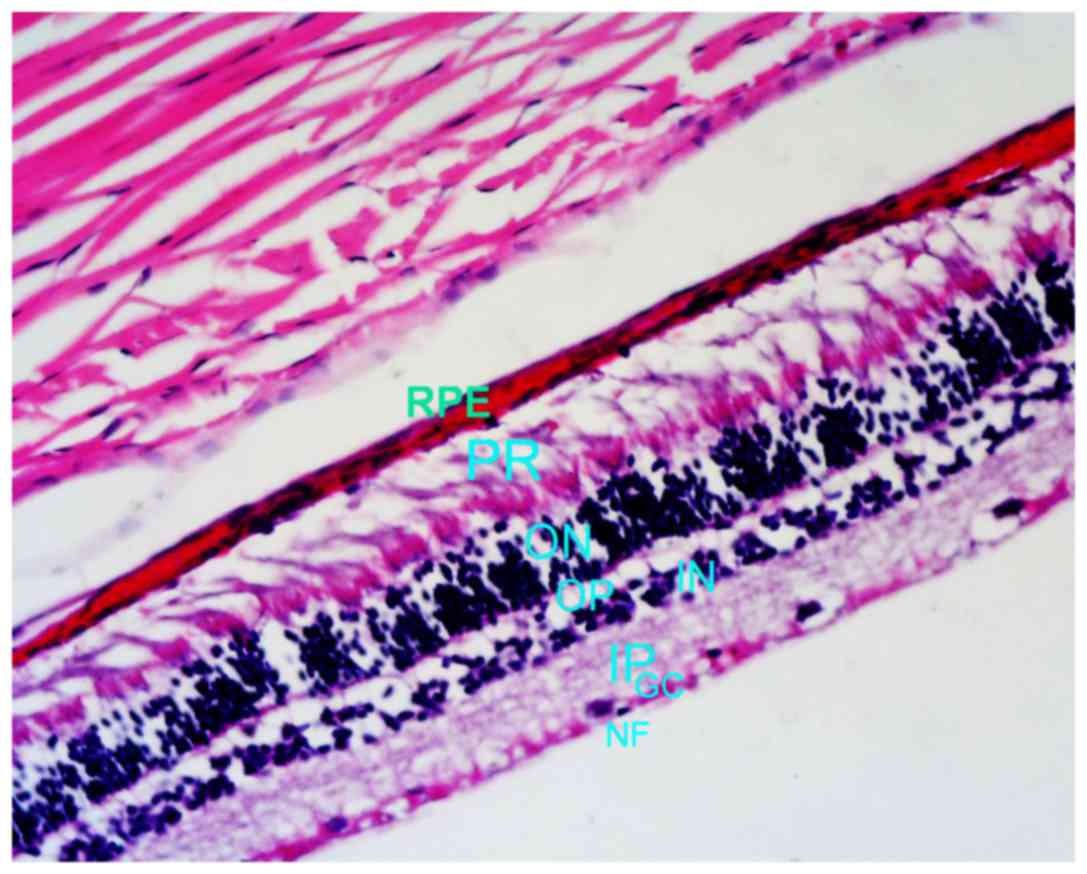
Layers of retina were normal, albeit the retinal inner and outer limiting membranes were observed with difficulties. In the control eyes, the cells of the nerve fiber, ganglion cell, inner plexiform, inner nuclear, outer plexiform, outer nuclear, photoreceptor cell layers, and retinal pigment epithelium were morphologically intact and well organized (Fig. 1). Similarly, the cells in the corresponding layers of treatment eyes were morphologically intact and well organized, and exhibited no bleeding, exudation or retinal detachment (Fig. 2).
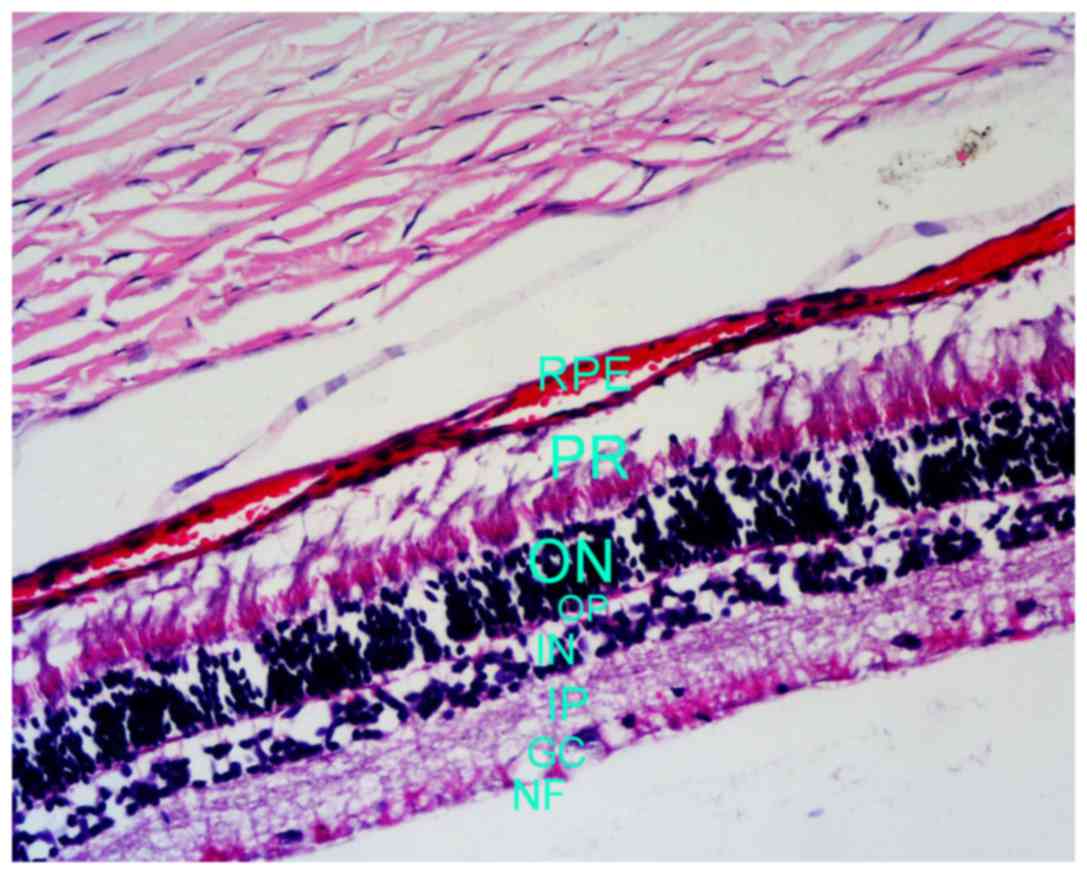
Figure 1.

Control eye (hematoxylin and eosin staining; magnification, ×100). RPE, retinal pigment epithelium; PR, photoreceptor cell layer, ON, outer plexiform layer; OP, outer plexiform layer; IN, inner nuclear layer; IP, inner plexiform layer; GC, ganglion cell layer; NF, nerve fiber layer.

Figure 2.

Treatment eye (hematoxylin and eosin staining; magnification, ×100). RPE, retinal pigment epithelium; PR, photoreceptor cell layer; ON, outer plexiform layer; OP, outer plexiform layer; IN, inner nuclear layer; IP, inner plexiform layer; GC, ganglion cell layer; NF, nerve fiber layer.

Discussion

In the present study, we tested the suitability of Suncon medical adhesive for 23G minimally invasive vitrectomy, with a specific focus to potential toxicity to retina. In addition to ophthalmologic evaluation, we recorded b-wave, which reflects the electrical activity in bipolar cells and Müller cells, and represents the functional status of retina (6). We demonstrate that intravitreal injection of 0.05 ml of Suncon medical adhesive causes no damage to the retinal function. Light-microscopy examination found that the cells in each layer of the retina in the treatment group were morphologically normal. Furthermore, no obvious inflammatory reaction and no adverse effects on function and morphology of retinal cells were observed.

In conclusion, Suncon medical adhesive injected at doses of 0.05 ml is well-tolerated by the retina. Therefore, the Suncon medical adhesive is a suitable alternative to fibrin glue. This may be especially relevant for patients with thinner suture in the scleral incision, to prevent incision leakage and incomplete closure.

Acknowledgements

This study was supported by the Major Research Project of Jiangsu Provincial Health Department (grant no. H201054).

References

1 

Batman C, Ozdamar Y, Mutevelli S, Sonmez K, Zilelioglu G and Karakaya J: A comparative study of tissue glue and vicryl suture for conjunctival and scleral closure in conventional 20-gauge vitrectomy. Eye (Lond). 23:1382–1387. 2009. View Article : Google Scholar : PubMed/NCBI

2 

Batman C, Ozdamar Y, Aslan O, Sonmez K, Mutevelli S and Zilelioglu G: Tissue glue in sutureless vitreoretinal surgery for the treatment of wound leakage. Ophthalmic Surg Lasers Imaging. 39:100–106. 2008. View Article : Google Scholar : PubMed/NCBI

3 

Huang M and Ye Y: Medical adhesive in the treatment of eyelid injury. J Ocular Trauma Occup Eye Dis. 25:8502003.(In Chinese).

4 

Setlik DE, Seldomridge DL, Adelman RA, Semchyshyn TM and Afshari NA: The effectiveness of isobutyl cyanoacrylate tissue adhesive for the treatment of corneal perforations. Am J Ophthalmol. 140:920–921. 2005. View Article : Google Scholar : PubMed/NCBI

5 

Meskin SW, Ritterband DC, Shapiro DE, Kusmierczyk J, Schneider SS, Seedor JA and Koplin RS: Liquid bandage (2-octyl cyanoacrylate) as a temporary wound barrier in clear corneal cataract surgery. Ophthalmology. 112:2015–2021. 2005. View Article : Google Scholar : PubMed/NCBI

6 

Wu L and Wu D: Clinical visual electrophysiology. Science Press; Beijing: pp. 17–20. 1999

Related Articles

  • Abstract
  • View
  • Download
  • Twitter
Copy and paste a formatted citation
Spandidos Publications style
Liu S, Li S, Zhang Z, Ji S and Liu H: Suncon medical adhesive is a suitable alternative to fibrin glue in the 23G minimally invasive vitrectomy. Exp Ther Med 14: 623-625, 2017.
APA
Liu, S., Li, S., Zhang, Z., Ji, S., & Liu, H. (2017). Suncon medical adhesive is a suitable alternative to fibrin glue in the 23G minimally invasive vitrectomy. Experimental and Therapeutic Medicine, 14, 623-625. https://doi.org/10.3892/etm.2017.4520
MLA
Liu, S., Li, S., Zhang, Z., Ji, S., Liu, H."Suncon medical adhesive is a suitable alternative to fibrin glue in the 23G minimally invasive vitrectomy". Experimental and Therapeutic Medicine 14.1 (2017): 623-625.
Chicago
Liu, S., Li, S., Zhang, Z., Ji, S., Liu, H."Suncon medical adhesive is a suitable alternative to fibrin glue in the 23G minimally invasive vitrectomy". Experimental and Therapeutic Medicine 14, no. 1 (2017): 623-625. https://doi.org/10.3892/etm.2017.4520
Copy and paste a formatted citation
x
Spandidos Publications style
Liu S, Li S, Zhang Z, Ji S and Liu H: Suncon medical adhesive is a suitable alternative to fibrin glue in the 23G minimally invasive vitrectomy. Exp Ther Med 14: 623-625, 2017.
APA
Liu, S., Li, S., Zhang, Z., Ji, S., & Liu, H. (2017). Suncon medical adhesive is a suitable alternative to fibrin glue in the 23G minimally invasive vitrectomy. Experimental and Therapeutic Medicine, 14, 623-625. https://doi.org/10.3892/etm.2017.4520
MLA
Liu, S., Li, S., Zhang, Z., Ji, S., Liu, H."Suncon medical adhesive is a suitable alternative to fibrin glue in the 23G minimally invasive vitrectomy". Experimental and Therapeutic Medicine 14.1 (2017): 623-625.
Chicago
Liu, S., Li, S., Zhang, Z., Ji, S., Liu, H."Suncon medical adhesive is a suitable alternative to fibrin glue in the 23G minimally invasive vitrectomy". Experimental and Therapeutic Medicine 14, no. 1 (2017): 623-625. https://doi.org/10.3892/etm.2017.4520
Follow us
  • Twitter
  • LinkedIn
  • Facebook
About
  • Spandidos Publications
  • Careers
  • Cookie Policy
  • Privacy Policy
How can we help?
  • Help
  • Live Chat
  • Contact
  • Email to our Support Team