Introduction
Multiple myeloma (MM) is a malignant plasma cell
disorder characterized by clonal proliferation of terminally
differentiated B cells in the bone marrow and by end-organ damage
related to monoclonal protein production, osteolytic bone disease,
anemia, hypercalcemia, renal injury or a combination of these
manifestations (1,2). Although therapeutic outcomes have
improved substantially with the introduction of proteasome
inhibitors (PIs), immunomodulatory drugs (IMiDs), anti-CD38
monoclonal antibodies, autologous stem cell transplantation,
bispecific antibodies and cellular therapies, MM remains largely
incurable once patients enter the relapsed/refractory phase
(1-4).
Extramedullary plasmacytomas (EMP), particularly
soft-tissue lesions that are biologically independent of the bone
marrow microenvironment, represent one of the most challenging
manifestations of MM; ~7% of patients have extramedullary disease
at diagnosis, and an additional 6-20% develop it later during the
disease course (5,6). EMP is typically associated with high
tumor burden, clonal evolution, treatment resistance and inferior
survival, and it is often regarded as a marker of biologically
aggressive disease (5,6). In the setting of relapsed/refractory
MM (RRMM), durable disease control becomes especially difficult
when extramedullary lesions coexist with acquired high-risk
cytogenetic abnormalities or prior exposure to multiple major drug
classes.
B-cell maturation antigen (BCMA) is an established
therapeutic target in RRMM because it is preferentially expressed
on malignant plasma cells and plays an important role in plasma
cell survival. Current BCMA-directed approaches include
antibody-drug conjugates, bispecific antibodies and chimeric
antigen receptor T-cell (CAR-T) therapy (3,4).
Among these, CAR-T therapy can induce deep responses in heavily
pretreated patients; however, outcomes remain less favorable in
patients with EMP, and relapse after BCMA CAR-T therapy remains a
clinically important problem (4,7,8).
Potential mechanisms of resistance include insufficient CAR-T
expansion or persistence, T-cell exhaustion, antigen modulation and
the immunosuppressive tumor microenvironment (7,9).
Retreatment after failure of an earlier BCMA-directed CAR-T product
is not yet standardized. Nevertheless, it is biologically plausible
that a fully humanized CAR construct could retain activity in
selected patients previously exposed to a non-humanized product,
particularly if reduced immunogenicity improves expansion and
persistence after reinfusion (7,8,10,11).
In parallel, the role of post-CAR-T maintenance therapy in MM is
under ative investigation, especially for patients with residual
radiographic disease or high-risk clinical features (12-15).
The present case report describes the clinical
course of a patient with advanced RRMM and bulky cranial EMP who
had previously received multiple lines of therapy, including
bortezomib, lenalidomide, pomalidomide, ixazomib, carfilzomib,
daratumumab, radiotherapy, autologous stem cell transplantation and
a prior non-humanized BCMA CAR-T product. The aim was to
characterize the clinical response and safety following eque-cel
treatment and subsequent pomalidomide maintenance.
Case report
A 38-year-old male patient was admitted to Peking
Union Medical College Hospital (Beijing, China) in January 2017
with chest pain and a parasternal plasmacytoma and was subsequently
diagnosed with MM. Positron emission tomography/computed tomography
(PET/CT) demonstrated multiple metabolically active osteolytic
lesions, consistent with disseminated myeloma bone disease,
together with the parasternal soft-tissue lesion. Serum protein
electrophoresis showed an M-protein concentration of 36.4 g/l
(normally undetectable in healthy individuals), indicating a
substantial circulating monoclonal immunoglobulin (Ig) burden, and
serum immunofixation electrophoresis identified an IgG monoclonal
band, confirming secretory IgG myeloma. Bone marrow morphology
showed 9% plasma cells. Fluorescence in situ hybridization
(FISH) analysis of CD138-sorted plasma cells did not reveal
high-risk cytogenetic abnormalities (data not shown). The patient
was diagnosed with MM IgG, Durie-Salmon stage IIIA, International
Staging System (ISS) stage II and Revised-ISS (R-ISS) stage II
(16,17).
From February 2017, the patient received five cycles
of first-line VRd induction therapy consisting of bortezomib 2.7 mg
intravenously on days 1, 8, 15 and 22, lenalidomide 25 mg orally on
days 1-21 and dexamethasone 40 mg intravenously on days 1, 8, 15
and 22. This treatment was selected because the patient was young
and transplant-eligible, and a PI/IMiDs-based triplet is a standard
frontline approach in newly diagnosed transplant-eligible MM. A
very good partial response (VGPR) was achieved, with resolution of
the sternal mass. In September 2017, the patient underwent
autologous stem cell transplantation and achieved a stringent CR
(sCR). They then received 4 additional cycles of VRd consolidation
and later maintenance with lenalidomide 25 mg every other day plus
dexamethasone 20 mg orally on days 1, 8, 15 and 22 for ~2 years. In
November 2020, IgGλ positivity recurred on serum immunofixation
electrophoresis, indicating biochemical relapse.
In January 2021, VPd (bortezomib 2.7 mg
intravenously on days 1, 8, 15 and 22, pomalidomide 4 mg orally on
days 1-21, and dexamethasone 40 mg intravenously on days 1, 8, 15
and 22) was selected as second-line therapy because the patient had
relapsed after lenalidomide maintenance and remained a candidate
for a bortezomib-containing regimen, while pomalidomide is active
in lenalidomide-exposed disease. After nine cycles, the best
response was VGPR. However, by January 2022, the serum M-protein
level had risen to 5.88 g/l, indicating disease progression with a
progression-free survival (PFS) of 12 months. The third-line
regimen was switched to eight cycles of IPd (ixazomib 4 mg on days
1, 8 and 15, pomalidomide 4 mg orally on days 1-21, and
dexamethasone 40 mg on days 1, 8, 15 and 22) as an all-oral salvage
regimen to maintain proteasome inhibition while changing the PI
backbone after progression on bortezomib-based treatment.
In February 2022, a right frontoparietal
extramedullary mass measuring 3 cm in diameter developed
clinically, and subsequently progressed to involve the right
frontoparietal and right temporoparietal regions, enlarging to ~10
cm. PET/CT demonstrated right frontoparietal bone destruction
measuring ~107x42 mm with an adjacent soft-tissue mass (SUVmax
9.6). Bone marrow aspiration revealed 5% plasma cells. At this
time, FISH detected newly acquired high-risk cytogenetic
abnormalities, including IgH/fibroblast growth factor receptor 3
(FGFR3) translocation [t(4;14)] and 1q21 amplification. These
abnormalities are considered high risk because t(4;14) is
associated with dysregulated FGFR3/multiple myeloma SET domain
signaling and inferior survival, whereas 1q21 gain/amplification is
linked to copy-number-driven upregulation of genes such as
cyclin-dependent kinase regulatory subunit 1B and myeloid cell
leukemia 1, promoting proliferation, treatment resistance and poor
prognosis (18,19).
The patient was then enrolled in the IBI346 clinical
trial of BCMA-targeted CAR-T therapy in October 2022. BCMA is a
surface antigen highly expressed on malignant plasma cells. The
infused product was a non-humanized CAR-T construct. During CAR-T
manufacturing, a new extramedullary mass emerged in the left
mandibular area. After infusion, both the left mandibular and right
frontoparietal masses continued to grow, and the serum M protein
level increased from 32.8 g/l in December 2022 to 38.5 g/l in
January 2023, confirming progression after non-humanized BCMA CAR-T
therapy.
In March 2023, because the disease was rapidly
progressing after non-humanized BCMA CAR-T therapy and urgent
cytoreduction was required while other immunotherapeutic options
were being arranged, the patient started fifth-line D-KPD
(daratumumab 1,200 mg intravenously on days 1, 8, 15 and 22,
carfilzomib 30 mg intravenously on days 1 and 2 and then 120 mg
intravenously on days 8 and 15 in cycle 1, pomalidomide 4 mg orally
on days 1-4 and then every other day on days 8-21 in cycle 1, and
dexamethasone 40 mg intravenously on days 1, 8, 15 and 22)
treatment and received radiotherapy (planning gross tumor volume 45
Gy/30 fractions) for the left mandibular mass. After five cycles,
the M-protein level rose from 11.97 g/l in July 2023 to 24 g/l in
August 2023, indicating relapse after a best response of partial
response (PR). Pomalidomide was then replaced with 2 cycles of oral
selinexor (D-KXD, selinexor 60 mg on days 1, 8, 15 and 22), but
neutropenia and thrombocytopenia developed during this sixth-line
therapy.
In December 2023, the patient received eque-cel, a
fully humanized BCMA CAR-T product approved in China for patients
with RRMM after at least three prior lines of therapy. Only fever
consistent with grade 1 cytokine release syndrome (CRS) occurred
within 2 weeks of infusion.
After 1 month of infusion, the serum M-protein level
decreased to 10.32 g/l (January 2024), and the 24-h urine M-protein
level became undetectable. After 2 months, the serum M-protein
level further declined to 5.18 g/l (February 2024), and by 6 months
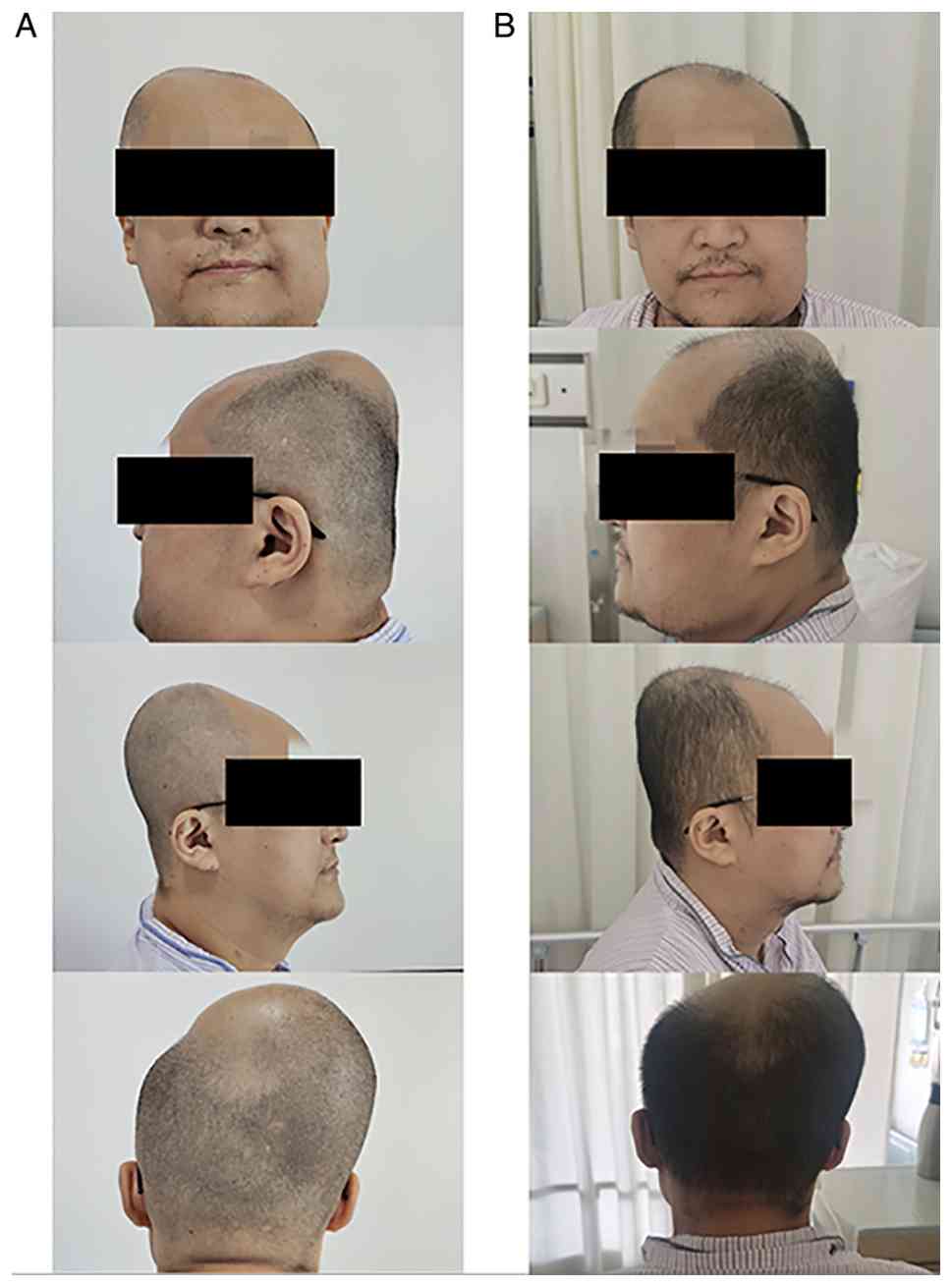
it had fallen to 0.53 g/l (June 2024). Clinically, the
extramedullary masses became softer and smaller within 13 days of
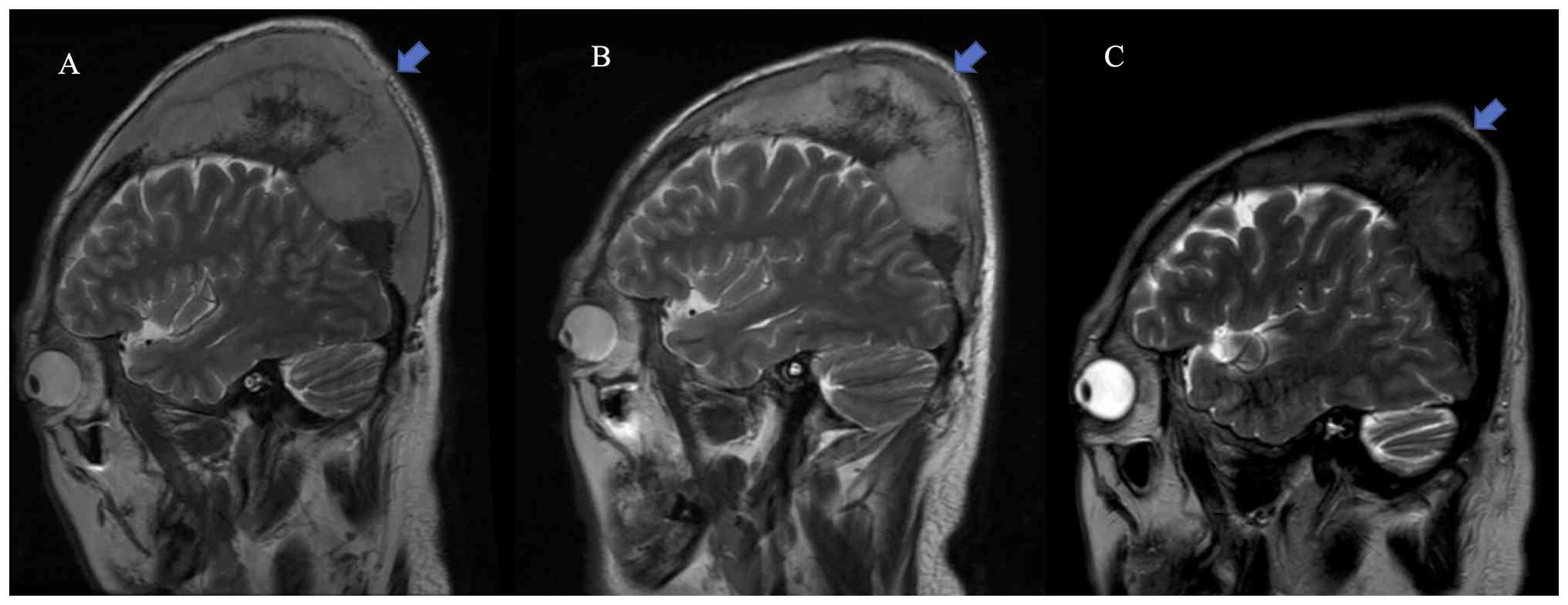
eque-cel infusion. Serial MRI imaging documented continuous
shrinkage of the right parietal lesion with reduction of the
extraosseous soft-tissue component (Figs. 1 and 2). Because residual extramedullary
disease persisted radiographically, pomalidomide maintenance was
initiated in March 2024 at 4 mg orally every other day on days 1-21
of each cycle, with the aim of consolidating response and
potentially supporting CAR-T persistence. At the 6-month follow-up,
the serum M-protein level remained at 0.53 g/l. By October 2024,
serial serum and urine immunofixation electrophoresis confirmed CR.
MRI showed sustained reduction of the right parietal lesion
(131.7x50.3 to 133x37 mm), corresponding to a ~20% decrease in the
sum of product diameters for extramedullary disease (Fig. 2). CAR-T kinetics showed peak
peripheral blood expansion (22.78% CAR+ cells) at day 11
after initial CAR-T therapy induction. CAR transgene copies in
peripheral blood genomic DNA were quantified using a commercial
TaqMan real-time PCR assay, the Blood/Cell CAR Copy Number
Detection Kit (cat. no. 102100; Shanghai Xingwan Biotechnology Co.,
Ltd.). The CAR, universal sequence (UNI) and single-copy gene (SCG)
primer/probe sets were supplied as a proprietary CAR primer/probe
premix included in this kit, with no separate catalogue numbers or
oligonucleotide sequences disclosed by the manufacturer. The assay
targets the CAR transgene, a UNI and a human SCG, with SCG serving
as the endogenous loading control. The reporter channels were FAM
for CAR, Cy5 for UNI and VIC for SCG, and CAR copy number was
calculated according to the manufacturer's formula: CAR copy
number/cell=2 x CAR/SCG. The CAR transgene copy number peaked at
7.13x10³ copies/µg DNA, and durable engraftment remained
detectable at day 90 (2.02x10² copies/µg DNA). On the
basis of clinical, laboratory and imaging findings, the treatment
was considered effective. At the latest follow-up, 19 months after
infusion, the patient remained on pomalidomide maintenance therapy
with sustained hematologic CR. The timeline of interventions and
responses is summarized in Table
I.
 | Table IClinical timeline of interventions,
responses and disease milestones. |
Table I
Clinical timeline of interventions,
responses and disease milestones.
| Time point | Treatment line | Intervention | Outcome | Extramedullary
disease |
|---|
| January 2017 | Diagnosis | | | Sternal EMP |
| February-August
2017 | 1st | Bortezomib,
lenalidomide and dexamethasone | VGPR | Mass disappeared |
| September 2017 | Consolidation | Autologous stem cell
transplantation | sCR | |
| October 2017-November
2020 | Maintenance | Lenalidomide | sCR to PD (41 month
PFS) | |
| January-December
2021 | 2nd | Bortezomib,
pomalidomide and dexamethasone | VGPR to PD (12 month
PFS) | |
| February-August
2022 | 3rd | Ixazomib,
pomalidomide and dexamethasone | SD to PD (4 month
PFS) | Frontoparietal EMP (3
cm) |
| December 2022 | 4th | Murine B-cell
maturation antigen chimeric antigen receptor T-cell therapy | PD | Left mandibular
EMP |
| March-August
2023 | 5th | Daratumumab,
carfilzomib, pomalidomide and dexamethasone + radiotherapy | PR to PD (5 month
PFS) | Persistent EMP |
| August-December
2023 | 6th | Daratumumab,
carfilzomib, selinexor and dexamethasone | Intolerance (Grade 4
cytopenia) | |
| December 2023 | 7th | Equecabtagene
autoleucel | Cytokine release
syndrome (Grade 1) | |
| January 2024 | | | VGPR | EMP reduction |
| March
2024-ongoing | Maintenance | Pomalidomide | | |
| Last follow up (19
months) | | | sCR | Ongoing response |
Discussion
The present study describes the case of a young
patient with R-ISS stage II who developed paraosseous
extramedullary disease and subsequently became refractory to
multiple treatment lines, including PIs (bortezomib, ixazomib and
carfilzomib), IMiDs (lenalidomide and pomalidomide), anti-CD38
therapy (daratumumab), autologous transplantation, radiotherapy and
a prior non-humanized BCMA CAR-T product. During disease evolution,
newly acquired t(4;14) and 1q21 amplification emerged, consistent
with clonal selection toward a more aggressive, treatment-resistant
phenotype. After progression following non-humanized BCMA CAR-T
therapy, additional chemotherapy was not considered contradictory
to the immunotherapeutic strategy; rather, it served as necessary
bridging cytoreduction to control the rapidly progressive bulky EMP
while access to a second BCMA-directed cellular product was being
secured. The subsequent hematologic CR and durable disease control
achieved with fully humanized BCMA CAR-T therapy suggests that this
approach can still be clinically meaningful, even after prior BCMA
CAR-T exposure in selected high-risk patients.
The FUMANBA-1 study is the most relevant clinical
context for the present case because it evaluated the same fully
human BCMA-directed CAR-T product, eque-cel in adults with RRMM
(8). In FUMANBA-1, eque-cel
produced a high overall response rate (ORR) of 96.0%, with 74.3% of
patients achieving CR or better, and the median PFS had not been
reached at the reported follow-up, with a 12-month PFS rate of
78.8% (8). The present patient
achieved a similarly deep hematologic response, with a sustained
sCR and ongoing control of extramedullary disease at 19 months
after infusion. However, this patient differed from the general
FUMANBA-1 population by having bulky cranial EMP, newly acquired
high-risk cytogenetic abnormalities and prior failure of a
non-humanized BCMA CAR-T product. Therefore, the durability
observed in the present case is clinically notable. The present
case does not prove superiority of fully humanized over
non-humanized BCMA CAR-T therapy, but it does support the clinical
plausibility that reducing immunogenicity and improving in
vivo persistence may recapture antimyeloma activity after
failure of a prior non-humanized construct. This interpretation is
biologically reasonable because antigen loss, limited CAR-T
expansion/persistence and T-cell exhaustion are recognized
mechanisms of relapse after BCMA CAR-T therapy (7).
Although non-humanized BCMA CAR-T therapy had
previously failed in the present patient, meaningful efficacy was
still achieved after fully humanized BCMA CAR-T treatment. One
possible explanation is that non-humanized antigen-recognition
domains can induce host anti-CAR immune responses, which may
shorten persistence on repeated exposure. By contrast, fully
humanized or fully human constructs are designed to reduce
immunogenicity while preserving antigen binding, thereby favoring
expansion and persistence (10,11).
In the present case, durable CAR transgene detection up to day 90
was consistent with this concept, although mechanistic confirmation
was not available.
EMP remains an important adverse factor for CAR-T
efficacy and survival. In MM, extramedullary spread reflects
biological escape from bone marrow dependence, and is associated
with altered adhesion and chemokine signaling, spatial clonal
heterogeneity, high tumor burden and a more immunosuppressive
microenvironment, all of which may impair CAR-T trafficking,
expansion and durable tumor control (5,8,9).
Consistent with this, the FUMANBA-1 trial reported a 12-month PFS
rate of 60.6% in patients with EMP compared with 81.8% in patients
without EMP (8). Similarly, a
retrospective analysis of commercially available BCMA CAR-T
products showed substantially lower ORR, PFS and overall survival
in the EMP subgroup compared with in patients without EMP (20). In the present patient, durable
control beyond 19 months despite bulky EMP and prior BCMA exposure
suggests that fully humanized BCMA CAR-T therapy may still provide
a clinically relevant benefit, particularly when followed by
carefully selected consolidation or maintenance treatment.
Compared with CARTITUDE-1 and KarMMa, the present
case shows both shared and distinct features in terms of response
depth, durability and safety. In CARTITUDE-1, ciltacabtagene
autoleucel (cilta-cel) produced an ORR of 97.9% and a sCR rate of
82.5%, with the median PFS not reached and a 27-month PFS rate of
54.9% after a median follow-up of 27.7 months (21). In KarMMa, idecabtagene vicleucel
(ide-cel) achieved an ORR of 73%, a CR-or-better rate of 33%, and a
median PFS of 8.8 months (22).
The present patient achieved sustained hematologic sCR with ongoing
extramedullary disease control at 19 months after eque-cel
infusion, which is directionally consistent with the deep responses
observed in pivotal BCMA CAR-T studies. However, unlike most
patients in these studies, the present patient had bulky cranial
EMP, newly acquired high-risk cytogenetic abnormalities and prior
failure of a non-humanized BCMA CAR-T product. With regard to
safety, only grade 1 CRS and no immune effector cell-associated
neurotoxicity syndrome occurred in this case, whereas CRS and
neurotoxicity were reported more frequently in the pivotal CAR-T
trials (21,22). Therefore, the present case does not
establish superiority of eque-cel over cilta-cel or ide-cel, but
suggests that fully humanized BCMA CAR-T therapy may remain active
in selected high-risk patients after prior non-humanized BCMA CAR-T
failure.
Beyond cellular therapy, the therapeutic landscape
of RRMM now also includes BCMA-directed bispecific antibodies,
which act as off-the-shelf T-cell engagers and can be administered
without individualized cell manufacturing (4). This practical advantage may be
particularly important when rapid treatment initiation is required.
By contrast, CAR-T therapy requires leukapheresis, individualized
manufacturing and often bridging disease control, but it can
produce very deep and durable responses in heavily pretreated RRMM
(8,21,22).
In patients with aggressive EMP, such as the present case, the
potential for profound tumor reduction and sustained cellular
persistence may be clinically relevant, whereas bispecific
antibodies remain an important alternative when immediate access or
manufacturing feasibility limits CAR-T treatment. These modalities
should therefore be considered complementary rather than mutually
exclusive, and the movement of CAR-T therapy to earlier lines is
supported by KarMMa-3 and CARTITUDE-4 (23,24).
Maintenance therapy remains a central strategy in
MM, but its role after CAR-T therapy is still being defined. In the
present patient, pomalidomide was chosen as maintenance therapy
because residual EMP persisted radiographically, the disease had
previously shown sensitivity to pomalidomide-containing regimens,
and IMiDs may enhance CAR-T function and persistence (12-15).
Recent clinical data have suggested that long-term pomalidomide
treatment after BCMA CAR-T therapy is feasible and may deepen or
maintain remission, particularly in patients with residual disease
or extramedullary involvement (15). Mechanistically,
lenalidomide-related studies have shown that IMiDs can enhance
anti-BCMA CAR-T activity by promoting T-cell activation/function
(13,14), whereas a pomalidomide-specific BCMA
CAR-T study reported reduced CAR-T cell apoptosis and enhanced
antigen-specific cytotoxicity, supporting improved CAR-T
survival/persistence and antimyeloma activity (15). Accordingly, maintenance therapy may
have contributed to the durability of response in the present case,
although the independent effect of pomalidomide cannot be separated
from that of CAR-T itself.
In conclusion, fully humanized BCMA CAR-T therapy
provided durable clinical benefit in a heavily pretreated patient
with RRMM, EMP, prior non-humanized BCMA CAR-T therapy failure and
newly acquired high-risk cytogenetic abnormalities. The present
case supports the feasibility of fully humanized BCMA CAR-T as a
salvage option after prior BCMA exposure and suggests that
maintenance therapy may help sustain response in selected patients.
The main limitations of the present study are that this is a single
case, the patient also received prior radiotherapy and subsequent
pomalidomide maintenance and no serial analyses of BCMA expression,
anti-CAR immunity or T-cell phenotype were available; therefore,
the precise mechanism of response cannot be established.
Acknowledgements
Not applicable.
Funding
Funding: This work was supported by CAMS Innovation Fund for
Medical Sciences (grant no. 2024-I2M-C&T-B-017), Cancer
Foundation of China, Wuju Innovative Anti-Tumor Research Fund
(grant no. CFC2023WJZD001) and National High Level Hospital
Clinical Research (grant no. 2025-PUMCH-C-040).
Availability of data and materials
The data generated in the present study are included
in the figures and tables of this article.
Authors' contributions
RZ and LC conceptualized the study and managed
clinical care. RZ collected and analyzed patient data and
interpreted laboratory/imaging results. RZ, JL and LZ supervised
CAR-T cell therapy administration, monitored adverse events and
contributed to clinical data validation. RZ contributed to the
original draft. JZ contributed to the conception and design of the
study, interpretation of the clinical data, critical revision of
the manuscript for important intellectual content, and provided
senior oversight. RZ and LC confirm the authenticity of all the raw
data. All authors read and approved the final version of the
manuscript.
Ethics approval and consent to
participate
The present study was approved by the Ethics
Committee of the Peking Union Medical College Hospital (approval
no. I-24PJ1292).
Patient consent for publication
Written informed consent was obtained from the
patient for publication of the case details and accompanying
images.
Competing interests
The authors declare that they have no competing
interests.
References
|
1
|
Cowan AJ, Green DJ, Kwok M, Lee S, Coffey
DG, Holmberg LA, Tuazon S, Gopal AK and Libby EN: Diagnosis and
management of multiple myeloma: A review. JAMA. 327:464–477.
2022.PubMed/NCBI View Article : Google Scholar
|
|
2
|
Malard F, Neri P, Bahlis NJ, Terpos E,
Moukalled N, Hungria VTM, Manier S and Mohty M: Multiple myeloma.
Nat Rev Dis Primers. 10(45)2024.PubMed/NCBI View Article : Google Scholar
|
|
3
|
Yu B, Jiang T and Liu D: BCMA-targeted
immunotherapy for multiple myeloma. J Hematol Oncol.
13(125)2020.PubMed/NCBI View Article : Google Scholar
|
|
4
|
Devasia AJ, Chari A and Lancman G:
Bispecific antibodies in the treatment of multiple myeloma. Blood
Cancer J. 14(158)2024.PubMed/NCBI View Article : Google Scholar
|
|
5
|
Bladé J, de Larrea CF, Rosiñol L, Cibeira
MT, Jiménez R and Powles R: Soft-tissue plasmacytomas in multiple
myeloma: incidence, mechanisms of extramedullary spread, and
treatment approach. J Clin Oncol. 29:3805–3812. 2011.PubMed/NCBI View Article : Google Scholar
|
|
6
|
Varettoni M, Corso A, Pica G,
Mangiacavalli S, Pascutto C and Lazzarino M: Incidence, presenting
features and outcome of extramedullary disease in multiple myeloma:
A longitudinal study on 1003 consecutive patients. Ann Oncol.
21:325–330. 2010.PubMed/NCBI View Article : Google Scholar
|
|
7
|
D'Agostino M and Raje N: Anti-BCMA CAR
T-cell therapy in multiple myeloma: Can we do better? Leukemia.
34:21–34. 2020.PubMed/NCBI View Article : Google Scholar
|
|
8
|
Li C, Zhou K, Hu Y, Zou D, Chen L, Chen B,
Liu J, Zhang X, Ren H, Hu K, et al: Equecabtagene autoleucel in
patients with relapsed or refractory multiple myeloma: The
FUMANBA-1 nonrandomized clinical trial. JAMA Oncol. 10:1681–1688.
2024.PubMed/NCBI View Article : Google Scholar
|
|
9
|
García-Ortiz A, Rodríguez-García Y,
Encinas J, Maroto-Martín E, Castellano E, Teixidó J and
Martínez-López J: The role of tumor microenvironment in multiple
myeloma development and progression. Cancers (Basel).
13(217)2021.PubMed/NCBI View Article : Google Scholar
|
|
10
|
Zhao Y, Liu Z, Wang X, Wu H, Zhang J, Yang
J, Zhang F, Liu L, Long J, Lu P and Chen Z: Treatment with
humanized selective CD19CAR-T cells shows efficacy in highly
treated B-ALL patients who have relapsed after receiving
murine-based CD19CAR-T therapies. Clin Cancer Res. 25:5595–5607.
2019.PubMed/NCBI View Article : Google Scholar
|
|
11
|
Wang D, Wang J, Hu G, Wang W, Xiao Y, Cai
H, Jiang L, Meng L, Yang Y, Zhou X, et al: A phase 1 study of a
novel fully human BCMA-targeting CAR (CT103A) in patients with
relapsed/refractory multiple myeloma. Blood. 137:2890–2901.
2021.PubMed/NCBI View Article : Google Scholar
|
|
12
|
Lacy MQ and McCurdy AR: Pomalidomide.
Blood. 122:2305–2309. 2013.PubMed/NCBI View Article : Google Scholar
|
|
13
|
Works M, Soni N, Hauskins C, Sierra C,
Baturevych A, Jones JC, Curtis W, Carlson P, Johnstone TG, Kugler
D, et al: Anti-B-cell maturation antigen chimeric antigen receptor
T cell function against multiple myeloma is enhanced in the
presence of lenalidomide. Mol Cancer Ther. 18:2246–2257.
2019.PubMed/NCBI View Article : Google Scholar
|
|
14
|
Zhao G, Wei R, Feng L, Wu Y, He F, Xiao M
and Cheng Z: Lenalidomide enhances the efficacy of anti-BCMA CAR-T
treatment in relapsed/refractory multiple myeloma: A case report
and revies of the literature. Cancer Immunol Immunother. 71:39–44.
2022.PubMed/NCBI View Article : Google Scholar
|
|
15
|
Yan Y, Tu Y, Cheng Q, Zhang J, Wang E,
Deng Z, Yu Y, Wang L, Liu R, Chu L, et al: BCMA CAR-T therapy
combined with pomalidomide is a safe and effective treatment for
relapsed/refractory multiple myeloma. J Transl Med.
22(1087)2024.PubMed/NCBI View Article : Google Scholar
|
|
16
|
Greipp PR, San Miguel J, Durie BG, Crowley
JJ, Barlogie B, Bladé J, Boccadoro M, Child JA, Avet-Loiseau H,
Kyle RA, et al: International staging system for multiple myeloma.
J Clin Oncol. 23:3412–3420. 2005.PubMed/NCBI View Article : Google Scholar
|
|
17
|
Palumbo A, Avet-Loiseau H, Oliva S,
Lokhorst HM, Goldschmidt H, Rosinol L, Richardson P, Caltagirone S,
Lahuerta JJ, Facon T, et al: Revised international staging system
for multiple myeloma: A report from international myeloma working
group. J Clin Oncol. 33:2863–2869. 2015.PubMed/NCBI View Article : Google Scholar
|
|
18
|
Kalff A and Spencer A: The t(4;14)
translocation and FGFR3 overexpression in multiple myeloma:
Prognostic implications and current clinical strategies. Blood
Cancer J. 2(e89)2012.PubMed/NCBI View Article : Google Scholar
|
|
19
|
Schmidt TM, Fonseca R and Usmani SZ:
Chromosome 1q21 abnormalities in multiple myeloma. Blood Cancer J.
11(83)2021.PubMed/NCBI View Article : Google Scholar
|
|
20
|
Dima D, Abdallah AO, Davis JA, Awada H,
Goel U, Rashid A, DeJarnette S, Anwer F, Shune L, Raza S, et al:
Impact of extraosseous extramedullary disease on outcomes of
patients with relapsed-refractory multiple myeloma receiving
standard-of-care chimeric antigen receptor T-cell therapy. Blood
Cancer J. 14(90)2024.PubMed/NCBI View Article : Google Scholar
|
|
21
|
Martin T, Usmani SZ, Berdeja JG, Agha M,
Cohen AD, Hari P, Avigan D, Deol A, Htut M, Lesokhin A, et al:
Ciltacabtagene autoleucel, an Anti-B-cell maturation antigen
chimeric antigen receptor T-Cell therapy, for relapsed/refractory
multiple myeloma: CARTITUDE-1 2-year follow-up. J Clin Oncol.
41:1265–1274. 2023.PubMed/NCBI View Article : Google Scholar
|
|
22
|
Munshi NC, Anderson LD Jr, Shah N, Madduri
D, Berdeja J, Lonial S, Raje N, Lin Y, Siegel D, Oriol A, et al:
Idecabtagene vicleucel in relapsed and refractory multiple myeloma.
N Engl J Med. 384:705–716. 2021.PubMed/NCBI View Article : Google Scholar
|
|
23
|
Rodriguez-Otero P, Ailawadhi S, Arnulf B,
Patel K, Cavo M, Nooka AK, Manier S, Callander N, Costa LJ, Vij R,
et al: Ide-cel or standard regimens in relapsed and refractory
multiple myeloma. N Engl J Med. 388:1002–1014. 2023.PubMed/NCBI View Article : Google Scholar
|
|
24
|
San-Miguel J, Dhakal B, Yong K, Spencer A,
Anguille S, Mateos MV, de Larrea CF, Martínez-López J, Moreau P,
Touzeau C, et al: Cilta-cel or standard care in
lenalidomide-refractory multiple myeloma. N Engl J Med.
389:335–347. 2023.PubMed/NCBI View Article : Google Scholar
|