Spandidos Publications Logo
  • About
    • About Spandidos
    • Aims and Scopes
    • Abstracting and Indexing
    • Editorial Policies
    • Reprints and Permissions
    • Job Opportunities
    • Terms and Conditions
    • Contact
  • Journals
    • All Journals
    • Oncology Letters
      • Oncology Letters
      • Information for Authors
      • Editorial Policies
      • Editorial Board
      • Aims and Scope
      • Abstracting and Indexing
      • Bibliographic Information
      • Archive
    • International Journal of Oncology
      • International Journal of Oncology
      • Information for Authors
      • Editorial Policies
      • Editorial Board
      • Aims and Scope
      • Abstracting and Indexing
      • Bibliographic Information
      • Archive
    • Molecular and Clinical Oncology
      • Molecular and Clinical Oncology
      • Information for Authors
      • Editorial Policies
      • Editorial Board
      • Aims and Scope
      • Abstracting and Indexing
      • Bibliographic Information
      • Archive
    • Experimental and Therapeutic Medicine
      • Experimental and Therapeutic Medicine
      • Information for Authors
      • Editorial Policies
      • Editorial Board
      • Aims and Scope
      • Abstracting and Indexing
      • Bibliographic Information
      • Archive
    • International Journal of Molecular Medicine
      • International Journal of Molecular Medicine
      • Information for Authors
      • Editorial Policies
      • Editorial Board
      • Aims and Scope
      • Abstracting and Indexing
      • Bibliographic Information
      • Archive
    • Biomedical Reports
      • Biomedical Reports
      • Information for Authors
      • Editorial Policies
      • Editorial Board
      • Aims and Scope
      • Abstracting and Indexing
      • Bibliographic Information
      • Archive
    • Oncology Reports
      • Oncology Reports
      • Information for Authors
      • Editorial Policies
      • Editorial Board
      • Aims and Scope
      • Abstracting and Indexing
      • Bibliographic Information
      • Archive
    • Molecular Medicine Reports
      • Molecular Medicine Reports
      • Information for Authors
      • Editorial Policies
      • Editorial Board
      • Aims and Scope
      • Abstracting and Indexing
      • Bibliographic Information
      • Archive
    • World Academy of Sciences Journal
      • World Academy of Sciences Journal
      • Information for Authors
      • Editorial Policies
      • Editorial Board
      • Aims and Scope
      • Abstracting and Indexing
      • Bibliographic Information
      • Archive
    • International Journal of Functional Nutrition
      • International Journal of Functional Nutrition
      • Information for Authors
      • Editorial Policies
      • Editorial Board
      • Aims and Scope
      • Abstracting and Indexing
      • Bibliographic Information
      • Archive
    • International Journal of Epigenetics
      • International Journal of Epigenetics
      • Information for Authors
      • Editorial Policies
      • Editorial Board
      • Aims and Scope
      • Abstracting and Indexing
      • Bibliographic Information
      • Archive
    • Medicine International
      • Medicine International
      • Information for Authors
      • Editorial Policies
      • Editorial Board
      • Aims and Scope
      • Abstracting and Indexing
      • Bibliographic Information
      • Archive
  • Articles
  • Information
    • Information for Authors
    • Information for Reviewers
    • Information for Librarians
    • Information for Advertisers
    • Conferences
  • Language Editing
Spandidos Publications Logo
  • About
    • About Spandidos
    • Aims and Scopes
    • Abstracting and Indexing
    • Editorial Policies
    • Reprints and Permissions
    • Job Opportunities
    • Terms and Conditions
    • Contact
  • Journals
    • All Journals
    • Biomedical Reports
      • Information for Authors
      • Editorial Policies
      • Editorial Board
      • Aims and Scope
      • Abstracting and Indexing
      • Bibliographic Information
      • Archive
    • Experimental and Therapeutic Medicine
      • Information for Authors
      • Editorial Policies
      • Editorial Board
      • Aims and Scope
      • Abstracting and Indexing
      • Bibliographic Information
      • Archive
    • International Journal of Epigenetics
      • Information for Authors
      • Editorial Policies
      • Editorial Board
      • Aims and Scope
      • Abstracting and Indexing
      • Bibliographic Information
      • Archive
    • International Journal of Functional Nutrition
      • Information for Authors
      • Editorial Policies
      • Editorial Board
      • Aims and Scope
      • Abstracting and Indexing
      • Bibliographic Information
      • Archive
    • International Journal of Molecular Medicine
      • Information for Authors
      • Editorial Policies
      • Editorial Board
      • Aims and Scope
      • Abstracting and Indexing
      • Bibliographic Information
      • Archive
    • International Journal of Oncology
      • Information for Authors
      • Editorial Policies
      • Editorial Board
      • Aims and Scope
      • Abstracting and Indexing
      • Bibliographic Information
      • Archive
    • Medicine International
      • Information for Authors
      • Editorial Policies
      • Editorial Board
      • Aims and Scope
      • Abstracting and Indexing
      • Bibliographic Information
      • Archive
    • Molecular and Clinical Oncology
      • Information for Authors
      • Editorial Policies
      • Editorial Board
      • Aims and Scope
      • Abstracting and Indexing
      • Bibliographic Information
      • Archive
    • Molecular Medicine Reports
      • Information for Authors
      • Editorial Policies
      • Editorial Board
      • Aims and Scope
      • Abstracting and Indexing
      • Bibliographic Information
      • Archive
    • Oncology Letters
      • Information for Authors
      • Editorial Policies
      • Editorial Board
      • Aims and Scope
      • Abstracting and Indexing
      • Bibliographic Information
      • Archive
    • Oncology Reports
      • Information for Authors
      • Editorial Policies
      • Editorial Board
      • Aims and Scope
      • Abstracting and Indexing
      • Bibliographic Information
      • Archive
    • World Academy of Sciences Journal
      • Information for Authors
      • Editorial Policies
      • Editorial Board
      • Aims and Scope
      • Abstracting and Indexing
      • Bibliographic Information
      • Archive
  • Articles
  • Information
    • For Authors
    • For Reviewers
    • For Librarians
    • For Advertisers
    • Conferences
  • Language Editing
Login Register Submit
  • This site uses cookies
  • You can change your cookie settings at any time by following the instructions in our Cookie Policy. To find out more, you may read our Privacy Policy.

    I agree
Search articles by DOI, keyword, author or affiliation
Search
Advanced Search
presentation
Molecular and Clinical Oncology
Join Editorial Board Propose a Special Issue
Print ISSN: 2049-9450 Online ISSN: 2049-9469
Journal Cover
March-April 2014 Volume 2 Issue 2

Full Size Image

Sign up for eToc alerts
Recommend to Library

Journals

International Journal of Molecular Medicine

International Journal of Molecular Medicine

International Journal of Molecular Medicine is an international journal devoted to molecular mechanisms of human disease.

International Journal of Oncology

International Journal of Oncology

International Journal of Oncology is an international journal devoted to oncology research and cancer treatment.

Molecular Medicine Reports

Molecular Medicine Reports

Covers molecular medicine topics such as pharmacology, pathology, genetics, neuroscience, infectious diseases, molecular cardiology, and molecular surgery.

Oncology Reports

Oncology Reports

Oncology Reports is an international journal devoted to fundamental and applied research in Oncology.

Experimental and Therapeutic Medicine

Experimental and Therapeutic Medicine

Experimental and Therapeutic Medicine is an international journal devoted to laboratory and clinical medicine.

Oncology Letters

Oncology Letters

Oncology Letters is an international journal devoted to Experimental and Clinical Oncology.

Biomedical Reports

Biomedical Reports

Explores a wide range of biological and medical fields, including pharmacology, genetics, microbiology, neuroscience, and molecular cardiology.

Molecular and Clinical Oncology

Molecular and Clinical Oncology

International journal addressing all aspects of oncology research, from tumorigenesis and oncogenes to chemotherapy and metastasis.

World Academy of Sciences Journal

World Academy of Sciences Journal

Multidisciplinary open-access journal spanning biochemistry, genetics, neuroscience, environmental health, and synthetic biology.

International Journal of Functional Nutrition

International Journal of Functional Nutrition

Open-access journal combining biochemistry, pharmacology, immunology, and genetics to advance health through functional nutrition.

International Journal of Epigenetics

International Journal of Epigenetics

Publishes open-access research on using epigenetics to advance understanding and treatment of human disease.

Medicine International

Medicine International

An International Open Access Journal Devoted to General Medicine.

Journal Cover
March-April 2014 Volume 2 Issue 2

Full Size Image

Sign up for eToc alerts
Recommend to Library

  • Article
  • Citations
    • Cite This Article
    • Download Citation
    • Create Citation Alert
    • Remove Citation Alert
    • Cited By
  • Similar Articles
    • Related Articles (in Spandidos Publications)
    • Similar Articles (Google Scholar)
    • Similar Articles (PubMed)
  • Download PDF
  • Download XML
  • View XML
Article

Clinical value of serum tumor markers CA19‑9, CA125 and CA72-4 in the diagnosis of pancreatic carcinoma

  • Authors:
    • Zi Wang
    • Ya‑Ping Tian
  • View Affiliations / Copyright

    Affiliations: Department of Clinical Biochemistry, Chinese PLA General Hospital, Beijing 100853, P.R. China
  • Pages: 265-268
    |
    Published online on: December 12, 2013
       https://doi.org/10.3892/mco.2013.226
  • Expand metrics +
Metrics: Total Views: 0 (Spandidos Publications: | PMC Statistics: )
Metrics: Total PDF Downloads: 0 (Spandidos Publications: | PMC Statistics: )
Cited By (CrossRef): 0 citations Loading Articles...

This article is mentioned in:


Abstract

CA125 and CA72-4 are members of a family of high‑molecular weight glycosylated proteins and are commonly considered as biomarkers in the diagnosis of ovarian and gastric cancer, respectively. However, recent studies have revealed that these two markers may be of clinical value in the diagnosis of pancreatic cancer. As the availability of data regarding CA72-4 and CA125 in the diagnosis of pancreatic cancer is limited, the aim of this study was to investigate the clinical value of serum tumor markers CA19‑9, CA125 and CA72-4 in the diagnosis of pancreatic carcinoma according to logistic regression analysis and receiver operating characteristic (ROC) curves and to investigate the correlation of these markers with tumor TNM stage and location. An immunoradiometric assay was used to measure pre‑operative serum CA19‑9, CA125 and CA72-4 levels in 75 patients with pancreatic carcinoma and 70 patients with benign pancreatic diseases. The concentrations of serum CA19‑9, CA125 and CA72-4 in patients with pancreatic carcinoma were found to be significantly higher (P<0.05) compared with those with benign pancreatic diseases. The combined detection of two serum markers (CA19‑9 + CA72-4) yielded a ROC value of 0.895 that was significantly higher compared to others (P<0.05) in distinguishing pancreatic cancer from benign pancreatic diseases. At optimal cut‑off, the sensitivity and specificity of combined detection (CA19‑9 + CA72-4) were 70.6 and 92.8%, respectively. The concentrations of CA125 and CA19‑9 in patients with pancreatic adenocarcinoma were found to be significantly higher (P<0.05) compared with those of pancreatic neuroendocrine carcinoma. In conclusion, the combined detection of CA19‑9 and CA72-4) may significantly improve the diagnostic specificity and the serum concentrations of CA125 and CA19‑9 are correlated with tumor histological type.

Introduction

Pancreatic cancer is the fourth leading cause of cancer-related mortality in USA (1) and is a highly lethal disease, characterized by difficulty of diagnosis, distant metastasis and aggressive local invasion at an early stage (2). The 5-year survival rate of pancreatic cancer was reported to be <5.5% (3–5) and almost all the patients succumbed to their disease within 2 years (6). Therefore, in order to improve prognosis, the key determinant is accurate diagnosis at an early stage. The detection of serum tumor markers was shown to be an effective and non-invasive diagnostic tool, with >5 serum tumor markers for the diagnosis of pancreatic cancer. It was recently suggested that CA125 and CA72-4 (7,8) were potentially of clinical value for the diagnosis of pancreatic cancer, although they were commonly considered as biomarkers for the diagnosis of ovarian and gastric cancer, respectively. However, in practice, there was inadequate availability of information regarding the use of CA125 and CA72-4 for the diagnosis of pancreatic cancer and it was hypothesized that the combined detection of these markers may increase their diagnostic sensibility or specificity. Receiver operating characteristic (ROC) curves (9,10) have been widely used as a standard approach for calculating the sensitivity and specificity of medical diagnostic tests. In this study, we aimed to investigate the diagnostic sensitivity and specificity of single and combined marker detection by ROC and evaluate the correlations between serum markers and clinically relevant parameters.

Materials and methods

Study population

Between January, 2012 and June, 2013, data were collected on 75 patients (31 females and 44 males) with pancreatic cancer, with a median age of 57 years (range, 25–80 years) and 70 patients with benign pancreatic diseases (27 women and 43 men), with a median age of 47 years (range, 26–73 years) in the PLA General Hospital, Beijing, China. All diagnoses were confirmed by at least one of the following: intraoperative biopsy examination, pathological examination, or radiological detection. According to the fifth edition of the TNM classification (11), there were 13 stage I, 8 stage II and 54 stage III–IV patients. The location of the tumor was divided into head and body/tail. The tumor size was divided into ≤5 or >5 cm in diameter. Serum samples were collected prior to operation or chemotherapy and the patients provided informed consent for the analysis of CA125, CA19-9 and CA72-4. This study was approved by the Medical Ethics Committee of the PLA General Hospital (Beijing, China).

Evaluation of tumor markers

The serum CA19-9, CA125 and CA72-4 levels were measured using the electrochemiluminescence immunoassay on the Roche cobas 6000 analyzer (Roche Diagnostics, Mennheim, Germany). The recommended cut-off values for diagnostic purposes were 37 U/l for CA19-9, 33 U/l for CA125 and 10 U/l for CA72-4.

Statistical analysis

The Mann-Whitney U test (SPSS 17.0 statistical software package for Windows; SPSS Inc., Chicago, IL, USA) was applied to determine the differences in marker levels, followed by a logistic regression analysis to identify the related serum markers in the diagnosis of pancreatic cancer and yield a logistic equation and an ROC curve. The MedCalc statistical software package (MedCalc Software, Mariakerke, Belgium) was to assess the difference between different areas under the curve (AUC) and to evaluate the diagnostic sensitivity and specificity at the optimal cut-off. The data was described by Q1–3. P<0.05 was considered to indicate a statistically significant difference.

Results

Serum concentrations of CA19-9, CA125 and CA72-4 in different groups

The concentrations of CA19-9, CA125 and CA72-4 in patients with pancreatic carcinoma were significantly higher (P<0.05) compared with those in patients with benign pancreatic diseases (Table I).

Table I

Serum concentrations of CA19-9, CA125 and CA72-4 in different patient groups [median (Q1–3)].

Table I

Serum concentrations of CA19-9, CA125 and CA72-4 in different patient groups [median (Q1–3)].

GroupsCA125 (ng/ml)CA19-9 (ng/ml)CA72-4 (ng/ml)
Pancreatic carcinoma34.1 (12.3, 164.8)a414.6 (60.6, 3132.0)a2.8 (1.7, 15.3)a
Benign pancreatic diseases17.9 (10.7, 87.4)14.3 (7.8, 57.0)1.2 (1.0, 1.9)

a P<0.05 compared with benign pancreatic diseases.

Value of serum CA19-9, CA125 and CA72-4 single and combined detection in the diagnosis of pancreatic cancer

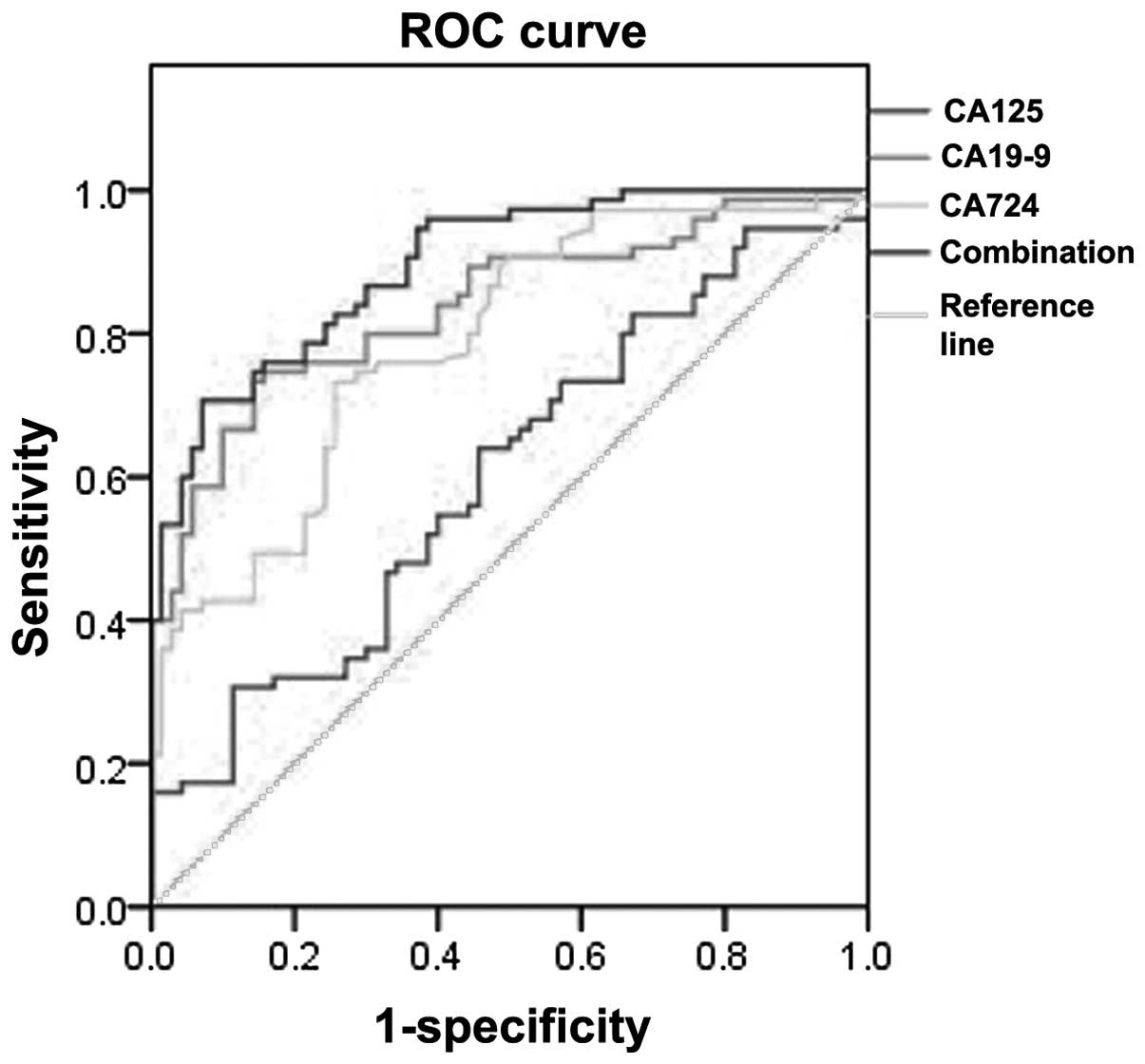
Logistic regression analysis was performed to identify related serum markers; subsequently, CA19-9 (P<0.05) and CA72-4 (P<0.05) were selected into the logistic regression equation (y=1.496−0.004xCA19-9 − 0.207xCA72-4, P<0.001). In terms of AUC, the combined detection of CA19-9 and CA72-4 was significantly higher (P<0.05) compared to that of other markers. The maximum corresponding sensitivity and specificity was yielded at the optimal cut-off point and the sensitivity of CA19-9 was the highest among marker detection, whereas the specificity of the combined detection of CA19-9 and CA72-4) was higher compared to others (Table II and Fig. 1).

Figure 1

Receiver operating characteristic (ROC) curve of single and combined marker detection in distinguishing pancreatic cancer from benign pancreatic diseases.

Table II

Performance characteristics of serum biomarkers for distinguishing pancreatic cancer from benign pancreatic diseases.

Table II

Performance characteristics of serum biomarkers for distinguishing pancreatic cancer from benign pancreatic diseases.

MarkersROC area (%)95% CISensitivity (%)Specificity (%)
CA19-983.8a(76.8–89.4)73.385.7
CA12560.2a(51.7–68.2)30.788.6
CA72-478.7a(71.2–85.1)71.487.1
CA19-9 + CA72-489.5(83.3–94.0)70.692.8

a P<0.05 compared with CA19-9 + CA72-4.

{ label (or @symbol) needed for fn[@id='tfn3-mco-02-02-0265'] } ROC, receiver operating characteristic; CI, confidence interval.

Association between serum markers and clinically related parameters of pancreatic cancer

The concentrations of CA125 and CA19-9 in patients with pancreatic adenocarcinoma were found to be significantly higher (P<0.05) compared with those with pancreatic neuroendocrine carcinoma. By contrast, as regards the levels of CA72-4, there was no significant difference (P>0.05) between pancreatic adenocarcinoma and pancreatic neuroendocrine carcinoma. In terms of tumor location, the concentrations of CA125, CA19-9 and CA72-4 were not significantly different (P>0.05) between head and body/tail. The levels of CA125, CA19-9 and CA72-4 in stage III–IV patients were found to be higher compared with those in stage II patients, although the difference was not significant (Table III).

Table III

Association between serum markers and clinically related parameters of pancreatic cancer [median (Q1–3)].

Table III

Association between serum markers and clinically related parameters of pancreatic cancer [median (Q1–3)].

CA125CA19-9CA72-4


ParametersNo.Value (ng/ml)P-valueValue (ng/ml)P-valueValue (ng/ml)P-value
Histological type
 Adenocarcinoma6246.4 (14.4–186.3)649.3 (132.9–3783.0)3.4 (1.7–16.4)
 Neuroendocrine carcinoma1315.0 (9.7–58.4)<0.0518.2 (7.7–107.7)<0.052.2 (1.8–4.5)0.291
Location
 Head4233.6 (12.3–169.3)412.4 (100.8–2237.5)2.7 (1.5–15.8)
 Body/tail3338.0 (12.3–162.0)0.835415.6 (36.4–3665.5)0.6583.4 (1.8–12.7)0.806
TNM stage
 I1311.7 (10.0–85.9)53.3 (13.4–1107.3)2.1 (1.1–3.6)
 II838.5 (11.3–183.1)226.1 (78.7–3623.7)3.4 (2.1–15.3)
 III–IV5453.5 (17.2–532.3)0.064492.6 (81.4–4653.7)0.3868.1 (1.8–122.8)0.082
Size (cm)
 ≤51814.5 (10.0–57.0)151.1 (27.2–935.6)2.4 (1.6–6.42)
 >52620.9 (13.2–141.6)0.346348.8 (47.0–1594.5)0.282.8 (1.4–18.0)0.702

[i] Parenthetical data, Q1 (the first quartile) and Q3 (the third quartile).

Discussion

As previously described, serological markers that were in essence antigens and bioactive materials from tumor tissues, minimally produced by normal cells (12), were commonly used for the diagnosis of pancreatic carcinoma, particularly CA19-9, an intracellular adhesion molecule with a molecular weight of >500000, that was widely applied in the identification of pancreatic cancer. In a previous study by Goonetilleke and Siriwardena (13), a systematic review of the MEDLINE database revealed that the median sensitivity of CA19-9 for diagnosing pancreatic cancer was 79, whereas the median specificity was 82%. Additionally, in a previous trial by Ni et al (14), the sensitivity of CA19-9 for the diagnosis of pancreatic cancer was ~80, whereas the specificity was merely 43%. Moreover, in a study by Ma et al (12), it was demonstrated that the sensitivity and specificity of CA19-9 for the diagnosis of pancreatic cancer were 79.49 and 95.31%, respectively.

Our study demonstrated that the concentration of CA19-9 in patients with pancreatic adenocarcinoma was significantly higher compared to that in pancreatic neuroendocrine carcinoma patients. Although the concentrations of CA19-9, CA125 and CA72-4 in stage III–IV were higher compared to those in stage II patients, the differences were not significant.

In 2001, CA125 (mucin 16) was identified by molecular cloning (15) as a cell surface glycoprotein that could be involved in promoting ovarian cancer cell growth. It was originally considered as a specific biological marker for ovarian cancer; however, with an increasing number of studies, it was demonstrated that it could also play an important role in diagnosing different types of cancer, including gastric, colorectal and pancreatic carcinoma. Furthermore, CA125 was found to be an independent predictor of poor outcome in pancreatic ductal adenocarcinoma and was strongly associated with patient survival rate (16). It was suggested that the concentrations of CA19-9 and CA125 were correlated with tumor size, clinical stage and tumor differentiation (17). However, in our study, the levels of serum CA125, CA19-9 and CA72-4 were not strongly affected by tumor size and although the specificity of the combined detection (CA19-9 + CA72-4) was increased to 92.8%, its sensitivity was inferior to that of CA19-9.

In conclusion, our findings suggested the specificity of the combined detection of CA19-9 and CA72-4) was increased to 92.8%, suggesting it may be a valuable strategy for pancreatic cancer screening at an early stage. In terms of sensitivity, the CA19-9 was found to be a reliable biomarker for the diagnosis of pancreatic cancer. Furthermore, the concentrations of CA125 and CA19-9 were found to be significantly different between pancreatic adenocarcinoma and neuroendocrine carcinoma.

Acknowledgements

This study was supported by grant no. 2011AA02A111 from the National High Technology Research and Development Program of China (863 Program).

Abbreviations:

ROC

receiver operating characteristic

AUC

area under the ROC curve

References

1 

Jemal A, Siegel R, Ward E, et al: Cancer statistics, 2008. CA Cancer J Clin. 58:71–96. 2008. View Article : Google Scholar

2 

Postier RG: The challenge of pancreatic cancer. Am J Surg. 186:579–582. 2003. View Article : Google Scholar : PubMed/NCBI

3 

Kato K, Kamada H, Fujimori T, Aritomo Y, Ono M and Masaki T: Molecular biologic approach to the diagnosis of pancreatic carcinoma using specimens obtained by EUS-guided fine needle aspiration. Gastroenterol Res Pract. 2012:2435242012. View Article : Google Scholar : PubMed/NCBI

4 

Li D, Xie K, Wolff R and Abbruzzese JL: Pancreatic cancer. Lancet. 363:1049–1057. 2004. View Article : Google Scholar

5 

Gudjonsson B: Carcinoma of the pancreas: critical analysis of costs, results of resections, and the need for standardized reporting. J Am Coll Surg. 181:483–503. 1995.PubMed/NCBI

6 

Niederhuber JE, Brennan MF and Menck HR: The national cancer data base report on pancreatic cancer. Cancer. 76:1671–1677. 1995. View Article : Google Scholar : PubMed/NCBI

7 

Haridas D, Chakraborty S, Ponnusamy MP, et al: Pathobiological implications of MUC16 expression in pancreatic cancer. PLoS One. 6:e268392011. View Article : Google Scholar : PubMed/NCBI

8 

Ding YL, Zhao YB, Rong Q and Lu XM: Analysis on high level of serum CA72-4 in patients with malignant tumors in 187 cases. Lab Med Clin. 7:15282010.(In Chinese).

9 

Zou KH, O’Malley AJ and Mauri L: Receiver-operating characteristic analysis for evaluating diagnostic tests and predictive models. Circulation. 115:654–657. 2007. View Article : Google Scholar : PubMed/NCBI

10 

Walter SD and Sinuff T: Studies reporting ROC curves of diagnostic and prediction data can be incorporated into meta-analyses using corresponding odds ratios. J Clin Epidemiol. 60:530–534. 2007. View Article : Google Scholar : PubMed/NCBI

11 

Sobin L and Wittekind C: TNM: Classification of Malignant Tumours. 5th edition. Wiley-Liss; New York, NY: 1997

12 

Ma Z, Ma Q and Wang Z: An evaluation of the diagnostic value of CA19-9 and CEA levels in patients with pancreatic cancer. J Nanjing Med Univ. 23:199–202. 2009. View Article : Google Scholar

13 

Goonetilleke KS and Siriwardena AK: Systematic review of carbohydrate antigen (CA 19-9) as a biochemical marker in the diagnosis of pancreatic cancer. Eur J Surg Oncol. 33:266–270. 2007. View Article : Google Scholar : PubMed/NCBI

14 

Ni XG, Bai XF, Mao YL, et al: The clinical value of serum CEA, CA19-9, and CA242 in the diagnosis and prognosis of pancreatic cancer. Eur J Surg Oncol. 31:164–169. 2005. View Article : Google Scholar : PubMed/NCBI

15 

Yin BW and Lloyd KO: Molecular cloning of the CA125 ovarian cancer antigen: identification as a new mucin, MUC16. J Biol Chem. 276:27371–27375. 2001. View Article : Google Scholar : PubMed/NCBI

16 

Streppel MM, Vincent A, Mukherjee R, et al: Mucin 16 (cancer antigen 125) expression in human tissues and cell lines and correlation with clinical outcome in adenocarcinomas of the pancreas, esophagus, stomach, and colon. Hum Pathol. 43:1755–1763. 2012. View Article : Google Scholar : PubMed/NCBI

17 

Zhou G, Niu L, Chiu D, He L and Xu K: Changes in the expression of serum markers CA242, CA199, CA125, CEA, TNF-alpha and TSGF after cryosurgery in pancreatic cancer patients. Biotechnol Lett. 34:1235–1241. 2012. View Article : Google Scholar

Related Articles

  • Abstract
  • View
  • Download
  • Twitter
Copy and paste a formatted citation
Spandidos Publications style
Wang Z and Tian YP: Clinical value of serum tumor markers CA19‑9, CA125 and CA72-4 in the diagnosis of pancreatic carcinoma. Mol Clin Oncol 2: 265-268, 2014.
APA
Wang, Z., & Tian, Y. (2014). Clinical value of serum tumor markers CA19‑9, CA125 and CA72-4 in the diagnosis of pancreatic carcinoma. Molecular and Clinical Oncology, 2, 265-268. https://doi.org/10.3892/mco.2013.226
MLA
Wang, Z., Tian, Y."Clinical value of serum tumor markers CA19‑9, CA125 and CA72-4 in the diagnosis of pancreatic carcinoma". Molecular and Clinical Oncology 2.2 (2014): 265-268.
Chicago
Wang, Z., Tian, Y."Clinical value of serum tumor markers CA19‑9, CA125 and CA72-4 in the diagnosis of pancreatic carcinoma". Molecular and Clinical Oncology 2, no. 2 (2014): 265-268. https://doi.org/10.3892/mco.2013.226
Copy and paste a formatted citation
x
Spandidos Publications style
Wang Z and Tian YP: Clinical value of serum tumor markers CA19‑9, CA125 and CA72-4 in the diagnosis of pancreatic carcinoma. Mol Clin Oncol 2: 265-268, 2014.
APA
Wang, Z., & Tian, Y. (2014). Clinical value of serum tumor markers CA19‑9, CA125 and CA72-4 in the diagnosis of pancreatic carcinoma. Molecular and Clinical Oncology, 2, 265-268. https://doi.org/10.3892/mco.2013.226
MLA
Wang, Z., Tian, Y."Clinical value of serum tumor markers CA19‑9, CA125 and CA72-4 in the diagnosis of pancreatic carcinoma". Molecular and Clinical Oncology 2.2 (2014): 265-268.
Chicago
Wang, Z., Tian, Y."Clinical value of serum tumor markers CA19‑9, CA125 and CA72-4 in the diagnosis of pancreatic carcinoma". Molecular and Clinical Oncology 2, no. 2 (2014): 265-268. https://doi.org/10.3892/mco.2013.226
Follow us
  • Twitter
  • LinkedIn
  • Facebook
About
  • Spandidos Publications
  • Careers
  • Cookie Policy
  • Privacy Policy
How can we help?
  • Help
  • Live Chat
  • Contact
  • Email to our Support Team