Spandidos Publications Logo
  • About
    • About Spandidos
    • Aims and Scopes
    • Abstracting and Indexing
    • Editorial Policies
    • Reprints and Permissions
    • Job Opportunities
    • Terms and Conditions
    • Contact
  • Journals
    • All Journals
    • Oncology Letters
      • Oncology Letters
      • Information for Authors
      • Editorial Policies
      • Editorial Board
      • Aims and Scope
      • Abstracting and Indexing
      • Bibliographic Information
      • Archive
    • International Journal of Oncology
      • International Journal of Oncology
      • Information for Authors
      • Editorial Policies
      • Editorial Board
      • Aims and Scope
      • Abstracting and Indexing
      • Bibliographic Information
      • Archive
    • Molecular and Clinical Oncology
      • Molecular and Clinical Oncology
      • Information for Authors
      • Editorial Policies
      • Editorial Board
      • Aims and Scope
      • Abstracting and Indexing
      • Bibliographic Information
      • Archive
    • Experimental and Therapeutic Medicine
      • Experimental and Therapeutic Medicine
      • Information for Authors
      • Editorial Policies
      • Editorial Board
      • Aims and Scope
      • Abstracting and Indexing
      • Bibliographic Information
      • Archive
    • International Journal of Molecular Medicine
      • International Journal of Molecular Medicine
      • Information for Authors
      • Editorial Policies
      • Editorial Board
      • Aims and Scope
      • Abstracting and Indexing
      • Bibliographic Information
      • Archive
    • Biomedical Reports
      • Biomedical Reports
      • Information for Authors
      • Editorial Policies
      • Editorial Board
      • Aims and Scope
      • Abstracting and Indexing
      • Bibliographic Information
      • Archive
    • Oncology Reports
      • Oncology Reports
      • Information for Authors
      • Editorial Policies
      • Editorial Board
      • Aims and Scope
      • Abstracting and Indexing
      • Bibliographic Information
      • Archive
    • Molecular Medicine Reports
      • Molecular Medicine Reports
      • Information for Authors
      • Editorial Policies
      • Editorial Board
      • Aims and Scope
      • Abstracting and Indexing
      • Bibliographic Information
      • Archive
    • World Academy of Sciences Journal
      • World Academy of Sciences Journal
      • Information for Authors
      • Editorial Policies
      • Editorial Board
      • Aims and Scope
      • Abstracting and Indexing
      • Bibliographic Information
      • Archive
    • International Journal of Functional Nutrition
      • International Journal of Functional Nutrition
      • Information for Authors
      • Editorial Policies
      • Editorial Board
      • Aims and Scope
      • Abstracting and Indexing
      • Bibliographic Information
      • Archive
    • International Journal of Epigenetics
      • International Journal of Epigenetics
      • Information for Authors
      • Editorial Policies
      • Editorial Board
      • Aims and Scope
      • Abstracting and Indexing
      • Bibliographic Information
      • Archive
    • Medicine International
      • Medicine International
      • Information for Authors
      • Editorial Policies
      • Editorial Board
      • Aims and Scope
      • Abstracting and Indexing
      • Bibliographic Information
      • Archive
  • Articles
  • Information
    • Information for Authors
    • Information for Reviewers
    • Information for Librarians
    • Information for Advertisers
    • Conferences
  • Language Editing
Spandidos Publications Logo
  • About
    • About Spandidos
    • Aims and Scopes
    • Abstracting and Indexing
    • Editorial Policies
    • Reprints and Permissions
    • Job Opportunities
    • Terms and Conditions
    • Contact
  • Journals
    • All Journals
    • Biomedical Reports
      • Information for Authors
      • Editorial Policies
      • Editorial Board
      • Aims and Scope
      • Abstracting and Indexing
      • Bibliographic Information
      • Archive
    • Experimental and Therapeutic Medicine
      • Information for Authors
      • Editorial Policies
      • Editorial Board
      • Aims and Scope
      • Abstracting and Indexing
      • Bibliographic Information
      • Archive
    • International Journal of Epigenetics
      • Information for Authors
      • Editorial Policies
      • Editorial Board
      • Aims and Scope
      • Abstracting and Indexing
      • Bibliographic Information
      • Archive
    • International Journal of Functional Nutrition
      • Information for Authors
      • Editorial Policies
      • Editorial Board
      • Aims and Scope
      • Abstracting and Indexing
      • Bibliographic Information
      • Archive
    • International Journal of Molecular Medicine
      • Information for Authors
      • Editorial Policies
      • Editorial Board
      • Aims and Scope
      • Abstracting and Indexing
      • Bibliographic Information
      • Archive
    • International Journal of Oncology
      • Information for Authors
      • Editorial Policies
      • Editorial Board
      • Aims and Scope
      • Abstracting and Indexing
      • Bibliographic Information
      • Archive
    • Medicine International
      • Information for Authors
      • Editorial Policies
      • Editorial Board
      • Aims and Scope
      • Abstracting and Indexing
      • Bibliographic Information
      • Archive
    • Molecular and Clinical Oncology
      • Information for Authors
      • Editorial Policies
      • Editorial Board
      • Aims and Scope
      • Abstracting and Indexing
      • Bibliographic Information
      • Archive
    • Molecular Medicine Reports
      • Information for Authors
      • Editorial Policies
      • Editorial Board
      • Aims and Scope
      • Abstracting and Indexing
      • Bibliographic Information
      • Archive
    • Oncology Letters
      • Information for Authors
      • Editorial Policies
      • Editorial Board
      • Aims and Scope
      • Abstracting and Indexing
      • Bibliographic Information
      • Archive
    • Oncology Reports
      • Information for Authors
      • Editorial Policies
      • Editorial Board
      • Aims and Scope
      • Abstracting and Indexing
      • Bibliographic Information
      • Archive
    • World Academy of Sciences Journal
      • Information for Authors
      • Editorial Policies
      • Editorial Board
      • Aims and Scope
      • Abstracting and Indexing
      • Bibliographic Information
      • Archive
  • Articles
  • Information
    • For Authors
    • For Reviewers
    • For Librarians
    • For Advertisers
    • Conferences
  • Language Editing
Login Register Submit
  • This site uses cookies
  • You can change your cookie settings at any time by following the instructions in our Cookie Policy. To find out more, you may read our Privacy Policy.

    I agree
Search articles by DOI, keyword, author or affiliation
Search
Advanced Search
presentation
Molecular and Clinical Oncology
Join Editorial Board Propose a Special Issue
Print ISSN: 2049-9450 Online ISSN: 2049-9469
Journal Cover
May-2016 Volume 4 Issue 5

Full Size Image

Sign up for eToc alerts
Recommend to Library

Journals

International Journal of Molecular Medicine

International Journal of Molecular Medicine

International Journal of Molecular Medicine is an international journal devoted to molecular mechanisms of human disease.

International Journal of Oncology

International Journal of Oncology

International Journal of Oncology is an international journal devoted to oncology research and cancer treatment.

Molecular Medicine Reports

Molecular Medicine Reports

Covers molecular medicine topics such as pharmacology, pathology, genetics, neuroscience, infectious diseases, molecular cardiology, and molecular surgery.

Oncology Reports

Oncology Reports

Oncology Reports is an international journal devoted to fundamental and applied research in Oncology.

Experimental and Therapeutic Medicine

Experimental and Therapeutic Medicine

Experimental and Therapeutic Medicine is an international journal devoted to laboratory and clinical medicine.

Oncology Letters

Oncology Letters

Oncology Letters is an international journal devoted to Experimental and Clinical Oncology.

Biomedical Reports

Biomedical Reports

Explores a wide range of biological and medical fields, including pharmacology, genetics, microbiology, neuroscience, and molecular cardiology.

Molecular and Clinical Oncology

Molecular and Clinical Oncology

International journal addressing all aspects of oncology research, from tumorigenesis and oncogenes to chemotherapy and metastasis.

World Academy of Sciences Journal

World Academy of Sciences Journal

Multidisciplinary open-access journal spanning biochemistry, genetics, neuroscience, environmental health, and synthetic biology.

International Journal of Functional Nutrition

International Journal of Functional Nutrition

Open-access journal combining biochemistry, pharmacology, immunology, and genetics to advance health through functional nutrition.

International Journal of Epigenetics

International Journal of Epigenetics

Publishes open-access research on using epigenetics to advance understanding and treatment of human disease.

Medicine International

Medicine International

An International Open Access Journal Devoted to General Medicine.

Journal Cover
May-2016 Volume 4 Issue 5

Full Size Image

Sign up for eToc alerts
Recommend to Library

  • Article
  • Citations
    • Cite This Article
    • Download Citation
    • Create Citation Alert
    • Remove Citation Alert
    • Cited By
  • Similar Articles
    • Related Articles (in Spandidos Publications)
    • Similar Articles (Google Scholar)
    • Similar Articles (PubMed)
  • Download PDF
  • Download XML
  • View XML
Article

False‑positive 18F‑fluorodeoxyglucose positron emission tomography/computed tomography in a patient with metallic implants following chondrosarcoma resection

  • Authors:
    • Pu Zhou
    • Jinliang Tang
    • Dong Zhang
    • Guanghui Li
  • View Affiliations / Copyright

    Affiliations: Institute for Cancer Research in People's Liberation Army, Xinqiao Hospital, Third Military Medical University, Chongqing 400037, P.R. China, Department of Radiology, Xinqiao Hospital, Third Military Medical University, Chongqing 400037, P.R. China, Department of Pathology, Xinqiao Hospital, Third Military Medical University, Chongqing 400037, P.R. China
  • Pages: 830-832
    |
    Published online on: March 3, 2016
       https://doi.org/10.3892/mco.2016.801
  • Expand metrics +
Metrics: Total Views: 0 (Spandidos Publications: | PMC Statistics: )
Metrics: Total PDF Downloads: 0 (Spandidos Publications: | PMC Statistics: )
Cited By (CrossRef): 0 citations Loading Articles...

This article is mentioned in:


Abstract

Positron emission tomography (PET) with fluorine‑18‑labeled fluorodeoxyglucose (18F‑FDG) has been used for the staging and evaluation of recurrence in cancer patients. We herein report a false‑positive result of 18F‑FDG PET̸computed tomography (CT) scan in a patient following chondrosarcoma resection and metallic implanting. A 35‑year‑old male patient with chondrosarcoma of the left iliac bone underwent radical resection, metal brace implanting and radiotherapy. A high uptake of 18F‑FDG was observed in the metallic implants and adjacent tissue during PET/CT scanning in the 5th year of follow‑up. tissue biopsy and follow‑up examination identified no tumor recurrence or infection at these sites, suggesting that the results of 18F‑FDG PET̸CT must be interpreted with caution in cancer patients with metallic implants.

Introduction

Fluorine-18-labeled fluorodeoxyglucose (18F-FDG) positron emission tomography (PET)/computed tomography (CT), which combines molecular with structural imaging, is a highly sensitive and specific modality for detecting primary tumors and metastatic lesions compared with magnetic resonance imaging (MRI), CT and bone scintigraphy (1). 18F-FDG PET/CT has been successfully used for the diagnosis, staging and assessing the recurrence of cancer (2); it has also contributed in distinguishing malignant osteochondromas and evaluating tumor grade in chondrosarcoma (3,4). However, a high FDG uptake may be observed in the metallic implant and adjacent tissue following chondrosarcoma resection. We herein report such a false-positive result of 18F-FDG PET/CT scan, which was identified by biopsy of the tissue adjacent to the implants and follow-up examination in this patient. To the best of our knowledge, no reports have yet been published on the effect of metallic artifacts on PET/CT detection in cancer patients.

Case report

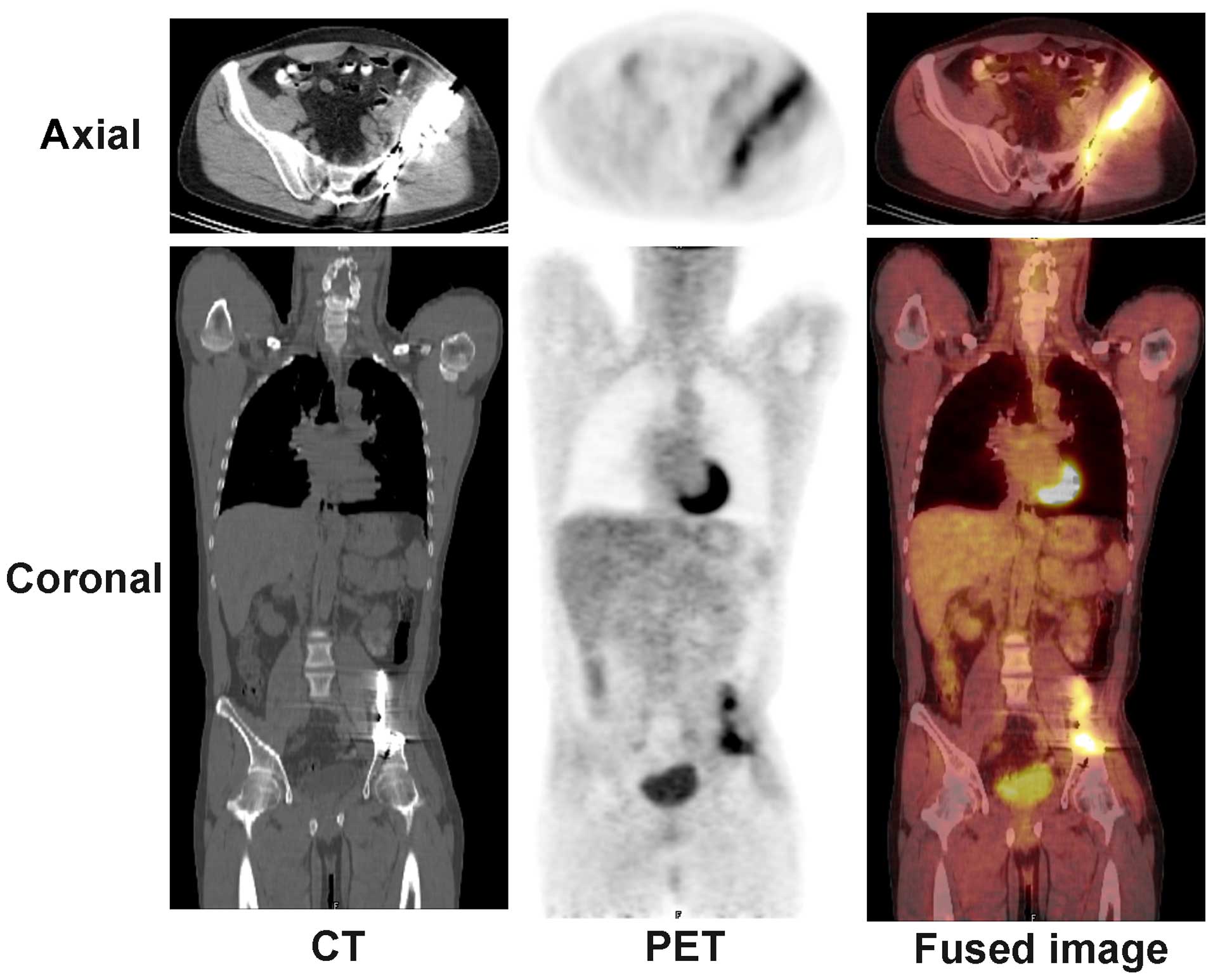
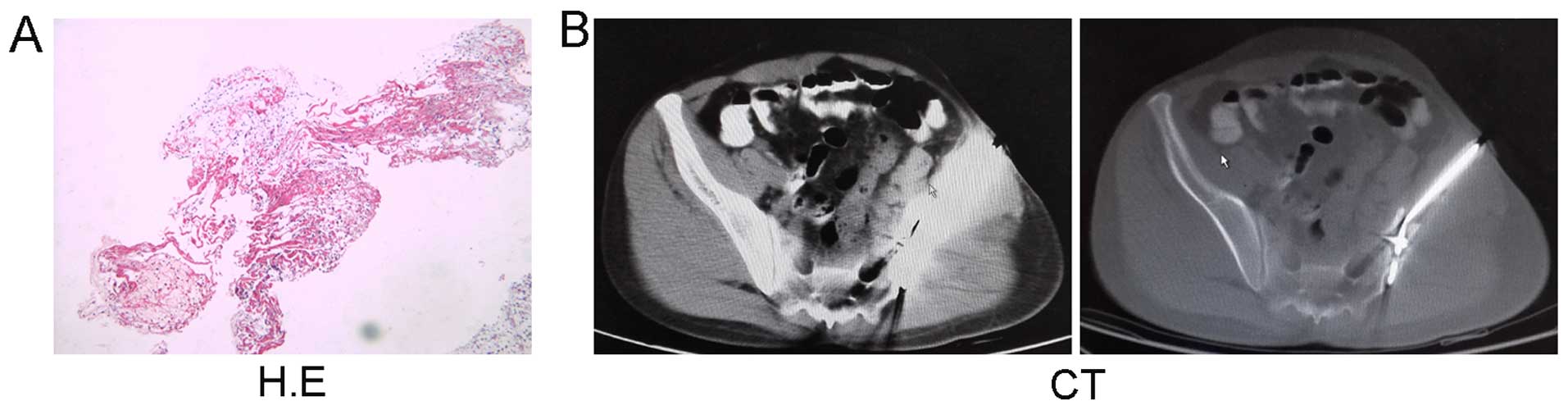
A 37 year-old man was diagnosed with low-grade chondrosarcoma of the left iliac bone, involving part of the adjacent muscle and soft tissue. The tumor was radically resected and a titanium alloy brace was implanted in the left pelvis in August 23, 2000. A second excision was performed following tumor relapse adjacent to the implant, which was detected by CT scanning in December, 2004. R1 resection margin was confirmed by pathological assessment and the patient underwent radical three-dimensional conformal radiotherapy of the left pelvis with a clinical target volume of 6-MV X-rays, with a total dose of 64 Gy/32 fr. This patient was regularly followed up with physical and imaging examinations, according to the follow-up schedule. 18F-FDG PET/CT scanning was performed in February, 2010, 5 years after the radiotherapy. High FDG uptake [maximum standardized uptake value (SUVmax) = 10.3] was found in the soft tissue surrounding the metallic implants (Fig. 1). Tumor relapse was suspected on PET/CT imaging. Multiple biopsies of tissues adjacent to the implants was performed in July, 2010. The pathology results revealed the presence of fibrous tissue, without inflammation or tumor recurrence. The false-positive result of the PET/CT examination was confirmed by tissue biopsy in this patient at the 5-year follow-up examination (Fig. 2). The titanium alloy brace was removed from the left pelvis at another hospital and marked fibrosis surrounding the implants was detected during surgery in October, 2015 (data not shown). The patient remains alive and disease-free, with a good performance status and no complaints during follow-up.

Figure 1.

Increased uptake of fluorodeoxyglucose (maximum standardized uptake value = 10.3) of adjacent metallic implants in the left pelvis 5 years after recurrent chondrosarcoma resection (February, 2010). The co-registered PET and CT image facilitated the utilization of CT-based attenuation correction for PET. CT, computed tomography; PET, positron emission tomography.

Figure 2.

Result of biopsy of tissue adjacent to the artifacts and conventional computed tomography (CT) scan at 10 years of follow-up following resection of chondrosarcoma of the left iliac bone. (A) Pathological examination revealed the presence of fibrous tissue adjacent to the metallic implant. (B) Axial CT scanning of the pelvis on May 21st, 2015. Right panel, soft tissue window; left panel, bone window. The structures surrounding the implants on CT scanning were the same as in February, 2010.

Discussion

The uptake of 18F-FDG by tissues is related to the glycolytic activity of the tissue during PET scanning (5,6). PET/CT imaging combines anatomical and functional images. Whole-body FDG-PET/CT scanning is widely used as a diagnostic and evaluating tool in patients with malignant tumors. Metallic implants are often used in patients in oncological surgery. MRI and CT scanning often display a compromised image quality in patients with metallic implants. Therefore, FDG-PET/CT plays an important role in detecting recurrent tumors in the vicinity of the artifacts in patients with cancer. Implant-associated infection and inflammation may also develop in certain patients postoperatively (7). Increased FDG uptake may also be associated with benign conditions, such as infection and inflammation (8,9). However, in this patient, the pathological examination identified no tumor recurrence or infection of the soft tissue adjacent to the artificial implants. The deceptively high uptake of the implants and adjacent tissue may be related to the artifacts in the left pelvis of this patient. It was previously reported that uninfected vascular metallic grafts resulted in FDG uptake for years, with SUVmax ranging from 2 to 4.2 (10). However, the SUVmax of the implants and adjacent tissue was 10.2 in this patient. The CT beam hardening metallic implants leads to enhanced or diminished radiotracer uptake, resulting in a ‘dark streak’ or ‘starburst’ appearance on CT images. The acquisition of PET images facilitates the utilization of CT-based attenuation correction for PET, which may lead to variable degrees of bias in the measures of FDG uptake in vivo. Dark streak artefacts cause signal loss and lead to an underestimation of the SUV. The starburst zones lead to attenuation overestimation, leading to an artificial increase of the SUV (11–14). The attenuation overestimation of metallic artefacts in CT images may account for the strong absorbance during PET imaging in this patient. Thus, the positivity of FDG-PET/CT should be interpreted with caution in cancer patients with metallic artifacts.

References

1 

Farwell MD, Pryma DA and Mankoff DA: PET/CT imaging in cancer: Current applications and future directions. Cancer. 120:3433–3445. 2014. View Article : Google Scholar : PubMed/NCBI

2 

Gámez-Cenzano C and Pino-Sorroche F: Standardization and quantification in FDG-PET/CT imaging for staging and restaging of malignant disease. PET Clin. 9:117–127. 2014. View Article : Google Scholar : PubMed/NCBI

3 

Feldman F, Vanheertum R and Saxena C: 18Fluoro-deoxyglucose positron emission tomography evaluation of benign versus malignant osteochondromas: Preliminary observations. J Comput Assist Tomogr. 30:858–864. 2006. View Article : Google Scholar : PubMed/NCBI

4 

Brenner W, Conrad EU and Eary JF: FDG PET imaging for grading and prediction of outcome in chondrosarcoma patients. Eur J Nucl Med Mol Imaging. 31:189–195. 2004. View Article : Google Scholar : PubMed/NCBI

5 

Conti PS, Lilien DL, Hawley K, Keppler J, Grafton ST and Bading JR: PET and [18F]-FDG in oncology: A clinical update. Nucl Med Biol. 23:717–735. 1996. View Article : Google Scholar : PubMed/NCBI

6 

Basu S, Hess S, Braad Nielsen PE, Olsen BB, Inglev S and Høilund-Carlsen PF: The basic principles of FDG-PET/CT imaging. PET Clin. 9:355–370. 2014. View Article : Google Scholar : PubMed/NCBI

7 

Dhanoa A, Singh Ajit V and Elbahri H: Deep infections after endoprosthetic replacement operations in orthopedic oncology patients. Surg Infect (Larchmt). 16:323–332. 2015. View Article : Google Scholar : PubMed/NCBI

8 

Hess S, Hansson SH, Pedersen KT, Basu S and Høilund-Carlsen PF: FDG-PET/CT in infectious and inflammatory diseases. PET Clin. 9:497–519. 2014. View Article : Google Scholar : PubMed/NCBI

9 

Vaidyanathan S, Patel CN, Scarsbrook AF and Chowdhury FU: FDG PET/CT in infection and inflammation - current and emerging clinical applications. Clin Radiol. 70:787–800. 2015. View Article : Google Scholar : PubMed/NCBI

10 

Berger P, Vaartjes I, Scholtens A, Moll FL, De Borst GJ, De Keizer B, Bots ML and Blankensteijn JD: Differential FDG-PET uptake patterns in uninfected and infected central prosthetic vascular grafts. Eur J Vasc Endovasc Surg. 50:376–383. 2015. View Article : Google Scholar : PubMed/NCBI

11 

Kennedy JA, Israel O, Frenkel A, Bar-Shalom R and Azhari H: The reduction of artifacts due to metal hip implants in CT-attenuation corrected PET images from hybrid PET/CT scanners. Med Biol Eng Comput. 45:553–562. 2007. View Article : Google Scholar : PubMed/NCBI

12 

Shimamoto H, Kakimoto N, Fujino K, Hamada S, Shimosegawa E, Murakami S, Furukawa S and Hatazawa J: Metallic artifacts caused by dental metal prostheses on PET images: A PET/CT phantom study using different PET/CT scanners. Ann Nucl Med. 23:443–449. 2009. View Article : Google Scholar : PubMed/NCBI

13 

Kamel EM, Burger C, Buck A, von Schulthess GK and Goerres GW: Impact of metallic dental implants on CT-based attenuation correction in a combined PET/CT scanner. Eur Radiol. 13:724–728. 2003. View Article : Google Scholar : PubMed/NCBI

14 

Buchbender C, Hartung-Knemeyer V, Forsting M, Antoch G and Heusner TA: Positron emission tomography (PET) attenuation correction artefacts in PET/CT and PET/MRI. Br J Radiol. 86:201205702013. View Article : Google Scholar : PubMed/NCBI

Related Articles

  • Abstract
  • View
  • Download
  • Twitter
Copy and paste a formatted citation
Spandidos Publications style
Zhou P, Tang J, Zhang D and Li G: False‑positive 18F‑fluorodeoxyglucose positron emission tomography/computed tomography in a patient with metallic implants following chondrosarcoma resection. Mol Clin Oncol 4: 830-832, 2016.
APA
Zhou, P., Tang, J., Zhang, D., & Li, G. (2016). False‑positive 18F‑fluorodeoxyglucose positron emission tomography/computed tomography in a patient with metallic implants following chondrosarcoma resection. Molecular and Clinical Oncology, 4, 830-832. https://doi.org/10.3892/mco.2016.801
MLA
Zhou, P., Tang, J., Zhang, D., Li, G."False‑positive 18F‑fluorodeoxyglucose positron emission tomography/computed tomography in a patient with metallic implants following chondrosarcoma resection". Molecular and Clinical Oncology 4.5 (2016): 830-832.
Chicago
Zhou, P., Tang, J., Zhang, D., Li, G."False‑positive 18F‑fluorodeoxyglucose positron emission tomography/computed tomography in a patient with metallic implants following chondrosarcoma resection". Molecular and Clinical Oncology 4, no. 5 (2016): 830-832. https://doi.org/10.3892/mco.2016.801
Copy and paste a formatted citation
x
Spandidos Publications style
Zhou P, Tang J, Zhang D and Li G: False‑positive 18F‑fluorodeoxyglucose positron emission tomography/computed tomography in a patient with metallic implants following chondrosarcoma resection. Mol Clin Oncol 4: 830-832, 2016.
APA
Zhou, P., Tang, J., Zhang, D., & Li, G. (2016). False‑positive 18F‑fluorodeoxyglucose positron emission tomography/computed tomography in a patient with metallic implants following chondrosarcoma resection. Molecular and Clinical Oncology, 4, 830-832. https://doi.org/10.3892/mco.2016.801
MLA
Zhou, P., Tang, J., Zhang, D., Li, G."False‑positive 18F‑fluorodeoxyglucose positron emission tomography/computed tomography in a patient with metallic implants following chondrosarcoma resection". Molecular and Clinical Oncology 4.5 (2016): 830-832.
Chicago
Zhou, P., Tang, J., Zhang, D., Li, G."False‑positive 18F‑fluorodeoxyglucose positron emission tomography/computed tomography in a patient with metallic implants following chondrosarcoma resection". Molecular and Clinical Oncology 4, no. 5 (2016): 830-832. https://doi.org/10.3892/mco.2016.801
Follow us
  • Twitter
  • LinkedIn
  • Facebook
About
  • Spandidos Publications
  • Careers
  • Cookie Policy
  • Privacy Policy
How can we help?
  • Help
  • Live Chat
  • Contact
  • Email to our Support Team