Spandidos Publications Logo
  • About
    • About Spandidos
    • Aims and Scopes
    • Abstracting and Indexing
    • Editorial Policies
    • Reprints and Permissions
    • Job Opportunities
    • Terms and Conditions
    • Contact
  • Journals
    • All Journals
    • Oncology Letters
      • Oncology Letters
      • Information for Authors
      • Editorial Policies
      • Editorial Board
      • Aims and Scope
      • Abstracting and Indexing
      • Bibliographic Information
      • Archive
    • International Journal of Oncology
      • International Journal of Oncology
      • Information for Authors
      • Editorial Policies
      • Editorial Board
      • Aims and Scope
      • Abstracting and Indexing
      • Bibliographic Information
      • Archive
    • Molecular and Clinical Oncology
      • Molecular and Clinical Oncology
      • Information for Authors
      • Editorial Policies
      • Editorial Board
      • Aims and Scope
      • Abstracting and Indexing
      • Bibliographic Information
      • Archive
    • Experimental and Therapeutic Medicine
      • Experimental and Therapeutic Medicine
      • Information for Authors
      • Editorial Policies
      • Editorial Board
      • Aims and Scope
      • Abstracting and Indexing
      • Bibliographic Information
      • Archive
    • International Journal of Molecular Medicine
      • International Journal of Molecular Medicine
      • Information for Authors
      • Editorial Policies
      • Editorial Board
      • Aims and Scope
      • Abstracting and Indexing
      • Bibliographic Information
      • Archive
    • Biomedical Reports
      • Biomedical Reports
      • Information for Authors
      • Editorial Policies
      • Editorial Board
      • Aims and Scope
      • Abstracting and Indexing
      • Bibliographic Information
      • Archive
    • Oncology Reports
      • Oncology Reports
      • Information for Authors
      • Editorial Policies
      • Editorial Board
      • Aims and Scope
      • Abstracting and Indexing
      • Bibliographic Information
      • Archive
    • Molecular Medicine Reports
      • Molecular Medicine Reports
      • Information for Authors
      • Editorial Policies
      • Editorial Board
      • Aims and Scope
      • Abstracting and Indexing
      • Bibliographic Information
      • Archive
    • World Academy of Sciences Journal
      • World Academy of Sciences Journal
      • Information for Authors
      • Editorial Policies
      • Editorial Board
      • Aims and Scope
      • Abstracting and Indexing
      • Bibliographic Information
      • Archive
    • International Journal of Functional Nutrition
      • International Journal of Functional Nutrition
      • Information for Authors
      • Editorial Policies
      • Editorial Board
      • Aims and Scope
      • Abstracting and Indexing
      • Bibliographic Information
      • Archive
    • International Journal of Epigenetics
      • International Journal of Epigenetics
      • Information for Authors
      • Editorial Policies
      • Editorial Board
      • Aims and Scope
      • Abstracting and Indexing
      • Bibliographic Information
      • Archive
    • Medicine International
      • Medicine International
      • Information for Authors
      • Editorial Policies
      • Editorial Board
      • Aims and Scope
      • Abstracting and Indexing
      • Bibliographic Information
      • Archive
  • Articles
  • Information
    • Information for Authors
    • Information for Reviewers
    • Information for Librarians
    • Information for Advertisers
    • Conferences
  • Language Editing
Spandidos Publications Logo
  • About
    • About Spandidos
    • Aims and Scopes
    • Abstracting and Indexing
    • Editorial Policies
    • Reprints and Permissions
    • Job Opportunities
    • Terms and Conditions
    • Contact
  • Journals
    • All Journals
    • Biomedical Reports
      • Information for Authors
      • Editorial Policies
      • Editorial Board
      • Aims and Scope
      • Abstracting and Indexing
      • Bibliographic Information
      • Archive
    • Experimental and Therapeutic Medicine
      • Information for Authors
      • Editorial Policies
      • Editorial Board
      • Aims and Scope
      • Abstracting and Indexing
      • Bibliographic Information
      • Archive
    • International Journal of Epigenetics
      • Information for Authors
      • Editorial Policies
      • Editorial Board
      • Aims and Scope
      • Abstracting and Indexing
      • Bibliographic Information
      • Archive
    • International Journal of Functional Nutrition
      • Information for Authors
      • Editorial Policies
      • Editorial Board
      • Aims and Scope
      • Abstracting and Indexing
      • Bibliographic Information
      • Archive
    • International Journal of Molecular Medicine
      • Information for Authors
      • Editorial Policies
      • Editorial Board
      • Aims and Scope
      • Abstracting and Indexing
      • Bibliographic Information
      • Archive
    • International Journal of Oncology
      • Information for Authors
      • Editorial Policies
      • Editorial Board
      • Aims and Scope
      • Abstracting and Indexing
      • Bibliographic Information
      • Archive
    • Medicine International
      • Information for Authors
      • Editorial Policies
      • Editorial Board
      • Aims and Scope
      • Abstracting and Indexing
      • Bibliographic Information
      • Archive
    • Molecular and Clinical Oncology
      • Information for Authors
      • Editorial Policies
      • Editorial Board
      • Aims and Scope
      • Abstracting and Indexing
      • Bibliographic Information
      • Archive
    • Molecular Medicine Reports
      • Information for Authors
      • Editorial Policies
      • Editorial Board
      • Aims and Scope
      • Abstracting and Indexing
      • Bibliographic Information
      • Archive
    • Oncology Letters
      • Information for Authors
      • Editorial Policies
      • Editorial Board
      • Aims and Scope
      • Abstracting and Indexing
      • Bibliographic Information
      • Archive
    • Oncology Reports
      • Information for Authors
      • Editorial Policies
      • Editorial Board
      • Aims and Scope
      • Abstracting and Indexing
      • Bibliographic Information
      • Archive
    • World Academy of Sciences Journal
      • Information for Authors
      • Editorial Policies
      • Editorial Board
      • Aims and Scope
      • Abstracting and Indexing
      • Bibliographic Information
      • Archive
  • Articles
  • Information
    • For Authors
    • For Reviewers
    • For Librarians
    • For Advertisers
    • Conferences
  • Language Editing
Login Register Submit
  • This site uses cookies
  • You can change your cookie settings at any time by following the instructions in our Cookie Policy. To find out more, you may read our Privacy Policy.

    I agree
Search articles by DOI, keyword, author or affiliation
Search
Advanced Search
presentation
Molecular and Clinical Oncology
Join Editorial Board Propose a Special Issue
Print ISSN: 2049-9450 Online ISSN: 2049-9469
Journal Cover
June-2016 Volume 4 Issue 6

Full Size Image

Sign up for eToc alerts
Recommend to Library

Journals

International Journal of Molecular Medicine

International Journal of Molecular Medicine

International Journal of Molecular Medicine is an international journal devoted to molecular mechanisms of human disease.

International Journal of Oncology

International Journal of Oncology

International Journal of Oncology is an international journal devoted to oncology research and cancer treatment.

Molecular Medicine Reports

Molecular Medicine Reports

Covers molecular medicine topics such as pharmacology, pathology, genetics, neuroscience, infectious diseases, molecular cardiology, and molecular surgery.

Oncology Reports

Oncology Reports

Oncology Reports is an international journal devoted to fundamental and applied research in Oncology.

Experimental and Therapeutic Medicine

Experimental and Therapeutic Medicine

Experimental and Therapeutic Medicine is an international journal devoted to laboratory and clinical medicine.

Oncology Letters

Oncology Letters

Oncology Letters is an international journal devoted to Experimental and Clinical Oncology.

Biomedical Reports

Biomedical Reports

Explores a wide range of biological and medical fields, including pharmacology, genetics, microbiology, neuroscience, and molecular cardiology.

Molecular and Clinical Oncology

Molecular and Clinical Oncology

International journal addressing all aspects of oncology research, from tumorigenesis and oncogenes to chemotherapy and metastasis.

World Academy of Sciences Journal

World Academy of Sciences Journal

Multidisciplinary open-access journal spanning biochemistry, genetics, neuroscience, environmental health, and synthetic biology.

International Journal of Functional Nutrition

International Journal of Functional Nutrition

Open-access journal combining biochemistry, pharmacology, immunology, and genetics to advance health through functional nutrition.

International Journal of Epigenetics

International Journal of Epigenetics

Publishes open-access research on using epigenetics to advance understanding and treatment of human disease.

Medicine International

Medicine International

An International Open Access Journal Devoted to General Medicine.

Journal Cover
June-2016 Volume 4 Issue 6

Full Size Image

Sign up for eToc alerts
Recommend to Library

  • Article
  • Citations
    • Cite This Article
    • Download Citation
    • Create Citation Alert
    • Remove Citation Alert
    • Cited By
  • Similar Articles
    • Related Articles (in Spandidos Publications)
    • Similar Articles (Google Scholar)
    • Similar Articles (PubMed)
  • Download PDF
  • Download XML
  • View XML
Case Report

Primary hepatic neuroendocrine tumor: A case report

  • Authors:
    • Asahiro Morishita
    • Hirohito Yoneyama
    • Takako Nomura
    • Teppei Sakamoto
    • Koji Fujita
    • Joji Tani
    • Hisaaki Miyoshi
    • Reiji Haba
    • Tsutomu Masaki
  • View Affiliations / Copyright

    Affiliations: Department of Gastroenterology and Neurology, Faculty of Medicine, Kagawa University, Kagawa 761‑0793, Japan, Department of Diagnostic Pathology, Faculty of Medicine, Kagawa University, Kagawa 761‑0793, Japan
  • Pages: 954-956
    |
    Published online on: March 17, 2016
       https://doi.org/10.3892/mco.2016.822
  • Expand metrics +
Metrics: Total Views: 0 (Spandidos Publications: | PMC Statistics: )
Metrics: Total PDF Downloads: 0 (Spandidos Publications: | PMC Statistics: )
Cited By (CrossRef): 0 citations Loading Articles...

This article is mentioned in:


Abstract

We herein present a case of an 87-year-old patient with multiple liver tumors identified on abdominal ultrasound. The assessment performed on admission included physical examination, computed tomography (CT) during hepatic angiography and CT during arterial portography. The examination revealed contrast enhancement of a proportion of the liver tumors (20 mm maximum diameter) during the arterial phase and mild contrast washout of those tumors during the delayed phase. On contrast‑enhanced magnetic resonance imaging using gadolinium ethoxybenzyl diethylenetriamine pentaacetic acid, certain liver tumors exhibited contrast enhancement during the early phase and contrast washout during the hepatocyte phase in both lobes. By contrast, no lesions were identified during positron emission tomography imaging of the liver. A liver biopsy was performed and immunohistochemical staining revealed enhanced expression of cytokeratin AE1̸AE3, synaptophysin, chromogranin A and CD56 and no expression of hepatocyte antigen or CΚ7. The mindbomb E3 ubiquitin protein ligase‑1 index was ~2% in most of the tumor. The liver tumors were finally diagnosed as multiple intrahepatic metastases from a primary hepatic neuroendocrine tumor (PHNET). The patient underwent transarterial chemoembolisation with a combination of miriplatin (84 mg) mixed with gelatin sponge particles and lipiodol. To the best of our knowledge, this is the first report of PHNET in an patient aged >85 years.

Introduction

Neuroendocrine tumors (NETs) have an average annual incidence of 2 per 100,000 cases among all tumors of the gastrointestinal tract. NETs primarily arise in the bronchopulmonary or gastrointestinal tracts (e.g., pancreas, ileum or appendix) and account for ~70% of all NETs found in the body (1–3). However, NETs are frequently reported as metastatic liver tumors, although the liver itself is rarely described as the site of the primary tumor. Since Edmondson first reported a case of primary hepatic NET (PHNET) (4), <100 cases have been reported in the English-language literature (3,5–9). The clinicopathological characteristics of PHNETs reveal that (i) they occur at a relatively young age (mean, 45 years), (ii) there is no known gender predominance, (iii) the majority of the cases are asymptomatic, (iv) the pathological diagnosis requires immunohistochemistry and (v) various therapeutic approaches may be attempted for PHNETs, such as hepatic lobectomy, systemic chemotherapy, transhepatic arterial chemoembolization (tace), radiofrequency ablation and liver transplantation (10–12). To the best of our knowledge, there has been no report of PHNET with multiple liver metastases in a patient aged >85 years to date.

Case report

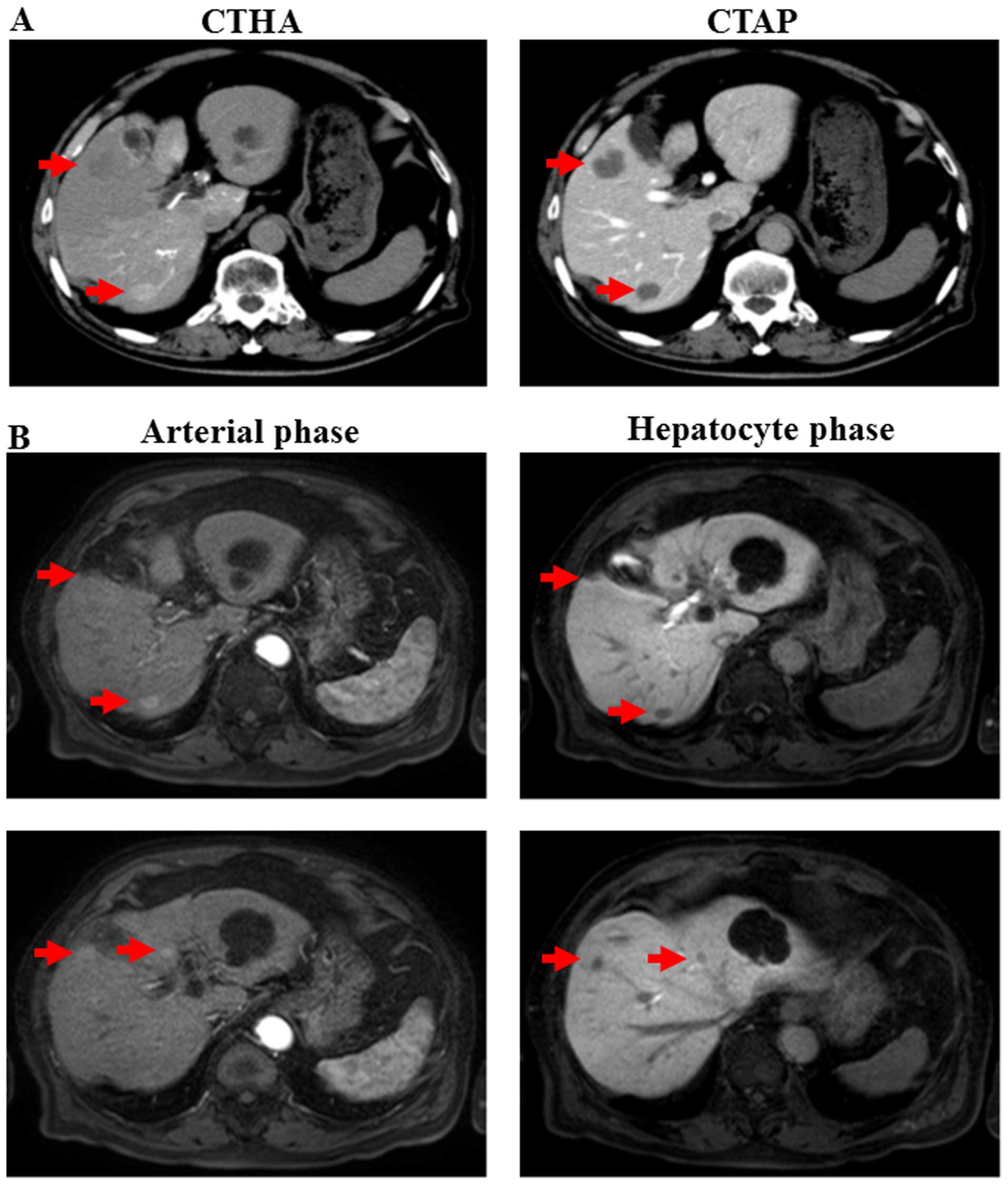
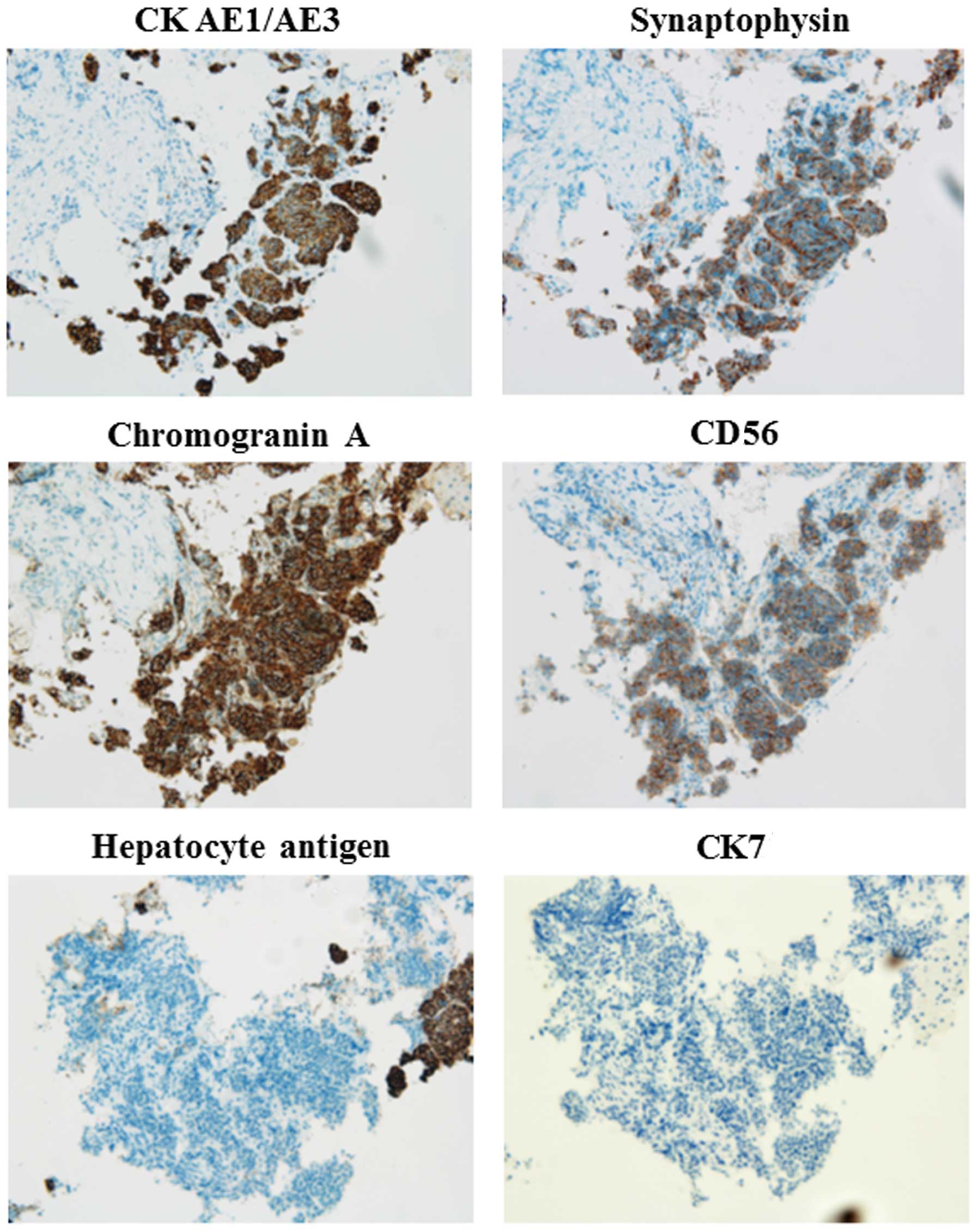
A 87-year-old man was referred to Kagawa University Hospital (Kagawa, Japan) with multiple liver tumors identified on abdominal ultrasound. The assessment performed on admission included physical examination, computed tomography (CT) during hepatic angiography and CT during arterial portography, and revealed multiple liver tumors (20 mm maximum diameter) (Fig. 1A). The liver tumors also exhibited hyperechogenicity and hypoechogenicity with acoustic shadows on ultrasonography (data not shown). On contrast-enhanced magnetic resonance imaging (MRI) using gadolinium ethoxybenzyl diethylenetriamine pentaacetic acid, certain tumors exhibited contrast enhancement during the early phase and contrast washout during the hepatocyte phase (Fig. 1B). By contrast, no lesions were identified during positron emission tomography (PET) imaging of the liver (data not shown). A liver biopsy was performed and immunohistochemical staining revealed enhanced expression of cytokeratin (CK) AE1/AE3, synaptophysin, chromogranin A and CD56, and no expression of hepatocyte antigen or CΚ7 (Fig. 2). No other primary lesion was detected and the patient was diagnosed with PHNETs. The mindbomb E3 ubiquitin protein ligase-1 index was ~2% in most of the tumor. The patient underwent TACE with a combination of miriplatin (total dose of 84 mg) mixed with gelatin sponge particles and lipiodol. The patient was treated using 3 courses of TACE, and partial response was identified during the follow-up examination, 21 months after the liver biopsy.

Figure 1.

(A) Computed tomography (CT) images during hepatic angiography (CTHA) and arterial portography (CTAP). (B) contrast-enhanced magnetic resonance imaging using gadolinium ethoxybenzyl diethylenetriamine pentaacetic acid during the arterial phase (left two panels) and the hepatocyte phase (right two panels). The tumors are indicated by the arrows.

Figure 2.

Immunohistochemistry was positive for the neuroendocrine tumor (NET) markers cytokeratin (ck) AE1/AE3, synaptophysin, chromogranin A and CD56 and negative for hepatocyte antigen and CK7 in primary hepatic NET tissues.

Discussion

NETs commonly develop in the gastrointestinal tract, pancreas and bronchopulmonary tract. In the majority of those cases, NETs detected in the liver have metastasized from different organs, and primary NETs originating in the liver are quite rare (13). PHNETs may be difficult to diagnose, even with pathological evidence, and must be differentiated from metastatic liver tumors. Therefore, clinical characteristics and imaging methods, including CT and MRI, are also crucial for definitively diagnosing PHNETs. In the present study, we diagnosed multiple liver tumors as PHNETs by histology and by applying various imaging modalities, such as CT, MRI and PET.

Non-specific symptoms, such as abdominal pain and distension, may be associated with the early stages of this disease. Additionally, several patients with gastrointestinal NETs suffer from carcinoid syndrome (14). This syndrome occurs in <10% of patients with gastrointestinal NETs and is associated with liver metastasis. Of note, carcinoid syndrome is rarely observed in PHNET patients (15).

PHNETs primarily occur in patients between aged 40–50 years and are usually located in the right lobe of the liver (10). In the present study, the onset age of PHNET was 87 years and the tumors were located in both lobes of the liver. PHNETs may slowly metastasize to the other side of the hepatic lobe. To date, this is the first report of a PHNET patient aged >85 years.

Although the origin of PHNETs has not been elucidated, it has been hypothesized that NET cells may spread to the intrahepatic biliary tract and undergo malignant transformation, or that malignant stem cells may be transdifferentiated to NET cells (16). As PHNETs are rare, slow-growing and asymptomatic, early-stage diagnosis may be difficult. In the present study, a patient aged 87 years presented with multiple intrahepatic tumors that were diagnosed as PHNETs. Therefore, it is crucial to elucidate the etiology and mechanism underlying the development of these tumors.

Immunohistochemical analysis is the most effective method for the diagnosis of PHNETs. In our study, representative immunohistochemical markers, such as CK AE1/AE3, synaptophysin, chromogranin A and CD56, were positive (Fig. 2). Additionally, hepatocyte antigen and CK7, which are not expressed in NETs, were negative (Fig. 2). Sundin et al (17) reported that synaptophysin and chromogranin A were useful markers for a definitive diagnosis of PHNETs. Moreover, the quantification of chromogranin A in the plasma may be used for the follow-up evaluation of NETs (1). These reports suggest that immunohistochemical markers are powerful tools for diagnosing PHNETs.

Surgical treatment is the only curative method, with 5- and 10-year survival rates of 78 and 59%, respectively (18). The majority of the PHNET patients underwent surgical resection if surgery was indicated. In our case, multiple PHNETs were detected in both lobes of the liver, and surgical resection was not considered to be an option. Therefore, TACE was performed with cisplatin. Yao et al (19) reported that hepatic chemoembolization for NETs effectively improves the clinical symptoms and achieves tumor control. TACE may be the most effective therapy for PHNETs with intrahepatic metastasis.

Radiofrequency ablation (RFA) may be used to treat HCCs sized <5 cm (20,21) when <3 tumors are present (21). Our case had at least 4 tumors in both hepatic lobes (Fig. 1); thus, RFA was not indicated. However, RFA may be useful for treating unresectable PHNETs.

In conclusion, PHNETs are rare, particularly in elderly individuals. immunohistochemistry is key to accurately diagnosing PHNETs. Surgery is the only curative option, but TACE and/or RFA may be considered as alternative approaches in the case of unresectable PHNETs.

References

1 

Modlin IM, Kidd M, Latich I, Zikusoka MN and Shapiro MD: Current status of gastrointestinal carcinoids. Gastroenterology. 128:1717–1751. 2005. View Article : Google Scholar : PubMed/NCBI

2 

Modlin IM, Sandor A, Tang LH, Kidd M and Zelterman D: A 40-year analysis of 265 gastric carcinoids. Am J Gastroenterol. 92:633–638. 1997.PubMed/NCBI

3 

Modlin IM, Shapiro MD and Kidd M: An analysis of rare carcinoid tumors: Clarifying these clinical conundrums. World J Surg. 29:92–101. 2005. View Article : Google Scholar : PubMed/NCBI

4 

Edmondson H: Tumor of the liver and intrahepatic bile duct. Atlas of Tumor Pathology. section 7, fascicle 25. Armed Forces Institute of Pathology. (Washington). 105–109. 1958.

5 

Kehagias D, Moulopoulos L, Smirniotis V, Pafiti A, Ispanopoulos S and Vlahos L: Imaging findings in primary carcinoid tumour of the liver with gastrin production. Br J Radiol. 72:207–209. 1999. View Article : Google Scholar : PubMed/NCBI

6 

Lin CW, Lai CH, Hsu CC, Hsu CT, Hsieh PM, Hung KC and Chen YS: Primary hepatic carcinoid tumor: A case report and review of the literature. Cases J. 2:902009. View Article : Google Scholar : PubMed/NCBI

7 

Schwartz G, Colanta A, Gaetz H, Olichney J and Attiyeh F: Primary carcinoid tumors of the liver. World J Surg Oncol. 6:912008. View Article : Google Scholar : PubMed/NCBI

8 

Zhu H, Sun K, Ward SC, Schwartz M, Thung SN and Qin L: Primary hepatic signet ring cell neuroendocrine tumor: A case report with literature review. Semin Liver Dis. 30:422–428. 2010. View Article : Google Scholar : PubMed/NCBI

9 

Mima K, Beppu T, Murata A, Otao R, Miyake K, Okabe H, Masuda T, Okabe K, Sugiyama S, Chikamoto A, et al: Primary neuroendocrine tumor in the liver treated by hepatectomy: Report of a case. Surg Today. 41:1655–1660. 2011. View Article : Google Scholar : PubMed/NCBI

10 

Gurung A, Yoshida EM, Scudamore CH, Hashim A, Erb SR and Webber DL: Primary hepatic neuroendocrine tumour requiring live donor liver transplantation: Case report and concise review. Ann Hepatol. 11:715–720. 2012.PubMed/NCBI

11 

Yang K, Cheng YS, Yang JJ, Jiang X and Guo JX: Primary hepatic neuroendocrine tumor with multiple liver metastases: A case report with review of the literature. World J Gastroenterol. 21:3132–3138. 2015. View Article : Google Scholar : PubMed/NCBI

12 

Lamberts SW, Hofland LJ and Nobels FR: Neuroendocrine tumor markers. Front Neuroendocrinol. 22:309–339. 2001. View Article : Google Scholar : PubMed/NCBI

13 

Yalav O, Ülkü A, Akçam TA, Demiryürek H and Doran F: Primary hepatic neuroendocrine tumor: Five cases with different preoperative diagnoses. Turk J Gastroenterol. 23:272–278. 2012. View Article : Google Scholar : PubMed/NCBI

14 

Shetty PK, Baliga SV, Balaiah K and Gnana PS: Primary hepatic neuroendocrine tumor: An unusual cystic presentation. Indian J Pathol Microbiol. 53:760–762. 2010. View Article : Google Scholar : PubMed/NCBI

15 

Mehta DC, Warner RR, Parnes I and Weiss M: An 18-year follow-up of primary hepatic carcinoid with carcinoid syndrome. J Clin Gastroenterol. 23:60–62. 1996. View Article : Google Scholar : PubMed/NCBI

16 

Kaya G, Pasche C, Osterheld MC, Chaubert P and Fontolliet C: Primary neuroendocrine carcinoma of the liver: An autopsy case. Pathol Int. 51:874–878. 2001. View Article : Google Scholar : PubMed/NCBI

17 

Sundin A, Eriksson B, Bergström M, Långström B, Oberg K and Orlefors H: PET in the diagnosis of neuroendocrine tumors. An NY Acad Sci. 1014:246–257. 2004. View Article : Google Scholar

18 

Knox CD, Anderson CD, Lamps LW, Adkins RB and Pinson CW: Long-term survival after resection for primary hepatic carcinoid tumor. Ann Surg Oncol. 10:1171–1175. 2003. View Article : Google Scholar : PubMed/NCBI

19 

Yao KA, Talamonti MS, Nemcek A, Angelos P, Chrisman H, Skarda J, Benson AB, Rao S and Joehl RJ: Indications and results of liver resection and hepatic chemoembolization for metastatic gastrointestinal neuroendocrine tumors. Surgery. 130:677–682; discussion 682–685. 2001. View Article : Google Scholar : PubMed/NCBI

20 

Boonsirikamchai P, Loyer EM, Choi H and Charnsangavej C: Planning and follow-up after ablation of hepatic tumors: Imaging evaluation. Surg Oncol Clin N Am. 20:301–315, viii. 2011. View Article : Google Scholar : PubMed/NCBI

21 

Gamblin TC, Christians K and Pappas SG: Radiofrequency ablation of neuroendocrine hepatic metastasis. Surg Oncol Clin N Am. 20:273–279, vii-viii. 2011. View Article : Google Scholar : PubMed/NCBI

Related Articles

  • Abstract
  • View
  • Download
  • Twitter
Copy and paste a formatted citation
Spandidos Publications style
Morishita A, Yoneyama H, Nomura T, Sakamoto T, Fujita K, Tani J, Miyoshi H, Haba R and Masaki T: Primary hepatic neuroendocrine tumor: A case report. Mol Clin Oncol 4: 954-956, 2016.
APA
Morishita, A., Yoneyama, H., Nomura, T., Sakamoto, T., Fujita, K., Tani, J. ... Masaki, T. (2016). Primary hepatic neuroendocrine tumor: A case report. Molecular and Clinical Oncology, 4, 954-956. https://doi.org/10.3892/mco.2016.822
MLA
Morishita, A., Yoneyama, H., Nomura, T., Sakamoto, T., Fujita, K., Tani, J., Miyoshi, H., Haba, R., Masaki, T."Primary hepatic neuroendocrine tumor: A case report". Molecular and Clinical Oncology 4.6 (2016): 954-956.
Chicago
Morishita, A., Yoneyama, H., Nomura, T., Sakamoto, T., Fujita, K., Tani, J., Miyoshi, H., Haba, R., Masaki, T."Primary hepatic neuroendocrine tumor: A case report". Molecular and Clinical Oncology 4, no. 6 (2016): 954-956. https://doi.org/10.3892/mco.2016.822
Copy and paste a formatted citation
x
Spandidos Publications style
Morishita A, Yoneyama H, Nomura T, Sakamoto T, Fujita K, Tani J, Miyoshi H, Haba R and Masaki T: Primary hepatic neuroendocrine tumor: A case report. Mol Clin Oncol 4: 954-956, 2016.
APA
Morishita, A., Yoneyama, H., Nomura, T., Sakamoto, T., Fujita, K., Tani, J. ... Masaki, T. (2016). Primary hepatic neuroendocrine tumor: A case report. Molecular and Clinical Oncology, 4, 954-956. https://doi.org/10.3892/mco.2016.822
MLA
Morishita, A., Yoneyama, H., Nomura, T., Sakamoto, T., Fujita, K., Tani, J., Miyoshi, H., Haba, R., Masaki, T."Primary hepatic neuroendocrine tumor: A case report". Molecular and Clinical Oncology 4.6 (2016): 954-956.
Chicago
Morishita, A., Yoneyama, H., Nomura, T., Sakamoto, T., Fujita, K., Tani, J., Miyoshi, H., Haba, R., Masaki, T."Primary hepatic neuroendocrine tumor: A case report". Molecular and Clinical Oncology 4, no. 6 (2016): 954-956. https://doi.org/10.3892/mco.2016.822
Follow us
  • Twitter
  • LinkedIn
  • Facebook
About
  • Spandidos Publications
  • Careers
  • Cookie Policy
  • Privacy Policy
How can we help?
  • Help
  • Live Chat
  • Contact
  • Email to our Support Team