Spandidos Publications Logo
  • About
    • About Spandidos
    • Aims and Scopes
    • Abstracting and Indexing
    • Editorial Policies
    • Reprints and Permissions
    • Job Opportunities
    • Terms and Conditions
    • Contact
  • Journals
    • All Journals
    • Oncology Letters
      • Oncology Letters
      • Information for Authors
      • Editorial Policies
      • Editorial Board
      • Aims and Scope
      • Abstracting and Indexing
      • Bibliographic Information
      • Archive
    • International Journal of Oncology
      • International Journal of Oncology
      • Information for Authors
      • Editorial Policies
      • Editorial Board
      • Aims and Scope
      • Abstracting and Indexing
      • Bibliographic Information
      • Archive
    • Molecular and Clinical Oncology
      • Molecular and Clinical Oncology
      • Information for Authors
      • Editorial Policies
      • Editorial Board
      • Aims and Scope
      • Abstracting and Indexing
      • Bibliographic Information
      • Archive
    • Experimental and Therapeutic Medicine
      • Experimental and Therapeutic Medicine
      • Information for Authors
      • Editorial Policies
      • Editorial Board
      • Aims and Scope
      • Abstracting and Indexing
      • Bibliographic Information
      • Archive
    • International Journal of Molecular Medicine
      • International Journal of Molecular Medicine
      • Information for Authors
      • Editorial Policies
      • Editorial Board
      • Aims and Scope
      • Abstracting and Indexing
      • Bibliographic Information
      • Archive
    • Biomedical Reports
      • Biomedical Reports
      • Information for Authors
      • Editorial Policies
      • Editorial Board
      • Aims and Scope
      • Abstracting and Indexing
      • Bibliographic Information
      • Archive
    • Oncology Reports
      • Oncology Reports
      • Information for Authors
      • Editorial Policies
      • Editorial Board
      • Aims and Scope
      • Abstracting and Indexing
      • Bibliographic Information
      • Archive
    • Molecular Medicine Reports
      • Molecular Medicine Reports
      • Information for Authors
      • Editorial Policies
      • Editorial Board
      • Aims and Scope
      • Abstracting and Indexing
      • Bibliographic Information
      • Archive
    • World Academy of Sciences Journal
      • World Academy of Sciences Journal
      • Information for Authors
      • Editorial Policies
      • Editorial Board
      • Aims and Scope
      • Abstracting and Indexing
      • Bibliographic Information
      • Archive
    • International Journal of Functional Nutrition
      • International Journal of Functional Nutrition
      • Information for Authors
      • Editorial Policies
      • Editorial Board
      • Aims and Scope
      • Abstracting and Indexing
      • Bibliographic Information
      • Archive
    • International Journal of Epigenetics
      • International Journal of Epigenetics
      • Information for Authors
      • Editorial Policies
      • Editorial Board
      • Aims and Scope
      • Abstracting and Indexing
      • Bibliographic Information
      • Archive
    • Medicine International
      • Medicine International
      • Information for Authors
      • Editorial Policies
      • Editorial Board
      • Aims and Scope
      • Abstracting and Indexing
      • Bibliographic Information
      • Archive
  • Articles
  • Information
    • Information for Authors
    • Information for Reviewers
    • Information for Librarians
    • Information for Advertisers
    • Conferences
  • Language Editing
Spandidos Publications Logo
  • About
    • About Spandidos
    • Aims and Scopes
    • Abstracting and Indexing
    • Editorial Policies
    • Reprints and Permissions
    • Job Opportunities
    • Terms and Conditions
    • Contact
  • Journals
    • All Journals
    • Biomedical Reports
      • Information for Authors
      • Editorial Policies
      • Editorial Board
      • Aims and Scope
      • Abstracting and Indexing
      • Bibliographic Information
      • Archive
    • Experimental and Therapeutic Medicine
      • Information for Authors
      • Editorial Policies
      • Editorial Board
      • Aims and Scope
      • Abstracting and Indexing
      • Bibliographic Information
      • Archive
    • International Journal of Epigenetics
      • Information for Authors
      • Editorial Policies
      • Editorial Board
      • Aims and Scope
      • Abstracting and Indexing
      • Bibliographic Information
      • Archive
    • International Journal of Functional Nutrition
      • Information for Authors
      • Editorial Policies
      • Editorial Board
      • Aims and Scope
      • Abstracting and Indexing
      • Bibliographic Information
      • Archive
    • International Journal of Molecular Medicine
      • Information for Authors
      • Editorial Policies
      • Editorial Board
      • Aims and Scope
      • Abstracting and Indexing
      • Bibliographic Information
      • Archive
    • International Journal of Oncology
      • Information for Authors
      • Editorial Policies
      • Editorial Board
      • Aims and Scope
      • Abstracting and Indexing
      • Bibliographic Information
      • Archive
    • Medicine International
      • Information for Authors
      • Editorial Policies
      • Editorial Board
      • Aims and Scope
      • Abstracting and Indexing
      • Bibliographic Information
      • Archive
    • Molecular and Clinical Oncology
      • Information for Authors
      • Editorial Policies
      • Editorial Board
      • Aims and Scope
      • Abstracting and Indexing
      • Bibliographic Information
      • Archive
    • Molecular Medicine Reports
      • Information for Authors
      • Editorial Policies
      • Editorial Board
      • Aims and Scope
      • Abstracting and Indexing
      • Bibliographic Information
      • Archive
    • Oncology Letters
      • Information for Authors
      • Editorial Policies
      • Editorial Board
      • Aims and Scope
      • Abstracting and Indexing
      • Bibliographic Information
      • Archive
    • Oncology Reports
      • Information for Authors
      • Editorial Policies
      • Editorial Board
      • Aims and Scope
      • Abstracting and Indexing
      • Bibliographic Information
      • Archive
    • World Academy of Sciences Journal
      • Information for Authors
      • Editorial Policies
      • Editorial Board
      • Aims and Scope
      • Abstracting and Indexing
      • Bibliographic Information
      • Archive
  • Articles
  • Information
    • For Authors
    • For Reviewers
    • For Librarians
    • For Advertisers
    • Conferences
  • Language Editing
Login Register Submit
  • This site uses cookies
  • You can change your cookie settings at any time by following the instructions in our Cookie Policy. To find out more, you may read our Privacy Policy.

    I agree
Search articles by DOI, keyword, author or affiliation
Search
Advanced Search
presentation
Molecular and Clinical Oncology
Join Editorial Board Propose a Special Issue
Print ISSN: 2049-9450 Online ISSN: 2049-9469
Journal Cover
July-2016 Volume 5 Issue 1

Full Size Image

Sign up for eToc alerts
Recommend to Library

Journals

International Journal of Molecular Medicine

International Journal of Molecular Medicine

International Journal of Molecular Medicine is an international journal devoted to molecular mechanisms of human disease.

International Journal of Oncology

International Journal of Oncology

International Journal of Oncology is an international journal devoted to oncology research and cancer treatment.

Molecular Medicine Reports

Molecular Medicine Reports

Covers molecular medicine topics such as pharmacology, pathology, genetics, neuroscience, infectious diseases, molecular cardiology, and molecular surgery.

Oncology Reports

Oncology Reports

Oncology Reports is an international journal devoted to fundamental and applied research in Oncology.

Experimental and Therapeutic Medicine

Experimental and Therapeutic Medicine

Experimental and Therapeutic Medicine is an international journal devoted to laboratory and clinical medicine.

Oncology Letters

Oncology Letters

Oncology Letters is an international journal devoted to Experimental and Clinical Oncology.

Biomedical Reports

Biomedical Reports

Explores a wide range of biological and medical fields, including pharmacology, genetics, microbiology, neuroscience, and molecular cardiology.

Molecular and Clinical Oncology

Molecular and Clinical Oncology

International journal addressing all aspects of oncology research, from tumorigenesis and oncogenes to chemotherapy and metastasis.

World Academy of Sciences Journal

World Academy of Sciences Journal

Multidisciplinary open-access journal spanning biochemistry, genetics, neuroscience, environmental health, and synthetic biology.

International Journal of Functional Nutrition

International Journal of Functional Nutrition

Open-access journal combining biochemistry, pharmacology, immunology, and genetics to advance health through functional nutrition.

International Journal of Epigenetics

International Journal of Epigenetics

Publishes open-access research on using epigenetics to advance understanding and treatment of human disease.

Medicine International

Medicine International

An International Open Access Journal Devoted to General Medicine.

Journal Cover
July-2016 Volume 5 Issue 1

Full Size Image

Sign up for eToc alerts
Recommend to Library

  • Article
  • Citations
    • Cite This Article
    • Download Citation
    • Create Citation Alert
    • Remove Citation Alert
    • Cited By
  • Similar Articles
    • Related Articles (in Spandidos Publications)
    • Similar Articles (Google Scholar)
    • Similar Articles (PubMed)
  • Download PDF
  • Download XML
  • View XML
Article

Albumin-bound paclitaxel for the treatment of refractory or relapsed small-cell lung cancer

  • Authors:
    • Hironori Yoshida
    • Young Hak Kim
    • Hiroaki Ozasa
    • Hiroki Nagai
    • Yuichi Sakamori
    • Takashi Nakaoku
    • Yoshitaka Yagi
    • Takahiro Tsuji
    • Takashi Nomizo
    • Michiaki Mishima
  • View Affiliations / Copyright

    Affiliations: Department of Respiratory Medicine, Graduate School of Medicine, Kyoto University, Kyoto 606‑8507, Japan
  • Pages: 213-215
    |
    Published online on: May 6, 2016
       https://doi.org/10.3892/mco.2016.887
  • Expand metrics +
Metrics: Total Views: 0 (Spandidos Publications: | PMC Statistics: )
Metrics: Total PDF Downloads: 0 (Spandidos Publications: | PMC Statistics: )
Cited By (CrossRef): 0 citations Loading Articles...

This article is mentioned in:


Abstract

Since nanoparticle albumin-bound (nab)-paclitaxel exerts clinically meaningful antitumor effects on various malignancies, including breast, gastric and non‑small-cell lung cancer, we hypothesized that treatment with nab‑paclitaxel may also be beneficial for patients with small‑cell lung cancer (SCLC). we herein evaluated the safety and efficacy of weekly, single‑agent nab‑paclitaxel in patients with refractory or relapsed SCLC. Between May, 2013 and February, 2015, 9 patients with refractory or relapsed SCLC were treated with single‑agent nab‑paclitaxel at the Kyoto University Hospital. The medical records of the patients were retrospectively reviewed. All the patients had been previously treated with ≥2 lines of chemotherapy prior to receiving nab‑paclitaxel. The median number of cycles of nab-paclitaxel was 2 (range, 1‑4) and 3 partial responses were observed (response rate: 33%). The toxicity was generally mild and manageable: grade 3/4 adverse events were only observed in 1 patient (grade 3 leukopenia). Thus, weekly administration of nab‑paclitaxel may be a viable treatment option in patients with refractory or relapsed SCLC. Considering that treatment options are quite limited in this patient population, further evaluation of this regimen may prove valuable in the clinical setting.

Introduction

Although small-cell lung cancer (SCLC) is initially highly sensitive to chemotherapy and radiotherapy, the majority of the patients eventually experience disease relapse and their prognosis is generally poor. To date, topotecan is the only Food and Drug Administration-approved drug for relapsed or refractory SCLC. In Japan, amrubicin is also available; however, the overall treatment options for such patients is limited.

Previous phase II studies have demonstrated that paclitaxel has antitumor activity in patients with pretreated SCLC (1). Recently, nanoparticle albumin-bound (nab)-paclitaxel (Abraxane®; Taiho, Tokyo, Japan) was developed to improve the therapeutic index of paclitaxel, and randomized studies have confirmed that nab-paclitaxel was more effective and exhibited a more favorable safety profile compared with conventional solvent-based paclitaxel (2).

In this study, based on this background, we retrospectively reviewed 9 patients with refractory or relapsed SCLC who were treated with nab-paclitaxel at Kyoto University Hospital.

Patients and methods

Patients

Between May, 2013 and February,2015, 64 patients with thoracic malignancies were treated with nab-paclitaxel. Of those patients, 8 had thymic tumors, 47 had non-small-cell lung cancer (NSCLC) and 9 had SCLC. Nab-paclitaxel (100 mg/m2) was administered on days 1, 8, and 15 of a 28-day cycle. Tumor response was evaluated by using the Response Evaluation Criteria in Solid Tumors, version 1.1 (3), and adverse events were graded by using the Common Terminology Criteria for Adverse Events, version 4.0 (http://ctep.cancer.gov/protocolDevelopment/electronic_applications/ctc.htm#ctc_40; http://ctep.cancer.gov/protocolDevelopment/electronic_applications/ctc.htm#ctc_40%3E*).

Type of relapse

In this study, sensitive relapse was defined as patients who responded to initial chemotherapy and developed disease recurrence >3 months after the completion of chemotherapy, whereas refractory relapse was defined as patients who did not respond to initial chemotherapy or developed disease recurrence within 3 months after the completion of chemotherapy.

Results

Patient characteristics

The patient characteristics are summarized in Table I. The median age of the patients was 67 years (range, 60–76 years) and our sample included 6 men and 3 women. The performance status was 0 in 4, 1 in 3, and 2 in 2 patients. All the patients had been previously treated with ≥2 lines of chemotherapy prior to receiving nab-paclitaxel (range, 2–9 lines). A total of 5 patients were classified as sensitive relapse and the remaining 4 as refractory relapse. Three patients had been previously treated with solvent-based paclitaxel.

Table I.

Patient characteristics at time of nab-paclitaxel administration (n=9).

Table I.

Patient characteristics at time of nab-paclitaxel administration (n=9).

PatientAge (years)GenderPS (ECOG)Disease extentNo. of previous chemotherapy regimensNo. of nab-paclitaxel cyclesSensitivity to first-line chemotherapyPrevious paclitaxel treatment
169Male1ED94SensitiveYes
273Male0LD62SensitiveYes
365Female2ED22RefractoryNo
468Male1ED54SensitiveNo
576Male0LD54SensitiveYes
656Female1ED22SensitiveNo
767Male0ED21RefractoryNo
864Male0ED21RefractoryNo
960Female2ED31RefractoryNo

[i] Nab, nanoparticle albumin-bound; PS, performance status; ECOG, Eastern Cooperative Oncology Group; LD, limited disease; ED, extensive disease.

Response

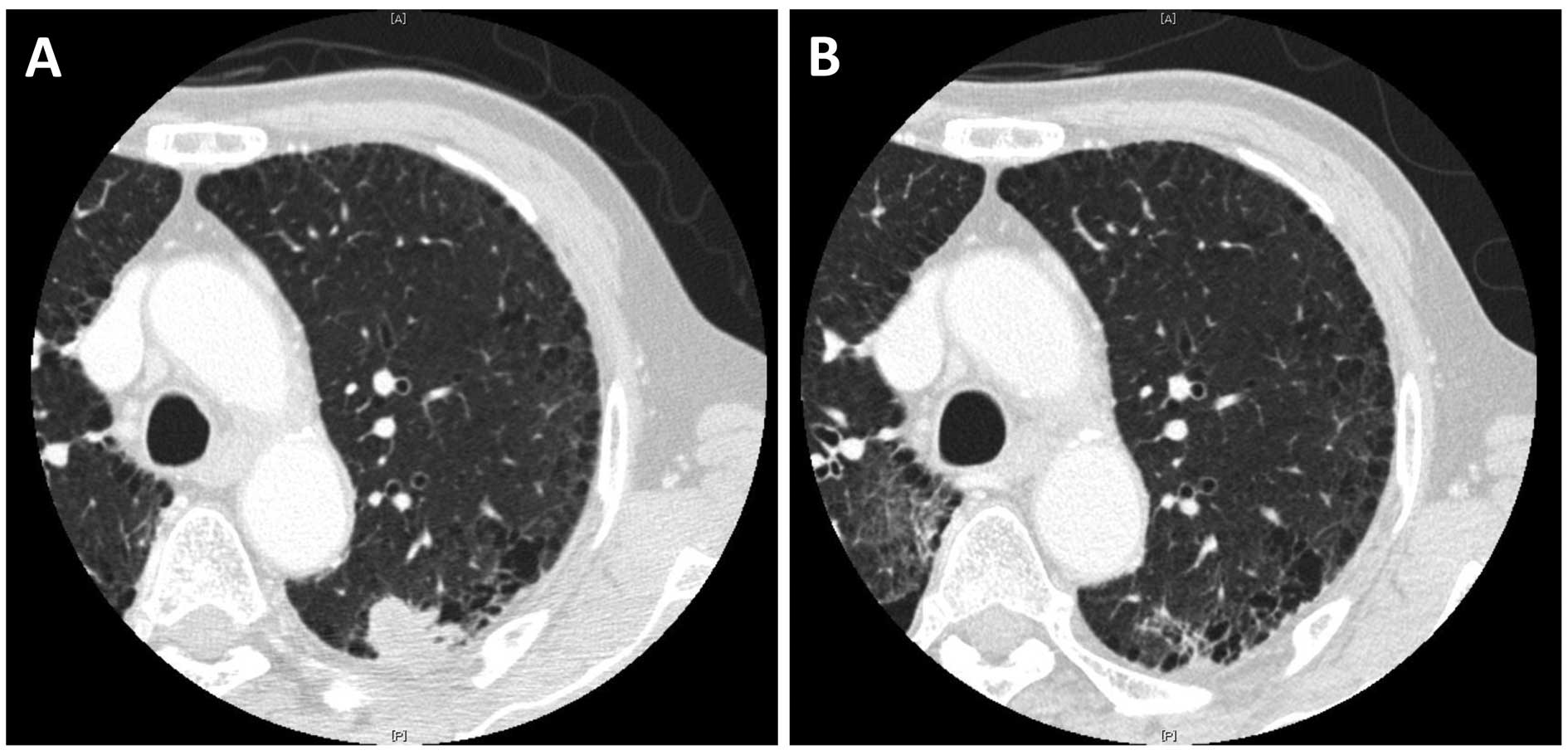
There were 3 partial responses (response rate: 33%) and a representative case is shown in Fig. 1. Among these 3 patients, all 3 were classified as sensitive relapse and 2 had been pretreated with solvent-based paclitaxel, both of whom achieved partial response after two cycles, but their disease progressed after four cycles of solvent-based paclitaxel. The median number of cycles of nab-paclitaxel was 2 (range, 1–4 cycles). The 2 non-evaluable cases were due to deterioration of epilepsy, without central nervous system metastases, in one case, and lack of adequate radiographic follow-up in the other case (Table II).

Figure 1.

Representative case responding to nanoparticle albumin-bound (nab)-paclitaxel following failure of solvent-based paclitaxel. Chest computed tomography images (A) prior to receiving nab-paclitaxel and (B) after two cycles of nab-paclitaxel; the nodule in the left upper pulmonary lobe has almost disappeared.

Table II.

Antitumor response.

Table II.

Antitumor response.

Type of responseNo. of patients%
Complete response0  0
Partial response333
Stable disease0  0
Progressive disease445
Not evaluable222
Overall response rate333
Toxicity

The toxicities of nab-paclitaxel are summarized in Table III. Of the 9 patients, only 1 developed a grade 3 event (leukopenia); no other grade 3/4 adverse events hematological or non-hematological, were observed. One patient required a dose reduction due to fatigue, but no treatment discontinuation was required.

Table III.

Summary of toxicities.

Table III.

Summary of toxicities.

ToxicityGrade 1Grade 2Grade 3Grade 4Grade 3/4 (%)
Leukopenia12101 (11)
Neutropenia21000 (0)
Anemia23000 (0)
Thrombocytopenia00000 (0)
Mucositis20000 (0)
Nausea10000 (0)
Vomiting00000 (0)
Diarrhea10000 (0)
Constipation40000 (0)
Fatigue61000 (0)
Neuropathy41000 (0)
Myalgia10000 (0)

Discussion

Despite an initial good response to chemotherapy, almost all SCLC patients experience relapse. To date, a number of studies on salvage chemotherapy have been conducted, and some demonstrated a clinical benefit. For example, topotecan prolonged survival time and improved quality of life compared with supportive care alone (4), and amrubicin exhibited efficacy comparable to that of topotecan (5). However, it is clear that the treatment options remain quite limited. Nab-paclitaxel has been approved for the treatment of NSCLC, but its efficacy against SCLC remains unknown.

In this study, we aimed to report the efficacy and toxicity of nab-paclitaxel for relapsed or refractory SCLC. Although all the patients were heavily pretreated, 3 patients achieved partial response with nab-paclitaxel. Interestingly, 2 patients who developed disease progression after weekly solvent-based paclitaxel treatment responded to nab-paclitaxel. In in vitro and mouse models, at an equitoxic dose, nab-paclitaxel-treated groups exhibited more complete regressions, longer time to recurrence, longer doubling time and prolonged survival, compared with solvent-based paclitaxel (6). In addtion, at an equal dose, intratumoral accumulation of paclitaxel was 33% higher for nab-paclitaxel vs. solvent-based paclitaxel (6). These results were consistent with the results of clinical trials of breast cancer (2) and NSCLC (7), and our study suggested the superiority of the nab-paclitaxel to solvent-based paclitaxel in SCLC as well.

In conclusion, our findings suggest that weekly administration of nab-paclitaxel may be a useful treatment option for refractory or relapsed SCLC. However, further investigation of nab-paclitaxel, alone or in combination with other agents, for SCLC is warranted.

References

1 

Yamamoto N, Tsurutani J, Yoshimura N, Asai G, Moriyama A, Nakagawa K, Kudoh S, Takada M, Minato Y and Fukuoka M: Phase II study of weekly paclitaxel for relapsed and refractory small cell lung cancer. Anticancer Res. 26:777–781. 2006.PubMed/NCBI

2 

Gradishar WJ, Tjulandin S, Davidson N, Shaw H, Desai N, Bhar P, Hawkins M and O'Shaughnessy J: Phase III trial of nanoparticle albumin-bound paclitaxel compared with polyethylated castor oil-based paclitaxel in women with breast cancer. J Clin Oncol. 23:7794–7803. 2005. View Article : Google Scholar : PubMed/NCBI

3 

Eisenhauer EA, Therasse P, Bogaerts J, Schwartz LH, Sargent D, Ford R, Dancey J, Arbuck S, Gwyther S, Mooney M, et al: New response evaluation criteria in solid tumours: revised RECIST guideline (version 1.1). Eur J Cancer. 45:228–247. 2009. View Article : Google Scholar : PubMed/NCBI

4 

O'Brien ME, Ciuleanu TE, Tsekov H, Shparyk Y, Cuceviá B, Juhasz G, Thatcher N, Ross GA, Dane GC and Crofts T: Phase III trial comparing supportive care alone with supportive care with oral topotecan in patients with relapsed small-cell lung cancer. J Clin Oncol. 24:5441–5447. 2006. View Article : Google Scholar : PubMed/NCBI

5 

von Pawel J, Jotte R, Spigel DR, O'Brien ME, Socinski MA, Mezger J, Steins M, Bosquée L, Bubis J, Nackaerts K, et al: Randomized phase III trial of amrubicin versus topotecan as second-line treatment for patients with small-cell lung cancer. J Clin Oncol. 32:4012–4019. 2014. View Article : Google Scholar

6 

Desai N, Trieu V, Yao Z, Louie L, Ci S, Yang A, Tao C, De T, Beals B, Dykes D, et al: Increased antitumor activity, intratumor paclitaxel concentrations and endothelial cell transport of cremophor-free, albumin-bound paclitaxel, ABI-007, compared with cremophor-based paclitaxel. Clin Cancer Res. 15:1317–1324. 2006. View Article : Google Scholar

7 

Socinski MA, Bondarenko I, Karaseva NA, Makhson AM, Vynnychenko I, Okamoto I, Hon JK, Hirsh V, Bhar P, Zhang H, et al: Weekly nab-paclitaxel in combination with carboplatin versus solvent-based paclitaxel plus carboplatin as first-line therapy in patients with advanced non-small-cell lung cancer: Final results of a phase III trial. J Clin Oncol. 30:2055–2062. 2012. View Article : Google Scholar : PubMed/NCBI

Related Articles

  • Abstract
  • View
  • Download
  • Twitter
Copy and paste a formatted citation
Spandidos Publications style
Yoshida H, Kim YH, Ozasa H, Nagai H, Sakamori Y, Nakaoku T, Yagi Y, Tsuji T, Nomizo T, Mishima M, Mishima M, et al: Albumin-bound paclitaxel for the treatment of refractory or relapsed small-cell lung cancer. Mol Clin Oncol 5: 213-215, 2016.
APA
Yoshida, H., Kim, Y.H., Ozasa, H., Nagai, H., Sakamori, Y., Nakaoku, T. ... Mishima, M. (2016). Albumin-bound paclitaxel for the treatment of refractory or relapsed small-cell lung cancer. Molecular and Clinical Oncology, 5, 213-215. https://doi.org/10.3892/mco.2016.887
MLA
Yoshida, H., Kim, Y. H., Ozasa, H., Nagai, H., Sakamori, Y., Nakaoku, T., Yagi, Y., Tsuji, T., Nomizo, T., Mishima, M."Albumin-bound paclitaxel for the treatment of refractory or relapsed small-cell lung cancer". Molecular and Clinical Oncology 5.1 (2016): 213-215.
Chicago
Yoshida, H., Kim, Y. H., Ozasa, H., Nagai, H., Sakamori, Y., Nakaoku, T., Yagi, Y., Tsuji, T., Nomizo, T., Mishima, M."Albumin-bound paclitaxel for the treatment of refractory or relapsed small-cell lung cancer". Molecular and Clinical Oncology 5, no. 1 (2016): 213-215. https://doi.org/10.3892/mco.2016.887
Copy and paste a formatted citation
x
Spandidos Publications style
Yoshida H, Kim YH, Ozasa H, Nagai H, Sakamori Y, Nakaoku T, Yagi Y, Tsuji T, Nomizo T, Mishima M, Mishima M, et al: Albumin-bound paclitaxel for the treatment of refractory or relapsed small-cell lung cancer. Mol Clin Oncol 5: 213-215, 2016.
APA
Yoshida, H., Kim, Y.H., Ozasa, H., Nagai, H., Sakamori, Y., Nakaoku, T. ... Mishima, M. (2016). Albumin-bound paclitaxel for the treatment of refractory or relapsed small-cell lung cancer. Molecular and Clinical Oncology, 5, 213-215. https://doi.org/10.3892/mco.2016.887
MLA
Yoshida, H., Kim, Y. H., Ozasa, H., Nagai, H., Sakamori, Y., Nakaoku, T., Yagi, Y., Tsuji, T., Nomizo, T., Mishima, M."Albumin-bound paclitaxel for the treatment of refractory or relapsed small-cell lung cancer". Molecular and Clinical Oncology 5.1 (2016): 213-215.
Chicago
Yoshida, H., Kim, Y. H., Ozasa, H., Nagai, H., Sakamori, Y., Nakaoku, T., Yagi, Y., Tsuji, T., Nomizo, T., Mishima, M."Albumin-bound paclitaxel for the treatment of refractory or relapsed small-cell lung cancer". Molecular and Clinical Oncology 5, no. 1 (2016): 213-215. https://doi.org/10.3892/mco.2016.887
Follow us
  • Twitter
  • LinkedIn
  • Facebook
About
  • Spandidos Publications
  • Careers
  • Cookie Policy
  • Privacy Policy
How can we help?
  • Help
  • Live Chat
  • Contact
  • Email to our Support Team