Introduction
Pancreatic cancer is the fourth leading cause of
cancer-related deaths in both men and women in Western countries
(1,2). Despite the recent advances in surgical
techniques and adjuvant therapies, prognosis for patients with
pancreatic cancer remains poor. The 5-year survival rate is only
24% even in patients with early disease and margin-negative
resection. For patients with pancreatic cancer present with
unresectable disease, the 5-year survival rate is worse at just 2%
(3). More effective treatment
strategies are urgently needed for the management of pancreatic
cancer.
Metformin, a medication in the biguanide class, is
used as an oral glucose-lowing agent in the treatment of type 2
diabetes mellitus (T2DM). It has been reported that metformin
treatment reduces hepatic gluconeogenesis by inhibiting
mitochondrial glycerophosphate dehydrogenase (4). Metformin were reported to play a
potential anticancer effect through molecular mechanisms of the
mammalian target of rapamycin (mTOR)-signaling pathway and
ATM/LKB1/AMPK axis (5–7). Preclinical work has also added to the
evidence that metformin have antineoplastic activity in pancreatic
cancer cell lines (8). Considering
all the results above, it is natural to regard metformin as a
well-tolerated and promising agent for prevention and treatment of
pancreatic cancer.
So far, there is a growing interest in investigating
the role of metformin for its anticancer effect in different cancer
types. Three systematic reviews assessed the effects of metformin
on clinical outcomes of any type of cancer and reported that
metformin was associated with a reduction in overall mortality and
cancer-specific mortality (9–11).
However, the results vary in the associations between different
cancer types and mortality risk with metformin exposure. For
example, results of several systematic reviews suggest that
treatment with metformin is associated with reduced cancer
mortality compared with other glucose-lowering therapies in
colorectal (12), breast (13), ovarian and endometrial cancer
(14), while was not associated with
the reduction of mortality in prostate cancer (15).
Also, several recent observational studies have
explored the association between use of metformin and clinical
outcomes of pancreatic cancer. Lee et al (16) supported that metformin exposure was
associated with improved clinical outcomes of pancreatic cancer
patients. However, Hwang et al (17), Reni et al (18) and Kordes et al (19) found that metformin exposure was not
associated with survival benefit in subjects with advanced
pancreatic cancer. Based on these studies, the relationship between
metformin use and the prognosis of pancreatic cancer in diabetic
patients is still controversial. Therefore, we performed a systemic
review and meta-analysis to assess the effect of metformin usage on
survival outcome of patients with concurrent diabetes and
pancreatic cancer.
Data collection methods
The meta-analysis was conducted in accordance with
the PRISMA guidelines (19), STROBE
Statement (20) as well as Cochrane
Collaboration guidelines (21).
Search strategy
We searched the PubMed, Web of Science,
Medline-Ovid, and Cochrane Library databases for relevant studies
up to 31th March 2017, which was performed by two study
investigators independently. The keywords combined with
corresponding Mesh terms used for searching included (metformin or
biguanide or dimethylbiguanidine) and (neoplasms or tumor or cancer
or carcinoma or malignancy) and (pancreas or pancreatic). In
addition, references cited in the identified studies, recent review
articles, meta-analyses and other relevant studies were also
scrutinized to identify potentially pertinent articles which
possibly missed in the original search.
Eligibility criteria
Inclusion criteria were: (1) patients with a pathologically confirmed
diagnosis of pancreatic adenocarcinoma; (2) original articles reported time to event
data [hazard ratios (HRs) with 95% confidence interval (CI)] belong
to association between metformin use and survival of pancreatic
cancer, and (3) study design:
Randomized controlled trials, cohort studies, or case-control
studies. Additionally, considering that diagnosis of diabetes was
regarded as an important confounder of the relationship between
metformin exposure and prognosis of pancreatic cancer, we
restricted this meta-analysis to studies that included only
pancreatic patients pre-existing with diabetes based on medical or
pathology reports. We excluded small sample size studies with no
time to event data provided or low study quality. No language
restriction was performed. When more than one publication reported
on the same study, only the publication with most complete dataset
or reported recently was included.
Data extraction
Data extraction was performed in duplicate by two
independent reviewers based on the inclusion criteria listed above.
Any disagreements were reconciled through group discussion. The
following information was extracted from eligible articles:
Publication data (study title, the first author's last name, study
country), study design (clinic-based or population-based cohort
studies, RCT or case-control studies), data source, cancer stage,
cancer subtypes, sample size, length of follow-up, outcomes, risk
estimates with their corresponding CIs, the matching variables in
the multivariable model, financial disclosure documentation, and
industry sponsorship.
Quality assessment
To ascertain the validity of the eligible studies,
the quality of nonrandomized observational studies was evaluated in
reference to the Newcastle Ottawa Scale (NOS) by two investigators
(22). In this ‘star system’,
included studies were judged on three aspects: Selection of study
groups, comparability of studies groups, and the ascertainment of
exposure or outcome. Based on this tool, the quality of
observational studies, with nine stars at most, was categorized as
low quality (less than 4 points), medium quality (a score of 5 or
6), or high quality (a score of 7 or higher).
Statistical analysis
Pooled HRs with 95% CI was analyzed. Heterogeneity
across included studies was analyzed by I2
statistics and Q test (23).
I2 values of >50% or Q test of P-values
less than 0.01 represented significant heterogeneity. Publication
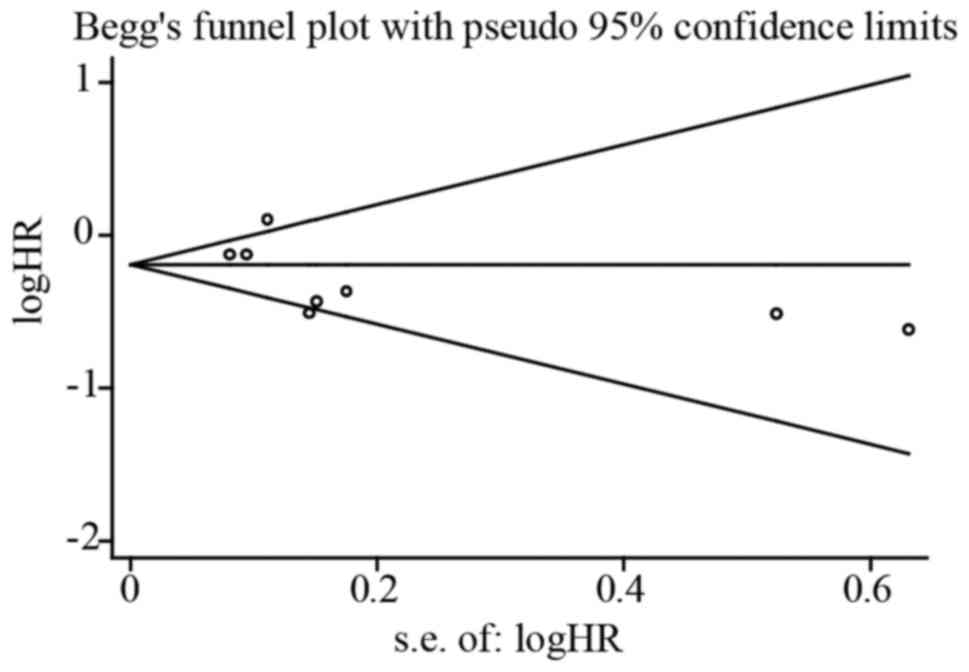
bias for observational studies was evaluated using Begg's funnel
plot and Egger's test (P<0.05 indicated the presence of
publication bias) (24–26). A DerSimonian-Laird (D-L)
random-effect model (27) was
selected to calculate the pooled HRs for overall survival (OS).
Otherwise, an inverse-variance fixed-effect meta-analysis model
(28) was chosen. The subgroup
analyses stratified by the potentially important factors, such as
study region, diabetes type, cancer stage as well as immortal time
bias, were further carried out to examine the source of possible
heterogeneity. Forest plot were distinguished according to the
author's surname and year of publication to illuminate the HRs with
95% CI. All main statistical analyses were conducted using Review
Manager Version 5.3 software package (Oxford, United Kingdom),
while publication bias and sensitivity analysis were performed
using Stata software (Stata Corp, College Station, TX, USA).
Results
Literature search
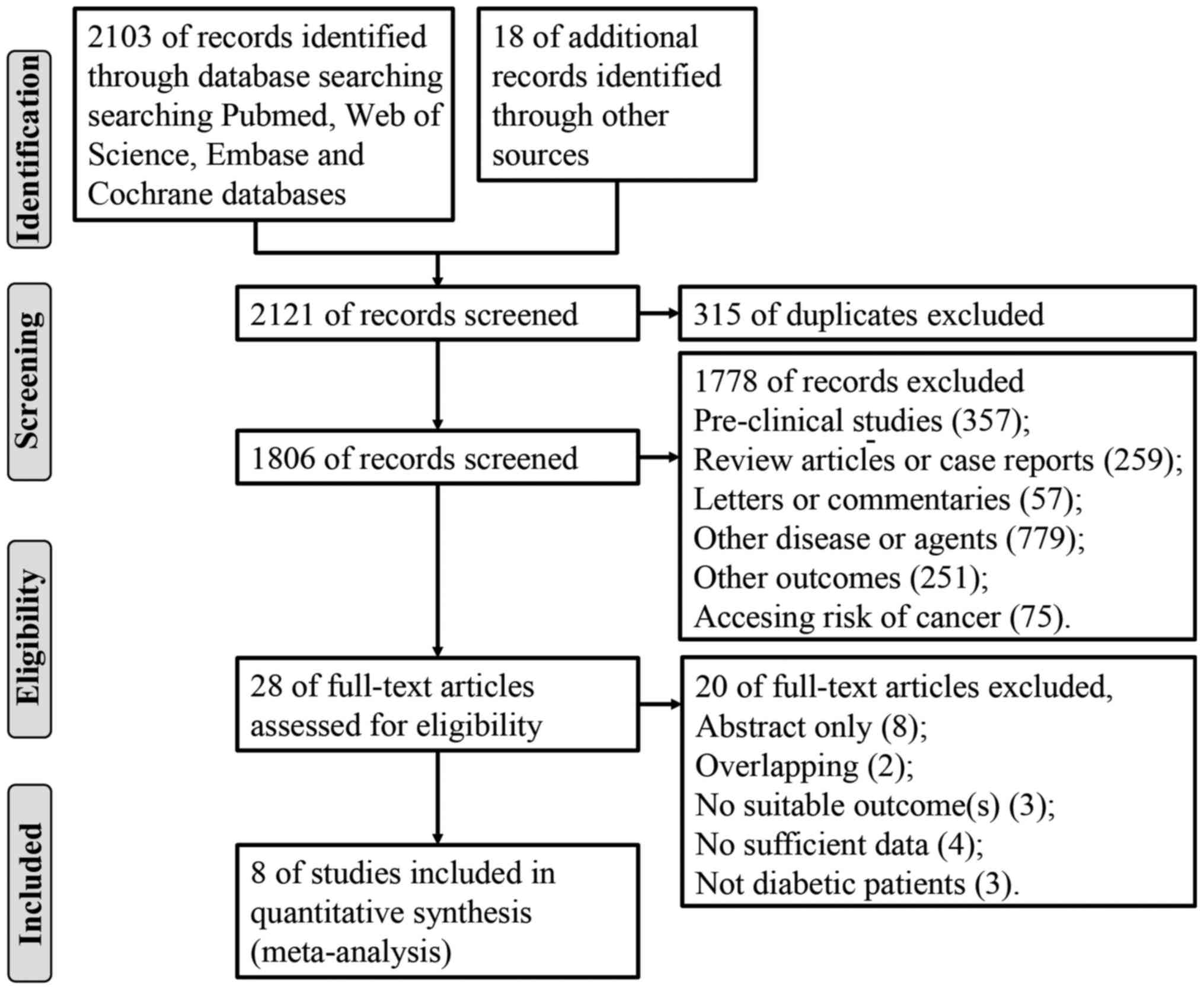
We retrieved a total of 2,121 citations through
electronic and manual search. After excluding 315 duplicate and
1,778 irrelevant articles based on titles or abstracts, we finally
included 28 citations seemed to meet the inclusion criteria for
detailed evaluation. After reading the full text, 20 were excluded
because article overlapping, no survival information, not diabetic
patients and no sufficient data. At last, 8 full articles (16,17,29–34)
matched our inclusion criteria and included in this meta-analysis.
The process of study selection is shown in a flow diagram (Fig. 1).
Characteristics of included studies
and study quality
Data on first author, publication year, country,
study design, study period, population, age, cancer treatment,
adjusting variables and follow-up time are presented in Table I. The eight observational studies in
the meta-analysis of overall survival included 4,293 pancreatic
cancer patients with diabetes, including 2,033 patients who took
metformin and 2,260 who did not. These studies were all published
in recent years (2012 to 2017), and six studies were published in
2016. Five studies were conducted in the United States (29,31–34), two
in Korea (16,30), one in UK (17). These eight eligible papers are all
retrospective cohort studies. Sample sizes ranged from 44 to 1916
patients. The percentage of metformin users in pancreatic cancer
patients ranged from 11 to 57%. Four studies (17,31,34,35)
explicitly mentioned exclusion of patients with type 1 diabetes
mellitus. In all the 8 studies, all estimates were adjusted for
potential confounders using multivariate analysis, though the
variables involved were not exactly the same among them. The
quality of the 8 included studies was appraised according to the
NOS, and NOS scores for each study are shown in Table I. All the 8 included studies are
cohort studies. Of the 8 included studies, 3 studies scored 8 and 5
studies scored 7, which showed a high quality of all the included
studies.
 | Table I.Characteristics of the 8 studies
included in the meta-analysis. |
Table I.
Characteristics of the 8 studies
included in the meta-analysis.
| Author, year | Country | Range | Sample size
(M/N-M) | Age (years) | DM | Cancer stage | Survival
analysis | Follow-up | NOS score | (Refs.) |
|---|
| Lee et al,
2016 | Korea | 2005–2013 | 237 (117/120) | 66 | T2DM | Resectable LAPC
MPC | Multivariate | 10.3 months | 8 | (16) |
| Hwang et al,
2013 | UK | 2003–2011 | 516 (247/269) | 72.5 | T2DM | APC | Multivariate | NR | 7 | (17) |
| Ambe et al,
2016 | USA | 1986–2013 | 44 (19/25) | 68 | DM | I, II | Multivariate | 19 months | 8 | (30) |
| Choi et al,
2016 | Korea | 2003–2010 | 183 (56/134) | 59.6 | DM | APC | Multivariate | 10.2 months | 7 | (31) |
| Kozak et al,
2016 | USA | 1998–2013 | 115 (13/102) | 69 | T2DM | I, II, III, IV | Multivariate | 11.23 months | 8 | (32) |
| Sadeghi et
al, 2012 | USA | 2000–2009 | 302 (117/185) | 64 | DM | Resectable
Unresectable Metastatic Nonmetastatic | Multivariate | 11.4 months | 7 | (33) |
| Amin et al,
2016 | USA | 2007–2011 | 1916
(1098/818) | 76.9 | DM | I, II, III, IV | Multivariate | NR | 7 | (34) |
| Chaiteerakij et
al, 2016 | USA | 2000–2011 | 980 (366/614) | 67.4 | T2DM | Resectable LAPC
MPC | Multivariate | 9.26 months | 7 | (35) |
Quantitative synthesis
The study-specific and pooled HRs for OS associated
with metformin in pancreatic cancer patients are shown in Fig. 2. All the eligible studies reported
the HR for OS when compared the overall survival of metformin with
non-metformin use groups. In a total of 8 studies, 4 studies
reported a statistically decreased risk of death from all causes in
pancreatic cancer patients with diabetes by multivariate analysis
(16,30,32,33).
However, no statistically significant differences were observed in
the other 4 studies (17,29,31,34).
Considering the presence of significant heterogeneity among all the
included studies (P=0.01; I2=64%), we used the
random-effects models to conduct the pooled analysis. The pooled
results demonstrated that metformin administration to patients with
pancreatic cancer and diabetes was associated with a 19% reduced
risk for overall mortality compared with those who did not receive
metformin (HR: 0.81; 95% CI: 0.70–0.93 by random effect).
In a fixed model analysis stratified by study region
(Asian or Western countries), we found that metformin exposure was
associated with a significantly reduced risk for death in Asian
countries (HR: 0.64; 95% CI: 0.52–0.80 by fixed effect; P=0.57 for
heterogeneity; I2=0%). In the subgroup of Western
countries, the meta-analysis demonstrated that the HR of OS was
0.88 (95% CI: 0.82–0.95 by fixed effect; P=0.08 for heterogeneity;
I2=50%) (Table
II). We next performed subgroup analyses by diabetes type
(diabetes or T2DM). In the subgroup of patients with diabetes (no
indication of diabetes type), metformin was still associated with
reduced death risk (HR: 0.85; 95% CI: 0.78–0.92 by fixed effect;
P=0.11 for heterogeneity; I2=50%). In the
subgroup of patients with T2DM, the relative survival benefit
associated with metformin reversed (HR: 0.84; 95% CI: 0.64–1.10 by
random effect; P=0.01 for heterogeneity; I2=73%)
(Table II). Analyses on cancer
stage did not show beneficial associations besides overall survival
among advanced pancreatic cancer patients (HR: 0.89; 95% CI:
0.56–1.42 by random effect; P=0.02 for heterogeneity;
I2=81%). Details of exposure assessment were not
presented in studies by Ambe et al (30), Chaiteerakij et al (35) and Choi et al (31), and metformin use with more than 1
month after cancer diagnosis in the study by Lee et al
(16), perhaps these studies were
prone to immortal time bias. Excluding the studies considered as be
prone to immortal time bias resulted in HRs (95% CIs) of 0.86
(0.69–1.07).
| Table II.Associations between metformin and
overall survival. |
Table II.
Associations between metformin and
overall survival.
|
|
| Pooled HR | Heterogeneity |
|---|
|
|
|
|
|
|---|
| Criteria | N | Fixed (95% CI) | Random (95%
CI) |
I2 (%) | P-value |
|---|
| Main effect | 8 | 0.86 [0.80,
0.92] | 0.81 [0.70,
0.93] | 60 | 0.01 |
| Region |
|
|
|
|
|
| Asian
country | 2 | 0.64 [0.52,
0.80] | 0.64 [0.52,
0.80] | 0 | 0.57 |
| Western
country | 6 | 0.88 [0.82,
0.95] | 0.87 [0.76,
1.00] | 50 | 0.08 |
| Diabetes type |
|
|
|
|
|
|
Diabetes | 4 | 0.85 [0.78,
0.92] | 0.76 [0.62,
0.94] | 50 | 0.11 |
|
T2DM | 4 | 0.88 [0.78,
0.99] | 0.84 [0.64,
1.10] | 73 | 0.01 |
| Cancer stage |
|
|
|
|
|
|
Early | 1 | 0.54 [0.16,
1.86] | – | – | – |
|
Advances | 2 | 0.97 [0.81,
1.17] | 0.89 [0.56,
1.42] | 81 | 0.02 |
| All
stage | 5 | 0.84 [0.78,
0.90] | 0.78 [0.67,
0.91] | 60 | 0.04 |
| Immortal time
bias |
|
|
|
|
|
|
With | 4 | 0.79 [0.69,
0.89] | 0.73 [0.59,
0.92] | 49 | 0.12 |
|
Without | 4 | 0.88 [0.82,
0.96] | 0.86 [0.69,
1.07] | 68 | 0.03 |
Sensitivity analysis and publication
bias
Taking into account the large variations in the
covariates of the included studies, we conducted a sensitivity
analysis. Sensitivity analysis was performed by sequential omission
of any individual studies to investigate the influence of single
data set on the overall meta-analysis. Sensitivity analysis
indicated that removal of each study from the meta-analysis did not
overthrow the result of the present pooled analysis. However,
results in heterogeneity was reduced when remove the study by Hwang
et al (17). Presence of
publication bias evaluated using Begg's funnel plot (P=0.458 for
metformin on OS) and Egger's linear regression test (P=0.195 for
metformin on OS) showed no obvious publication bias (Fig. 3).
Discussion
Our meta-analysis assessed the effects of metformin
exposure on overall survival of pancreatic cancer patients with
diabetes mellitus. In fact, our meta-analysis including 4,293
participants from eight cohort studies revealed that diabetic
patients with pancreatic cancer using metformin achieved an
estimated survival benefit of 19% compared with non-metformin
users. In sub-group analysis, metformin administration
significantly associated with a good prognosis in patients from
Asian. As shown in Western, metformin exposure may also associate
with a good prognosis in these patients but the effect was
modest.
As a well-accepted anti-diabetes drug, the potential
anti-cancer effects of metformin have not been fully elucidated.
Metformin modulates several signal pathways crucial to cancer
progression. It inhibits lipogenic pathways and activates
AMP-activated kinase (AMPK) (36–38), an
inhibitor of cellular proliferation via the mammalian target of
rapamycin (mTOR) pathway (39,40) to
decrease cell metabolism status and reduce serum concentrations of
insulin and insulin growth factor I (IGF-I) (41,42).
Although experimental evidences have confirmed the anti-tumor
effect of metformin, results of clinical and epidemiological
researches are complex and inconsistent. Our meta-analysis are
inconsistent with a previous meta-analysis of overall survival in
pancreatic cancer patients with concurrent diabetes, which included
two observational studies and found that metformin use was
associated with a survival benefit (HR: 0.668; 95% CI: 0.397–1.125)
in patients with resected pancreatic cancer, but no statistically
significant difference was found (29).
A number of potential limitations need to be
considered in this meta-analysis. First, the included studies are
mainly retrospective cohort studies. No randomized controlled
trials or prospective studies were included, which reduced the
reliability of evidence. Second, high I2
indicated high heterogeneity between studies, which were actualized
in a mixture of populations with different treatment background and
diverse inclusion criteria, study population, and adjustment.
Third, the included studies didn't show the impact of diabetes
type, data of diabetes onset, the concentration or duration of
metformin exposure. Thus, the observed benefit from concentration
or duration of metformin treatment cannot be clearly defined.
Fourth, the impact of other hypoglycemic agents such as insulin,
sulfonylureas and thiazolidinedione were only adjusted in one study
(17), which might inversely affect
clinical outcomes of pancreatic cancer. Finally, after excluding
studies prone to have immortal time bias, meta-analysis of existing
studies does not support a survival benefit (HR: 0.86, 95% CI:
0.69–1.07, I2=68%), which suggest that the
proposed beneficial effect of metformin on cancer survival might be
based on immortal time bias.
There are also several strengths in this
meta-analysis. First, one strength of this current meta-analysis
was a comprehensive search strategy and inclusion criteria to
extract as much information from the literature as possible,
including information from any publication type and any language.
Second, we performed sensitivity analysis to investigate whether
any single study changed the results, and the results showed the
robustness of the conclusions. Third, based on the NOS scores, all
the eligible studies in the meta-analysis were of high quality with
stars ranged from 7–8. At last, both qualitative analysis by Begg's
test and Egger's test showed no major publication bias.
In summary, our finding suggests that metformin
usage in pancreatic cancer patients with concurrent diabetes seem
to have an improved survival outcome. However, the proposed
beneficial effect of metformin on pancreatic cancer survival may be
based on immortal time bias. Methodological challenges of
pharmacoepidemiologic studies have to be taken into account in
observational studies of metformin in pancreatic cancer. Further
carefully designed observational studies and potentially RCTs
should be designed to improve the study quality, as well as taking
several confounding factors into consideration, including date of
diabetes onset, intensity and duration of metformin exposure as
well as other clinical characteristics.
Acknowledgements
The present study was supported by Zhejiang Medical
Technology and Education (No. 2015RCB006).
References
|
1
|
Jemal A, Bray F, Center MM, Ferlay J, Ward
E and Forman D: Global cancer statistics. CA Cancer J Clin.
61:69–90. 2011. View Article : Google Scholar : PubMed/NCBI
|
|
2
|
Tempero MA, Malafa MP, Behrman SW, Benson
AB III, Casper ES, Chiorean EG, Chung V, Cohen SJ, Czito B,
Engebretson A, et al: Pancreatic adenocarcinoma, version 2.2014:
Featured updates to the NCCN guidelines. J Natl Compr Canc Netw.
12:1083–1093. 2014. View Article : Google Scholar : PubMed/NCBI
|
|
3
|
Inoki K, Zhu T and Guan KL: TSC2 mediates
cellular energy response to control cell growth and survival. Cell.
115:577–590. 2003. View Article : Google Scholar : PubMed/NCBI
|
|
4
|
Madiraju AK, Erion DM, Rahimi Y, Zhang XM,
Braddock DT, Albright RA, Prigaro BJ, Wood JL, Bhanot S, MacDonald
MJ, et al: Metformin suppresses gluconeogenesis by inhibiting
mitochondrial glycerophosphate dehydrogenase. Nature. 510:542–546.
2014. View Article : Google Scholar : PubMed/NCBI
|
|
5
|
Del Barco S, Vazquez-Martin A, Cufí S,
Oliveras-Ferraros C, Bosch-Barrera J, Joven J, Martin-Castillo B
and Menendez JA: Metformin: Multi-faceted protection against
cancer. Oncotarget. 2:896–917. 2011. View Article : Google Scholar : PubMed/NCBI
|
|
6
|
Ben Sahra I, Le Marchand-Brustel Y, Tanti
JF and Bost F: Metformin in cancer therapy: A new perspective for
an old antidiabetic drug? Mol Cancer Ther. 9:1092–1099. 2010.
View Article : Google Scholar : PubMed/NCBI
|
|
7
|
Jalving M, Gietema JA, Lefrandt JD, de
Jong S, Reyners AK, Gans RO and de Vries EG: Metformin: Taking away
the candy for cancer? Eur J Cancer. 46:2369–2380. 2010. View Article : Google Scholar : PubMed/NCBI
|
|
8
|
Luo Q, Hu D, Hu S, Yan M, Sun Z and Chen
F: In vitro and in vivo anti-tumor effect of metformin as a novel
therapeutic agent in human oral squamous cell carcinoma. BMC
Cancer. 12:5172012. View Article : Google Scholar : PubMed/NCBI
|
|
9
|
Zhang P, Li H, Tan X, Chen L and Wang S:
Association of metformin use with cancer incidence and mortality: A
meta-analysis. Cancer Epidemiol. 37:207–218. 2013. View Article : Google Scholar : PubMed/NCBI
|
|
10
|
Zhang ZJ and Li S: The prognostic value of
metformin for cancer patients with concurrent diabetes: A
systematic review and meta-analysis. Diabetes Obes Metab.
16:707–710. 2014. View Article : Google Scholar : PubMed/NCBI
|
|
11
|
Yin M, Zhou J, Gorak EJ and Quddus F:
Metformin is associated with survival benefit in cancer patients
with concurrent type 2 diabetes: A systematic review and
meta-analysis. Oncologist. 18:1248–1255. 2013. View Article : Google Scholar : PubMed/NCBI
|
|
12
|
Meng F, Song L and Wang W: Metformin
improves overall survival of colorectal cancer patients with
diabetes: A meta-analysis. J Diabetes Res. 2017:50632392017.
View Article : Google Scholar : PubMed/NCBI
|
|
13
|
Xu H, Chen K, Jia X, Tian Y, Dai Y, Li D,
Xie J, Tao M and Mao Y: Metformin use is associated with better
survival of breast cancer patients with diabetes: A meta-analysis.
Oncologist. 20:1236–1244. 2015. View Article : Google Scholar : PubMed/NCBI
|
|
14
|
Tang YL, Zhu LY, Li Y, Yu J, Wang J, Zeng
XX, Hu KX, Liu JY and Xu JX: Metformin use is associated with
reduced incidence and improved survival of endometrial cancer: A
meta-analysis. BioMed Res Int. 2017:59053842017. View Article : Google Scholar : PubMed/NCBI
|
|
15
|
Deng D, Yang Y, Tang X, Skrip L, Qiu J,
Wang Y and Zhang F: Association between metformin therapy and
incidence, recurrence and mortality of prostate cancer: Evidence
from a meta-analysis. Diabetes Metab Res Rev. 31:595–602. 2015.
View Article : Google Scholar : PubMed/NCBI
|
|
16
|
Lee SH, Yoon SH, Lee HS, Chung MJ, Park
JY, Park SW, Song SY, Chung JB and Bang S: Can metformin change the
prognosis of pancreatic cancer? Retrospective study for pancreatic
cancer patients with pre-existing diabetes mellitus type 2. Dig
Liver Dis. 48:435–440. 2016. View Article : Google Scholar : PubMed/NCBI
|
|
17
|
Hwang AL, Haynes K, Hwang WT and Yang YX:
Metformin and survival in pancreatic cancer: A retrospective cohort
study. Pancreas. 42:1054–1059. 2013. View Article : Google Scholar : PubMed/NCBI
|
|
18
|
Reni M, Dugnani E, Cereda S, Belli C,
Balzano G, Nicoletti R, Liberati D, Pasquale V, Scavini M, Maggiora
P, et al: (Ir)relevance of metformin treatment in patients with
metastatic pancreatic cancer: An open-label, randomized phase II
trial. Clin Cancer Res. 22:1076–1085. 2016. View Article : Google Scholar : PubMed/NCBI
|
|
19
|
Kordes S, Pollak MN, Zwinderman AH, Mathôt
RA, Weterman MJ, Beeker A, Punt CJ, Richel DJ and Wilmink JW:
Metformin in patients with advanced pancreatic cancer: A
double-blind, randomised, placebo-controlled phase 2 trial. Lancet
Oncol. 16:839–847. 2015. View Article : Google Scholar : PubMed/NCBI
|
|
20
|
Moher D, Liberati A, Tetzlaff J and Altman
DG: PRISMA Group: Preferred reporting items for systematic reviews
and meta-analyses: The PRISMA statement. Int J Surg. 8:336–341.
2010. View Article : Google Scholar : PubMed/NCBI
|
|
21
|
von Elm E, Altman DG, Egger M, Pocock SJ,
Gøtzsche PC and Vandenbroucke JP: STROBE Initiative: The
strengthening the reporting of observational studies in
epidemiology (STROBE) statement: Guidelines for reporting
observational studies. J Clin Epidemiol. 61:344–349. 2008.
View Article : Google Scholar : PubMed/NCBI
|
|
22
|
Higgins JPT: GSe: Cochrane handbook for
systematic reviews of interventions Version 5.1.0 (updated March
2011). The Cochrane Collaboration available from. https://www.cochrane-handbook.orgMarch 2–2016
|
|
23
|
Wells GA, Shea B, O'Connell D, Peterson J,
Welch V, Losos M and Tugwell P: The Newcastle-Ottawa Scale (NOS)
for assessing the quality of non-randomized studies in
meta-analysis. 2000.
|
|
24
|
van Houwelingen HC, Arends LR and Stijnen
T: Advanced methods in meta-analysis: Multivariate approach and
meta-regression. Stat Med. 21:589–624. 2002. View Article : Google Scholar : PubMed/NCBI
|
|
25
|
Copas J and Shi JQ: Meta-analysis, funnel
plots and sensitivity analysis. Biostatistics. 1:247–262. 2000.
View Article : Google Scholar : PubMed/NCBI
|
|
26
|
Begg CB and Mazumdar M: Operating
characteristics of a rank correlation test for publication bias.
Biometrics. 50:1088–1101. 1994. View
Article : Google Scholar : PubMed/NCBI
|
|
27
|
Egger M, Smith Davey G, Schneider M and
Minder C: Bias in meta-analysis detected by a simple, graphical
test. BMJ. 315:629–634. 1997. View Article : Google Scholar : PubMed/NCBI
|
|
28
|
DerSimonian R and Laird N: Meta-analysis
in clinical trials. Control Clin Trials. 7:177–188. 1986.
View Article : Google Scholar : PubMed/NCBI
|
|
29
|
Mantel N and Haenszel W: Statistical
aspects of the analysis of data from retrospective studies of
disease. J Natl Cancer Inst. 22:719–748. 1959.PubMed/NCBI
|
|
30
|
Ambe CM, Mahipal A, Fulp J, Chen L and
Malafa MP: Effect of metformin use on survival in resectable
pancreatic cancer: A single-institution experience and review of
the literature. PLoS One. 11:e01516322016. View Article : Google Scholar : PubMed/NCBI
|
|
31
|
Choi Y, Kim TY, Oh DY, Lee KH, Han SW, Im
SA, Kim TY and Bang YJ: The impact of diabetes mellitus and
metformin treatment on survival of patients with advanced
pancreatic cancer undergoing chemotherapy. Cancer Res Treat.
48:171–179. 2016. View Article : Google Scholar : PubMed/NCBI
|
|
32
|
Kozak MM, Anderson EM, von Eyben R, Pai
JS, Poultsides GA, Visser BC, Norton JA, Koong AC and Chang DT:
Statin and metformin use prolongs survival in patients with
resectable pancreatic cancer. Pancreas. 45:64–70. 2016. View Article : Google Scholar : PubMed/NCBI
|
|
33
|
Sadeghi N, Abbruzzese JL, Yeung SC, Hassan
M and Li D: Metformin use is associated with better survival of
diabetic patients with pancreatic cancer. Clin Cancer Res.
18:2905–2912. 2012. View Article : Google Scholar : PubMed/NCBI
|
|
34
|
Amin S, Mhango G, Lin J, Aronson A,
Wisnivesky J, Boffetta P and Lucas AL: Metformin improves survival
in patients with pancreatic ductal adenocarcinoma and pre-existing
diabetes: A propensity score analysis. Am J Gastroenterol.
111:1350–1357. 2016. View Article : Google Scholar : PubMed/NCBI
|
|
35
|
Chaiteerakij R, Petersen GM, Bamlet WR,
Chaffee KG, Zhen DB, Burch PA, Leof ER, Roberts LR and Oberg AL:
Metformin use and survival of patients with pancreatic cancer: A
cautionary lesson. J Clin Oncol. 34:1898–1904. 2016. View Article : Google Scholar : PubMed/NCBI
|
|
36
|
Lee MS, Hsu CC, Wahlqvist ML, Tsai HN,
Chang YH and Huang YC: Type 2 diabetes increases and metformin
reduces total, colorectal, liver and pancreatic cancer incidences
in Taiwanese: A representative population prospective cohort study
of 800,000 individuals. BMC Cancer. 11:202011. View Article : Google Scholar : PubMed/NCBI
|
|
37
|
Lu S and Archer MC: Sp1 coordinately
regulates de novo lipogenesis and proliferation in cancer cells.
Int J Cancer. 126:416–425. 2010. View Article : Google Scholar : PubMed/NCBI
|
|
38
|
Nair V, Pathi S, Jutooru I, Sreevalsan S,
Basha R, Abdelrahim M, Samudio I and Safe S: Metformin inhibits
pancreatic cancer cell and tumor growth and downregulates Sp
transcription factors. Carcinogenesis. 34:2870–2879. 2013.
View Article : Google Scholar : PubMed/NCBI
|
|
39
|
Zhang Y, Storr SJ, Johnson K, Green AR,
Rakha EA, Ellis IO, Morgan DA and Martin SG: Involvement of
metformin and AMPK in the radioresponse and prognosis of luminal
versus basal-like breast cancer treated with radiotherapy.
Oncotarget. 5:12936–12949. 2014. View Article : Google Scholar : PubMed/NCBI
|
|
40
|
Lonardo E, Cioffi M, Sancho P,
Sanchez-Ripoll Y, Trabulo SM, Dorado J, Balic A, Hidalgo M and
Heeschen C: Metformin targets the metabolic achilles heel of human
pancreatic cancer stem cells. PLoS One. 8:e765182013. View Article : Google Scholar : PubMed/NCBI
|
|
41
|
Soares HP, Ni Y, Kisfalvi K, Sinnett-Smith
J and Rozengurt E: Different patterns of Akt and ERK feedback
activation in response to rapamycin, active-site mTOR inhibitors
and metformin in pancreatic cancer cells. PLoS One. 8:e572892013.
View Article : Google Scholar : PubMed/NCBI
|
|
42
|
Dowling RJ, Zakikhani M, Fantus IG, Pollak
M and Sonenberg N: Metformin inhibits mammalian target of
rapamycin-dependent translation initiation in breast cancer cells.
Cancer Res. 67:10804–10812. 2007. View Article : Google Scholar : PubMed/NCBI
|
|
43
|
El-Mir MY, Nogueira V, Fontaine E, Avéret
N, Rigoulet M and Leverve X: Dimethylbiguanide inhibits cell
respiration via an indirect effect targeted on the respiratory
chain complex I. J Biol Chem. 275:223–228. 2000. View Article : Google Scholar : PubMed/NCBI
|