Introduction
Although gastric cancer is thought to be a highly
heterogeneous disease (1),
adenocarcinoma is still the most frequent pathological type in
clinics. Neuroendocrine cancer (NEC) in the stomach is uncommon and
only accounts for approximately 0.1–0.2% of all cancers that occur
in the organ (2). Concurrent
occurrence of gastric adenocarcinoma and neuroendocrine cancer is
rare and has only been registered in a few case reports so far.
To date, such concurrent lesions have been
classified into two subgroups according to their morphological
features, named the composite-type and the collision-type; in the
former, both elements seem to be mixed haphazardly, while in the
latter, the tumors are considered double tumors with ‘a hand in
hand’ conformation (3). Based on the
complex relationship of the cancers, definite pathological
diagnosis of such lesions is difficult. Most of the previous cases
were diagnosed by gross specimens from surgery, such as
gastrectomy. In 2010, the WHO named mixed adenoneuroendocrine
carcinomas (MANECs), which present neuroendocrine cells (usually
over 30% of all tumor cells) mixed with nonendocrine components
(usually adenocarcinoma) (4), as a
new category in the list of NECs. Interestingly, some of the
previous cases are likely to be reclassified into this group
retrospectively.
In this study, we present a case of gastric
adenocarcinoma concurrent with metastatic NEC treated by nivolumab
and chemotherapy (based on the XELOX regimen). The overall survival
time of the patient was approximately 6 months. Our case addresses
the possibility of concurrent gastric adenocarcinoma and NEC in the
clinic; however, the efficacy of a combined regimen such as
immunotherapy (nivolumab, for example) and chemotherapy for such
disorders still needs further validation.
Case report
A 39-year-old man was first revealed by the
13C breath test to have an H. pylori infection
during a routine physical examination; however, no treatment was
adopted. Six months later, he suddenly presented tarry stool after
drinking and underwent a gastric endoscopy, the pathological
results of which indicated a well-differentiated adenocarcinoma on
the gastric corpus (Fig. 1A);
further immunohistochemical staining indicated the presence of CD4
(3+), CD8 (3+), MAGEA3 (2+), NY-ESO-1 (−), and PD-L1 (−) (Fig. 1B-F). Subsequent PET-CT examination
showed the following: 1). Irregular wall thickening on the distal
gastric corpus and antrum, particularly the greater curvature,
indicated gastric cancer with adjacent fatty infiltration, and the
greater omentum, ascending and transverse colon were likely to be
involved; 2). Multiple lymph node metastases were present around
the left supraclavicular and neck, to the right of the
diaphragmatic feet, and in the left gastric artery area, celiac
axis, liver and gastric ligament, small omental bursa, mesentery,
retroperitoneal abdominal aorta and inferior vena cava; 3). The
right and left femoral cavity, as well as multiple bones throughout
the body, presented metastatic lesions. The patient then underwent
a bone marrow biopsy, which confirmed metastatic cancer, and FISH
for Her-2 (negative). He then received the first cycle of nivolumab
(160 mg) treatment in another hospital and came to our department.
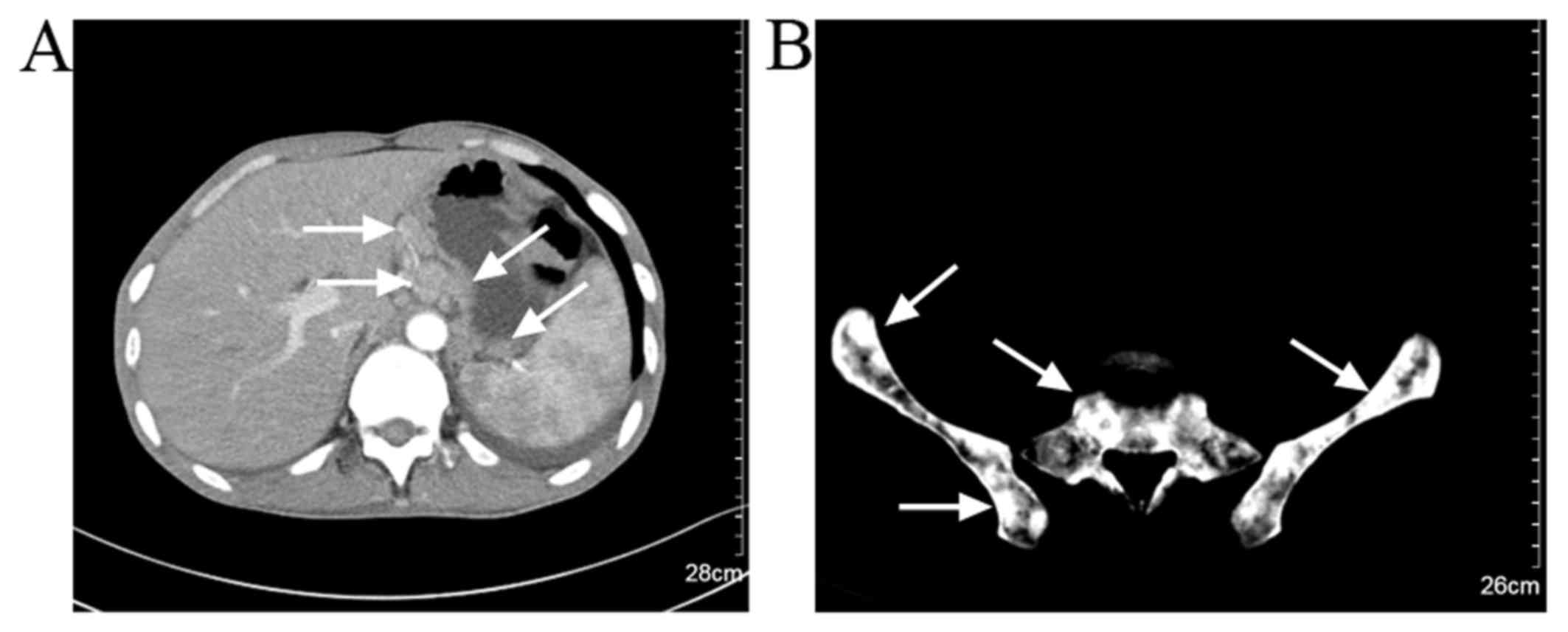
Further review of baseline images including chest, abdomen and
pelvis computed tomography (CT) scans confirmed the previous
imagological diagnosis (Fig. 2).
Next, he received the second cycle of nivolumab and took
capecitabine (1.5 g po twice per day, days 1–14 every 3 weeks)
simultaneously. After that, another 3 cycles of nivolumab and XELOX
(oxaliplatin 200 mg ivgtt, day 1+ capecitabine 1.5 g po twice per
day, days 1–14) regimen treatments were executed; however, the
intervals of the treatment plan were not executed as scheduled
because of severe complications, including myelosuppression (grade
2–3 decreased platelet count and grade 1–2 anemia) and grade 1–3
hand-foot syndrome. Evaluation of the therapeutic effects was
conducted by abdominal CT scan and a blood test for tumor markers
as planned (Fig. 3). Stable disease
(SD) and obvious progressive disease (PD) were detected after 3 and
5 cycles of treatment, respectively. He received the last 2 cycles
of treatment even though the disease was considered to be PD. A
further biopsy of the metastatic collarbone lymph nodes indicated
neuroendocrine cancer with the following immunohistochemical
staining: synaptophysin (+), CD56 (+), CK/CK7 (+), CK20 (−), Villin
(−), Ki-67 (>75%) (Fig. 4). All
the treatments were then ceased because of the poor performance
status and severe complications; he died on December 12. Written
informed consent was obtained from the patient's father.
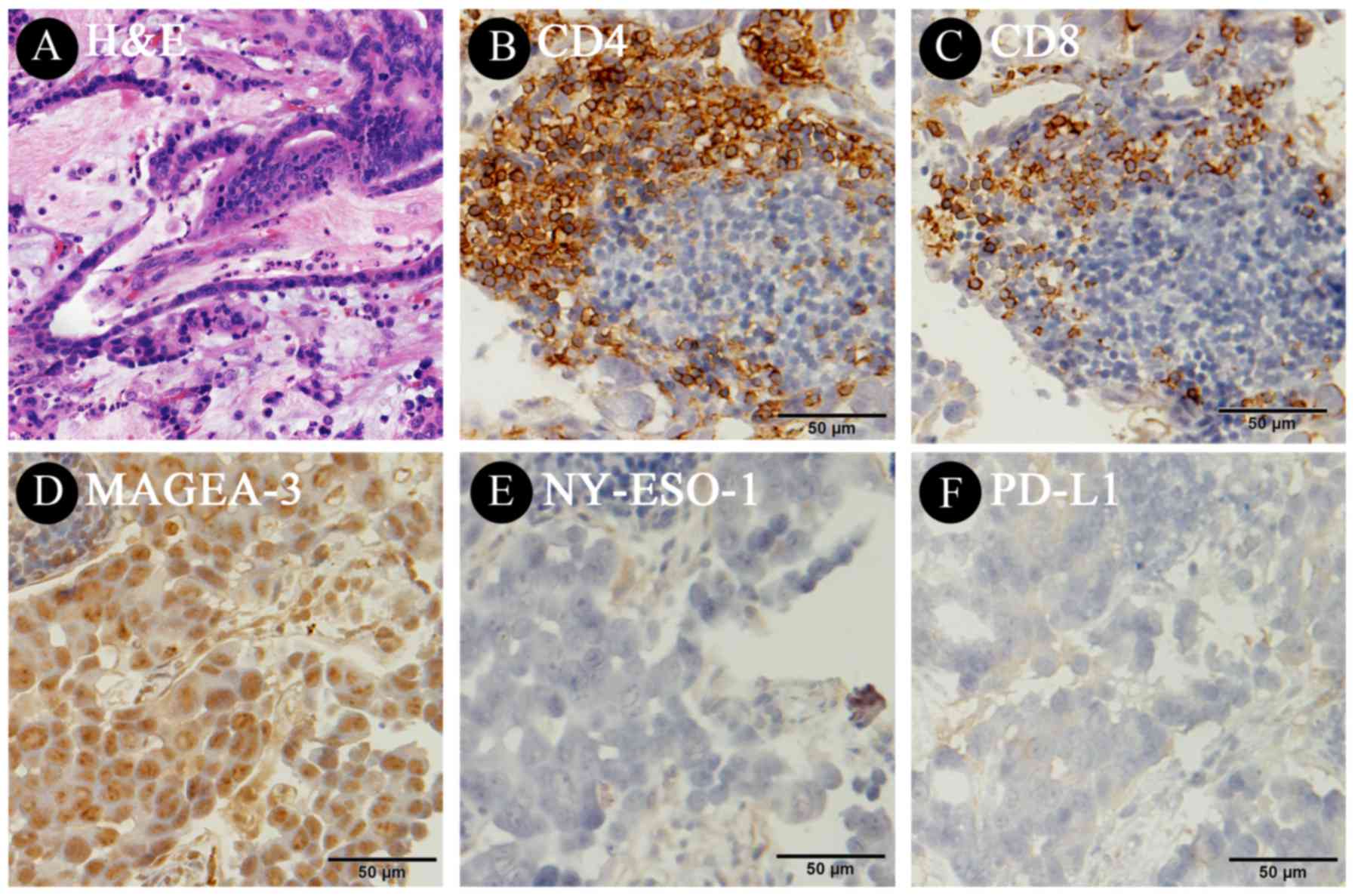 | Figure 1.Histological results of H&E
staining and immunohistochemistry by gastric endoscopy. (A)
Well-differentiated adenocarcinoma from the superficial mucous
membrane layer of the gastric corpus (H&E: magnification,
×100). (B) CD4 membrane-positive cells clustered in the tumor
(Magnification, ×200). (C) CD8 membrane-positive cells could also
be seen in the tumor, but the area was smaller than that observed
for CD4 (magnification, ×200). (D) MAGEA3 staining was diffusely
positive in nearly all tumor cells. (E) NY-ESO-1 and (F) PD-L1
staining was negative in all tumor cells (magnification, ×200).
H&E, hematoxylin and eosin; CD, cluster of differentiation;
MAGEA3, melanoma antigen family member A3; NY-ESO-1, New York
esophageal squamous cell carcinoma 1; PD-L1, programmed cell death
1 ligand 1. |
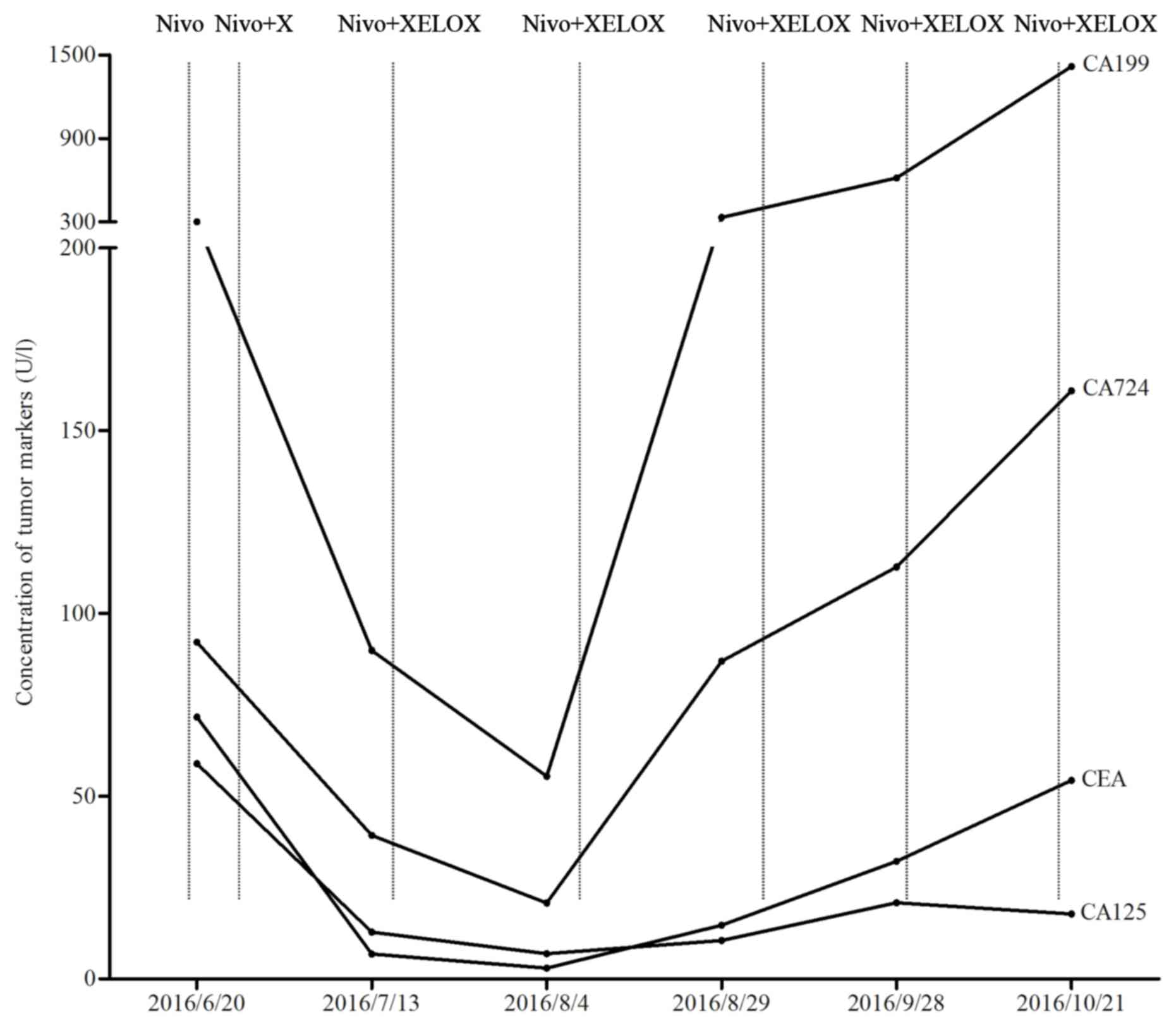 | Figure 3.Variation in tumor markers during the
course of treatment. Following 4 cycles of treatment, the levels of
CA199, CA724, CEA and CA125 decreased markedly, and the image
examination indicated a stable disease; however, an evident
progressive disease could be detected following this, and CA199 and
CA724 increased markedly. CA, carbohydrate antigen; CEA,
carcinoembryonic antigen; Nivo, nivolumab; XELOX, oxaliplatin +
capecitabine. |
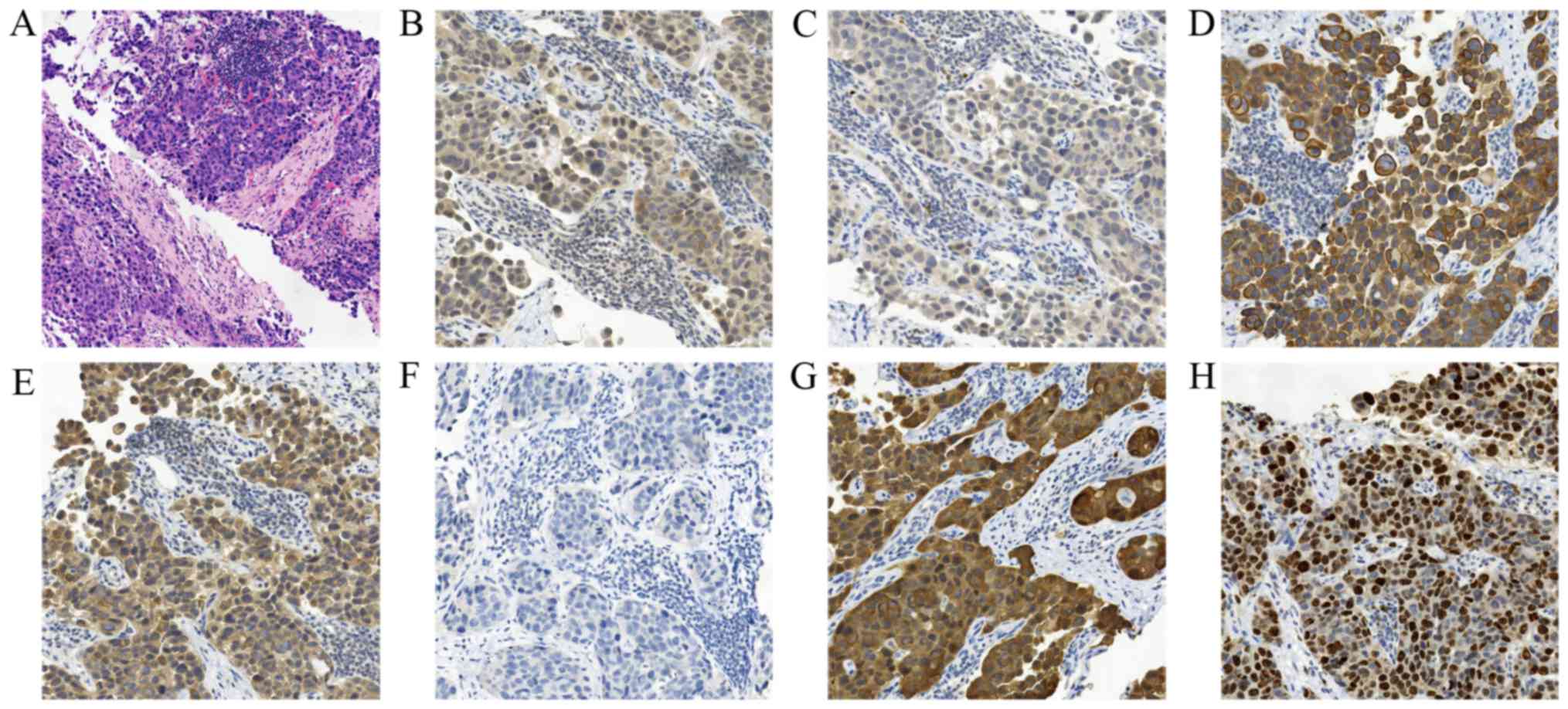 | Figure 4.Histological results from biopsy
specimens from metastatic collarbone lymph nodes (H&E staining
and immunohistochemistry). (A) Many poorly differentiated
neuroendocrine cancer cells were clustered in the sample (H&E:
magnification, ×10). (B-G) The cancer cells were diffusely positive
for (B) Syn, (C) cluster of differentiation-56, (D) CK and (E) CK7,
and were negative for (F) CK20 and (G) Vim (all, magnification,
×20). (H) The cancer cells presented high proliferative capacity,
and Ki-67 was diffusely positive with an index >75%
(magnification, ×20). H&E, hematoxylin and eosin; CK, creatine
kniase; Syn, synaptophysin; Vim, vimentin. |
Discussion
Gastric adenocarcinoma concurrent with metastatic
NEC is a rare phenomenon. To the best of our knowledge, concurrent
gastric adenocarcinoma and NEC are uncommon and have only been
registered in a few case reports (Table
I) (5–23). In our study, the patient was treated
with nivolumab and chemotherapy. Although a transient disease
regression was observed, the PFS (~3.5 months) and OS (~6 months)
were still unsatisfactory; the efficacy of the combined regimen for
such disorders needs further validation in the future.
 | Table I.Case reports of concurrent gastric
adenocarcinoma and neuroendocrine cancer. |
Table I.
Case reports of concurrent gastric
adenocarcinoma and neuroendocrine cancer.
| Author, year | Gender | Age, years | Final pathological
findings | Positive markers for
NEC | Treatment | Overall survival
time | (Refs.) |
|---|
| Okamoto et al,
2003 | Female | 78 | Poorly differentiated
adenocarcinoma+NEC+hepatoid adenocarcinoma | CgA | Gastrectomy | 4 years and 6
months | (5) |
| Yasuda et al,
2006 | Female | 74 | Poorly differentiated
adenocarcinoma+NEC | CgA, NSE |
Gastrectomy+chemotherapy
(cisplatin+5-Fu) | 1 year and 10
months | (6) |
| Park et al,
2007 | Male | 48 | Well differentiated
adenocarcinoma+NEC | – |
Gastrectomy+chemotherapy
(cisplatin+etoposide, TS-1) | >5 years 3
months | (7) |
| Kim et al,
2009 | Male | 77 | Poorly differentiated
adenocarcinoma+NEC+hepatoid adenocarcinoma | CgA, Syn | Gastrectomy | 91 days | (8) |
| Jung et al,
2009 | Male | 59 | Adenocarcinoma+large
cell NEC | CD56 | Gastrectomy | Not reported | (9) |
| Mrόz et al,
2009 | Male | 56 | Poorly
differentiated adenocarcinoma+NEC | CgA, Syn,
Ki-67(70%) |
Gastrectomy+adjuvant chemotherapy | Not reported | (10) |
| Jang et al,
2010 | Male | 50 | Well
differentiated+large cell NEC | CgA, Syn, NSE | Gastrectomy | Not reported | (11) |
| Cho et al,
2010 | Male | 67 |
Adenocarcinoma+large cell NEC | – | Gastrectomy | Not reported | (12) |
| Terada et
al, 2011 | Male | 76 |
Adenocarcinoma+large cell NEC | CK, Syn, CgA, PDGF,
Ki-67 (90%) |
Gastrectomy+adjuvant chemotherapy | Not reported | (13) |
| Miguchi et
al, 2012 | Male | 72 | Moderately
differentiated adenocarcinoma+NEC | CgA, Syn, NSE,
Ki-67 (95%) |
Gastrectomy+adjuvant chemotherapy
(S-1) | Not reported | (14) |
| Nakayama et
al, 2012 | Male | 74 | Poorly
differentiated adenocarcinoma+NEC | Syn, CD56 | Endoscopic
examination | ~2 years | (15) |
| Lee et al,
2013 | Male | 70 | Well differentiated
adenocarcinoma+NEC | CgA, Syn, CD56 | Endoscopic
submucosal dissection | Not reported | (16) |
| Li et al,
2014 | Male | 56 | Moderately
differentiated adenocarcinoma+NEC | CgA, Syn, Vim,
TTF-1, CD117, Ki67 (80%) |
Gastrectomy+adjuvant chemotherapy
(FOLFOX) | Not reported | (17) |
| Lipi et al,
2014 | Male | 50 |
Adenocarcinoma+NEC+hepatoid
adenocarcinoma | AE1/AE3, CgA,
Syn |
Gastrectomy+adjuvant chemotherapy
(cisplatin+etoposide) | Not reported | (18) |
| Zhang et al,
2014 | Male | 68 |
Adenocarcinoma+NEC+squamous cell
carcinoma | CgA, Syn,
Ki-67(70%) | Gastrectomy | Not reported | (19) |
| Payet et al,
2015 | Male | 71 |
Adenocarcinoma+large-cell NEC | Syn, AE1/AE3 | Gastrectomy | Not reported | (20) |
| Aoyagi et
al, 2016 | Male | 76 | Poorly
differentiated adenocarcinoma+signet ring cell carcinoma+NEC | Syn, CD56,
Ki-67(23.1%) |
Gastrectomy+adjuvant chemotherapy
(tegafur-uracil) | 72 months | (21) |
| Mitchell et
al, 2015 | Male | 70 | Moderately
differentiated adenocarcinoma+NEC | AE1/AE3, NSE,
Ki-67(<2%) | Gastrectomy | Not reported | (22) |
| Mainali et
al, 2017 | Male | 67 | Well differentiated
adenocarcinoma+NEC | – | Gastrectomy | Not reported | (23) |
In recent years, the detection of a neuroendocrine
element in gastrointestinal cancers has been increasingly
registered, which has often prevented concise diagnosis. In fact,
the majority of previous cases (5,6,8–15,17–21,23)
were diagnosed by gross specimens from surgeries such as
gastrectomy because the neuroendocrine component is usually located
in the mucosa, while the adenocarcinoma is seated in the deeper
layers (7,14,21,24);
furthermore, each of the two cancer types can occasionally present
pathological evidence for the differentiation of the other
(14,25–28) or
the possibility of transformation from one type to the other
(29). In our study, a MANEC (or, to
be more precise, a high-grade MANEC by La Rosa's report) (30) likely occurred according to the new
categorization by WHO in 2010, considering that some reports have
indicated that gastric NEC is prone to metastasis (13) and that the cells in metastatic sites
are similar to those in the primary sites (2,11).
However, due to the lack of gross samples and autopsy, it is
impossible to estimate the percentage of cell elements in the
tumor, and thus, a definite diagnosis was difficult.
To date, consensus guidelines for the management of
double or multiple original cancers have not been established. La
Rosa et al (30) suggested
that priority should be given to the more malignant elements in the
mass. For our case, some guidelines recommended management in the
same manner as for gastric adenocarcinomas (31). For example, Li et al (17) reported that the FOLFOX regimen in
such cases could achieve a 12-month disease-free survival. However,
as NEC is notorious for its aggressive nature, most investigators
have suggested that these elements should be considered therapeutic
targets (32). In 1999, Mitry et
al (33) first reported the
efficacy of etoposide and cisplatin regimens in a cohort of 53
neuroendocrine cancers (including 3 cases that occurred in gastric
cancer); Uchiyama et al (2)
introduced S-1-based regimens as adjuvant therapy for 7 cases, and
the 3-year overall survival rate was 83.8%. Okita et al
(34) reported that cisplatin plus
irinotecan regimens received a good response in 12 cases. Notably,
Ip et al (35) reported a
spontaneous complete regression of gastric NEC that seemed to be
mediated by cytomegalovirus-induced cross-autoimmunity. In our
case, the patient was treated with the XELOX regimen based on the
first pathological results, and whether replacement with schemes
such as etoposide and cisplatin could have led to tumor regression
is unknown because of the poor physical states and severe
complications of the patient at the terminal stage.
In recent years, immunotherapy has become
increasingly popular in treating cancers, but the efficacy of such
therapies is still being validated. A major problem for such
therapies is the lack of reliable biomarkers for patient selection
and response evaluation. Predictive biomarkers such as PD-L1 were
under extensive study to this end; unfortunately, although
expression of PD-L1 was detected in 50% of stage II and III gastric
cancers (36), it has been found to
be insufficient for patient selection for immunotherapy thus far
(37). A phase 1b clinical trial in
2016 first reported the application of pembrolizumab (another
immunotherapy agent) for recurrent or metastatic gastric cancer
(38). Subsequently, the efficacy of
nivolumab in advanced gastric cancer was established in a phase 3
trial with a registered median overall survival of 5.26 months
(39). Other agents targeting PD-L1
(such as avelumab) are still under clinical investigation. However,
there are still no clinical trials concerning immunotherapeutic
agents for concurrent or multiple cancers. In our case, the patient
was treated with the nivolumab plus XELOX regime; considering the
reported PFS (5.8 months) and OS (11.8 months) of single XELOX in
advanced gastric cancer (40), it is
difficult to conclude whether such combined therapies could help
prolong the OS for such patients; however, additional clinical
studies are still needed in the future.
Concurrent gastric adenocarcinoma and NEC can occur
in the clinic, and interpretation of the pathological results
should be done cautiously in the absence of gross specimens. The
efficacy of therapeutic strategies such as immunotherapy and
chemotherapy still requires further validation.
Acknowledgements
Not applicable.
Funding
The present study was supported by the Natural
Science Foundation of China (grant no. 81503391), Natural Science
Foundation Project of Hainan (grant no. 817352) and Medical and
Health Science Innovation Project of Sanya (grant no.
2016YW08).
Availability of data and materials
All data generated or analyzed during this study are
included in this published article.
Authors' contributions
BY and MC performed the case study, collected the
data and images of the case and produced the draft of the
manuscript. JY, FL and HL critically analyzed the manuscript for
important intellectual content. All authors read and approved the
final manuscript.
Ethics approval and consent to
participate
The present study was approved by the Medical Ethics
Committee of the Hainan Branch of PLA General Hospital. Written
informed consent was obtained from the patient's father.
Patient consent for publication
Written informed consent was obtained from the
patient's father.
Competing interests
The authors declare that they have no competing
interests.
References
|
1
|
Shah MA and Ajani JA: Gastric cancer-an
enigmatic and heterogeneous disease. JAMA. 303:1753–1754. 2010.
View Article : Google Scholar : PubMed/NCBI
|
|
2
|
Uchiyama C, Tamura S, Nakatsuka S, Takeno
A, Miki H, Kanemura T, Nakahira S, Suzuki R, Nakata K, Takeda Y and
Kato T: Immunohistochemical consistency between primary tumors and
lymph node metastases of gastric neuroendocrine carcinoma. World J
Surg Oncol. 10:1152012. View Article : Google Scholar : PubMed/NCBI
|
|
3
|
Fukui H, Takada M, Chiba T, Kashiwagi R,
Sakane M, Tabata F, Kuroda Y, Ueda Y, Kawamata H, Imura J and
Fujimori T: Concurrent occurrence of gastric adenocarcinoma and
duodenal neuroendocrine cell carcinoma: A composite tumour or
collision tumours? Gut. 48:853–856. 2001. View Article : Google Scholar : PubMed/NCBI
|
|
4
|
Kim BS, Park YS, Yook JH and Kim BS:
Comparison of the prognostic values of the 2010 WHO classification,
AJCC 7th edition and ENETS classification of gastric neuroendocrine
tumors. Medicine (Baltimore). 95:e39772016. View Article : Google Scholar : PubMed/NCBI
|
|
5
|
Okamoto T, Ogasahara K, Fujiki M, Takagi
H, Ikeda H, Makino T, Moriga T, Kawamoto K, Sano K, Yoshida Y, et
al: Primary coexistent neuroendocrine carcinoma, hepatoid
adenocarcinoma, and tubular adenocarcinoma of the stomach with
focal trophoblastic differentiation in metastatic lymph nodes. J
Gastroenterol. 38:608–610. 2003. View Article : Google Scholar : PubMed/NCBI
|
|
6
|
Yasuda K, Fujiwara H, Nomura H, Sogo Y,
Sakai K and Teramura K: A case of neuroendocrine cell carcinoma and
poorly differentiated adenocarcinoma of the stomach in synchronous
multiple cancer. Jpn J Gastroenterol Surg. 39:446–451. 2006.
View Article : Google Scholar
|
|
7
|
Park BS, Jo TY, Seo HI, Kim HS, Kim DH,
Jeon TY, Kim DH, Sim MS and Kim JY: Gastric collision tumor
(adenocarcinoma and neuroendocrine carcinoma) diagnosed as a
advanced gastric cancer. J Korean Surg Soc. 73:173–177. 2007.
|
|
8
|
Kim A, Kim SW, Song SK and Bae YK: Gastric
adenocarcinoma with coexistent hepatoid adenocarcinoma and
neuroendocrine carcinoma: A case report. Korean J Pathol. 43:79–82.
2009. View Article : Google Scholar
|
|
9
|
Jung JH, Kim YC, Kim JH, Chung HS, Cheung
DY, Kim JI, Park SH and Kim JK: A case of a gastric composite tumor
with an adenocarcinoma and a large cell neuroendocrine carcinoma.
Korean J Gastrointest Endosc. 39:93–96. 2009.
|
|
10
|
Mrόz A, Kiedrowski M, Malinowska M and
Sopyło R: Collision tumour of the stomach-adenocarcinoma and
neuroendocrine carcinoma: Case report and review of the literature.
Pol J Pathol. 2:94–97. 2009.
|
|
11
|
Jang KY, Moon WS, Lee H, Kim CY and Park
HS: Gastric collision tumor of large cell neuroendocrine carcinoma
and adenocarcinoma-a case report. Pathol Res Pract. 206:387–390.
2010. View Article : Google Scholar : PubMed/NCBI
|
|
12
|
Cho KH, Chang YW, Sohn SD, Hwangbo Y, Shim
J, Jang JY, Kim HJ and Kim BH: Metastatic large cell neuroendocrine
carcinoma combined with gastric adenocarcinoma. Korean J
Gastrointest Endosc. 41:94–97. 2010.
|
|
13
|
Terada T and Maruo H: Simultaneous large
cell neuroendocrine carcinoma and adenocarcinoma of the stomach.
World J Gastroenterol. 17:4831–4834. 2011. View Article : Google Scholar : PubMed/NCBI
|
|
14
|
Miguchi M, Iseki M and Shimatani K:
Advanced gastric neuroendocrine carcinoma with an adenocarcinoma
component. Case Rep Gastroenterol. 6:52–57. 2012. View Article : Google Scholar : PubMed/NCBI
|
|
15
|
Nakayama Y, Higure A, Shibao K, Sato N,
Matayoshi N and Yamaguchi K: Synchronous occurrence of early
neuroendocrine carcinoma and tubular adenocarcinoma in the stomach.
Clin J Gastroenterol. 5:307–311. 2012. View Article : Google Scholar : PubMed/NCBI
|
|
16
|
Lee JH, Kim HW, Kang DH, Choi CW, Park SB
and Kim SH: A gastric composite tumor with an adenocarcinoma and a
neuroendocrine carcinoma: A case report. Clin Endosc. 46:280–283.
2013. View Article : Google Scholar : PubMed/NCBI
|
|
17
|
Li S, Cao X, Jiang C and Wang Q: Combined
neuroendocrine carcinoma and adenocarcinoma in the stomach: A case
report. Oncol Lett. 7:953–955. 2014. View Article : Google Scholar : PubMed/NCBI
|
|
18
|
Lipi L, Sachdev R, Gautam D, Singh J and
Mohapatra I: Triple composite tumor of stomach: A rare combination
of alpha fetoprotein positive hepatoid adenocarcinoma, tubular
adenocarcinoma and large cell neuroendocrine carcinoma. Indian J
Pathol Microbiol. 57:98–100. 2014. View Article : Google Scholar : PubMed/NCBI
|
|
19
|
Zhang W, Xiao W, Ma H, Sun M, Chen H and
Zheng S: Neuroendocrine liver metastasis in gastric mixed
adenoneuroendocrine carcinoma with trilineage cell differentiation:
A case report. Int J Clin Exp Pathol. 7:6333–6338. 2014.PubMed/NCBI
|
|
20
|
Payet E, Pilco PI, Montes J,
Cordero-Morales A, Savitzky MJ and Stenning-Persivale K: Collision
tumour of large-cell neuroendocrine carcinoma and adenocarcinoma in
the stomach: A case report. Ecancermedicalscience. 10:6162016.
View Article : Google Scholar : PubMed/NCBI
|
|
21
|
Aoyagi K, Kizaki J, Isobe T and Akaqi Y: A
case of gastric cancer with neuroendocrine carcinoma, signet ring
cell carcinoma components, and intramural metastases. Am J Case
Rep. 17:274–279. 2016. View Article : Google Scholar : PubMed/NCBI
|
|
22
|
Mitchell MS, Walinchus-Foster L, Thomas L,
Shi Q, Nagori M, Khan W, Mirza W, Cortes M, Masalmeh OA, Zerti H
and Mohamed A: Synchronous adenocarcinoma and neuroendocrine tumors
of the stomach. Am J Cancer Case Rep. 4:125–128. 2016.
|
|
23
|
Mainali N, Nepal N, Kumar CP, Sinha A,
Rajbanshi S, Rauniyar S and Yadav A: Co-existence of gastric
adenocarcinoma and neuroendocrine carcinoma: A rare entity. J
Pathol Nepal. 7:1221–1223. 2017. View Article : Google Scholar
|
|
24
|
Nishikura K, Watanabe H, Iwafuchi M,
Fujiwara T, Kojima K and Ajioka Y: Carcinogenesis of gastric
endocrine cell carcinoma: Analysis of histopathology and p53 gene
alteration. Gastric Cancer. 6:203–209. 2003. View Article : Google Scholar : PubMed/NCBI
|
|
25
|
Kim JJ, Kim JY, Hur H, Cho YK and Han SU:
Clinicopathologic significance of gastric adenocarcinoma with
neuroendocrine features. J Gastric Cancer. 11:195–199. 2011.
View Article : Google Scholar : PubMed/NCBI
|
|
26
|
Zhang T, Su D, Mao Z, Guo X, Wang L and
Bai L: Prognostic role of neuroendocrine cell differentiation in
human gastric carcinoma. Int J Clin Exp Med. 8:7837–7842.
2015.PubMed/NCBI
|
|
27
|
Bakkelund K, Fossmark R, Nordrum I and
Waldum H: Signet ring cells in gastric carcinomas are derived from
neuroendocrine cells. J Histochem Cytochem. 54:615–621. 2006.
View Article : Google Scholar : PubMed/NCBI
|
|
28
|
Yamazaki K: A gastric carcinosarcoma with
neuroendocrine cell differentiation and undifferentiated
spindle-shaped sarcoma component possibly progressing from the
conventional tubular adenocarcinoma; an immunohistochemical and
ultrastructural study. Virchows Arch. 442:77–81. 2003.PubMed/NCBI
|
|
29
|
Lim SU, Seo SS, Yoon JY, Cho DH, Bae SY,
Bae WK, Shim HJ, Cho SH and Chung IJ: A case of gastric
adenocarcinoma developed in neuroendocrine carcinoma after
chemotherapy. Chonnam Med J. 44:188–193. 2008. View Article : Google Scholar
|
|
30
|
La Rosa S, Marando A, Sessa F and Capella
C: Mixed adenoneuroendocrine carcinomas (MANECs) of the
gastrointestinal tract: An update. Cancers (Basel). 4:11–30. 2012.
View Article : Google Scholar : PubMed/NCBI
|
|
31
|
Sato Y, Hashimoto S, Mizuno K, Takeuchi M
and Terai S: Management of gastric and duodenal neuroendocrine
tumors. World J Gastroenterol. 22:6817–6828. 2016. View Article : Google Scholar : PubMed/NCBI
|
|
32
|
Fukuda T, Ohnishi Y, Nishimaki T, Ohtani H
and Tachikawa S: Early gastric cancer of the small cell type. Am J
Gastroenterol. 83:1176–1179. 1988.PubMed/NCBI
|
|
33
|
Mitry E, Baudin E, Ducreux M, Sabourin JC,
Rufié P, Aparicio T, Aparicio T, Lasser P, Elias D, Duvillard P, et
al: Treatment of poorly differentiated neuroendocrine tumours with
etoposide and cisplatin. Br J Cancer. 81:1351–1355. 1999.
View Article : Google Scholar : PubMed/NCBI
|
|
34
|
Okita NT, Kato K, Takahari D, Hirashima Y,
Nakajima TE, Matsubara J, Hamaguchi T, Yamada Y, Shimada Y,
Taniguchi H and Shirao K: Neuroendocrine tumors of the stomach:
Chemotherapy with cisplatin plus irinotecan is effective for
gastric poorly-differentiated neuroendocrine carcinoma. Gastric
Cancer. 14:161–165. 2011. View Article : Google Scholar : PubMed/NCBI
|
|
35
|
Ip YT, Pong WM, Kao SS and Chan JK:
Spontaneous complete regression of gastric large-cell
neuroendocrine carcinoma: Mediated by cytomegalovirus-induced
cross-autoimmunity? Int J Surg Pathol. 19:355–358. 2011. View Article : Google Scholar : PubMed/NCBI
|
|
36
|
Zhang L, Qiu M, Jin Y, Ji J, Li B, Wang X,
Yan S, Xu R and Yang D: Programmed cell death ligand 1 (PD-L1)
expression on gastric cancer and its relationship with
clinicopathologic factors. Int J Clin Exp Pathol. 8:11084–11091.
2015.PubMed/NCBI
|
|
37
|
Gibney GT, Weiner LM and Atkins MB:
Predictive biomarkers for checkpoint inhibitor-based immunotherapy.
Lancet Oncol. 17:e542–e551. 2016. View Article : Google Scholar : PubMed/NCBI
|
|
38
|
Muro K, Chung HC, Shankaran V, Geva R,
Catenacci D, Gupta S, Eder JP, Golan T, Le DT, Burtness B, et al:
Pembrolizumab for patients with PD-L1-positive advanced gastric
cancer (KEYNOTE-012): A multicentre, open-label, phase 1b trial.
Lancet Oncol. 17:717–726. 2016. View Article : Google Scholar : PubMed/NCBI
|
|
39
|
Kang YK, Boku N, Satoh T, Ryu MH, Chao Y,
Kato K, Chung HC, Chen JS, Muro K, Kang WK, et al: Nivolumab in
patients with advanced gastric or gastro-oesophageal junction
cancer refractory to, or intolerant of, at least two previous
chemotherapy regimens (ONO-4538-12, ATTRACTION-2): A randomised,
double-blind, placebo-controlled, phase 3 trial. Lancet.
390:2461–2471. 2017. View Article : Google Scholar : PubMed/NCBI
|
|
40
|
Park YH, Lee JL, Ryoo BY, Ryu MH, Yang SH,
Kim BS, Shin DB, Chang HM, Kim TW, Yuh YJ and Kang YK: Capecitabine
in combination with Oxaliplatin (XELOX) as a first-line therapy for
advanced gastric cancer. Cancer Chemother Pharmacol. 61:623–629.
2008. View Article : Google Scholar : PubMed/NCBI
|