Introduction
Head and neck cancers (HNC) account for a
significant proportion of cancers in the USA (1). HNCs are typically treated with surgery,
radiotherapy, chemotherapy, or in combination. Single surgical
treatment with or without radiation is the standard therapy for
Tumor-Node-Metastases (TNM) stages I and II (2). On the other hand, a combination of
surgery, radiotherapy, and chemotherapy may be used for more
advanced TNM stages (3). TNM staging
is a widely used scoring system among prognostic factors for
determining patient survival (1,4).
Previously, several biomarkers were studied as serologic markers
albeit low specificity and difficult clinical application (5). As such, there is a need for finding
effective and clinically efficient biomarkers purposed as
prognostic factors for HNCs (6–8).
In recent studies, platelet activation was observed
to be a significant biological process for cancer occurrence and
metastasis (9). Platelet (PLT) and
mean platelet volume (MPV) are typical measures of platelet
activation (10), where high levels
of MPV signify irregular platelet production and activation
(11). It has also been observed
that abnormal MPV levels are associated with patients with various
disorders and malignant tumors. Building on this information,
several studies have recently investigated the prognostic utility
of the combination of PLT and MPV (COP-MPV). A recent study by Park
et al (12) found that the
COP-MPV was a significant prognostic indicator in oral cavity
cancer. Additionally, the COP-MPV has been found to be a prognostic
indicator in non-small cell lung cancer (NSCLC) (13), and esophageal cancer as well
(14). The study by Park was a small
sample study with only 40 patients, and only consisted of patients
with oral cavity cancer (12). In
this context, the goal of our study was to (a) evaluate the
prognostic utility of the COP-MPV in a larger sample size, with
patients of all HNC subsites and (b) to determine the
clinicopathological characteristics associated with COP-MPV.
Materials and methods
Study design
This is a retrospective cohort study that included
consecutively-treated patients with HNC treated at the New York
Head & Neck Institute (NYHNI) from 2009–2016. This study is
part of a large retrospectively managed cancer database (15,16) and
was approved by the Institutional Review Board of the Northwell
Health System (IRB# 17-0280-LHH). The study conforms to the
guidelines stupilated in the Declaration of Helsinki. The inclusion
criteria of the study included: i) histologically confirmed HNC
(excluding thyroid); ii) undergoing curative intent surgery; iii)
availability of complete clinical data and disease records. The
exclusion criteria included: i) clinical evidence of pretreatment
infection, other inflammatory disease or comorbidity that would
influence results of the platelet count; ii) benign disease; iii)
biopsies or non-curative intent procedures or palliative
procedures; iv) lymphoproliferative malignancies; v) incomplete
medical records which include absence of preoperative complete
blood count (CBC); vi) CBC that was taken more than two weeks
pre-operatively; and vii) neoadjuvant chemotherapy or radiation
therapy. Patients were screened with pre-defined International
Classification of Diseases (ICD) 9/10 codes and were treated
according to physician discretion consistent with contemporary
treatment paradigms.
Variable selection and data
collection
Various literature were reviewed for significant
prognostic factors in HNC that could be used to generate univariate
and multivariate statistical models. The established prognostic
factors for HNC used in the data collection process included: age,
sex, body mass index (BMI), alcohol history, smoking history,
eastern cooperative oncology group (ECOG) score, and Karnofsky
performance status. All patients were retrospectively graded based
on the Adult Comorbidity Evaluation 27 (ACE-27) score, a validated
comorbidity scoring system for head and neck cancer (17). Treatment and tumor variables were
also incorporated: Tumor differentiation, staging (8th Edition of
American Joint Committee on Cancer System) (18), adjuvant radiation (RT), adjuvant
chemotherapy (CT), and surgical margin status. For oropharyngeal
tumors, human papillomavirus (HPV) status was determined according
to either p16 positivity via immunohistochemistry, or HPV DNA
detection. In addition, CBC markers of interest were considered as
well and included: the hemoglobin (Hb), platelet count, mean
platelet volume, and white blood cell count (WBC). Since a unified
scoring system has not been developed for the COP-MPV, we utilized
the scoring system developed in the largest dataset published on
the COP-MPV, by Zhang et al (14). The cutoffs for platelet count and
platelet volume were set to 212 (109/L) and 10.6 (fl)
respectively. A score of 1 was given if one of the cutoffs were
met, and a score of 2 was given if both cutoffs were met.
Patient records were retrieved electronically from
the REDCap database (19). Necessary
and relevant clinical information were gathered from the patients'
scanned documents. Such documents included clinical, pathological,
or laboratory reports. CBC parameters were obtained from
preoperative lab results.
Endpoint definition
Event-free survival (EFS) was chosen as the primary
endpoint. We chose EFS as the primary endpoint as a recent study by
Michiels et al (20) had
shown that the EFS was an effective proxy for OS as the primary
survival endpoint. EFS was defined as the date of surgery to last
follow-up or ‘event’, depending on which date was earliest. An
‘event’ was defined as any progress, local or distant recurrence,
or death. If there was no occurrence of an ‘event’ at the last
follow-up, the patient was censored for the survival analysis.
Statistical analysis
Parametric tests such as Chi-square tests and
t-tests were used to evaluate the differences between the
relationship of clinicopathological features. With Kaplan-Meier
curves (KM), EFS was estimated and log-rank tests were used to
identify survival differences between the KM curves. Furthermore,
Cox proportional hazards model (CPH) was used to determine the
hazard ratio (HR) of the aforementioned variables. Multivariate
analyses was conducted on all variables recorded with regards to
EFS. For generating a multivariate CPH model, backwards variable
selection was used. For the backwards multivariate model, variables
with P>0.1 were removed from the model. Hazard ratios (HR) with
95% confidence intervals (95% CI) with two-sided P-values are
presented. The chosen alpha level was 0.05, and all P-values less
than the alpha level were considered statistically significant. All
statistical analyses, excluding cutoff derivation, were performed
using MedCalc for Windows, version 15.0 (MedCalc Software bvba,
Ostend, Belgium).
Results
A total of 113 patients met the inclusion and
exclusion criteria for this study (Table
I). The most common site of tumor was the Oral Cavity (46%)
followed by the oropharynx (18%). Of the oropharyngeal tumors, 15
(75%) were associated with either p16 or HPV DNA. In regards to
tumor histology, the most prominent type was squamous cell
carcinoma (93 patients, 82.3%). A total of 27 (24%) patients had a
COP-MPV score of 0, 65 (58%) of patients had score of 1, and 21
(19%) of patients had score of 2. With regards to the
clinicopathological characteristics and COP-MPV score, only WBC
count was associated with higher COP-MPV values (P=0.0036, Table I).
 | Table I.Summary of cohort characteristics
stratified by COP-MPV. |
Table I.
Summary of cohort characteristics
stratified by COP-MPV.
| Variable | COP-MPV
0a | COP-MPV
1a | COP-MPV
2a | P-value |
|---|
| Age (years) | 66.48 | 63.23 | 64.048 | 0.6027 |
| Sex |
| Male | 20 | 43 | 13 | 0.6444 |
|
Female | 7 | 22 | 8 |
|
| BMI
(kg/m2) | 24.89 | 26.50 | 28.76 | 0.0655 |
| History of alcohol
use |
| Yes | 12 | 33 | 12 | 0.6810 |
| No | 15 | 32 | 9 |
|
| History of
smoking |
| Yes | 13 | 31 | 12 | 0.7426 |
| No | 14 | 34 | 9 |
|
| ECOG score |
| 0 | 16 | 50 | 16 | 0.3801 |
| 1 | 9 | 14 | 4 |
|
| 2 | 2 | 1 | 1 |
|
| Tumor primary
location |
|
Nasopharynx | 0 | 1 | 0 | 0.2692 |
|
Oropharynx | 5 | 13 | 2 |
|
| Oral
cavity | 8 | 29 | 15 |
|
|
Larynx | 4 | 6 | 0 |
|
| Salivary
gland | 3 | 7 | 2 |
|
| Paranasal
sinus | 2 | 5 | 0 |
|
| Cervical
lymph node or unknown primary | 2 | 1 |
|
|
|
Cutaneous | 3 | 3 | 0 |
|
| Tumor histology |
|
Adenocarcinoma | 1 | 5 | 0 | 0.6290 |
| Squamous
cell carcinoma | 21 | 52 | 20 |
|
| Adenoid
cystic carcinoma | 1 | 1 | 0 |
|
|
Mucoepidermoid carcinoma | 1 | 1 | 0 |
|
| Basal
cell carcinoma | 1 | 0 | 0 |
|
|
Other | 2 | 6 | 1 |
|
| Tumor
differentiation |
| Unable to
assess | 7 | 5 | 4 | 0.0617 |
| Well
differentiated | 7 | 10 | 3 |
|
| Moderate
differentiation | 11 | 29 | 10 |
|
| Poor
differentiation | 2 | 21 | 4 |
|
| Staging pT |
| pT0 | 2 | 2 | 2 | 0.6384 |
|
pT1 | 10 | 25 | 9 |
|
|
pT2 | 11 | 19 | 6 |
|
|
pT3 | 3 | 11 | 1 |
|
|
pT4 | 1 | 8 | 3 |
|
| Staging pN |
|
pN0 | 19 | 41 | 16 | 0.8009 |
|
pN1 | 3 | 10 | 2 |
|
|
pN2 | 3 | 7 | 3 |
|
|
pN3 | 2 | 6 | 0 |
|
| Adjuvant
radiotherapy |
|
Yes | 12 | 27 | 4 | 0.1339 |
| No | 15 | 38 | 17 |
|
| Adjuvant
chemoradiotherapy |
|
Yes | 6 | 14 | 2 | 0.4420 |
| No | 21 | 51 | 19 |
|
| Surgical margin
status |
|
Positive | 3 | 9 | 3 | 0.9292 |
|
Negative | 24 | 56 | 18 |
|
| WBC
(109/l) | 6.51 | 7.56 | 9.16 | 0.0036b |
| Hemoglobin
(g/dl) | 13.39 | 13.30 | 6.81 | 0.1356 |
| MPV (fl) | 9.66 | 9.81 | 11.25 |
<0.0001b |
| Platelet Count
(109/l) | 178.33 | 249.88 | 275.14 |
<0.0001b |
With regards to the survival analysis, the
multivariate analysis of EFS revealed that age, sex, BMI, Karnofsky
score, ACE score, tumor differentiation, Staging-N, WBC, platelet
count, and COP MPV were not significant prognostic indicators
(Table II). The factors associated
with EFS in the multivariable model were higher tumor grade
(HR=2.37, 95% CI: 1.17–4.84, P=0.0171), higher tumor stage
(HR=8.91, 95% CI: 3.46–22.91, P<0.0001), higher nodal stage (pN1
HR=3.41, 95% CI: 1.11–10.47, P=0.0321; pN2 HR=3.30, 95% CI
1.23–8.86, P=0.0177), positive surgical margins (HR=3.77, 95% CI:
1.54–9.24, P=0.0037), and higher hemoglobin count (HR=0.62, 95% CI:
0.50–0.78, P<0.0001). COP-MPV was not associated with EFS in the
multivariate survival analysis. To confirm if COP-MPV did not have
a prognostic effect, we performed a further Kaplan Meier analysis
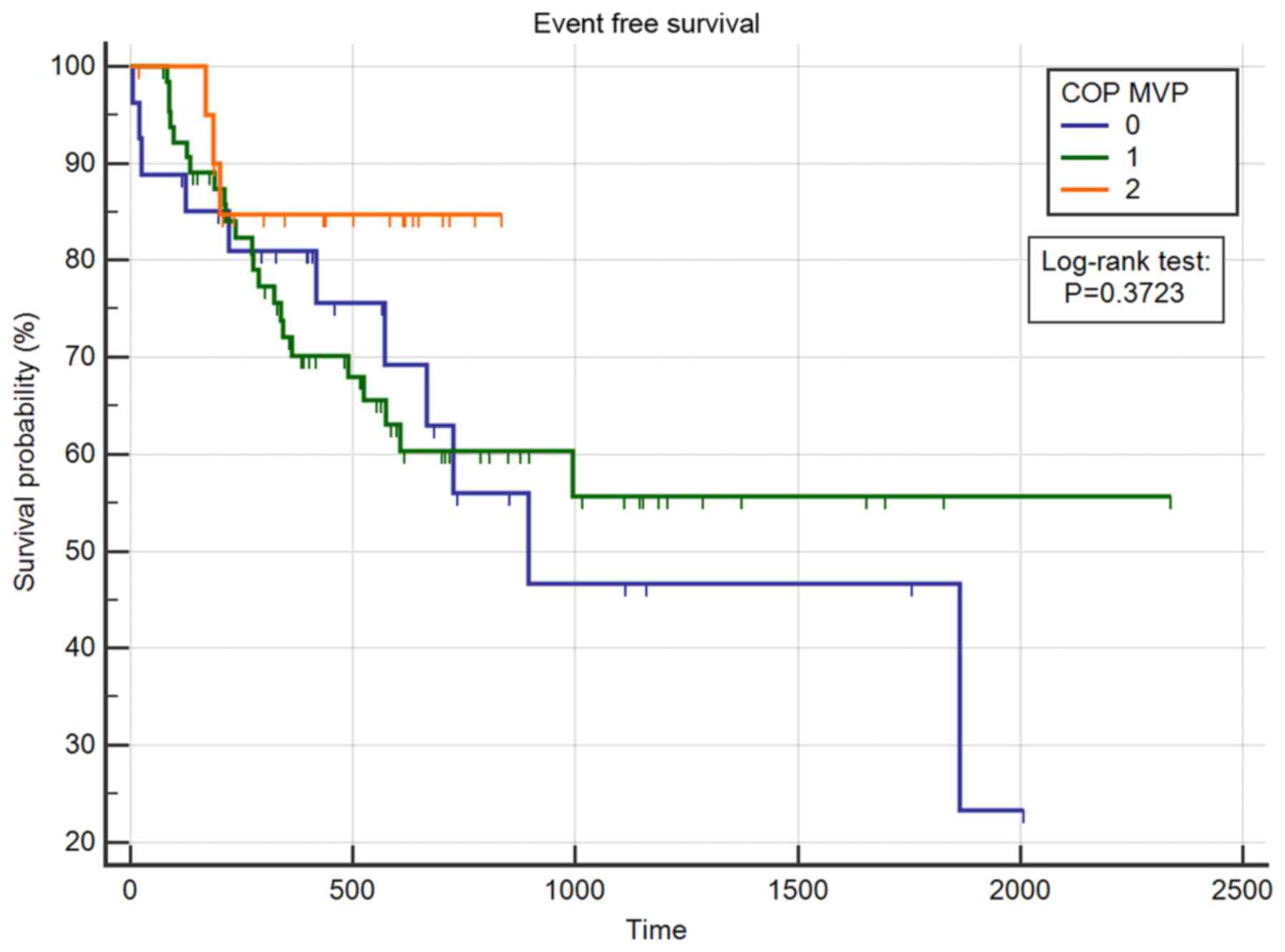
with a log-rank test. The Kaplan-Meier analysis revealed that
COP-MPV was not associated with EFS (P=0.3723, Fig. 1).
| Table II.Multivariate Cox Regression Analysis
of Event-Free Survival. |
Table II.
Multivariate Cox Regression Analysis
of Event-Free Survival.
|
| Multivariate
analysis |
|---|
|
|
|
|---|
| Variable | HR | 95% CI | P-value |
|---|
| Age | Nsa | – | – |
| Sex |
|
Male | Reference |
|
|
|
Female | Nsa | – | – |
| BMI | Nsa | – | – |
| History of alcohol
use | Nsa | – | – |
| History of
smoking | Nsa | – | – |
| Overall ACE-27
score | Nsa | – | – |
| ECOG score | Nsa | – | – |
| Karnofsky
score |
|
100 | Reference |
|
|
| 90 | Nsa | – | – |
| 80 | Nsa | – | – |
|
≤70 | c | – | – |
| Tumor primary
location | Nsa | – | – |
| Tumor
differentiation |
| Well
differentiated | Reference |
|
|
|
Moderately differentiated | 2.37 | 1.17–4.84 | 0.0171b |
| Poorly
differentiated | Nsa | – | – |
| Staging pT |
|
pT1 | Reference |
|
|
|
pT2 | Nsa | – | – |
|
pT3 | 8.91 | 3.46–22.91 |
<0.0001b |
|
pT4 | Nsa | – | – |
| Staging pN |
|
pN0 | Reference |
|
|
|
pN1 | 3.41 | 1.11–10.47 | 0.0321b |
|
pN2 | 3.30 | 1.23–8.86 | 0.0177b |
|
pN3 | c |
|
|
| Adjuvant
radiotherapy | Nsa | – | – |
| Adjuvant
chemoradiotherapy | Nsa | – | – |
| Surgical margin
status | 3.77 | 1.54–9.24 | 0.0037b |
| WBC | Nsa | – | – |
| Hemoglobin | 0.62 | 0.50–0.78 |
<0.0001b |
| MPV | 2.16 | 0.95–4.92 | 0.0659 |
| Platelet count | Nsa | – | – |
| COP-MPV |
| 0 | Reference |
|
|
| 1 | Nsa | – | – |
| 2 | Nsa | – | – |
Discussion
The COP-MPV scoring system was developed by
combining PLT and MPV to measure platelet activation and to assess
the prognosis of cancer patients. As such, previous studies
revealed COP-MPV to be an ideal and effective prognostic factor for
these type of patients (12–14). Building upon previous research by
others, this study sought to validate the prognostic value of
COP-MPV for all HNC subsites. The results and analyses of this
study revealed that COP-MPV was not associated with our primary
survival outcome, EFS. There were no significant differences
between COP-MPV scores of 0,1 and 2 with regard to EFS.
Additionally, COP-MPV was not associated with EFS in the univariate
Kaplan Meier analysis either. In our multivariate survival
analysis, we found that known factors for survival, namely
differentiation, tumor stage, surgical margins, and hemoglobin were
associated with EFS.
In comparison to other studies (12–14),
similar factors were incorporated into the analyses of the results.
This included age, sex, tumor location, degree of differentiation,
TNM stage, WBC, platelet count, and mean platelet volume. In this
study, we additionally controlled for BMI, ECOG score, Karnofsky
score, types of treatment modalities, and surgical margin
status.
It should be noted that by accounting for different
factors in analyses potential differences in significance values
will arise and thus could also influence the determination of
whether COP-MPV affects survival. Another key difference between
our study and other studies is the area of interest for cancers. In
our study various locations of cancer of the head and neck area
were included, whereas other studies mainly focused on areas of
higher specification or a particular type of carcinom (12–14). As
a result, by considering different afflicted locations it may
explain why our significance scores were different from other
studies.
Of note, the study by Park et al (12) found that the COP-MPV was
significantly associated with survival in their multivariate
analysis. However, we believe that their results might be limited
due to several reasons. Firstly, they had a small sample size of
patients; secondly, their multivariate model did not account for
important covariates such as adjuvant therapies and comorbidities
which would have significantly biased their results. Our results
agree with certain aspects of their study; they also found that
tumor stage (P=0.735) and nodal stage (P=1.00) were not associated
with COP-MPV scores. Nevertheless, we believe the work by Park
et al (12) is the first
report of COP-MPV for a HNC subsite. In our study, we analyzed
patients from all HNC subsites, in a larger sample size than the
previous study by Park et al (12).
We acknowledge several limitations in our study.
Firstly, this is a retrospective cohort study where some elements
of bias might be in the data. Secondly, considering that different
types of HNCs were included, each may have their own prognostic
characteristics. We are unable to definitely draw a conclusion that
the COP-MPV is not effective in all HNC subsites. Our study has
several strengths: First, this includes rigorous control for all
prognostic covariates in our analyses; Secondly, the included
patients had similar treatment regimens where all experienced
curative intent surgery with or without adjuvant radiation or
chemotherapy; Third, unlike previously mentioned literature, we
used the latest staging system (AJCC 8th edition) in our study,
which has been shown to have improved prognostic discrimination
between stages (18). It should be
acknowledged that the use of older staging criteria by other
studies might have affected their results. Most importantly, this
study adds on to the literature for COP-MPV as this is the first
comprehensive study examining the prognostic utility of COP-MPV in
all HNC subsites.
In conclusion, we did not find COP-MPV to be related
to the survival endpoint EFS. However, high quality prospective
studies should be considered and are needed to validate our
conclusions for COP-MPV. At this time, we cannot recommend the
COP-MPV as a prognostic indicator in HNC.
Acknowledgements
Not applicable.
Funding
No funding was received.
Availability of data and materials
The analyzed data sets generated during the study
are available from the corresponding author on reasonable
request.
Authors' contributions
TT, EL, CO, MW, JK, JC, ST and PC conceived and
designed the experiments. TT, EL, CO, MW, JK, JC, ST and PC
performed the experiments. TT, EL, CO, MW, JK, JC, ST and PC wrote
the paper.
Ethics approval and consent to
participate
The present study was approved by the review boards
of the Northwell Health System (New York, NY, USA).
Patient consent for publication
Not applicable.
Competing interests
The authors declare that they have no competing
interests.
References
|
1
|
Forastiere A, Koch W, Trotti A and
Sidransky D: Head and neck cancer. N Engl J Med. 345:1890–1900.
2001. View Article : Google Scholar : PubMed/NCBI
|
|
2
|
Lydiatt DD, Robbins KT, Byers RM and Wolf
PF: Treatment of stage I and II oral tongue cancer. Head Neck.
15:308–312. 1993. View Article : Google Scholar : PubMed/NCBI
|
|
3
|
Layland MK, Sessions DG and Lenox J: The
influence of lymph node metastasis in the treatment of squamous
cell carcinoma of the oral cavity, oropharynx, larynx, and
hypopharynx: N0 versus N+. Laryngoscope. 115:629–639.
2005. View Article : Google Scholar : PubMed/NCBI
|
|
4
|
Woolgar JA, Rogers S, West CR, Errington
RD, Brown JS and Vaughan ED: Survival and patterns of recurrence in
200 oral cancer patients treated by radical surgery and neck
dissection. Oral Oncol. 35:257–265. 1999. View Article : Google Scholar : PubMed/NCBI
|
|
5
|
Yotsukura S and Mamitsuka H: Evaluation of
serum-based cancer biomarkers: A brief review from a clinical and
computational viewpoint. Crit Rev Oncol Hematol. 93:103–115. 2015.
View Article : Google Scholar : PubMed/NCBI
|
|
6
|
Tham T, Bardash Y, Herman SW and
Costantino PD: Neutrophil-to-lymphocyte ratio as a prognostic
indicator in head and neck cancer: A systematic review and
meta-analysis. Head Neck. 40:2546–2557. 2018. View Article : Google Scholar : PubMed/NCBI
|
|
7
|
Tham T, Olson C, Khaymovich J, Herman SW
and Costantino PD: The lymphocyte-to-monocyte ratio as a prognostic
indicator in head and neck cancer: A systematic review and
meta-analysis. Eur Arch Otorhinolaryngol. 275:1663–1670. 2018.
View Article : Google Scholar : PubMed/NCBI
|
|
8
|
Tham T, Bardash Y, Teegala S, Herman WS
and Costantino PD: The red cell distribution width as a prognostic
indicator in upper aerodigestive tract (UADT) cancer: A systematic
review and meta-analysis. Am J Otolaryngol. 39:453–458. 2018.
View Article : Google Scholar : PubMed/NCBI
|
|
9
|
Lip GY, Chin BS and Blann AD: Cancer and
the prothrombotic state. Lancet Oncol. 3:27–34. 2002. View Article : Google Scholar : PubMed/NCBI
|
|
10
|
Kamath S, Blann AD and Lip GY: Platelet
activation: Assessment and quantification. Eur Heart J.
22:1561–1571. 2001. View Article : Google Scholar : PubMed/NCBI
|
|
11
|
Gasparyan AY, Ayvazyan L, Mikhailidis DP
and Kitas GD: Mean platelet volume: A link between thrombosis and
inflammation? Curr Pharm Des. 17:47–58. 2011. View Article : Google Scholar : PubMed/NCBI
|
|
12
|
Park JW, Kim CH, Ha YC, Kim MY and Park
SM: Count of platelet and mean platelet volume score: Serologic
prognostic factor in patients with oral squamous cell carcinoma. J
Korean Assoc Oral Maxillofac Surg. 43:305–311. 2017. View Article : Google Scholar : PubMed/NCBI
|
|
13
|
Gao L, Zhang H, Zhang B, Zhang L and Wang
C: Prognostic value of combination of preoperative platelet count
and mean platelet volume in patients with resectable non-small cell
lung cancer. Oncotarget. 8:15632–15641. 2017.PubMed/NCBI
|
|
14
|
Zhang F, Chen Z, Wang P, Hu X, Gao Y and
He J: Combination of platelet count and mean platelet volume
(COP-MPV) predicts postoperative prognosis in both resectable early
and advanced stage esophageal squamous cell cancer patients. Tumour
Biol. 37:9323–9331. 2016. View Article : Google Scholar : PubMed/NCBI
|
|
15
|
Tham T, Khaymovich J and Costantino P:
Investigation of the relationship between markers of systemic
inflammatory response and head and neck tumor characteristics.
bioRxiv. Aug 23–2018.(Epub ahead of print). doi:
https://doi.org/10.1101/399162.
|
|
16
|
Tham T, Olson C, Wotman M, Teegala S,
Khaymovich J, Coury J and Costantino P: Evaluation of the
prognostic utility of the hemoglobin-to-red cell distribution width
ratio in head and neck cancer. Eur Arch Otorhinolaryngol.
275:2869–2878. 2018. View Article : Google Scholar : PubMed/NCBI
|
|
17
|
Piccirillo JF, Tierney RM, Costas I, Grove
L and Spitznagel EL Jr: Prognostic importance of comorbidity in a
hospital-based cancer registry. JAMA. 291:2441–2447. 2004.
View Article : Google Scholar : PubMed/NCBI
|
|
18
|
Amin MB, Edge SB, Greene FL, Byrd DR,
Brookland RK, Washington MK, Gershenwald JE, Compton CC, Hess KR,
Sullivan DC, et al: AJCC Cancer Staging Manual. 8th. Springer; New
York, NY: 2017, View Article : Google Scholar
|
|
19
|
Harris PA, Taylor R, Thielke R, Payne J,
Gonzalez N and Conde JG: Research electronic data capture (REDCap)
- a metadata-driven methodology and workflow process for providing
translational research informatics support. J Biomed Inform.
42:377–381. 2009. View Article : Google Scholar : PubMed/NCBI
|
|
20
|
Michiels S, Le Maître A, Buyse M,
Burzykowski T, Maillard E, Bogaerts J, Vermorken JB, Budach W,
Pajak TF, Ang KK, et al MARCH and MACH-NC Collaborative Groups, :
Surrogate endpoints for overall survival in locally advanced head
and neck cancer: Meta-analyses of individual patient data. Lancet
Oncol. 10:341–350. 2009. View Article : Google Scholar : PubMed/NCBI
|