Spandidos Publications Logo
  • About
    • About Spandidos
    • Aims and Scopes
    • Abstracting and Indexing
    • Editorial Policies
    • Reprints and Permissions
    • Job Opportunities
    • Terms and Conditions
    • Contact
  • Journals
    • All Journals
    • Oncology Letters
      • Oncology Letters
      • Information for Authors
      • Editorial Policies
      • Editorial Board
      • Aims and Scope
      • Abstracting and Indexing
      • Bibliographic Information
      • Archive
    • International Journal of Oncology
      • International Journal of Oncology
      • Information for Authors
      • Editorial Policies
      • Editorial Board
      • Aims and Scope
      • Abstracting and Indexing
      • Bibliographic Information
      • Archive
    • Molecular and Clinical Oncology
      • Molecular and Clinical Oncology
      • Information for Authors
      • Editorial Policies
      • Editorial Board
      • Aims and Scope
      • Abstracting and Indexing
      • Bibliographic Information
      • Archive
    • Experimental and Therapeutic Medicine
      • Experimental and Therapeutic Medicine
      • Information for Authors
      • Editorial Policies
      • Editorial Board
      • Aims and Scope
      • Abstracting and Indexing
      • Bibliographic Information
      • Archive
    • International Journal of Molecular Medicine
      • International Journal of Molecular Medicine
      • Information for Authors
      • Editorial Policies
      • Editorial Board
      • Aims and Scope
      • Abstracting and Indexing
      • Bibliographic Information
      • Archive
    • Biomedical Reports
      • Biomedical Reports
      • Information for Authors
      • Editorial Policies
      • Editorial Board
      • Aims and Scope
      • Abstracting and Indexing
      • Bibliographic Information
      • Archive
    • Oncology Reports
      • Oncology Reports
      • Information for Authors
      • Editorial Policies
      • Editorial Board
      • Aims and Scope
      • Abstracting and Indexing
      • Bibliographic Information
      • Archive
    • Molecular Medicine Reports
      • Molecular Medicine Reports
      • Information for Authors
      • Editorial Policies
      • Editorial Board
      • Aims and Scope
      • Abstracting and Indexing
      • Bibliographic Information
      • Archive
    • World Academy of Sciences Journal
      • World Academy of Sciences Journal
      • Information for Authors
      • Editorial Policies
      • Editorial Board
      • Aims and Scope
      • Abstracting and Indexing
      • Bibliographic Information
      • Archive
    • International Journal of Functional Nutrition
      • International Journal of Functional Nutrition
      • Information for Authors
      • Editorial Policies
      • Editorial Board
      • Aims and Scope
      • Abstracting and Indexing
      • Bibliographic Information
      • Archive
    • International Journal of Epigenetics
      • International Journal of Epigenetics
      • Information for Authors
      • Editorial Policies
      • Editorial Board
      • Aims and Scope
      • Abstracting and Indexing
      • Bibliographic Information
      • Archive
    • Medicine International
      • Medicine International
      • Information for Authors
      • Editorial Policies
      • Editorial Board
      • Aims and Scope
      • Abstracting and Indexing
      • Bibliographic Information
      • Archive
  • Articles
  • Information
    • Information for Authors
    • Information for Reviewers
    • Information for Librarians
    • Information for Advertisers
    • Conferences
  • Language Editing
Spandidos Publications Logo
  • About
    • About Spandidos
    • Aims and Scopes
    • Abstracting and Indexing
    • Editorial Policies
    • Reprints and Permissions
    • Job Opportunities
    • Terms and Conditions
    • Contact
  • Journals
    • All Journals
    • Biomedical Reports
      • Information for Authors
      • Editorial Policies
      • Editorial Board
      • Aims and Scope
      • Abstracting and Indexing
      • Bibliographic Information
      • Archive
    • Experimental and Therapeutic Medicine
      • Information for Authors
      • Editorial Policies
      • Editorial Board
      • Aims and Scope
      • Abstracting and Indexing
      • Bibliographic Information
      • Archive
    • International Journal of Epigenetics
      • Information for Authors
      • Editorial Policies
      • Editorial Board
      • Aims and Scope
      • Abstracting and Indexing
      • Bibliographic Information
      • Archive
    • International Journal of Functional Nutrition
      • Information for Authors
      • Editorial Policies
      • Editorial Board
      • Aims and Scope
      • Abstracting and Indexing
      • Bibliographic Information
      • Archive
    • International Journal of Molecular Medicine
      • Information for Authors
      • Editorial Policies
      • Editorial Board
      • Aims and Scope
      • Abstracting and Indexing
      • Bibliographic Information
      • Archive
    • International Journal of Oncology
      • Information for Authors
      • Editorial Policies
      • Editorial Board
      • Aims and Scope
      • Abstracting and Indexing
      • Bibliographic Information
      • Archive
    • Medicine International
      • Information for Authors
      • Editorial Policies
      • Editorial Board
      • Aims and Scope
      • Abstracting and Indexing
      • Bibliographic Information
      • Archive
    • Molecular and Clinical Oncology
      • Information for Authors
      • Editorial Policies
      • Editorial Board
      • Aims and Scope
      • Abstracting and Indexing
      • Bibliographic Information
      • Archive
    • Molecular Medicine Reports
      • Information for Authors
      • Editorial Policies
      • Editorial Board
      • Aims and Scope
      • Abstracting and Indexing
      • Bibliographic Information
      • Archive
    • Oncology Letters
      • Information for Authors
      • Editorial Policies
      • Editorial Board
      • Aims and Scope
      • Abstracting and Indexing
      • Bibliographic Information
      • Archive
    • Oncology Reports
      • Information for Authors
      • Editorial Policies
      • Editorial Board
      • Aims and Scope
      • Abstracting and Indexing
      • Bibliographic Information
      • Archive
    • World Academy of Sciences Journal
      • Information for Authors
      • Editorial Policies
      • Editorial Board
      • Aims and Scope
      • Abstracting and Indexing
      • Bibliographic Information
      • Archive
  • Articles
  • Information
    • For Authors
    • For Reviewers
    • For Librarians
    • For Advertisers
    • Conferences
  • Language Editing
Login Register Submit
  • This site uses cookies
  • You can change your cookie settings at any time by following the instructions in our Cookie Policy. To find out more, you may read our Privacy Policy.

    I agree
Search articles by DOI, keyword, author or affiliation
Search
Advanced Search
presentation
Molecular and Clinical Oncology
Join Editorial Board Propose a Special Issue
Print ISSN: 2049-9450 Online ISSN: 2049-9469
Journal Cover
March-2023 Volume 18 Issue 3

Full Size Image

Sign up for eToc alerts
Recommend to Library

Journals

International Journal of Molecular Medicine

International Journal of Molecular Medicine

International Journal of Molecular Medicine is an international journal devoted to molecular mechanisms of human disease.

International Journal of Oncology

International Journal of Oncology

International Journal of Oncology is an international journal devoted to oncology research and cancer treatment.

Molecular Medicine Reports

Molecular Medicine Reports

Covers molecular medicine topics such as pharmacology, pathology, genetics, neuroscience, infectious diseases, molecular cardiology, and molecular surgery.

Oncology Reports

Oncology Reports

Oncology Reports is an international journal devoted to fundamental and applied research in Oncology.

Experimental and Therapeutic Medicine

Experimental and Therapeutic Medicine

Experimental and Therapeutic Medicine is an international journal devoted to laboratory and clinical medicine.

Oncology Letters

Oncology Letters

Oncology Letters is an international journal devoted to Experimental and Clinical Oncology.

Biomedical Reports

Biomedical Reports

Explores a wide range of biological and medical fields, including pharmacology, genetics, microbiology, neuroscience, and molecular cardiology.

Molecular and Clinical Oncology

Molecular and Clinical Oncology

International journal addressing all aspects of oncology research, from tumorigenesis and oncogenes to chemotherapy and metastasis.

World Academy of Sciences Journal

World Academy of Sciences Journal

Multidisciplinary open-access journal spanning biochemistry, genetics, neuroscience, environmental health, and synthetic biology.

International Journal of Functional Nutrition

International Journal of Functional Nutrition

Open-access journal combining biochemistry, pharmacology, immunology, and genetics to advance health through functional nutrition.

International Journal of Epigenetics

International Journal of Epigenetics

Publishes open-access research on using epigenetics to advance understanding and treatment of human disease.

Medicine International

Medicine International

An International Open Access Journal Devoted to General Medicine.

Journal Cover
March-2023 Volume 18 Issue 3

Full Size Image

Sign up for eToc alerts
Recommend to Library

  • Article
  • Citations
    • Cite This Article
    • Download Citation
    • Create Citation Alert
    • Remove Citation Alert
    • Cited By
  • Similar Articles
    • Related Articles (in Spandidos Publications)
    • Similar Articles (Google Scholar)
    • Similar Articles (PubMed)
  • Download PDF
  • Download XML
  • View XML
Case Report Open Access

Reconstruction of the lateral collateral ligament using the plantaris tendon after wide excision of soft tissue sarcoma of the knee: A case report

  • Authors:
    • Yuichi Tsuha
    • Hiromichi Oshiro
    • Kohei Mizuta
    • Tomoko Tamaki
    • Yasunori Tome
    • Naoki Wada
    • Kotaro Nishida
  • View Affiliations / Copyright

    Affiliations: Department of Orthopedic Surgery, Graduate School of Medicine, University of The Ryukyus, Nishihara, Okinawa 903-0215, Japan, Department of Pathology and Oncology, Graduate School of Medicine, University of The Ryukyus, Nishihara, Okinawa 903-0215, Japan
    Copyright: © Tsuha et al. This is an open access article distributed under the terms of Creative Commons Attribution License.
  • Article Number: 23
    |
    Published online on: February 9, 2023
       https://doi.org/10.3892/mco.2023.2619
  • Expand metrics +
Metrics: Total Views: 0 (Spandidos Publications: | PMC Statistics: )
Metrics: Total PDF Downloads: 0 (Spandidos Publications: | PMC Statistics: )
Cited By (CrossRef): 0 citations Loading Articles...

This article is mentioned in:


Abstract

An 83‑year‑old woman presented with a 1‑year history of a growing mass on the lateral surface of the right knee. Magnetic resonance imaging revealed a large soft tissue tumor in the subcutis of the right knee. The mass in the right knee rapidly increased, due to hemorrhage from the tumor. A needle biopsy revealed that the diagnosis was synovial sarcoma. The patient underwent wide excision and lateral collateral ligament reconstruction using the plantaris tendon. The patient had a Musculoskeletal Tumor Society Score of 86% at the lateset follow‑up. In conclusion, reconstruction of the lateral collateral ligament using the plantaris tendon may be useful for preserving the function of the knee joint after resection of the soft tissue due to sarcoma of the knee.

Introduction

Soft tissue sarcomas of the knee often require wide excisions, affecting normal healthy tissues such as the joint capsule, ligaments, muscles, and bones. After the resection of a sarcoma, ligament and/or soft tissue reconstruction is recommended (1-3). Insufficiency or injury to the collateral ligament of the knee affects its stability and function (2,4). Reconstruction of the collateral ligaments using various types of grafts has been reported (1,5-7). Interestingly, the plantaris tendon has been used for the reconstruction of the anterolateral ligament of the ankle, the medial collateral ligament of the knee, and the Achilles tendon (8-12). However, there is a lack of literature on the reconstruction of the lateral collateral ligament using the plantaris tendon after wide excision of a malignant soft tissue sarcoma.

Herein, we present a case report of the reconstruction of the lateral collateral ligament using the plantaris tendon, after wide excision of soft tissue sarcoma in the knee.

Case report

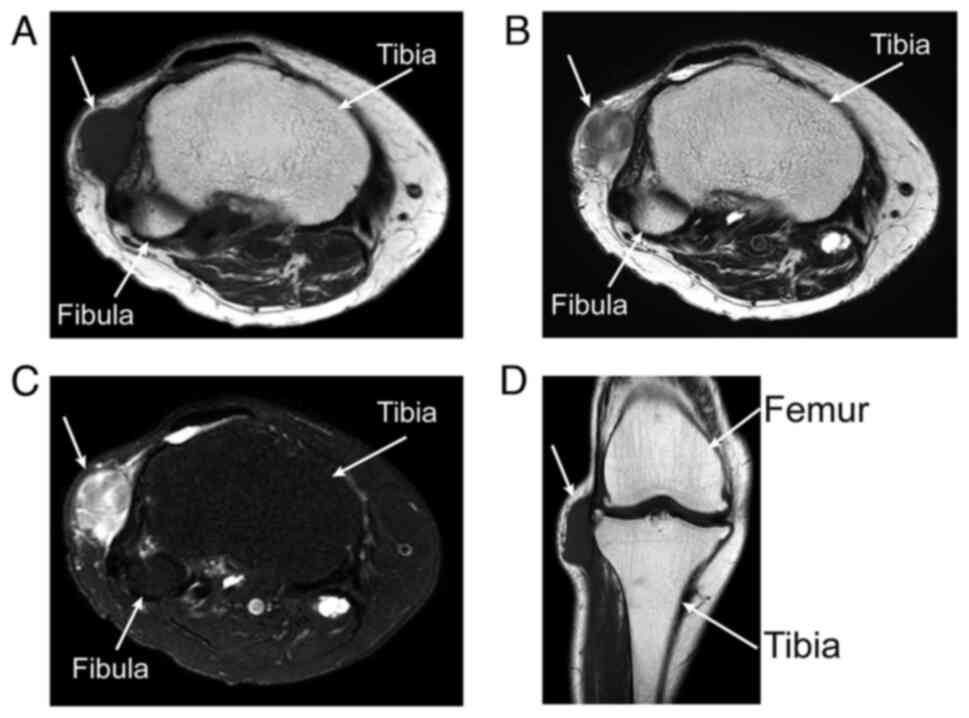
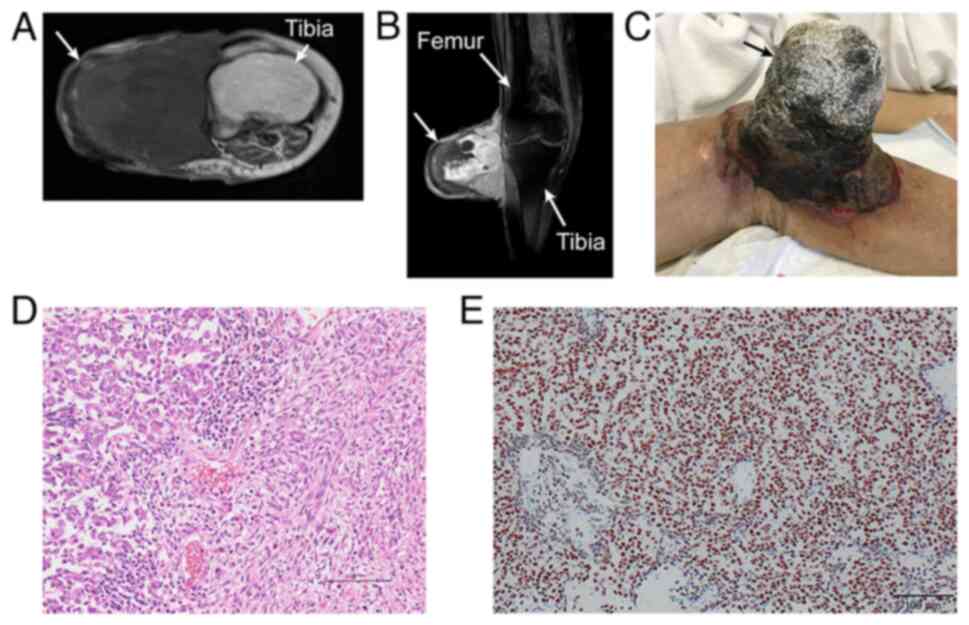
An 83-year-old woman presented to a hospital with a three-month history of a growing mass on the lateral surface of the right knee. Magnetic resonance imaging (MRI) revealed a soft tissue tumor measuring 15x27x30 mm in the subcutis of the right knee (Fig. 1A-D). The patient was referred to University of the Ryukyus Hospital (Nishihara, Japan) for further examination and treatment in July 2020. However, the patient did not visit our institution since she was not experiencing any pain. The size of the mass rapidly increased, and hemorrhage from the tumor occurred two weeks ago. The patient then decided to revisit the initial hospital, where MRI revealed a large tumor measuring 65x73x80 mm (Fig. 2A and B). The patient was referred to our institution again. On admission, she had no knee pain due to the tumor. We applied Mohs paste (13) to the surface of the tumor to control the bleeding (Fig. 2C). Distant pulmonary metastases were not found on chest computed tomography. Subsequently, needle biopsy and histopathological examination revealed biphasic spindle and epithelial cell components by hematoxylin and eosin staining (Fig. 2D). Most of the tumor cells were positive for SS18-SSX fusion-specific antibody (Fig. 2E), and breakaparts of SS18 in the tumor cells were confirmed with fluorescence in situ hybridization (data not shown). The patient was diagnosed with biphasic synovial sarcoma.

Figure 1

Initial magnetic resonance imaging. (A-D) The tumor (arrows) is located on the lateral aspect of the subcutis in the right knee. (A) It has low intensity on the T1-weighted image, (B) heterogenous isointensity and high intensity on the T2-weighted image, and (C) heterogenous isointensity and high intensity on the short tau inversion recovery image. (D) Coronal view on the T1-weighted image.

Figure 2

Preoperative photographs, magnetic resonance images, and histopathological examination. The enlarged tumor measures 65x73x80 mm (arrows). (A) Axial view on the T1-weighted image. (B) Coronal view on the short tau inversion recovery image. (C) A huge mushroom-like tumor on the outside of the right knee; self-destruction is also observed. The white paste is Mohs paste applied to control hemorrhage from the tumor. (D and E) Histopathological examination showing the spindle and epithelial cell components by hematoxylin and eosin staining. The immunohistochemistry satining of the SS18-SSX fusion-specific antibody reveals that most of the tumor cells are positive. Scale bars are 100 µm.

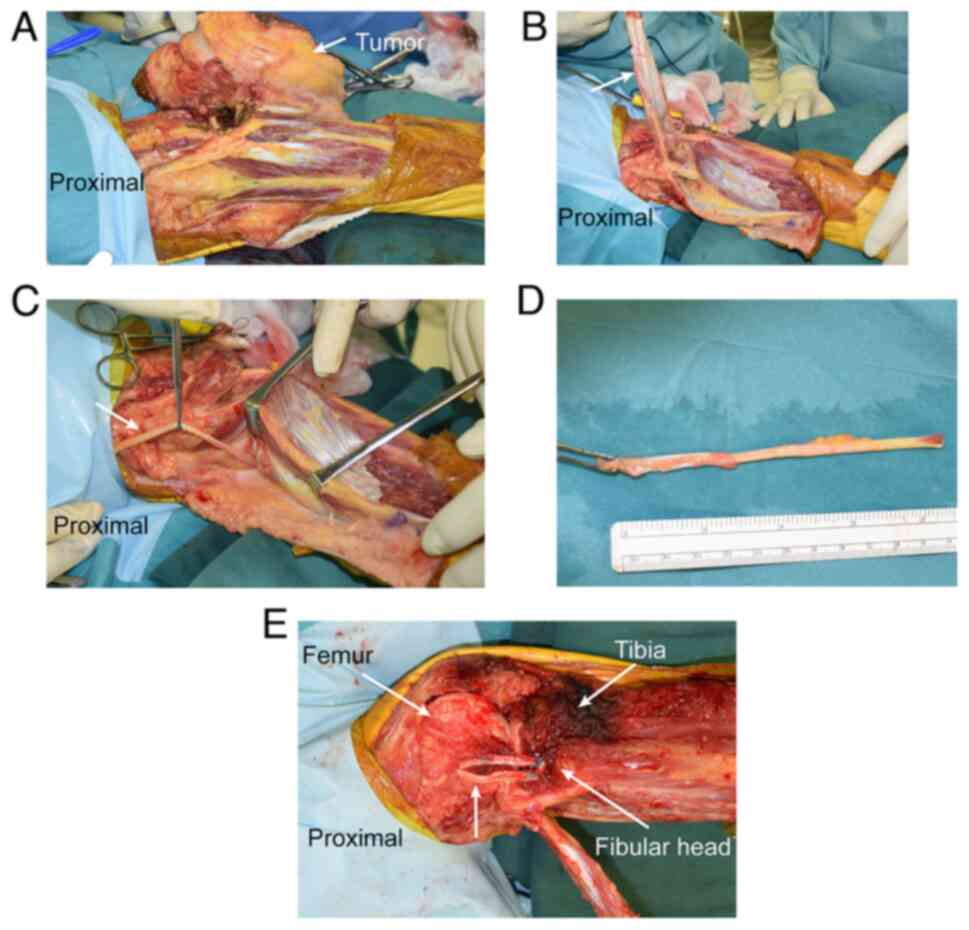
The patient underwent a wide excision and reconstruction of the right knee. The tumor was excised with adequate margins, including the joint capsule, lateral collateral ligament, and fascia of the anterolateral compartment of the lower leg (Fig. 3A). A lateral gastrocnemius flap was elevated to cover the soft tissue defect in the right knee (Fig. 3B). The 11-cm plantaris tendon was harvested for lateral collateral ligament reconstruction (Fig. 3C and D). The double-folded plantaris tendon was attached to the lateral femoral condyle and the head of the fibula using suture anchors with manual maximum tension at 0 degrees of knee extension to reconstruct the lateral collateral ligament (Fig. 3E). Further, the soft tissue defect of the lateral aspect of the right knee was covered with the lateral gastrocnemius flap. The skin defect was covered with an artificial dermis (Terudermis®, ALCARE Co., Ltd., Japan) and continuous negative-pressure wound therapy was applied to it. Postoperatively, the right knee was immobilized with an extended position knee brace for three weeks. The patient was encouraged to walk with the knee brace fixation as much as possible, and range of motion exercises of the knee were allowed three weeks after surgery. The patient was discharged from our hospital two months after surgery. In order to cover the skin defect, split-thickness skin grafting was performed at the initial hospital four months after the primary surgery.

Figure 3

Intraoperative photographs. (A) Wide excision with an adequate margin including the joint capsule, lateral collateral ligament, and fascia of the anterolateral compartment of the lower leg. (B) The lateral gastrocnemius flap (arrow) is elevated to cover the soft tissue defect in the right knee. (C and D) The plantaris tendon (arrow) is harvested for lateral collateral ligament reconstruction. (E) the double-folded plantaris tendon (arrow) is attached with suture anchors to reconstruct the lateral collateral ligament.

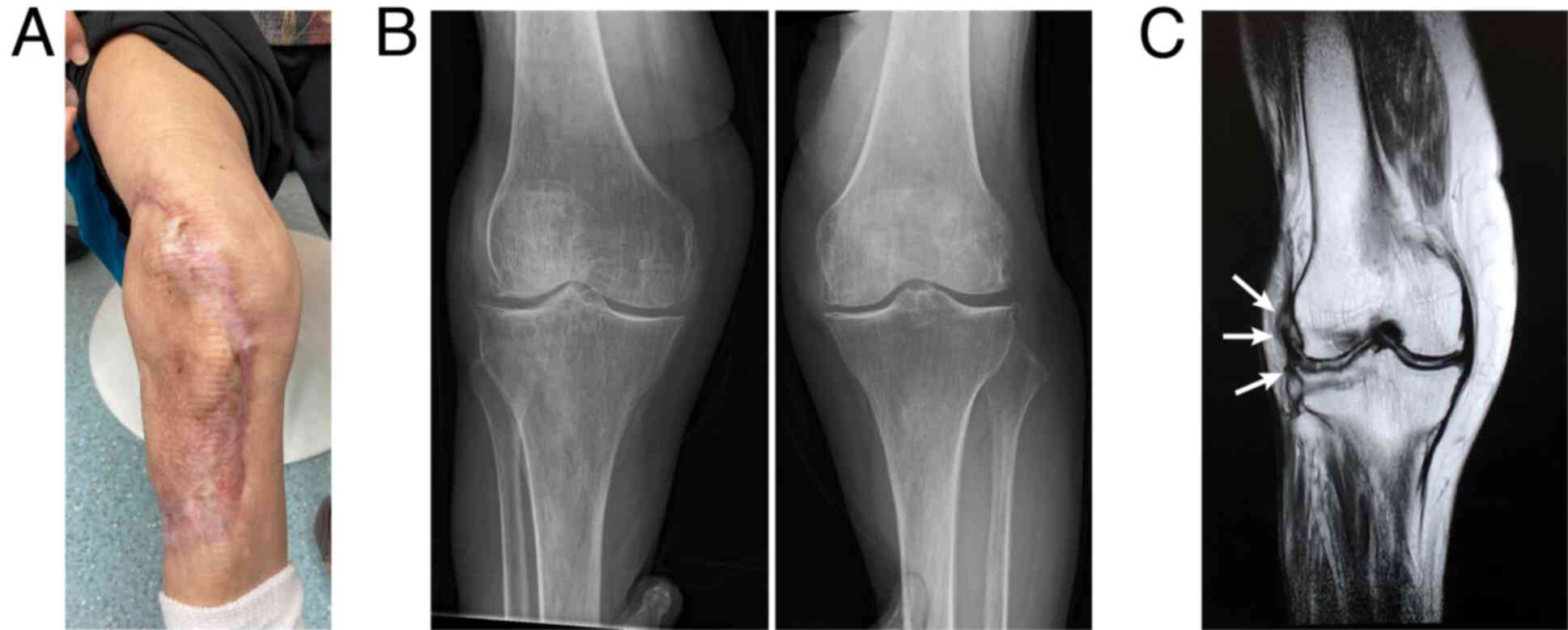
At the 24-month follow-up, the patient could walk using a T-cane without the lateral thrust of the right knee. Joint space narrowing and osteophytes were found, but no lateral instabilities of the right or left knee were found on varus stress radiographs of the knee (Fig. 4A and B). She had no complications from the plantaris tendon harvesting. The range of motion of the right knee was measured from 110˚ in flexion to 0˚. The patient had a Musculoskeletal Tumor Society (MSTS) score of 86%, and MRI revealed survival of the grafted plantaris tendon (Fig. 4C). No recurrence or distant metastases were observed at the latest follow-up.

Figure 4

Postoperative photographs and magnetic resonance images. (A) Postoperative appearance. (B) Postoperative radiographs. Joint space narrowing, and osteophytes, but no lateral instability is shown with firm endpoints on the varus stress test of the right knee (left) as well as the left knee (right). (C) Postoperative magnetic resonance image of the coronal view on the T2-weighted image. Survival of the grafted plantaris tendon (arrows) is seen. No recurrence is found 24 months after the primary surgery.

Discussion

We successfully reconstructed the lateral collateral ligament of the knee using the plantaris tendon after wide excision of a soft tissue sarcoma. Moreover, the soft tissue defect was covered with a lateral gastrocnemius flap and artificial dermis. Subsequently, the skin defect was covered with a skin graft.

Various types of grafts have been reported to be used for the reconstruction of the lateral collateral ligament of the knee, including gracilis and biceps femoris grafts (5), semitendinosus grafts (6), quadriceps tendon-patellar bone autografts (7), and bone-tendon-bone grafts (1). These tendons were advantageous for the reconstruction of collateral knee ligaments due to their biomechanical strength. The disadvantages of harvesting the above-mentioned tendons wee not well-described (1,5-7). However, the disadvantage of harvesting major tendons may be the potential risk of causing functional impairments. One study reported the utilization of a bone-tendon-bone graft for the reconstruction of the collateral ligament of the knee after the resection of soft tissue sarcomas (1). In the study, reconstruction of the medial and lateral collateral ligaments was performed in three separate cases. Knee stability was achieved without any complications in all cases.

We used the plantaris tendon for the reconstruction of the lateral collateral ligament of the knee in this case. In a cadaveric study, 9% of the examined limbs lacked the plantaris tendon (14). Several reports have revealed that ultrasonography was helpful to confirm the presence of the plantaris tendon (15,16). Biomechanically, the single-strand plantaris tendon has a much lower ultimate load compared to the peroneus longus and Achilles tendons due to the plantaris tendon's small cross-sectional area (17). However, the biomechanical properties of the double-folded plantaris tendon are comparable to those of the original medial patellofemoral ligament, and thus the plantaris tendon may be suitable for medial patellofemoral ligament reconstruction (9). The plantaris tendon displays excellent biomechanical properties for anterolateral ligament (ALL) reconstruction (18). After using a double-folded plantaris tendon in ALL reconstruction, during anterior cruciate ligament (ACL) repair, patients were able to perform normal rehabilitation without any restrictions. Despite the evidence for the use of the plantaris tendon in reconstructive surgery, there is a lack of literature on its use in collateral ligament reconstruction for soft tissue tumor surgery. In this study, the plantaris tendon was used for the reconstruction of the lateral collateral ligament of the knee following the wide excision of a malignant soft tissue sarcoma.

Reconstruction using the plantaris tendon has some advantages. First, the functional loss of the knee is minimized if the plantaris tendon is harvested. Second, harvesting the plantaris tendon is straightforward when the gastrocnemius flap is elevated to cover the soft tissue defect. To the best of our knowledge, this is the first report of reconstruction of the lateral collateral ligament using the plantaris tendon. The patient was able to walk using a T-cane without the lateral thrust of the knee, and no instabilities of the right knee were observed 24 months after the primary surgery. Although the patient had a favorable MSTS score and satisfactory knee function, the patient required careful long-term follow-up for the tumor and knee function. In conclusion, reconstruction of the lateral collateral ligament using the plantaris tendon may be useful for preserving the function of the knee joint after resection of soft tissue sarcoma of the knee.

Acknowledgements

The authors would like to thank Dr. Ryo Katsuki for his data collection at the Okinawa Prefectural Yaeyama Hospital.

Funding

Funding: No funding was received.

Availability of data and materials

All data generated and analyzed during this study are included in this published article.

Authors' contributions

YTs, HO, KM, YTo and KN contributed to conception of this study. YTs, HO and KM contributed to acquisition of data. YTs, YTo, HO, KM and KN wrote and edited the manuscript. YTo and KN conducted revision of the manuscript for important intellectual content. YTo and HO performed the surgery and postoperative management. TT and NW perfrmed the pathological examination/diagnosis and the immunohistochemistry staining of the SS18-SSX fusion-specific antibody. YTs and YTo confirmed the authenticity of all the raw data. All authors read and approved the final manuscript.

Ethics approval and consent to participate

Not applicable.

Patient consent for publication

Written informed consent was obtained from the patient for publication of this case report and any accompanying images.

Competing interests

YTo is on the editorial board for Cancer Diagnosis and Prognosis. KN is on the editorial board of the Journal of Orthopaedic Research and is a board member of the International Society for the Study of Lumbar Spine.

References

1 

Popov P, Barner-Rasmussen I and Tukiainen E: Microvascular flaps and collateral ligament reconstructions for soft tissue sarcomas at the knee joint. Ann Plast Surg. 64:24–27. 2010.PubMed/NCBI View Article : Google Scholar

2 

Abdel MP, Papagelopoulos PJ, Morrey ME, Inwards CY, Wenger DE, Rose PS and Sim FH: Malignant proximal fibular tumors: Surgical management of 112 cases. J Bone Joint Surg Am. 94(e165)2012.PubMed/NCBI View Article : Google Scholar

3 

Zhao SC, Zhang CQ and Zhang CL: Reconstruction of lateral knee joint stability following resection of proximal fibula tumors. Exp Ther Med. 7:405–410. 2014.PubMed/NCBI View Article : Google Scholar

4 

Erler K, Demiralp B, Ozdemir MT and Basbozkurt M: Treatment of proximal fibular tumors with en bloc resection. Knee. 11:489–496. 2004.PubMed/NCBI View Article : Google Scholar

5 

Senevirathna S, Stragier B and Geutjens G: Posterolateral corner reconstruction of the knee using gracilis autograft and biceps femoris. Arthrosc Tech. 11:e741–e753. 2022.PubMed/NCBI View Article : Google Scholar

6 

Buzzi R, Aglietti P, Vena LM and Giron F: Lateral collateral ligament reconstruction using a semitendinosus graft. Knee Surg Sports Traumatol Arthrosc. 12:36–42. 2004.PubMed/NCBI View Article : Google Scholar

7 

Chen CH, Chen WJ and Shih CH: Lateral collateral ligament reconstruction using quadriceps tendon-patellar bone autograft with bioscrew fixation. Arthroscopy. 17:551–554. 2001.PubMed/NCBI View Article : Google Scholar

8 

Vlaic J, Josipovic M, Bohacek I and Jelic M: The plantaris muscle: Too important to be forgotten. A review of evolution, anatomy, clinical implications and biomechanical properties. J Sports Med Phys Fitness. 59:839–845. 2019.PubMed/NCBI View Article : Google Scholar

9 

Vlaic J, Josipovic M, Bohacek I, Pilipovic A, Skavic P, Schauperl Z and Jelic M: Plantaris tendon is valuable graft for the medial patellofemoral ligament reconstruction: A biomechanical study. Knee. 38:212–219. 2022.PubMed/NCBI View Article : Google Scholar

10 

Walther M: Management on chronic lateral ankle instability with an autologous plantaris longus graft. In: Operative Techniques in Foot and Ankle Surgery. Easley ME, Wiesel SW and Albert TJ (eds). Lippincott Williams & Wilkins, a Wolters Kluwer Business, Philadelphia, PA, pp1076-1083, 2021.

11 

Hamid K and Easley ME: Subacute and chronic Achilles tendon disorders and ruptures. In: Operative Techniques in Foot and Ankle Surgery. Easley ME, Wiesel SW and Albert TJ (eds). Lippincott Williams & Wilkins, a Wolters Kluwer Business, Philadelphia, PA, pp1141-1165, 2021.

12 

Lynn TA: Repair of the torn achilles tendon, using the plantaris tendon as a reinforcing membrane. J Bone Joint Surg Am. 48:268–272. 1966.PubMed/NCBI

13 

Mohs FE, Sevringhaus EL and Schmidt ER: Conservative amputation of gangrenous parts by chemosurgery. Ann Surg. 114:274–282. 1941.PubMed/NCBI View Article : Google Scholar

14 

Simpson SL, Hertzog MS and Barja RH: The plantaris tendon graft: An ultrasound study. J Hand Surg Am. 16:708–711. 1991.PubMed/NCBI View Article : Google Scholar

15 

Chang KV, Wu WT and Özçakar L: Ultrasonograpy imaging for the dignosis and guided injection of plantaris tendo strain in a paitnet with tennis leg. Am J Phys Med Rehabil. 97:e60–e61. 2018.PubMed/NCBI View Article : Google Scholar

16 

Hung CY and Chang KV: An uncommon cause of posterior leg pain-ultrasound image of plantaris tendinopathy. J Clin Diagn Res. 10:YJ01–YJ02. 2016.PubMed/NCBI View Article : Google Scholar

17 

Bohnsack M, Sürie B, Kirsch IL and Wülker N: Biomechanical properties of commonly used autogenous transplants in the surgical treatment of chronic lateral ankle instability. Foot Ankle Int. 23:661–664. 2002.PubMed/NCBI View Article : Google Scholar

18 

Josipović M, Vlaić J, Serdar J, Šimunović M, Nizić D, Schauperl Z, Bojanić I and Jelić M: Plantaris tendon: a novel graft for anterolateral ligament reconstruction and additional reinforcement for anterior cruciate ligament autografts in combined reconstructive procedures. Knee Surg Sports Traumatol Arthrosc. 28:2604–2608. 2020.PubMed/NCBI View Article : Google Scholar

Related Articles

  • Abstract
  • View
  • Download
  • Twitter
Copy and paste a formatted citation
Spandidos Publications style
Tsuha Y, Oshiro H, Mizuta K, Tamaki T, Tome Y, Wada N and Nishida K: Reconstruction of the lateral collateral ligament using the plantaris tendon after wide excision of soft tissue sarcoma of the knee: A case report. Mol Clin Oncol 18: 23, 2023.
APA
Tsuha, Y., Oshiro, H., Mizuta, K., Tamaki, T., Tome, Y., Wada, N., & Nishida, K. (2023). Reconstruction of the lateral collateral ligament using the plantaris tendon after wide excision of soft tissue sarcoma of the knee: A case report. Molecular and Clinical Oncology, 18, 23. https://doi.org/10.3892/mco.2023.2619
MLA
Tsuha, Y., Oshiro, H., Mizuta, K., Tamaki, T., Tome, Y., Wada, N., Nishida, K."Reconstruction of the lateral collateral ligament using the plantaris tendon after wide excision of soft tissue sarcoma of the knee: A case report". Molecular and Clinical Oncology 18.3 (2023): 23.
Chicago
Tsuha, Y., Oshiro, H., Mizuta, K., Tamaki, T., Tome, Y., Wada, N., Nishida, K."Reconstruction of the lateral collateral ligament using the plantaris tendon after wide excision of soft tissue sarcoma of the knee: A case report". Molecular and Clinical Oncology 18, no. 3 (2023): 23. https://doi.org/10.3892/mco.2023.2619
Copy and paste a formatted citation
x
Spandidos Publications style
Tsuha Y, Oshiro H, Mizuta K, Tamaki T, Tome Y, Wada N and Nishida K: Reconstruction of the lateral collateral ligament using the plantaris tendon after wide excision of soft tissue sarcoma of the knee: A case report. Mol Clin Oncol 18: 23, 2023.
APA
Tsuha, Y., Oshiro, H., Mizuta, K., Tamaki, T., Tome, Y., Wada, N., & Nishida, K. (2023). Reconstruction of the lateral collateral ligament using the plantaris tendon after wide excision of soft tissue sarcoma of the knee: A case report. Molecular and Clinical Oncology, 18, 23. https://doi.org/10.3892/mco.2023.2619
MLA
Tsuha, Y., Oshiro, H., Mizuta, K., Tamaki, T., Tome, Y., Wada, N., Nishida, K."Reconstruction of the lateral collateral ligament using the plantaris tendon after wide excision of soft tissue sarcoma of the knee: A case report". Molecular and Clinical Oncology 18.3 (2023): 23.
Chicago
Tsuha, Y., Oshiro, H., Mizuta, K., Tamaki, T., Tome, Y., Wada, N., Nishida, K."Reconstruction of the lateral collateral ligament using the plantaris tendon after wide excision of soft tissue sarcoma of the knee: A case report". Molecular and Clinical Oncology 18, no. 3 (2023): 23. https://doi.org/10.3892/mco.2023.2619
Follow us
  • Twitter
  • LinkedIn
  • Facebook
About
  • Spandidos Publications
  • Careers
  • Cookie Policy
  • Privacy Policy
How can we help?
  • Help
  • Live Chat
  • Contact
  • Email to our Support Team