Spandidos Publications Logo
  • About
    • About Spandidos
    • Aims and Scopes
    • Abstracting and Indexing
    • Editorial Policies
    • Reprints and Permissions
    • Job Opportunities
    • Terms and Conditions
    • Contact
  • Journals
    • All Journals
    • Oncology Letters
      • Oncology Letters
      • Information for Authors
      • Editorial Policies
      • Editorial Board
      • Aims and Scope
      • Abstracting and Indexing
      • Bibliographic Information
      • Archive
    • International Journal of Oncology
      • International Journal of Oncology
      • Information for Authors
      • Editorial Policies
      • Editorial Board
      • Aims and Scope
      • Abstracting and Indexing
      • Bibliographic Information
      • Archive
    • Molecular and Clinical Oncology
      • Molecular and Clinical Oncology
      • Information for Authors
      • Editorial Policies
      • Editorial Board
      • Aims and Scope
      • Abstracting and Indexing
      • Bibliographic Information
      • Archive
    • Experimental and Therapeutic Medicine
      • Experimental and Therapeutic Medicine
      • Information for Authors
      • Editorial Policies
      • Editorial Board
      • Aims and Scope
      • Abstracting and Indexing
      • Bibliographic Information
      • Archive
    • International Journal of Molecular Medicine
      • International Journal of Molecular Medicine
      • Information for Authors
      • Editorial Policies
      • Editorial Board
      • Aims and Scope
      • Abstracting and Indexing
      • Bibliographic Information
      • Archive
    • Biomedical Reports
      • Biomedical Reports
      • Information for Authors
      • Editorial Policies
      • Editorial Board
      • Aims and Scope
      • Abstracting and Indexing
      • Bibliographic Information
      • Archive
    • Oncology Reports
      • Oncology Reports
      • Information for Authors
      • Editorial Policies
      • Editorial Board
      • Aims and Scope
      • Abstracting and Indexing
      • Bibliographic Information
      • Archive
    • Molecular Medicine Reports
      • Molecular Medicine Reports
      • Information for Authors
      • Editorial Policies
      • Editorial Board
      • Aims and Scope
      • Abstracting and Indexing
      • Bibliographic Information
      • Archive
    • World Academy of Sciences Journal
      • World Academy of Sciences Journal
      • Information for Authors
      • Editorial Policies
      • Editorial Board
      • Aims and Scope
      • Abstracting and Indexing
      • Bibliographic Information
      • Archive
    • International Journal of Functional Nutrition
      • International Journal of Functional Nutrition
      • Information for Authors
      • Editorial Policies
      • Editorial Board
      • Aims and Scope
      • Abstracting and Indexing
      • Bibliographic Information
      • Archive
    • International Journal of Epigenetics
      • International Journal of Epigenetics
      • Information for Authors
      • Editorial Policies
      • Editorial Board
      • Aims and Scope
      • Abstracting and Indexing
      • Bibliographic Information
      • Archive
    • Medicine International
      • Medicine International
      • Information for Authors
      • Editorial Policies
      • Editorial Board
      • Aims and Scope
      • Abstracting and Indexing
      • Bibliographic Information
      • Archive
  • Articles
  • Information
    • Information for Authors
    • Information for Reviewers
    • Information for Librarians
    • Information for Advertisers
    • Conferences
  • Language Editing
Spandidos Publications Logo
  • About
    • About Spandidos
    • Aims and Scopes
    • Abstracting and Indexing
    • Editorial Policies
    • Reprints and Permissions
    • Job Opportunities
    • Terms and Conditions
    • Contact
  • Journals
    • All Journals
    • Biomedical Reports
      • Information for Authors
      • Editorial Policies
      • Editorial Board
      • Aims and Scope
      • Abstracting and Indexing
      • Bibliographic Information
      • Archive
    • Experimental and Therapeutic Medicine
      • Information for Authors
      • Editorial Policies
      • Editorial Board
      • Aims and Scope
      • Abstracting and Indexing
      • Bibliographic Information
      • Archive
    • International Journal of Epigenetics
      • Information for Authors
      • Editorial Policies
      • Editorial Board
      • Aims and Scope
      • Abstracting and Indexing
      • Bibliographic Information
      • Archive
    • International Journal of Functional Nutrition
      • Information for Authors
      • Editorial Policies
      • Editorial Board
      • Aims and Scope
      • Abstracting and Indexing
      • Bibliographic Information
      • Archive
    • International Journal of Molecular Medicine
      • Information for Authors
      • Editorial Policies
      • Editorial Board
      • Aims and Scope
      • Abstracting and Indexing
      • Bibliographic Information
      • Archive
    • International Journal of Oncology
      • Information for Authors
      • Editorial Policies
      • Editorial Board
      • Aims and Scope
      • Abstracting and Indexing
      • Bibliographic Information
      • Archive
    • Medicine International
      • Information for Authors
      • Editorial Policies
      • Editorial Board
      • Aims and Scope
      • Abstracting and Indexing
      • Bibliographic Information
      • Archive
    • Molecular and Clinical Oncology
      • Information for Authors
      • Editorial Policies
      • Editorial Board
      • Aims and Scope
      • Abstracting and Indexing
      • Bibliographic Information
      • Archive
    • Molecular Medicine Reports
      • Information for Authors
      • Editorial Policies
      • Editorial Board
      • Aims and Scope
      • Abstracting and Indexing
      • Bibliographic Information
      • Archive
    • Oncology Letters
      • Information for Authors
      • Editorial Policies
      • Editorial Board
      • Aims and Scope
      • Abstracting and Indexing
      • Bibliographic Information
      • Archive
    • Oncology Reports
      • Information for Authors
      • Editorial Policies
      • Editorial Board
      • Aims and Scope
      • Abstracting and Indexing
      • Bibliographic Information
      • Archive
    • World Academy of Sciences Journal
      • Information for Authors
      • Editorial Policies
      • Editorial Board
      • Aims and Scope
      • Abstracting and Indexing
      • Bibliographic Information
      • Archive
  • Articles
  • Information
    • For Authors
    • For Reviewers
    • For Librarians
    • For Advertisers
    • Conferences
  • Language Editing
Login Register Submit
  • This site uses cookies
  • You can change your cookie settings at any time by following the instructions in our Cookie Policy. To find out more, you may read our Privacy Policy.

    I agree
Search articles by DOI, keyword, author or affiliation
Search
Advanced Search
presentation
Molecular and Clinical Oncology
Join Editorial Board Propose a Special Issue
Print ISSN: 2049-9450 Online ISSN: 2049-9469
Journal Cover
June-2024 Volume 20 Issue 6

Full Size Image

Sign up for eToc alerts
Recommend to Library

Journals

International Journal of Molecular Medicine

International Journal of Molecular Medicine

International Journal of Molecular Medicine is an international journal devoted to molecular mechanisms of human disease.

International Journal of Oncology

International Journal of Oncology

International Journal of Oncology is an international journal devoted to oncology research and cancer treatment.

Molecular Medicine Reports

Molecular Medicine Reports

Covers molecular medicine topics such as pharmacology, pathology, genetics, neuroscience, infectious diseases, molecular cardiology, and molecular surgery.

Oncology Reports

Oncology Reports

Oncology Reports is an international journal devoted to fundamental and applied research in Oncology.

Experimental and Therapeutic Medicine

Experimental and Therapeutic Medicine

Experimental and Therapeutic Medicine is an international journal devoted to laboratory and clinical medicine.

Oncology Letters

Oncology Letters

Oncology Letters is an international journal devoted to Experimental and Clinical Oncology.

Biomedical Reports

Biomedical Reports

Explores a wide range of biological and medical fields, including pharmacology, genetics, microbiology, neuroscience, and molecular cardiology.

Molecular and Clinical Oncology

Molecular and Clinical Oncology

International journal addressing all aspects of oncology research, from tumorigenesis and oncogenes to chemotherapy and metastasis.

World Academy of Sciences Journal

World Academy of Sciences Journal

Multidisciplinary open-access journal spanning biochemistry, genetics, neuroscience, environmental health, and synthetic biology.

International Journal of Functional Nutrition

International Journal of Functional Nutrition

Open-access journal combining biochemistry, pharmacology, immunology, and genetics to advance health through functional nutrition.

International Journal of Epigenetics

International Journal of Epigenetics

Publishes open-access research on using epigenetics to advance understanding and treatment of human disease.

Medicine International

Medicine International

An International Open Access Journal Devoted to General Medicine.

Journal Cover
June-2024 Volume 20 Issue 6

Full Size Image

Sign up for eToc alerts
Recommend to Library

  • Article
  • Citations
    • Cite This Article
    • Download Citation
    • Create Citation Alert
    • Remove Citation Alert
    • Cited By
  • Similar Articles
    • Related Articles (in Spandidos Publications)
    • Similar Articles (Google Scholar)
    • Similar Articles (PubMed)
  • Download PDF
  • Download XML
  • View XML
Article Open Access

Solitary large malignant lymphoma in the head and neck region

  • Authors:
    • Dae-Neung Lee
    • Dong Hoon Lee
    • Joo Yeon Koo
    • Sang Chul Lim
  • View Affiliations / Copyright

    Affiliations: Department of Otolaryngology‑Head and Neck Surgery, Chonnam National University Medical School and Chonnam National University Hwasun Hospital, Jeonnam 58128, Republic of Korea, Department of Pathology, Chonnam National University Medical School and Chonnam National University Hwasun Hospital, Jeonnam 58128, Republic of Korea
    Copyright: © Lee et al. This is an open access article distributed under the terms of Creative Commons Attribution License.
  • Article Number: 39
    |
    Published online on: April 17, 2024
       https://doi.org/10.3892/mco.2024.2737
  • Expand metrics +
Metrics: Total Views: 0 (Spandidos Publications: | PMC Statistics: )
Metrics: Total PDF Downloads: 0 (Spandidos Publications: | PMC Statistics: )
Cited By (CrossRef): 0 citations Loading Articles...

This article is mentioned in:


Abstract

The present study examined the clinical characteristics of patients with a final diagnosis of solitary large malignant lymphoma of the head and neck after surgery. Between January 2015 and December 2022, 13 patients with a final diagnosis of solitary large malignant lymphoma of the head and neck after surgery were enrolled. The most common symptom of solitary large malignant lymphoma was a neck mass (n=11; 84.6%). The most common sites of the head and neck were neck level II (eight patients), neck level IV (two patients), parotid glands (two patients) and the tongue (two patients). The number of malignant lymphomas was as follows: 11 patients had one large tumor and two patients had two large tumors. The mean tumor size was 4.0±1.3 cm (range; 2.7‑6.8 cm). Among the two patients with two lymphomas, the size of the second neck mass was 3.2 cm in one patient and 2.7 cm in the other patient. The most common type of solitary large malignant lymphoma was diffuse large B‑cell lymphoma (n=6, 46.2%). A total of 12 patients are currently under follow‑up without disease recurrence after treatment completion and one patient diagnosed 1 month ago is currently undergoing radiation therapy. The follow‑up period was 47.3±19.0 months (range; 1‑62 months). The possibility of solitary large malignant lymphoma of the head and neck should be considered. As it is difficult to accurately diagnose solitary large malignant lymphoma before surgery, surgical resection is required for differentiation from other diseases.

Introduction

Neck mass can develop due to infectious, inflammatory, congenital, traumatic, benign, or malignant causes (1). Exclusion of other diseases is essential for the accurate diagnosis of neck mass (1-4).

Lymphoma accounts for 12% of all malignant tumors occurring in the head and neck region and is the third most common malignant tumor after squamous cell carcinoma and thyroid cancer (5). Lymphomas are generally classified into Hodgkin lymphoma and non-Hodgkin lymphoma (1,3,5). Hodgkin lymphoma typically occurs in the lymph nodes of the neck, while non-Hodgkin lymphoma can spread to extranodal sites, including the major salivary glands, paranasal sinuses and Waldeyer ring (1). Non-Hodgkin lymphoma accounts for ~90% of all lymphoma (5). Treatment of malignant lymphoma is very diverse and treatment is only possible with an accurate diagnosis (5,6). Treatment of malignant lymphoma is very diverse and treatment is only possible with an accurate diagnosis (6). The prognosis of patients with early-stage disease was improved compared with that of patients with late-stage disease (5).

In malignant lymphoma, multiple neck masses are one of the most common manifestations (1,4). However, there have been recent cases where a solitary large neck mass was diagnosed as malignant lymphoma on definitive biopsy. Therefore, the present study examined the clinical characteristics of patients with a final diagnosis of solitary large malignant lymphoma in the head and neck region following surgery at a hospital.

Patients and methods

The present study received approval from the Institutional Review Board of Chonnam National University Hwasun Hospital (approval no. CNUHH-2023-021). Patients with a final diagnosis of solitary large malignant lymphoma in the head and neck region after surgery between January 2015 and December 2022 were enrolled. All cases that did not meet this criteria were excluded.

Clinical data obtained from the patients were reviewed, including sex, age, past medical history, symptoms, duration of symptoms, site, number and size of malignant lymphoma, preoperative fine-needle aspiration cytology (FNAC), preoperative diagnosis, final histopathologic results after surgery, postoperative treatment, postoperative complications, current status and follow-up.

One or more radiological examinations, including computed tomography, magnetic resonance imaging and ultrasound, were conducted for all patients before surgery to assess the extent of the lesion and assist with treatment planning. All surgical specimens were confirmed by histopathological examination with immunophenotyping.

Results

The clinical findings of 13 patients with solitary large malignant lymphoma of the head and neck are summarized in w I. Of the 13 patients with solitary large malignant lymphoma, eight were male and five female. The mean age of the patients was 50.7±23.2 years (range; 15-80 years). Examination of past medical history identified three patients with hypertension, one with angina and one with liver cirrhosis.

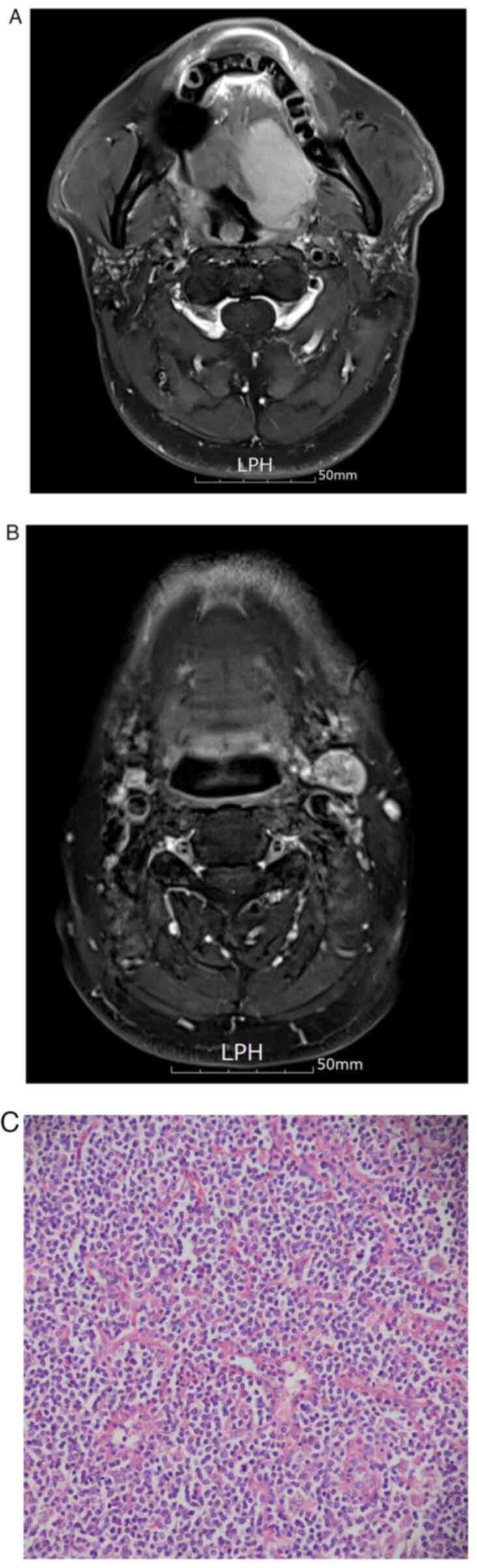
The most common symptom of solitary large malignant lymphoma was a neck mass (n=11; 84.6%). Two patients with malignant lymphoma of the tongue complained of foreign body sensation in the throat (n=1) and coughing (n=1). None complained of B symptoms such as fever, chill and weight loss. The duration of symptoms was 2.4±3.4 months (range; 0.2-12 months). Overall, 6 patients (46.2%) had right-sided malignant lymphoma and seven patients (53.8%) had left-sided malignant lymphoma. The most common sites of solitary large malignant lymphoma in the head and neck region were neck level II in eight patients, neck level IV in two patients, parotid glands in two patients and the tongue in two patients. One patient had masses both on the tongue and at neck level II (Fig. 1).

Figure 1

On magnetic resonance imaging examinations, a 55-year-old male patient presented with huge lymphoma both (A) on the tongue and (B) at neck level II. (C) The final histopathologic biopsy result shows complete architecture effacement without residual follicles. Angioimmunoblastic T-cell lymphoma cells typically exhibit small to intermediate-sized nuclei with mild atypia and clear cytoplasm (hematoxylin and eosin staining; magnification, x400).

The number of malignant lymphomas was as follows: 11 patients had one large tumor and two patients had two large tumors. The mean tumor size was 4.0±1.3 cm (range; 2.7-6.8 cm). Among the two patients with two lymphomas, the size of the second neck mass was 3.2 cm in one patient and 2.7 cm in the other. Preoperative FNAC was performed on 11 patients (84.6%). FNAC results identified four patients with reactive lymphadenitis, three patients with atypical lymphoid lesion, three patients with non-diagnostic results and one patient with poorly differential malignancy. The preoperative diagnosis (based on imaging tests, physical examination and FNAC results) was benign neck mass in seven cases, malignant lymphoma in three cases, parotid tumors in two cases and metastatic carcinoma in one case.

All patients underwent surgical resection under general anesthesia and were diagnosed with malignant lymphoma based on the final histopathologic biopsy. There were no major complications after surgery. The most common type of solitary large malignant lymphoma was diffuse large B-cell lymphoma (n=6; 46.2%), followed by follicular lymphoma (n=3), classic Hodgkin lymphoma (n=2), angioimmunoblastic T-cell lymphoma (n=1) and marginal zone B-cell lymphoma (n=1).

A total of 11 patients (84.6%) received postoperative treatment, including chemotherapy (n=8), radiation therapy (n=2), or both (n =1). The remaining two patients underwent periodic follow-up without any treatment. A total of 12 patients are currently under follow-up without disease recurrence after the completion of treatment and one patient diagnosed 1 month ago is currently undergoing radiation therapy. The follow-up period was 47.3±19.0 months (range; 1-62 months).

Discussion

In the present study, analysis of solitary large malignant lymphoma in the head and neck region demonstrated that neck mass was the most common symptom and mainly occurred at neck level II. Of the 13 patients with malignant lymphoma, 11 of them had a single large neck mass with a mean size of 4.0 cm. The remaining two patients had two neck masses and all four neck masses were larger than 2.7 cm. The most common type of solitary large malignant lymphoma was diffuse large B-cell lymphoma (46.2%).

Although various tests such as FNAC, imaging tests and blood tests were performed, only three patients (23.1%) were diagnosed as having malignant lymphoma before surgery. FNAC is a highly accurate, safe and cost-effective method, which is widely used in initial tests for the histopathological evaluation of neck masses (1). However, it is not recommended for the diagnosis of malignant lymphoma because the tumor tissue architecture cannot be obtained (1,6). Based on the FNAC results of the present study, malignancy was found in only one case and atypical lymphoid lesions were suspected in three cases.

On imaging tests, malignant lymphoma is characterized by a round-shaped morphology with a size of >1 cm and multiple or conglomerate neck lymph nodes (4,7). In the present study, the possibility of malignant lymphoma before surgery was not considered because it mainly appeared as a solitary large neck mass on imaging tests.

Accurate diagnosis and treatment of solitary large malignant lymphoma requires multidisciplinary collaboration (5,6). The histopathologic examination through surgical excision and subtype confirmation through immunophenotyping are essential (1-7). Treatment for malignant lymphoma of the head and neck may include systemic chemotherapy with or without radiation therapy. Immunotherapy, high-dose chemotherapy and stem cell transplant are also treatment options (1,3,5).

All patients survived without recurrence of malignant lymphoma except for one patient who was recently diagnosed and is receiving treatment. In addition, two patients with pediatric-type follicular lymphoma are being followed up without any recurrence and without additional treatment other than surgery.

In summary, a solitary large neck mass should be considered as a differential disease of malignant lymphoma in the head and neck region and histopathologic results obtained through surgical excision could accurately confirm the diagnosis.

The present study has limitations in that the retrospective nature of the study, which may introduce bias in data collection and analysis. Additionally, the reliance on surgical resection for diagnosis may not be feasible in all cases and may limit the applicability of the findings to patients who are not surgical candidates.

The possibility of solitary large malignant lymphoma in the head and neck region should be considered. As it is difficult to accurately diagnose solitary large malignant lymphoma before surgery, surgical resection is required to differentiate it from other diseases.

Acknowledgements

Not applicable.

Funding

Funding: No funding was received.

Availability of data and materials

The data generated in the present study may be requested from the corresponding author.

Authors' contributions

DHL and DNL conducted and designed the research. DHL and DNL confirm the authenticity of all the raw data. DHL and SCL performed the experiments, analyzed data and wrote the paper. DHL, DNL and JYK provided technical support and designed the tables. All authors contributed to the article and all authors read and approved the final manuscript.

Ethics approval and consent to participate

The present study received approval from the Institutional Review Board of Chonnam National University Hwasun Hospital (Jeonnam, Republic of Korea; approval no. CNUHH-2023-021). Informed patient consent was waived due to this being a retrospective study of case records.

Patient consent for publication

Not applicable.

Competing interests

The authors declare that they have no competing interests.

References

1 

Chorath K and Rajasekaran K: Evaluation and management of a neck mass. Med Clin North Am. 105:827–837. 2021.PubMed/NCBI View Article : Google Scholar

2 

Ammar MI, Oeppen RS, Bowles C and Brennan PA: Hard neck lumps: A review of uncommon and sometimes overlooked causes of these worrying presentations. Br J Oral Maxillofac Surg. 55:899–903. 2017.PubMed/NCBI View Article : Google Scholar

3 

Cabeçadas J, Martinez D, Andreasen S, Mikkelsen LH, Molina-Urra R, Hall D, Strojan P, Hellquist H, Bandello F, Rinaldo A, et al: Lymphomas of the head and neck region: An update. Virchows Arch. 474:649–665. 2019.PubMed/NCBI View Article : Google Scholar

4 

Venkitakrishnan R, Paul M, Sleeba T, Abraham L, Joshi M, Augustine J, Ramachandran D, Cleetus M and Vijay A: Expecting the unexpected-primary mediastinal large B cell lymphoma presenting as huge lung parenchymal mass. Respir Med Case Rep. 32(101370)2021.PubMed/NCBI View Article : Google Scholar

5 

Yan S, Ma J, Yang M, Liu B, Li S, Yang L, Zhang Q and Li X: Analysis of the clinicopathologic characteristics and prognosis of head and neck lymphoma. Anal Cell Pathol (Amst). 2022(4936099)2022.PubMed/NCBI View Article : Google Scholar

6 

Gao YH, Xu Q, Wei G, Liu HS, Wu X, Liu LH, Wu LL, Zhao GM and Diao LP: Primary giant lymphoma of the right thigh: A case report and brief review of the literature. Oncol Lett. 4:1023–1026. 2012.PubMed/NCBI View Article : Google Scholar

7 

Payabvash S, Brackett A, Forghani R and Malhotra A: Differentiation of lymphomatous, metastatic, and non-malignant lymphadenopathy in the neck with quantitative diffusion-weighted imaging: Systematic review and meta-analysis. Neuroradiology. 61:897–910. 2019.PubMed/NCBI View Article : Google Scholar

Related Articles

  • Abstract
  • View
  • Download
  • Twitter
Copy and paste a formatted citation
Spandidos Publications style
Lee D, Lee DH, Koo JY and Lim SC: Solitary large malignant lymphoma in the head and neck region. Mol Clin Oncol 20: 39, 2024.
APA
Lee, D., Lee, D.H., Koo, J.Y., & Lim, S.C. (2024). Solitary large malignant lymphoma in the head and neck region. Molecular and Clinical Oncology, 20, 39. https://doi.org/10.3892/mco.2024.2737
MLA
Lee, D., Lee, D. H., Koo, J. Y., Lim, S. C."Solitary large malignant lymphoma in the head and neck region". Molecular and Clinical Oncology 20.6 (2024): 39.
Chicago
Lee, D., Lee, D. H., Koo, J. Y., Lim, S. C."Solitary large malignant lymphoma in the head and neck region". Molecular and Clinical Oncology 20, no. 6 (2024): 39. https://doi.org/10.3892/mco.2024.2737
Copy and paste a formatted citation
x
Spandidos Publications style
Lee D, Lee DH, Koo JY and Lim SC: Solitary large malignant lymphoma in the head and neck region. Mol Clin Oncol 20: 39, 2024.
APA
Lee, D., Lee, D.H., Koo, J.Y., & Lim, S.C. (2024). Solitary large malignant lymphoma in the head and neck region. Molecular and Clinical Oncology, 20, 39. https://doi.org/10.3892/mco.2024.2737
MLA
Lee, D., Lee, D. H., Koo, J. Y., Lim, S. C."Solitary large malignant lymphoma in the head and neck region". Molecular and Clinical Oncology 20.6 (2024): 39.
Chicago
Lee, D., Lee, D. H., Koo, J. Y., Lim, S. C."Solitary large malignant lymphoma in the head and neck region". Molecular and Clinical Oncology 20, no. 6 (2024): 39. https://doi.org/10.3892/mco.2024.2737
Follow us
  • Twitter
  • LinkedIn
  • Facebook
About
  • Spandidos Publications
  • Careers
  • Cookie Policy
  • Privacy Policy
How can we help?
  • Help
  • Live Chat
  • Contact
  • Email to our Support Team