Introduction
As an oral immunomodulatory agent, lenalidomide has
been widely employed in the treatment of hematological
malignancies, including multiple myeloma, light-chain (AL)
amyloidosis, lymphoma and myelodysplastic syndromes. Its principal
mechanisms of action involve the inhibition of tumor cell
proliferation, the enhancement of host immune responses and
modulation of cytokine activity within the bone marrow
microenvironment (1). pure red cell
aplasia (PRCA) is characterized by the selective failure of
erythropoiesis in the bone marrow. Clinically, it manifests as
normocytic, normochromic anemia with a profoundly reduced
reticulocyte count and a marked reduction or the absence of
erythroid precursors, while granulopoiesis and megakaryopoiesis
remain preserved. The etiology of PRCA is heterogeneous,
encompassing viral infections, medications, autoimmune disorders
and malignancies (2). The most
common hematological toxicities associated with the use of
lenalidomide include neutropenia, anemia and thrombocytopenia.
By contrast, lenalidomide-associated PRCA is
exceedingly rare, with only 4 cases reported to date (3-5). Of
these, 3 patients had MM and one had MDS. All developed acute-onset
severe anemia following a period of lenalidomide therapy, and bone
marrow evaluation confirmed PRCA. Each case responded favorably to
cyclosporine treatment, achieving hematologic recovery. The present
study describes a rare case of PRCA arising during lenalidomide
therapy in a patient with POEMS syndrome.
Case report
A 61-year-old woman was diagnosed with POEMS
syndrome at the Department of Hematology, the Third Hospital of
Mianyang (Sichuan, China (in May, 2021. She presented with numbness
and edema of the lower extremities. Initial laboratory tests
revealed the following: A white blood cell count (WBC) of
5.2x10⁹/l, a hemoglobin level of 86 g/l, a platelet
count of 134x109/l, and an absolute reticulocyte count
(RET#) of 109.6x10⁹/l. Serum M-protein was detected at
2.88 g/l, and immunofixation electrophoresis identified a
monoclonal IgA-λ band. A bone marrow smear demonstrated a mildly
increased proportion of plasma cells (3%), and flow cytometry
revealed 0.52% monoclonal plasma cells. An abdominal ultrasound
confirmed splenomegaly, while electromyography revealed axonal
injury involving the motor nerves of the lower limbs.
Following the diagnosis, the patient was initiated
on the RD regimen, consisting of lenalidomide (25 mg, days 1-21)
and dexamethasone (10 mg, days 1-2, 8-9, 15-16 and 22-23).
Following three cycles, her lower-extremity edema and numbness
improved, hemoglobin levels rose to 100 g/l and serum M-protein
became undetectable. However, prior to the fourth cycle, she
developed the sudden worsening of fatigue, accompanied by dizziness
and palpitations. She denied fever, abdominal pain, diarrhea,
nausea, vomiting, jaundice, hematuria or melena.
Repeat laboratory testing revealed the following: A
WBC of 6.07x10⁹/l, a hemoglobin level of 22 g/l, a
platelet count of 63x109/l, and a RET# of
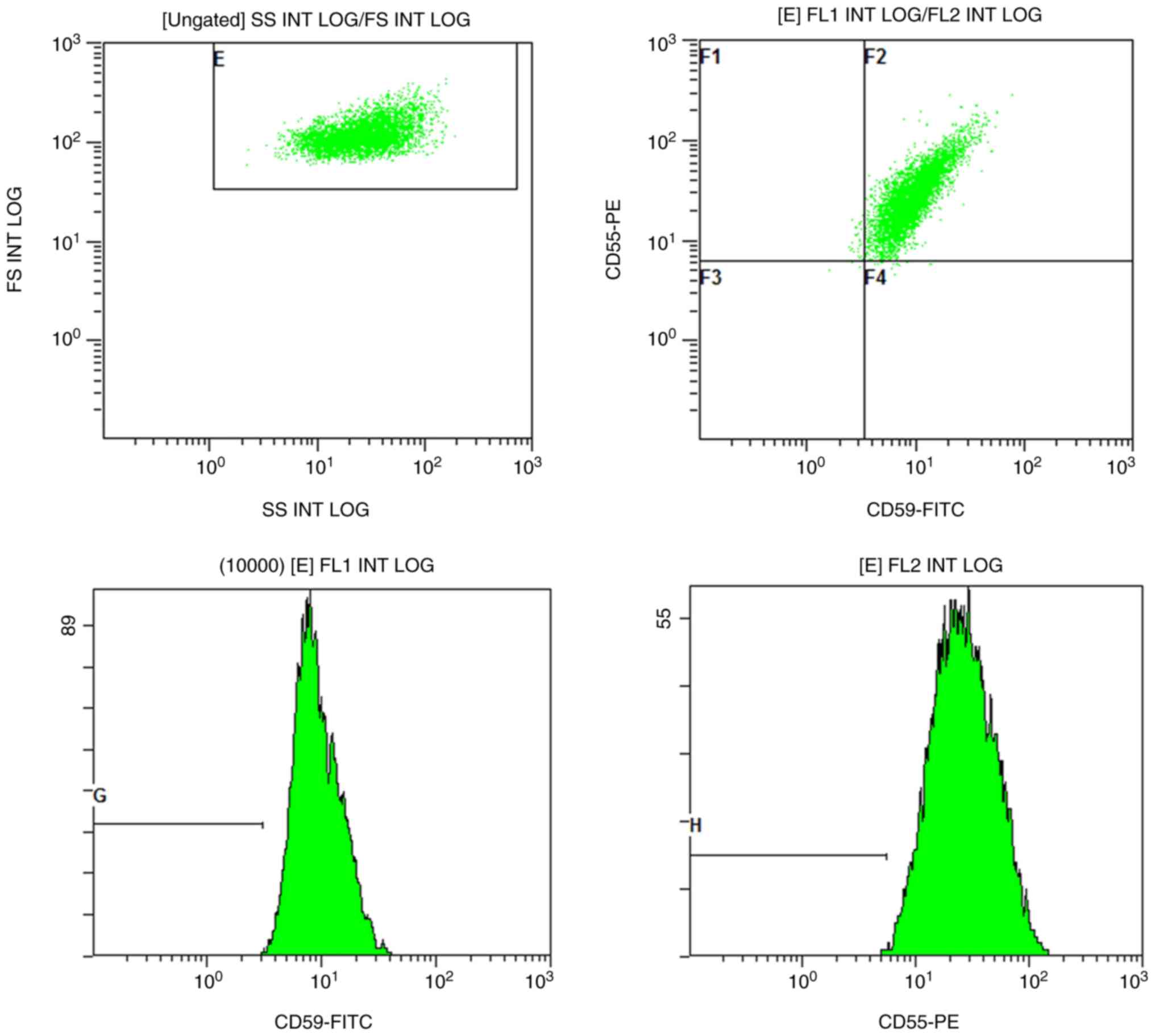
4x10⁹/l. A hemolysis panel was negative, as was the
expression of CD55 and CD59 detected using flow cytometry (the flow
cytometric analysis for CD55 and CD59 expression was not outsourced
to a certified third-party laboratory, KingMed Diagnostics,
Guangzhou, China) (Fig. 1). The
total bilirubin level was 9.6 µmol/l (reference range, 0-20
µmol/l); the autoimmune panel, including ANA, anti-dsDNA and
anti-ENA antibodies was negative. Serum protein electrophoresis and
immunofixation electrophoresis revealed no abnormal monoclonal
bands. Serologies for hepatitis A, B, and C viruses, Epstein-Barr
virus, HIV and parvovirus B19 were negative. The serum ferritin
level was elevated at 2,338 ng/ml, while the levels of serum
folate, vitamin B12 and vascular endothelial growth factor (VEGF)
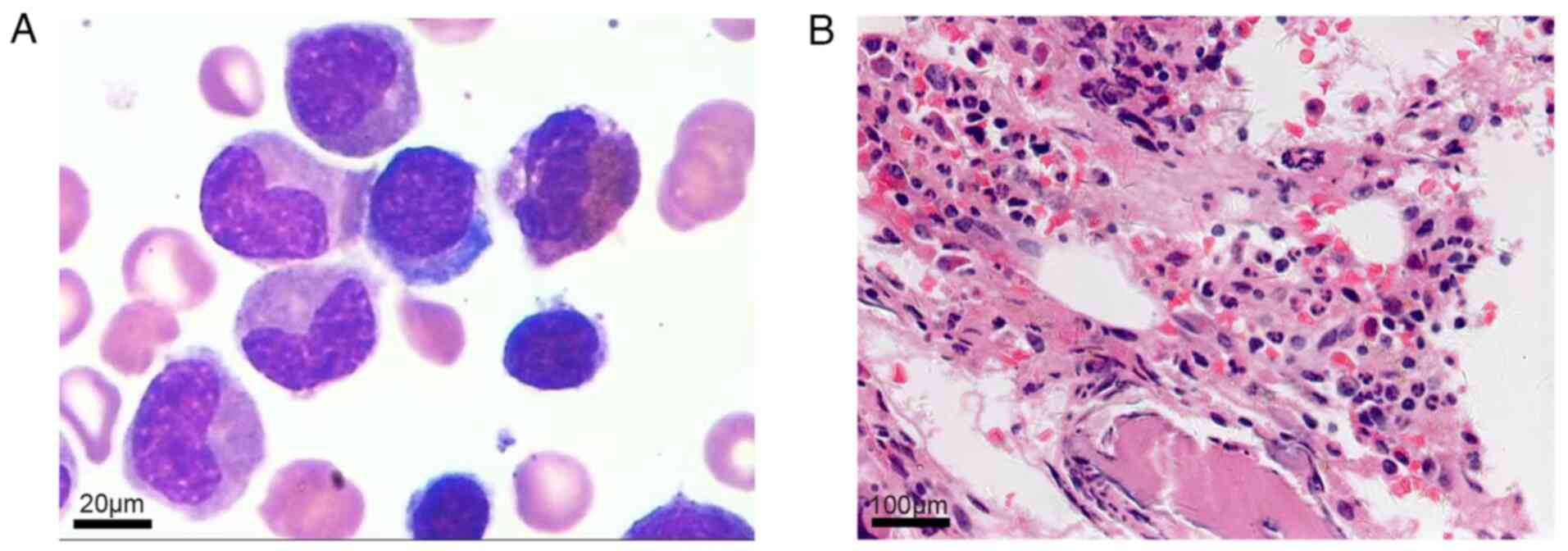
were within normal limits. A bone marrow smear revealed
hypercellularity with granulocytic predominance (64.5%) and the
complete absence of erythroid precursors (Fig. 2A). Fig.
2 illustrates bone marrow smear and bone marrow biopsy sections
stained with Wright-Giemsa and hematoxylin and eosin (H&E),
respectively. The bone marrow smear (Fig. 2A) was prepared and stained at the
Department of Laboratory Medicine, The Third Hospital of Mianyang,
Sichuan Mental Health Center, Sichuan, China. Bone marrow aspirate
smears were air-dried and fixed in absolute methanol for 10 min at
room temperature, followed by staining with Wright-Giemsa solution
(Beijing Solarbio Science & Technology Co., Ltd.) for 15 min
and rinsing in distilled water. The bone marrow biopsy (Fig. 2B) was processed and stained by an
external laboratory, namely KingMed Diagnostics (www.kingmed.com.cn). The specimen was
paraffin-embedded and sectioned at a thickness of 4 µm, fixed in
10% neutral buffered formalin for 24 h at room temperature, and
stained with hematoxylin and eosin according to standard protocols.
Microscopic images were captured using an Olympus BX53 light
microscope (Olympus Corporation). The bone marrow biopsy revealed
hypercellular marrow with marked granulocytic hyperplasia and
severely reduced erythropoiesis (Fig.
2B), confirming the diagnosis of PRCA.
Lenalidomide was discontinued, and the patient was
commenced on immunosuppressive therapy with cyclosporine and
corticosteroids, along with supportive transfusions. Following
stabilization, cyclosporine was continued on an outpatient basis,
while corticosteroids were tapered according to clinical response.
At the 4-month follow-up, the hemoglobin levels had increased to
~110 g/l, and serum M-protein remained undetectable.
Discussion
PRCA is a rare form of anemia characterized by a
marked reduction or complete absence of erythroid precursors in the
bone marrow, leading to severe anemia. PRCA may arise from diverse
etiologies, including viral infections, medications, autoimmune
disorders, and malignancies. The central pathological mechanism
involves immune-mediated destruction of erythroid precursor cells,
encompassing both cellular and humoral immune responses (2). POEMS syndrome is an uncommon
multisystem disorder associated with plasma cell dyscrasia, with an
estimated incidence of <1 per million individuals (6,7).
Although its exact pathogenesis remains incompletely understood,
the disease is closely linked to abnormal plasma cell
proliferation. These plasma cells often secrete lambda light chains
and VEGF, contributing to increased vascular permeability and
multisystem organ dysfunction (8-11).
Other cytokines, such as interleukin (IL)-12, IL-6 and IL-1β, may
also play a role in the disease process (12,13).
The occurrence of PRCA secondary to POEMS syndrome
is exceedingly rare, and the literature on this association is
limited. Some reports suggest that PRCA in this context may be
related to abnormalities in T-cell subsets or the presence of
autoantibodies, both of which can target erythroid progenitors.
Furthermore, patients with POEMS syndrome often demonstrate
elevated levels of VEGF, TNF-α and interferon-γ (IFN-γ), cytokines
that may contribute to erythroid suppression via aberrant immune
activation (7). In addition,
monoclonal gammopathy (M-protein) has been implicated in the
pathogenesis of PRCA. In the study by Korde et al (14) 24% of 51 patients with PRCA were found
to harbor M-protein, and plasma cell-directed therapy led to
remission in these cases. M-proteins may directly bind to erythroid
precursor antigens, thereby inhibiting erythropoiesis, or activate
the complement system, leading to immune-mediated destruction
(14,15). Notably, PRCA associated with POEMS or
M-protein typically occurs early in the disease course and is often
refractory to immunosuppressive therapy. By contrast, the patient
in the present study developed PRCA after achieving hematological
and clinical improvement with lenalidomide. The delayed onset
during disease control, coupled with the responsiveness to
cyclosporine and corticosteroids, argues against POEMS- or
M-protein-related PRCA and supports a drug-related etiology.
Nevertheless, given the established associations between PRCA and
plasma cell dyscrasias, a causal role of POEMS or M-protein cannot
be completely excluded. The temporal sequence, however, suggests
that lenalidomide-induced PRCA is the most plausible explanation in
this case.
Lenalidomide is an oral immunomodulatory agent
widely used in hematological malignancies. Its primary mechanisms
of action include the inhibition of tumor cell proliferation, the
enhancement of host immune responses, and the modulation of
cytokines such as VEGF and TNF-α. It has also demonstrated efficacy
in POEMS syndrome (1,16). Hematological toxicities, however, are
common, most notably neutropenia, anemia and thrombocytopenia. PRCA
is a rare, yet increasingly recognized adverse effect of
lenalidomide. To date, only 4 cases have been reported (Table I): Of these, 3 patients had multiple
myeloma and 1 patient had myelodysplastic syndrome. Consistent with
the case in the present study, all cases exhibited abrupt severe
anemia following exposure to lenalidomide, the analysis of bone
marrow revealed the absence of erythropoiesis, and favorable
responses to cyclosporine therapy. The exact mechanisms of
lenalidomide-associated PRCA remain unclear. Several hypotheses
have been proposed: i) Immunomodulatory effects: Lenalidomide
enhances T-cell and natural killer cell activity. While beneficial
for antitumor immunity, this may lead to the aberrant targeting of
erythroid progenitors. ii) Cytokine dysregulation: Lenalidomide
alters the expression of cytokines, notably IL-2 and IFN-γ, which
are known inhibitors of erythropoiesis (1). iii) MHC class I upregulation: Recently,
Hu et al (5) proposed a novel
mechanism, demonstrating that lenalidomide upregulates MHC-I
expression on erythroid precursors, thereby enhancing
CD8+ T-cell recognition and cytotoxicity. This provides
theoretical support for a ‘drug-immune cross-talk’ model. However,
the evidence is preliminary: Their study involved an in-depth
analysis of only 1 case with an additional validation, without
larger cohorts or controls, precluding estimation of incidence or
relative risk. Moreover, erythroid cells from healthy donors did
not exhibit this phenotype, suggesting that individual
susceptibility is required (5).
Thus, while biologically plausible, these mechanisms remain
speculative and require confirmation in larger cohorts. Therefore,
PRCA induced by lenalidomide is likely the result of a
multifactorial immunologic process. Beyond lenalidomide, other
immunomodulatory drugs (IMiDs), such as thalidomide and
pomalidomide, also exert profound immunomodulatory and
anti-angiogenic effects (17,18).
Reports of severe cytopenias, including anemia and aplastic
presentations, exist with these agents, suggesting that the risk of
profound erythroid suppression may not be unique to lenalidomide.
This raises the possibility of a broader class effect among IMiDs,
although direct PRCA cases remain rare.
 | Table IClinical characteristics of the four
cases of pure red cell aplasia identified in the literature. |
Table I
Clinical characteristics of the four
cases of pure red cell aplasia identified in the literature.
| Patient no. | First author, year of
publication | Sex/age (years) | Underlying
disease | Clinical
presentation | Treatment
regimen | Outcome | (Refs.) |
|---|
| 1 | Ito, 2018 | F/77 | MM | Anemia; erythroid
precursors 0.4% | Cyclosporine | Hemoglobin increased
from 68 to 102 g/l after 1 month | (3) |
| 2 | Ito, 2018 | M/73 | MM | Anemia; erythroid
precursors 3.1% | Cyclosporine | Hemoglobin increased
from 79 to 99 g/l after 1 month; died of underlying disease
progression at 6 months | (3) |
| 3 | Dolai, 2014 | M/47 | MDS | Anemia; erythroid
precursors <5% | Cyclosporine +
prednisone | Hemoglobin returned
to pre-PRCA levels after 2 months | (4) |
| 4 | Hu, 2024 | - | MM | Anemia; erythroid
precursors absent | Cyclosporine | Hemoglobin increased
from 55 to 109 g/l after 5 months | (5) |
In the case in the present study, the patient
developed severe anemia following lenalidomide treatment.
Laboratory tests revealed a markedly reduced reticulocyte count,
and bone marrow examination demonstrated a profound decrease in
erythroid precursors with preserved granulopoiesis and
megakaryopoiesis, consistent with PRCA. Other common causes of PRCA
were excluded, making lenalidomide the most likely etiological
factor. Following the discontinuation of lenalidomide and
initiation of cyclosporine combined with corticosteroids, the
patient's condition stabilized, and hemoglobin levels gradually
returned to normal.
When PRCA arises in the setting of POEMS syndrome or
other M protein-related disorders, it is essential to determine
whether the anemia is secondary to the underlying disease. In such
cases, therapy should primarily target the primary disorder. By
contrast, lenalidomide-associated PRCA requires a different
approach. Recommended strategies include the withdrawal of
lenalidomide, supportive care and the initiation of
immunosuppressive therapy. While some patients may achieve
spontaneous recovery after discontinuing the drug, those with
persistent or severe anemia should receive early immunosuppressive
treatment along with transfusion support. For the underlying
disease, an alternative regimen should be selected to avoid disease
progression.
In conclusion, the present case report highlights a
rare, yet clinically significant complication of lenalidomide
therapy. The pathogenesis appears to involve complex immunologic
processes; however, current evidence remains preliminary. While
lenalidomide-induced PRCA is the most likely explanation in the
patient described herein, the possibility of contribution from
POEMS or M-protein-related mechanisms cannot be completely
excluded. Larger studies incorporating genetic and immunologic
profiling are warranted to clarify predisposition factors, confirm
causality and guide safer therapeutic strategies.
Acknowledgements
Not applicable.
Funding
Funding: The present study was supported by a grant from the
Health Commission of Mianyang, Sichuan Province (grant no.
202208).
Availability of data and materials
The data generated in the present study may be
requested from the corresponding author.
Authors' contributions
MD and QL conceived and designed the study. MD and
XK analyzed and summarized the data of the patient and wrote the
manuscript. JW, WJ and LZ collected the laboratory examination data
and bone marrow examination images of the patient. LL and YZ
participated in the clinical diagnosis and treatment
decision-making of the patient, provided critical guidance on case
management, and contributed to the revision of the manuscript. MD
and QL confirm the authenticity of all the raw data. All authors
have read and approved the final manuscript.
Ethics approval and consent to
participate
This study was conducted in accordance with the
principles expressed in the Declaration of Helsinki. Written
consent was obtained from the patient for her participation in the
present case report.
Patient consent for publication
Written consent was obtained from the patient for
the publication of her data in the present case report.
Competing interests
The authors declare that they have no competing
interests.
References
|
1
|
Chanan-Khan AA and Cheson BD: Lenalidomide
for the treatment of B-cell malignancies. J Clin Oncol.
26:1544–1552. 2008.PubMed/NCBI View Article : Google Scholar
|
|
2
|
Gurnari C and Maciejewski JP: How I manage
acquired pure red cell aplasia in adults. Blood. 137:2001–2009.
2021.PubMed/NCBI View Article : Google Scholar
|
|
3
|
Ito T, Nakaya A, Fujita S, Satake A,
Nakanishi T, Azuma Y, Tsubokura Y, Konishi A, Hotta M, Yoshimura H,
et al: Secondary pure red cell aplasia in multiple myeloma treated
with lenalidomide. Leuk Res Rep. 10:4–6. 2018.PubMed/NCBI View Article : Google Scholar
|
|
4
|
Dolai TK, Dutta S, Mandal PK, Saha S and
Bhattacharyya M: Lenalidomide-induced pure red cell aplasia. Turk J
Haematol. 31:99–100. 2014.PubMed/NCBI View Article : Google Scholar
|
|
5
|
Hu Q, Liu Y, Yue Q, Zhou S, Jin X, Lin F,
Huang XJ, Zhuang J, Lu J, Gao X and Lee HY: Lenalidomide-induced
pure red cell aplasia is associated with elevated expression of
MHC-I molecules on erythrocytes. Nat Commun.
15(10131)2024.PubMed/NCBI View Article : Google Scholar
|
|
6
|
Li J and Zhou DB: New advances in the
diagnosis and treatment of POEMS syndrome. Br J Haematol.
161:303–315. 2013.PubMed/NCBI View Article : Google Scholar
|
|
7
|
Dispenzieri A: POEMS syndrome: Update on
diagnosis, risk-stratification, and management. Am J Hematol.
98:1934–1950. 2023.PubMed/NCBI View Article : Google Scholar
|
|
8
|
Nishi J, Arimura K, Utsunomiya A, Yonezawa
S, Kawakami K, Maeno N, Ijichi O, Ikarimoto N, Nakata M, Kitajima
I, et al: Expression of vascular endothelial growth factor in sera
and lymph nodes of the plasma cell type of Castleman's disease. Br
J Haematol. 104:482–485. 1999.PubMed/NCBI View Article : Google Scholar
|
|
9
|
Mineta M, Hatori M, Sano H, Hosaka M,
Kokubun S, Hiroki E, Hatakeyama A and Ogasawara T: Recurrent
Crow-Fukase syndrome associated with increased serum levels of
vascular endothelial growth factor: A case report and review of the
literature. Tohoku J Exp Med. 210:269–277. 2006.PubMed/NCBI View Article : Google Scholar
|
|
10
|
Kanai K, Kuwabara S, Misawa S and Hattori
T: Failure of treatment with anti-VEGF monoclonal antibody for
long-standing POEMS syndrome. Intern Med. 46:311–313.
2007.PubMed/NCBI View Article : Google Scholar
|
|
11
|
Sekiguchi Y, Misawa S, Shibuya K, Nasu S,
Mitsuma S, Iwai Y, Beppu M, Sawai S, Ito S, Hirano S, et al:
Ambiguous effects of anti-VEGF monoclonal antibody (bevacizumab)
for POEMS syndrome. J Neurol Neurosurg Psychiatry. 84:1346–1348.
2013.PubMed/NCBI View Article : Google Scholar
|
|
12
|
Soubrier M, Dubost JJ, Serre AF, Ristori
JM, Sauvezie B, Cathebras P, Piette JC, Chapman A, Authier FJ and
Gherardi RK: Growth factors in POEMS syndrome: Evidence for a
marked increase in circulating vascular endothelial growth factor.
Arthritis Rheum. 40:786–787. 1997.PubMed/NCBI View Article : Google Scholar
|
|
13
|
Kanai K, Sawai S, Sogawa K, Mori M, Misawa
S, Shibuya K, Isose S, Fujimaki Y, Noto Y, Sekiguchi Y, et al:
Markedly upregulated serum interleukin-12 as a novel biomarker in
POEMS syndrome. Neurology. 79:575–582. 2012.PubMed/NCBI View Article : Google Scholar
|
|
14
|
Korde N, Zhang Y, Loeliger K, Poon A,
Simakova O, Zingone A, Costello R, Childs R, Noel P, Silver S, et
al: Monoclonal gammopathy-associated pure red cell aplasia. Br J
Haematol. 173:876–883. 2016.PubMed/NCBI View Article : Google Scholar
|
|
15
|
Verma R: Molecular pathways engaged by
immunomodulatory agents in monoclonal gammopathy-associated pure
red cell aplasia rescue. Front Oncol. 10(1490)2020.PubMed/NCBI View Article : Google Scholar
|
|
16
|
Li J, Huang XF, Cai QQ, Wang C, Cai H,
Zhao H, Zhang L, Cao XX, Gale RP and Zhou DB: A prospective phase
II study of low dose lenalidomide plus dexamethasone in patients
with newly diagnosed polyneuropathy, organomegaly, endocrinopathy,
monoclonal gammopathy, and skin changes (POEMS) syndrome. Am J
Hematol. 93:803–809. 2018.PubMed/NCBI View Article : Google Scholar
|
|
17
|
Franks ME, Macpherson GR and Figg WD:
Thalidomide. Lancet. 363:1802–1811. 2004.PubMed/NCBI View Article : Google Scholar
|
|
18
|
Lacy MQ and McCurdy AR: Pomalidomide.
Blood. 122:2305–2309. 2013.PubMed/NCBI View Article : Google Scholar
|