Introduction
Knee osteoarthritis, the most common type of
osteoarthritis, is a chronic degeneration of the articular
cartilage around a joint. This disease commonly affects individuals
over 45 years of age but has been identified in all age groups. In
a previous study, the prevalence of knee osteoarthritis was
identified as 12.2% and was significantly higher in females (14.9%)
than in males (8.7%). Prevalence was revealed to increase with age
(1). A variety of risk factors
have been correlated with knee osteoarthritis: age, obesity, female
gender, trauma, repetitive knee trauma, muscle weakness, joint
laxity, mechanical forces, kneeling, squatting and miniscal
injuries (2,3). In addition, various genetic
polymorphisms may be associated with knee osteoarthritis (4).
Previous studies have demonstrated that growth
differentiation factor 5 (GDF 5), a member of the transforming
growth factor-β (TGF-β) superfamily, is important in
musculoskeletal processes, affecting endochondral ossification,
synovial joint and bone formation (5,6). The
+104T/C polymorphism (rs143383) in the 5′ untranslated region (UTR)
of GDF5 affects transcriptional activity in the GDF5 gene core
promoter and transcriptional activity was found to be reduced in
subjects carrying the T allele (6). An association between the +104T/C
polymorphism and knee osteoarthritis was previously demonstrated
(7–12). However, published results have been
inconsistent. In this study, we performed a meta-analysis to
investigate whether or not the +104T/C polymorphism is associated
with knee osteoarthritis risk.
Materials and methods
Selection of studies
Data were independently gathered in duplicate by two
investigators on the basis of a standard protocol. Discrepancies
were settled by discussion until a consensus was reached. A
literature search was conducted for studies that examined
associations between the +104T/C polymorphism and knee
osteoarthritis. A search was performed on PubMed, Google Scholar
and the China National Knowledge Infrastructure database using the
following keywords: ‘5′-UTR or GDF5’, ‘+104T/C polymorphism or
genotype’ and ‘knee osteoarthritis’.
Selection criteria
To be eligible for inclusion in this meta-analysis,
the following criteria were established: i) case-control study that
addressed knee osteoarthritis cases and healthy controls; ii)
studies that evaluated the association between +104T/C polymorphism
and knee osteoarthritis risk; iii) studies that included sufficient
genotype data for extraction; and iv) the genotype distribution
among the control population in Hardy-Weinberg equilibrium
(HWE).
Data extraction
The following information was extracted from the
eligible studies: i) first author; ii) year of publication; iii)
country; iv) ethnicity; v) sample size of subjects with and without
CAD; vi) genotype distribution of subjects with and without knee
osteoarthritis; and vii) P-value for HWE test in subjects without
knee osteoarthritis.
Statistical analysis
Crude odds ratios (ORs) with 95% confidence
intervals (CIs) were calculated to estimate the strength of
correlation between the +104T/C polymorphism and knee
osteoarthritis risk. The pooled ORs were performed under a
homozygote comparison (TT vs. CC), a heterozygote comparison (TT
vs. TC), a dominant model (CC+TC vs. TT) and a recessive model
(TT+TC vs. CC). In addition, we conducted a stratification analysis
in Asian and European individuals to explore and explain diversity
among the results of various studies (7). We tested whether genotype frequencies
of controls were in HWE using the Chi-square test. Q- and
I2 tests were performed to evaluate whether the
variation was due to heterogeneity or chance. If heterogeneity was
identified among the studies (I2<50%), the pooled OR
was estimated by the fixed-effects model. Otherwise, the
random-effects model was used to estimate the pooled OR.
Sensitivity analysis was performed through the random-effects model
values compared with the fixed-effects to ensure the stability of
the results. Publication bias was assessed by Begg's test
(P<0.05 was considered to indicate a statistically significant
difference). Analyses were performed using STATA version 12.0
(Stata Corporation, College Station, TX, USA). All P-values were
two-sided.
Results
Characteristics of studies
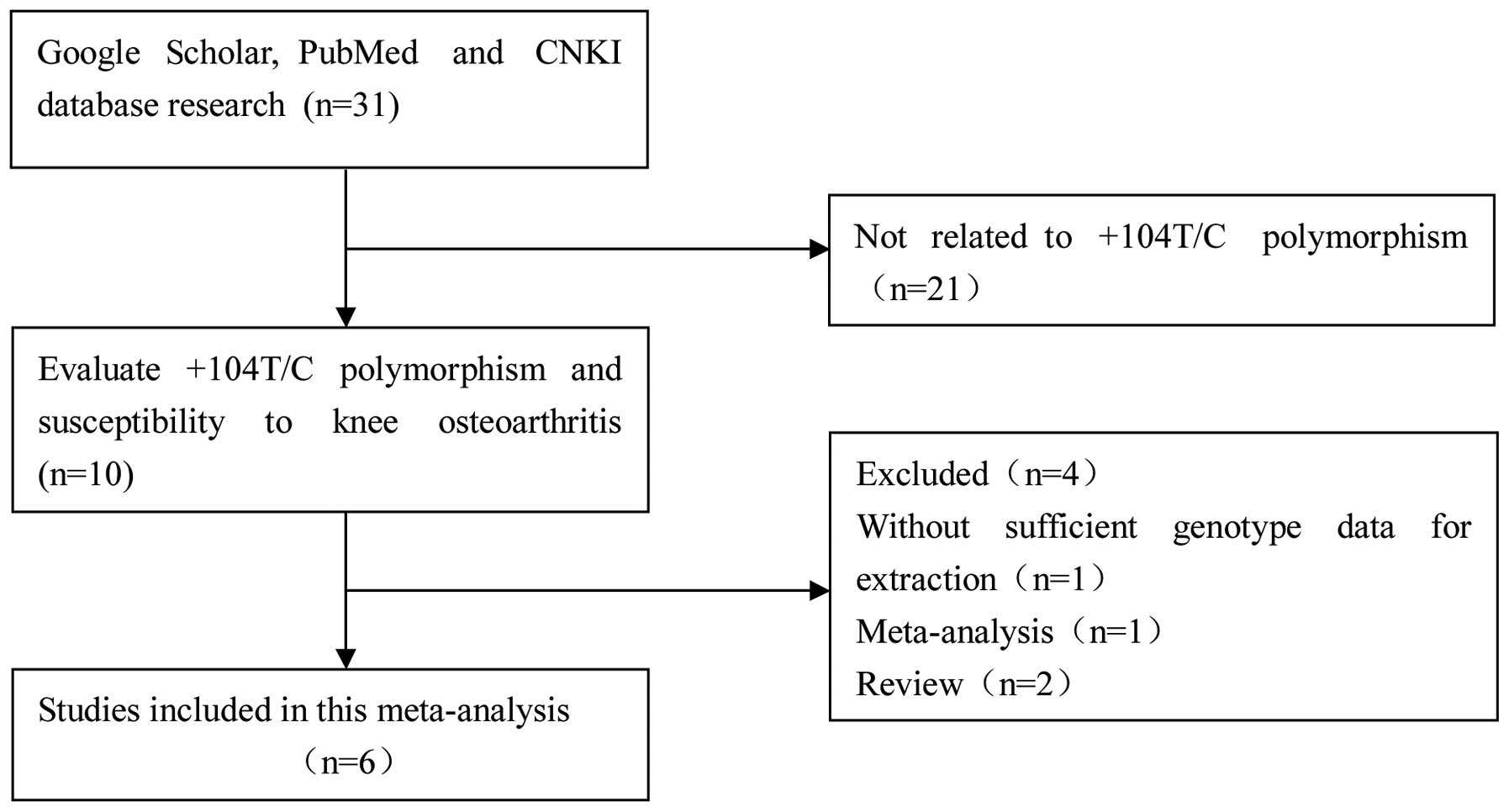
A total of 33 studies were obtained by the
literature search, among which 6 fit the inclusion criteria
(8–13). The flowchart of reviews
demonstrates the detailed process of selection (Fig. 1). Of the 25 excluded studies, 21
were not associated with +104T/C polymorphism, 1 did not have
sufficient genotype data for extraction, 1 was a meta-analysis and
2 were reviews. Data were collected from 2,744 knee osteoarthritis
patients and 4,518 controls. Genotype distributions among the
controls of all included studies were consistent with HWE. The 6
included studies contained 8 population studies of 5 Asian and 3
Caucasian groups. Information from these studies and the number of
cases and controls with TT, TC and CC genotypes reported in each
are shown in Table I.
 | Table ICharacteristics of the included
studies for meta-analysis. |
Table I
Characteristics of the included
studies for meta-analysis.
| Study included | Year | Area | Ethnicity | Cases/controls | Genotypes for
cases | Genotypes for
controls | HWE test |
|---|
|
|
|---|
| TT | TC | CC | TT | TC | CC |
|---|
| Miyamoto et
al(8) | 2007 | China | Asians | 313/485 | 197 | 97 | 19 | 244 | 193 | 48 | 0.28 |
| Miyamoto et
al(8) | 2007 | Japan | Asians | 718/861 | 44 | 243 | 31 | 473 | 330 | 58 | 0.97 |
| Southam et
al(9) | 2007 | UK | Caucasians | 509/822 | 219 | 238 | 52 | 324 | 372 | 126 | 0.26 |
| Southam et
al(9) | 2007 | Spain | Caucasians | 274/1196 | 102 | 136 | 36 | 439 | 563 | 194 | 0.55 |
| Tsezou et
al(10) | 2008 | Greece | Caucasians | 251/268 | 95 | 126 | 30 | 99 | 125 | 44 | 0.67 |
| Yao et
al(11) | 2008 | China | Asians | 298/452 | 189 | 93 | 16 | 232 | 182 | 38 | 0.78 |
| Zhang et
al(12) | 2010 | Korea | Asians | 276/298 | 150 | 115 | 11 | 159 | 113 | 26 | 0.36 |
| Tawonsawatruk et
al(13) | 2011 | Thailand | Asians | 90/103 | 38 | 41 | 11 | 33 | 47 | 23 | 0.42 |
Results of meta-analysis
A summary of the meta-analysis findings of the
association between +104T/C polymorphism and knee osteoarthritis
risk is shown in Table II.
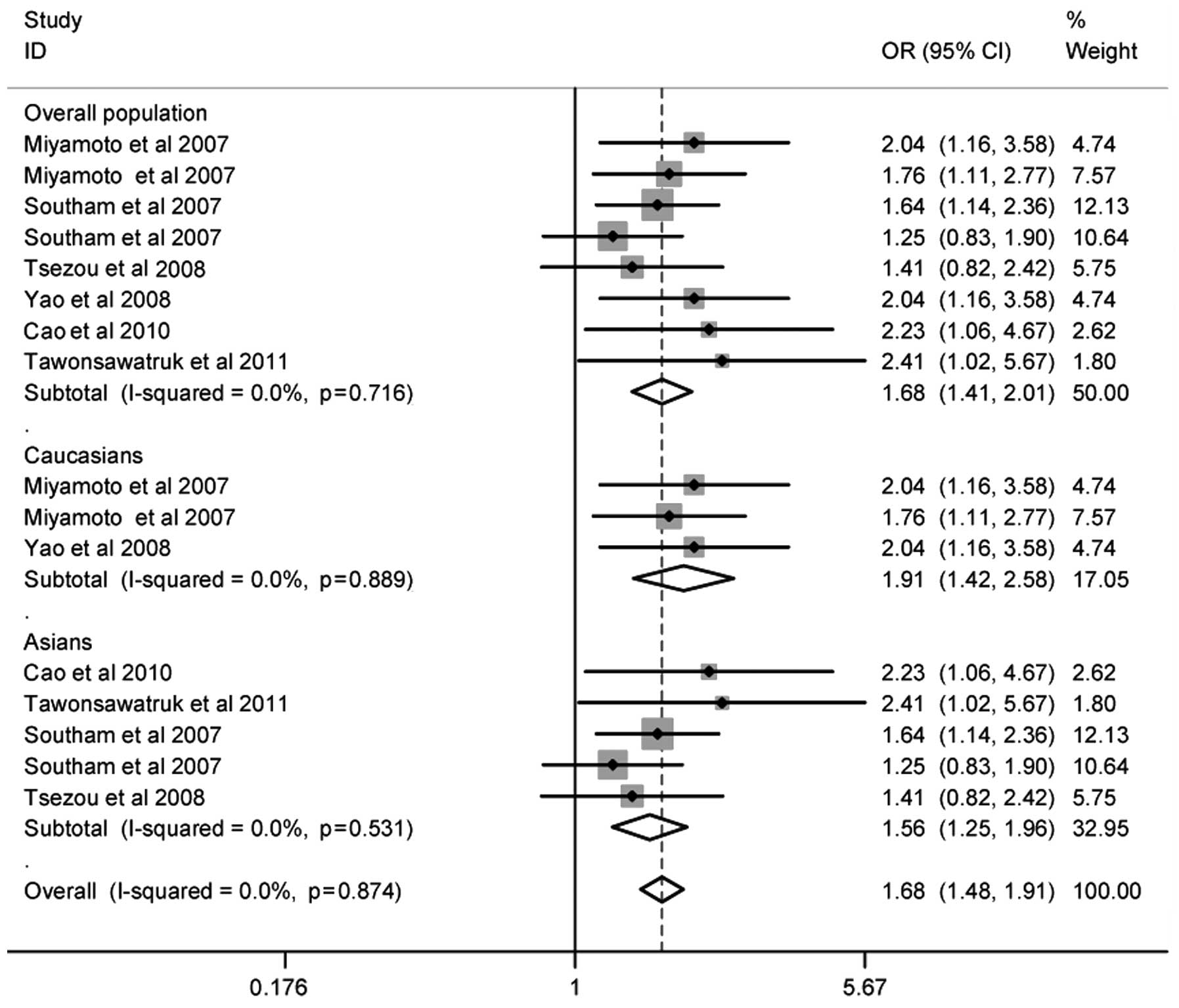
Overall, we found a significant association of +104T/C polymorphism
with knee osteoarthritis risk (TT vs. CC: OR 1.68, 95%
CI=1.41–2.01; TT vs. TC: OR 1.18, 95% CI=1.01–1.38; dominant model:
OR 0.72, 95% CI=0.61–0.86). In the subgroup analysis based on
ethnicity, studies were divided into Caucasian and Asian
populations. The same association was observed in the Caucasian (TT
vs. CC: OR 1.45, 95% CI=1.13–1.85) and Asian (TT vs. CC: OR 1.99,
95% CI=1.53–2.60; TT vs. TC: OR 1.33, 95% CI=1.16–1.52; dominant
model: OR 0.64, 95% CI=0.56–0.72; recessive model: OR 1.77, 95%
CI=1.37–2.29) groups. Sensitivity analysis was performed through
random-effects model values compared with the fixed-effects, the
results of which indicated no statistically significant difference,
rendering the values of meta-analysis valid (TT vs. CC: OR 1.68,
95% CI=1.40–2.01; TT vs. TC: OR 1.19, 95% CI=1.07–1.32; dominant
model: OR 0.74, 95% CI=0.67–0.81; recessive model: OR 0.28, 95%
CI=0.25–0.32). Publication bias of the studies was assessed using
the funnel plot and Begg's test. Publication bias was not observed
in the funnel plot (all P>0.05, Table II and Fig 2).
| Table IISummary ORs and 95% CIs of the +104T/C
polymorphism and knee osteoarthritis risk. |
Table II
Summary ORs and 95% CIs of the +104T/C
polymorphism and knee osteoarthritis risk.
| Subgroup | Genetic model | Sample size | Type of model | Test of
heterogeneity | Test of
association | Test of publication
bias |
|---|
|
|
|
|
|---|
| Case | Control | I2
(%) | P-value | OR | 95% CI | z | P-value |
|---|
| Overall | TT vs. CC | 2744 | 4518 | Fixed | 0.0 | 0.71 | 1.68 | 1.41–2.01 | 1.95 | 0.05 |
| TT vs. TC | | | Random | 51.2 | 0.05 | 1.18 | 1.01–1.38 | 1.95 | 0.05 |
| Dominant model | | | Random | 63.6 | 0.01 | 0.72 | 0.61–0.86 | 1.95 | 0.05 |
| Recessive model | | | Random | 99.0 | 0.00 | 1.05 | 0.23–4.72 | 1.95 | 0.05 |
| Caucasian | TT vs. CC | 1034 | 2286 | Fixed | 0.0 | 0.63 | 1.45 | 1.13–1.85 | 0.00 | 1.00 |
| TT vs. TC | | | Fixed | 0.0 | 0.84 | 1.00 | 0.85–1.18 | 0.00 | 1.00 |
| Dominant model | | | Fixed | 0.0 | 0.75 | 0.92 | 0.79–1.07 | 0.00 | 1.00 |
| Recessive model | | | Random | 99.4 | 0.00 | 0.41 | 0.03–6.20 | 0.00 | 1.00 |
| Asian | TT vs. CC | 1710 | 2232 | Fixed | 0.0 | 0.95 | 1.99 | 1.53–2.60 | 1.36 | 0.17 |
| TT vs. TC | | | Fixed | 45.4 | 0.12 | 1.33 | 1.16–1.52 | 1.36 | 0.17 |
| Dominant model | | | Fixed | 30.7 | 0.22 | 0.64 | 0.56–0.72 | 1.36 | 0.17 |
| Recessive model | | | Fixed | 0.0 | 0.93 | 1.77 | 1.37–2.29 | 1.36 | 0.17 |
Discussion
The association of genetic polymorphism and knee
osteoarthritis has recently attracted growing attention. Miyamoto
et al were the first study group to investigate the
association between +104T/C polymorphism in the 5′-UTR of GDF5 and
knee osteoarthritis in Asians. The results showed a significant
correlation between +104T/C polymorphism and knee osteoarthritis
risk in Japanese and Chinese populations. More recent studies have
confirmed this correlation between +104T/C polymorphism and
susceptibility to knee osteoarthritis. However, a number of studies
have also demonstrated a conflicting correlation. In the present
study, we quantitatively assessed the correlation between +104T/C
polymorphism and knee osteoarthritis risk. Six studies were
included with a total of 2,744 knee osteoarthritis patients and
4,518 controls. Overall, a significant correlation was observed
between the +104T/C polymorphism and knee osteoarthritis risk in
Caucasian (TT vs. CC: OR 1.45, 95% CI=1.13–1.85) and Asian (TT vs.
CC: OR 1.99, 95% CI=1.53–2.60; TT vs. TC: OR 1.33, 95%
CI=1.16–1.52; dominant model: OR 0.64, 95% CI=0.56–0.72; recessive
model: OR 1.77, 95% CI=1.37–2.29) individuals. No evidence was
found for publication bias in this meta-analysis for the +104T/C
polymorphism. As the eligible study number was limited in the
meta-analysis, these results require further investigation.
The mechanistic correlation between the +104T/C
polymorphism and knee osteoarthritis risk remains unclear. GDF5 is
involved in articular cartilage development, regeneration and
maintenance and is a specific marker for synovial joints of
appendicular skeletons (14). The
+104T/C polymorphism regulates transcriptional activity in the GDF5
gene core promoter and the T allele reveals reduced transcriptional
activity, this SNP may be the biological basis for the alteration
in function (8). This evidence
suggests that the +104T/C polymorphism is important in the
development of knee osteoarthritis.
Several potential limitations of the present study
should be noted. First, the results may be affected by additional
confounding factors, including gender and age. We were unable to
perform gender- and age-related subgroup analyses due to incomplete
data. Second, the effect of genetic and environmental interactions
was not addressed in our meta-analysis. Third, the number of
studies and subjects in the studies included in the meta-analysis
by specific subgroups was small. Therefore, additional studies with
larger sample sizes are required.
In conclusion, the present study indicates that
+104T/C polymorphism in the 5′-UTR of GDF5 is associated with risk
of knee osteoarthritis. However, further studies of gene-gene and
gene-environment interactions should be taken into consideration to
investigate this correlation.
References
|
1
|
Quintana JM, Arostegui I, Escobar A, et
al: Prevalence of knee and hip osteoarthritis and the
appropriateness of joint replacement in an older population. Arch
Intern Med. 168:1576–1584. 2008. View Article : Google Scholar : PubMed/NCBI
|
|
2
|
Lementowski PW and Zelicof SB: Obesity and
osteoarthritis. Am J Orthop (Belle Mead NJ). 37:148–151. 2008.
|
|
3
|
Reid CR, Bush PM, Cummings NH, McMullin DL
and Durrani SK: A review of occupational knee disorders. J Occup
Rehabil. 20:489–501. 2010. View Article : Google Scholar : PubMed/NCBI
|
|
4
|
Valdes AM, Loughlin J, Timms KM, et al:
Genome-wide association scan identifies a
prostaglandin-endoperoxide synthase 2 variant involved in risk of
knee osteoarthritis. Am J Hum Genet. 82:1231–1240. 2008. View Article : Google Scholar : PubMed/NCBI
|
|
5
|
Nishitoh H, Ichijo H, Kimura M, et al:
Identification of type I and type II serine/threonine kinase
receptors for growth/differentiation factor-5. J Biol Chem.
271:21345–21352. 1996. View Article : Google Scholar : PubMed/NCBI
|
|
6
|
Mikic B, Battaglia TC, Taylor EA, et al:
The effect of growth/differentiation factor-5 deficiency on femoral
composition and mechanical behavior in mice. Bone. 30:733–737.
2002. View Article : Google Scholar : PubMed/NCBI
|
|
7
|
Ding DL, Liu SJ and Zhu HZ: Association
between the CCR2-Val64Ile polymorphism and susceptibility to HIV-1
infection: a meta-analysis. Mol Med Rep. 4:181–186. 2011.PubMed/NCBI
|
|
8
|
Miyamoto Y, Mabuchi A, Shi D, et al: A
functional polymorphism in the 5′ UTR of GDF5 is associated with
susceptibility to osteoarthritis. Nat Genet. 39:529–533. 2007.
|
|
9
|
Southam L, Rodriguez-Lopez J, Wilkins JM,
et al: An SNP in the 5′-UTR of GDF5 is associated with
osteoarthritis susceptibility in Europeans and with in vivo
differences in allelic expression in articular cartilage. Hum Mol
Genet. 16:2226–2232. 2007.
|
|
10
|
Tsezou A, Satra M, Oikonomou P, Bargiotas
K and Malizos KN: The growth differentiation factor 5 (GDF5) core
promoter polymorphism is not associated with knee osteoarthritis in
the Greek population. J Orthop Res. 26:136–140. 2008. View Article : Google Scholar : PubMed/NCBI
|
|
11
|
Yao C, Dai J and Qin JH: A single nucleid
polymorphisms (SNP) in the 5′UTR of GDF5 is associated with knee
osteoarthritis. Jiangsu Med J. 12:1198–1199. 2008.(In Chinese).
|
|
12
|
Cao Z, Lee HS, Song JH, et al: Growth
differentiation factor 5 (GDF5) core promoter polymorphism is not
associated with susceptibility to osteoarthritis of the knee in the
Korean population. Korean J Pathol. 44:404–409. 2010. View Article : Google Scholar
|
|
13
|
Tawonsawatruk T, Changthong T,
Pingsuthiwong S, et al: A genetic association study between growth
differentiation factor 5 (GDF 5) polymorphism and knee
osteoarthritis in Thai population. J Orthop Surg Res. 6:472011.
View Article : Google Scholar : PubMed/NCBI
|
|
14
|
Storm EE, Huynh TV, Copeland NG, et al:
Limb alterations in brachypodism mice due to mutations in a new
member of the TGF beta-superfamily. Nature. 368:639–643. 1994.
View Article : Google Scholar : PubMed/NCBI
|