Introduction
Prostate cancer is a malignant disease that
originates in the prostate gland, and it is the second most
commonly observed disease of the male reproductive system (1). The incidence of prostate cancer
increase with age and there are clear regional differences
(2–4), for example the incidence is higher in
the US and Europe compared with Asia (5,6). It
has been reported that prostate cancer is the second most common
cause of cancer-related mortality among males, with a high
mortality rate (7). In China, the
incidence is lower in younger males, however, the mortality rate is
strongly associated with age, with the highest mortality rates
observed in older males (8,9).
With the rise in the number of older individuals in China, the
number of mortalities associated with prostate cancer has increased
in recent years (8–10).
Berberine is a quaternary ammonium salt and a member
of the protoberberine group of isoquinoline alkaloids. It is an
important ingredient with biological properties in Chinese medicine
(11,12). It is predominantly found in the
roots, rhizomes, stems and bark of a number of medicinal plants,
including Mahonia aquifolium (Oregon grape),
Phellodendron amurense (Amur cork tree), Berberis
aristata (tree turmeric), Hydrastis canadensis
(goldenseal), Coptis chinensis (Chinese goldthread),
Tinospora cordifolia and Eschscholzia californica
(Californian poppy). Berberine has a strong inhibitory effect on
growth and replication in a variety of microorganisms (13,14).
Berberine has primarily been used in early clinical trials to treat
intestinal infections or diarrhea (15,16).
In addition, it has been found that berberine has an important role
in lowering blood pressure in the treatment of cardiovascular
disease and diabetes (17–19).
Recently, in vivo and in vitro
evidence has shown that berberine has potent anti-inflammatory and
antitumor effects; however, its mechanism of action has yet to be
clarified (20–23). In the present study, the antitumor
effects of berberine were explored and the underlying mechanisms
were investigated in PC3 human and RM-1 mouse prostate cancer cell
lines.
Material and methods
Cells and reagents
PC3 human and RM-1 mouse prostate cancer cell lines
were obtained from American Type Culture Collection (Manassas, VA,
USA) and cultured in Dulbecco’s modified Eagle’s medium
supplemented with 10% fetal calf serum (Hyclone Corporation, South
Logan, UT, USA). Berberine and MTT were purchased from
Sigma-Aldrich (St. Louis, MO, USA). The purity of berberine was
≥98% and it was dissolved in dimethyl sulfoxide
(Sigma-Aldrich).
MTT assay
The cells were cultured in Dulbecco’s modified
Eagle’s medium supplemented with 10% fetal calf serum in an
atmosphere of 5% CO2. When the cell density reached
~70%, different concentrations of berberine were added to treat the
cells. In one group, the prostate cancer cells were incubated with
5, 10, 20 or 50 μM berberine for 24 h, while in the other group,
the cells were incubated with 10 μM berberine for 24, 48 or 72 h.
The survival rate of the cells was then measured via an MTT assay
as previously described (24,25).
The 96-well plates containing the cells were read on a microplate
reader (Thermo Scientific, Rockford, IL, USA) with a test
wavelength of 490 nm and a reference wavelength of 570 nm.
Flow cytometric analysis
The levels of apoptosis of the PC3 cells were tested
by Annexin V/propidium iodide (PI) dual staining according to the
manufacturer’s instructions (Santa Cruz Biotechnology Inc., Santa
Cruz, CA, USA). Briefly, the cells were washed in
phosphate-buffered saline and treated with different concentrations
of berberine (10 and 50 μM)for 24 or 48 h followed by resuspension
in a binding buffer (10 mM HEPES-NaOH pH 7.4; 25 mM
CaCl2 and 144 mM NaCl). Subsequently, Annexin V (0.1
μg/μl) and PI (0.05 μg/μl) staining dyes were added and the cells
were incubated in the dark for 30 min on ice. The cells were then
subjected to fluorescence-activated cell sorting (FACS) analysis;
the samples were tested by the BD FACSCalibur Cell Sorting system
(BD Biosciences, San Jose, CA, USA).
Statistical analysis
SPSS statistical package version 11.5 (SPSS, Inc.,
Chicago, IL, USA) was used to analyze the data. All experiments
were performed at least three times and results are presented as
the mean ± standard error of the mean. P<0.01 was considered to
indicate a statistically significant difference.
Results
Antitumor effects of berberine on
prostate cancer cells increase with concentration
In order to explore whether berberine exhibited
antitumor effects on prostate cancer cells, the PC3 human and RM-1
mouse prostate cancer cell lines were used as cellular models. The
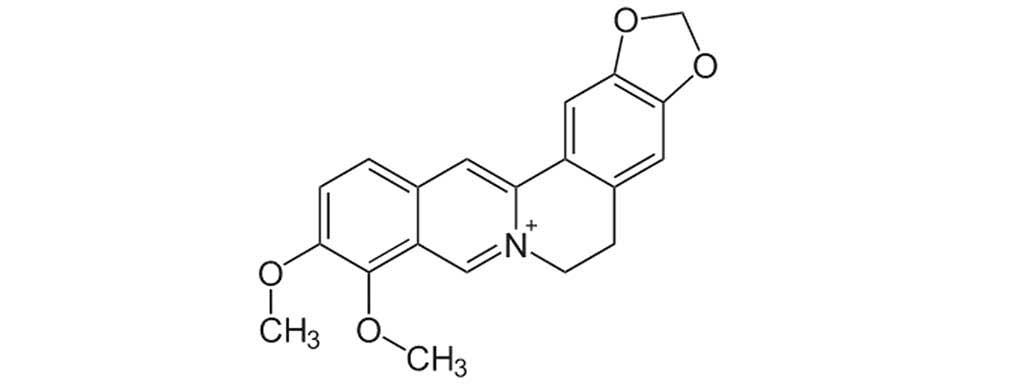
structure of berberine is shown in Fig. 1. Different concentrations of
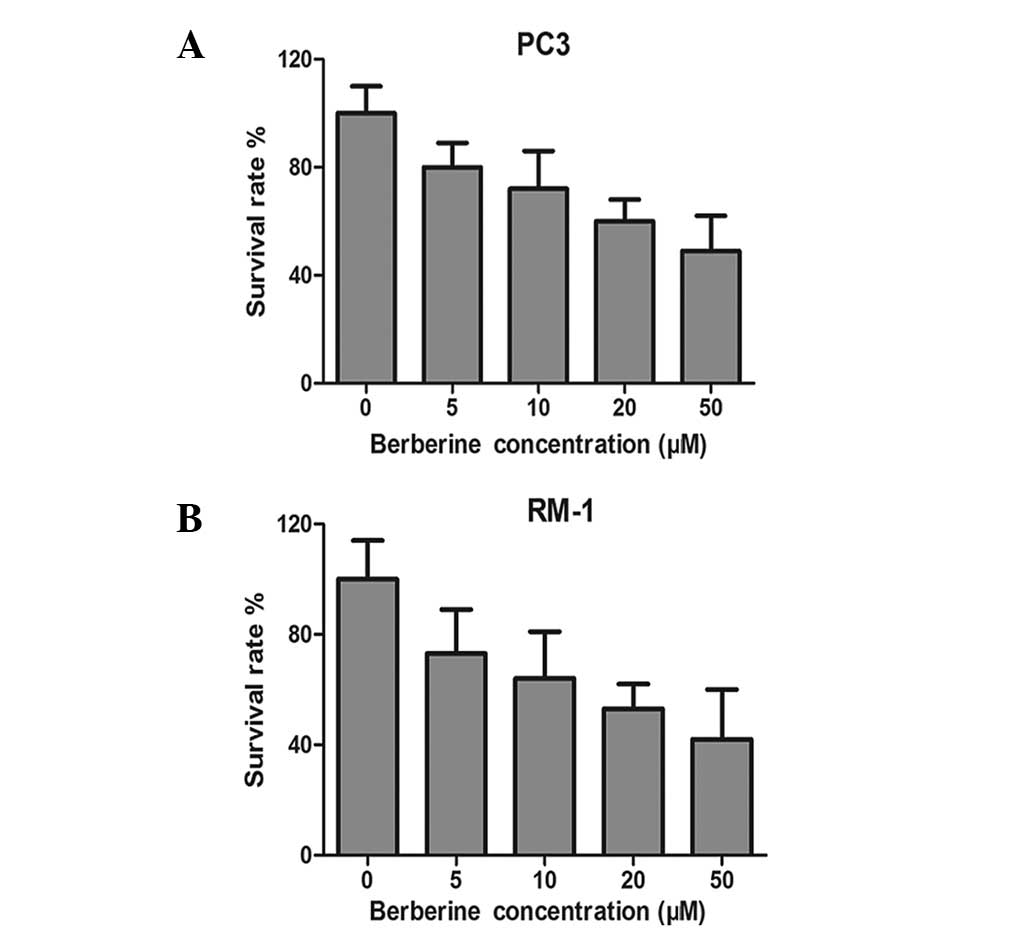
berberine were used to treat PC3 and RM-1 cells for 24 h. As shown
in Fig. 2, the survival rates of
PC3 and RM-1 cells as detected by an MTT assay were markedly
reduced when treated with increasing concentrations of berberine.
The results demonstrated that berberine has an antitumor effect and
that the inhibitory effects increased in a concentration-dependent
manner.
Berberine kills prostate cancer cells in
a time-dependent manner
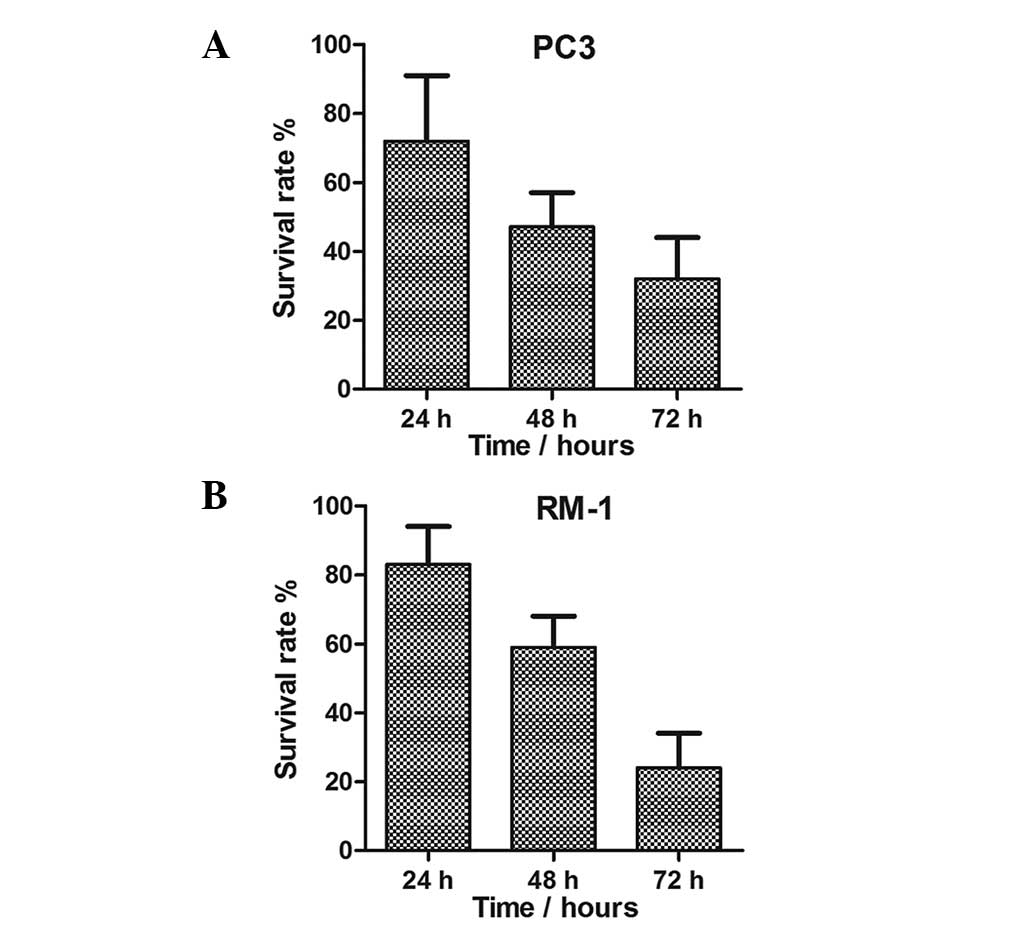
The PC3 and RM-1 cells were treated for different
times with berberine at a concentration of 10 μM. The MTT assay
(Fig. 3) revealed that the
survival rate of prostate cancer cells was decreased in a
time-dependent manner. Here, untreated cells were used as negative
controls and all of the samples were analyzed in duplicates.
Berberine induces the apoptosis of human
prostate cancer PC3 cells
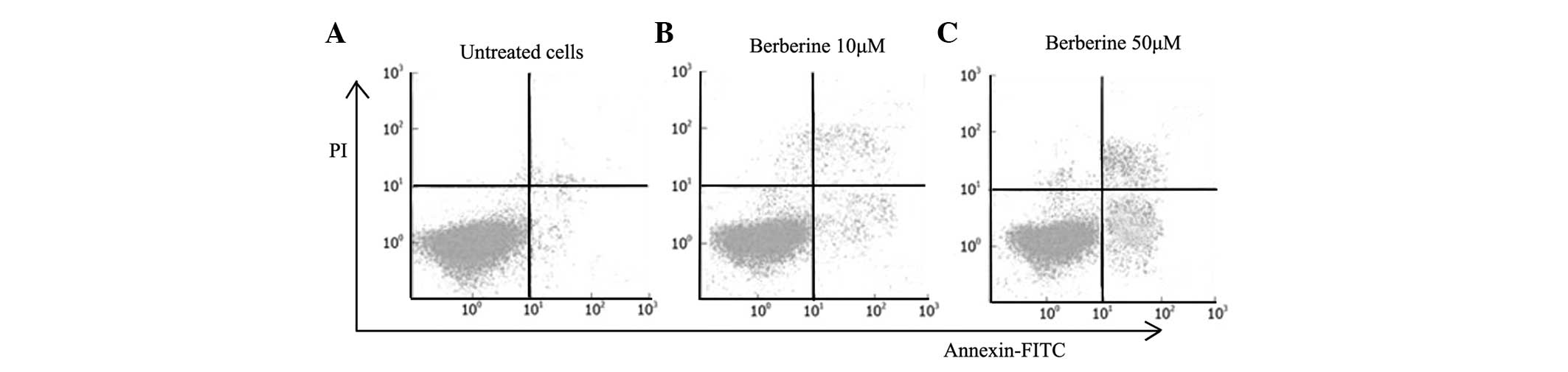
PC3 human prostate cancer cells were treated with 10
μM or 50 μM berberine for 24 h. As shown in Fig. 4, the apoptosis rates of the PC3
cells treated with berberine were significantly higher compared
with those of the untreated cells, and the apoptosis rate increased
in a concentration-dependent manner.
Berberine induces cell-cycle arrest in
the G0/G1 and G2/M phases
In order to elucidate the mechanism underlying the
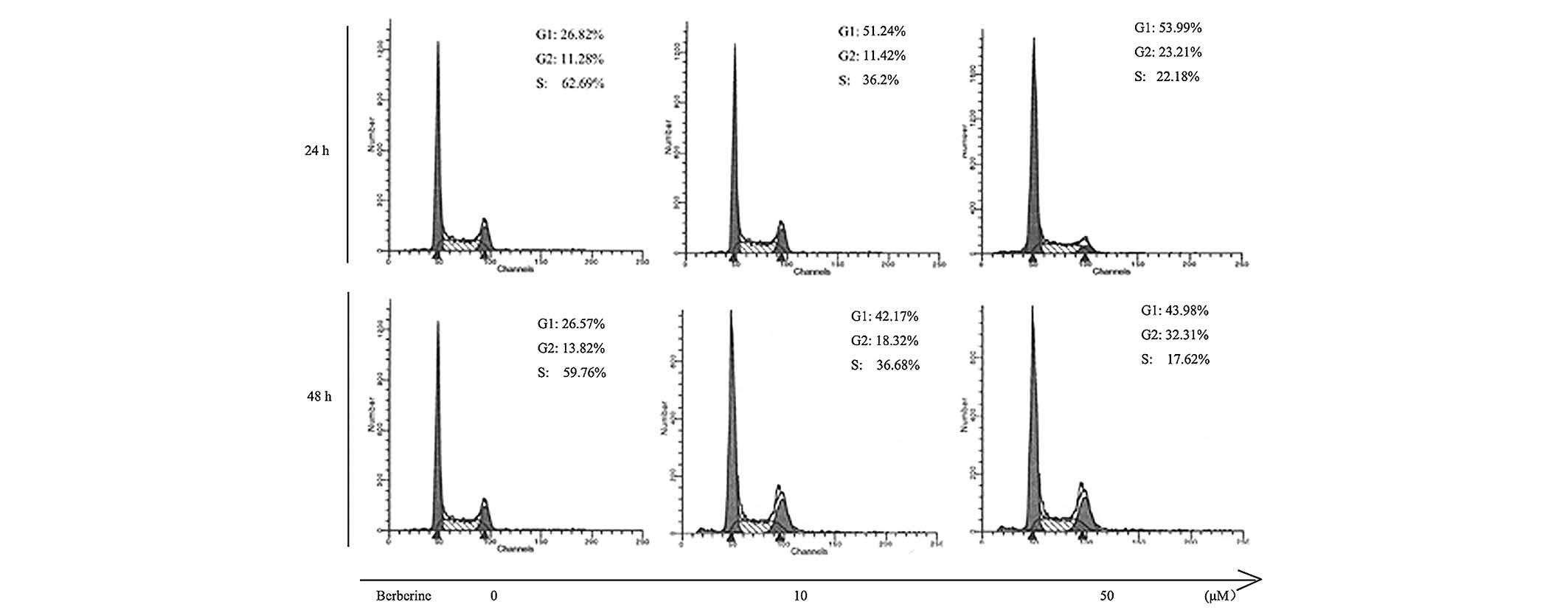
effects of berberine, cell-cycle analysis of PC3 cells was
performed using a FACS assay. PC3 cells were treated with 10 μM
berberine for 24 or 48 h, and cell-cycle analysis was performed
using a PI staining method (Fig.
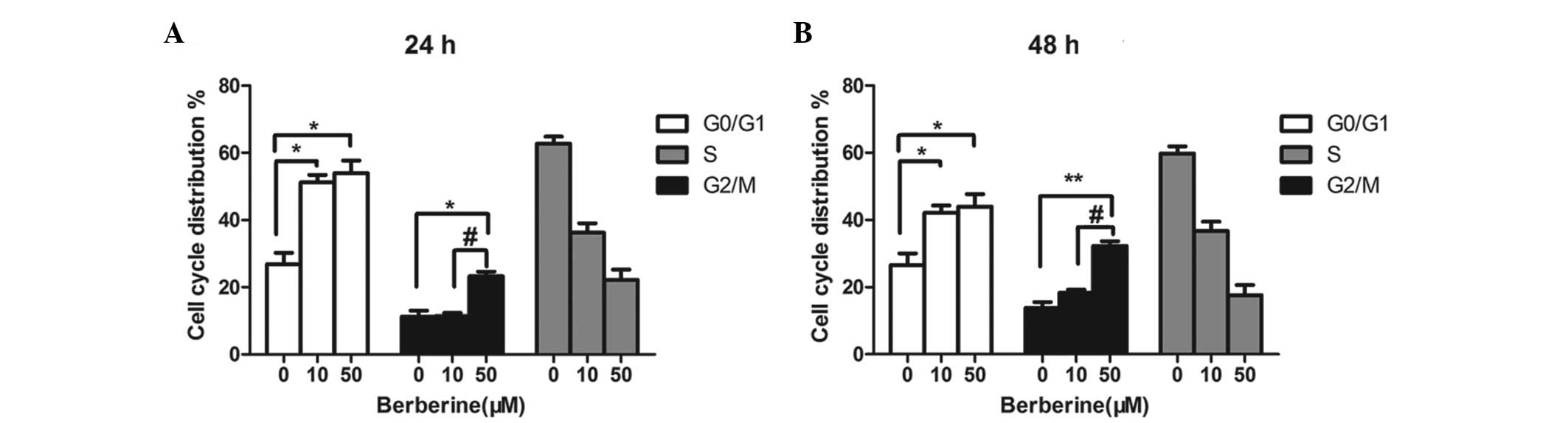
5). As shown in Fig. 6, the
distribution of PC3 cells in the cell cycle phases was analyzed.
The results demonstrated that the treatment of cells with 10 μM
berberine induced G0/G1 phase arrest
(P<0.05). However, with an increased berberine concentration of
50 μM, the survival rates of the PC3 cells in the G2/M
phase (28.4%; data not shown) were significantly increased compared
with those treated with 10 μM berberine (13.2%; data not shown),
which suggests that different signaling pathways associated with
the cell cycle were activated when PC3 cells were treated with low
and high concentrations of berberine.
Discussion
Prostate cancer is one of the most common types of
malignancies in males, which significantly affects quality of life
(1,26). In the late stages of prostate
cancer, treatment primarily consists of chemotherapy. However, the
chemotherapeutic drugs that are currently used are expensive and
have serious side-effects, hence, it is useful to identify novel
natural compounds with low toxicity for the treatment of prostate
cancer. Berberine is an important compound that is extracted in
traditional Chinese medicine (27). It has an key role in clinical
trials and in the anti-inflammatory response, and has antitumor
effects (28–30). In the present study, we further
explored the mechanism of anti-tumor activity of beberine on human
and mouse prostate cancer cells. Berberine is primarily used in the
clinical treatment of intestinal infections. Recent studies have
found that berberine may have an important role in the treatment of
diabetes and cardiovascular diseases in addition to antitumor
activity.
In the present study, the inhibitory effects of
berberine on prostate cancer and its mechanisms were investigated.
PC3 human and RM-1 mouse prostate cancer cells were used as
cellular models. The results of the MTT assay revealed that
berberine significantly inhibited the proliferation of PC3 and RM-1
cells in a concentration- and time-dependent manner. Cell cycle
distribution results showed that berberine induced
G0/G1 phase arrest and apoptosis in PC3
prostate cancer cells, which is consistent with the results
described in other studies (31–33).
Berberine inhibits the growth of a variety of tumor
cells, and its antitumor mechanisms include the induction of cell
cycle arrest and apoptosis (34–37).
The current study determined that different signaling pathways were
activated when prostate cancer cells were treated with low or high
concentrations of berberine. The results demonstrated that
G0/G1 phase arrest was induced at a lower
concentrarion of berberine, and G2/M phase arrest was
observed with an increased berberine concentration of 50 μM.
Different proteins were expressed at different cell cycle stages,
and these proteins are associated with different signalling
pathways. However, the regulatory mechanisms by which berberine
induced G2/M phase arrest remain unclear. In addition,
Liu et al (38) found that
high concentrations of berberine could induce G2/M phase
arrest in human osteosarcoma cells, and that this was not dependent
on p53 function.
In conclusion, the results of the present study have
provided a rationale for the development of berberine-based
therapies to treat malignant tumors and have aided in the
elucidation of the mechanism underlying the antitumor activity of
berberine in prostate cancer cells.
References
|
1
|
Xiao H, Tan F, Goovaerts P, et al:
Multilevel factors associated with overall mortality for men
diagnosed with prostate cancer in florida. Am J Mens Health.
8:316–326. 2013. View Article : Google Scholar : PubMed/NCBI
|
|
2
|
Gerritse FL, Meulenbeld HJ, Roodhart JM,
et al: Analysis of docetaxel therapy in elderly (≥70 years)
castration resistant prostate cancer patients enrolled in the
Netherlands Prostate Study. Eur J Cancer. 49:3176–3183. 2013.
View Article : Google Scholar : PubMed/NCBI
|
|
3
|
Damaschke NA, Yang B, Bhusari S, Svaren JP
and Jarrard DF: Epigenetic susceptibility factors for prostate
cancer with aging. Prostate. 73:1721–1730. 2013. View Article : Google Scholar : PubMed/NCBI
|
|
4
|
No authors listed. Summaries for patients.
Effect of age, tumor risk, and comorbidity on prostate cancer
survival. Ann Intern Med. 158:709–717. 2013. View Article : Google Scholar
|
|
5
|
Greenberg DC, Wright KA, Lophathanon A,
Muir KR and Gnanapragasam VJ: Changing presentation of prostate
cancer in a UK population - 10 year trends in prostate cancer risk
profiles in the East of England. Br J Cancer. 109:2115–2120. 2013.
View Article : Google Scholar : PubMed/NCBI
|
|
6
|
Carter HB: American Urological Association
(AUA) guideline on prostate cancer detection: process and
rationale. BJU Int. 112:543–547. 2013. View Article : Google Scholar : PubMed/NCBI
|
|
7
|
Lamy S, Wilmart JF, Hein T, Scheiden R and
Capesius C: Prostate cancer in Luxembourg from 1982 to 2006.
Incidence and mortality. Survival of a hospital cohort. Bull Soc
Sci Med Grand Duche Luxemb. 6–19. 2013.(In French).
|
|
8
|
Peng P, Gong YM, Bao PP, et al: Estimates
and prediction of prostate cancer incidence, mortality and
prevalence in China, 2008. Zhonghua Liu Xing Bing Xue Za Zhi.
33:1056–1059. 2012.(In Chinese).
|
|
9
|
Zhang L, Wu S, Guo LR and Zhao XJ:
Diagnostic strategies and the incidence of prostate cancer: reasons
for the low reported incidence of prostate cancer in China. Asian J
Androl. 11:9–13. 2009. View Article : Google Scholar
|
|
10
|
Song FJ, Zhang BL, He M, et al: Trend
analysis of the incidence of prostate cancer in Tianjin between
1981 and 2004. Zhonghua Yi Xue Za Zhi. 90:2811–2814. 2010.(In
Chinese). PubMed/NCBI
|
|
11
|
Wang JR, Tanaka T, Zhang H, Kouno I and
Jiang ZH: Formation and conformation of baicalin-berberine and
wogonoside-berberine complexes. Chem Pharm Bull (Tokyo).
60:706–711. 2012. View Article : Google Scholar
|
|
12
|
Philogène BJ, Arnason JT, Towers GH, et
al: Berberine: A naturally occurring phototoxic alkaloid. J Chem
Ecol. 10:115–123. 1984. View Article : Google Scholar : PubMed/NCBI
|
|
13
|
Li B, Zhu WL and Chen KX: Advances in the
study of berberine and its derivatives. Yao Xue Xue Bao.
43:773–787. 2008.(In Chinese). PubMed/NCBI
|
|
14
|
Chin LW, Cheng YW, Lin SS, et al:
Anti-herpes simplex virus effects of berberine from Coptidis
rhizoma, a major component of a Chinese herbal medicine,
Ching-Wei-San. Arch Virol. 155:1933–1941. 2010. View Article : Google Scholar : PubMed/NCBI
|
|
15
|
Derosa G and Maffioli P: Alkaloids in the
nature: pharmacological applications in clinical practice of
berberine and mate tea. Curr Top Med Chem. 14:200–206. 2014.
View Article : Google Scholar
|
|
16
|
Zhang Q, Piao XL, Piao XS, Lu T, Wang D
and Kim SW: Preventive effect of Coptis chinensis and berberine on
intestinal injury in rats challenged with lipopolysaccharides. Food
Chem Toxicol. 49:61–69. 2011. View Article : Google Scholar
|
|
17
|
Yao J, Kong W and Jiang J: Learning from
berberine: Treating chronic diseases through multiple targets. Sci
China Life Sci. Oct 30–2013.(Epub ahead of print). View Article : Google Scholar : PubMed/NCBI
|
|
18
|
Doggrell SA: Berberine - a novel approach
to cholesterol lowering. Expert Opin Investig Drugs. 14:683–685.
2005. View Article : Google Scholar : PubMed/NCBI
|
|
19
|
Affuso F, Mercurio V, Fazio V and Fazio S:
Cardiovascular and metabolic effects of Berberine. World J Cardiol.
2:71–77. 2010. View Article : Google Scholar : PubMed/NCBI
|
|
20
|
Chappell WH, Abrams SL, Franklin RA, et
al: Ectopic NGAL expression can alter sensitivity of breast cancer
cells to EGFR, Bcl-2, CaM-K inhibitors and the plant natural
product berberine. Cell Cycle. 11:4447–4461. 2012. View Article : Google Scholar : PubMed/NCBI
|
|
21
|
Yu M, Tong X, Qi B, et al: Berberine
enhances chemosensitivity to irinotecan in colon cancer via
inhibition of NFκB. Mol Med Rep. 9:249–254. 2014.
|
|
22
|
Pierpaoli E, Arcamone AG, Buzzetti F,
Lombardi P, Salvatore C and Provinciali M: Antitumor effect of
novel berberine derivatives in breast cancer cells. Biofactors.
39:672–679. 2013. View Article : Google Scholar : PubMed/NCBI
|
|
23
|
Hur JM and Kim D: Berberine inhibited
radioresistant effects and enhanced anti-tumor effects in the
irradiated-human prostate cancer cells. Toxicol Res. 26:109–115.
2010. View Article : Google Scholar : PubMed/NCBI
|
|
24
|
Bernas T and Dobrucki J: Mitochondrial and
nonmitochondrial reduction of MTT: interaction of MTT with TMRE,
JC-1, and NAO mitochondrial fluorescent probes. Cytometry.
47:236–242. 2002. View Article : Google Scholar : PubMed/NCBI
|
|
25
|
Sylvester PW: Optimization of the
tetrazolium dye (MTT) colorimetric assay for cellular growth and
viability. Methods Mol Biol. 716:157–168. 2011. View Article : Google Scholar : PubMed/NCBI
|
|
26
|
Zhou ZR, Zhu XD, Xia J, et al: Short-term
versus long-term hormone therapy plus radiotherapy or prostatectomy
for prostate cancer: a systematic review and meta-analysis. J
Cancer Res Clin Oncol. 139:783–796. 2013. View Article : Google Scholar : PubMed/NCBI
|
|
27
|
Huang ZJ, Zeng Y, Lan P, Sun PH and Chen
WM: Advances in structural modifications and biological activities
of berberine: an active compound in traditional Chinese medicine.
Mini Rev Med Chem. 11:1122–1129. 2011. View Article : Google Scholar
|
|
28
|
Pierpaoli E, Arcamone AG, Buzzetti F,
Lombardi P, Salvatore C and Provinciali M: Antitumor effect of
novel berberine derivatives in breast cancer cells. Biofactors.
39:672–679. 2013. View Article : Google Scholar : PubMed/NCBI
|
|
29
|
Goto H, Kariya R, Shimamoto M, et al:
Antitumor effect of berberine against primary effusion lymphoma via
inhibition of NF-κB pathway. Cancer Sci. 103:775–781. 2012.
View Article : Google Scholar : PubMed/NCBI
|
|
30
|
Wang Z, Chen Z, Yang S, et al: Berberine
ameliorates collagen-induced arthritis in rats associated with
anti-inflammatory and anti-angiogenic effects. Inflammation.
37:1789–1798. 2014. View Article : Google Scholar : PubMed/NCBI
|
|
31
|
Barzilai A and Yamamoto K: DNA damage
responses to oxidative stress. DNA Repair (Amst). 3:1109–1115.
2004. View Article : Google Scholar
|
|
32
|
Muralimanoharan SB, Kunnumakkara AB,
Shylesh B, et al: Butanol fraction containing berberine or related
compound from nexrutine inhibits NFkappaB signaling and induces
apoptosis in prostate cancer cells. Prostate. 69:494–504. 2009.
View Article : Google Scholar :
|
|
33
|
Choi MS, Oh JH, Kim SM, et al: Berberine
inhibits p53-dependent cell growth through induction of apoptosis
of prostate cancer cells. Int J Oncol. 34:1221–1230.
2009.PubMed/NCBI
|
|
34
|
Kim JB, Lee KM, Ko E, et al: Berberine
inhibits growth of the breast cancer cell lines MCF-7 and
MDA-MB-231. Planta Med. 74:39–42. 2008. View Article : Google Scholar : PubMed/NCBI
|
|
35
|
Chidambara Murthy KN, Jayaprakasha GK and
Patil BS: The natural alkaloid berberine targets multiple pathways
to induce cell death in cultured human colon cancer cells. Eur J
Pharmacol. 688:14–21. 2012. View Article : Google Scholar : PubMed/NCBI
|
|
36
|
Yan L, Yan K, Kun W, et al: Berberine
inhibits the migration and invasion of T24 bladder cancer cells via
reducing the expression of heparanase. Tumor Biol. 34:215–221.
2013. View Article : Google Scholar
|
|
37
|
Letasiova S, Jantova S, Cipak L and
Muckova M: Berberine-antiproliferative activity in vitro and
induction of apoptosis/necrosis of the U937 and B16 cells. Cancer
Lett. 239:254–262. 2006. View Article : Google Scholar
|
|
38
|
Liu Z, Liu Q, Xu B, et al: Berberine
induces p53-dependent cell cycle arrest and apoptosis of human
osteosarcoma cells by inflicting DNA damage. Mutat Res. 662:75–83.
2009. View Article : Google Scholar : PubMed/NCBI
|