Spandidos Publications Logo
  • About
    • About Spandidos
    • Aims and Scopes
    • Abstracting and Indexing
    • Editorial Policies
    • Reprints and Permissions
    • Job Opportunities
    • Terms and Conditions
    • Contact
  • Journals
    • All Journals
    • Oncology Letters
      • Oncology Letters
      • Information for Authors
      • Editorial Policies
      • Editorial Board
      • Aims and Scope
      • Abstracting and Indexing
      • Bibliographic Information
      • Archive
    • International Journal of Oncology
      • International Journal of Oncology
      • Information for Authors
      • Editorial Policies
      • Editorial Board
      • Aims and Scope
      • Abstracting and Indexing
      • Bibliographic Information
      • Archive
    • Molecular and Clinical Oncology
      • Molecular and Clinical Oncology
      • Information for Authors
      • Editorial Policies
      • Editorial Board
      • Aims and Scope
      • Abstracting and Indexing
      • Bibliographic Information
      • Archive
    • Experimental and Therapeutic Medicine
      • Experimental and Therapeutic Medicine
      • Information for Authors
      • Editorial Policies
      • Editorial Board
      • Aims and Scope
      • Abstracting and Indexing
      • Bibliographic Information
      • Archive
    • International Journal of Molecular Medicine
      • International Journal of Molecular Medicine
      • Information for Authors
      • Editorial Policies
      • Editorial Board
      • Aims and Scope
      • Abstracting and Indexing
      • Bibliographic Information
      • Archive
    • Biomedical Reports
      • Biomedical Reports
      • Information for Authors
      • Editorial Policies
      • Editorial Board
      • Aims and Scope
      • Abstracting and Indexing
      • Bibliographic Information
      • Archive
    • Oncology Reports
      • Oncology Reports
      • Information for Authors
      • Editorial Policies
      • Editorial Board
      • Aims and Scope
      • Abstracting and Indexing
      • Bibliographic Information
      • Archive
    • Molecular Medicine Reports
      • Molecular Medicine Reports
      • Information for Authors
      • Editorial Policies
      • Editorial Board
      • Aims and Scope
      • Abstracting and Indexing
      • Bibliographic Information
      • Archive
    • World Academy of Sciences Journal
      • World Academy of Sciences Journal
      • Information for Authors
      • Editorial Policies
      • Editorial Board
      • Aims and Scope
      • Abstracting and Indexing
      • Bibliographic Information
      • Archive
    • International Journal of Functional Nutrition
      • International Journal of Functional Nutrition
      • Information for Authors
      • Editorial Policies
      • Editorial Board
      • Aims and Scope
      • Abstracting and Indexing
      • Bibliographic Information
      • Archive
    • International Journal of Epigenetics
      • International Journal of Epigenetics
      • Information for Authors
      • Editorial Policies
      • Editorial Board
      • Aims and Scope
      • Abstracting and Indexing
      • Bibliographic Information
      • Archive
    • Medicine International
      • Medicine International
      • Information for Authors
      • Editorial Policies
      • Editorial Board
      • Aims and Scope
      • Abstracting and Indexing
      • Bibliographic Information
      • Archive
  • Articles
  • Information
    • Information for Authors
    • Information for Reviewers
    • Information for Librarians
    • Information for Advertisers
    • Conferences
  • Language Editing
Spandidos Publications Logo
  • About
    • About Spandidos
    • Aims and Scopes
    • Abstracting and Indexing
    • Editorial Policies
    • Reprints and Permissions
    • Job Opportunities
    • Terms and Conditions
    • Contact
  • Journals
    • All Journals
    • Biomedical Reports
      • Information for Authors
      • Editorial Policies
      • Editorial Board
      • Aims and Scope
      • Abstracting and Indexing
      • Bibliographic Information
      • Archive
    • Experimental and Therapeutic Medicine
      • Information for Authors
      • Editorial Policies
      • Editorial Board
      • Aims and Scope
      • Abstracting and Indexing
      • Bibliographic Information
      • Archive
    • International Journal of Epigenetics
      • Information for Authors
      • Editorial Policies
      • Editorial Board
      • Aims and Scope
      • Abstracting and Indexing
      • Bibliographic Information
      • Archive
    • International Journal of Functional Nutrition
      • Information for Authors
      • Editorial Policies
      • Editorial Board
      • Aims and Scope
      • Abstracting and Indexing
      • Bibliographic Information
      • Archive
    • International Journal of Molecular Medicine
      • Information for Authors
      • Editorial Policies
      • Editorial Board
      • Aims and Scope
      • Abstracting and Indexing
      • Bibliographic Information
      • Archive
    • International Journal of Oncology
      • Information for Authors
      • Editorial Policies
      • Editorial Board
      • Aims and Scope
      • Abstracting and Indexing
      • Bibliographic Information
      • Archive
    • Medicine International
      • Information for Authors
      • Editorial Policies
      • Editorial Board
      • Aims and Scope
      • Abstracting and Indexing
      • Bibliographic Information
      • Archive
    • Molecular and Clinical Oncology
      • Information for Authors
      • Editorial Policies
      • Editorial Board
      • Aims and Scope
      • Abstracting and Indexing
      • Bibliographic Information
      • Archive
    • Molecular Medicine Reports
      • Information for Authors
      • Editorial Policies
      • Editorial Board
      • Aims and Scope
      • Abstracting and Indexing
      • Bibliographic Information
      • Archive
    • Oncology Letters
      • Information for Authors
      • Editorial Policies
      • Editorial Board
      • Aims and Scope
      • Abstracting and Indexing
      • Bibliographic Information
      • Archive
    • Oncology Reports
      • Information for Authors
      • Editorial Policies
      • Editorial Board
      • Aims and Scope
      • Abstracting and Indexing
      • Bibliographic Information
      • Archive
    • World Academy of Sciences Journal
      • Information for Authors
      • Editorial Policies
      • Editorial Board
      • Aims and Scope
      • Abstracting and Indexing
      • Bibliographic Information
      • Archive
  • Articles
  • Information
    • For Authors
    • For Reviewers
    • For Librarians
    • For Advertisers
    • Conferences
  • Language Editing
Login Register Submit
  • This site uses cookies
  • You can change your cookie settings at any time by following the instructions in our Cookie Policy. To find out more, you may read our Privacy Policy.

    I agree
Search articles by DOI, keyword, author or affiliation
Search
Advanced Search
presentation
Oncology Letters
Join Editorial Board Propose a Special Issue
Print ISSN: 1792-1074 Online ISSN: 1792-1082
Journal Cover
November-December 2010 Volume 1 Issue 6

Full Size Image

Sign up for eToc alerts
Recommend to Library

Journals

International Journal of Molecular Medicine

International Journal of Molecular Medicine

International Journal of Molecular Medicine is an international journal devoted to molecular mechanisms of human disease.

International Journal of Oncology

International Journal of Oncology

International Journal of Oncology is an international journal devoted to oncology research and cancer treatment.

Molecular Medicine Reports

Molecular Medicine Reports

Covers molecular medicine topics such as pharmacology, pathology, genetics, neuroscience, infectious diseases, molecular cardiology, and molecular surgery.

Oncology Reports

Oncology Reports

Oncology Reports is an international journal devoted to fundamental and applied research in Oncology.

Experimental and Therapeutic Medicine

Experimental and Therapeutic Medicine

Experimental and Therapeutic Medicine is an international journal devoted to laboratory and clinical medicine.

Oncology Letters

Oncology Letters

Oncology Letters is an international journal devoted to Experimental and Clinical Oncology.

Biomedical Reports

Biomedical Reports

Explores a wide range of biological and medical fields, including pharmacology, genetics, microbiology, neuroscience, and molecular cardiology.

Molecular and Clinical Oncology

Molecular and Clinical Oncology

International journal addressing all aspects of oncology research, from tumorigenesis and oncogenes to chemotherapy and metastasis.

World Academy of Sciences Journal

World Academy of Sciences Journal

Multidisciplinary open-access journal spanning biochemistry, genetics, neuroscience, environmental health, and synthetic biology.

International Journal of Functional Nutrition

International Journal of Functional Nutrition

Open-access journal combining biochemistry, pharmacology, immunology, and genetics to advance health through functional nutrition.

International Journal of Epigenetics

International Journal of Epigenetics

Publishes open-access research on using epigenetics to advance understanding and treatment of human disease.

Medicine International

Medicine International

An International Open Access Journal Devoted to General Medicine.

Journal Cover
November-December 2010 Volume 1 Issue 6

Full Size Image

Sign up for eToc alerts
Recommend to Library

  • Article
  • Citations
    • Cite This Article
    • Download Citation
    • Create Citation Alert
    • Remove Citation Alert
    • Cited By
  • Similar Articles
    • Related Articles (in Spandidos Publications)
    • Similar Articles (Google Scholar)
    • Similar Articles (PubMed)
  • Download PDF
  • Download XML
  • View XML
Article

Outcome of cephalic vein cut-down approach: A safe and feasible approach for totally implantable venous access device placement

  • Authors:
    • Shinichiro Koketsu
    • Shinishi Samesima
    • Satomi Yoneyama
    • Toshiyuki Okada
    • Shigeru Tomozawa
    • Hiroyuki Horikoshi
    • Toshio Sawada
  • View Affiliations / Copyright

    Affiliations: First Department of Surgery, Koshigaya Hospital, Dokkyo Medical University, Koshigaya, Saitama 343-8555, Japan, Department of Surgery, Gunma Cancer Center, Gunma, Japan, Department of Radiology, Gunma Cancer Center, Gunma, Japan
  • Pages: 1029-1032
    |
    Published online on: September 23, 2010
       https://doi.org/10.3892/ol.2010.189
  • Expand metrics +
Metrics: Total Views: 0 (Spandidos Publications: | PMC Statistics: )
Metrics: Total PDF Downloads: 0 (Spandidos Publications: | PMC Statistics: )
Cited By (CrossRef): 0 citations Loading Articles...

This article is mentioned in:


Abstract

This study aimed to evaluate the safety and feasibility of the venous access via the cephalic vein cut-down (CVCD) approach for totally implantable venous access device (TIVAD) placements. A total of 79 patients who received TIVAD for the treatment of unresectable or recurrent colorectal carcinomas were recruited. The operation time and the complications were evaluated. Results showed the TIVAD placement via the CVCD approach was successful in 74 patients. A total of 5 patients required conversion to a percutaneous puncture approach. The mean operation time was 34.7 min. No intraoperative or postoperative complications were observed. Therefore, the CVCD approach is a safe and feasible method for TIVAD placement.

Introduction

Significant improvements have been made in the chemotherapy of unresectable or recurrent colorectal carcinomas. These improvements are due to the development of combination chemotherapies, including fluorouracil, irinotecan or oxaliplatin, in combination with molecular-targeting agents, including bevacizumab and cetuximab. The use of a totally implantable venous access device (TIVAD) is recommended for administration of these chemotherapeutic agents.

TIVADs are generally placed in position by the percutaneous subclavian vein approach. This approach causes infrequent intraoperative or postoperative complications, including pneumothorax, arterial puncture, hemothorax, injury to brachial plexus (1–5) and pinch-off syndrome (6).

Venous access via the cephalic vein cut-down (CVCD) method has been widely described as a safe and rapid approach (7–10). However, this technique is not currently widely used for the placement of TIVADs. Since the cephalic vein shows few anatomical anomalies (11), this approach is suitable for the placement of TIVADs.

This study examined the outcome of the venous access via the CVCD method for the placement of TIVADs.

Materials and methods

A total of 79 consecutive patients with unresectable or recurrent colorectal carcinomas underwent TIVAD placement surgeries between June 2007 and October 2008.

The patients were brought to the operating room and placed in a supine position. The operation was performed using local anesthesia (0.5% of xylocaine; AstraZeneca, UK). Patients who felt uneasy during the operation were administered an intravenous injection of 15 mg of pentazocine (Astellas, Japan). Surgery was performed under maximal barrier precaution. The TIVAD placements were performed by two surgeons. Each stage of the surgical procedure of this study was supervised by one of the two surgeons.

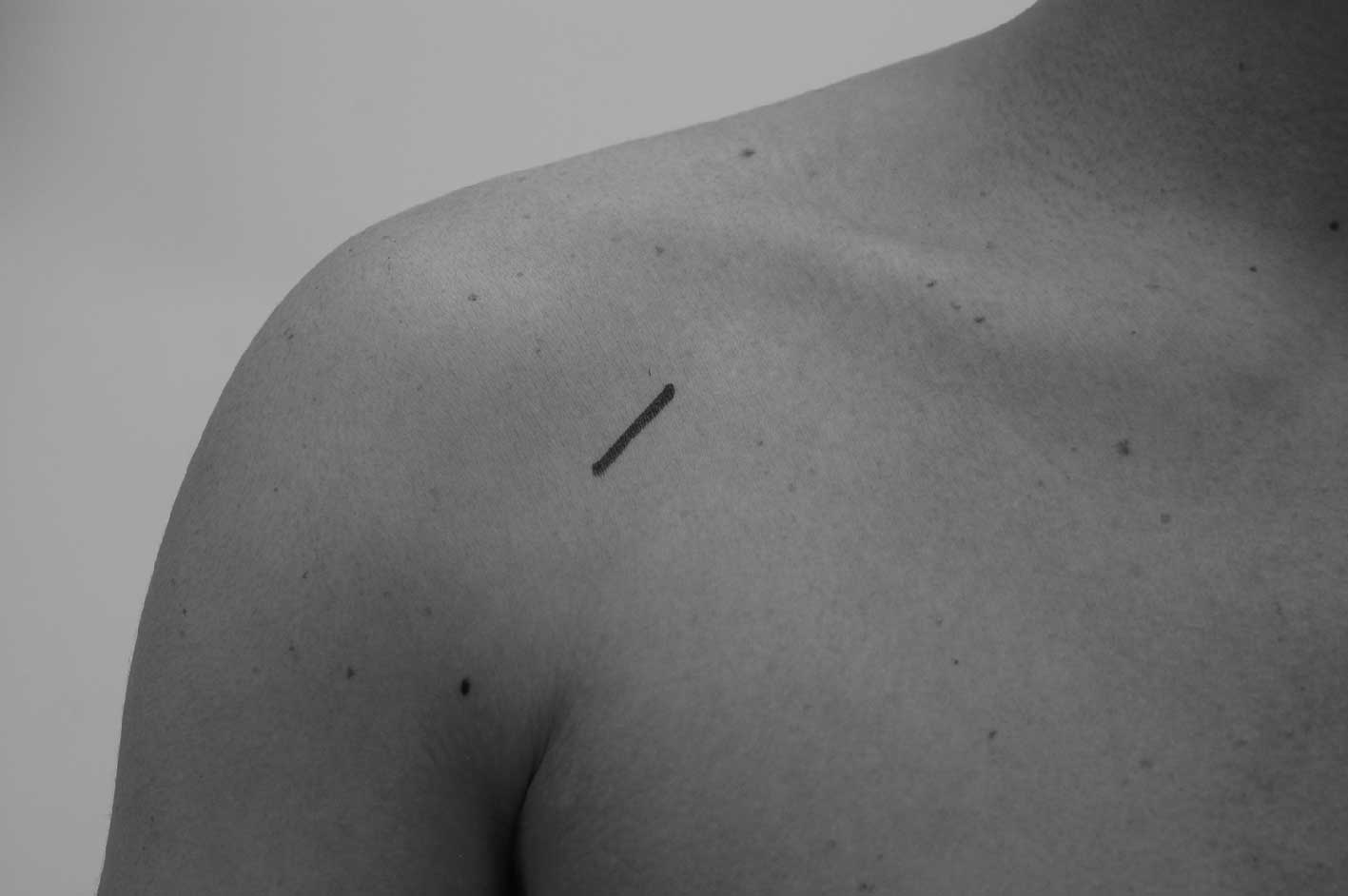
The cephalic vein passes through the clavipectoral (deltopectoral) triangle to join the axillary vein. A 3-cm wide skin incision was made in the infraclavicular region between the pectoralis major muscle and the triangular muscle (Fig. 1). The cephalic vein was identified in the adipose tissue along the deltopectoral groove. An incision of 3 mm in length was made on the surface of the vein. A Groshong catheter was inserted via the cephalic vein and connected to the port (BardPort X-port isp; Bard Access Systems Inc., Salt Lake City, UT, USA). The port was implanted in the subcutaneous space. The position of the catheter tip and the shape of the catheter lumen were confirmed by X-ray.

Figure 1

A skin incision site in the infraclavicular region.

If the TIVAD placement by the CVCD approach was unsuccessful, the procedure was converted to the conventional percutaneous puncture approach of the subclavian vein. The operation time, and any intraoperative and post-operative complications were recorded.

Results

A total of 79 TIVAD placements were performed for 79 consecutive patients. TIVAD placement via the CVCD approach was completed in 74 patients (93.7%). The CVCD approach was not successful in the remaining 5 patients (6.3%). Subsequently, the 5 patients required conversion to a percutaneous puncture approach. The mean operation time was 34.7 min (median 30, range 17–103 min). The cephalic vein was not detected in 2 cases, and in 1 case the cephalic vein was too narrow to insert the catheter. In 2 cases where the cephalic vein merged to the axillary vein, the tip of the catheter was not able to reach the superior vena cava. When the cephalic vein merged to the axillary vein vertically, the catheter tip reached only as far as the distal side of the axillary vein. In such cases, we attempted to change the merging angle of the cephalic and axillary veins to a more acute angle by leaning the head of the patient to the opposite side or moving the arm and shoulder. Manipulation of the angle normally allows the tip of the catheter to reach the superior vena cava when the merging point was vertical. However, in the 2 cases noted above, this manipulation was not successful.

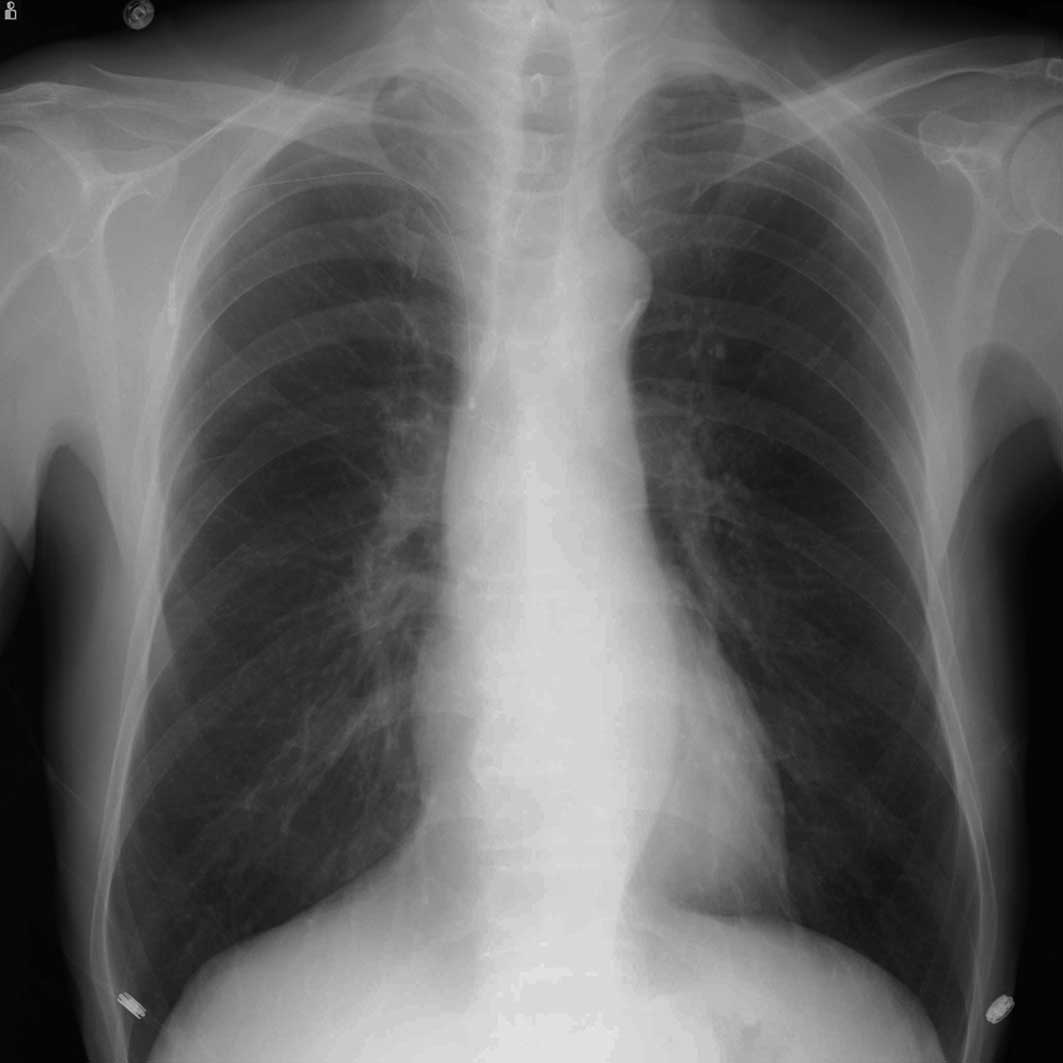
No intraoperative or immediate postoperative complications were observed. A chest radiograph was obtained following the surgery to detect the position of the catheter tip and the distortion of the catheter lumen (Fig. 2). A distortion in the catheter may indicate pinch-off syndrome. In this study, no catheter distortion was detected.

Figure 2

Chest X-ray following placement of a totally implantable venous access device.

Discussion

TIVADs are normally placed using the percutaneous subclavian vein approach. The percutaneous approach has occasionally caused intraoperative and postoperative complications, such as pneumothorax, arterial puncture, hemothorax or injury to the brachial plexus (1–5). The intraoperative complication rate of the percutaneous approach was reported to be 3–7% (1–5). The technique used for TIVAD implantation is now considered to be safer due to the use of image-guided navigation techniques, such as venous ultrasonography or venography. However, the risk of complications remains when the percutaneous puncture approach is used.

CVCD does not require risking a puncture and is associated with a very low rate of complications. A number of studies have compared the cut-down and percutaneous approaches and reported the superiority and safety of the cut-down approach compared to the conventional percutaneous method (9,10).

Pinch-off syndrome has been reported as a complication of TIVAD (12,13). This syndrome is thought to be caused by the compression of the catheter by the clavicle and the first rib (12,13). Catheter compression may lead to obstruction followed by fracture of the catheter. Of note is that the pinch-off syndrome was not observed in a number of studies using the cut-down technique (9,10,12).

Moreover, in the cardiovascular field, pinch-off syndrome is known as subclavian crush syndrome, which has been reported to occur with pacemaker leads implanted via the subclavian puncture technique. In these cases, conductor fracture and insulation breaches develop via compression of a lead that passes between the first rib and the clavicle. In this study, it was suggested that strong consideration should be given to obtain venous access primarily via the cephalic cut-down technique, due to the possibility of complications of subclavian crush syndrome with the percutaneous puncture approach.

The CVCD approach requires a surgical technique. Given the increase in the number of colorectal carcinoma patients worldwide, this technique may be of practical value. In this study, TIVAD placements were performed by the CVCD method and the outcome was evaluated.

The cephalic vein passes through the clavipectoral (deltopectoral) triangle to merge with the axillary vein. Since the cephalic vein shows few anatomical anomalies (11), it is suitable for cut-down and the placement of TIVAD.

TIVAD placement by CVCD was performed in 79 patients and completed in 74 patients. The remaining 5 patients required conversion to a percutaneous approach. The reasons for the conversion were due to abnormalities of the cephalic vein, including failure to detect the cephalic vein, a narrow cephalic vein and abnormal merging of the cephalic and axillary veins. In this study, the failure rate was found to be 6%, which is lower than that in previous studies where a range of 8–30% was reported (7,9,10).

Currently, the depth of the deltopectoral groove, location of cephalic vein and the margins of the axillary vein are routinely checked by ultrasonography prior to surgery. This increases the success rate of completing a CVCD method. We are therefore developing safer, more rapid and more practical placement methods for TIVADs.

In conclusion, this study showed that the CVCD technique is a safe and feasible approach for TIVAD placement. Additionally, this technique is associated with a lower rate of severe complications, reported to be up to 10%, compared to the percutaneous method (9,10).

References

1 

Biffi R, de Braud F, Orsi F, et al: Totally implantable central venous access ports for long-term chemotherapy. A prospective study analyzing complications and costs of 333 devices with a minimum follow-up of 180 days. Ann Oncol. 9:767–773. 1998. View Article : Google Scholar

2 

Kincaid EH, Davis PW, Chang MC, Fenstermaker JM and Pennell TC: ‘Blind’ placement of long-term central venous access devices: report of 589 consecutive procedures. Am Surg. 65:520–524. 1999.

3 

Poorter RL, Lauw FN, Bemelman WA, Bakker PJ, Taat CW and Veenhof CH: Complications of an implantable venous access device (Port-a-Cath) during intermittent continuous infusion of chemotherapy. Eur J Cancer. 32A:2262–2266. 1996. View Article : Google Scholar : PubMed/NCBI

4 

Nightingale CE, Norman A, Cunningham D, Young J, Webb A and Filshie J: A prospective analysis of 949 long-term central venous access catheters for ambulatory chemotherapy in patients with gastrointestinal malignancy. Eur J Cancer. 33:398–403. 1997. View Article : Google Scholar : PubMed/NCBI

5 

Di Carlo I, Barbagallo F, Toro A, Sofia M, Lombardo R and Cordio S: External jugular vein cutdown approach, as a useful alternative, supports the choice of the cephalic vein for totally implantable access device placement. Ann Surg Oncol. 12:1–4. 2005.PubMed/NCBI

6 

Di Carlo I, Fisichella P, Russello D, Puleo S and Latteri F: Catheter fracture and cardiac migration: a rare complication of totally implantable venous devices. J Surg Oncol. 73:172–173. 2000.PubMed/NCBI

7 

Povoski SP: A prospective analysis of the cephalic vein cutdown approach for chronic indwelling central venous access in 100 consecutive cancer patients. Ann Surg Oncol. 7:496–502. 2000. View Article : Google Scholar : PubMed/NCBI

8 

Di Carlo I, Cordio S, La Greca G, et al: Totally implantable venous access devices implanted surgically: a retrospective study on early and late complications. Arch Surg. 136:1050–1053. 2001.PubMed/NCBI

9 

Sarzo G, Finco C, Parise P, et al: Insertion of prolonged venous access device: a comparison between surgical cutdown and percutaneous techniques. Chir Ital. 56:437–442. 2004.PubMed/NCBI

10 

Chang HM, Hsieh CB, Hsieh HF, et al: An alternative technique for totally implantable central venous access devices. A retrospective study of 1311 cases. Eur J Surg Oncol. 32:90–93. 2006. View Article : Google Scholar : PubMed/NCBI

11 

Le Saout J, Vallee B, Person H, Doutriaux M, Blanc J and Nguyen H: Anatomical basis for the surgical use of the cephalic vein (V. Cephalica). 74 anatomical dissections 189 surgical dissections. J Chir. 120:131–134. 1983.PubMed/NCBI

12 

Andris DA, Krzywda EA, Schulte W, Ausman R and Quebbeman EJ: Pinch-off syndrome: a rare etiology for central venous catheter occlusion. J Parenter Enteral Nutr. 18:531–533. 1994. View Article : Google Scholar : PubMed/NCBI

13 

Hinke DH, Zandt-Stastny DA, Goodman LR, Quebbeman EJ, Krzywda EA and Andris DA: Pinch-off syndrome: a complication of implantable subclavian venous access devices. Radiology. 177:353–356. 1990. View Article : Google Scholar : PubMed/NCBI

14 

Roelke M, O'Nunain SS, Osswald S, Garan H, Harthorne JW and Ruskin JN: Subclavian crush syndrome complicating transvenous cardioverter defibrillator systems. Pace. 18:973–979. 1995. View Article : Google Scholar : PubMed/NCBI

Related Articles

  • Abstract
  • View
  • Download
  • Twitter
Copy and paste a formatted citation
Spandidos Publications style
Koketsu S, Samesima S, Yoneyama S, Okada T, Tomozawa S, Horikoshi H and Sawada T: Outcome of cephalic vein cut-down approach: A safe and feasible approach for totally implantable venous access device placement. Oncol Lett 1: 1029-1032, 2010.
APA
Koketsu, S., Samesima, S., Yoneyama, S., Okada, T., Tomozawa, S., Horikoshi, H., & Sawada, T. (2010). Outcome of cephalic vein cut-down approach: A safe and feasible approach for totally implantable venous access device placement. Oncology Letters, 1, 1029-1032. https://doi.org/10.3892/ol.2010.189
MLA
Koketsu, S., Samesima, S., Yoneyama, S., Okada, T., Tomozawa, S., Horikoshi, H., Sawada, T."Outcome of cephalic vein cut-down approach: A safe and feasible approach for totally implantable venous access device placement". Oncology Letters 1.6 (2010): 1029-1032.
Chicago
Koketsu, S., Samesima, S., Yoneyama, S., Okada, T., Tomozawa, S., Horikoshi, H., Sawada, T."Outcome of cephalic vein cut-down approach: A safe and feasible approach for totally implantable venous access device placement". Oncology Letters 1, no. 6 (2010): 1029-1032. https://doi.org/10.3892/ol.2010.189
Copy and paste a formatted citation
x
Spandidos Publications style
Koketsu S, Samesima S, Yoneyama S, Okada T, Tomozawa S, Horikoshi H and Sawada T: Outcome of cephalic vein cut-down approach: A safe and feasible approach for totally implantable venous access device placement. Oncol Lett 1: 1029-1032, 2010.
APA
Koketsu, S., Samesima, S., Yoneyama, S., Okada, T., Tomozawa, S., Horikoshi, H., & Sawada, T. (2010). Outcome of cephalic vein cut-down approach: A safe and feasible approach for totally implantable venous access device placement. Oncology Letters, 1, 1029-1032. https://doi.org/10.3892/ol.2010.189
MLA
Koketsu, S., Samesima, S., Yoneyama, S., Okada, T., Tomozawa, S., Horikoshi, H., Sawada, T."Outcome of cephalic vein cut-down approach: A safe and feasible approach for totally implantable venous access device placement". Oncology Letters 1.6 (2010): 1029-1032.
Chicago
Koketsu, S., Samesima, S., Yoneyama, S., Okada, T., Tomozawa, S., Horikoshi, H., Sawada, T."Outcome of cephalic vein cut-down approach: A safe and feasible approach for totally implantable venous access device placement". Oncology Letters 1, no. 6 (2010): 1029-1032. https://doi.org/10.3892/ol.2010.189
Follow us
  • Twitter
  • LinkedIn
  • Facebook
About
  • Spandidos Publications
  • Careers
  • Cookie Policy
  • Privacy Policy
How can we help?
  • Help
  • Live Chat
  • Contact
  • Email to our Support Team