Introduction
The influenza virus is a pathogen that causes
respiratory disease in humans and has the potential to cause
epidemics and pandemics (1). During
the 1918 pandemic, 40–50 million individuals succumbed to the
disease globally (2). During the
2009 pandemic, 17,483 mortalities were reported to the World Health
Organization with an estimate of 200 million H1N1 influenza cases
worldwide for December 2010 (3). In
the United States, influenza is more frequent in winter and is
associated with 36,000 mortalities annually (4). In Mexico, influenza has been
associated with 7–12% of respiratory infections in certain areas
(5,6).
Influenza infection is characterized by sudden
respiratory symptoms (fever, myalgia, headache, coughing,
pharyngeal aching and rhinitis) (7). The uncomplicated disease improves
within 3–7 days. However, in certain individuals with risk factors,
complications may present including viral pneumonia, secondary
bacterial infections or coinfections, sepsis and even mortality. In
young children, influenza infection may present as sepsis with a
high fever (8). The risk factors
include pneumopathy, cardiopathy and an immunocompromised state
that may be observed among patients with cancer or human
immunodeficiency virus (HIV) and steroid recipients (4,9–16).
Chemotherapy inhibits the ability of the immune
system to develop an immune response to invading pathogens via
vaccination or incidental exposure and acts by suppressing bone
marrow production and decreasing the vital components of the immune
system (17). There is controversy
with regard to the humoral immune response to influenza vaccination
in children with cancer who are receiving chemotherapy. Certain
authors have reported an effective antibody response in such
children, albeit at a lower proportion than among healthy
individuals, especially when receiving chemotherapy at the moment
of vaccination (18,19).
Certain studies have suggested that cellular
immunity to an influenza vaccine is a useful predictor of
protection against disease in the elderly (20). The cellular immune response to an
influenza vaccine has been described as the expansion of
CD8+ and CD4+ T lymphocytes with surface
markers that classify them as effector or memory T cells based on
the surface markers CD62L and CD45RA (21–24);
other molecules, including CD27, are costimulatory and indicate
activation (25). These surface
markers have yet to be characterized in children with cancer who
are receiving chemotherapy and who have been immunized with an
influenza vaccine. The objective of this study was to characterize
the cellular and humoral immune responses to influenza vaccination
among children with cancer who are receiving chemotherapy.
Materials and methods
Ethics
This study was a prospective, quasi-experimental,
comparative clinical trial with auto controls. The study was
approved by the Institutional Review Board of the Hospital Infantil
de México Federico Gómez (Mexico City, Mexico; HIM/2007/025) and
the School of Medicine of the Universidad Nacional Autónoma de
México (Mexico City, Mexico; 19–2007). Informed consent forms were
signed by the parents or guardians of all the study participants.
The study was conducted following the Good Clinical Practice and
the International Conference of Harmonization standards.
Study population
The patients included in the study were 56
individuals with cancer who were aged 2–16 years and were receiving
chemotherapy at the Oncology Department of the Hospital Infantil de
México Federico Gómez, Mexico. Exclusion criteria were an allergy
to egg protein, thrombocytopenia or the lack of a follow-up blood
collection. The subjects received the inactivated trivalent
influenza vaccine prior to chemotherapy administration. No
participant had a history of influenza vaccination. Blood samples
were obtained prior to and at 4 weeks after vaccination for humoral
and cellular assays. The clinical symptoms were assessed over 14
days and on day 30.
Influenza vaccine and vaccine
administration
Inactivated trivalent Vaxigrip vaccine (Sanofi
Pasteur, Paris, France), containing 15 μg of hemagglutinin protein
for each virus [A/New Caledonia/20/99 (H1N1), A/Wisconsin/67/2005
(H3N2) and B/Malaysia/2560/2004] was used for the winter season of
2006–2007. Fluarix vaccine (GlaxoSmithKline, Mexico) containing 15
μg of hemagglutinin protein for each virus [A/Solomon
Islands/3/2006 (H1N1), A/Wisconsin/67/2005 (H3N2) and
B/Malaysia/2560/2004] was used for the winter season of 2007–2008.
The vaccine was administered intramuscularly over the deltoid area
of the left arm.
Influenza antibody assay
IgG anti-influenza antibodies were detected by the
hemagglutination inhibition (HI) technique. Briefly, the serum was
separated by centrifugation and frozen at −70°C until tested in
parallel. Aliquots of serum (50 μl) treated with enzyme-destroying
receptor overnight in several dilutions were placed in duplicate
24-well plates. A concentration of 8 hemagglutination units (HU)
for each virus (A H1N1, A H3N2 and B) was added for 30 min. A 0.85%
suspension of turkey erythrocytes was added for 20 min until
inhibition of hemagglutination was observed. A titer of ≥1:40 was
considered a positive response.
Cell proliferation measured by
3H-thymidine
Fresh peripheral blood mononuclear cells (PBMC) were
separated from whole blood by Ficoll-Hypaque gradients and added to
96-well microtiter plates at a concentration of 3×10⁵
cells/well in RPMI-1640 medium (Gibco, Gaithersburg, MD, USA)
containing 10% normal human serum (Sigma-Aldrich, St. Louis, MO,
USA). The influenza antigen, prepared from infected Madin-Darby
Canine Kidney (MDCK) cell lysates or an uninfected cell control,
was added at dilutions of 1:4, 1:8 and 1:16 in triplicate wells.
T-cell proliferation was measured by adding 3H-thymidine
(2.5 μCi per well) after 5 days for 6–18 h. The stimulation index
(SI) was calculated as the mean counts per minute (cpm) in the
influenza antigen-stimulated wells divided by the mean cpm in the
control wells. Phytohemagglutinin (Difco, Detroit, MI, USA) and
tetanus toxoid (Calbiochem, La Jolla, CA, USA) were used as
positive controls.
Cell populations measured by flow
cytometry
Separated PBMC were added to 96-well microtiter
plates at a concentration of 3×10⁵ cells/well in
RPMI-1640 (Gibco) with 10% normal human serum (Sigma-Aldrich). The
cells were stimulated with the inactivated influenza antigen or an
uninfected cell control (MDCK cells); concanavalin A was used as a
mitogen control. After 5 days, the cells were stained with
monoclonal antibodies conjugated to CD8-Pe-Cy7, CD4-PeCy5 and
CD19-PE cells and with markers related to activation and memory
CD45RA-PE and CD27-FITC cells (BD Pharmigen, La Jolla, CA, USA).
The cell frequencies were measured using flow cytometry in the
FacsCanto II cytometer (Becton Dickinson and Company, Franklin
Lakes, NJ, USA).
Statistical analysis
Geometric mean titers (GMT), mean cpm values and the
mean cell frequencies prior to and at 1 month after vaccination
were compared using the non-parametric Mann-Whitney U test. The
percentages were compared using Chi-square tests and p<0.05 was
considered to indicate a statistically significant result. Results
are expressed as the means ± standard deviation (SD) and the
antibody response as geometric mean titers with 95% confidence
intervals (CI).
Results
Study population and clinical
characteristics
A total of 56 children were included in the study,
recruited in the winter seasons between December 2006 and February
2007 (33 individuals) and between October 2007 and February 2008
(23 individuals). The mean age (±SD) was 6.6±3.6 years, the mean
weight was 22.4±10.1 kg and the mean height was 1.1±0.2 m. The
underlying diagnosis was acute lymphoblastic leukemia (ALL) in 75,
solid tumors in 23 and lymphoma in 2% of the patients. All 56
children were receiving chemotherapy at the moment of vaccination.
Among the patients with ALL, 19% were on the induction phase and
81% on the maintenance phase of chemotherapy. Of the 56 patients,
25% were on one chemotherapy drug, 40 on two, 16 on three, 16 on
four and 3 on five. The majority of patients were receiving either
methotrexate or vincristine alone or in combination with other
chemotherapy agents: 53% received vincristine, 47% methotrexate,
19% cytarabine, 19% daunorubicin, 25% L-asparaginase, 15%
cyclophosphamide, 15% mercaptopurine, 15% dexamethasone, 6%
etoposide, 6% actinomycin and 3% carboplatin.
Antibody response to influenza
vaccine
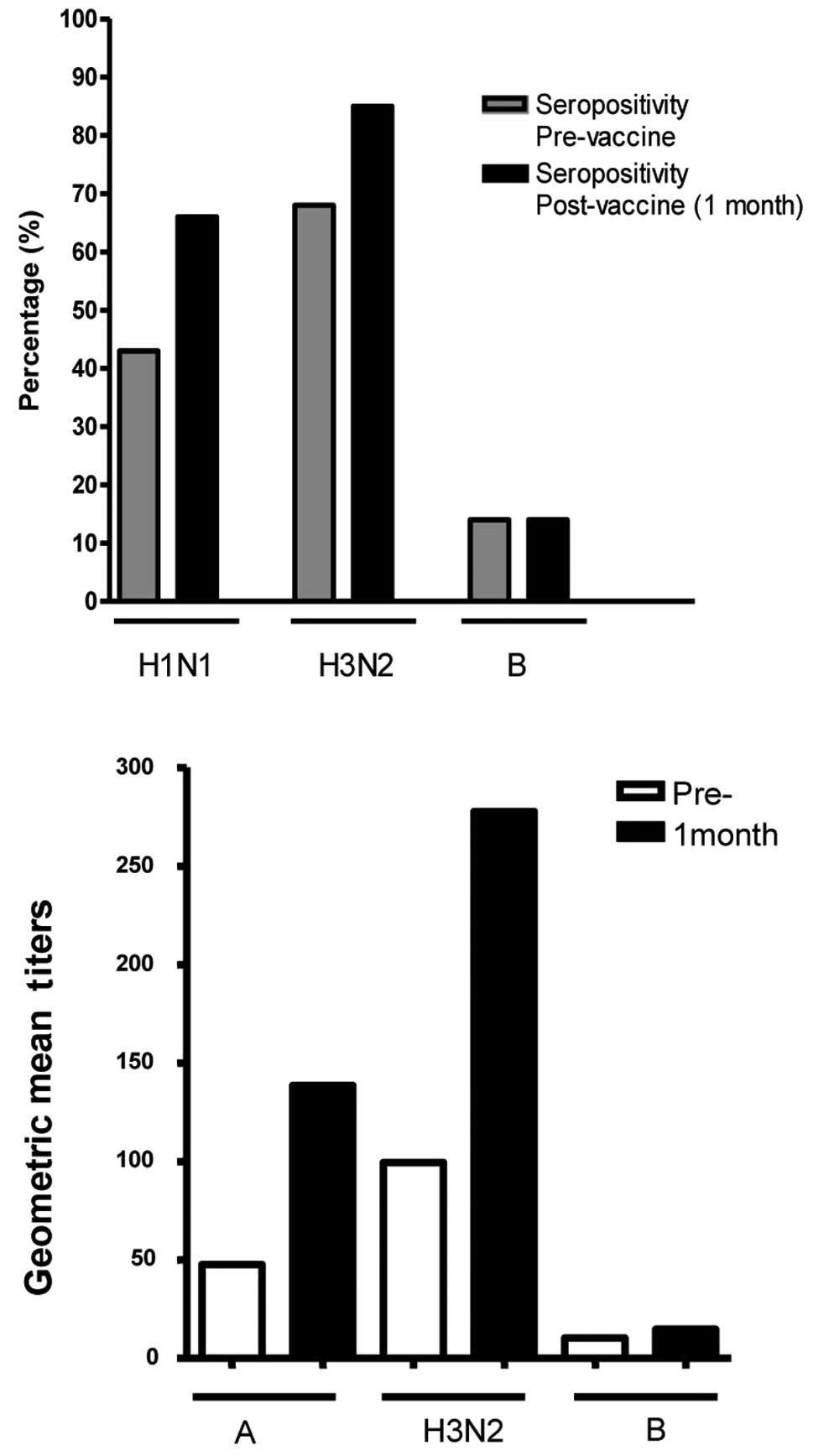
Seropositivity for the three serotypes (H1N1, H3N2
and B) prior to vaccination was observed in 43% of the patients and
an increase to 73% was observed 1 month after vaccination. An
individual analysis for each serotype of the virus at 1 month after
vaccination demonstrated an increase in seropositivity from 43%
prior to vaccination to 63% for the H1N1 serotype (p=0.02), from 68
to 85% following vaccination for the H3N2 serotype (p=0.05) and
from 0 to 14% for the B serotype (p=0.006; Fig. 1). An increase in the GMT was
observed from 31.35 (95% CI, 29–111) prior to vaccination to 143.45
(95% CI, 284–640) 1 month after immunization for all three
serotypes (p<0.001). An individual analysis by serotype revealed
an increase in the GMT for the H1N1 influenza virus from 47 (95%
CI, 128–378) prior to vaccination to 138 (95% CI, 363–685)
following immunization (p=0.009) and for the H3N2 virus from 99
(95% CI, 208–485) to 277 (95%, CI, 466–775; p=0.009). This
contrasted with the influenza B virus, where no statistically
significant increase in the GMT was observed, ranging from 10 (95%
CI, 9–10) prior to vaccination to 14 (95% CI, 5–58) following
immunization (p=0.11).
Cell-mediated immune response to
influenza vaccine
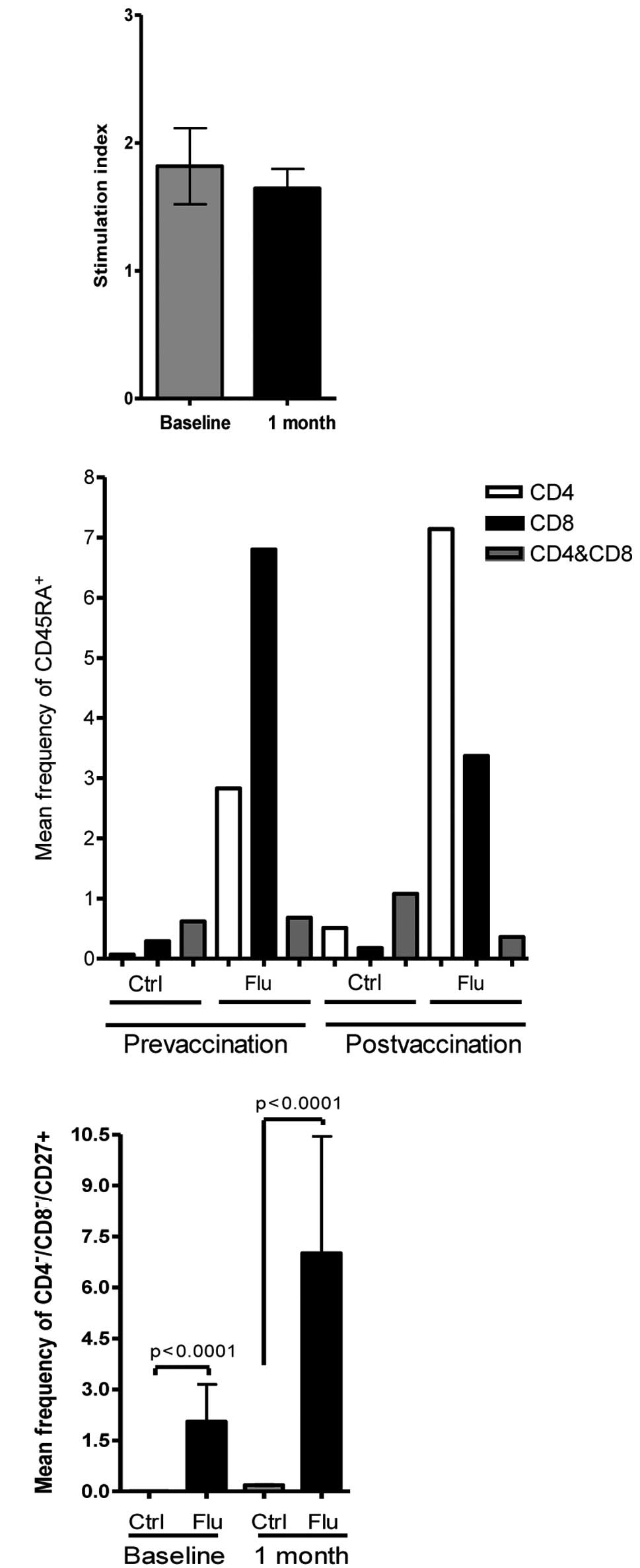
We did not observe any increase in the mean SI value
of 1.19±0.70 prior to vaccination compared with 1.65±1.03 following
influenza immunization (p=0.31) using the lymphoproliferation assay
measured by 3H-thymidine (Fig. 2A). No differences were observed in
the percentages of CD4+ and CD8+ T cells
prior to and following vaccination with or without influenza
antigen stimulation. However, an increase was observed in the
expression of CD45RA in CD4+ T cells with influenza
antigen stimulation (0.07±0.05 without stimulation vs. 2.83±1.46
stimulated; p<0.001) and in CD8+ T cells (0.29±0.24
without stimulation vs. 6.80±1.74 stimulated; p<0.001) prior to
vaccination and in CD8+ T cells following vaccination
(0.18±0.15 without stimulation vs. 3.37±1.65 stimulated; p=0.01;
Fig. 2B). An increase in expression
of the CD27 molecule was observed in
CD4−/CD8− cells when stimulated with
influenza antigen prior to vaccination (0.01±0.007 without
stimulation vs. 3.15±0.96 stimulated; p<0.0001), as well as
following vaccination (0.21±0.16 without stimulation vs. 10.44±3.58
stimulated; p<0.0001). A difference in the expression of CD27
with influenza stimulation prior to vaccination was observed
(3.15±0.96 vs. 10.44±3.58 following vaccination; p=0.05; Fig. 2C). These
CD4−/CD8− cells were also
CD56−/CD16− (data not shown).
Adverse effects
The vaccine was well tolerated by the individuals;
no serious adverse effects were reported and no hospitalizations
due to the influenza vaccination were reported. Most individuals
presented with local symptoms: 70% with pain, 9% with erythema, 4%
with swelling and 2% with redness in the injection area. General
symptoms included 5% of children presenting with fever, 2% with
rhinorrhea, 2% with malaise, 4% with myalgias, 5% with headache and
2% with coughing. The general symptoms resolved spontaneously
within days following the administration of symptomatic
treatment.
Discussion
Influenza is a significant disease worldwide due to
its pathogenic characteristics and its ability to constantly change
external surface proteins. The virus can cause severe disease and
has the potential to cause epidemics and pandemics even when
patients have had previous contact with related strains of the
virus (26,27). A notable example is the 2009
influenza type A H1N1 pandemic first reported in Mexico. This
pandemic was caused by a novel recombinant virus, with atypical
manifestations in the first reported cases that developed fatal
pneumonia (28–32). The disease is usually mild in
healthy individuals, but immunocompromised patients may develop
severe pneumonia and secondary bacterial infections and can succumb
to the disease. Due to the potential severe disease and the
associated complications, influenza vaccination is recommended
annually for this high-risk population (26,27).
In Mexico, there have been few studies concerning
influenza infections prior to the 2009 pandemic and the data are
scarce. The influenza surveillance network (FluNet) from the World
Health Organization reported 97 cases of influenza virus in Mexico
in 2006, 384 in 2007 and 118 in 2008; in contrast to 81,701 cases
detected during the 2009 pandemic and 2,878 until June 2010
(33). Two groups in Mexico
reported incidence of influenza prior to the pandemic of 7–12%
(5,6). Although the present study had a small
sample size, it was observed that 43% of the subjects expressed
antibodies against influenza types A H1N1, A H3N2 and B prior to
vaccination; this proportion increased to 73% following
vaccination. The observation of 43% seropositivity prior to
vaccination suggests an underreporting of influenza cases, the
circulation of the virus and previous infection since no study
participants had a history of influenza vaccination. Although these
children were receiving chemotherapy during immunization, the
antibody response increased following influenza vaccination to 73%.
This is in contrast to the results of a previous study which
suggested that chemotherapy limits the ability to develop a
sufficient immune response to vaccination and reported a
seropositivity level of 32% following vaccination (19).
An increase in the level of antibodies was observed
1 month after vaccination, in the absence of a cellular immune
response detected by the 3H-thymidine cell proliferation
assay. However, an increase in the expression of CD45RA+
in CD4+ and CD8+ cells prior to vaccination
and CD8+ cells following vaccination was detected,
suggesting activation prior to vaccination. CD45 in combination
with CCR7 in CD8+ cells are markers of naïve cells
(CD45RA+ CCR7+), effector cells
(CD45RA−/CCR7−), central memory cells
(CD45RA−/CCR7+), effector memory cells
(CD45RA−/CCR7−) or RA effector memory cells
(CD45RA+/CCR7−) (24). CD45RA alone with CD4 and CD8 are
naïve cells, which react with a new antigen. This explains the
increase in these cells prior to vaccination when stimulated with
influenza virus. CD4+/CD45RA+ T cells
increased with influenza stimulation following vaccination,
contrary to a decrease observed in
CD8+/CD45RA+ T cells stimulated after
vaccination. The decrease in the two naïve populations may be
explained by the effect of the chemotherapy agents, but the
increase in the CD4 population may suggest a faster recovery of the
naïve CD4 T cells rather than naïve CD8 T cells.
An increase in the expression of CD27 was also
observed in CD4−/CD8−/CD19− cells
when stimulated with influenza antigen and expression was higher
following vaccination. These cells were CD56− to rule
out natural killer cells (data not shown) and were then gated in
the lymphocyte area in a flow cytometry forward side scatter plot,
suggesting the activation of a precursor of T or B cells. Mature
lymphocytes did not express this marker, only the
CD4−/CD8− cells. Staining the cells with
other precursor markers may have yielded noteworthy results, but
the present study did not observe any increase in this population
until the recruitment of the patients was already finished.
The lack of lymphoproliferative responses of mature
lymphocytes, measured by 3H-thymidine and by flow
cytometry, may be explained by the constant assault on the cells
induced by chemotherapy. Chemotherapy is cytotoxic to lymphocytes
and to the bone marrow (17). The
bone marrow increases the production of blood cells that enter the
circulation and precursors are located within the peripheral blood
of children undergoing chemotherapy. This may explain the presence
of lymphocyte precursors. However, in this study, the lymphocyte
precursors associated with the activation marker CD27 (data not
reported previously). Although chemotherapy is toxic to bone marrow
and lymphocytes, the present study revealed that 43% of patients
expressed influenza-specific antibodies prior to vaccination. This
suggests that memory B cells or memory plasma cells in the bone
marrow are not fully affected by chemotherapy.
These results suggest that immunization against
influenza in children with cancer who are receiving chemotherapy
may increase the seropositivity rates, the GMT values and cellular
immune responses with the activation of probable lymphoid
precursors. The influenza vaccine was well tolerated in this
population.
Acknowledgements
We are grateful for the generous donation of
influenza vaccine from GlaxoSmithKline, Mexico. We are grateful to
the participants of the study and their parents and guardians, to
the social worker Juana Rodríguez-Castillo and to the pediatric
fellows at the Department of Infectious Disease Eneida
Sanchez-Medina and Mildred Zambrano-Leal for their assistance with
the patients' recruitment. This study was supported in part by a
grant from the Fogarty International Center and the Office of
Research on Women's Health (TW006193) and in part by a grant from
the Federal Funds of the Hospital Infantil de México Federico Gómez
(CO/2007/038). This study was presented as an abstract at the 48th
Annual Interscience Conference on Antimicrobial Agents and
Chemotherapy (ICAAC) and the Infectious Disease Society of America
(IDSA) 46th Annual Meeting, Washington, DC, USA, October 2008 and
the annual meeting of the Asociación Mexicana de Infectología y
Microbiología, León, Guanajuato, México, May 2008.
References
|
1
|
Wright PF and Webster RG:
Orthomyxoviruses. Fields Virology. Knipe DM and Howley PM: 4th
edition. Lippincott Williams & Wilkins; Philadelphia: pp.
1534–1579. 2001
|
|
2
|
Cox NJ and Subbarao K: Influenza. Lancet.
354:1277–1282. 1999. View Article : Google Scholar : PubMed/NCBI
|
|
3
|
Girard MP, Tam JS, Assossou OM and Kieny
MP: The 2009 A (H1N1) influenza virus pandemic: A review. Vaccine.
28:4895–4902. 2010. View Article : Google Scholar : PubMed/NCBI
|
|
4
|
Thompson WW, Shay DK, Weintraub E, et al:
Mortality associated with influenza and respiratory syncytial virus
in the United States. JAMA. 289:179–186. 2003. View Article : Google Scholar : PubMed/NCBI
|
|
5
|
Ayora-Talavera G, Gongora-Biachi RA,
Lopez-Martinez I, et al: Detection of human influenza virus in
Yucatan, Mexico. Rev Invest Clin. 54:410–414. 2002.PubMed/NCBI
|
|
6
|
Noyola DE, Rodriguez-Moreno G,
Sanchez-Alvarado J, Martinez-Wagner R and Ochoa-Zavala JR: Viral
etiology of lower respiratory tract infections in hospitalized
children in Mexico. Pediatr Infect Dis J. 23:118–123. 2004.
View Article : Google Scholar : PubMed/NCBI
|
|
7
|
Nicholson KG: Clinical features of
influenza. Semin Respir Infect. 7:26–37. 1992.
|
|
8
|
Dagan R and Hall CB: Influenza A virus
infection imitating bacterial sepsis in early infancy. Pediatr
Infect Dis. 3:218–221. 1984. View Article : Google Scholar : PubMed/NCBI
|
|
9
|
Thompson WW, Shay DK, Weintraub E, et al:
Influenza-associated hospitalizations in the United States. JAMA.
292:1333–1340. 2004. View Article : Google Scholar : PubMed/NCBI
|
|
10
|
Barker WH and Mullooly JP: Impact of
epidemic type A influenza in a defined adult population. Am J
Epidemiol. 112:798–811. 1980.PubMed/NCBI
|
|
11
|
Lui KJ and Kendal AP: Impact of influenza
epidemics on mortality in the United States from October 1972 to
May 1985. Am J Public Health. 77:712–716. 1987. View Article : Google Scholar : PubMed/NCBI
|
|
12
|
Eickhoff TC, Sherman IL and Serfling RE:
Observations on excess mortality associated with epidemic
influenza. JAMA. 176:776–782. 1961. View Article : Google Scholar : PubMed/NCBI
|
|
13
|
Barker WH and Mullooly JP: Pneumonia and
influenza deaths during epidemics: implications for prevention.
Arch Intern Med. 142:85–89. 1982. View Article : Google Scholar : PubMed/NCBI
|
|
14
|
Simonsen L, Clarke MJ, Schonberger LB,
Arden NH, Cox NJ and Fukuda K: Pandemic versus epidemic influenza
mortality: a pattern of changing age distribution. J Infect Dis.
178:53–60. 1998. View
Article : Google Scholar : PubMed/NCBI
|
|
15
|
Keren R, Zaoutis TE, Bridges CB, et al:
Neurological and neuromuscular disease as a risk factor for
respiratory failure in children hospitalized with influenza
infection. JAMA. 294:2188–2194. 2005. View Article : Google Scholar : PubMed/NCBI
|
|
16
|
Grijalva CG, Craig AS, Dupont WD, et al:
Estimating influenza hospitalizations among children. Emerg Infect
Dis. 12:103–109. 2006. View Article : Google Scholar : PubMed/NCBI
|
|
17
|
Balmer CM, Valley AW and Iannucci A:
Cancer treatment and chemotherapy. Pharmacotherapy: A
Pathophysiologic Approach. DiPiro JT, Talbert RL, Yee GC, Matzke
GR, Wells BG, Posey M and Schwinghammer T: 6th edition.
McGraw-Hill; New York, NY: pp. 2279–2328. 2005
|
|
18
|
Anderson H, Petrie K, Berrisford C,
Charlett A, Thatcher N and Zambon M: Seroconversion after influenza
vaccination in patients with lung cancer. Br J Cancer. 80:219–220.
1999. View Article : Google Scholar : PubMed/NCBI
|
|
19
|
Matsuzaki A, Suminoe A, Koga Y, Kinukawa
N, Kusuhara K and Hara T: Immune response after influenza
vaccination in children with cancer. Pediatr Blood Cancer.
45:831–837. 2005. View Article : Google Scholar : PubMed/NCBI
|
|
20
|
McElhaney JE, Xie D, Hager WD, et al: T
cell responses are better correlates of vaccine protection in the
elderly. J Immunol. 176:6333–6339. 2006. View Article : Google Scholar : PubMed/NCBI
|
|
21
|
Woodland DL: Cell-mediated immunity to
respiratory virus infections. Curr Opin Immunol. 15:430–435. 2003.
View Article : Google Scholar : PubMed/NCBI
|
|
22
|
Kim SV and Flavell RA: Immunology.
CD8alphaalpha and T cell memory. Science. 304:529–530. 2004.
View Article : Google Scholar : PubMed/NCBI
|
|
23
|
Kaech SM, Wherry EJ and Ahmed R: Effector
and memory T-cell differentiation: implications for vaccine
development. Nat Rev Immunol. 2:251–262. 2002. View Article : Google Scholar : PubMed/NCBI
|
|
24
|
Robinson HL and Amara RR: T cell vaccines
for microbial infections. Nat Med. 11:S25–S32. 2005. View Article : Google Scholar : PubMed/NCBI
|
|
25
|
Matter MS, Claus C and Ochsenbein AF:
CD4+ T cell help improves CD8+ T cell memory
by retained CD27 expression. Eur J Immunol. 38:1847–1856. 2008.
|
|
26
|
Smith NM, Bresee JS, Shay DK, Uyeki TM,
Cox NJ and Strikas RA: Prevention and Control of Influenza:
recommendations of the Advisory Committee on Immunization Practices
(ACIP). MMWR Recomm Rep. 55(RR-10): 1–42. 2006.
|
|
27
|
Weber DJ and Rutala WA: Immunization of
immunocompromised persons. Immunol Allergy Clin North Am.
23:605–634. v–vi. 2003. View Article : Google Scholar : PubMed/NCBI
|
|
28
|
Fraser C, Donnelly CA, Cauchemez S, et al:
Pandemic potential of a strain of influenza A (H1N1): early
findings. Science. 324:1557–1561. 2009. View Article : Google Scholar : PubMed/NCBI
|
|
29
|
Dawood FS, Jain S, Finelli L, et al:
Emergence of a novel swine-origin influenza A (H1N1) virus in
humans. N Engl J Med. 360:2605–2615. 2009. View Article : Google Scholar : PubMed/NCBI
|
|
30
|
Sotelo J and Perez-Padilla R: The flu
epidemic in Mexico: the challenges for doctors. BMJ. 338:b18202009.
View Article : Google Scholar : PubMed/NCBI
|
|
31
|
Butler D: Swine flu goes global. Nature.
458:1082–1083. 2009. View
Article : Google Scholar : PubMed/NCBI
|
|
32
|
Perez-Padilla R, de la Rosa-Zamboni D,
Ponce de Leon S, et al: Pneumonia and respiratory failure from
swine-origin influenza A (H1N1) in Mexico. N Engl J Med.
361:680–689. 2009. View Article : Google Scholar : PubMed/NCBI
|
|
33
|
World Health Organization. Influenza
surveillance network. URL http://gamapserver.who.int/GlobalAtlas/DataQuery/viewData.asp.
Accessed June 29, 20102010
|