Introduction
Solitary extramedullary plasmacytoma is a relatively
rare neoplastic disorder arising from B-lymphocytes. Although
solitary extramedullary plasmacytoma may occur in numerous organs,
including the central nervous system, urinary bladder, thyroid,
breast, testes, parotid glands and lymph nodes (1), to the best of our knowledge, the
occurrence of plasmacytoma in the conjunctiva is unusual. In the
present study, we present a case report of plasmacytoma confined to
the conjunctiva of a 17-year-old female.
Case report
Patient examination
A 17-year-old Chinese female was admitted to the
Chinese PLA General Hospital with a progressively increasing
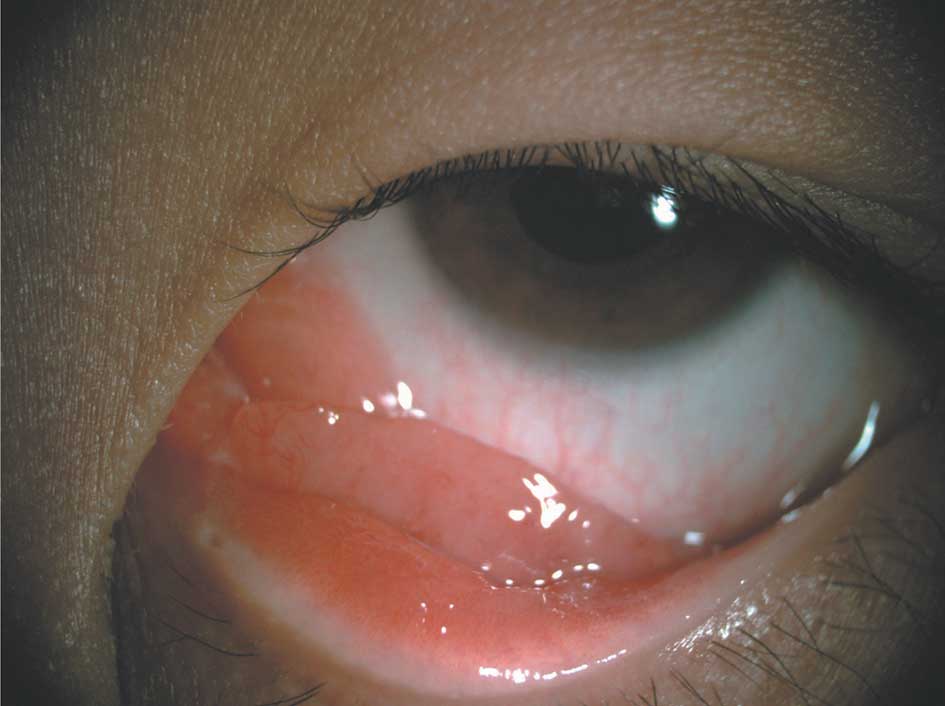
painless swelling in the lower fornix conjunctiva of the left eye,
which was first noticed two months prior to presentation. There was
no history of ocular infection or trauma in the affected eye and
the family history of the patient revealed no ocular problems. Upon
examination, the visual acuity of the patient was 20/20 oculi
uterque (OU). Located on the lower fornix conjunctiva of the
left eye, without congestion of palpebral or bulbar conjunctiva,
was a mobile, elastic, pink mass approximately 23×13 mm in size and
its surface was smooth (Fig. 1).
The remaining ophthalmic examination was unremarkable.
Immunohistochemistry
A surgical excision of the lesion with amniotic
membrane transplantation was performed. Under microscopic
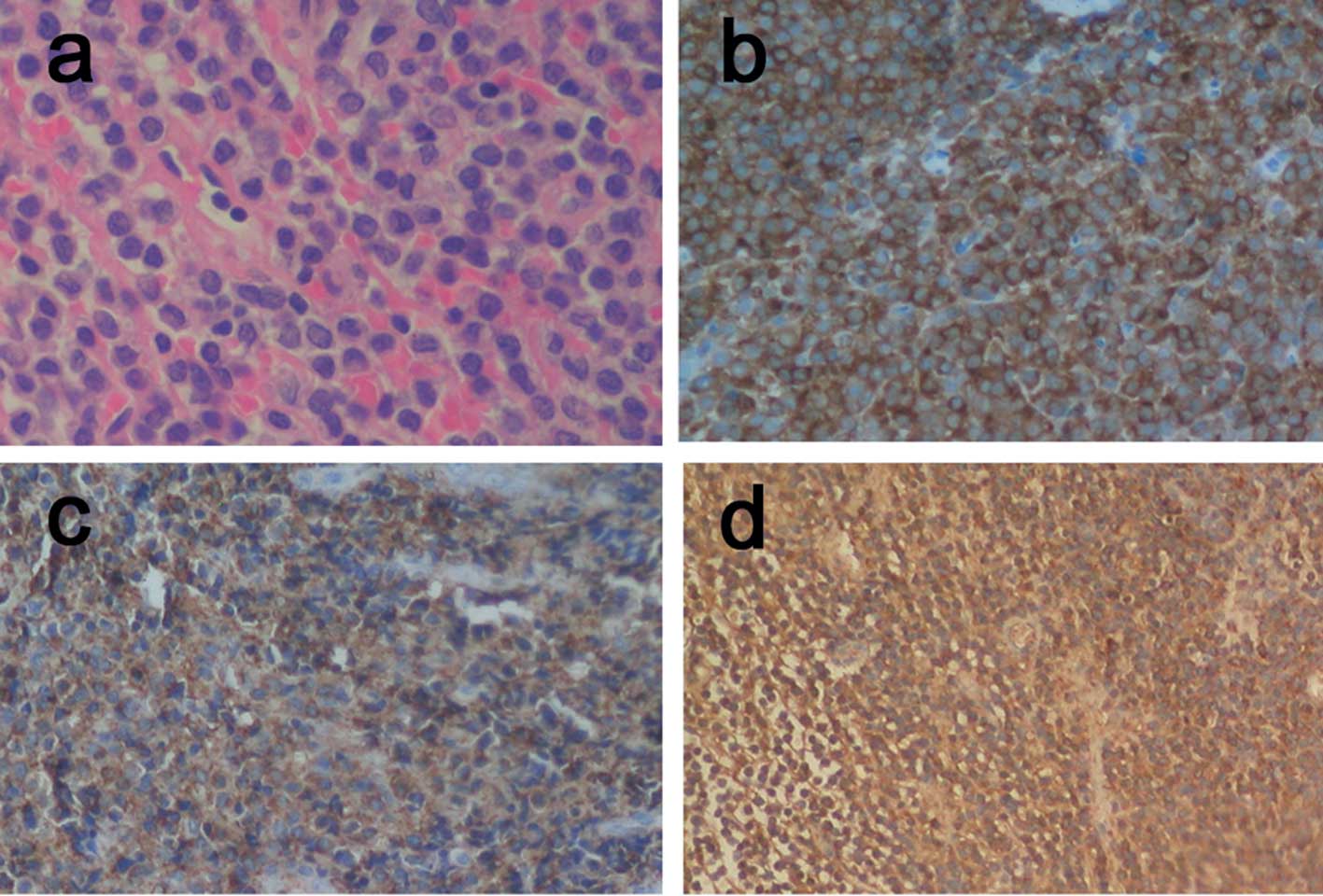
examination, the specimen revealed sheets of plasma cells with a
high proliferative index, which were surrounded by connective
tissue. A number of the plasma cells had mitotic figures, which
demonstrated that binucleated plasma cells were also observed
(Fig. 2A). Immunocytochemical
staining showed that CD138, IgG and κ light chain were present and
λ light chain was not (Fig. 2B, C and
D). Further investigation with bone marrow aspirate showed that
the cellularity and number of plasma cells were normal, without any
myeloma cells. A complete skeletal survey failed to show bony
masses or osteolytic events. Serum protein electrophoresis was
within normal limits and urine was negative for Bence Jones
protein.
Treatment
Following surgery, the patient received a course of
radiotherapy (a dose of 40 Gy in 10 administrations) and was
invited for a checkup once a month. On follow-up (12 months) there
was no sign of local recurrence or the development of multiple
myeloma.
Discussion
Primary solitary extramedullary plasmacytoma is rare
and it may be diagnosed on the condition of no evidence of solitary
plasmacytoma of bone or multiple myeloma, including the bone
marrow, without local tumour, and normal urine, serum
electrophoresis and haemoglobin (2). The occurrence of plasmacytoma in the
eye is infrequent. Olivieri et al (3) reported a case of eyelid plasmacytoma.
Yumori et al (4) described a
case of bulbar conjunctival plasmacytoma, which was not associated
with clinical or laboratory signs of multiple myeloma. Certain
cases report that plasmacytoma occurring in the eye is not true
plasmacytoma, but instead is a granuloma due to chronic
inflammation (5).
Immunocytochemical staining may confirm diagnosis when the
histopathological appearance is ambiguous. The origin of the
plasmacytoma in the present case is unclear, but the plasmacytoma
demonstrated a proliferation of CD138, CD79a and κ light chain and
the expression profiles were in accordance with plasmacytoma.
The prognosis for patients with plasmacytoma is
favorable. Treatment includes surgery, radiotherapy and
chemotherapy. The patient in this case was treated with surgery
followed by radiotherapy, as bone marrow and blood examinations
were normal and systemic evaluation did not reveal similar lesions
elsewhere.
In conclusion, we report a rare case of plasmacytoma
originating in the fornix conjunctiva. No complications or tumor
recurrence have been noted thus far. However, a longer follow up is
required.
References
|
1
|
Dimopoulos MA, Kiamouris C and Moulopoulos
LA: Solitary plasmacytoma of bone and extramedullary plasmacytoma.
Hematol Oncol Clin North Am. 13:1249–1257. 1999. View Article : Google Scholar : PubMed/NCBI
|
|
2
|
Wax MK, Yun KJ and Omar RA: Extramedullary
plasmacytomas of the head and neck. Otolaryngol Head Neck Surg.
109:877–885. 1993.PubMed/NCBI
|
|
3
|
Olivieri L, Di Ianni M, Giansanti M,
Falini B and Tabilio A: Primary eyelid plasmacytoma. Med Oncol.
17:74–75. 2000. View Article : Google Scholar
|
|
4
|
Yumori JW, Ilsen P and Bright DC:
Conjunctival plasmacytoma. Optometry. 81:234–239. 2010. View Article : Google Scholar : PubMed/NCBI
|
|
5
|
Seddon JM, Corwin JM, Weiter JJ, Brisbane
JU and Sutula FC: Solitary extramedullary plasmacytoma of the
palpebral conjunctiva. Br J Ophthalmol. 66:450–454. 1982.
View Article : Google Scholar : PubMed/NCBI
|