Spandidos Publications Logo
  • About
    • About Spandidos
    • Aims and Scopes
    • Abstracting and Indexing
    • Editorial Policies
    • Reprints and Permissions
    • Job Opportunities
    • Terms and Conditions
    • Contact
  • Journals
    • All Journals
    • Oncology Letters
      • Oncology Letters
      • Information for Authors
      • Editorial Policies
      • Editorial Board
      • Aims and Scope
      • Abstracting and Indexing
      • Bibliographic Information
      • Archive
    • International Journal of Oncology
      • International Journal of Oncology
      • Information for Authors
      • Editorial Policies
      • Editorial Board
      • Aims and Scope
      • Abstracting and Indexing
      • Bibliographic Information
      • Archive
    • Molecular and Clinical Oncology
      • Molecular and Clinical Oncology
      • Information for Authors
      • Editorial Policies
      • Editorial Board
      • Aims and Scope
      • Abstracting and Indexing
      • Bibliographic Information
      • Archive
    • Experimental and Therapeutic Medicine
      • Experimental and Therapeutic Medicine
      • Information for Authors
      • Editorial Policies
      • Editorial Board
      • Aims and Scope
      • Abstracting and Indexing
      • Bibliographic Information
      • Archive
    • International Journal of Molecular Medicine
      • International Journal of Molecular Medicine
      • Information for Authors
      • Editorial Policies
      • Editorial Board
      • Aims and Scope
      • Abstracting and Indexing
      • Bibliographic Information
      • Archive
    • Biomedical Reports
      • Biomedical Reports
      • Information for Authors
      • Editorial Policies
      • Editorial Board
      • Aims and Scope
      • Abstracting and Indexing
      • Bibliographic Information
      • Archive
    • Oncology Reports
      • Oncology Reports
      • Information for Authors
      • Editorial Policies
      • Editorial Board
      • Aims and Scope
      • Abstracting and Indexing
      • Bibliographic Information
      • Archive
    • Molecular Medicine Reports
      • Molecular Medicine Reports
      • Information for Authors
      • Editorial Policies
      • Editorial Board
      • Aims and Scope
      • Abstracting and Indexing
      • Bibliographic Information
      • Archive
    • World Academy of Sciences Journal
      • World Academy of Sciences Journal
      • Information for Authors
      • Editorial Policies
      • Editorial Board
      • Aims and Scope
      • Abstracting and Indexing
      • Bibliographic Information
      • Archive
    • International Journal of Functional Nutrition
      • International Journal of Functional Nutrition
      • Information for Authors
      • Editorial Policies
      • Editorial Board
      • Aims and Scope
      • Abstracting and Indexing
      • Bibliographic Information
      • Archive
    • International Journal of Epigenetics
      • International Journal of Epigenetics
      • Information for Authors
      • Editorial Policies
      • Editorial Board
      • Aims and Scope
      • Abstracting and Indexing
      • Bibliographic Information
      • Archive
    • Medicine International
      • Medicine International
      • Information for Authors
      • Editorial Policies
      • Editorial Board
      • Aims and Scope
      • Abstracting and Indexing
      • Bibliographic Information
      • Archive
  • Articles
  • Information
    • Information for Authors
    • Information for Reviewers
    • Information for Librarians
    • Information for Advertisers
    • Conferences
  • Language Editing
Spandidos Publications Logo
  • About
    • About Spandidos
    • Aims and Scopes
    • Abstracting and Indexing
    • Editorial Policies
    • Reprints and Permissions
    • Job Opportunities
    • Terms and Conditions
    • Contact
  • Journals
    • All Journals
    • Biomedical Reports
      • Information for Authors
      • Editorial Policies
      • Editorial Board
      • Aims and Scope
      • Abstracting and Indexing
      • Bibliographic Information
      • Archive
    • Experimental and Therapeutic Medicine
      • Information for Authors
      • Editorial Policies
      • Editorial Board
      • Aims and Scope
      • Abstracting and Indexing
      • Bibliographic Information
      • Archive
    • International Journal of Epigenetics
      • Information for Authors
      • Editorial Policies
      • Editorial Board
      • Aims and Scope
      • Abstracting and Indexing
      • Bibliographic Information
      • Archive
    • International Journal of Functional Nutrition
      • Information for Authors
      • Editorial Policies
      • Editorial Board
      • Aims and Scope
      • Abstracting and Indexing
      • Bibliographic Information
      • Archive
    • International Journal of Molecular Medicine
      • Information for Authors
      • Editorial Policies
      • Editorial Board
      • Aims and Scope
      • Abstracting and Indexing
      • Bibliographic Information
      • Archive
    • International Journal of Oncology
      • Information for Authors
      • Editorial Policies
      • Editorial Board
      • Aims and Scope
      • Abstracting and Indexing
      • Bibliographic Information
      • Archive
    • Medicine International
      • Information for Authors
      • Editorial Policies
      • Editorial Board
      • Aims and Scope
      • Abstracting and Indexing
      • Bibliographic Information
      • Archive
    • Molecular and Clinical Oncology
      • Information for Authors
      • Editorial Policies
      • Editorial Board
      • Aims and Scope
      • Abstracting and Indexing
      • Bibliographic Information
      • Archive
    • Molecular Medicine Reports
      • Information for Authors
      • Editorial Policies
      • Editorial Board
      • Aims and Scope
      • Abstracting and Indexing
      • Bibliographic Information
      • Archive
    • Oncology Letters
      • Information for Authors
      • Editorial Policies
      • Editorial Board
      • Aims and Scope
      • Abstracting and Indexing
      • Bibliographic Information
      • Archive
    • Oncology Reports
      • Information for Authors
      • Editorial Policies
      • Editorial Board
      • Aims and Scope
      • Abstracting and Indexing
      • Bibliographic Information
      • Archive
    • World Academy of Sciences Journal
      • Information for Authors
      • Editorial Policies
      • Editorial Board
      • Aims and Scope
      • Abstracting and Indexing
      • Bibliographic Information
      • Archive
  • Articles
  • Information
    • For Authors
    • For Reviewers
    • For Librarians
    • For Advertisers
    • Conferences
  • Language Editing
Login Register Submit
  • This site uses cookies
  • You can change your cookie settings at any time by following the instructions in our Cookie Policy. To find out more, you may read our Privacy Policy.

    I agree
Search articles by DOI, keyword, author or affiliation
Search
Advanced Search
presentation
Oncology Letters
Join Editorial Board Propose a Special Issue
Print ISSN: 1792-1074 Online ISSN: 1792-1082
Journal Cover
August 2012 Volume 4 Issue 2

Full Size Image

Sign up for eToc alerts
Recommend to Library

Journals

International Journal of Molecular Medicine

International Journal of Molecular Medicine

International Journal of Molecular Medicine is an international journal devoted to molecular mechanisms of human disease.

International Journal of Oncology

International Journal of Oncology

International Journal of Oncology is an international journal devoted to oncology research and cancer treatment.

Molecular Medicine Reports

Molecular Medicine Reports

Covers molecular medicine topics such as pharmacology, pathology, genetics, neuroscience, infectious diseases, molecular cardiology, and molecular surgery.

Oncology Reports

Oncology Reports

Oncology Reports is an international journal devoted to fundamental and applied research in Oncology.

Experimental and Therapeutic Medicine

Experimental and Therapeutic Medicine

Experimental and Therapeutic Medicine is an international journal devoted to laboratory and clinical medicine.

Oncology Letters

Oncology Letters

Oncology Letters is an international journal devoted to Experimental and Clinical Oncology.

Biomedical Reports

Biomedical Reports

Explores a wide range of biological and medical fields, including pharmacology, genetics, microbiology, neuroscience, and molecular cardiology.

Molecular and Clinical Oncology

Molecular and Clinical Oncology

International journal addressing all aspects of oncology research, from tumorigenesis and oncogenes to chemotherapy and metastasis.

World Academy of Sciences Journal

World Academy of Sciences Journal

Multidisciplinary open-access journal spanning biochemistry, genetics, neuroscience, environmental health, and synthetic biology.

International Journal of Functional Nutrition

International Journal of Functional Nutrition

Open-access journal combining biochemistry, pharmacology, immunology, and genetics to advance health through functional nutrition.

International Journal of Epigenetics

International Journal of Epigenetics

Publishes open-access research on using epigenetics to advance understanding and treatment of human disease.

Medicine International

Medicine International

An International Open Access Journal Devoted to General Medicine.

Journal Cover
August 2012 Volume 4 Issue 2

Full Size Image

Sign up for eToc alerts
Recommend to Library

  • Article
  • Citations
    • Cite This Article
    • Download Citation
    • Create Citation Alert
    • Remove Citation Alert
    • Cited By
  • Similar Articles
    • Related Articles (in Spandidos Publications)
    • Similar Articles (Google Scholar)
    • Similar Articles (PubMed)
  • Download PDF
  • Download XML
  • View XML
Article

Advantages of the quenching probe method over other PCR-based methods for detection of the JAK2 V617F mutation

  • Authors:
    • Aya Ono
    • Yuki Okuhashi
    • Yusuke Takahashi
    • Mai Itoh
    • Nobuo Nara
    • Shuji Tohda
  • View Affiliations / Copyright

    Affiliations: Department of Laboratory Medicine, Tokyo Medical and Dental University, Tokyo 113-8519, Japan
  • Pages: 205-208
    |
    Published online on: May 31, 2012
       https://doi.org/10.3892/ol.2012.741
  • Expand metrics +
Metrics: Total Views: 0 (Spandidos Publications: | PMC Statistics: )
Metrics: Total PDF Downloads: 0 (Spandidos Publications: | PMC Statistics: )
Cited By (CrossRef): 0 citations Loading Articles...

This article is mentioned in:


Abstract

The detection of a V617F mutation (G to T exchange at nucleotide 1,849) in the JAK2 gene is crucial for the diagnosis of myeloproliferative neoplasms (MPN) such as polycythemia vera. Although sequence analysis is the standard method for detection, it is not suitable for clinical examinations due to the requirement of expensive equipment. In this study, we evaluated the efficiencies of four PCR-based methods to detect JAK2 V617F: allele-specific PCR (AS-PCR), PCR-restriction fragment length polymorphism (PCR-RFLP), high-resolution melting analysis (HRM) and the quenching probe method (QP). The HEL cell line, which harbors a homozygous JAK2 V617F mutation, as well as bone marrow samples from 16 MPN patients and normal control samples, were used in this assessment. The sensitivity of the detection limit of all four methods was also examined using samples of HEL cells mixed in a variety of ratios with cells containing wild‑type JAK2. The results of all four methods were found to be concordant. AS-PCR was shown to be the most sensitive; however, it produced false positive results. Although PCR-RFLP demonstrated high specificity, it was time consuming. By contrast, results were obtained using HRM and QP in only 2 h. It was easier to recognize the curves derived from the mutant allele obtained using QP. QP is also suitable for the rough estimation of allele burden. JAK2 V617F assays are mainly used for diagnosis at presentation in clinical settings. We therefore conclude that in situations where high sensitivity is not required, QP is the preferable method for the detection of JAK2 V617F. To the best of our knowledge, this is the first report to demonstrate the efficiency of the QP method for the detection of JAK2 V617F using a standard thermal cycler.

Introduction

Janus kinase 2 (JAK2) is a cytoplasmic tyrosine kinase that has roles in hematopoietic growth factor signaling pathways such as those stimulated by erythropoietin and interleukin-3. An acquired mutation of G to T at nucleotide 1,849 of JAK2, JAK2 V617F, constitutively activates signaling in hematopoietic stem cells and leads to the development of myeloproliferative neoplasms (MPN) such as polycythemia vera (PV), essential thrombocythemia (ET), and primary myelofibrosis (PMF). Indeed, JAK2 mutation is included in the diagnostic criteria of these three diseases (1).

Although sequence analysis is currently the standard method for the detection of JAK2 mutation, this technique is not suitable for clinical examinations in hospital laboratories as it requires expensive equipment and takes time. Moreover, the sensitivity of the detection limit of sequencing is not less than 10–20% (2). Therefore, the use of various PCR-based methods such as allele-specific PCR (AS-PCR), PCR-restriction fragment length polymorphism (PCR-RFLP) and high-resolution melting analysis (HRM) has been investigated. Recently, the quenching probe method (QP) has been attracting attention as a novel technique capable of detecting single nucleotide polymorphisms and mutations (3).

In QP, an oligonucleotide with a cytosine modified by fluorescent dye at the 3′ end (Q probe) is used as the probe. Following completion of PCR, a melting curve analysis is performed. At low temperature, the probes hybridize with PCR products and their fluorescence is quenched by an electron transfer to adjacent guanine bases in the PCR products. As the temperature is raised, the probes dissociate from the PCR products and the fluorescent signal increases. Since the probes dissociate from unmatched products at lower temperatures than perfectly matched products, it is possible to detect mutations.

In this study, we performed a comparative evaluation of the efficiency and sensitivity of four PCR-based methods to detect JAK2 V617F. To the best of our knowledge, this is the first study to demonstrate the efficiency of the QP method for the detection of JAK2 V617F using a standard thermal cycler.

Materials and methods

Cells and DNA extraction

Two leukemia cell lines were used. HEL, an erythroid leukemia cell line with a homozygous JAK2 V617F mutation, was supplied by the Japanese Collection of Research Bioresources (Ibaraki, Japan). KOPT-K1, a T-lymphoblastic leukemia cell line with wild-type JAK2, was donated by Drs. Harashima and Orita (Fujisaki Cell Center, Japan). To investigate the sensitivity of the detection limit, samples of HEL cells and KOPT-K1 cells mixed at various ratios were used. We obtained bone marrow samples from 16 MPN patients (six PV, eight ET, one PMF, and one unclassifiable MPN) with informed consent. Blood samples from two normal volunteers were used as a control. DNA was extracted from cells following the spin column method using QIAamp DNA Blood Mini kit (Qiagen, Germantown, MD, USA).

AS-PCR

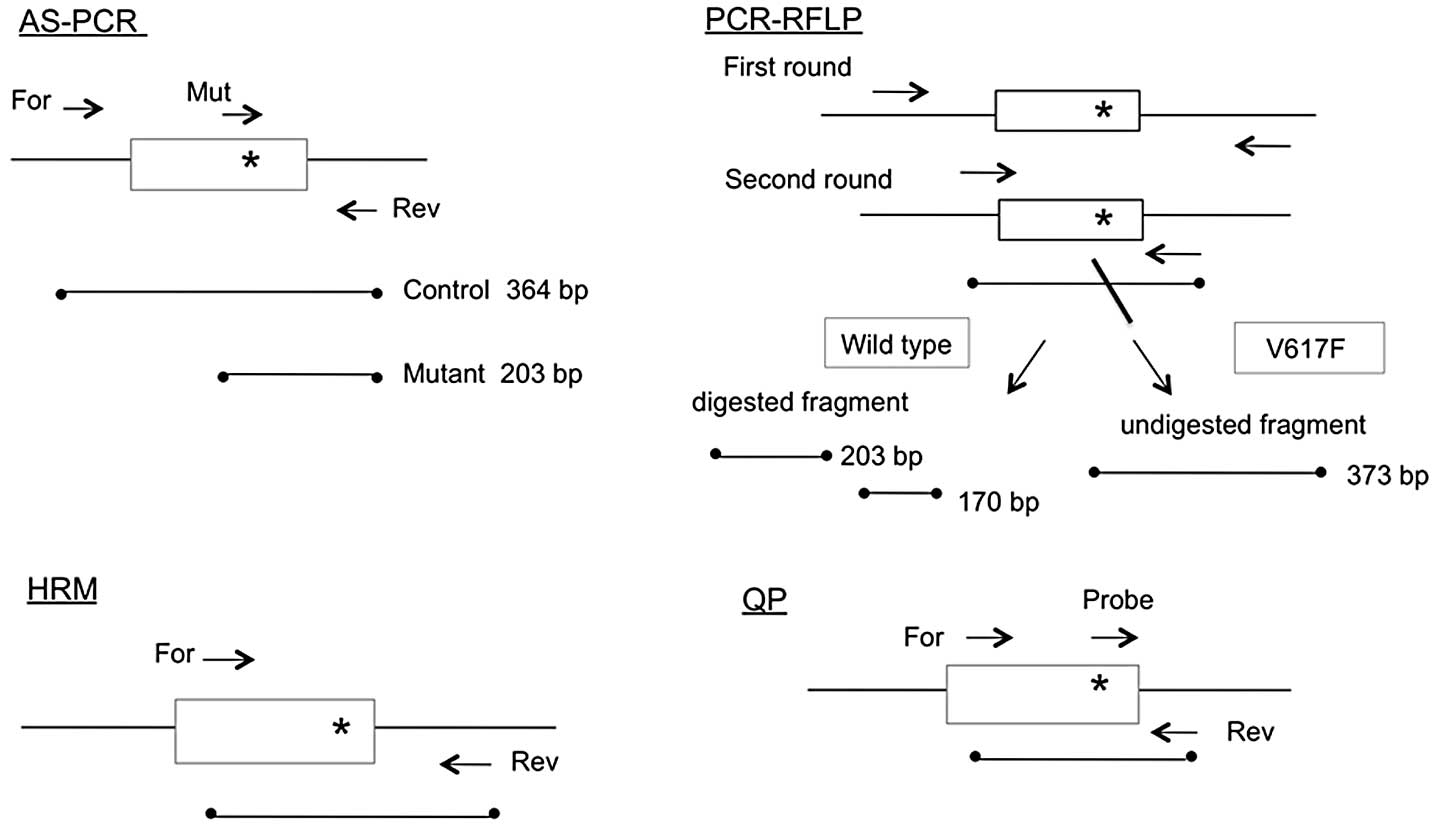
The schematic outlines of all four PCR methods are shown in Fig. 1, while the primer sequences used are presented in Table I. The AS-PCR method used in this study was modified from a previously reported protocol (4) and the mutant primer contained an intentional mismatch at the third nucleotide from the 3′ end to improve specificity. Amplifications were performed in a 50 μl reaction volume with 0.2 μg DNA, 1.5 mM MgCl2, 0.2 mM dNTP, 0.5 μM primers, and 1 unit Taq polymerase (Takara, Japan), and the resulting PCR products were electrophoresed in a 2% agarose gel and stained with ethidium bromide. The assay was repeated at least three times to ascertain the reproducibility of this method.

Figure 1

Schematic outline of four PCR-based detection methods for JAK2 V617F mutation.

Table I

Primers, probes and PCR protocols.

Table I

Primers, probes and PCR protocols.

MethodPrimer sequenceNo. of cyclesMelting point temperatureRef.
AS-PCRFor: 5′-atctatagtcatgctgaaagtaggagaaag-3′
Mut: 5′-agcatttggttttaaattatggagtatatt-3′
Rev: 5′-ctgaatagtcctacagtgttttcagtttca-3′
4094°C 1 min, 57°C 1 min, 72°C 1 min4
PCR-RFLP
 First roundFor: 5′-ggtttcctcagaacgttgatgg-3′
Rev: 5′-ttgtttgggcattgtaaccttc-3′
3594°C 1 min, 55°C 1 min, 72°C 1 min5
 Second roundFor: 5′-tgctgaaagtaggagaaagtgcat-3′
Rev: 5′-tcctacagtgttttcagtttcaaaaa-3′
2594°C 1 min, 60°C 1 min, 72°C 1 min
HRMFor: 5′-agcaagctttctcacaagca-3′
Rev: 5′-ctgacacctagctgtgatcctg-3′
4595°C 15 sec, 58°C 15 sec, 72°C 15 sec6
QPFor: 5′-gcagcaagtatgatgagcaagctttctc-3′
Rev: 5′-gctctgagaaaggcattagaaagcctg-3′
Probe: 5′-agtatgtttctgtggagac-(BODIPY FL)-3′
4595°C 15 sec, 58°C 15 sec, 72°C 15 sec7

[i] The primer and probe sequences correspond to those in the indicated references. The base corresponding to the mutated nucleotide 1,849 is underlined.

PCR-RFLP

The PCR-RFLP method used in this study was modified from a previously reported protocol (5). The first round of nested PCR was performed in a 50 μl reaction volume with 0.2 μg DNA sample, 1.5 mM MgCl2, 0.2 mM dNTP, 0.5 μM primers, and 1 unit Taq polymerase. The second round of PCR was performed in a 50 μl reaction volume containing 2 μl of the first round products. The resulting products were digested with BsaXI (New England Biolabs, Hitchin, UK), and the PCR products and BsaXI-treated products were electrophoresed as described above.

HRM

HRM was performed using a LightCycler Nano (Roche Diagnostics, Mannheim, Germany) according to a previously reported protocol, with modifications (6). Amplifications were performed in a 20 μl reaction volume with 30 ng DNA sample, 3 mM MgCl2, 0.2 μM primers and 10 μl Master Mix [LC 480 High Resolution Melting Master (Roche)] following incubation for 10 min at 95°C. Melting conditions were as follows: denaturation at 95°C for 1 min, renaturation at 40°C for 1 min, and melting at a gradient from 60–95°C with 50 fluorescent acquisitions per 1°C. The normalized and temperature-shifted difference curves were determined using LightCycler Nano HRM software (Roche).

QP

The QP method was performed with modifications to a previously reported protocol (7) using a LightCycler Nano. Following incubation for 10 min at 95°C, amplifications were performed in a 20 μl reaction volume with 30 ng DNA sample, 1.5 mM MgCl2, 0.2 μM primers, 0.1 μM Q probe, and 10 μl reaction mix [LC 480 Genotyping Master (Roche)]. The Q probe was labeled with BODIPY FL at its 3′ end, and had a sequence complementary to the mutant allele. Following completion of PCR, the temperature was maintained at 95°C for 1 min, 40°C for 1 min, and then gradually increased to 90°C at the rate of 0.05°C/sec, during which the fluorescence signal was continually acquired. The curves for degree of fluorescence increase (dF/dT) were obtained from the data using LightCycler Nano software (Roche).

Direct sequencing

To confirm the G to T mutation at nucleotide 1,849, the PCR products from selected samples were sequenced using a 3130xl Genetic Analyzer and BigDye v3.1 (Applied Biosystems, Foster City, CA, USA).

Results

Discrimination between wild-type and mutant alleles

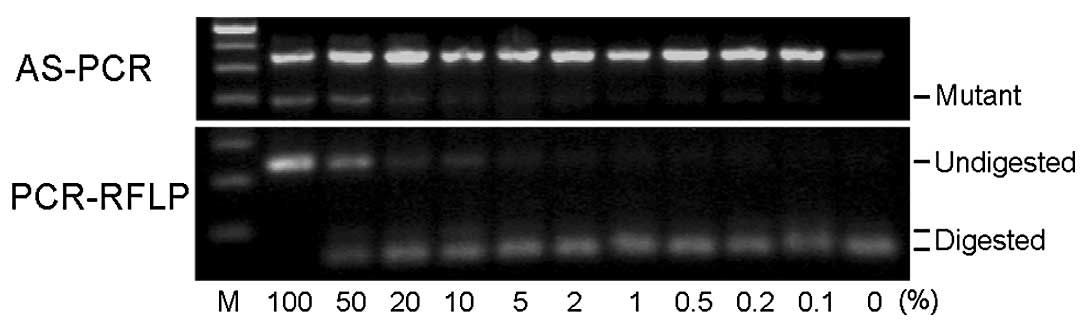
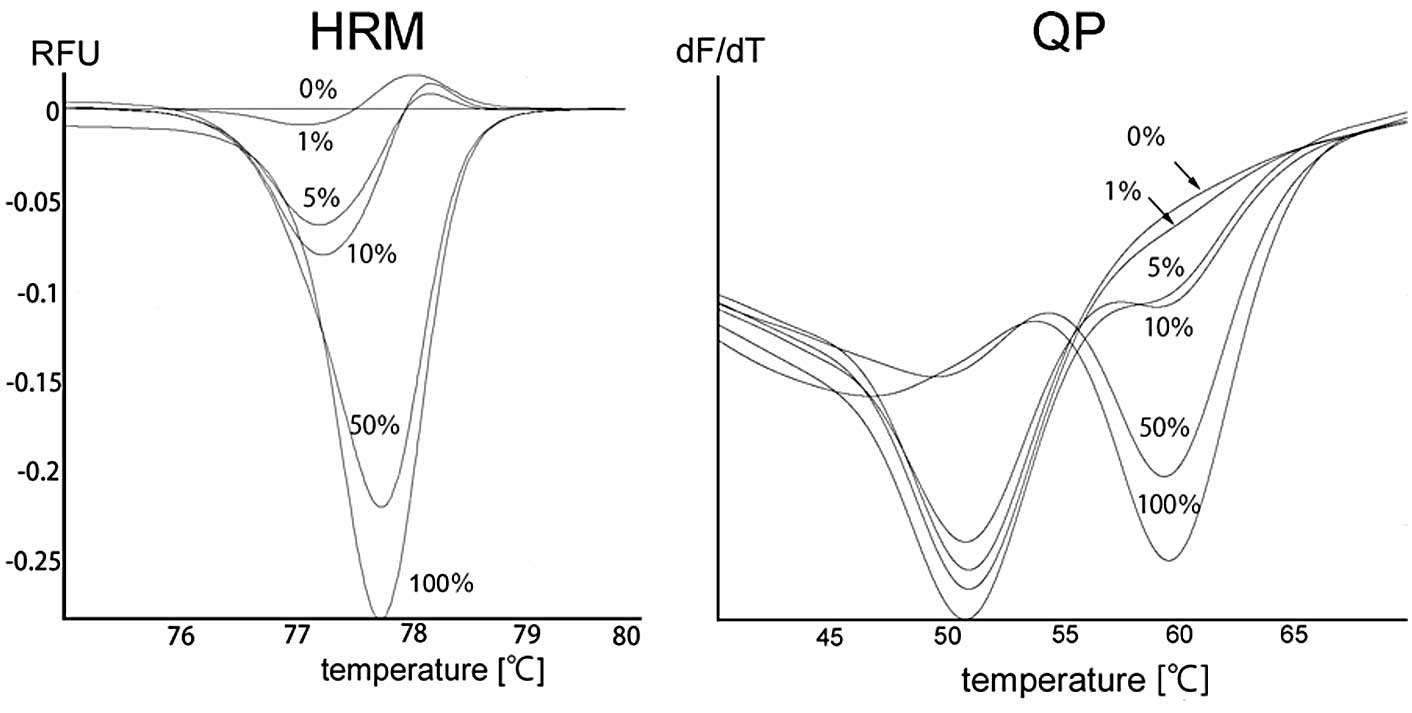
The AS-PCR method produced a 364-bp band from wild-type and mutant alleles, as well as a 203-bp band from the mutant allele (upper panel of Fig. 2). The nested PCR products obtained by PCR-RFLP were 373 bp in size. Following BsaXI digestion, the products from the wild-type allele were cut into 203-bp and 170-bp fragments while the products from the mutant allele remained unchanged (lower panel of Fig. 2). With the HRM method, the melting profile of the wild-type control was designated as the horizontal line to which the normalized and temperature-shifted difference curves were drawn. The samples containing mutant products are distinguishable by their concave-up curves (left panel of Fig. 3). Finally, with the QP method, the wild-type allele produced concave-up curves with the lowest point at 51°C, while the mutant allele produced concave-up curves with the lowest point at 60°C (right panel of Fig. 3).

Figure 2

Sensitivity of detection limit of AS-PCR and PCR-RFLP for JAK2 V617F mutation. DNA extracted from samples containing mixtures of HEL and KOPT-K1 cells was used; numbers indicate the percentage of HEL cells in the given sample. The PCR products (upper panel) and the nested PCR products digested with BsaXI (lower panel) were electrophoresed in an agarose gel. M, 100 bp marker.

Figure 3

Sensitivity of HRM and QP for the detection of JAK2 V617F mutation. DNA extracted from samples containing mixtures of HEL and KOPT-K1 cells was used; numbers indicate the percentage of HEL cells in the given sample.

Detection of the JAK2 V617F mutation in patient samples

Of the 16 patient samples, 7 (3 PV, 3 ET, zero PMF, and one unclassifiable MPN) were determined to be V617F-positive. Although the results obtained by AS-PCR from a few samples were initially discrepant with those obtained via the other methods, this was settled by adjusting the MgCl2 concentration and annealing temperature. The results from the four PCR-based methods and direct sequencing were ultimately found to be concordant.

Sensitivity of detection

We examined the sensitivity of the detection limit using DNA extracted from samples containing mixtures of HEL and KOPT-K1 cells in various ratios. Fig. 2 shows representative results from AS-PCR and PCR-RFLP. The numbers indicate the percentage of HEL cells in the given sample. Although the mutant bands obtained by AS-PCR from low percentage samples are not clearly visible in this photograph, the bands from the 0.2–0.5% mutant samples were visible on a transilluminator. The PCR-RFLP method detected mutants in 1–2% samples. As shown in the left panel of Fig. 3, the samples containing 1–5% mutant allele were distinguishable by their concave-up curves on HRM. Finally, QP detected the mutant allele in samples containing 5% mutant, as evidenced by the concave-up curves with the lowest point at 60°C of the samples (right panel of Fig. 3).

Discussion

In this study, we compared the efficiency of four PCR-based methods to detect JAK2 V617F (Table II). AS-PCR was found to be the most sensitive method of the four, although this method did have weaknesses. Firstly, this method was initially found to produce false-positive results in a small number of samples due to the annealing of the mutant primer to the wild-type allele. Secondly, it is not possible to estimate the mutant allele burden using this method. To cope with this weakness, another AS-PCR was carried out according to a previously reported protocol using two primers for the mutant allele and wild-type allele individually, in addition to the outer forward and reverse primers (8). However, the sensitivity and reproducibility were not as good with this protocol, likely due to competition of the primers (data not shown).

Table II

Comparison of PCR methods.

Table II

Comparison of PCR methods.

MethodSensitivity (%)Time (h)StrengthsWeaknesses
AS-PCR0.2–0.54.5High sensitivityPossible false positive
PCR-RFLP1–29.5High specificityTime consuming
HRM1–52.0Fast resultsDifficult to identify the mutant curve at low percentages
QP52.0Easy to recognize the mutant curveRequires high quality DNA

[i] Sensitivity refers to the detection limit obtained in experiments using samples of mixed HEL and KOPT-K1 cells. Time is the number of hours required for results to be obtained after DNA extraction.

The PCR-RFLP method did not result in false-positive and false-negative results in this study. Furthermore, this method was able to approximately estimate the mutant allele burden by comparing the density of the digested bands and undigested band. However, the weakness of this method is that it is time consuming, taking 9.5 h to obtain results. While it was possible to obtain results after the first round of PCR and subsequent enzyme digestion from cell line samples, detection in patient samples required nested PCR.

By contrast, HRM and QP are able to produce results in 2 h as there is no need for gel electrophoresis with these methods. However, high purity DNA samples are required; crude DNA samples did not produce clear results due to non-specific PCR products that caused the vacillation of the curves. Therefore, a spin-column method should be used for DNA extraction rather than a phenol/chloroform or agglutination partition method. When HRM and QP were compared, it was easier to recognize the curves derived from the mutant alleles using the QP method as the curves created by the wild-type allele and mutant allele have different positions on the temperature axis. Moreover, it is possible to roughly estimate allele burden quantification following QP by comparing the sizes of the curves at 51°C to those at 60°C, as well as the proportions of two curves from a given patient sample to that shown in Fig. 3.

Taken together, AS-PCR was found to be the best method for the detection of JAK2 V617F in terms of sensitivity, while QP was the best method in terms of promptness and ease of interpretation. In clinical settings, JAK2 V617F assays are mainly used for diagnosis at presentation rather than for detecting minimal residual diseases. As cells expressing the mutant allele usually account for more than 10% of the samples in these cases, high sensitivity is not necessarily required. We therefore suggest that QP would be the preferable method for JAK2 V617F detection in clinical examination in hospitals.

Acknowledgements

We thank Dr N. Murakami and Dr T. Fukuda (Tokyo Medical and Dental University) for their assistance in obtaining samples from the patients. This study was supported in part by a Grant-in-Aid for Scientific Research (C) from the Japan Society for the Promotion of Science (No. 18690522).

References

1 

Thiele J, Kvasnycka HM, Orazi A, Tefferi A and Birgegard G: Polycythemia vera. WHO Classification of Tumours of Haematopoietic and Lymphoid Tissues. Swerdlow SH, Campo E, Harris NL, Jaffe ES, Pileri ES, Stein H, Thiele J and Vardiman JW: IARC Press; Geneva: pp. 40–43. 2008

2 

James C, Ugo V, Le Couédic JP, et al: A unique clonal JAK2 mutation leading to constitutive signalling causes polycythaemia vera. Nature. 434:1144–1148. 2005. View Article : Google Scholar

3 

Crockett AO and Wittwer CT: Fluorescein-labeled oligonucleotides for real-time PCR: using the inherent quenching of deoxyguanosine nucleotides. Anal Biochem. 290:89–97. 2001. View Article : Google Scholar : PubMed/NCBI

4 

Baxter EJ, Scott LM, Campbell PJ, et al: Acquired mutation of the tyrosine kinase JAK2 in human myeloproliferative disorders. Lancet. 365:1054–1061. 2005. View Article : Google Scholar : PubMed/NCBI

5 

Horn T, Kremer M, Dechow T, et al: Detection of the activating JAK2 V617F mutation in paraffin-embedded trephine bone marrow biopsies of patients with chronic myeloproliferative diseases. J Mol Diagn. 8:299–304. 2006. View Article : Google Scholar : PubMed/NCBI

6 

Er TK, Lin SF, Chang JG, et al: Detection of the JAK2 V617F missense mutation by high resolution melting analysis and its validation. Clin Chim Acta. 408:39–44. 2009. View Article : Google Scholar : PubMed/NCBI

7 

Tanaka R, Kuroda J, Stevenson W, et al: Fully automated and super-rapid system for the detection of JAK2V617F mutation. Leuk Res. 32:1462–1467. 2008. View Article : Google Scholar : PubMed/NCBI

8 

Jones AV, Kreil S, Zoi K, et al: Widespread occurrence of the JAK2 V617F mutation in chronic myeloproliferative disorders. Blood. 106:2162–2168. 2005. View Article : Google Scholar : PubMed/NCBI

Related Articles

  • Abstract
  • View
  • Download
  • Twitter
Copy and paste a formatted citation
Spandidos Publications style
Ono A, Okuhashi Y, Takahashi Y, Itoh M, Nara N and Tohda S: Advantages of the quenching probe method over other PCR-based methods for detection of the JAK2 V617F mutation. Oncol Lett 4: 205-208, 2012.
APA
Ono, A., Okuhashi, Y., Takahashi, Y., Itoh, M., Nara, N., & Tohda , S. (2012). Advantages of the quenching probe method over other PCR-based methods for detection of the JAK2 V617F mutation. Oncology Letters, 4, 205-208. https://doi.org/10.3892/ol.2012.741
MLA
Ono, A., Okuhashi, Y., Takahashi, Y., Itoh, M., Nara, N., Tohda , S."Advantages of the quenching probe method over other PCR-based methods for detection of the JAK2 V617F mutation". Oncology Letters 4.2 (2012): 205-208.
Chicago
Ono, A., Okuhashi, Y., Takahashi, Y., Itoh, M., Nara, N., Tohda , S."Advantages of the quenching probe method over other PCR-based methods for detection of the JAK2 V617F mutation". Oncology Letters 4, no. 2 (2012): 205-208. https://doi.org/10.3892/ol.2012.741
Copy and paste a formatted citation
x
Spandidos Publications style
Ono A, Okuhashi Y, Takahashi Y, Itoh M, Nara N and Tohda S: Advantages of the quenching probe method over other PCR-based methods for detection of the JAK2 V617F mutation. Oncol Lett 4: 205-208, 2012.
APA
Ono, A., Okuhashi, Y., Takahashi, Y., Itoh, M., Nara, N., & Tohda , S. (2012). Advantages of the quenching probe method over other PCR-based methods for detection of the JAK2 V617F mutation. Oncology Letters, 4, 205-208. https://doi.org/10.3892/ol.2012.741
MLA
Ono, A., Okuhashi, Y., Takahashi, Y., Itoh, M., Nara, N., Tohda , S."Advantages of the quenching probe method over other PCR-based methods for detection of the JAK2 V617F mutation". Oncology Letters 4.2 (2012): 205-208.
Chicago
Ono, A., Okuhashi, Y., Takahashi, Y., Itoh, M., Nara, N., Tohda , S."Advantages of the quenching probe method over other PCR-based methods for detection of the JAK2 V617F mutation". Oncology Letters 4, no. 2 (2012): 205-208. https://doi.org/10.3892/ol.2012.741
Follow us
  • Twitter
  • LinkedIn
  • Facebook
About
  • Spandidos Publications
  • Careers
  • Cookie Policy
  • Privacy Policy
How can we help?
  • Help
  • Live Chat
  • Contact
  • Email to our Support Team