Introduction
The renal pelvis does not contain an intestinal or
squamous epithelium, but is normally lined by a urothelium.
However, under rare circumstances, particularly those of chronic
infection and urinary calculi, the transitional cell epithelium may
undergo phenotypical changes, usually in the form of intestinal
metaplasia, which are considered to be closely associated with
adenocarcinoma (1–5). In addition, for simple intestinal
metaplasia of the renal pelvis without abnormal renal function, it
has not been well established whether eliminating such stimulating
factors may reverse the pathological changes. The present study
describes a case of intestinal metaplasia of the renal pelvis where
a panel of immunohistochemical biomarkers were applied to aid in
the determination of the origin and prognosis of the malignancy. A
review of the previously reported cases is also presented. Written
informed consent was obtained from the patient.
Case report
Patient diagnosis
A 56-year-old female was admitted to the Third
Xiangya Hospital of Central South University (Changsha, China) in
October 2010 due to backache on the right side that had persisted
for one year. The patient had a history of controlled hypertension
and recurrent right kidney stones, and therefore, had undergone
extracorporeal shock wave lithotripsy on several occasions over ~10
years previously. The physical examination was unremarkable.
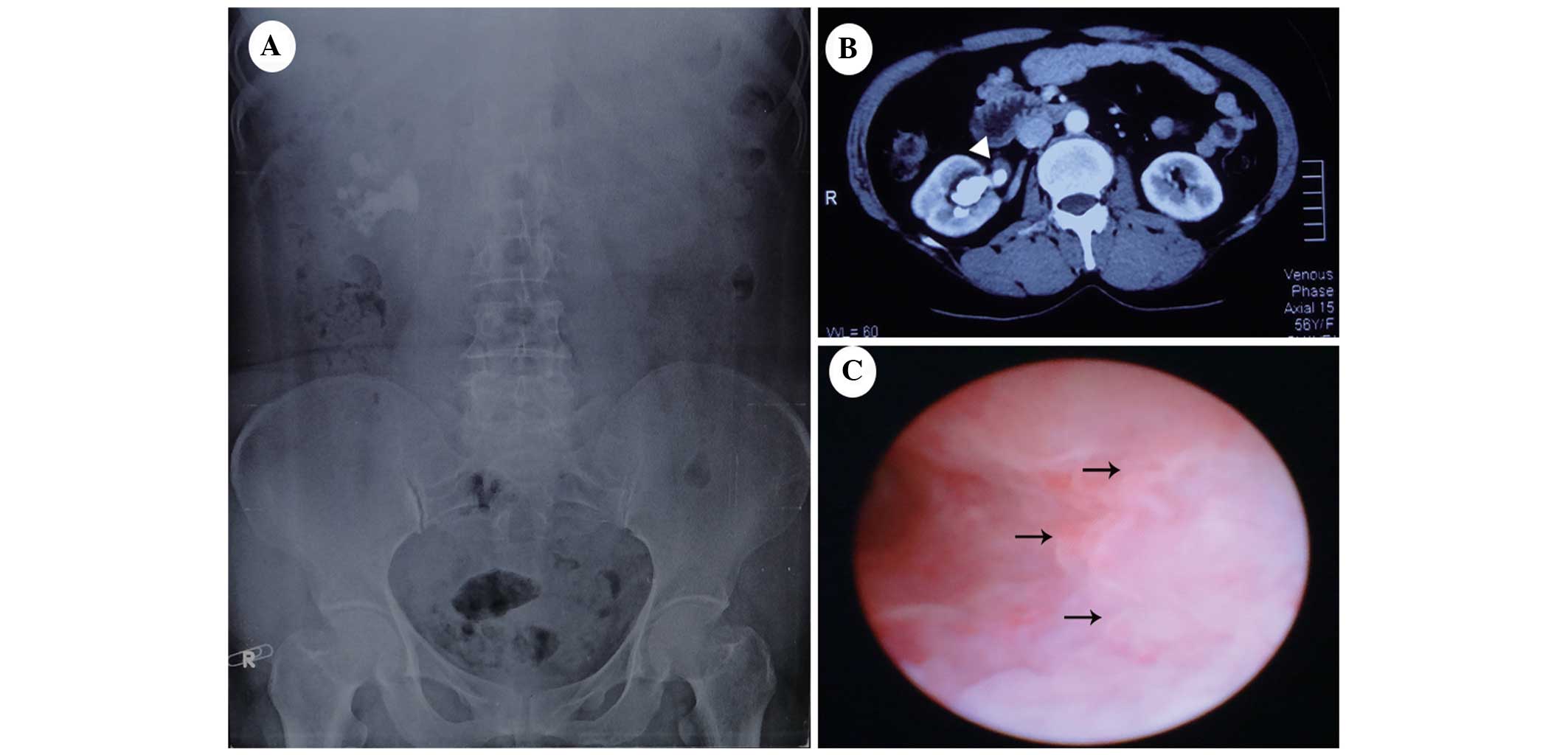
Abdominal X-ray revealed right renal staghorn calculi (Fig. 1A). Contrast enhanced computerized
tomography (CT) demonstrated slight contrast enhancement in a
lesion measuring 6×10 mm in diameter in the right renal pelvis
(Fig. 1B), indicating that the
tumor could not be excised. No enlarged lymph nodes were observed
on the CT image. Urine analysis revealed the values of 20 white
blood cells per high-power field (normal, <10 white blood cells
per high-power field), 35 red blood cells per high-power field
(normal, <5 red blood cells per high-power field), proteinuria
of 50 mg/l (normal, <100 mg/ml) and no bacteria in urine
culture. The serum levels of α-fetoprotein (AFP), carcinoembryonic
antigen (CEA) and carbohydrate antigen (CA)19-9 were normal.
Treatment and follow-up
Percutaneous nephrolithotomy was subsequently
performed. Upon nephroscopy, a minor local protrusion, but no
evident lump was observed in an area measuring 10×15 mm in the
mucosa of the renal pelvis (Fig.
1C). Biopsies were conducted four times for the pathological
analysis of the suspicious lesions. Following the removal of the
calculi, the recovery was uneventful, and the patient was
discharged from the hospital six days later. The pathological
diagnosis was of significant intestinal metaplasia, and radical
nephrectomy or local lesions electrovaporization was subsequently
recommended, however the patient selected active surveillance. To
date, subsequent to three years of follow-up, the patient is alive,
with no evidence of tumor progression observed on CT scan and with
normal serum AFP, CEA and CA19-9 levels.
Pathological findings
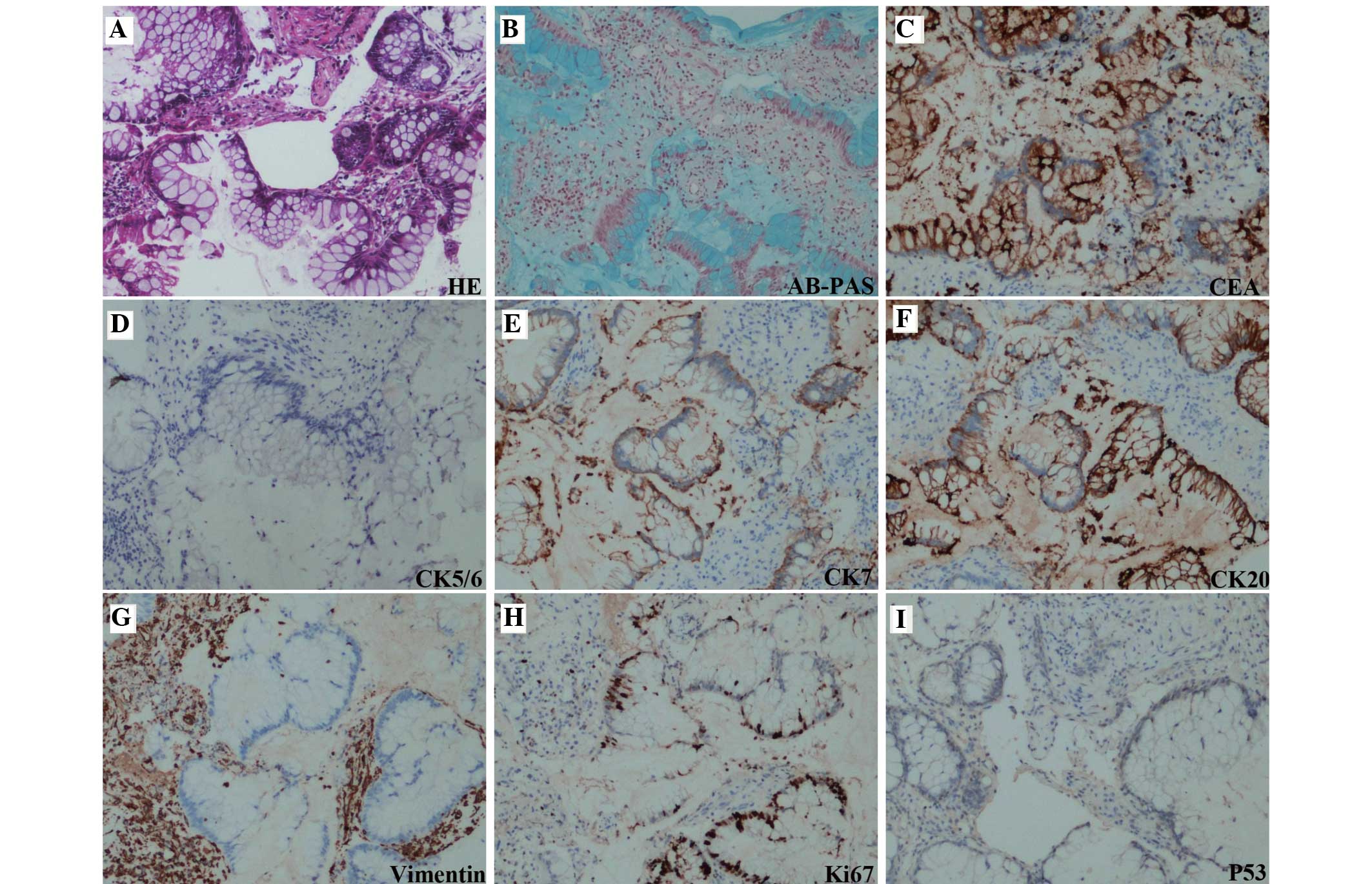
Hematoxylin-eosin (HE) staining revealed that the
biopsied tissues were composed of significant intestinal metaplasia
with abundant goblet cells (Fig.
2A). Part of the glandular epithelium exhibited low-grade
dysplasia. No squamous metaplasia or invasive adenocarcinoma was
observed. In addition to the glandular zone, infiltration with
lymphocytes and plasma cells was observed. Staining with alcian
blue-periodic acid Schiff revealed abundant mucin within the
cytoplasm of the glandular epithelium (Fig. 2B). In all the biopsies, no normal
transitional epithelium was observed. Immunohistochemical analysis
revealed positive expression for CEA, CK7 and CK20, however,
negative expression was observed for CK5/6 and vimentin in the
metaplastic urothelium (Fig. 2C–G).
Furthermore, Ki67 expression was diffusely positive with an mean
labeling index of 12% in 10 random microscopic fields, whereas p53
was negative in all instances (Fig. 2H
and I).
Discussion
Cases of metaplasia of the renal pelvis without
associated malignancy are extremely rare, and to the best of our
knowledge, only 18 cases have been previously reported in the
English language literature (Table
I) (1,6–17). A
review of this literature showed that the mean age of these
patients was 51.2±14.0 years and the male to female ratio was
2.6:1, with a male predominance. In total, eight of the 18 subjects
exhibited intestinal metaplasia (single intestinal or combined with
squamous metaplasia). Almost all of the reported subjects had
experienced a long history of irritations of the renal pelvis, the
majority of which were chronic urinary tract infections,
hydronephrosis and calculus. Of the reported subjects, 15 patients
(83.3%) exhibited calculi and more than half of the subjects
suffered from a large calculus or multiple calculi of the renal
pelvis (11/18; 61.1%). Therefore, the long-term effects of chronic
irritations are likely to be associated with metaplasia of the
urothelium of the renal pelvis.
 | Table IReports of metaplasia of the renal
pelvis without associated malignancy. |
Table I
Reports of metaplasia of the renal
pelvis without associated malignancy.
| First author/s, year
(ref.) | Gender/age,
years | Type of
metaplasia | Calculus | Associated
condition |
|---|
| Foot, 1944 (6) | F/54 | Intestinal | ++ | Pyonephrosis |
| Torassa, 1948
(7) | M/46 | Intestinal | ++ | Pyonephrosis and
multiple abscesses |
| Maclean and Fowler,
1956 (8) | F/39 | Intestinal | ++ | Chronic
pyelonephritis |
| Krag and Alcott, 1957
(9) | M/52 | Intestinal and
squamous | ++ | Hydronephrosis and
pyonephrosis |
| Gordan, 1963
(10) | M/55 | Intestinal and
squamous | + | Chronic
pyelonephritis |
| M/50 | Glandular | − | Bladder dysfunction
and pyonephrosis |
| Towers, 1963
(11) | F/55 | Cystic and
intestinal | U | Pyonephrosis |
| Salm, 1969 (12) | M/55 | Intestinal and
squamous | ++ | Phronic
pyelonephritis |
| Ward, 1971 (13) | M/49 | Glandular and
squamous | ++ | Pyonephrosis. |
| M/40 | Glandular | + | U |
| M/64 | Squamous and
glandular | + | Pyonephrosis |
| Blacklock et
al, 1983 (14) | M/61 | Squamous and
mucinous | ++ | Chronic
pyelonephritis |
| M/21 | Squamous and
mucinous | ++ | Chronic
pyelonephritis and hydronephrosis |
| Lam and Choi, 1995
(15) | M/79 | Mucinous | ++ | Chronic
pyelonephritis and nephrosclerosis |
| Mathur et al,
2004 (16) | M/40 | Mucinous | ++ | Chronic
pyelonephritis |
| Deniz et al,
2010 (1) | M/32 | Intestinal | + | Chronic
pyelonephritis and renal atrophy |
| Siderits et
al, 2012 (17) | F/74 | Squamous | − | Renal obstruction and
pyohydronephrosis |
| Present case | F/56 | Intestinal | ++ | Pyonephrosis |
The exact mechanism by which intestinal metaplasia
occurs is not entirely understood, however, it has been
hypothesized to be associated with the endodermal origin of the
embryonal cloaca and intestine (12). Therefore, the divergent metaplastic
potentialities of the urinary transitional epithelium to squamous,
mucinous or intestinal metaplasia can be readily explained
(12). In addition, intestinal
metaplasia within the upper urinary tract is extremely unusual and
may prompt the surgeon to consider a primary intestinal
pathological cause (13). Usually,
a normal urothelium expresses simple epithelial cytokeratins,
including CK5/6, CK7 and CK20, while in gastroenteric tumors, this
does not occur (1,21). In the present case, CK5/6 expression
was absent in the metaplastic epithelium, however, stronger CK20
expression was present. Therefore, we proposed that the renal
pelvis epithelium underwent changes in phenotype in the intestinal
metaplasia and may not be of primary intestinal pathology.
Precancerous changes are hypothesized to contribute
to the metaplastic changes in the urothelium, and adenocarcinomas
may arise from metaplastic changes of an epithelium that is
potentially unstable (18). The
presence of adenocarcinoma in combination with intestinal
metaplasia has been frequently observed (3–5,19,20).
Similarly, with intestinal metaplasia of the renal pelvis, a
significant history of chronic irritations, including inflammation
and calculi, are also present in the majority of cases of
adenocarcinoma (2–4,19).
Spires et al (2) reviewed a
total of 59 cases of adenocarcinoma and observed that tubulovillous
and mucinous tissue types, which accounted for 93% of cases, were
morphologically similar to intestinal tumors, and therefore may
arise from foci of intestinal metaplasia. Considering this,
adenocarcinomas are likely to develop from the progressive
transformation of these metaplastic cells in a stepwise
adenoma-carcinoma sequence, possibly in a similar manner to colonic
carcinogenesis (3). Notably, these
conclusions were predominantly based on the synchronous presence of
cancer in the specimen, which also contained metaplastic changes.
In addition, in numerous other cases, the neoplasms arose without
any preceding metaplastic changes (21,22).
Therefore, the malignancy of metaplasia in the renal pelvis remains
controversial.
The occurrence of metaplasia in the renal pelvis
without an associated malignancy is rare, as reviewed previously
(16). In the bladder, cystitis
glandularis and intestinal metaplasia have been proposed to
represent precursors of bladder adenocarcinoma (23,24).
However, this notion has now been challenged. By observing 53
patients for 10 years and 136 patients for 2.6 years, respectively,
Corica et al (25) and Smith
et al (24) revealed that
cystitis glandularis or intestinal metaplasia had no tendency
towards carcinoma. The identification and removal of the causes of
cystitis glandularis, such as upper urinary tract obstruction, were
considered as the most important management methods (26). However, in the renal pelvis, further
evaluation ir required to determine whether intestinal metaplasia
has the potential to progress to adenocarcinoma and whether
etiological treatment may reverse the pathological changes. To
date, no reports have traced progression to malignancy in patients
with a final diagnosis of intestinal metaplasia of the renal
pelvis.
Elevated serum levels of AFP, CEA and CA19-9 have
been reported in several studies of adenocarcinoma of the renal
pelvis and were considered to be effective prognostic biomarkers
(22,27). In the current case, the serum levels
of AFP, CEA and CA19-9 were normal and remained normal subsequent
to three years of follow-up. However, immunohistochemical staining
revealed strong CEA expression. In addition, the expression of
tumor markers p53 and Ki67 was also evaluated in the tissue. The
results revealed p53-negative expression, but diffusely-positive
expression for Ki67, suggesting a potential proliferation ability
of the intestinal metaplasia of the renal pelvis. Notably, in this
case, the biopsies that were obtained were superficial to a certain
extent, and it is possible that the potential adenocarcinoma below
the mucosa may have been overlooked, as the CT scan suggested
limited lesions in the renal pelvis. Due to the poor prognosis of
adenocarcinoma of the renal pelvis, for which the majority of
patients succumb to the disease within two to five years (27), radical nephrectomy or local lesions
electrovaporization remained the recommended treatment for the
current patient following the removal of the calculi by
percutaneous nephrolithotomy; however, the patient selected active
surveillance. Subsequent to three years of follow-up by CT imaging
every six months, no further progression was observed. The
surveillance will continue for the foreseeable future.
In conclusion, intestinal metaplasia of the renal
pelvis is closely associated with chronic stimuli, particularly
from complex calculi and urinary tract infections. It remains
controversial whether intestinal metaplasia may progress to
adenocarcinoma. Etiological treatment and close follow-up may be
suitable and practical for local intestinal metaplasia, however
this option may pose an increased risk. Future studies examining
the long-term outcomes in a larger series of patients with
intestinal metaplasia of the renal pelvis may be of value to
further delineate the association between intestinal metaplasia and
renal pelvis carcinoma.
Acknowledgements
This study was supported by the Fundamental Research
Funds for the Central Universities of Central South University
(grant no. 72150050368).
References
|
1
|
Deniz K, Kala M and Kaya R: Intestinal
metaplasia of the renal pelvis. Urol J. 7:287–289. 2010.
|
|
2
|
Spires SE, Banks ER, Cibull ML, et al:
Adenocarcinoma of renal pelvis. Arch Pathol Lab Med. 117:1156–1160.
1993.
|
|
3
|
Sagnotta A, Dente M, Socciarelli F, et al:
Primary adenocarcinoma of the renal pelvis: histologic features of
a stepwise process from intestinal hyperplasia to dysplasia in a
patient with chronic renal abscess. Int J Surg Pathol. 22:182–185.
2013.
|
|
4
|
Tsuzuki T, Kouketsu H, Ono K, Kobayashi H
and Obata K: Primary adenocarcinoma of the renal pelvis with
special reference to histochemical observations. Pathol Int.
46:791–796. 1996.
|
|
5
|
Toyoda H, Mabuchi T and Fukuda K: Mucinous
cystadenoma with malignant transformation arising in the renal
pelvis. Pathol Int. 47:174–178. 1997.
|
|
6
|
Foot NC: Glandular metaplasia of the
epithelium of the urinary tract. South Med J. 37:137–142. 1944.
|
|
7
|
Torassa GL Jr: Pyelitis glandularis. J
Urol. 60:393–397. 1948.
|
|
8
|
Maclean JT and Fowler VB: Pathology of
tumors of the renal pelvis and ureter. J Urol. 75:384–415.
1956.
|
|
9
|
Krag DO and Alcott DL: Glandular
metaplasia of the renal pelvis; report of a case. Am J Clin Pathol.
27:672–680. 1957.
|
|
10
|
Gordon A: Intestinal metaplasia of the
urinary tract epithelium. J Pathol Bacteriol. 85:441–444. 1963.
|
|
11
|
Towers RP: Aspects of metaplasia in
genito-urinary pathology. J Ir Med Assoc. 53:179–183. 1963.
|
|
12
|
Salm R: Combined intestinal and squamous
metaplasia of the renal pelvis. J Clin Pathol. 22:187–191.
1969.
|
|
13
|
Ward AM: Glandular neoplasia within the
urinary tract. The aetiology of adenocarcinoma of the urothelium
with a review of the literature I Introduction: the origin of
glandular epithelium in the renal pelvis, ureter and bladder.
Virchows Arch A Pathol Pathol Anat. 352:296–311. 1971.
|
|
14
|
Blacklock AR, Geddes JR and Black JW:
Mucinous and squamous metaplasia of the renal pelvis. J Urol.
130:544–545. 1983.
|
|
15
|
Lam KY and Choi CH: Massive enlargement of
the kidney in glandular metaplasia of the renal pelvis. Nephron.
69:91–92. 1995.
|
|
16
|
Mathur S, Singh MK, Rao SI and Seth A:
Mucinous metaplasia of the renal pelvic epithelium in a case of
recurrent urolithiasis and pyelonephritis. Urol Int. 72:355–357.
2004.
|
|
17
|
Siderits RH, Fingerman J, Hazra A, et al:
Renal pelviceal keratinizing squamous metaplasia with sparing of
pyramidal zones. Case Rep Urol. 2012:2427802012.
|
|
18
|
Manunta A, Vincendeau S, Kiriakou G, Lobel
B and Guille F: Non-transitional cell bladder carcinomas. BJU Int.
95:497–502. 2005.
|
|
19
|
Park S, Meng MV, Greenberg MS, Deng DY and
Stoller ML: Muconephrosis. Urology. 60:3442002.
|
|
20
|
Rao P, Pinheiro N Jr, Franco M, et al:
Pseudomyxoma peritonei associated with primary mucinous borderline
tumor of the renal pelvicalyceal system. Arch Pathol Lab Med.
133:1472–1476. 2009.
|
|
21
|
Takehara K, Nomata K, Eguchi J, et al:
Mucinous adenocarcinoma of the renal pelvis associated with
transitional cell carcinoma in the renal pelvis and the bladder.
Int J Urol. 11:1016–1018. 2004.
|
|
22
|
Yang K, Zheng XY, Wang YL, Zhao K and
Jiang H: Alpha-fetoprotein and carbohydrate antigen 19–9 producing
advanced adenocarcinoma of renal pelvis and ureter. Can Urol Assoc
J. 7:E750–E753. 2013.
|
|
23
|
Williamson SR, Lopez-Beltran A, Montironi
R and Cheng L: Glandular lesions of the urinary bladder: clinical
significance and differential diagnosis. Histopathology.
58:811–834. 2011.
|
|
24
|
Smith AK, Hansel DE and Jones JS: Role of
cystitis cystica et glandularis and intestinal metaplasia in
development of bladder carcinoma. Urology. 71:915–918. 2008.
|
|
25
|
Corica FA, Husmann DA, Churchill BM, et
al: Intestinal metaplasia is not a strong risk factor for bladder
cancer: study of 53 cases with long-term follow-up. Urology.
50:427–431. 1997.
|
|
26
|
Li A, Liu S, Lu H, et al: Clinical
character of cystitis glandularis accompanied with upper urinary
tract obstruction. Can Urol Assoc J. 7:E708–E710. 2013.
|
|
27
|
Ye YL, Bian J, Huang YP, et al: Primary
mucinous adenocarcinoma of the renal pelvis with elevated CEA and
CA19-9. Urol Int. 87:484–488. 2011.
|