Introduction
Solitary fibrous tumors (SFTs) are rare spindle-cell
mesenchymal neoplasms that are predominantly found in the pleura
(1). Extrapleural SFTs are uncommon
and occur in various locations that are associated with the lungs,
pericardium, mediastinum, upper respiratory tract, bones and soft
tissue of any site. Central nervous system SFTs, first described by
Carneiro et al (2), are
extremely rare. Over the past 10 years, a few studies on central
nervous system SFTs have been reported, with the majority of cases
located in the spinal cord. Intracranial lesions, however, are not
always observed. It is reported that central nervous system SFTs
account for ~0.09% of meningeal tumors (3). Forming a pre-operative diagnosis for
intracranial SFTs is difficult due to the atypical symptoms and
imaging manifestations, and therefore, it mainly depends on the
post-operative pathological examination. To date, the clinical
course, histogenesis, cytogenetics and prognosis for intracranial
SFTs remain largely unknown (4). The
treatment for the tumors mainly depends upon a surgical resection
and the prognosis for patients with SFTs is good when the tumors
are completely resected. The current study reports two cases of
primary SFTs of the brain and reviews the previously reported
cases, with a discussion of the possible differential diagnosis.
The patients provided written informed consent.
Case report
Case one
A 39-year-old male presented to the Department of
Neurosurgery (The First Affiliated Hospital of Zhengzhou
University, Zhengzhou, Henan, China) on March 20, 2014, with right
haunch pain, right leg weakness and paresthesia that had been
apparent for 3 months. The patient had been diagnosed with a
meningioma on the left frontal lobe and was treated successfully by
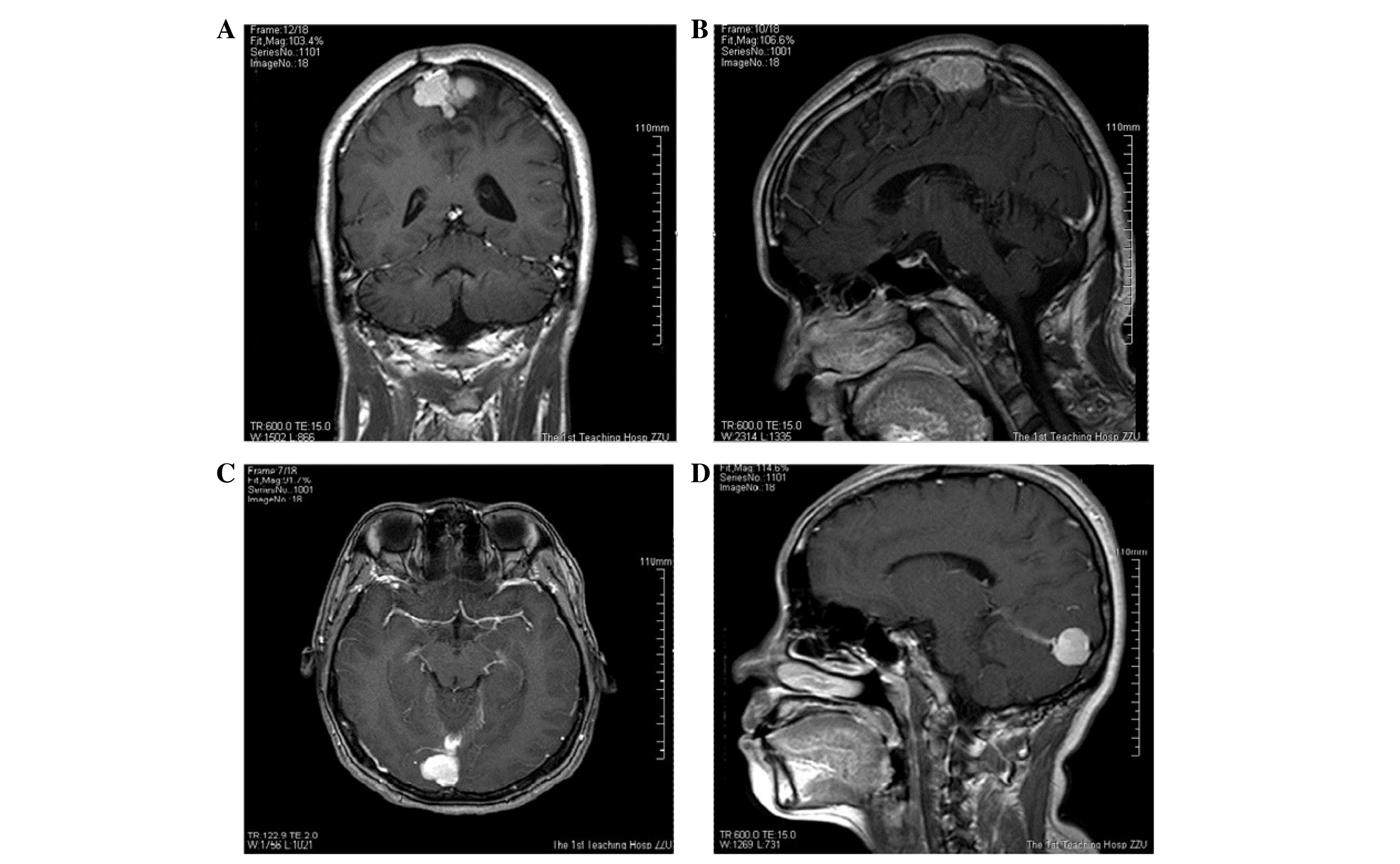
tumor resection 13 years earlier. Magnetic resonance imaging (MRI)
showed a relapsing, dumbbell-like, relatively well-defined lesion,
34×27 mm in size, located on the frontal and temporal lobes. The
mass crossed the superior sagittal sinus and the cerebral falx
(Fig. 1). The lesion exhibited a
moderate signal intensity on T1-weighted imaging, a relatively high
signal intensity on T2-weighted imaging and homogeneous enhancement
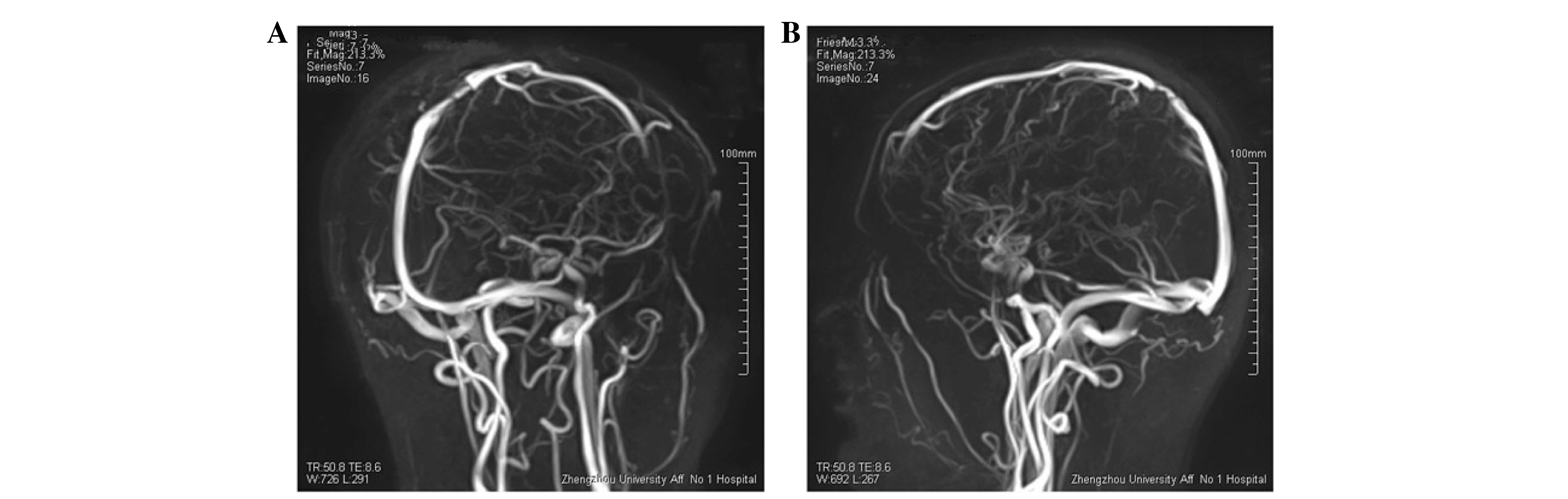
on T1-weighted imaging with gadolinium. MR venography disclosed
external compression and infiltration into the superior sagittal
sinus, with moderate surrounding brain tissue edema (Fig. 2). The tumor was visualized via a
cross-midline craniectomy, where it was observed that the tumor had
invaded the cerebral falx and the wall of the superior sagittal
sinus. The tumor was almost totally resected away from the
surrounding brain tissue and sinus, with a little tumor tissue
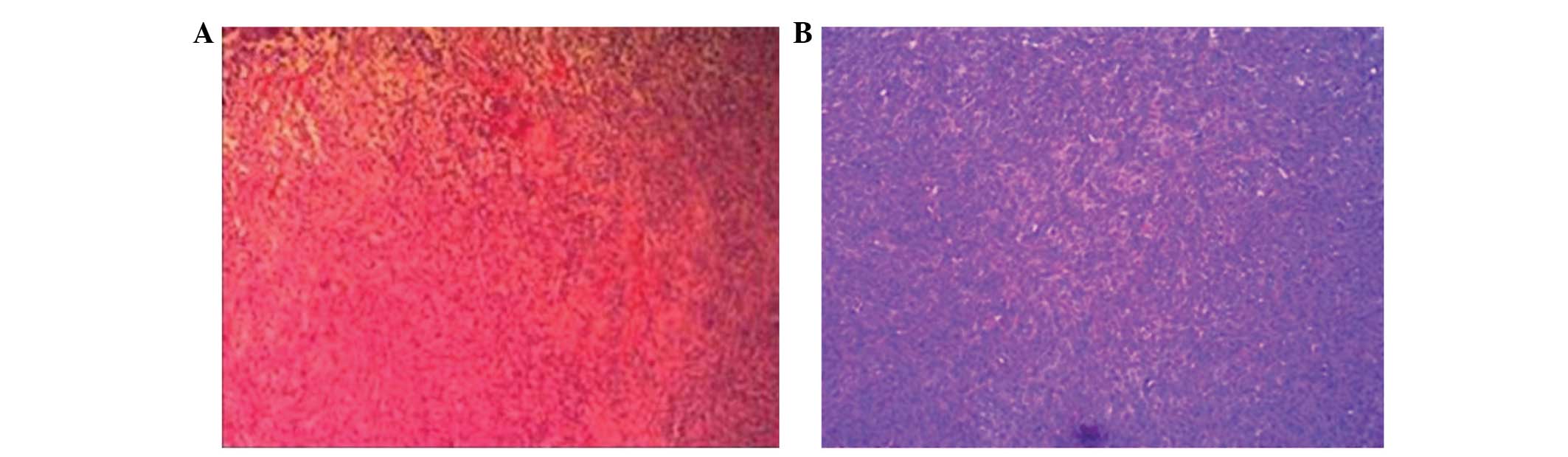
remaining in the sinus. A lesion with a spindle cell morphology was
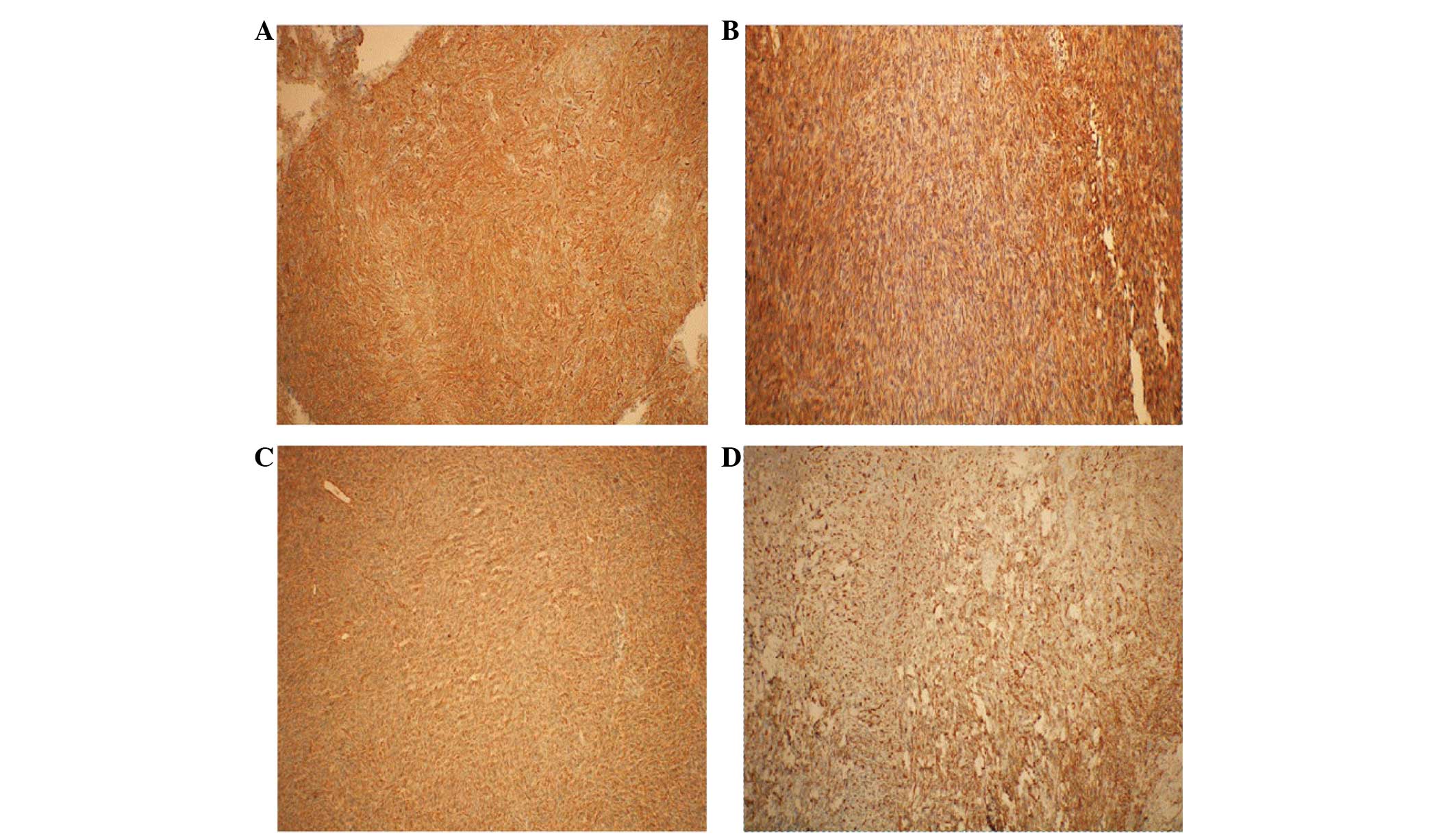
determined on pathological examination (Fig. 3). Microscopic immunohistochemical
examination demonstrated a strong immunoreaction for cluster of
differentiation (CD)34, vimentin and B-cell lymphoma 2 (Bcl-2), but
a negative reaction for epithelial membrane antigen (EMA) and S-100
(Fig. 4). The frozen section analysis
confirmed the presence of spindle cells and confirmed a diagnosis
of an SFT. The post-operative neurological status was substantially
improved and regular follow-up examinations for 6 months
post-surgery have shown that the patient is currently
disease-free.
Case two
A 42-year-old female presented with a history of
unexpected loss of consciousness with no limb twitches and high
fever for 20 days, was admitted to hospital on February 25, 2014.
MRI showed a quasi-circular lesion in the occipital lobe, which was
13×18 mm in size; the lesion exhibited a clear boundary with the
brain and it was observed to stretch across the torcular herophili
and the tentorium cerebelli. The lesion exhibited a moderate signal
intensity on T1-weighted imaging, a high signal intensity on
T2-weighted imaging and homogeneous enhancement on T1-weighted
imaging with gadolinium (Fig. 1).
During surgery, it was disclosed that the tumor was compressing the
torcular herophili and had an abundant blood supply. A near-total
resection was performed, with only a little of the tissue that had
invaded into the sinus remaining. The pathological examination
revealed an SFT with a spindle cell morphology, high density and
obvious nuclear fission (Fig. 3). The
tumor was distinctively positive for CD34, but not for S-100,
cytokeratin (CK) and EMA (Fig. 4).
The patient achieved a good outcome, with no epilepsy or other
neurological symptoms experienced on a regular 6-month follow-up.
The patient is currently disease free.
Discussion
An SFT is a form of benign and circumscribed lesion
that was first defined by Klemperer and Rabin in 1931 (5). The tumor originates from the mesenchymal
cells rather than the mesothelial cells and mainly affects the
pleura and mediastinum. The microscopic histology of SFTs reveals
that the tissue exhibits a proliferation of spindle cells with a
variety of growth patterns (3).
Central nervous system SFTs account for only 0.09% of all meningeal
tumors, while intracranial SFTs are extremely rare (6). The majority of intracranial SFTs are
found in females. The tumors grow slowly and certain patients may
develop the symptoms of episodic headaches, gait imbalance,
dizziness, sensory disturbance, hemiplegic paralysis or epileptic
seizure, while other patients may be asymptomatic, with no
distinctive local symptoms (7). Only
when the lesions become large enough or infringe into the important
functional areas, will clear clinical symptoms arise.
Currently, the diagnosis of intracranial SFTs
depends on immunohistochemical staining. Staining for CD34, CD99,
Bcl-2 and vimentin is almost always strongly positive. CD34 is
expressed in hematopoietic stem cells, the endothelium,
hematopoietic stem cells, endothelial progenitor cells, myeloid
progenitor cells and certain mesenchymal cells in the dermis, and
can be found in nearly all cases. CD34 is therefore the most
significant and sensitive index property (8). However, the deficiency of CD34 has also
been observed in certain cases (9).
SFTs are immunoreactive for Bcl-2, with a positive expression rate
of 80–100% (10,11). CD99 is also strongly exhibited in
certain cases of SFT, with a positive expression rate of 75–100%
(12). At the same time, other
referential elements exhibit no expression, including EMA, CK,
S-100 and α-smooth muscle actin, as reported by previous studies
(2,13–16). SFT
is difficult to distinguish from meningeal hemangiopericytoma
(HPC), which exhibits a high rate of recurrence and late
extracranial metastases (17). A
recent study has revealed the difference between HPC and SFT in
terms of behavioral biology (18).
Unlike SFTs, which originate from mesenchymal cells, HPC is the
most common dural-based mesenchymal tumor. Identical to SFT, the
immunohistochemistry of HPC also reveals a high percentage of cases
with vimentin (85%) expression, but few cases with CD34 (25%)
expression (19). In addition, HPC is
markedly different compared with SFT with regard to dense laminae,
which are highly cellular vascularized monotonous spindle cell
proliferations (20).
SFTs are frequently misdiagnosed as other tumors,
including neurofibroma, fibrous meningioma, hemangiopericytoma,
malignant fibrous histiocytoma and fibrosarcoma, on MRI (21,22). In
one study, more than half (66.7%) of SFTs exhibited an isointense
signal on T1-weighted imaging, while heterogeneous and hypointense
cases accounted for nearly one-third of cases (20.8 and 11.1%,
respectively) (23). However,
hyperintensity on T1-weighted imaging is not frequently reported
(3). The most common status on
T2-weighted imaging is a hypointense signal (62.2%) with the
remaining signals attributed as hyperintense or heterogeneous. In
one study, the majority of cases exhibited homogenous enhancement
with gadolinium administration (78%) (24). MR venography and angiography are of
great significance in order to reveal associations between the
blood supply and the intracranial artery prior to surgery (25).
SFTs are generally localized lesions. Extremely few
cases may be malignant or undergo malignant transformation
(26). The tumors are frequently
confused with other meningeal tumors on imageological diagnosis.
The use of chemotherapy or radiotherapy for the treatment of SFTs
does not show much promise (17). The
main principle of treating the disease is early surgical excision,
which greatly alleviates the neurological symptoms. Due to the
limitations of the lesions, the majority can be completely removed.
The current study presents two cases of SFTs in which the patients
accepted surgical therapy and achieved a good prognosis on the
6-month follow-up.
In conclusion, an SFT is a type of benign tumor that
originates from the mesenchymal cells. The diagnosis of an SFT
relies mainly on immunohistochemical staining, which is
characterized by the positive expression of CD34 and Bcl-2.
Radiotherapy and chemotherapy to the tumor is dissatisfactory. As a
benign and localized disease, SFT has a good neurological outcome
following early surgical treatment, and recurrences are rarely
recorded.
References
|
1
|
Suzuki SO, Fukui M, Nishio S and Iwaki T:
Clinicopathological features of solitary fibrous tumor of the
meninges, An immunohistochemical reappraisal of cases previously
diagnosed to be fibrous meningioma or hemangiopericytoma. Pathol
Int. 50:808–817. 2000. View Article : Google Scholar : PubMed/NCBI
|
|
2
|
Carneiro SS, Scheithauer BW, Nascimento
AG, Hirose T and Davis DH: Solitary fibrous tumor of the meninges,
A lesion distinct from fibrous meningioma. Histopathology. Am J
Clin Pathol. 106:217–224. 1996.PubMed/NCBI
|
|
3
|
Suster S, Nascimento AG, Miettinen M,
Sickel JZ and Moran CA: Solitary fibrous tumors of soft tissue.
Histopathology. Am J Surg Pathol. 19:1257–1266. 1995. View Article : Google Scholar : PubMed/NCBI
|
|
4
|
Gold JS, Antonescu CR, Hajdu C, Ferrone
CR, Hussain M, Lewis JJ, Brennan MF and Coit DG: Clinicopathologic
correlates of solitary fibrous tumors. Cancer. 94:1057–1068. 2002.
View Article : Google Scholar : PubMed/NCBI
|
|
5
|
Klemperer P and Rabin CB: Primary
neoplasia of the pleura: A report of five cases. Arch Pathol.
1:385–412. 1931.
|
|
6
|
Brunori A, Cerasoli S, Donati R,
Giangaspero F and Chiappetta F: Solitary fibrous tumor of the
meninges, Two new cases and review of the literature. Surg Neurol.
51:636–640. 1999. View Article : Google Scholar : PubMed/NCBI
|
|
7
|
Fargen KM, Opalach KJ, Wakefield D, Jacob
RP, Yachnis AT and Lister JR: The central nervous system solitary
fibrous tumor, A review of clinical, imaging and pathologic
findings among all reported cases from 1996 to 2010. Clin Neurol
Neurosurg. 113:703–710. 2011. View Article : Google Scholar : PubMed/NCBI
|
|
8
|
Fina L, Molgaard HV, Robertson D, Bradley
NJ, Monaghan P, Delia D, Sutherland DR, Baker MA and Greaves MF:
Expression of the CD34 gene in vascular endothelial cells. Blood.
75:2417–2426. 1990.PubMed/NCBI
|
|
9
|
Ng HK, Choi PC, Wong CW, To KF and Poon
WS: Metastatic solitary fibrous tumor of the meninges.
Histopathology. J Neurosurg. 93:490–493. 2000. View Article : Google Scholar : PubMed/NCBI
|
|
10
|
Alawi F, Stratton D and Freedman PD:
Solitary fibrous tumor of the oral soft tissues, A
clinicopathologic and immunohistochemical study of 16 cases. Am J
Surg Pathol. 25:900–910. 2001. View Article : Google Scholar : PubMed/NCBI
|
|
11
|
Chen HJ, Zhang HY, Li X, Guo LX, Wei B,
Guo H, Bu H, Yang K and Liu BL: Solitary fibrous tumor, The
clinicopathologic and immunohistochemical characteristics of 26
cases. Sichuan Da Xue Xue Bao Yi Xue Ban. 35:675–679. 2004.(In
Chinese). PubMed/NCBI
|
|
12
|
Zhang H, Lucas DR, Pass HI and Che M:
Disseminated malignant solitary fibrous tumor of the pleura. Pathol
Int. 54:111–115. 2004. View Article : Google Scholar : PubMed/NCBI
|
|
13
|
Artlich A and Schmidt D:
Immunohistochemical profile of meningiomas and their histological
subtypes. Hum Pathol. 21:843–849. 1990. View Article : Google Scholar : PubMed/NCBI
|
|
14
|
Das A, Tan WL and Smith DR: Expression of
extracellular matrix markers in benign meningiomas. Neuropathology.
23:275–281. 2003. View Article : Google Scholar : PubMed/NCBI
|
|
15
|
Kobayashi K, Imagama S, Ito Z, Ando K,
Ukai J, Muramoto A, Shinjo R, Matsumoto T, Nakashima H, Matsuyama Y
and Ishiguro N: Recurrence of solitary fibrous tumor of the
cervical spinal cord. Nagoya J Med Sci. 76:217–223. 2014.PubMed/NCBI
|
|
16
|
Ishii K, Nakamura M, Matsumoto M, Mukai M,
Toyama Y and Chiba K: Intramedullary solitary fibrous tumor of the
spinal cord. J Orthop Sci. 14:450–454. 2009. View Article : Google Scholar : PubMed/NCBI
|
|
17
|
Munks S: Solitary fibrous tumor (SFT) of
the nasal mucosa. Laryngorhinootologie. 82:655–658. 2003.(In
German). View Article : Google Scholar : PubMed/NCBI
|
|
18
|
Ambrosini-Spaltro A and Eusebi V:
Meningeal hemangiopericytomas and hemangiopericytoma/solitary
fibrous tumors of extracranial soft tissues: A comparison. Virchows
Arch. 456:343–354. 2010. View Article : Google Scholar : PubMed/NCBI
|
|
19
|
Perry A, Scheithauer BW and Nascimento AG:
The immunophenotypic spectrum of meningeal hemangiopericytoma, A
comparison with fibrous meningioma and solitary fibrous tumor of
meninges. Am J Surg Pathol. 21:1354–1360. 1997. View Article : Google Scholar : PubMed/NCBI
|
|
20
|
Nielsen GP, O'Connell JX, Dickersin GR and
Rosenberg AE: Solitary fibrous tumor of soft tissue, A report of 15
cases, including 5 malignant examples with light microscopic,
immunohistochemical and ultrastructural data. Mod Pathol.
10:1028–1037. 1997.PubMed/NCBI
|
|
21
|
Suzuki SO, Fukui M, Nishio S and Iwaki T:
Clinicopathological features of solitary fibrous tumor of the
meninges, An immunohistochemical reappraisal of cases previously
diagnosed to be fibrous meningioma or hemangiopericytoma. Pathol
Int. 50:808–817. 2000. View Article : Google Scholar : PubMed/NCBI
|
|
22
|
Prayson RA, McMahon JT and Barnett GH:
Solitary fibrous tumor of the meninges. Histopathology. J
Neurosurg. 86:1049–1052. 1997. View Article : Google Scholar : PubMed/NCBI
|
|
23
|
Koçak A, Cayli SR, Saraç K and Aydin NE:
Intraventricular solitary fibrous tumor: An unusual tumor with
radiological, ultrastructural and immunohistochemical evaluation,
Case report. Neurosurgery. 54:213–216; discussion 216–217. 2004.
View Article : Google Scholar
|
|
24
|
Caroli E, Salvati M, Orlando ER, Lenzi J,
Santoro A and Giangaspero F: Solitary fibrous tumors of the
meninges, Report of four cases and literature review. Neurosurg
Rev. 27:246–251. 2004. View Article : Google Scholar : PubMed/NCBI
|
|
25
|
Ahn JY, Shim JY, Yang WI and Kim TS:
Meningeal solitary fibrous tumor as an unusual cause of
exophthalmos, Case report and review of the literature.
Neurosurgery. 48:1362–1366. 2001. View Article : Google Scholar : PubMed/NCBI
|
|
26
|
Gidwani AL, Mullan FJ and Kenny B:
Solitary fibrous tumour of the falciform ligament containing
multiple foci of malignant transformation. J Clin Pathol.
57:546–547. 2004. View Article : Google Scholar : PubMed/NCBI
|