Introduction
Clear cell sarcoma of the kidney (CCSK) is a rare,
malignant childhood tumor occurring most frequently in the second
and third years of life (1). CCSK has
a wide histological spectrum and may often resemble other pediatric
renal tumors, resulting in considerable diagnostic challenges. The
clinical presentation of CCSK includes a large tumor size (mean
diameter, 11.3 cm), a mucoid texture, foci of necrosis and
prominent cyst formation (2).
Typically, the therapeutic drugs used to treat CCSK include
vincristine, doxorubicin and dactinomycin (3). The diagnosis of CCSK is important for
its prevention, management and treatment. However, only 68% of
CCSKs were correctly identified by institutional pathologists
during the last cooperative group clinical protocol (4). Therefore, there is an urgent requirement
to identify novel biomarkers for CCSK diagnosis.
Over the previous decades, genetic studies regarding
CCSK have been limited and the underlying mechanism of the disease
consequently remains unclear. Dhamne et al (5) reported that cyclin D1 (CCND1) may be a
central molecule in the pathogenesis of CCSK, primarily regulated
by nuclear factor κB (NF-κB) cells. Forkhead box D1 and
cbp/p300-interacting transactivator, with Glu/Asp-rich
carboxy-terminal domain 1, are highly expressed in CCSK, with
oxidative-stress-responsive kinase 1, an early embryonic marker,
also expressed at high levels in CCSK and at greater levels than
observed in normal kidneys or Wilms' tumors (WT) (6). Little et al (7) identified the dysregulation of epidermal
growth factor receptor (EGFR) at multiple levels within CCSK. Boo
et al (8) detected the
expression of vascular endothelial growth factor (VEGF) and
angiopoietin 2 in CCSK tumor cells, indicating that angiogenesis in
CCSK may involve these proteins. Furthermore, Short et al
(9) reported that CCSK is typically
hypermethylated at the CpG of thrombospondin-1, which is a
suspected angiogenic factor, suggesting that angiogenesis serves a
role in CCSK. Therefore, the specific role of angiogenesis in CCSK
development requires full investigation, with the aim of novel
targets being identified.
In the present study, the mechanism of CCSK was
investigated using pathway analysis and protein-protein interaction
(PPI) networks, whilst the role of VEGFA in CCSK development was
predicted through gene ontology (GO) and transcription factor
binding site (TFBS) analyses. The results demonstrated that VEGFA
and its associated genes serve important roles during CCSK
development and progression.
Materials and methods
Affymetrix chip data
The Gene Expression Omnibus (GEO) database located
in the National Center for Biotechnology Information is currently
the largest fully public gene expression resource, including
214,268 samples and 4,500 platforms (10). The chip dataset GSE2712, which
includes 14 CCSK, 15 WT and 3 fetal kidney (FK) samples, was
downloaded from GEO (4). In the
present study, the gene expression patterns of 14 CCSKs were
compared to 3 FK samples through the use of oligonucleotide arrays.
The platform used was the GPL96 (HG-U133A) GeneChip® Human Genome
2.0 U133A Array (Affymetrix, Inc., Santa Clara, CA, USA).
Data preprocessing and the
identification of differentially-expressed genes (DEGs)
The Affy R package is a package of functions and
classes for the analysis of oligonucleotide arrays (11). Data preprocessing was performed using
robust multi-array average in the Affy R package, including
background-adjusted, normalized and log-transformed values
(12). The original CEL file data was
then transformed to probe-level. Following this, the probe-level
data was converted to gene symbols by the perl procedure (13). When several probes corresponded to one
gene symbol, the gene expression value was calculated as the mean
of each probe. DEGs between the 14 CCSKs and 3 FK samples were
identified by Significance Analysis of Microarrays using the R
package, with |log fold-change| >1.5 and false discovery rate
<0.05 (14,15).
Functional analysis
In the present study, the Database for Annotation,
Visualization and Integrated Discovery (DAVID) was applied to
conduct Kyoto Encyclopedia of Genes and Genomes (KEGG) analyses of
the DEGs. The DAVID bioinformatics resource consists of an
integrated biological knowledge base and analytical tools aimed at
systematically extracting biological meaning from large gene or
protein lists (16). KEGG is a
knowledge base that allows for the systematic analysis of gene
functions (17). For the present
study, the significant KEGG pathways, in which the DEGs were
enriched, were screened out with P<0.05 and the most notable
pathways were selected for further analysis.
PPI analysis
PPI analysis was conducted on the DEGs that were
enriched in the most significant KEGG pathways through the use of
the Search Tool for the Retrieval of Interacting Genes/Proteins
(STRING). The genes with PPI ≥30 were described as hot genes. The
STRING database (http://string-db.org/) provides global protein
interactions and associations (18).
The PPI network was then visualized using Cytoscape software
(19).
GO analysis
The up- and downregulated genes that interacted with
hot genes were run through GO analysis by DAVID. GO terms are
significantly overrepresented in a set of genes from three aspects,
consisting of the cellular component, molecular function (MF) and
biological process (BP) (20). The
significant GO terms with P<0.05 were selected for further
analysis.
TFBS analysis
TFBS analysis implements objects representing
specific profile matrices, binding sites and sets thereof, pattern
generators and pattern database interfaces (21). In the present study, the whole genome
rVista (http://genome.lbl.gov/cgi-bin/WGRVistaInput5.pl?cfg_dir=gp_r4099_169)
was used to select TFBS for hot genes (22). TFBS analysis was performed from 5,000
bp to the transcription start site and the significant TFBS was
selected with P<0.01. Finally, the result was visualized by
Cytoscape software.
Results
Identified DEGs and significant
pathways
Based on the aforementioned analysis, a total of
2,681 DEGs between 14 CCSK and 3 FK samples were identified,
including 543 upregulated and 2,138 downregulated genes.
Furthermore, a total of 33 overexpressed genes, including
wingless-type MMTV integration site family, member 5A and
fibroblast growth factor receptor 1, were demonstrated to be
significantly enriched in the cancer-associated pathways
(P=1.35×10⁻⁶). Additionally, a total of 50 downregulated
genes, including VEGFA and p21-activated kinase 4, were
significantly enriched in focal adhesion (P=1.03×10⁻⁵)
(Table I).
 | Table I.Most significant pathways in which the
differentially-expressed genes were enriched (P<0.05). |
Table I.
Most significant pathways in which the
differentially-expressed genes were enriched (P<0.05).
| Term | Count | P-value | Genes | Gene regulation |
|---|
| hsa05200: Pathways in
cancer | 33 |
1.35×10⁻⁶ | WNT5A, FGFR1, FGF18,
WNT5B, FGF9, PDGFA, FOXO1, FGF13, ZBTB16, KIT, GLI2, GLI1, AKT1,
IGF1R, WNT4, CASP3, CASP8, RUNX1, CEBPA, EGFR, AR, BMP2, TCF7,
CTBP2, EPAS1, CDK6, CDKN1A, CCND1, CDKN1B, PDGFRA, PTCH1, WNT11,
PIAS1 | Upregulated |
| hsa04510: Focal
adhesion | 50 |
1.03×10⁻⁵ | PAK4, ILK, PDGFC,
AKT3, ACTN4, ROCK1, ROCK2, FLNB, VASP, PRKCB, PPP1CA, LAMC3, VEGFA
MAPK3, RELN, LAMC1, COL1A1, PARVB, PARVA, IBSP, CAV2, ERBB2, TNC,
ITGB1, PXN, MYL9, LAMB2, DOCK1, ITGAV, SOS2, COL6A3, THBS1, SPP1,
COL4A4, VAV3, MET, ITGA2, MYLPF, MYL12B, ITGA3, MYL12A, ITGA4,
CAPN2, COL4A6, KDR, LAMA1, LAMA5, ITGA8, ITGA7, MYLK | Downregulated |
PPI network
Combined with the STRING database, PPI analysis was
performed on the 33 upregulated and 50 downregulated genes enriched
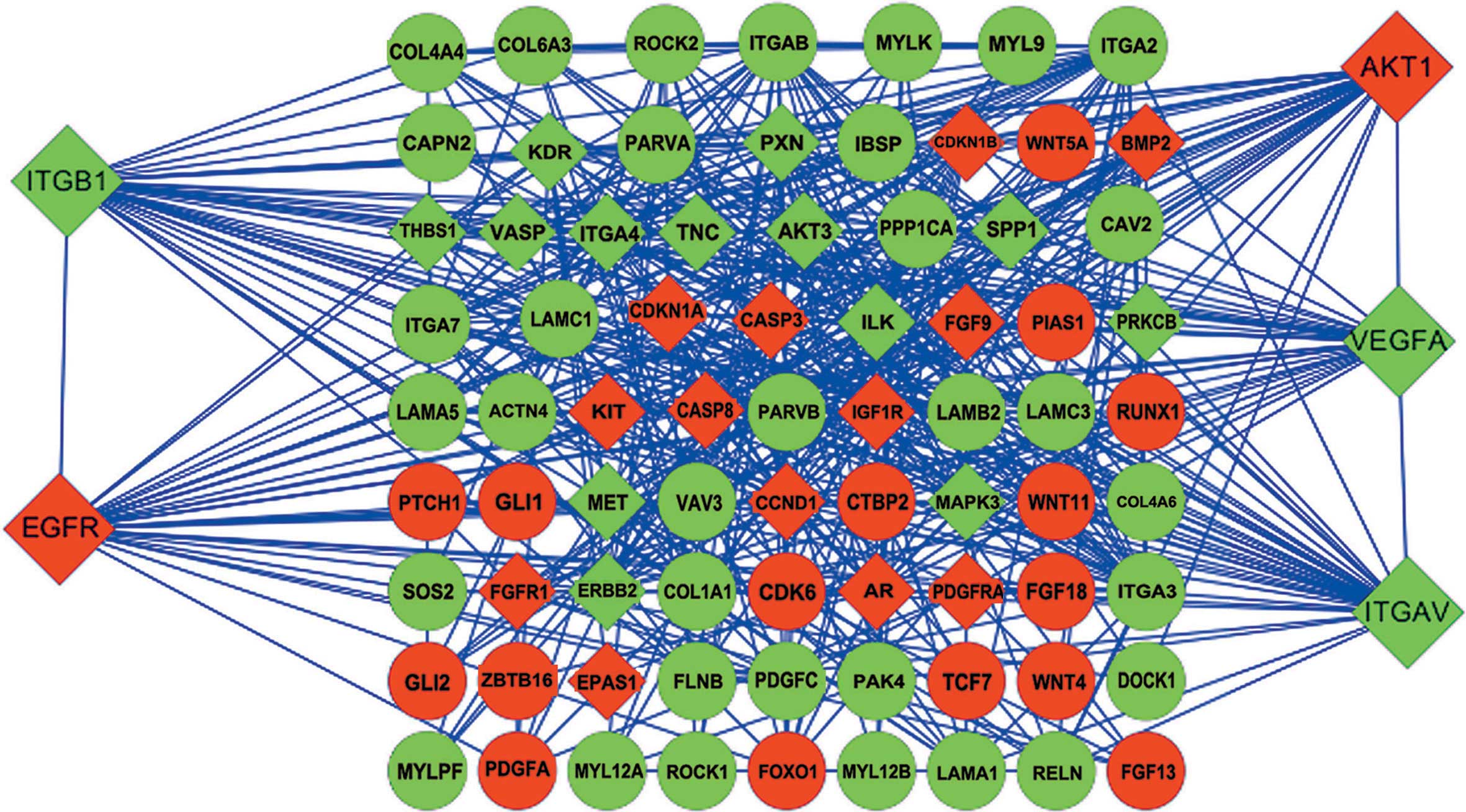
in the two pathways. The PPI network is presented in Fig. 1, with five hot genes screened out,
including three overexpressed genes [VEGFA, integrin αV (ITGαV) and
integrin β1 (ITGβ1)] and two downregulated genes [v-akt murine
thymoma viral oncogene homolog 1 (AKT1) and EGFR].
GO analysis for VEGFA-associated
genes
As presented in Table
II, the VEGFA-associated upregulated genes [cyclin D1 and
cyclin-dependent kinase inhibitor 1B (CDKN1B)] were significantly
enriched in three MF terms, including cyclin-dependent protein
kinase regulator activity (P=0.0137), protein kinase regulator
activity (P=0.0408) and kinase regulator activity (P=0.0408).
Furthermore, downregulated genes (receptor tyrosine-protein kinase
erbB-2 (ERBB2), mesenchymal-epithelial transition (MET) tyrosine
kinase receptor and kinase insert domain receptor (KDR)] markedly
disturbed two MF terms and three BP terms. The most significant MF
and BP terms were transmembrane receptor protein tyrosine kinase
activity (P=3.39×10⁻⁴) and transmembrane receptor
protein tyrosine kinase signaling pathway
(P=7.93×10⁻⁴).
| Table II.Significant GO terms for vascular
endothelial growth factor A-related genes (P<0.05). |
Table II.
Significant GO terms for vascular
endothelial growth factor A-related genes (P<0.05).
| Category | Term | P-value | Genes | Regulation |
|---|
| GOTERM_MF_FAT | GO:0016538
cyclin-dependent protein kinase regulator activity |
1.37×10⁻² | CCND1, CDKN1B | Upregulated |
| GOTERM_MF_FAT | GO:0019887 protein
kinase regulator activity |
4.08×10⁻² | CCND1, CDKN1B | Upregulated |
| GOTERM_MF_FAT | GO:0019207 kinase
regulator activity |
4.08×10⁻² | CCND1, CDKN1B | Upregulated |
| GOTERM_MF_FAT | GO:0004714
transmembrane receptor protein tyrosine kinase activity |
3.39×10⁻⁴ | ERBB2, MET, KDR | Downregulated |
| GOTERM_MF_FAT | GO:0004713 protein
tyrosine kinase activity |
1.48×10⁻³ | ERBB2, MET, KDR | Downregulated |
| GOTERM_BP_FAT | GO:0007169
transmembrane receptor protein tyrosine kinase signaling
pathway |
7.93×10⁻⁴ | ERBB2, MET, KDR | Downregulated |
| GOTERM_BP_FAT | GO:0007167
enzyme-linked receptor protein signaling pathway |
1.71×10⁻³ | ERBB2, MET, KDR | Downregulated |
| GOTERM_BP_FAT | GO:0006928 cell
motion |
5.01×10⁻³ | ERBB2, VASP,
KDR | Downregulated |
Results of TFBS analysis
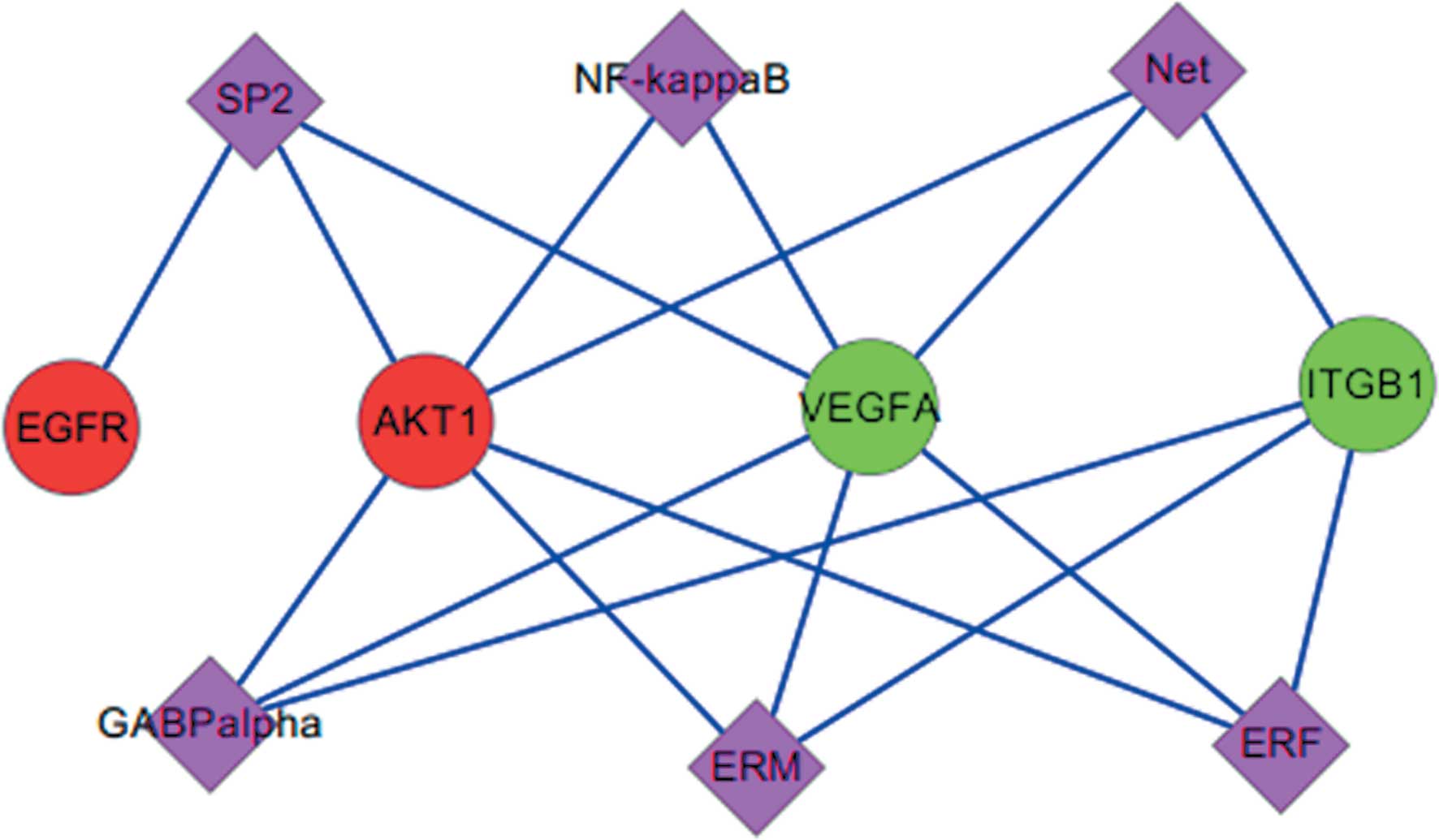
TFBS analysis was performed on the four hot genes of
VEGFA, ITGβ1, EGFR and AKTI. The results are presented in Fig. 2. VEGFA was demonstrated to be
regulated by six TFs, including ETS domain-containing transcription
factor (ERF), erythromycin resistance methylase (ERM), GA binding
protein subunit α (GABPα), norepinephrine transporter (Net), NF-κB
and Sp2 transcription factor. Similarly, the upregulated gene,
AKT1, was also regulated by the same six TFs.
Discussion
CCSK was originally described in 1970, and often
develops in children <3 years (23). CCSK has presented significant
diagnostic and clinical challenges, thus numerous studies have
aimed to investigate the mechanism of CCSK and also to identify
markers for the diagnosis and treatment of the disease. In the
present study, the underlying pathogenesis of CCSK was predicted
through the use of bioinformatic approaches, with novel markers
singled out for use in therapeutics.
A total of 2,681 DEGs, between 14 CCSK and 3 FK
samples, were identified. In these DEGs, 2,138 genes were
identified to be downregulated in CCSK samples, including VEGFA,
whilst 543 were overexpressed. Such results suggest that these
dysregulations may induce the development of CCSK, particularly in
the downregulated genes. Furthermore, it was demonstrated that 33
upregulated genes were significantly enriched in cancer-associated
pathways (P=1.35×10⁻⁶), whilst 50 downregulated genes,
including VEGFA, were enriched in focal adhesion pathways
(P=1.03×10⁻⁵). These findings indicate that the
dysregulation of these genes may induce CCSK by disturbing these
two pathways. Previous studies have demonstrated that these
pathways serve important roles in cancer development and
progression (24,25), which is consistent with the results
from the current study.
In addition, a PPI network was constructed and hot
genes were identified. By using DEGs enriched in the two most
significant pathways and the STRING database, the PPI network was
established and five hot genes were singled out. In the network,
numerous genes interacted with VEGFA, which included the two
upregulated hot genes AKT1 and EGFR, and the two downregulated
genes ITGβ1 and ITGαV. VEGFA is a member of the platelet-derived
growth factor/VEGF family and encodes a protein that is typically
identified as a disulfide-linked homodimer; it is also an
angiogenic factor that is required for tumor growth and metastasis
(26). The protein it encodes is a
glycosylated mitogen, specifically acting on endothelial cells,
with its effects including increased vascular permeability, the
promotion of cell migration, the induction of angiogenesis,
vasculogenesis and endothelial cell growth, and the inhibition of
apoptosis. EGFR, a growth factor receptor tyrosine kinase, has been
detected as a common component of multiple types of cancer
(27). AKT1 has been widely studied
and is demonstrated to be frequently overexpressed in human cancer,
with the ability to accelerate cell proliferation and suppress
programmed cell death (28). Hunt
et al (29) reported that the
aberrant activation and expression of ITGβ1 has been identified in
a number of malignancies. ITαV is associated with numerous types of
cancer, including colon, gastric and breast cancer (30). Based on previous studies, these five
hot genes have been widely investigated and detected in multiple
tumors. Notably, in the present study, the dysregulation of these
genes was also identified in CCSK, suggesting that the five hot
genes serve important roles in CCSK development.
Furthermore, the functions of VEGFA-associated genes
were analyzed by GO. The two upregulated genes, CCND1 and CDKN1B,
were involved in kinase regulation, whilst the downregulated genes,
ERBB2, MET and KDR, were significantly enriched in protein tyrosine
kinase regulation. CCND1 is involved in several human malignancies,
including breast, colorectal and non-small cell lung cancer
(31). Variant genotypes of CDKN1B,
encoding p27 KIP1, are associated with an increased risk of breast
cancer, prostate carcinoma and human hepatocellular carcinoma
(32). Overexpression of ERBB2, a
receptor-like tyrosine kinase, has been detected in several types
of human carcinomas (33). The MET
tyrosine kinase receptor promotes tissue remodeling, which
subsequently induces organ homeostasis, cancer metastasis and wound
repair (34). Jang et al
(35) demonstrated that VEGF and KDR
serve important roles in angiogenesis, contributing to the
development and progression of numerous tumors. The results of the
present study demonstrated that these genes were associated with
CCSK development, which is consistent with previous studies.
Through TFBS analysis, six TFs that regulated VEGFA,
including ERF, ERM, GABPα, Net, NF-κB and SP2, were identified.
These six TFs have the ability to regulate VEGFA expression,
indicating that the conditions of these TFs may induce the
upregulation, downregulation or normal expression of VEGFA, with
the downregulated VEGFA believed to subsequently induce CCSK. Boo
et al (8) reported the
expression of VEGF in CCSK tumor cells, indicating that
angiogenesis in CCSK may involve VEGF. However, the associations
between VEGF and TFs in CCSK have not yet been investigated.
Therefore, to the best of our knowledge, the present study predicts
that these TFs are important in CCSK development, diagnosis and
treatment for the first time.
In conclusion, the current study investigated the
underlying mechanism of CCSK and identified novel diagnostic
markers for the disease. Downregulated VEGFA and its interacting
genes may initiate CCSK development by interrupting two different
pathways, kinase regulation and protein tyrosine kinase metabolism.
Additionally, VEGFA, ITGB1, ATK1 and EGFR would be the diagnostic
markers for CCSK, while ERF, ERM, GABPα, Net, NF-κB and SP2 may
function as targets for CCSK therapy. The present study focused on
an original insight regarding the pathogenesis of CCSK and
identified novel markers, as well as targets for the disease.
However, due to the disadvantages and limitations of bioinformatic
approaches, further investigation is required to verify such
results.
References
|
1
|
Hartman RJ Jr, Welchons DR, Teot L, Chow J
and Cendron M: Incidental capture of rarely diagnosed pediatric
tumor, An infant boy with clear cell sarcoma of the kidney.
Urology. 82:1416–1418. 2013. View Article : Google Scholar : PubMed/NCBI
|
|
2
|
Argani P, Perlman EJ, Breslow NE, Browning
NG, Green DM, D'Angio GJ and Beckwith JB: Clear cell sarcoma of the
kidney, A review of 351 cases from the National Wilms Tumor Study
Group Pathology Center. Am J Surg Pathol. 24:4–18. 2000. View Article : Google Scholar : PubMed/NCBI
|
|
3
|
Seibel NL, Li S, Breslow NE, Beckwith JB,
Green DM, Haase GM, Ritchey ML, Thomas PR, Grundy PE, Finklestein
JZ, et al: Effect of duration of treatment on treatment outcome for
patients with clear-cell sarcoma of the kidney: A report from the
National Wilms' Tumor Study Group. J Clin Oncol. 22:468–473. 2004.
View Article : Google Scholar : PubMed/NCBI
|
|
4
|
Cutcliffe C, Kersey D, Huang CC, Zeng Y,
Walterhouse D and Perlman EJ: Renal Tumor Committee of the
Children's Oncology Group: Clear cell sarcoma of the kidney.
Up-regulation of neural markers with activation of the sonic
hedgehog and Akt pathways. Clin Cancer Res. 11:7986–7994. 2005.
View Article : Google Scholar : PubMed/NCBI
|
|
5
|
Dhamne S, Brown RE, Covinsky M, Dhamne C,
Eldin K and Tatevian N: Clear cell sarcoma of kidney,
Morphoproteomic analysis reveals genomic correlates and therapeutic
options. Pediatr Dev Pathol. 16:20–27. 2013. View Article : Google Scholar : PubMed/NCBI
|
|
6
|
Karlsson J, Mengelbier Holmquist L,
Ciornei CD, Naranjo A, O'Sullivan MJ and Gisselsson D: Clear cell
sarcoma of the kidney demonstrates an embryonic signature
indicative of a primitive nephrogenic origin. Genes Chromosomes
Cancer. 53:381–391. 2014. View Article : Google Scholar : PubMed/NCBI
|
|
7
|
Little SE, Bax DA, Rodriguez-Pinilla M,
Natrajan R, Messahel B, Pritchard-Jones K, Vujanic GM, Reis-Filho
JS and Jones C: Multifaceted dysregulation of the epidermal growth
factor receptor pathway in clear cell sarcoma of the kidney. Clin
Cancer Res. 13:4360–4364. 2007. View Article : Google Scholar : PubMed/NCBI
|
|
8
|
Boo YJ, Fisher JC, Haley MJ, Cowles RA,
Kandel JJ and Yamashiro DJ: Vascular characterization of clear cell
sarcoma of the kidney in a child, A case report and review. J
Pediatr Surg. 44:2031–2036. 2009. View Article : Google Scholar : PubMed/NCBI
|
|
9
|
Short SS, Zmora O, Hunter CJ, Wang L,
Siegel S and Ford HR: Large clear cell sarcoma of the kidney
mistaken as Wilms' tumor. J Pediatr Surg Rep. 1:235–238. 2013.
View Article : Google Scholar
|
|
10
|
Barrett T, Wilhite SE, Ledoux P,
Evangelista C, Kim IF, Tomashevsky M, Marshall KA, Phillippy KH,
Sherman PM, Holko M, et al: NCBI GEO: Archive for functional
genomics data sets - update. Nucleic Acids Res. 41:D991–D995. 2013.
View Article : Google Scholar : PubMed/NCBI
|
|
11
|
Gautier L, Cope L and Bolstad BM: andI
rizarry RA: affy - analysis of Affymetrix GeneChip data at the
probe level. Bioinformatics. 20:307–315. 2004. View Article : Google Scholar : PubMed/NCBI
|
|
12
|
Irizarry RA, Hobbs B, Collin F,
Beazer-Barclay YD, Antonellis KJ, Scherf U and Speed TP:
Exploration, normalization, and summaries of high density
oligonucleotide array probe level data. Biostatistics. 4:249–264.
2003. View Article : Google Scholar : PubMed/NCBI
|
|
13
|
Tiengo A, Barbarini N, Troiani S, Rusconi
L and Magni P: A Perl procedure for protein identification by
peptide mass fingerprinting. BMC Bioinformatics. 10(Suppl 12):
S112009. View Article : Google Scholar : PubMed/NCBI
|
|
14
|
Efron B, Tibshirani R, Storey JD and
Tusher V: Empirical Bayes analysis of a microarray experiment. J Am
Stat Assoc. 96:1151–1160. 2001. View Article : Google Scholar
|
|
15
|
Efron B and Tibshirani R: Empirical bayes
methods and false discovery rates for microarrays. Genet Epidemiol.
23:70–86. 2002. View Article : Google Scholar : PubMed/NCBI
|
|
16
|
Huang DW, Sherman BT, Tan Q, Collins JR,
Alvord WG, Roayaei J, Stephens R, Baseler MW, Lane HC and Lempicki
RA: The DAVID Gene Functional Classification Tool, A novel
biological module-centric algorithm to functionally analyze large
gene lists. Genome Biol. 8:R1832007. View Article : Google Scholar : PubMed/NCBI
|
|
17
|
Kanehisa M and Goto S: KEGG: Kyoto
encyclopedia of genes and genomes. Nucleic Acids Res. 28:27–30.
2000. View Article : Google Scholar : PubMed/NCBI
|
|
18
|
Franceschini A, Szklarczyk D, Frankild S,
Kuhn M, Simonovic M, Roth A, Lin J, Minguez P and Bork P: vonM
ering C and Jensen LJ: STRING v9. Histopathology. Nucleic Acids
Res. 41:D808–D815. 2013.PubMed/NCBI
|
|
19
|
Saito R, Smoot ME, Ono K, Ruscheinski J,
Wang P-L, Lotia S, Pico AR, Bader GD and Ideker T: A travel guide
to Cytoscape plugins. Nat Methods. 9:1069–1076. 2012. View Article : Google Scholar : PubMed/NCBI
|
|
20
|
Ashburner M, Ball CA, Blake JA, Botstein
D, Butler H, Cherry JM, Davis AP, Dolinski K, Dwight SS, Eppig JT,
et al: Gene Ontology: Tool for the unification of biology. The Gene
Ontology Consortium. Nat Genet. 25:25–29. 2000. View Article : Google Scholar : PubMed/NCBI
|
|
21
|
Lenhard B and Wasserman WW: TFBS:
Computational framework for transcription factor binding site
analysis. Bioinformatics. 18:1135–1136. 2002. View Article : Google Scholar : PubMed/NCBI
|
|
22
|
Loots GG, Ovcharenko I, Pachter L, Dubchak
I and Rubin EM: rVista for comparative sequence-based discovery of
functional transcription factor binding sites. Genome Res.
12:832–839. 2002. View Article : Google Scholar : PubMed/NCBI
|
|
23
|
Kidd JM: Exclusion of certain renal
neoplasms from the category of Wilms tumor. Am J Pathol.
59:16a1970.
|
|
24
|
McLean GW, Carragher NO, Avizienyte E,
Evans J, Brunton VG and Frame MC: The role of focal-adhesion kinase
in cancer - a new therapeutic opportunity. Nat Rev Cancer.
5:505–515. 2005. View
Article : Google Scholar : PubMed/NCBI
|
|
25
|
Rodriguez-Gonzalez A, Lin T, Ikeda AK,
Simms-Waldrip T, Fu C and Sakamoto KM: Role of the aggresome
pathway in cancer, Targeting histone deacetylase 6-dependent
protein degradation. Cancer Res. 68:2557–2560. 2008. View Article : Google Scholar : PubMed/NCBI
|
|
26
|
Hanrahan V, Currie MJ, Gunningham SP,
Morrin HR, Scott PA, Robinson BA and Fox SB: The angiogenic switch
for vascular endothelial growth factor (VEGF)-A, VEGF-B, VEGF-C,
and VEGF-D in the adenoma-carcinoma sequence during colorectal
cancer progression. J Pathol. 200:183–194. 2003. View Article : Google Scholar : PubMed/NCBI
|
|
27
|
Nicholson RI and Gee JM: andH arper ME:
EGFR and cancer prognosis. Eur J Cancer. 37((Suppl 4)): S9–S15.
2001. View Article : Google Scholar : PubMed/NCBI
|
|
28
|
Liu H, Radisky DC, Nelson CM, Zhang H,
Fata JE, Roth RA and Bissell MJ: Mechanism of Akt1 inhibition of
breast cancer cell invasion reveals a protumorigenic role for TSC2.
Proc Natl Acad Sci USA. 103:4134–4139. 2006. View Article : Google Scholar : PubMed/NCBI
|
|
29
|
Hunt S, Jones AV, Hinsley EE, Whawell SA
and Lambert DW: MicroRNA-124 suppresses oral squamous cell
carcinoma motility by targeting ITGB1. FEBS Lett. 585:187–192.
2011. View Article : Google Scholar : PubMed/NCBI
|
|
30
|
Daemen A, Gevaert O, De Bie T, Debucquoy
A, Machiels J-P, De Moor B and Haustermans K: Integrating
microarray and proteomics data to predict the response on cetuximab
in patients with rectal cancer. Pac Symp Biocomput. 13:166–177.
2008.
|
|
31
|
Porter TR, Richards FM, Houlston RS, Evans
DG, Jankowski JA, Macdonald F, Norbury G, Payne SJ, Fisher SA,
Tomlinson I and Maher ER: Contribution of cyclin d1 (CCND1) and
E-cadherin (CDH1) polymorphisms to familial and sporadic colorectal
cancer. Oncogene. 21:1928–1933. 2002. View Article : Google Scholar : PubMed/NCBI
|
|
32
|
Fornari F, Gramantieri L, Ferracin M,
Veronese A, Sabbioni S, Calin GA, Grazi GL, Giovannini C, Croce CM,
Bolondi L and Negrini M: MiR-221 controls CDKN1C/p57 and CDKN1B/p27
expression in human hepatocellular carcinoma. Oncogene.
27:5651–5661. 2008. View Article : Google Scholar : PubMed/NCBI
|
|
33
|
Harari D and Yarden Y: Molecular
mechanisms underlying ErbB2/HER2 action in breast cancer. Oncogene.
19:6102–6114. 2000. View Article : Google Scholar : PubMed/NCBI
|
|
34
|
Trusolino L, Bertotti A and Comoglio PM:
MET signalling, Principles and functions in development, organ
regeneration and cancer. Nat Rev Mol Cell Biol. 11:834–848. 2010.
View Article : Google Scholar : PubMed/NCBI
|
|
35
|
Jang MJ, Jeon YJ, Kim JW, Cho YK, Lee SK,
Hwang SG, Oh D and Kim NK: Association of VEGF and KDR single
nucleotide polymorphisms with colorectal cancer susceptibility in
Koreans. Mol Carcinog. 52((Suppl 1)): E60–E69. 2013. View Article : Google Scholar : PubMed/NCBI
|