Introduction
Prostate cancer (PCa) is a slow-growing but often
aggressive cancer (1). The frequency
of PCa is particularly high in Europe and USA (2,3). Factors
such as diet, habit and genetic background have been implicated in
the development of PCa (4). The
genetic background may contribute to the risk of PCa, as suggested
by associations with race, family and specific gene variants
(5). Men who have a first-degree
relative (brother or father) with PCa have twice the risk of
developing PCa, and those with two first-degree relatives affected
have a 5-fold greater risk compared with men with no family history
(2,3,6). Apoptosis
is a programmed cell death process in normal physiological and
pathological conditions (7–9). Microarrays studies have enabled the
identification of genes that are differentially regulated in cancer
(7). Apoptosis inhibition is a
critical pathophysiological factor that contributes to the onset
and progression of PCa, even if the molecular mechanisms are not
completely understood (8,9). The leucine zipper, down-regulated in
cancer 1 (LDOC-1) gene, mapping on chromosome Xq27, codes for a
nuclear protein of 146 amino acids with a molecular weight of ~17
kDa, and consists of only one exon (Online Mendelian Inheritance in
Man 300402) (10). Literature data
(10–14) have indicated greater or lesser
expression of LDOC-1 in a variety of tumor types. The aim of the
present study was to investigate the expression of the LDOC-1 gene
in LNCaP and PC3 PCa cell lines compared with normal prostate cell
lines PNT1A and PNT2 by reverse transcription-quantitative
polymerase chain reaction (RT-qPCR). In addition,
immunohistochemical studies for the protein LDOC-1 were performed
on histological samples of normal prostate and prostate
carcinoma.
Materials and methods
Cell lines
Four cell lines, PNT2, PNT1A, PC-3 and LNCaP, were
used in the present study. PNT2 primary culture was obtained
post-mortem from the prostate of a 33-year-old man (15,16). This
prostate possessed a well differentiated morphology, with the
expression of cytokeratin 19, 18 and 8, the latter being a feature
of differentiated luminal cells of the glandular prostate (15,17). The
PNT1A normal human immortalized prostatic cell line has been proved
to be a model for analysis of cellular processes such as the
proliferation of prostatic epithelium in response to androgens and
growth factors, and can be considered a non-tumorigenic cell line
based on its molecular and biochemical properties, which are close
to those of the normal prostate epithelium (15,16). The
PC-3 cell line was originally derived from advanced
androgen-independent bone metastasis/metastasized PCa (18). LNCaP is a cell line derived from a
needle biopsy of human prostate adenocarcinoma cells of a
50-year-old Caucasian man (19). The
PNT1A, PNT2, LNCaP and PC-3 cell lines used in the present study
were purchased from the American Type Culture Collection (Manassas,
VA, USA) and cultured in RPMI-1640 medium (Thermo Fisher
Scientific, Inc., Waltham, MA, USA) supplemented with 10% fetal
bovine serum (Thermo Fisher Scientific, Inc.) and 1%
penicillin-streptomycin. All cells were maintained at standard cell
culture conditions (37°C and 5% CO2 in a humidified
incubator).
RNA extraction and RT-qPCR
RNA extraction, RT and qPCR for each sample were
conducted as previously reported (13). LDOC-1 gene expression level was
normalized to glyceraldehyde 3-phosphate dehydrogenase gene
expression level, and the target mean crossing point definition was
used to indicate the mean normalized cycle threshold (13).
Patient and control prostate
tissues
The present study included 15 cases of PCa with
different Gleason score (3 prostates removed by prostectomy autopsy
and 11 prostatic biopsies) and 12 cases of normal prostatic tissues
(3 prostates removed by post-mortem autopsy in normal donors and 9
prostatic biopsies). The samples were collected between January
2012 and December 2014. The diagnosis and grading of PCa was made
by two different pathologists (A.G. and F.F.) at the Pathology Unit
of the Cannizzaro Hospital (Catania, Italy), according to the 2005
International Society of Urological Pathology Consensus Conference
(20). All samples were obtained from
the Pathology Unit of the Cannizzaro Hospital (Catania, Italy). The
protocol was approved by the internal Institutional Review Board of
Cannizzaro Hospital, and informed written consent was obtained from
each patient with PCa or, if deceased, by his/her relatives.
Immunohistochemical staining
Prostate section tissues (4-µm thick) were obtained
from all normal donors and PCa patients. All sections were
formalin-fixed and paraffin-embedded following standard methods. A
rabbit polyclonal antibody raised against human LDOC-1 protein was
used for immunohistochemistry (NBP1-80,323; Novus Biologicals, LLC,
Littleton, CO, USA). As indicated by the manufacturer's protocol,
this antibody, at a dilution of 1:150, has been demonstrated to
reliably recognize LDOC-1 proteins in PCa and normal prostate by
immunohistochemistry. In the present study, the slides were
deparaffinized, rehydrated, subjected to 3×5 min cycles in a
microwave at 360 W in citrate buffer, preincubated in 3%
H2O2 in citrate buffer and thoroughly washed
in Tris-buffered saline (TBS) [50 mm Tris-HCl (pH 7.4) and 150 mm
NaCl] containing 0.05% Tween 20 (washing buffer). Slides were then
pre-incubated with 3% bovine serum albumin (BSA; Thermo Fisher
Scientific, Inc.) in TBS for 30 min, incubated with a 1:150
dilution of anti-LDOC-1 antibody in TBS containing 1% BSA and
thoroughly washed in washing buffer prior to detection with the
LSAB 2 kit (contaning anti-mouse, biotinylated, peroxidase-labeled
streptavidin and 3,3′-diaminobenzidine-4HCl (Dako North America,
Inc., Carpinteria, CA, USA), following the manufacturer's protocol.
Upon detection, the sections were counterstained with hematoxylin,
dehydrated and mounted in xylene-based DPX mountant (BDH, Ltd.,
Pool, UK).
Microscopic evaluation
Slides were observed under a microscope, and cells
were visually scored at ×10, 20 and 40 magnification. To evaluate
the percentage of positive tumor cells and the signal intensity,
≤500 cells were analyzed for each PCa and normal prostate tissue.
LDOC-1-positive cells were evaluated independently in a blinded
fashion by two observers (A.G. and M.S.). No significant difference
was observed between the two observers. The signal intensity was
evaluated in arbitrary units from 1 (light) to 3 (dark).
Statistical analysis
Results are presented as the mean ± standard error.
Data were analyzed bu Student's t-test or one-way analysis of
variance, followed by Duncan's multiple range test. Statistical
analyses were performed using Statview version 5.01 for Windows
(SAS Institute, Cary, NC, USA). P<0.05 was considered to
indicate a statistically significant difference.
Results
RT-qPCR
The LDOC-1 gene was overexpressed in LNCaP and PC-3
PCa cell lines compared with the two PNT1A and PNT2 normal prostate
cell lines (Table I). Particularly, a
marked increase in messenger RNA (mRNA) expression of LDOC-1 in
LNCaP and PC-3 PCa cell lines was observed in comparison with the
PNT2 cell line (Table I).
 | Table I.mRNA expression of LDOC-1 and GAPDH
genes in LNCap and PC-3 prostate cancer cell lines compared with
PNT1A and PNT2 normal prostate cell lines. |
Table I.
mRNA expression of LDOC-1 and GAPDH
genes in LNCap and PC-3 prostate cancer cell lines compared with
PNT1A and PNT2 normal prostate cell lines.
| A, mRNA expression in
PNT1A vs. LNCaP cells |
|---|
|
|---|
|
| PNTA1 | LNCaP |
|---|
|
|
|
|
|---|
| mRNA expression | M. Cp | RT | M. Cp | RT |
|---|
| Target gene
LDOC-1 | 23.04 | 1.000 | 20.66 | 6.505 |
| Reference gene
GAPDH | 22.39 | – | 22.71 | – |
|
| B, mRNA expression in
PNT1A vs. PC-3 cells |
|
|
| PNTA1 | PC-3 |
|
|
|
|
| mRNA expression | M. Cp | RT | M. Cp | RT |
|
| Target gene
LDOC-1 | 23.04 | 1.000 | 20.08 | 8.819 |
| Reference gene
GAPDH | 22.39 | – | 22.57 | – |
|
| C, mRNA expression in
PNT2 vs. LNCaP cells |
|
|
| PNT2 | LNCaP |
|
|
|
|
| mRNA expression | M. Cp | RT | M. Cp | RT |
|
| Target gene
LDOC-1 | 23.00 | 1.000 | 20.66 | 9.727 |
| Reference gene
GAPDH | 21.77 | – | 22.71 | – |
|
| D, mRNA expression in
PNT2 vs. PC-3 cells |
|
|
| PNT2 | PC-3 |
|
|
|
|
| mRNA expression | M. Cp | RT | M. Cp | RT |
|
| Target gene
LDOC-1 | 23.00 | 1.000 | 20.08 | 13.190 |
| Reference gene
GAPDH | 21.77 | – | 22.57 | – |
Immunohistochemical
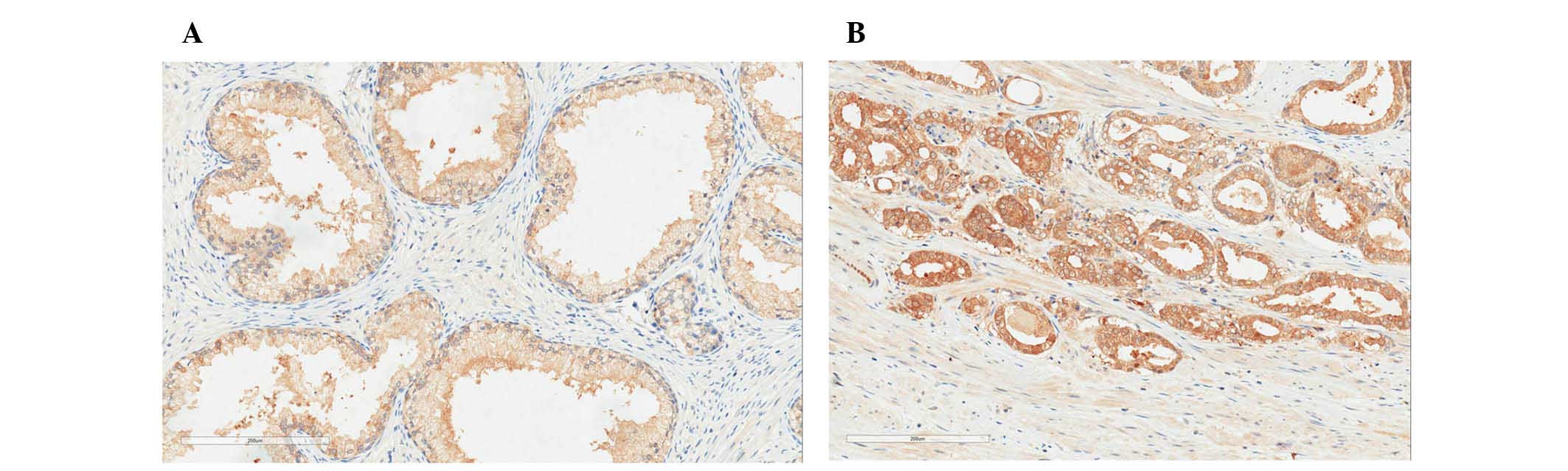
The 12 normal tissues sections exhibited cytoplasmic
signal for the protein LDOC-1 (mean percentage of positive cells,
95.75±2.01%), with a signal intensity of 1 or 2 (Table II and Fig.
1A). LDOC-1-positive cytoplasmic signal was present in all 15
PCa samples (mean number of positive cells, 96.00±1.96%), with a
signal intensity of 3 in all PCa sections (Table II and Fig.
1B). No nuclear staining was observed in any of the samples. A
more intense signal of LDOC-1 protein was evidenced in samples of
PCa samples.
| Table II.Expression of leucine zipper,
down-regulated in cancer 1 protein in normal prostate and prostate
carcinoma. |
Table II.
Expression of leucine zipper,
down-regulated in cancer 1 protein in normal prostate and prostate
carcinoma.
| Normal prostate | Prostate
carcinoma |
|---|
|
|
|---|
| ID | Type | Age,
yearsa | Positive cells
(%)b | Sig. int. | ID | Type | Age,
yearsc | Gl. sc. | Positive cells
(%)d | Sig. int. |
|---|
| N1 | Biopsy | 68 | 97 | 2 | PA 1 | Prost. | 69 | 4+4 | 95 | 3 |
| N2 | Biopsy | 64 | 98 | 1 | PA 2 | Prost. | 61 | 3+5 | 98 | 3 |
| N3 | Biopsy | 63 | 95 | 2 | PA 3 | Prost. | 63 | 4+4 | 99 | 3 |
| N4 | Biopsy | 65 | 99 | 1 | PA 4 | Biopsy | 64 | 4+4 | 93 | 3 |
| N5 | Autopsy | 79 | 94 | 2 | PA 5 | Biopsy | 81 | 4+3 | 97 | 3 |
| N6 | Biopsy | 74 | 93 | 2 | PA 6 | Biopsy | 74 | 4+4 | 98 | 3 |
| N7 | Biopsy | 72 | 97 | 2 | PA 7 | Biopsy | 70 | 4+4 | 95 | 3 |
| N8 | Biopsy | 67 | 95 | 1 | PA 8 | Biopsy | 68 | 4+4 | 94 | 3 |
| N9 | Biopsy | 56 | 94 | 2 | PA 9 | Biopsy | 56 | 3+3 | 98 | 3 |
| N10 | Biopsy | 69 | 97 | 1 | PA 10 | Biopsy | 66 | 4+3 | 96 | 3 |
| N11 | Autopsy | 71 | 93 | 2 | PA 11 | Biopsy | 74 | 3+3 | 96 | 3 |
| N12 | Autopsy | 88 | 97 | 2 | PA 12 | Biopsy | 61 | 3+3 | 93 | 3 |
|
|
|
|
|
| PA 13 | Biopsy | 67 | 3+4 | 94 | 3 |
|
|
|
|
|
| PA 14 | Biopsy | 70 | 4+4 | 98 | 3 |
|
|
|
|
|
| PA 15 | Biopsy | 69 | 3+5 | 96 | 3 |
Discussion
RT-qPCR analysis demonstrated that mRNA LDOC-1 was
overexpressed in LNCaP and PC-3 PCa cell lines compared with normal
prostate cell lines. These data were confirmed by an increased
expression of the protein LDOC-1 in the tissues of PCa patients
compared with normal prostate tissues. Gene conversions on the X
chromosome (LDOC-1 maps in Xq27) have been linked with genetic
diseases and disorders (21). These
variations lead to haplotypes with an increased susceptibility to
PCa; therefore it cannot be excluded that any rearrangements may
favor an overexpression of LDOC-1 in PCa. LDOC-1 is a known
regulator of the nuclear factor (NF)-κB-mediated pathway of
apoptosis through the inhibition of NF-κB (12). The expression of Wiskott-Aldrich
syndrome protein family, member 3 induces the translocation of
LDOC-1 from the nucleus to the cytoplasm, resulting in the
inhibition of LDOC1-induced apoptosis (22,23). In
addition, the transcription factor myeloid zinc finger gene 1 was
demonstrated to interact with LDOC-1 and to enhance the activity of
LDOC-1, thus favoring apoptosis (22,23).
Recently, Buchholtz et al (24) observed a low expression of LDOC-1 in
ovarian cancer cells. This does not exclude the fact that, in
certain tumors, there may be a higher expression of the gene
LDOC-1, where the mechanism of pro-apoptotic activity may be
triggered as a last resort to block the tumor progression.
Furthermore, it cannot be excluded that, in PCa, there may be less
mechanisms of methylation, thus leading to gene overexpression for
various reasons that remain to be clarified.
In conclusion, the present results could be useful
for better understanding the potential role LDOC-1 in the search of
novel anticancer mechanisms in PCa.
References
|
1
|
Steinberg GD, Carter BS, Beaty TH, Childs
B and Walsh PC: Family history and the risk of prostate cancer.
Prostate. 17:337–347. 1990. View Article : Google Scholar : PubMed/NCBI
|
|
2
|
Jemal A, Murray T, Samuels A, Ghafoor A,
Ward E and Thun MJ: Cancer statistics, 2003. CA Cancer J Clin.
53:5–26. 2003. View Article : Google Scholar : PubMed/NCBI
|
|
3
|
Trojan L, Kiknavelidze K, Knoll T, Alken P
and Michel MS: Prostate cancer therapy: Standard management, new
options and experimental approaches. Anticancer Res. 25:551–561.
2005.PubMed/NCBI
|
|
4
|
Kucuk O: Chemoprevention of prostate
cancer. Cancer Metastasis Rev. 21:111–124. 2002. View Article : Google Scholar : PubMed/NCBI
|
|
5
|
Hoffman RM, Gilliland FD, Eley JW, Harlan
LC, Stephenson RA, Stanford JL, Albertson PC, Hamilton AS, Hunt WC
and Potosky AL: Racial and ethnic differences in advanced-stage
prostate cancer: The prostate cancer outcomes study. J Natl Cancer
Inst. 93:388–395. 2001. View Article : Google Scholar : PubMed/NCBI
|
|
6
|
Lichtenstein P, Holm NV, Verkasalo PK,
Iliadou A, Kaprio J, Koskenvuo M, Pukkala E, Skytthe A and Hemminki
K: Environmental and heritable factors in the causation of
cancer-analyses of cohorts of twins from Sweden, Denmark and
Finland. N Engl J Med. 343:78–85. 2000. View Article : Google Scholar : PubMed/NCBI
|
|
7
|
Dhanasekaran SM, Barrette TR, Ghosh D,
Shah R, Varambally S, Kurachi K, Pienta KJ, Rubin MA and Chinnaiyan
AM: Delineation of prognostic biomarkers in prostate cancer.
Nature. 412:822–826. 2001. View
Article : Google Scholar : PubMed/NCBI
|
|
8
|
Guseva NV, Taghiyev AF, Rokhlin OW and
Cohen MB: Death receptor-induced cell death in prostate cancer. J
Cell Biochem. 91:70–99. 2004. View Article : Google Scholar : PubMed/NCBI
|
|
9
|
Zornig M, Hueber AO, Baum W and Evan G:
Apoptosis regulators and their role in tumorigenesis. Biochem
Biophys Acta. 1551:F1–F37. 2001.PubMed/NCBI
|
|
10
|
Nagasaki K, Manabe T, Hanzawa H, Maass N,
Tsukada T and Yamaguchi K: Identification of a novel gene, LDOC1,
down-regulated in cancer cell lines. Cancer Lett. 140:227–234.
1999. View Article : Google Scholar : PubMed/NCBI
|
|
11
|
Nagasaki K, Schem C, von Kaisenberg C,
Biallek M, Rösel F, Jonat W and Mass N: Leucine-zipper protein,
LDOC1, inhibits NF-kappaB activation and sensitizes pancreatic
cancer cells to apoptosis. Int J Cancer. 105:454–458. 2003.
View Article : Google Scholar : PubMed/NCBI
|
|
12
|
Nagasaki K, Schem C, von Kaisenberg C,
Biallek M, Rösel F and Jonat W: Leucine-zipper protein, LDOC1,
inhibits NF-kappaB activation and sensitizes pancreatic cancer
cells to apoptosis. Int J Cancer. 105:454–458. 2003. View Article : Google Scholar : PubMed/NCBI
|
|
13
|
Salemi M, Giuffrida D, Giuffrida MC, Soma
PF, Rolfo A, Cimino L, Condorelli RA, Castiglione R, La Vignera S
and Calogero AE: LDOC1 gene expression in two patients with head
and neck squamous cell carcinomas and parkinson's disease. Tumori.
98:86e–88e. 2012.PubMed/NCBI
|
|
14
|
Mizutani K, Koike D, Suetsugu S and
Takenawa T: WAVE3 functions as a negative regulator of LDOC1. J
Biochem. 138:639–646. 2005. View Article : Google Scholar : PubMed/NCBI
|
|
15
|
Cussenot O, Berthon P, Berger R,
Mowszowicz I, Faille A, Hojman F, Teillac P, Le Duc A and Calvo F:
Immortalization of human adult normal prostatic epithelial cells by
liposomes containing large T-SV40 gene. J Urol. 146:881–886.
1991.PubMed/NCBI
|
|
16
|
Avancès C, Georget V, Térouanne B, Orio F,
Cussenot O, Mottet N, Costa P and Sultan C: Human prostatic cell
line PNT1A, a useful tool for studying androgen receptor
transcriptional activity and its differential subnuclear
localization in the presence of androgens and antiandrogens. Mol
Cell Endocrinol. 184:13–24. 2001. View Article : Google Scholar : PubMed/NCBI
|
|
17
|
Berthon P, Cussenot O, Hopwood L, Leduc A
and Maitland N: Functional expression of sv40 in normal human
prostatic epithelial and fibroblastic cells-differentiation pattern
of nontumorigenic cell-lines. Int J Oncol. 6:333–343.
1995.PubMed/NCBI
|
|
18
|
Kaighn ME, Narayan KS, Ohnuki Y, Lechner
JF and Jones LW: Establishment and characterization of a human
prostatic carcinoma cell line (PC-3). Invest Urol. 17:16–23.
1979.PubMed/NCBI
|
|
19
|
Marcelli M, Cunningham GR, Haidacher SJ,
Padayatty SJ, Sturgis L, Kagan C and Denner L: Caspase-7 is
activated during lovastatin-induced apoptosis of the prostate
cancer cell line LNCaP. Cancer Res. 58:76–83. 1998.PubMed/NCBI
|
|
20
|
Epstein JI, Allsbrook WC Jr, Amin MB and
Egevad LL: ISUP Grading Committee: The 2005 International Society
of Urological Pathology (ISUP) Consensus Conference on Gleason
Grading of Prostatic Carcinoma. Am J Surg Pathol. 29:1228–1242.
2005. View Article : Google Scholar : PubMed/NCBI
|
|
21
|
Kouprina N, Pavlicek A, Noskov V, Solomon
G, Otstot J, Isaacs W, Carpten JD, Trent JM, Schleutker J, Barrett
JC, et al: Dynamic structure of the SPANX gene cluster mapped to
the prostate cancer susceptibility locus HPCX at Xq27. Genome Res.
15:1477–1486. 2005. View Article : Google Scholar : PubMed/NCBI
|
|
22
|
Inoue M, Takahashi K, Niide O, Shibata M,
Fukuzawa M and Ra C: LDOC1, a novel MZF-1-interacting protein,
induces apoptosis. FEBS Lett. 579:604–608. 2005. View Article : Google Scholar : PubMed/NCBI
|
|
23
|
Mizutani K, Koike D, Suetsugu S and
Takenawa T: WAVE3 functions as a negative regulator of LDOC1. J
Biochem. 138:639–646. 2001. View Article : Google Scholar
|
|
24
|
Buchholtz ML, Brüning A, Mylonas I and
Jückstock J: Epigenetic silencing of the LDOC1 tumor suppressor
gene in ovarian cancer cells. Arch Gynecol Obstet. 290:149–154.
2014. View Article : Google Scholar : PubMed/NCBI
|