Spandidos Publications Logo
  • About
    • About Spandidos
    • Aims and Scopes
    • Abstracting and Indexing
    • Editorial Policies
    • Reprints and Permissions
    • Job Opportunities
    • Terms and Conditions
    • Contact
  • Journals
    • All Journals
    • Oncology Letters
      • Oncology Letters
      • Information for Authors
      • Editorial Policies
      • Editorial Board
      • Aims and Scope
      • Abstracting and Indexing
      • Bibliographic Information
      • Archive
    • International Journal of Oncology
      • International Journal of Oncology
      • Information for Authors
      • Editorial Policies
      • Editorial Board
      • Aims and Scope
      • Abstracting and Indexing
      • Bibliographic Information
      • Archive
    • Molecular and Clinical Oncology
      • Molecular and Clinical Oncology
      • Information for Authors
      • Editorial Policies
      • Editorial Board
      • Aims and Scope
      • Abstracting and Indexing
      • Bibliographic Information
      • Archive
    • Experimental and Therapeutic Medicine
      • Experimental and Therapeutic Medicine
      • Information for Authors
      • Editorial Policies
      • Editorial Board
      • Aims and Scope
      • Abstracting and Indexing
      • Bibliographic Information
      • Archive
    • International Journal of Molecular Medicine
      • International Journal of Molecular Medicine
      • Information for Authors
      • Editorial Policies
      • Editorial Board
      • Aims and Scope
      • Abstracting and Indexing
      • Bibliographic Information
      • Archive
    • Biomedical Reports
      • Biomedical Reports
      • Information for Authors
      • Editorial Policies
      • Editorial Board
      • Aims and Scope
      • Abstracting and Indexing
      • Bibliographic Information
      • Archive
    • Oncology Reports
      • Oncology Reports
      • Information for Authors
      • Editorial Policies
      • Editorial Board
      • Aims and Scope
      • Abstracting and Indexing
      • Bibliographic Information
      • Archive
    • Molecular Medicine Reports
      • Molecular Medicine Reports
      • Information for Authors
      • Editorial Policies
      • Editorial Board
      • Aims and Scope
      • Abstracting and Indexing
      • Bibliographic Information
      • Archive
    • World Academy of Sciences Journal
      • World Academy of Sciences Journal
      • Information for Authors
      • Editorial Policies
      • Editorial Board
      • Aims and Scope
      • Abstracting and Indexing
      • Bibliographic Information
      • Archive
    • International Journal of Functional Nutrition
      • International Journal of Functional Nutrition
      • Information for Authors
      • Editorial Policies
      • Editorial Board
      • Aims and Scope
      • Abstracting and Indexing
      • Bibliographic Information
      • Archive
    • International Journal of Epigenetics
      • International Journal of Epigenetics
      • Information for Authors
      • Editorial Policies
      • Editorial Board
      • Aims and Scope
      • Abstracting and Indexing
      • Bibliographic Information
      • Archive
    • Medicine International
      • Medicine International
      • Information for Authors
      • Editorial Policies
      • Editorial Board
      • Aims and Scope
      • Abstracting and Indexing
      • Bibliographic Information
      • Archive
  • Articles
  • Information
    • Information for Authors
    • Information for Reviewers
    • Information for Librarians
    • Information for Advertisers
    • Conferences
  • Language Editing
Spandidos Publications Logo
  • About
    • About Spandidos
    • Aims and Scopes
    • Abstracting and Indexing
    • Editorial Policies
    • Reprints and Permissions
    • Job Opportunities
    • Terms and Conditions
    • Contact
  • Journals
    • All Journals
    • Biomedical Reports
      • Information for Authors
      • Editorial Policies
      • Editorial Board
      • Aims and Scope
      • Abstracting and Indexing
      • Bibliographic Information
      • Archive
    • Experimental and Therapeutic Medicine
      • Information for Authors
      • Editorial Policies
      • Editorial Board
      • Aims and Scope
      • Abstracting and Indexing
      • Bibliographic Information
      • Archive
    • International Journal of Epigenetics
      • Information for Authors
      • Editorial Policies
      • Editorial Board
      • Aims and Scope
      • Abstracting and Indexing
      • Bibliographic Information
      • Archive
    • International Journal of Functional Nutrition
      • Information for Authors
      • Editorial Policies
      • Editorial Board
      • Aims and Scope
      • Abstracting and Indexing
      • Bibliographic Information
      • Archive
    • International Journal of Molecular Medicine
      • Information for Authors
      • Editorial Policies
      • Editorial Board
      • Aims and Scope
      • Abstracting and Indexing
      • Bibliographic Information
      • Archive
    • International Journal of Oncology
      • Information for Authors
      • Editorial Policies
      • Editorial Board
      • Aims and Scope
      • Abstracting and Indexing
      • Bibliographic Information
      • Archive
    • Medicine International
      • Information for Authors
      • Editorial Policies
      • Editorial Board
      • Aims and Scope
      • Abstracting and Indexing
      • Bibliographic Information
      • Archive
    • Molecular and Clinical Oncology
      • Information for Authors
      • Editorial Policies
      • Editorial Board
      • Aims and Scope
      • Abstracting and Indexing
      • Bibliographic Information
      • Archive
    • Molecular Medicine Reports
      • Information for Authors
      • Editorial Policies
      • Editorial Board
      • Aims and Scope
      • Abstracting and Indexing
      • Bibliographic Information
      • Archive
    • Oncology Letters
      • Information for Authors
      • Editorial Policies
      • Editorial Board
      • Aims and Scope
      • Abstracting and Indexing
      • Bibliographic Information
      • Archive
    • Oncology Reports
      • Information for Authors
      • Editorial Policies
      • Editorial Board
      • Aims and Scope
      • Abstracting and Indexing
      • Bibliographic Information
      • Archive
    • World Academy of Sciences Journal
      • Information for Authors
      • Editorial Policies
      • Editorial Board
      • Aims and Scope
      • Abstracting and Indexing
      • Bibliographic Information
      • Archive
  • Articles
  • Information
    • For Authors
    • For Reviewers
    • For Librarians
    • For Advertisers
    • Conferences
  • Language Editing
Login Register Submit
  • This site uses cookies
  • You can change your cookie settings at any time by following the instructions in our Cookie Policy. To find out more, you may read our Privacy Policy.

    I agree
Search articles by DOI, keyword, author or affiliation
Search
Advanced Search
presentation
Oncology Letters
Join Editorial Board Propose a Special Issue
Print ISSN: 1792-1074 Online ISSN: 1792-1082
Journal Cover
October-2016 Volume 12 Issue 4

Full Size Image

Sign up for eToc alerts
Recommend to Library

Journals

International Journal of Molecular Medicine

International Journal of Molecular Medicine

International Journal of Molecular Medicine is an international journal devoted to molecular mechanisms of human disease.

International Journal of Oncology

International Journal of Oncology

International Journal of Oncology is an international journal devoted to oncology research and cancer treatment.

Molecular Medicine Reports

Molecular Medicine Reports

Covers molecular medicine topics such as pharmacology, pathology, genetics, neuroscience, infectious diseases, molecular cardiology, and molecular surgery.

Oncology Reports

Oncology Reports

Oncology Reports is an international journal devoted to fundamental and applied research in Oncology.

Experimental and Therapeutic Medicine

Experimental and Therapeutic Medicine

Experimental and Therapeutic Medicine is an international journal devoted to laboratory and clinical medicine.

Oncology Letters

Oncology Letters

Oncology Letters is an international journal devoted to Experimental and Clinical Oncology.

Biomedical Reports

Biomedical Reports

Explores a wide range of biological and medical fields, including pharmacology, genetics, microbiology, neuroscience, and molecular cardiology.

Molecular and Clinical Oncology

Molecular and Clinical Oncology

International journal addressing all aspects of oncology research, from tumorigenesis and oncogenes to chemotherapy and metastasis.

World Academy of Sciences Journal

World Academy of Sciences Journal

Multidisciplinary open-access journal spanning biochemistry, genetics, neuroscience, environmental health, and synthetic biology.

International Journal of Functional Nutrition

International Journal of Functional Nutrition

Open-access journal combining biochemistry, pharmacology, immunology, and genetics to advance health through functional nutrition.

International Journal of Epigenetics

International Journal of Epigenetics

Publishes open-access research on using epigenetics to advance understanding and treatment of human disease.

Medicine International

Medicine International

An International Open Access Journal Devoted to General Medicine.

Journal Cover
October-2016 Volume 12 Issue 4

Full Size Image

Sign up for eToc alerts
Recommend to Library

  • Article
  • Citations
    • Cite This Article
    • Download Citation
    • Create Citation Alert
    • Remove Citation Alert
    • Cited By
  • Similar Articles
    • Related Articles (in Spandidos Publications)
    • Similar Articles (Google Scholar)
    • Similar Articles (PubMed)
  • Download PDF
  • Download XML
  • View XML
Article Open Access

Overlap of the cancer genome atlas and the immune epitope database

  • Authors:
    • Shaimaa Sait
    • Timothy Fawcett
    • George Blanck
  • View Affiliations / Copyright

    Affiliations: Department of Molecular Medicine, Morsani College of Medicine, Tampa, FL 33612, USA, Department of Chemical and Biomedical Engineering, College of Engineering, Research Computing University of South Florida, Tampa, FL 33620, USA
    Copyright: © Sait et al. This is an open access article distributed under the terms of Creative Commons Attribution License.
  • Pages: 2982-2984
    |
    Published online on: August 10, 2016
       https://doi.org/10.3892/ol.2016.4991
  • Expand metrics +
Metrics: Total Views: 0 (Spandidos Publications: | PMC Statistics: )
Metrics: Total PDF Downloads: 0 (Spandidos Publications: | PMC Statistics: )
Cited By (CrossRef): 0 citations Loading Articles...

This article is mentioned in:


Abstract

Mutant peptides resulting from cancer drivers or passenger mutations are expected to have the potential to serve as a basis for cancer vaccines. However, a number of parameters regulate vaccine‑associated immunogenicity, including the suitability of a peptide for binding to an antigen‑presenting molecule or antibody. In order to obtain a basic indication of the prospect of human cancer epitope identification via current database development strategies, an overlap of the mutant Homo sapiens epitopes listed on the Immune Epitope Database (IEDB) and the mutant peptides indicated by The Cancer Genome Atlas (TCGA) somatic mutation database was obtained. No putative TCGA mutant peptides were detected among the 8,890 14‑18 amino acid (AA) IEDB peptides available. In total, 3 IEDB mutant epitopes that encompassed a TCGA mutant AA position, but did not overlap the exact position of the TCGA mutant AA, were detected. The results of the present analysis confirm that verification of certain aspects of cancer epitope function can be obtained via the continued and systematic expansion of databases representing human protein epitopes. However, the analysis also indicates that there is relatively limited systematic information available regarding antigen‑presenting molecule epitopes and cancer‑related mutant peptides.

Introduction

The development of cancer vaccines has become a high priority in the field of cancer treatment. However, there are numerous parameters that affect the success of an immune response against an antigen, including the binding of a T-cell receptor to a major histocompatibility complex (MHC)-bound antigen and antigen processing. Empirical evaluations of vaccine efficacy parameters are costly and time-consuming. Thus, bioinformatic approaches may provide a useful alternative.

The Immune Epitope Database (IEDB) includes >35,000 human peptides known to either bind to human leukocyte antigen (HLA) class I or II, or to have other immune receptor binding properties (1,2). Knowledge of the capacity of a peptide to bind to antigen-presenting molecules could potentially improve the selection of cancer vaccine candidates that are based on mutant peptides, whether these result from cancer drivers or passenger mutations. In addition, sufficient database development may allow for a better understanding of any presumed selection against the binding of cancer peptide neoantigens to MHC molecules as an aspect of cancer development.

The present study focused on searching for overlaps of The Cancer Genome Atlas (TCGA) mutant peptides (3,4) and peptides in the IEDB, in order to discover cancer-related peptides that have the demonstrable capability to bind to MHC molecules.

Materials and methods

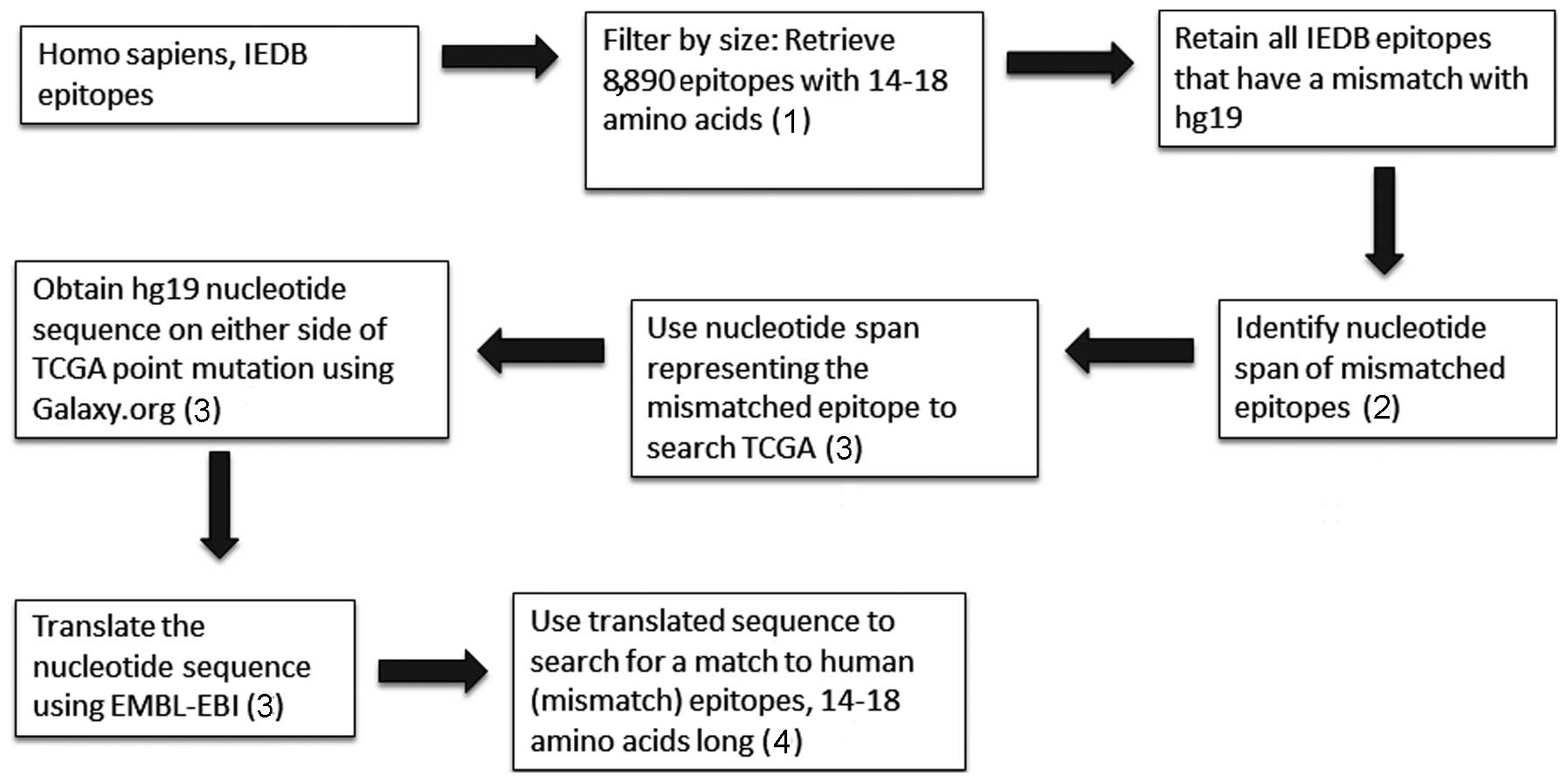
The overview of the approach is provided in Fig. 1. Supporting online material (SOM) representing each stage of the approach were also used in the present study (http://www.universityseminarassociates.com/Supporting_online_material_for_scholarly_pubs.php) (5). Briefly, human epitopes were downloaded from the IEDB (www.iedb.org) using the following search terms: Epitope, linear epitope; antigen, Homo sapiens (human) (ID: 9606, Homo sapiens); host, humans; assay, all assays; MHC restriction, MHCI and MHCII; disease, any disease. The results comprised ~35,000 epitopes and were downloaded as an Excel file. Epitopes that ranged between 14–18 amino acids (AAs) in size were used to determine mismatches with the human genome version 19 (hg19) reference genome at genome.ucsc.edu. The nucleotide spans of the mismatches were obtained by using the BLAT search (http://genome.ucsc.edu/cgi-bin/hgBlat?command=start) to search a local database, which was created from the TCGA download portal and consisted of a collection of all TCGA cancer mutations (https://tcga-data.nci.nih.gov/tcga/tcgaDownload.jsp). The recovered nucleotide positions were extended with hg19 nucleotides using The Extract Genomic DNA tool at https://usegalaxy.org/. The extended regions were then translated into all possible reading frames (including forward and reverse) using the European Molecular Biology Laboratory-European Bioinformatics Institute to generate a database for screening the IEDB 14–18 AA set, in order to verify the IEDB matches and to detect mismatches at the location of the TCGA mutation. All HLA candidates were removed due to overly extensive sequence variation. Gene family members that were originally inaccurately regarded as hg19 mismatches, may be found in the SOM files by Sait et al (5) (Table I).

Figure 1.

Overview of the procedure used to determine whether any IEDB peptides, which did not match the hg19, matched putative TCGA mutant peptides. The file numbers (1–4) in the figure refer to the supporting online material files by Sait et al (http://www.universityseminarassociates.com/Supporting_online_material_for_scholarly_pubs.php), which include results and details on each step of the procedure. IEDB, Immune Epitope Database; TCGA, The Cancer Genome Atlas; hg19, human genome version 19; EMBL-EBI, European Molecular Biology Laboratory-European Bioinformatics Institute.

Table I.

Identification of IEDB peptides that overlap the position of a mutant amino acid in the TCGA database.

Table I.

Identification of IEDB peptides that overlap the position of a mutant amino acid in the TCGA database.

Hugo gene symbolNormal peptide sequence (hg19)IEDB ID numberIEDB peptide (hg19 mismatched amino acid in large type, bold)hg19 translation of TCGA mutation on either side of mutation positionTCGA mutation chromosome numberTCGA cancer datasetTCGA nucleotide numberMHC
ATP1A2NPREAKACVVHGSDLK103447NPRDAKACVVHGSDLKVVHGSDL  1LUAD/LIHC160104960HLA-DQB
ACVVHG  1LIHC160104952
CVVHGS  1LIHC160104955
VVHGSDL  1LUAD/LIHC160104960
COL2A1GEPGIAGFKGEQGPKG107398GKPGIAGFKGEQGPKGIAGFKG12READ   48380651HLA-DRB1
TROVE2LQEMPLTALLRNLGKM118499LQEMPTLALLRNLGKMALLRNL  1SKCM193045674NA

[i] Data were obtained from the supporting online material files by Sait et al (5) (http://www.universityseminarassociates.com/Supporting_online_material_for_scholarly_pubs.php) using the procedure described in Fig. 1. IEDB, Immune Epitope Database; TCGA, The Cancer Genome Atlas; hg19, human genome version 19; ID, identification; MHC, major histocompatibility complex; ATP1A2, ATPase Na+/K+ transporting subunit α 2; LUAD, lung adenocarcinoma; LIHC, liver hepatocellular carcinoma; READ, rectum adenocarcinoma; SKCM, skin cutaneous melanoma; COL2A1, collagen type II α 1; TROVE2, Telomerase, Ro and Vault domain family member 2; LUAD, Lung Adenocarcinoma; HLA-DQB, major histocompatibility complex, class II, DO β; HLA-DRB1, major histocompatibility complex, class II, DR β 1; NA, not applicable.

Results and Discussion

The present study was required to determine whether detecting an IEDB peptide that had a mismatch at the exact position of a TCGA mutant AA was possible. Therefore, a search was performed among the 8,890 IEDB human peptides consisting of 14–18 AAs, with translated AAs on either side of all TCGA point mutations, to check for overlap with an IEDB epitope that had a mismatch with the hg19 version of the reference genome. Since the translations represented exact matches with the hg19 translations, the 8,890 epitopes consisting of 14–18 AA were searched, allowing for one mismatch with the translations used, in order to ‘surround’ the location of the TCGA mutation. According to this protocol, while the TCGA point mutation-referenced translations overlapped the position of the TCGA mutation, these translations matched hg19 exactly, thus requiring the single mismatch standard for searching the aforementioned 8,890 IEDB epitopes for an exact match.

Numerous IEDB epitopes were identified using this method; however, following the exclusion of IEDB epitopes that did not match the gene of the TCGA mutation, only one IEDB peptide had a non-hg19 AA in the position of the TCGA mutant AA. This IEDB epitope mapped to integrin subunit β 3 (ITGB3), which is a known ITGB3 single nucleotide polymorphism. The data supporting this finding is presented in SOM file no. 5 of Sait et al (5).

To determine whether the TCGA mutant AA positions overlapped IEDB peptides that contained a mismatch with the hg19 AA sequence, without the TCGA position equaling the precise location of the IEDB mismatched AAs, the protocol indicated in Fig. 1 was followed. The results are provided in Table I. This protocol indicated that, following the removal of mismatches attributable to closely associated family members or mismatches detected anomalously due to repeats within a protein, 3 IEDB peptides, which were a mismatch to hg19, also overlapped the position of the TCGA mutant AA. For details of the results that were obtained by pursuing this approach, including the discounted IEDB peptides that were anomalously recovered using the Fig. 1 approach, please see SOM file no. 6 in Sait et al (5). Overall, these results indicate that mutant peptides in human cancer overlap apparent mutant peptides in the IEDB, suggesting that the AAs surrounding TCGA mutants are not fundamentally a hindrance to MHC binding. Notably, two of the proteins represented by the overlap of TCGA mutations and IEDB non-hg19 peptides represent the extracellular matrix, ITGB3 and collagen type II α 1, an emerging topic in the field of cancer research (4,6,7).

However, the general paucity of the overlap of the two databases strongly indicates that, from a bioinformatic perspective, there is very little information available for determining which cancer drivers or passenger mutations have the potential of significant MHC binding. This conclusion is even more striking considering the extensive MHC polymorphism and protease activities that could impact binding affinities of cancer peptides (8).

In conclusion, there is a strong case to be made for the development of a more comprehensive human immuno-peptidome project, with the particular aim of determining whether cancer peptides are selected for the reduced likelihood of MHC occupancy.

References

1 

He Y and Xiang Z: Databases and in silico tools for vaccine design. Methods Mol Biol. 993:115–127. 2013. View Article : Google Scholar : PubMed/NCBI

2 

Helmberg W: Bioinformatic databases and resources in the public domain to aid HLA research. Tissue Antigens. 80:295–304. 2012. View Article : Google Scholar : PubMed/NCBI

3 

Akbani R, Ng PK, Werner HM, Shahmoradgoli M, Zhang F, Ju Z, Liu W, Yang JY, Yoshihara K, Li J, et al: A pan-cancer proteomic perspective on the cancer genome atlas. Nat Commun. 5:38872014. View Article : Google Scholar : PubMed/NCBI

4 

Parry ML, Ramsamooj M and Blanck G: Big genes are big mutagen targets: A connection to cancerous, spherical cells? Cancer Lett. 356:479–482. 2015. View Article : Google Scholar : PubMed/NCBI

5 

Sait S, Fawcett T and Blanck G: Supporting online materials for Overlap of The Cancer Genome Atlas and the Immune Epitope Database. http://www.universityseminarassociates.com/Supporting_online_material_for_scholarly_pubs.phpAccessed. June 10–2016

6 

Parry ML and Blanck G: Flat cells come full sphere: Are mutant cytoskeletal-related proteins oncoprotein-monsters or useful immunogens? Hum Vaccin Immunother. 12:120–123. 2016. View Article : Google Scholar : PubMed/NCBI

7 

Naba A, Clauser KR, Whittaker CA, Carr SA, Tanabe KK and Hynes RO: Extracellular matrix signatures of human primary metastatic colon cancers and their metastases to liver. BMC Cancer. 14:5182014. View Article : Google Scholar : PubMed/NCBI

8 

Cronin K, Escobar H, Szekeres K, Reyes-Vargas E, Rockwood AL, Lloyd MC, Delgado JC and Blanck G: Regulation of HLA-DR peptide occupancy by histone deacetylase inhibitors. Hum Vaccin Immunother. 9:784–789. 2013. View Article : Google Scholar : PubMed/NCBI

Related Articles

  • Abstract
  • View
  • Download
  • Twitter
Copy and paste a formatted citation
Spandidos Publications style
Sait S, Fawcett T and Blanck G: Overlap of the cancer genome atlas and the immune epitope database. Oncol Lett 12: 2982-2984, 2016.
APA
Sait, S., Fawcett, T., & Blanck, G. (2016). Overlap of the cancer genome atlas and the immune epitope database. Oncology Letters, 12, 2982-2984. https://doi.org/10.3892/ol.2016.4991
MLA
Sait, S., Fawcett, T., Blanck, G."Overlap of the cancer genome atlas and the immune epitope database". Oncology Letters 12.4 (2016): 2982-2984.
Chicago
Sait, S., Fawcett, T., Blanck, G."Overlap of the cancer genome atlas and the immune epitope database". Oncology Letters 12, no. 4 (2016): 2982-2984. https://doi.org/10.3892/ol.2016.4991
Copy and paste a formatted citation
x
Spandidos Publications style
Sait S, Fawcett T and Blanck G: Overlap of the cancer genome atlas and the immune epitope database. Oncol Lett 12: 2982-2984, 2016.
APA
Sait, S., Fawcett, T., & Blanck, G. (2016). Overlap of the cancer genome atlas and the immune epitope database. Oncology Letters, 12, 2982-2984. https://doi.org/10.3892/ol.2016.4991
MLA
Sait, S., Fawcett, T., Blanck, G."Overlap of the cancer genome atlas and the immune epitope database". Oncology Letters 12.4 (2016): 2982-2984.
Chicago
Sait, S., Fawcett, T., Blanck, G."Overlap of the cancer genome atlas and the immune epitope database". Oncology Letters 12, no. 4 (2016): 2982-2984. https://doi.org/10.3892/ol.2016.4991
Follow us
  • Twitter
  • LinkedIn
  • Facebook
About
  • Spandidos Publications
  • Careers
  • Cookie Policy
  • Privacy Policy
How can we help?
  • Help
  • Live Chat
  • Contact
  • Email to our Support Team