Introduction
Parosteal osteosarcoma is a kind of malignant tumor
with a low malignant degree and good differentiation, accounting
for 3–5% of malignant tumors (1).
Parosteal osteosarcoma often occurs in the distal humerus, mostly
manifested as a painless mass; it is very similar to the benign
bone tumor, so both tumors are prone to misdiagnosis clinically
(2).
At present, there are no special precautionary
measures for parosteal osteosarcoma, and its treatment is also
dominated by surgical resection, supplemented by chemotherapy.
hsa-mir-148b is located on the human autosomal 12q13.13 and its
expression is low in many human tumor tissues. Studies have shown
that (3), miR-148b plays a role as a
negative regulator of DNMT3B expression by inhibiting intracellular
DNA methylation. Other studies have shown that (4) highly expressed miR-148b inhibits the
proliferation and tumorigenesis of hepatoblastoma HepG2, and
induces cell apoptosis through caspase-3 and caspase-9. miR-148b
also regulates cyclin D1 and p21 to induce S-phase arrest and
inhibits the invasion of hepatoblastoma. Therefore, it can be
inferred from the above that miR-148b expression may reverse tumor
progression to some extent. Currently, there are few studies on
human serum albumin-micro RNA miR-148b in parosteal osteosarcoma,
but there are many studies in breast cancer (5), hepatocellular carcinoma (6), lung cancer (7) and colorectal cancer (8).
In this study, the expression differences of
miR-148b in stage-I and II parosteal osteosarcoma were detected and
its effects on development of parosteal osteosarcoma were
investigated.
Materials and methods
Specimen collection
A total of 47 cases of fresh tissues of stage-I and
II parosteal osteosarcoma and the corresponding para-carcinoma
normal bone tissues resected by operation (stored in liquid
nitrogen within 10 min) in The First Affiliated Hospital of Wenzhou
Medical University from 2007 to 2012 were collected. All patients
were diagnosed with parosteal osteosarcoma in Pathology Department
in the hospital, including 27 males and 20 females aged 20.5±8.1
years. In terms of Enneking staging, there were 20 cases in stage
I, 15 cases in stage IIA, 9 cases in stage IIB and 3 cases in stage
III. All the patients in this experimental study were followed up.
This study was approved by the Ethics Committee of The First
Affiliated Hospital of Wenzhou Medical University, and the patients
or their families signed the informed consent.
Major reagents and instruments
Reverse transcriptase and reverse transcription kit
were purchased from Takara Biotechnology Co., Ltd. (Beijing,
China); 2 × synergy brands (SYBR) Green quantitative polymerase
chain reaction (qPCR) mix and RevertAid first strand complementary
DNA (cDNA) synthesis kit were both purchased from Invitrogen
(Thermo Fisher Scientific, Inc., Waltham, MA, USA); 7900HT
fluorescence qPCR instrument was purchased from Applied Biosystems
(Thermo Fisher Scientific, Inc.); primers were synthesized by
Sangon Biotech Co., Ltd. (Shanghai, China).
RNA extraction and RT-qPCR
RNA extraction
Parosteal osteosarcoma tissues and normal
para-carcinoma tissues were ground and added with the lysis buffer.
The total RNA was extracted by using the TRIzol reagent, and the
concentration and purity of RNA extracted were detected by using
the ultraviolet spectrophotometer. RNAs with the optical density
(OD)260/OD280 ratio between 1.8 and 2.1 were reverse transcribed
into cDNA. Reaction conditions are as follows: 72°C for 3 min, 42°C
for 60 min, and 95°C for 3 min. The synthesized cDNA reaction
solution was stored at −20°C.
Reverse transcription (RT)-qPCR
RT-qPCR was performed by using miScript SYBR-Green
PCR kit, and the reaction system was prepared according to the
instructions. miR-148b: forward primer:
5′-CCAAATTTCCCAATCAGGCATCACAG-3′; reverse primer:
5′-TAACCATTAGCAGGGTCCGAGGTATTC-3′. Reaction conditions are as
follows: pre-denaturation at 95°C for 10 min; 95°C for 15 sec, 60°C
for 30 sec and 72°C for 15 sec, a total of 45 cycles.
Glyceraldehyde-3-phosphate dehydrogenase (GAPDH) was used as the
internal reference, and the relative expression level of miR-148b
was calculated by using 2−ΔΔCq.
Statistical analysis
In this study, Statistical Product and Service
Solutions (SPSS) 17.0 software package (SPSS Inc., Chicago, IL,
USA) was used for data processing and statistical analysis.
Measurement data are presented as mean ± standard deviation. The
Chi-square test was used for enumeration data, Student's t-test was
used for the measurement data between groups, and analysis of
variance was used for the measurement data among groups.
Kaplan-Meier analysis was used for survival analysis and log-rank
test for comparison of survival rate between the two groups. Cox
regression analysis was used for the univariate analysis of
survival data. P<0.05 was considered to indicate a statistically
significant difference.
Results
miR-148b expression in parosteal
osteosarcoma tissues and para-carcinoma normal tissues
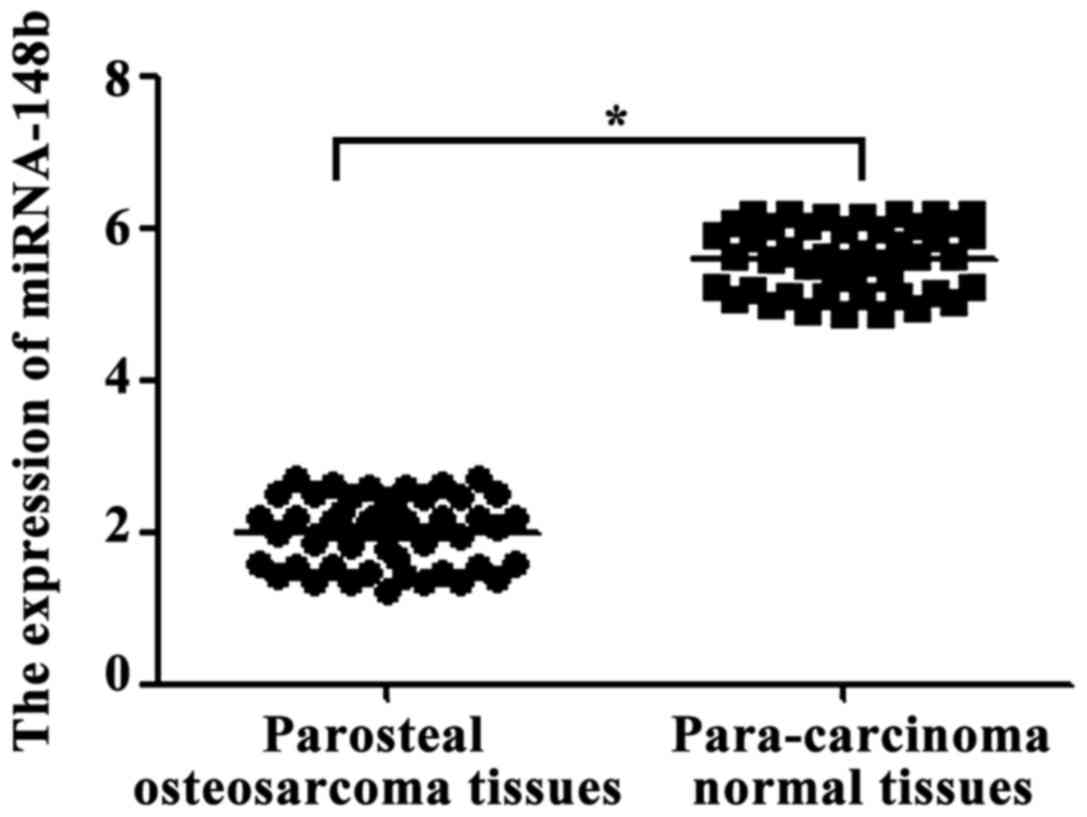
The detection of 47 cases of parosteal osteosarcoma
tissues via RT-qPCR showed that the relative expression level of
miR-148b in parosteal osteosarcoma tissues was significantly lower
than that in para-carcinoma normal tissues, and the difference was
statistically significant (P<0.05) (Fig. 1).
Correlation analysis of clinical
factors of parosteal osteosarcoma and miR-148b expression
According to the median value obtained in the
experiment, patients with parosteal osteosarcoma were divided into
the high-expression group (n=22) and the low-expression group
(n=25). The statistical analysis showed that the low expression of
miR-148b was not correlated with the sex, age, Enneking staging,
chemotherapy, smoking history, tumor size and pathological type
(P>0.05), but was correlated with the lung metastasis
(P<0.05) (Table I).
 | Table I.Correlation analysis of clinical
factors of parosteal osteosarcoma and hsa-miR-148b expression. |
Table I.
Correlation analysis of clinical
factors of parosteal osteosarcoma and hsa-miR-148b expression.
| Clinical factor | n | Low-expression
hsa-miR-148b | High-expression
hsa-miR-148b | χ2 | P-value |
|---|
| Sex |
|
|
| 0.094 | 0.784 |
| Male | 27 | 17 | 10 |
|
|
|
Female | 20 | 8 | 12 |
|
|
| Age |
|
|
| 0.574 | 0.614 |
| ≥30 | 21 | 13 | 8 |
|
|
|
<30 | 26 | 12 | 14 |
|
|
| Tumor size |
|
|
| 0.841 | 0.517 |
| >5
cm | 17 | 10 | 7 |
|
|
| ≤5
cm | 30 | 15 | 15 |
|
|
| Enneking staging |
|
|
| 0.874 | 0.769 |
| Stage
I | 20 | 12 | 8 |
|
|
| Stage
II | 24 | 11 | 13 |
|
|
| Stage
III | 3 | 2 | 1 |
|
|
| Pathological |
|
|
| 0.414 | 0.376 |
|
Osteoblast | 21 | 10 | 11 |
|
|
|
Chondrocyte | 14 | 8 | 6 |
|
|
|
Fibroblast | 7 | 4 | 3 |
|
|
|
Others | 5 | 3 | 2 |
|
|
| Chemotherapy |
|
|
| 0.494 | 0.582 |
| Yes | 27 | 15 | 12 |
|
|
| No | 20 | 10 | 10 |
|
|
| Smoking history |
|
|
| 0.541 | 0.618 |
| Yes | 27 | 17 | 10 |
|
|
| No | 20 | 10 | 10 |
|
|
| Lung metastasis |
|
|
| 3.574 | 0.014 |
| Yes | 35 | 20 | 15 |
|
|
| No | 12 | 5 | 7 |
|
|
Kaplan-Meier survival analysis
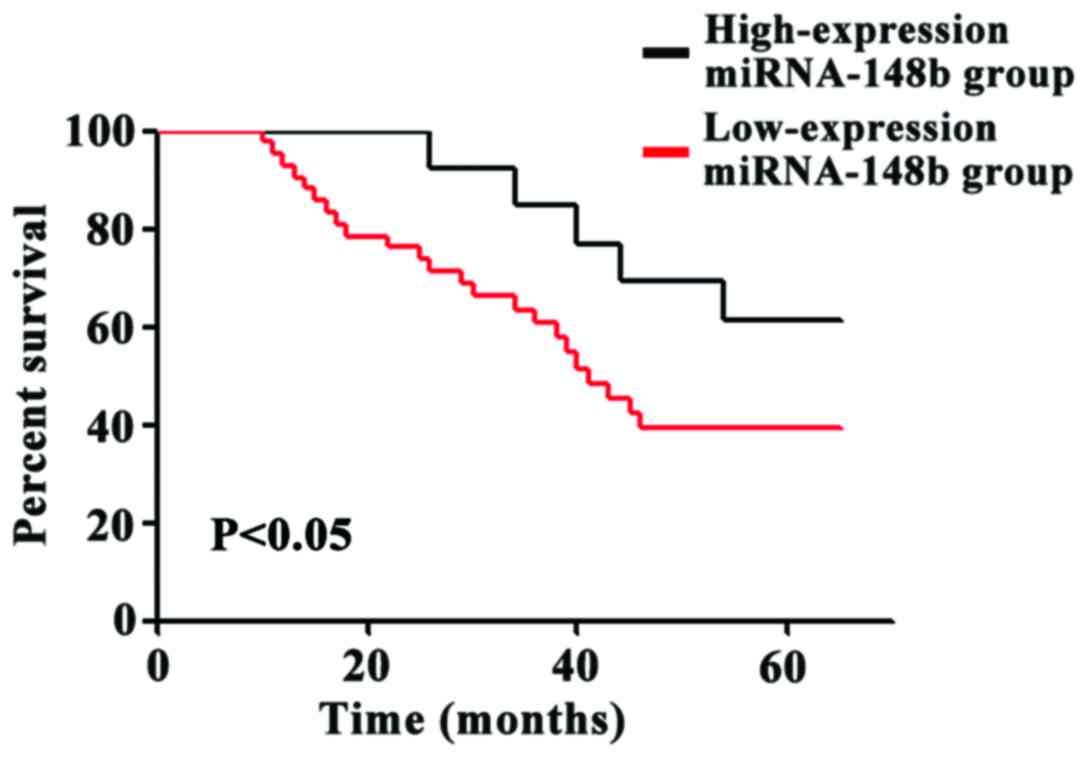
Forty-seven patients were followed up for 72 months.
Five out of 22 patients with parosteal osteosarcoma in
high-expression group died, and the 5-year survival rate was 77.2%.
Nineteen out of 25 patients with parosteal osteosarcoma in the
low-expression group died, and the 5-year survival rate was 40%. As
shown in Fig. 2 the survival time of
patients in the high-expression group was significantly longer than
that of patients in the low-expression group, and the difference
was statistically significant (P<0.05) (Fig. 2).
Cox regression analysis
Finally, all clinical data were collected and
analyzed by univariate Cox regression, and the factors with
P<0.05 were analyzed by multivariate Cox regression. The results
of univariate Cox regression analysis showed that the factors had
no correlation with patients' sex, age, tumor size, chemotherapy,
smoking history and Enneking stage (P>0.05), but had
correlations with the pathological type, lung metastasis and
low-expression miR-148b in patients (P<0.05). The multivariate
Cox regression analysis revealed that the low expression of
miR-148b was an independent factor affecting the prognosis of
patients with parosteal osteosarcoma (P<0.05) (Table II).
| Table II.Cox regression analysis of miR-148b
and clinical factors in the prognosis of patients with parosteal
osteosarcoma. |
Table II.
Cox regression analysis of miR-148b
and clinical factors in the prognosis of patients with parosteal
osteosarcoma.
| Pathological
characteristic | Univariate Cox | Multivariate Cox |
|---|
|
|
|
|---|
|
| HR | 95% CI | χ2 | P-value | HR | 95% CI | χ2 | P-value |
|---|
| Sex | 1.841 | 0.677–2.984 | 0.874 | 0.415 |
|
|
|
|
| Age | 1.417 | 0.874–3.541 | 0.687 | 0.533 |
|
|
|
|
| Tumor size | 0.874 | 0.438–1.874 | 1.341 | 0.474 |
|
|
|
|
| Enneking
staging | 0.611 | 0.398–1.341 | 3.568 | 0.749 |
|
|
|
|
| Pathological
type | 3.841 | 1.984–4.984 | 7.543 | 0.017 | 2.341 | 1.094–3.846 | 0.679 | 0.084 |
| Chemotherapy | 0.984 | 0.684–2.165 | 1.267 | 0.081 |
|
|
|
|
| Smoking
history | 0.688 | 0.384–1.488 | 0.987 | 0.384 |
|
|
|
|
| Lung
metastasis | 3.412 | 1.974–5.847 | 7.151 | 0.024 |
|
|
|
|
| miRNA-158b
expression | 4.974 | 1.974–11.541 | 8.984 | 0.001 | 4.869 | 1.533–13.846 | 1.467 | 0.003 |
Discussion
At present, parosteal osteosarcoma mainly exists in
adolescents and children, and is one of the bone tumors with a high
malignant grade and strong capacity for invasion and proliferation
(9,10). It often occurs in distal humerus, and
its early symptoms are swelling and pain and it is not easily
detectable; if there is no appropriate treatment, patients are
prone to lung metastasis, thus leading to poor prognosis (11).
miRNA is a non-coding small-molecule single-stranded
RNA that is highly conserved in the body, and increasing evidence
in the literature world-wide shows that miRNAs are involved in
tumor migration, invasion and proliferation, and cell regulation
capacity (12). It has been reported
(13) that the miRNA expression is
different in parosteal osteosarcoma tissues; some miRNAs are
upregulated, while some are downregulated, which may play a certain
regulating role in the occurrence and development of tumors
(14). miR-148b is expressed in a
variety of tumors, such as nasopharyngeal carcinoma (15), liver cancer (16) and lung cancer (17). However, there are not many studies on
miR-148b in parosteal osteosarcoma. In this study, the correlation
analysis was performed for the expression of miR-148b in patients
with parosteal osteosarcoma for the first time, so as to provide
new targets and scientific basis for the treatment of parosteal
osteosarcoma.
The results of this study showed that the expression
of miR-148b had a statistically significant difference in parosteal
osteosarcoma tissues and para-carcinoma normal tissues. Ge et
al (18) reported that the
miR-148b is downregulated in lung cancer tissues, suggesting that
there may be a certain relationship between them. It was found via
correlation analysis that the low expression of miR-148b was not
related to the patients' sex, age, Enneking staging, chemotherapy,
smoking history, tumor size or pathological type (P>0.05), but
related to the lung metastasis (P>0.05). Finally, Cox regression
analysis was performed for the data collected. The univariate Cox
regression analysis revealed that the pathological type, lung
metastasis and low-expression miR-148b were the prognostic factors,
while the multivariate Cox regression analysis showed that the
low-expression miR-148b was an independent factor affecting the
prognosis of patients with parosteal osteosarcoma, which further
suggested that the low-expression of miR-148b is one of the key
factors affecting the clinicobiological behavior of parosteal
osteosarcoma, and the low-expression of miR-148b plays a role in
the occurrence, development and prognosis of parosteal
osteosarcoma; furthermore, the low-expression hsa-miR-148b can be
used as an effective prognostic index for patients with parosteal
osteosarcoma. In recent years, the treatment level of parosteal
osteosarcoma has improved, and the survival rates after different
therapeutic regimens have also increased, but drug resistance
generally occurs in the late stage of treatment, and the risk for
recurrence and metastasis is high (19,20).
There were also shortcomings in this study: the
patients were from one city, so the samples were not representative
because of the lack of geographical differences; besides, the small
sample size might produce biased results. This study is a clinical
study, and the mechanism of the role of miR-148b was not
investigated. It can only be speculated that downregulation of
miR-148b may lead to the activation or inactivation of its
downstream target genes so that the development of cancer can be
promoted. In future studies, the number of samples will be
increased and in-depth investigations on the downstream pathways
and target genes of miR-148b will be performed to support the
results of this study.
In conclusion, the expression of miR-148b in
parosteal osteosarcoma tissues and para-carcinoma normal tissues
and the clinical factors were detected via RT-qPCR in this study
for the first time. It was found that the expression of miR-148b
was low in patients with parosteal osteosarcoma, and miR-148b was
related to the lung metastasis in patients. Moreover, it was found
via Kaplan-Meier survival analysis that the survival time in the
low-expression group was significantly shorter than that in the
high-expression group. These results suggest that the differential
expression of miR-148b can be used as a potential biological index
of parosteal osteosarcoma.
Acknowledgements
Not applicable.
Funding
No funding was received.
Availability of data and materials
The datasets used and/or analyzed during the present
study are available from the corresponding author on reasonable
request.
Authors' contributions
WL, LW and XZ conceived and designed the study. WL,
SY, XC and PC were responsible for the collection and analysis of
the patient data. LW and XZ interpreted the data and drafted the
manuscript. WL and PC revised the manuscript critically for
important intellectual content. All authors read and approved the
final study.
Ethics approval and consent to
participate
The study was approved by the Ethics Committee of
The First Affiliated Hospital of Wenzhou Medical University. Signed
informed consents were obtained from the patients or the
guardians.
Consent for publication
Not applicable.
Competing interests
The authors declare that they have no competing
interests.
References
|
1
|
Isakoff MS, Bielack SS, Meltzer P and
Gorlick R: Osteosarcoma: Current treatment and a collaborative
pathway to success. J Clin Oncol. 33:3029–3035. 2015. View Article : Google Scholar : PubMed/NCBI
|
|
2
|
Luetke A, Meyers PA, Lewis I and Juergens
H: Osteosarcoma treatment - where do we stand? A state of the art
review. Cancer Treat Rev. 40:523–532. 2014. View Article : Google Scholar : PubMed/NCBI
|
|
3
|
Azizi M, Teimoori-Toolabi L, Arzanani MK,
Azadmanesh K, Fard-Esfahani P and Zeinali S: MicroRNA-148b and
microRNA-152 reactivate tumor suppressor genes through suppression
of DNA methyltransferase-1 gene in pancreatic cancer cell lines.
Cancer Biol Ther. 15:419–427. 2014. View Article : Google Scholar : PubMed/NCBI
|
|
4
|
Zhang JG, Shi Y, Hong DF, Song M, Huang D,
Wang CY and Zhao G: MiR-148b suppresses cell proliferation and
invasion in hepatocellular carcinoma by targeting WNT1/β-catenin
pathway. Sci Rep. 5:80872015. View Article : Google Scholar : PubMed/NCBI
|
|
5
|
Borel F, Konstantinova P and Jansen PL:
Diagnostic and therapeutic potential of miRNA signatures in
patients with hepatocellular carcinoma. J Hepatol. 56:1371–1383.
2012. View Article : Google Scholar : PubMed/NCBI
|
|
6
|
Liu Q, Xu Y, Wei S, Gao W, Chen L, Zhou T,
Wang Z, Ying M and Zheng Q: miRNA-148b suppresses hepatic cancer
stem cell by targeting neuropilin-1. Biosci Rep. 35:e002292015.
View Article : Google Scholar : PubMed/NCBI
|
|
7
|
Yang JS, Li BJ, Lu HW, Chen Y, Lu C, Zhu
RX, Liu SH, Yi QT, Li J and Song CH: Serum miR-152, miR-148a,
miR-148b, and miR-21 as novel biomarkers in non-small cell lung
cancer screening. Tumour Biol. 36:3035–3042. 2015. View Article : Google Scholar : PubMed/NCBI
|
|
8
|
Li T, Yin J, Yuan L, Wang S, Yang L, Du X
and Lu J: Downregulation of microRNA-139 is associated with
hepatocellular carcinoma risk and short-term survival. Oncol Rep.
31:1699–1706. 2014. View Article : Google Scholar : PubMed/NCBI
|
|
9
|
Chen X, Bahrami A, Pappo A, Easton J,
Dalton J, Hedlund E, Ellison D, Shurtleff S, Wu G, Wei L, et al:
St. Jude Children's Research Hospital–Washington University
Pediatric Cancer Genome Project: Recurrent somatic structural
variations contribute to tumorigenesis in pediatric osteosarcoma.
Cell Rep. 7:104–112. 2014. View Article : Google Scholar : PubMed/NCBI
|
|
10
|
Cheng D, Qiu X, Zhuang M, Zhu C, Zou H and
Liu Z: MicroRNAs with prognostic significance in osteosarcoma: A
systemic review and meta-analysis. Oncotarget. 8:81062–81074. 2017.
View Article : Google Scholar : PubMed/NCBI
|
|
11
|
Wang Z and Cai H, Lin L, Tang M and Cai H:
Upregulated expression of microRNA-214 is linked to tumor
progression and adverse prognosis in pediatric osteosarcoma.
Pediatr Blood Cancer. 61:206–210. 2014. View Article : Google Scholar : PubMed/NCBI
|
|
12
|
Wu X, Zhong D, Gao Q, Zhai W, Ding Z and
Wu J: MicroRNA-34a inhibits human osteosarcoma proliferation by
downregulating ether à go-go 1 expression. Int J Med Sci.
10:676–682. 2013. View Article : Google Scholar : PubMed/NCBI
|
|
13
|
Cote GA, Gore AJ, McElyea SD, Heathers LE,
Xu H, Sherman S and Korc M: A pilot study to develop a diagnostic
test for pancreatic ductal adenocarcinoma based on differential
expression of select miRNA in plasma and bile. Am J Gastroenterol.
109:1942–1952. 2014. View Article : Google Scholar : PubMed/NCBI
|
|
14
|
Dahlmans D, Houzelle A, Schrauwen P and
Hoeks J: Mitochondrial dynamics, quality control and miRNA
regulation in skeletal muscle: Implications for obesity and related
metabolic disease. Clin Sci (Lond). 130:843–852. 2016. View Article : Google Scholar : PubMed/NCBI
|
|
15
|
Wu M, Ye X, Wang S, Li Q, Lai Y and Yi Y:
MicroRNA-148b suppresses proliferation, migration, and invasion of
nasopharyngeal carcinoma cells by targeting metastasis-associated
gene 2. OncoTargets Ther. 10:2815–2822. 2017. View Article : Google Scholar
|
|
16
|
Drakaki A, Hatziapostolou M, Polytarchou
C, Vorvis C, Poultsides GA, Souglakos J, Georgoulias V and
Iliopoulos D: Functional microRNA high throughput screening reveals
miR-9 as a central regulator of liver oncogenesis by affecting the
PPARA-CDH1 pathway. BMC Cancer. 15:5422015. View Article : Google Scholar : PubMed/NCBI
|
|
17
|
Yang JS, Li BJ, Lu HW, Chen Y, Lu C, Zhu
RX, Liu SH, Yi QT, Li J and Song CH: Serum miR-152, miR-148a,
miR-148b, and miR-21 as novel biomarkers in non-small cell lung
cancer screening. Tumour Biol. 36:3035–3042. 2015. View Article : Google Scholar : PubMed/NCBI
|
|
18
|
Ge H, Li B, Hu WX, Li RJ, Jin H, Gao MM
and Ding CM: MicroRNA-148b is down-regulated in non-small cell lung
cancer and associated with poor survival. Int J Clin Exp Pathol.
8:800–805. 2015.PubMed/NCBI
|
|
19
|
Josefsson A, Hobbs R, Mauxion T, Frey E,
Terezakis S, Meyer C, Loeb D and Sgouros G: Combined treatment
planning and therapy using 153Sm-EDTMP RPT with XRT in pediatric
metastatic osteosarcoma patients. J Nucl Med. 56:3412015.
|
|
20
|
Xu YF, Jiang SJ, Wang YQ, Yao YW and Liu
YX: A survival analysis and treatment outcomes of 131 cases of
osteosarcoma treated with high-dose methotrexate multidrug
chemotherapy. Int J Clin Exp Med. 9:8465–8473. 2016.
|