Introduction
Nasopharyngeal carcinoma (NPC) is a common head and
neck malignancy in southern China, with distinct geographical and
ethnic characteristics (1). Its
development is closely linked to Epstein-Barr virus (EBV)
infection, genetic susceptibility and environmental exposure, among
other contributing factors (2). In
low-risk populations, the incidence of NPC peaks moderately at
15–24 years of age, plateaus or slightly declines at 35–39 years
and reaches a second, higher peak at ~65-79 years (3). With the aging population, the number
of elderly patients with NPC is gradually increasing. However,
these patients often face significant treatment challenges due to
declining physical function and multiple comorbidities and they are
frequently excluded from clinical studies (4). As a result, there is no consensus on
the treatment of elderly patients with NPC. Patients of very high
age with NPC are rare in clinical practice. This case report
details the successful treatment of a ~90-year-old patient with NPC
with lung metastasis, aiming to provide a reference for the
treatment of similar patients.
Case report
Case presentation
An 89-year-old male presented at Shanghai Fourth
People's Hospital (Shanghai, China) in February 2023 with a 6-month
history of recurrent blood-stained nasal discharge. The patient had
a history of cerebral infarction for eight years but denied any
major cardiopulmonary diseases or allergies. Nasopharyngeal
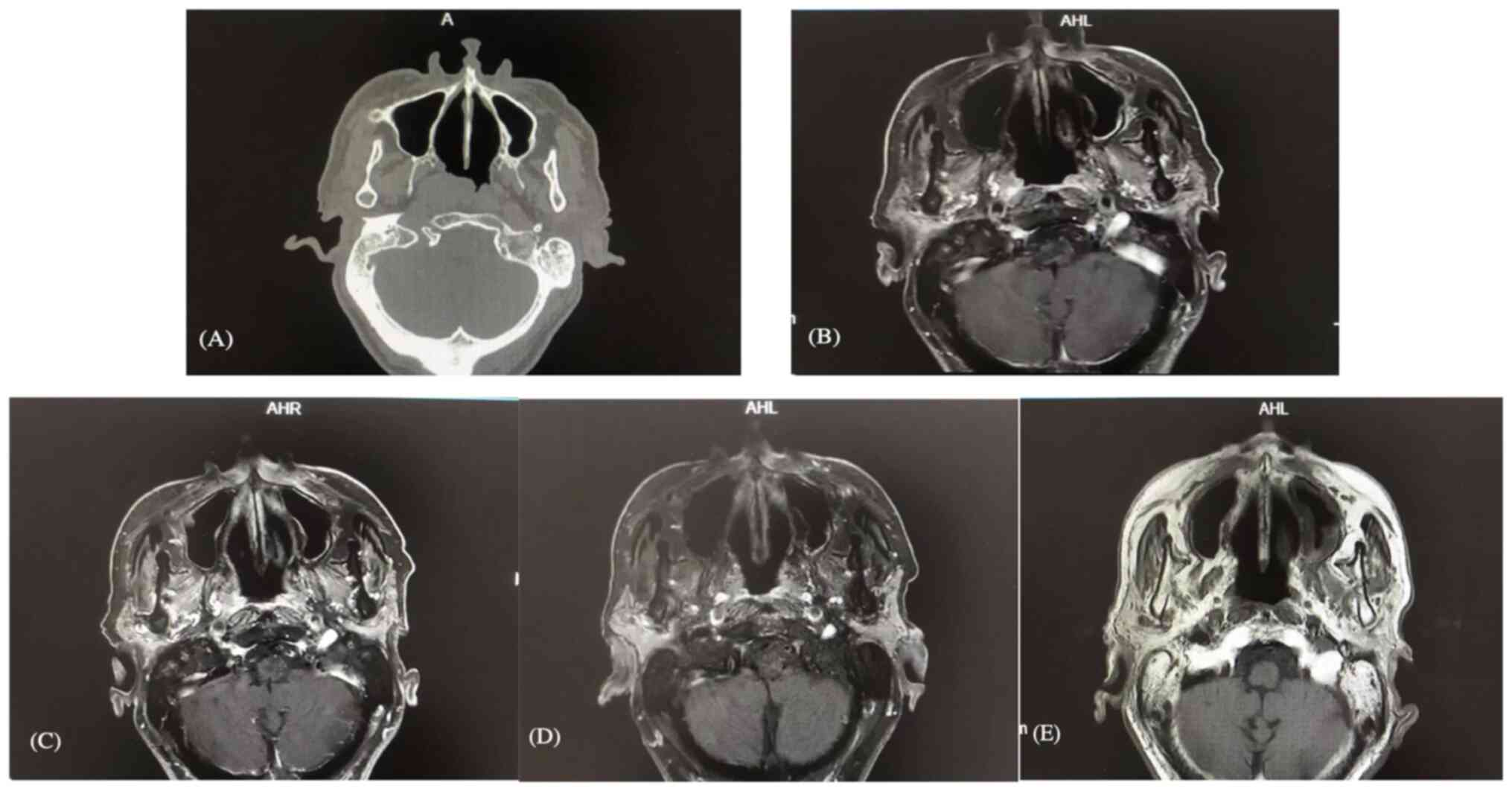
computed tomography (CT) revealed a mass in the right nasopharynx
(Fig. 1A) and a biopsy confirmed
NPC (keratinizing squamous cell carcinoma). IgA against EBV Zta
protein was positive (EBV antibody test; Shanghai Kecheng Bio).
There are no specific tumor markers for nasopharyngeal carcinoma
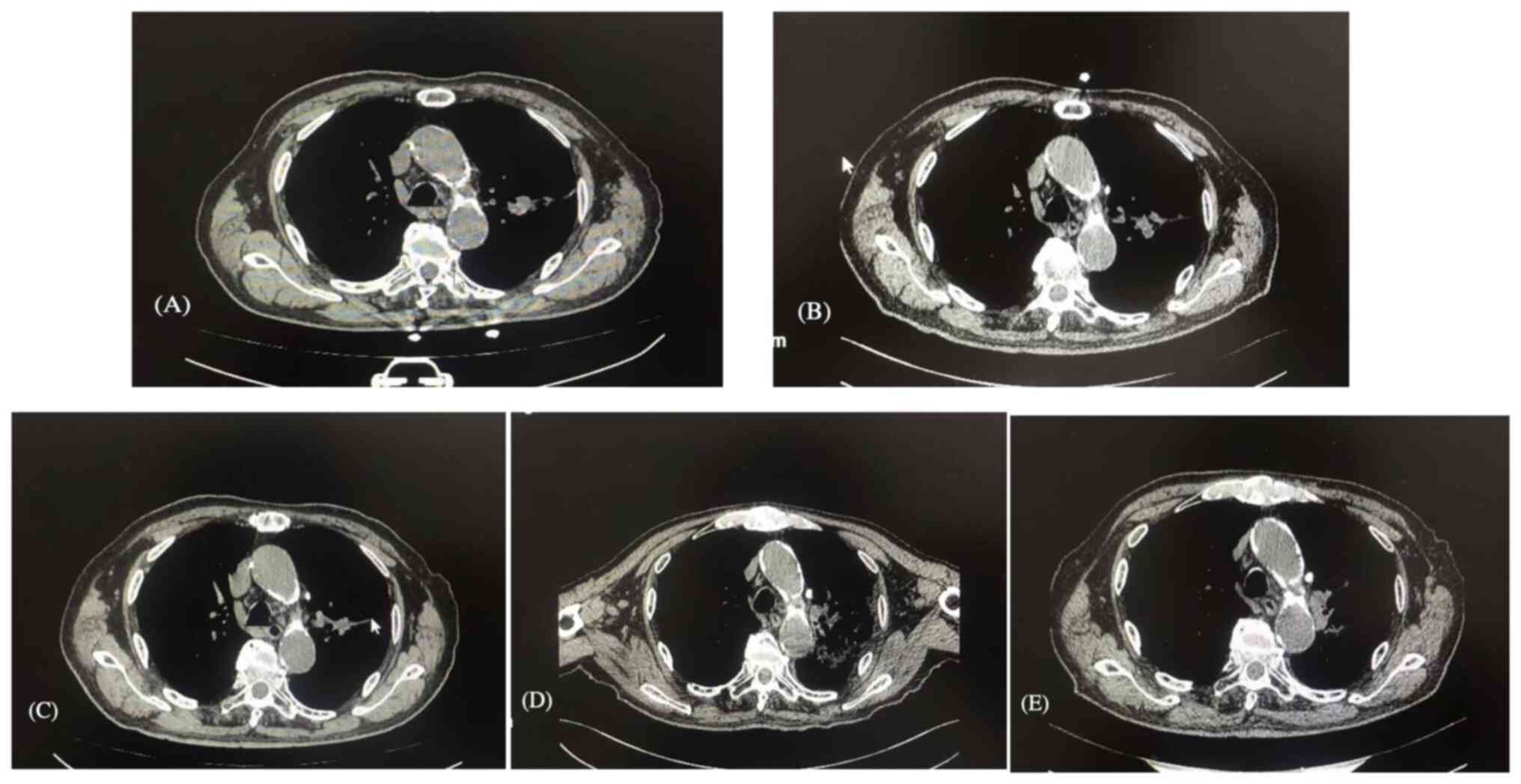
and the patient did not undergo tumor marker testing. Chest CT
showed a nodule in the left upper lobe (25×22 mm) (Fig. 2A). Regarding the patient's lung
condition, it is worth mentioning that no pulmonary nodules were
found during the patient's previous comprehensive medical check-up
half a year ago, which included pulmonary CT imaging. However,
concurrently with the diagnosis of NPC, a neoplastic lesion in the
lung was detected. Due to the patient's advanced age, the family
members, after careful consideration of the risks associated with
puncture for pathological biopsy, elected to forgo further biopsy.
Based on the principle of a single oncologic process, the lung
lesion was clinically diagnosed as a metastatic focus, and further
evaluation led to a diagnosis of NPC (cT1N0M1, lung metastasis),
with a Performance Status score of 2. Patients with PS 2, defined
as symptomatic but completely ambulatory or with <50% of their
time in bed during the day (5).
Treatment process
Radiotherapy for nasopharyngeal tumor
Considering the patient's advanced age, asymptomatic
lung lesion and a history of cerebral infarction that did not
affect daily activities, a multidisciplinary team decided to
proceed with radiotherapy for the nasopharyngeal tumor. The history
of cerebral infarction did not influence the treatment
decision-making. From February to March, 2023, the patient received
intensity-modulated radiotherapy with the following doses: PGTV
(nasopharyngeal tumor): 70 Gy in 35 fractions (Fx); and PCTV
(nasopharynx + cervical lymphatic drainage area): 60 Gy in 30 Fx.
Concurrent oral capecitabine (1.5 g twice daily) was administered
to enhance local control. The patient tolerated the treatment well,
with only oral mucositis as an adverse effect, which was managed
symptomatically without interrupting radiotherapy. The
blood-stained nasal discharge gradually resolved.
Treatment of lung lesion
On August 23, 2023, follow-up nasopharyngeal
magnetic resonance imaging (MRI) showed slight thickening of the
left nasopharynx, consistent with post-radiotherapy changes
(Fig. 1B). Chest CT revealed a
nodule in the right upper lobe (29×23 mm), indicating progression
of the lung lesion (Fig. 2B). Given
the patient's tolerance to prior treatment, stereotactic body
radiotherapy (SBRT) was administered to the lung lesion from August
28 to September 12, 2023, with a dose of 60 Gy in 12 Fx.
Concurrently, to enhance systemic antitumor effects, the patient
received two cycles of immunotherapy with tislelizumab (200 mg
intravenously) on September 4 and September 26, 2023.
Maintenance therapy
Following the above treatments, the patient
continued maintenance therapy with oral capecitabine (1.5 g twice
daily), underwent nasopharyngeal MRI and pulmonary CT every 6
months, and was regularly monitored for disease progression. Since
capecitabine was used as a radiosensitizer during radiotherapy
without any adverse reactions, it was chosen for maintenance
therapy <6 months later, which did not involve any drug
resistance. The main reasons for selecting capecitabine for
maintenance therapy were its tolerable adverse reactions and the
convenience of outpatient follow-up without the need for
hospitalization.
Treatment outcomes and follow-up
After comprehensive treatment, the blood-stained
nasal discharge resolved completely and oral mucositis gradually
healed. Follow-up observations showed that the patient remained in
a good general condition with retained self-care ability.
Nasopharyngeal MRI and pulmonary CT findings indicated that
nasopharyngeal and lung lesions remained stable without new
metastatic foci (Figs. 1C-E and
2C-E). The patient underwent
examinations at the Department of Otorhinolaryngology, Shanghai
Fourth People's Hospital prior to treatment, but did not undergo
nasopharyngeal MRI. Only nasopharyngeal CT was performed, which had
little impact on the staging based on the examination results.
After radiotherapy, nasopharyngeal MRI was conducted and the
findings were consistent with the pre-treatment staging (Fig. 1B). The patient undergoes follow-up
evaluations every 6 months. As of the time of manuscript
submission, the patient remains alive with no evidence of disease
progression and continues to receive oral capecitabine maintenance
therapy.
Discussion
The present study reported on the case of an elderly
patient with NPC with lung metastasis. Treatment decisions were
carefully tailored based on the patient's age, physical condition
and tumor characteristics.
The nasopharynx is a critical anatomical region
adjacent to vital structures such as the brainstem, spinal cord and
parotid glands (6). According to
the recommendations of NPS treatment guidelines, radiotherapy is
the primary modality for patients with early-stage and locally
advanced NPC (7). Precise target
delineation during radiotherapy is essential to ensure adequate
dose delivery to the tumor and potential lymphatic drainage areas
while minimizing damage to surrounding normal tissues (8). Severe complications, such as brainstem
injury leading to neurological dysfunction (9), radiation-induced myelopathy causing
paralysis (10) and parotid gland
damage resulting in xerostomia (11), must be avoided. Currently, the
treatment of elderly patients with NPC still refers to the NPC
diagnosis and treatment guidelines. In the present case, advanced
radiotherapy techniques and meticulous planning enabled effective
dose delivery (PGTV 70 Gy/35 Fx, PCTV 60 Gy/30 Fx) with only mild
and manageable oral mucositis, demonstrating the feasibility and
safety of precision radiotherapy in elderly patients.
NPC exhibits a strong propensity for metastasis,
with ~5–8% of patients presenting with distant metastases at the
time of diagnosis (12). The lungs
rank among the most frequent sites of distant metastasis in NPC
cases (13). Patients with
exclusive pulmonary metastases demonstrate significantly superior
overall survival (OS), whereas those with solitary pulmonary
metastases achieve a disease-free survival exceeding 60 months
(14,15).
When the lung lesion progressed, SBRT was employed
due to its unique advantages for localized lung lesions. SBRT
delivers high-dose radiation in a short period, precisely targeting
tumor cells while sparing surrounding normal lung tissue, thereby
reducing the risk of radiation pneumonitis and preserving
respiratory function (16).
Combined immunotherapy, such as tislelizumab, activates the immune
system to recognize and attack tumor cells, targeting both the lung
lesion and potential systemic micrometastases, synergizing with
SBRT (17).
A previous study reported that the positive rate of
programmed cell death ligand 1 (PD-L1) in NPC is as high as 90% or
higher (18). In the present case,
the patient's family refused PD-L1 testing of the patient but
consented to concurrent chemoradiotherapy with immunotherapeutic
agents. Relevant studies reported that monotherapy with programmed
cell death 1 antibodies in recurrent/metastatic NPC achieved
objective response rates of 20.5 to 34.0%, 1-year progression-free
survival rates of 19.3 to 33.0% and 1-year OS rates of 59.0 to
63.0% (19–21). The incidence rate of immune-related
adverse events was 15%, primarily manifesting as rash, liver
dysfunction, stomatitis and anemia. Only one patient developed
sepsis leading to death. Given the lack of clinical data on the
application of immunotherapy in elderly patients with NPC, these
studies provide clinical evidence for the application of
immunotherapy in patients with NPC, including elderly patients.
Currently, there is no relevant literature on the application of
immunotherapy in elderly patients, to the best of our knowledge. In
the present study, the choice of two cycles of immunotherapy for
the patient was intended for radiosensitization during
radiotherapy. Immunotherapy was discontinued after radiotherapy,
and oral chemotherapy was selected for maintenance therapy due to
the patient's reluctance to be hospitalized.
Delayed diagnosis, presence of comorbidities and
poor performance status further increase the complexity of managing
elderly patients with NPC (22,23). A
study has shown that the incidence of comorbidities in elderly
patients with NPC ranges from 22.4 to 58%, with comorbidities
significantly associated with worse OS (24). The Charlson Comorbidity Index
(25) and Adult Comorbidity
Evaluation-27 scale (26) are
currently the most commonly used assessment tools. Comorbidities
have a significant impact on the survival of elderly patients with
NPC and should be a primary consideration in treatment
decision-making (27).
Throughout the treatment, close monitoring and
timely adjustments ensured the patient tolerated the intensive
antitumor therapy, achieving favorable short-term outcomes.
Currently, only limited literature (or specific studies) exists on
geriatric NPC, and there are no specific reports on
treatment-related adverse reactions in patients. The treatment of
elderly patients with NPC with metastasis remains a clinical
challenge. The present case provides a successful example of
individualized treatment and further cases are needed to optimize
therapeutic strategies.
In conclusion, for elderly patients with NPC with
lung metastasis, an individualized comprehensive treatment
strategy, including precision radiotherapy, concurrent
chemotherapy, immunotherapy and maintenance therapy, can
effectively control tumor progression and prolong survival while
preserving quality of life. This approach preliminarily shows
clinical application potential and warrants broader application.
The single-case nature of this study and the absence of a control
group limit the generalizability of the present findings. Further
research with a larger sample size is warranted to validate the
conclusions.
Acknowledgements
Not applicable.
Funding
This study was funded by the Subject Boosting Plan of Shanghai
Fourth People's Hospital (grant no. SY-XKZT-2021-1014).
Availability of data and materials
The data generated in the present study may be
requested from the corresponding author.
Authors' contributions
TTC designed the study, wrote and revised the
manuscript, checked and confirmed the authenticity of the raw data
and approved the final version of the manuscript for publication.
TTC has agreed both to be personally accountable for the author's
own contributions and for the accuracy and integrity of any part of
the submitted work.
Ethics approval and consent to
participate
The study was approved by the Ethics Committee of
Shanghai Fourth People's Hospital (approval no. 2021-099-001). The
patient and their family members were fully informed about the
treatment modality and provided signed informed consent.
Patient consent for publication
Informed consent was obtained from the patient for
the publication of this case report, including the publication of
all images, clinical data and other data included in the
manuscript.
Competing interests
The author declares that they have no competing
interests.
References
|
1
|
Chang ET, Ye W, Zeng YX and Adami HO: The
evolving epidemiology of nasopharyngeal carcinoma. Cancer Epidemiol
Biomarkers Prev. 30:1035–1047. 2021. View Article : Google Scholar : PubMed/NCBI
|
|
2
|
Su ZY, Siak PY, Lwin YY and Cheah SC:
Epidemiology of nasopharyngeal carcinoma: current insights and
future outlook. Cancer Metastasis Rev. 43:919–939. 2024. View Article : Google Scholar : PubMed/NCBI
|
|
3
|
Merabishvili V: Review Cancer incidence in
Five Continents Vol. XI/Ed. by F. Bray, M. Colombet, L. Mery, M.
Piñeros, A. Znaor, R. Zanetti and J. Ferlay. IARC Sci. publ. № 166,
Lyon, France, 1545 p. Voprosy Onkologii. 67:8552021. View Article : Google Scholar
|
|
4
|
Hutchins LF, Unger JM, Crowley JJ, Coltman
CA Jr and Albain KS: Underrepresentation of patients 65 years of
age or older in cancer-treatment trials. N Engl J Med.
341:2061–2067. 1999. View Article : Google Scholar : PubMed/NCBI
|
|
5
|
Oken MM, Creech RH, Tormey DC, Horton J,
Davis TE, McFadden ET and Carbone PP: Toxicity and response
criteria of the Eastern cooperative oncology group. Am J Clin
Oncol. 5:649–655. 1982. View Article : Google Scholar : PubMed/NCBI
|
|
6
|
Mukherji SK and Castillo M: Normal
cross-sectional anatomy of the nasopharynx, oropharynx, and oral
cavity. Neuroimaging Clin N Am. 8:211–218. 1998. View Article : Google Scholar : PubMed/NCBI
|
|
7
|
Tang LL, Chen YP, Chen CB, Chen MY, Chen
NY, Chen XZ, Du XJ, Fang WF, Feng M, Gao J, et al: The Chinese
society of clinical oncology (CSCO) clinical guidelines for the
diagnosis and treatment of nasopharyngeal carcinoma. Cancer Commun
(Lond). 41:1195–1227. 2021. View Article : Google Scholar : PubMed/NCBI
|
|
8
|
Au KH, Ngan RKC, Ng AWY, Poon DMC, Ng WT,
Yuen KT, Lee VHF, Tung SY, Chan ATC, Sze HCK, et al: Treatment
outcomes of nasopharyngeal carcinoma in modern era after intensity
modulated radiotherapy (IMRT) in Hong Kong: A report of 3328
patients (HKNPCSG 1301 study). Oral Oncol. 77:16–21. 2018.
View Article : Google Scholar : PubMed/NCBI
|
|
9
|
Yao CY, Zhou GR, Wang LJ, Xu JH, Ye JJ,
Zhang LF, He X, Chen ZZ and Huang SF: A retrospective dosimetry
study of intensity-modulated radiotherapy for nasopharyngeal
carcinoma: Radiation-induced brainstem injury and dose-volume
analysis. Radiat Oncol. 13:1942018. View Article : Google Scholar : PubMed/NCBI
|
|
10
|
Qin DX, Hu YH, Yan JH, Xu GZ, Cai WM, Wu
XL, Cao DX and Gu XZ: Analysis of 1379 patients with nasopharyngeal
carcinoma treated by radiation. Cancer. 61:1117–1124. 1988.
View Article : Google Scholar : PubMed/NCBI
|
|
11
|
Zhou P, Zhou R, Yu YF, Rao MY and Wu SG:
Xerostomia: An easily ignored symptom induced by induction
chemotherapy in patients with nasopharyngeal carcinoma. Head Neck.
45:3024–3032. 2023. View Article : Google Scholar : PubMed/NCBI
|
|
12
|
Cao X, He LR, Xie FY, Chen YF and Wen ZS:
Factors determining the survival of nasopharyngeal carcinoma with
lung metastasis alone: Does combined modality treatment benefit?
BMC Cancer. 11:3702011. View Article : Google Scholar : PubMed/NCBI
|
|
13
|
Zeng L, Tian YM, Huang Y, Sun XM, Wang FH,
Deng XW, Han F and Lu TX: Retrospective analysis of 234
nasopharyngeal carcinoma patients with distant metastasis at
initial diagnosis: Therapeutic approaches and prognostic factors.
PLoS One. 9:e1080702014. View Article : Google Scholar : PubMed/NCBI
|
|
14
|
Hui EP, Leung SF, Au JS, Zee B, Tung S,
Chua D, Sze WM, Law CK, Leung TW and Chan AT: Lung metastasis alone
in nasopharyngeal carcinoma: A relatively favorable prognostic
group. A study by the Hong Kong Nasopharyngeal carcinoma study
group. Cancer. 101:300–306. 2004. View Article : Google Scholar : PubMed/NCBI
|
|
15
|
Teo PM, Kwan WH, Lee WY, Leung SF and
Johnson PJ: Prognosticators determining survival subsequent to
distant metastasis from nasopharyngeal carcinoma. Cancer.
77:2423–2431. 1996. View Article : Google Scholar : PubMed/NCBI
|
|
16
|
Rieber J, Streblow J, Uhlmann L, Flentje
M, Duma M, Ernst I, Blanck O, Wittig A, Boda-Heggemann J, Krempien
R, et al: Stereotactic body radiotherapy (SBRT) for medically
inoperable lung metastases-A pooled analysis of the German working
group ‘stereotactic radiotherapy.’. Lung Cancer. 97:51–58. 2016.
View Article : Google Scholar : PubMed/NCBI
|
|
17
|
Yang X, Ren H, Li Z, Peng X and Fu J:
Combinations of radiotherapy with immunotherapy in nasopharyngeal
carcinoma. Int Immunopharmacol. 125((Pt A)): 1110942023. View Article : Google Scholar : PubMed/NCBI
|
|
18
|
Zhang J, Fang W, Qin T, Yang Y, Hong S,
Liang W, Ma Y, Zhao H, Huang Y, Xue C, et al: Co-expression of PD-1
and PD-L1 predicts poor outcome in nasopharyngeal carcinoma. Med
Oncol. 32:862015. View Article : Google Scholar : PubMed/NCBI
|
|
19
|
Fang W, Yang Y, Ma Y, Hong S, Lin L, He X,
Xiong J, Li P, Zhao H, Huang Y, et al: Camrelizumab (SHR-1210)
alone or in combination with gemcitabine plus cisplatin for
nasopharyngeal carcinoma: results from two single-arm, phase 1
trials. Lancet Oncol. 19:1338–1350. 2018. View Article : Google Scholar : PubMed/NCBI
|
|
20
|
Hsu C, Lee SH, Ejadi S, Even C, Cohen RB,
Le Tourneau C, Mehnert JM, Algazi A, van Brummelen EMJ, Saraf S, et
al: Safety and antitumor activity of pembrolizumab in patients with
programmed death-ligand 1-positive nasopharyngeal carcinoma:
Results of the KEYNOTE-028 study. J Clin Oncol. 35:4050–4056. 2017.
View Article : Google Scholar : PubMed/NCBI
|
|
21
|
Ma BBY, Lim WT, Goh BC, Hui EP, Lo KW,
Pettinger A, Foster NR, Riess JW, Agulnik M, Chang AYC, et al:
Antitumor activity of nivolumab in recurrent and metastatic
nasopharyngeal carcinoma: An International, multicenter study of
the mayo clinic phase 2 consortium (NCI-9742). J Clin Oncol.
36:1412–1418. 2018. View Article : Google Scholar : PubMed/NCBI
|
|
22
|
Zhang R, He Y, Wei B, Lu Y, Zhang J, Zhang
N, He R, Xue H and Zhu B: Nasopharyngeal carcinoma burden and its
attributable risk factors in China: Estimates and forecasts from
1990 to 2050. Int J Environ Res Public Health. 20:29262023.
View Article : Google Scholar : PubMed/NCBI
|
|
23
|
Chan WL, Chow JCH, Xu ZY, Li J, Kwong WTG,
Ng WT and Lee AWM: Management of nasopharyngeal carcinoma in
elderly patients. Front Oncol. 12:8106902022. View Article : Google Scholar : PubMed/NCBI
|
|
24
|
Huang Y, Chen W, Haque W, Verma V, Xing Y,
The BS and Brian Butler E: The impact of comorbidity on overall
survival in elderly nasopharyngeal carcinoma patients: A National
cancer data base analysis. Cancer Med. 7:1093–1101. 2018.
View Article : Google Scholar : PubMed/NCBI
|
|
25
|
Charlson ME, Pompei P, Ales KL and
MacKenzie CR: A new method of classifying prognostic comorbidity in
longitudinal studies: Development and validation. J Chronic Dis.
40:373–383. 1987. View Article : Google Scholar : PubMed/NCBI
|
|
26
|
Piccirillo JF: Importance of comorbidity
in head and neck cancer. Laryngoscope. 110:593–602. 2000.
View Article : Google Scholar : PubMed/NCBI
|
|
27
|
Göllnitz I, Inhestern J, Wendt TG,
Buentzel J, Esser D, Böger D, Mueller AH, Piesold JU,
Schultze-Mosgau S, Eigendorff E, et al: Role of comorbidity on
outcome of head and neck cancer: A population-based study in
Thuringia, Germany. Cancer Med. 5:3260–3271. 2016. View Article : Google Scholar : PubMed/NCBI
|