Introduction
Colorectal cancer (CRC) is among the most common
types of malignancy in the United States, with a lifetime
prevalence of ~5% (1). It is proposed
by the adenoma-carcinoma sequence (ACS) model that the carcinoma
arises from a pre-existing adenoma (2). The serrated pathway to CRC formation, in
which serrated polyps develop into cancer, has been proposed as an
alternative route to colorectal carcinogenesis (3,4). According
to the 2010 World Health Organization (WHO) classification
(5), serrated polyps may be
categorized as hyperplastic polyps (HPs), sessile serrated
adenoma-polyps (SSA/Ps) or traditional serrated adenomas
(TSAs).
Doublecortin and CaM kinase-like-1 protein (DCLK1,
also known as DCAMKL1) is a microtubule-binding member of the
calmodulin-dependent kinase family that serves important roles in
the regulation of cell differentiation, migration and apoptosis,
and has also been proposed as a marker for intestinal stem cells
and cancer stem cells (6–9). In animal models with xenografted colonic
or pancreatic tumors, silencing of the DCLK1 gene resulted
in a decrease in tumor size (10–12).
Although the precise tumor-promoting mechanism of DCLK1 is yet to
be determined, it has been demonstrated that reduced DCLK1
expression correlates with increased expression of tumor suppressor
microRNAs (miRs), including miR-145, miR-200 and let-7a (11,12).
Indeed, DCLK1 has been indicated to function as an oncogene
in several types of tumor, including CRC (13–15),
pancreatic cancer (8), hepatocellular
carcinoma (16), gastric cancer
(17) and Barrett's adenocarcinoma
(18).
To the best of our knowledge, no previous study has
comprehensively measured the expression of DCLK1 in serrated and
non-serrated colorectal neoplasias. In the current study, to
clarify the molecular and clinicopathological characteristics of
the serrated tumorigenic pathway, immunohistochemistry was used to
evaluate DCLK1 expression in 120 endoscopically-resected samples of
serrated and non-serrated colorectal neoplasias.
Materials and methods
Patient samples
As described in our previous study on fragile
histidine triad and cyclooxygenase-2 expression in serrated
neoplasia (19), tumor specimens were
obtained from 120 patients (90 males and 30 females; mean age,
66.1±11.5 years), who had undergone endoscopic resection at Tottori
University Hospital (Tottori, Japan) between January 2009 and
December 2014. The samples included 20 HPs, 16 TSAs and 26 sessile
serrated adenoma/polyps (SSA/Ps), making a total of 62 serrated
polyps, as well as 20 non-serrated adenomas, 20 carcinoma in
adenomas (CIAs) and 18 early pure colorectal carcinomas without any
adenoma component (EPCs). Patients with familial adenomatous
polyposis (FAP), hereditary nonpolyposis CRC (HNPCC) or
hyperplastic polyposis (HPP) were excluded from the study. Serrated
lesions (HPs, SSAs and TSAs) were classified on the basis of WHO
criteria (5). The 20 HPs were
subdivided into ten microvesicular HPs (MVHPs) and ten goblet cell
HPs (GCHPs). Non-serrated adenomas measuring >10 mm were used
for the study. All histological types of CIAs and EPCs were
well-differentiated adenocarcinomas. In addition, these neoplasms
were confined to the mucosa or submucosa. Histological evaluations
were performed according to the classification established by the
Japanese General Rules for Clinical and Pathological Studies on
Cancer of the Colon, Rectum and Anus (20). In the study, non-serrated adenoma
samples corresponded to low- or high-grade adenoma/dysplasia, and
CIA and EPC samples of mucosa and submucosa corresponded to
non-invasive carcinoma or intramucosal and submucosal carcinoma
according to the Vienna classification system (21). Tumors were divided into polypoid, and
flat or depressed groups on the basis of their morphological
features. Flat and depressed tumors were defined as having
endoscopically visibly flat or depressed mucosal lesions, with a
height measuring >50% of their diameter (22). All other tumorous lesions in the colon
were termed polypoid lesions. The clinical characteristics of the
patients are reported in our previous study (19). All cases were de-identified prior to
analysis, and written informed consent was obtained from all
patients. The study was approved by the Institutional Review Board
of Tottori University and was conducted in accordance with the
Declaration of Helsinki.
Immunohistochemical staining
Immunohistochemical staining was performed on
paraffin-embedded 5-mm sections following fixation in 10% formalin
overnight at room temperature. All sections were
immunohistochemically stained with rabbit polyclonal anti-DCLK1
antibody (ab37994; dilution 1:80; Abcam, Cambridge, MA, USA).
Heat-induced epitope retrieval was performed in citrate buffer (pH
6.0) using a microwave oven at 99°C. Primary antibody incubation
was carried out overnight at 4°C. Detection was performed with a
Vectastain Elite ABC kit (Vector Laboratories, Inc., Burlingame,
CA, USA) according to the manufacturer's instructions. As a
negative control, the primary antibody was replaced with serum
immunoglobulin G (GTX35035; GeneTex, Inc., Irvine, CA, USA) at the
same dilution. A CIA sample from the total cohort exhibiting strong
intensity immunostaining for DCLK1, defined by the staining
evaluation method of a previous study (13), was used as a positive control. For
each specimen, at least five fields were viewed under a light
microscope (magnification, ×100; Olympus Corporation, Tokyo,
Japan). Immunohistochemical staining of DCLK1 expression was
analyzed by two independent observers blinded to the clinical
information.
Assessment of DCLK1
immunostaining
The extent (or proportion) of DCLK1 staining was
scored as: 0 (<5% positive cells), 1 (5–30% positive cells), 2
(31–60% positive cells) or 3 (61–100% positive cells); the staining
intensity was scored as: 0 (negative), 1 (mild), 2 (moderate) or 3
(strong), as previously described (13). The final score was determined from the
combination of the staining intensity and proportion scores.
Negative expression of DCLK1 was defined as a combined score of
0–1; low expression was defined as a combined score of 2–3; and
high expression was defined as a combined score of 4–6 (13).
Statistical analysis
Statistical analysis was performed using the
Fisher's exact test, χ2 test with Yates' correction or
Mann-Whitney U test. P<0.05 was considered to indicate
statistical significance. All statistical calculations were
performed using Stat Flex (version 6.0; Artech Co., Ltd., Osaka,
Japan).
Results
Clinicopathological features
The clinicopathological characteristics of the
patients are reported in our previous study (19).
DCLK1 expression in early colorectal
neoplasms
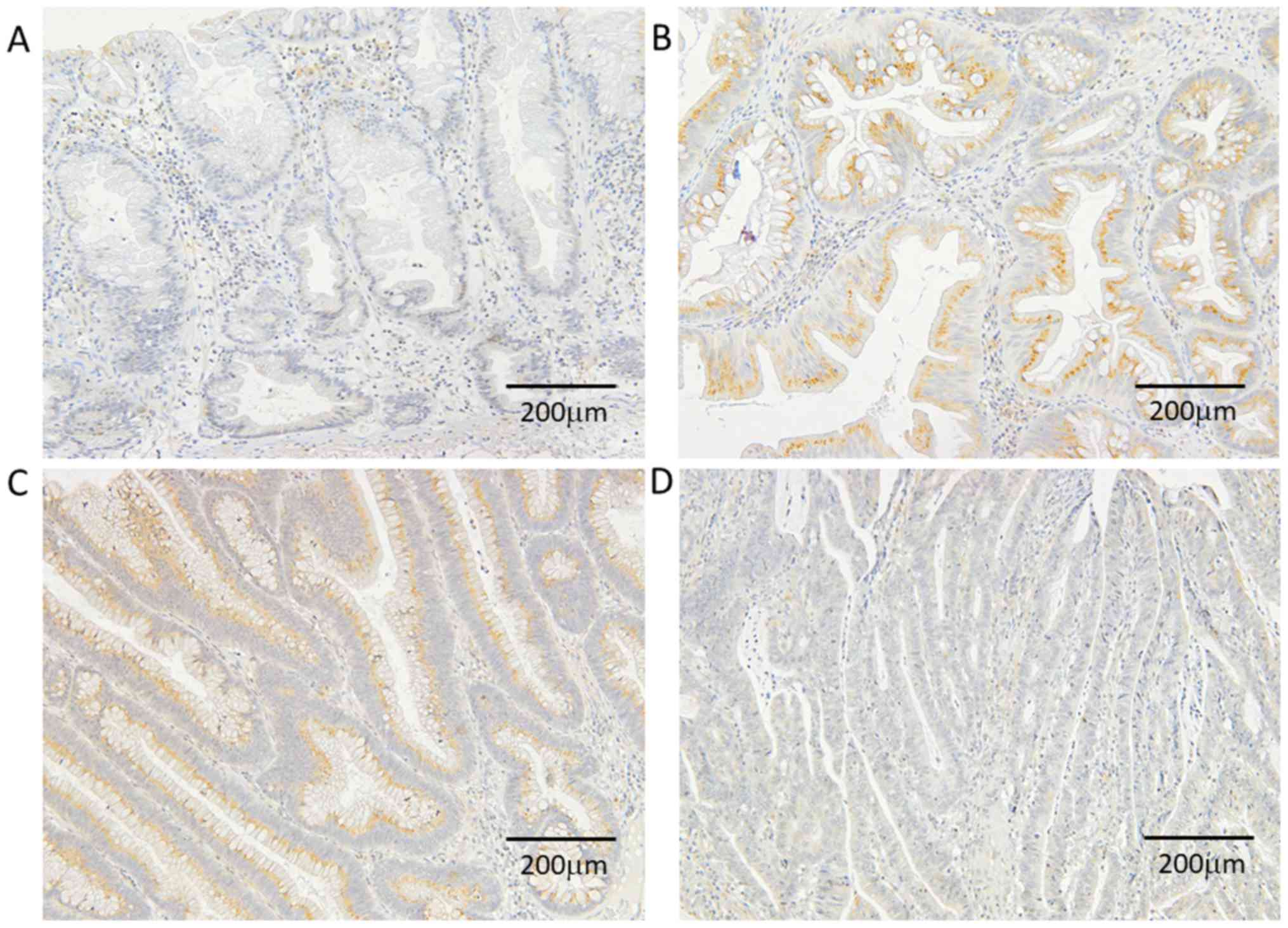
The results of the immunohistochemical staining
experiments are presented in Fig. 1
and Table I. High DCLK1 expression
was detected in 20.0% of HPs (23.1% of MVHPs and 14.3% of GCHPs),
37.5% of TSAs, 7.7% of SSA/Ps, 80.0% of non-serrated adenomas,
75.0% of CIAs and 50.0% of EPCs. Negative or low DCLK1 expression
was frequently observed in HPs (P<0.0001), TSAs (P<0.005),
SSA/Ps (P<0.00001) and EPCs (P<0.04) compared with
non-serrated adenomas and CIAs. In addition, negative or low DCLK1
expression was significantly more frequent in SSA/Ps (92.3%)
compared with TSAs (62.5%; P<0.05). High DCLK1 expression was
more common in non-serrated adenomas (80.0%) compared with serrated
polyps (19.4%; P=0.01). Furthermore, high DCLK1 expression was more
frequent in CIAs (75.0%) compared with EPCs (50.0%; P=0.10).
Potential associations between protein expression and
clinicopathological data (age, sex, tumor size, tumor location,
macroscopic features, depth of invasion and lymphatic and venous
invasion) were also analyzed; however, no significant associations
were observed.
 | Table I.DCLK1 expression in early colorectal
neoplasms. |
Table I.
DCLK1 expression in early colorectal
neoplasms.
|
|
| DCLK1 expression, n
(%) |
|---|
|
|
|
|
|---|
| Neoplasm type | Sample size, n | Negative or low | High |
|---|
| GCHP | 7 | 6 (85.7)a | 1 (14.3)g |
| MVHP | 13 | 10
(76.9)a | 3 (23.1)g |
| TSA | 16 | 10
(62.5)b | 6 (37.5)g |
| SSA/Ps | 26 | 24
(92.3)c | 2 (7.7)g |
| Adenoma | 20 | 4 (20.0)d | 16
(80.0)h |
| CIA | 20 | 5 (25.0)e | 15
(75.0)i |
| EPC | 18 | 9 (50.0)f | 9 (50.0)j |
Discussion
The ACS and the serrated pathway are two distinct
models that explain the development of colorectal neoplasms
(3,23). Serrated colorectum polyps exhibit
distinct histological features and malignant potential (3). CRCs arising from the serrated pathway
are also frequently associated with aberrant patterns of promoter
methylation (4), a phenotype
discussed further below. Previous reports have suggested that DCLK1
may mark cancer stem cells in gastrointestinal and other cancers
(10,24), while others have identified DCLK1
upregulation in several types of cancer, including esophageal,
stomach, colorectal, pancreatic and liver cancer (8,13–18). In addition, increased DCLK1 expression
has been identified in Barrett's esophagus, a premalignant lesion
that can progress to esophageal adenocarcinoma, and may be regarded
as an early molecular predictor of tumor progression (18). Although DCLK1 has been demonstrated to
be upregulated in human colorectal adenoma and cancer (13), studies on the expression of DCLK1 in
serrated tumor tissue are lacking. Thus, the present study was the
first to demonstrate that DCLK1 protein was not overexpressed in
serrated tumor tissues.
To the best of our knowledge, no study to date has
compared DCLK1 expression levels in SSA/Ps, TSAs, non-serrated
adenomas and adenocarcinomas. The present results indicate that
negative or low DCLK1 expression is frequent in serrated
neoplasias, particularly SSA/Ps, when compared with non-serrated
neoplasias. Aberrant crypt foci in the right side of the colon, as
a characteristic of MVHP, are a precursor lesion for the
SSA/P-cancer sequence (22). In the
present study, negative or low DCLK1 expression was detected in
23.1% of MVHPs. The serrated pathway involves widespread aberrant
DNA methylation in promoter regions, a phenomenon termed CpG island
methylator phenotype (4). As promoter
methylation is commonly associated with transcriptional repression
and subsequent reduction (or loss) of gene function, methylation at
the DCLK1 promoter potentially explains the reduced
expression observed in serrated polyps (6,25).
Therefore, it is possible that DCLK1 overexpression may serve a
secondary role in this pathway. In addition, absent or low
expression of DCLK1 was significantly more frequent in SSA/Ps
(92.3%) compared with TSAs (62.5%), indicating that each serrated
tumor type has different molecular features.
Absent or low expression of DCLK1 in EPCs was
frequent when compared with non-serrated adenomas and CIAs, and had
an intermediate frequency between that of non-serrated
adenomas/CIAs and serrated polyps, supporting the hypothesis that
the molecular pathogenesis of EPC is distinct from that of the ACS
regarding the expression of DCLK1. EPCs may therefore contain
tumors derived from the serrated pathway as well as the ACS.
In conclusion, in the early developmental stage of
the serrated tumors, DCLK1 expression was infrequently detected,
unlike the situation in ACS tumors. However, as the number of tumor
samples in the current study was limited, further large-scale
studies are now required to more precisely determine the role of
DCLK1 in serrated tumorigenesis.
References
|
1
|
Siegel R, Ma J, Zou Z and Jemal A: Cancer
statistics, 2014. CA Cancer J Clin. 64:9–29. 2014. View Article : Google Scholar : PubMed/NCBI
|
|
2
|
Vogelstein B, Fearon ER, Hamilton SR, Kern
SE, Preisinger AC, Leppert M, Nakamura Y, White R, Smits AM and Bos
JL: Genetic alterations during colorectal-tumor development. N Engl
J Med. 319:525–532. 1988. View Article : Google Scholar : PubMed/NCBI
|
|
3
|
Mäkinen MJ, George SM, Jernvall P, Mäkelä
J, Vihko P and Karttunen TJ: Colorectal carcinoma associated with
serrated adenoma - prevalence, histological features, and
prognosis. J Pathol. 193:286–294. 2001. View Article : Google Scholar : PubMed/NCBI
|
|
4
|
O'Brien MJ, Yang S, Huang CS, Shepherd C,
Cerda S and Farraye FA: The serrated polyp pathway to colorectal
carcinoma. Diagn Histopathol. 14:78–93. 2008. View Article : Google Scholar
|
|
5
|
Snover DC, Ahnen DJ and Burt RW: Serrated
polyps of the colon and rectum and serrated polyposisWHO
Classification of Tumors of the Digestive System. Bosman FT,
Carneiro F, Hruban RH and Theise ND: IARC Press; Lyon, France: pp.
160–165. 2010
|
|
6
|
May R, Riehl TE, Hunt C, Sureban SM, Anant
S and Houchen CW: Identification of a novel putative
gastrointestinal stem cell and adenoma stem cell marker,
doublecortin and CaM kinase-like-1, following radiation injury and
in adenomatous polyposis coli/multiple intestinal neoplasia mice.
Stem Cells. 26:630–637. 2008. View Article : Google Scholar : PubMed/NCBI
|
|
7
|
May R, Sureban SM, Lightfoot SA, Hoskins
AB, Brackett DJ, Postier RG, Ramanujam R, Rao CV, Wyche JH, Anant S
and Houchen CW: Identification of a novel putative pancreatic
stem/progenitor cell marker DCAMKL-1 in normal mouse pancreas. Am J
Physiol Gastrointest Liver Physiol. 299:G303–G310. 2010. View Article : Google Scholar : PubMed/NCBI
|
|
8
|
Bailey JM, Alsina J, Rasheed ZA,
McAllister FM, Fu YY, Plentz R, Zhang H, Pasricha PJ, Bardeesy N,
Matsui W, et al: DCLK1 marks a morphologically distinct
subpopulation of cells with stem cell properties in preinvasive
pancreatic cancer. Gastroenterology. 146:245–256. 2014. View Article : Google Scholar : PubMed/NCBI
|
|
9
|
Westphalen CB, Takemoto Y, Tanaka T,
Macchini M, Jiang Z, Renz BW, Chen X, Ormanns S, Nagar K, Tailor Y,
et al: Dclk1 defines quiescent pancreatic progenitors that promote
injury-induced regeneration and tumorigenesis. Cell Stem Cell.
18:441–455. 2016. View Article : Google Scholar : PubMed/NCBI
|
|
10
|
Nakanishi Y, Seno H, Fukuoka A, Ueo T,
Yamaga Y, Maruno T, Nakanishi N, Kanda K, Komekado H, Kawada M, et
al: Dclk1 distinguishes between tumor and normal stem cells in the
intestine. Nat Genet. 45:98–103. 2013. View
Article : Google Scholar : PubMed/NCBI
|
|
11
|
Sureban SM, May R, Ramalingam S,
Subramaniam D, Natarajan G, Anant S and Houchen CW: Selective
blockade of DCAMKL-1 results in tumor growth arrest by a Let-7a
MicroRNA-dependent mechanism. Gastroenterology. 137:649–659,
659.e1-659.e2. 2009. View Article : Google Scholar : PubMed/NCBI
|
|
12
|
Sureban SM, May R, Qu D, Weygant N,
Chandrakesan P, Ali N, Lightfoot SA, Pantazis P, Rao CV, Postier RG
and Houchen CW: DCLK1 regulates pluripotency and angiogenic factors
via microRNA-dependent mechanisms in pancreatic cancer. PLoS One.
8:e739402013. View Article : Google Scholar : PubMed/NCBI
|
|
13
|
Gagliardi G, Goswami M, Passera R and
Bellows CF: DCLK1 immunoreactivity in colorectal neoplasia. Clin
Exp Gastroenterol. 5:35–42. 2012. View Article : Google Scholar : PubMed/NCBI
|
|
14
|
Gao T, Wang M, Xu L, Wen T, Liu J and An
G: DCLK1 is up-regulated and associated with metastasis and
prognosis in colorectal cancer. J Cancer Res Clin Oncol.
142:2131–2140. 2016. View Article : Google Scholar : PubMed/NCBI
|
|
15
|
Ikezono YU, Koga H, Abe M, Akiba J,
Kawahara A, Yoshida T, Nakamura T, Iwamoto H, Yano H, Kage M, et
al: High expression of the putative cancer stem cell marker, DCLK1,
in rectal neuroendocrine tumors. Oncol Lett. 10:2015–2020.
2015.PubMed/NCBI
|
|
16
|
Sureban SM, Madhoun MF, May R, Qu D, Ali
N, Fazili J, Weygant N, Chandrakesan P, Ding K, Lightfoot SA and
Houchen CW: Plasma DCLK1 is a marker of hepatocellular carcinoma
(HCC): Targeting DCLK1 prevents HCC tumor xenograft growth via a
microRNA-dependent mechanism. Oncotarget. 6:37200–37215. 2015.
View Article : Google Scholar : PubMed/NCBI
|
|
17
|
Mutoh H, Sashikawa M, Sakamoto H and
Tateno T: Cyclooxygenase 2 in gastric carcinoma is expressed in
doublecortin- and CaM kinase-like-1-positive tuft cells. Gut Liver.
8:508–518. 2014. View
Article : Google Scholar : PubMed/NCBI
|
|
18
|
Vega KJ, May R, Sureban SM, Lightfoot SA,
Qu D, Reed A, Weygant N, Ramanujam R, Souza R, Madhoun M, et al:
Identification of the putative intestinal stem cell marker
doublecortin and CaM kinase-like-1 in Barrett's esophagus and
esophageal adenocarcinoma. J Gastroenterol Hepatol. 27:773–780.
2012. View Article : Google Scholar : PubMed/NCBI
|
|
19
|
Tamoto A, Yashima K, Hosoda K, Yamamoto S,
Kawata S, Ikebuchi Y, Matsumoto K, Kawaguchi K, Harada K, Murawaki
Y and Isomoto H: Protein expression of Fragile Histidine Triad and
cyclooxgenase-2 in serrated neoplasia of the colorectum. Oncol
Lett. 14:3683–3688. 2017.PubMed/NCBI
|
|
20
|
Japanese General Rules for Clinical and
Pathological Studies on Cancer of the Colon: Rectum and Anus.
Japanese Society for Cancer of the Colon and Rectum. 2009.
|
|
21
|
Schlemper RJ, Riddell RH, Kato Y, Borchard
F, Cooper HS, Dawsey SM, Dixon MF, Fenoglio-Preiser CM, Fléjou JF,
Geboes K, et al: The Vienna classification of gastrointestinal
epithelial neoplasia. Gut. 47:251–255. 2000. View Article : Google Scholar : PubMed/NCBI
|
|
22
|
Saitoh Y, Waxman I, West AB, Popnikolov
NK, Gatalica Z, Watari J, Obara T, Kohgo Y and Pasricha PJ:
Prevalence and distinctive biologic features of flat colorectal
adenomas in a North American population. Gastroenterology.
120:1657–1665. 2001. View Article : Google Scholar : PubMed/NCBI
|
|
23
|
Jass JR: Classification of colorectal
cancer based on correlation of clinical, morphological and
molecular features. Histopathology. 50:113–130. 2007. View Article : Google Scholar : PubMed/NCBI
|
|
24
|
Mirzaei A, Tavoosidana G, Modarressi MH,
Rad AA, Fazeli MS, Shirkoohi R, Tavakoli-Yaraki M and Madjd Z:
Upregulation of circulating cancer stem cell marker, DCLK1 but not
Lgr5, in chemoradiotherapy-treated colorectal cancer patients.
Tumour Biol. 36:4801–4810. 2015. View Article : Google Scholar : PubMed/NCBI
|
|
25
|
Vedeld HM, Skotheim RI, Lothe RA and Lind
GE: The recently suggested intestinal cancer stem cell marker DCLK1
is an epigenetic biomarker for colorectal cancer. Epigenetics.
9:346–350. 2014. View Article : Google Scholar : PubMed/NCBI
|