Introduction
Non-small cell lung cancer (NSCLC) is one of the
most common malignancies, accounting for 85% of all lung cancer
cases, and its treatment continues to be severe challenge in the
clinic (1). Although significant
progress has been made in regard to drug development, there are
still few drugs that have long-term benefits in the treatment of
NSCLC (2–4). Therefore, there is an urgent demand
to identify novel targets and drugs to improve systemic therapy for
patients with NSCLC.
The c-Src proto-oncogene belongs to the Src family
of protein tyrosine kinases, which include c-Src, Fyn, Lyn, Lck,
Yes, Blk and Hck (5). c-Src
regulates signals from multiple cell surface molecules, including
growth factors, G protein-coupled receptors and integrins (6). It has been reported previously that
levels of c-Src protein were elevated or kinase activity was
overactivated in many types of tumors, including NSCLC (7,8). In
tumor cells, the activation of c-Src mediated cell growth, cell
proliferation, cell survival and cell invasion (9). Previous studies have reported that
c-Src was activated in NSCLC cells and primary tumor tissues, and
its inhibition led to decreased cell growth and cell cycle arrest
(10,11).
In the present study, oxfendazole potently
suppressed the activation of c-Src in NSCLC cells, and inhibited
NSCLC cell survival. In addition, overexpression of c-Src decreased
the effects of oxfendazole on NSCLC cells. Further studies revealed
that oxfendazole induced cell cycle arrest at the
G0/G1 phase, and downregulated
Cyclin-dependent kinase (CDK) signaling in NSCLC cells, including
CDK4, CDK6, retinoblastoma protein (p-Rb) and E2 transcription
factor 1 (E2F1) inhibition, and the upregulation of p53 and p21. In
addition, oxfendazole enhanced the cytotoxicity of cisplatin
against NSCLC cells by reducing c-Src activation.
Materials and methods
Cells, culture and chemicals
The NSCLC cell lines A549, H460, H1299, H1650 and
H1975 were purchased from American Type Culture Collection
(Manassas, VA, USA). All NSCLC cell lines were maintained in
RPMI-1640 medium with 10% fetal bovine serum (Gibco; Thermo Fisher
Scientific, Inc., Waltham, MA, USA), 100 U/ml of streptomycin and
100 µg/ml of penicillin. Oxfendazole was purchased from Selleck
Chemicals (Houston, TX, USA). Cisplatin was purchased from
Sigma-Aldrich (Merck KGaA, Darmstadt, Germany).
Epidermal growth factor (EGF)
stimulation
A549 and H1299 cells (1×10⁶ cells/well)
were seeded in 6-well plates overnight. Then, the cells were
starved overnight in serum-free medium. Subsequently, starved A549
and H1299 cells were incubated with 0, 10 or 20 µM of OFD for 6 h
at 37°C, then stimulated with 10 ng/ml EGF (P5552; Beyotime
Institute of Biotechnology, Haimen, China) for 20 min at 37°C.
Immunoblotting
Immunoblotting was conducted as previously described
(12,13). Briefly, cells (1×10⁶
cells/well) were lysed by RIPA lysis (P0013B; Beyotime Institute of
Biotechnology), and whole cell lysates were extracted. Then,
proteins were determined by BCA method (BCA kit, P0011; Beyotime
Institute of Biotechnology) and 30 µg of total proteins were
subjected to SDS-PAGE separation by using 10% or 12% acrylamide
gel, and the proteins were transferred onto 0.2 µm polyvinylidene
difluoride (PVDF) membrane (1620177; Bio-Rad Laboratories, Inc.,
Hercules, CA, USA), followed by immunoblotting with specific
antibodies. The primary antibodies phosphorylated (p)-c-Src
(Tyr416) (6943; 1:1,000), c-Src (2109; 1:1,000), CDK4 (12790;
1:1,000), CDK6 (13331; 1:1,000), p-Rb (Ser807/811) (8516; 1:1,000),
E2F1 (3742; 1:1,000), p53 (2527; 1:1,000) and p21 (2947; 1:1,000)
were purchased from Cell Signaling Technology, Inc. (Danvers, MA,
USA). Anti-GAPDH antibody (AM1020A; 1:5.000) was purchased from
Abgent Biotech Co., Ltd. (Suzhou, China). Anti-mouse (A0216;
1:1,000) and anti-rabbit (A0208; 1:1,000) immunoglobulin G (IgG)
horseradish peroxidase-conjugated antibodies were purchased from
Beyotime Institute of Biotechnology (Haimen, Nantong, China). All
immunoblotting signals were further assessed by using ECL (BeyoECL
Plus kit, P0018M; Beyotime Institute of Biotechnology) and analyzed
with Quality One software (version number: 4.0.1; Bio-Rad
Laboratories, Inc.).
Cell growth and viability
Viable cells (8,000 cells/well) were analyzed by
Cell Counting Kit-8 (CCK-8; BioTools, Inc., Jupiter, FL, USA) assay
according to the manufacturer's instruction, as described
previously (14). To assess the
effect of OFD on the survival rates of different NSCLC cell lines,
5 NSCLC cell lines were treated with 0, 5, 10 or 20 µM of OFD for
24 h at 37°C, or cells were treated by 5 µM OFD for 0, 24, 48 or 72
h at 37°C, followed by a CCK-8 assay. For the transfected cells,
A549 or H1299 cells were treated with 0, 2.5, 5 or 10 µM of OFD for
24 h at 37°C. In addition, A549 and H1299 cells were treated with 5
µM cisplatin for 24 h at 37°C in the presence or absence of 10 µM
OFD, and then the cells were assessed by a CCK-8 assay.
Plasmids construction and gene
transfection
The human c-Src gene was generated and cloned into
the pcDNA3.1 vector as previously described (15,16).
The primers for c-Src amplification were as follows: Forward,
5′-ATGGGTAGCAACAAGAGCAAGC-3′ and reverse,
5′-CTAGAGGTTCTCCCCGGGCTGGTA-3′. A549 or H1299 cells were
transfected with 1 µg/µl empty vector (pcDNA3.1 vector) or 1 µg/µl
c-Src plasmids for 24 h by Lipofectamine® 2000™
(Invitrogen; Thermo Fisher Scientific, Inc.) according to the
manufacturer's instructions.
Cell cycle analysis
Cell cycle analysis was performed as previously
described (17). A549 and H1299
cells (1×10⁶ cells/well) were treated with 0, 5 or 10 µM
of oxfendazole for 24 h at 37°C prior to cell cycle analysis. Then,
cells were fixed with 70% cold ethanol overnight at −20°C and
washed with cold PBS, followed by being resuspended in 100 µl PBS
containing 100 µg/ml RnaseA (Beijing Solarbio Science &
Technology, Co., Ltd., Beijing, China) for 30 min at 37°C. Cells
were then washed with cold PBS and incubated with propidium iodide
(PI) for 5 min at room temperature by using the Cell Cycle
Detection kit (C1052; Beyotime Institute of Biotechnology). Cell
cycle distribution was analyzed on a flow cytometer
(Attune® NxT; Thermo Fisher Scientific, Inc.) and the
data was analyzed by FlowJo 7.6.1 (FlowJo LLC, Ashland, OR,
USA).
Statistical analysis
Statistical analysis was performed using Statistical
Package for Social Sciences 13.0 for Windows (SPSS, Inc., Chicago,
IL, USA). The results were presented as the mean ± standard
deviation. One-way analysis of variance with Bonferroni post hoc
tests were used to determine significance. P<0.05 was considered
to indicate a statistically significant difference.
Results
Oxfendazole inhibits c-Src activation
in NSCLC cells
To evaluate the effects of oxfendazole on c-Src
activation in NSCLC cells, a panel of NSCLC cell lines were treated
with oxfendazole for 24 h, followed by immunoblotting against
p-c-Src (Tyr416) and c-Src. As shown in Fig. 1A and B, c-Src was activated in all
five NSCLC cell lines, and oxfendazole markedly inhibited the
phosphorylation of c-Src. In addition, oxfendazole downregulated
the phosphorylation of c-Src in a concentration-dependent manner in
A549 and H1299 cells (Fig. 1C).
Next, A549 and H1299 cells were starved overnight in serum-free
medium followed by oxfendazole treatment and epidermal growth
factor (EGF) stimulation. As shown in Fig. 1D, EGF, a key trigger of c-Src
signaling, markedly activated c-Src, but this action was suppressed
by oxfendazole in a concentration-dependent manner. These results
suggested that oxfendazole inhibited the activation of c-Src in
NSCLC cells, and that it may be a novel c-Src inhibitor.
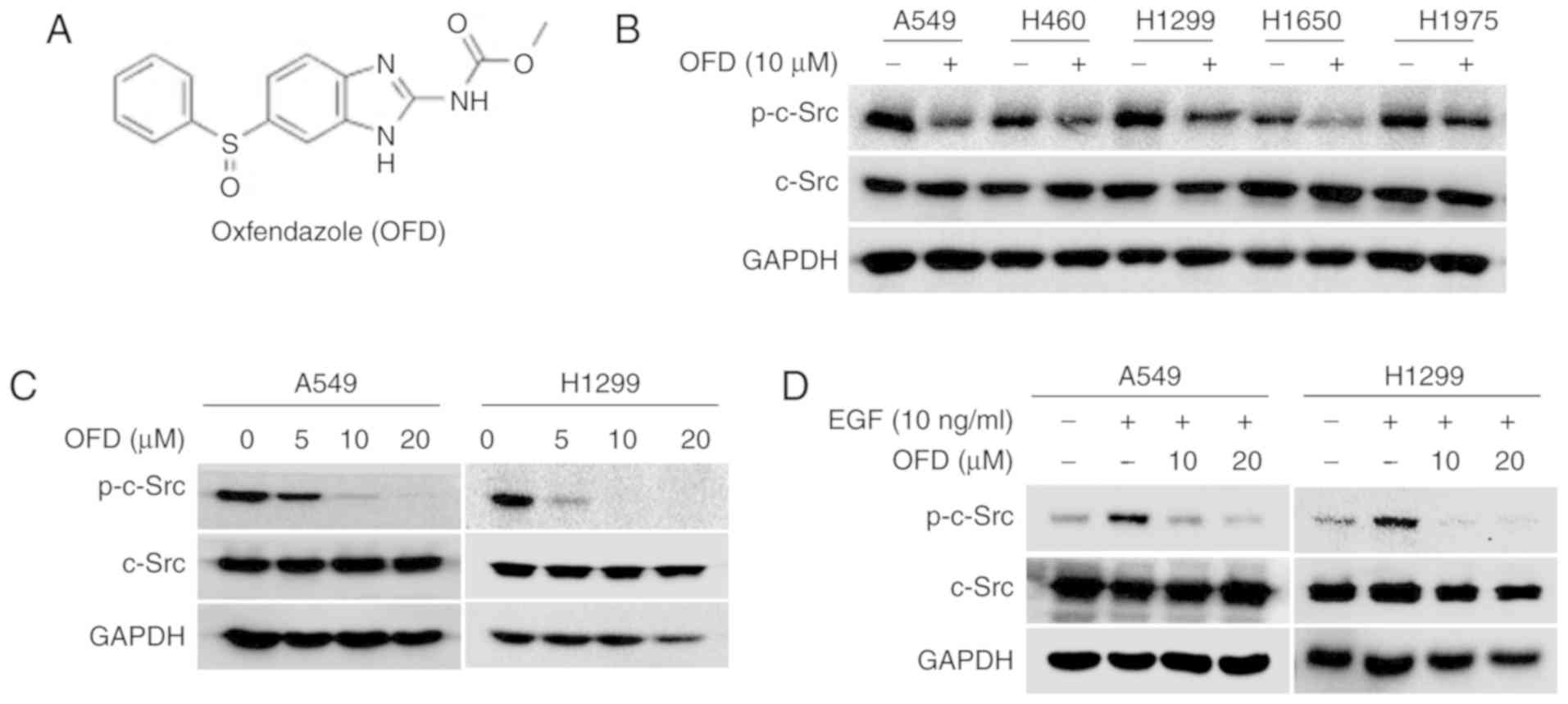 | Figure 1.Oxfendazole inhibits c-Src activation
in NSCLC cells. (A) The chemical structure of OFD. (B) Five NSCLC
cell lines were treated with 10 µM OFD for 24 h at 37°C, and then
cells were prepared for immunoblotting against p-c-Src and c-Src.
GAPDH was used as an internal control. (C) A549 and H1299 cells
were treated with increased concentrations of OFD for 24 h at 37°C,
followed by immunoblotting against p-c-Src, c-Src and GAPDH. (D)
Following starvation overnight in serum-free medium, A549 and H1299
cells were incubated with increased concentrations of OFD for 6 h,
then stimulated with EGF (10 ng/ml) for 20 min at 37°C. The cells
were then prepared for immunoblotting against p-c-Src, c-Src and
GAPDH. NSCLC, non-small cell lung cancer; OFD, oxfendazole; p-,
phosphorylated; EGF, epidermal growth factor. |
Oxfendazole inhibits cell survival in
NSCLC cells
It was previously reported that the activation of
c-Src promoted the cell survival of tumor cells (9). In the present study, to evaluate the
effects of oxfendazole on NSCLC cell survival, a panel of NSCLC
cell lines were treated with increased concentrations of
oxfendazole for 24 h, followed by a CCK-8 assay. As shown in
Fig. 2A, oxfendazole decreased
NSCLC cell viability in a concentration-dependent manner. In
addition, oxfendazole also inhibited the cell survival of A549 and
H1299 cells in a time-dependent manner (Fig. 2B). Furthermore, when A549 and H1299
cells were transfected with c-Src plasmids, oxfendazole-induced
cell death was significantly attenuated (Fig. 2C and D). For example, in A549 cells
treated with 10 µM of oxfendazole, the fraction of surviving cells
was increased from 50% in vector-transfected cells to 60% in
c-Src-transfected cells (Fig. 2C).
In H1299 cells treated with 10 µM of oxfendazole, the fraction of
surviving cells was increased from 55% in vector-transfected cells
to 65% in c-Src-transfected cells (Fig. 2D). These results indicated that
c-Src signaling may be involved in the underlying mechanism of the
action of oxfendazole.
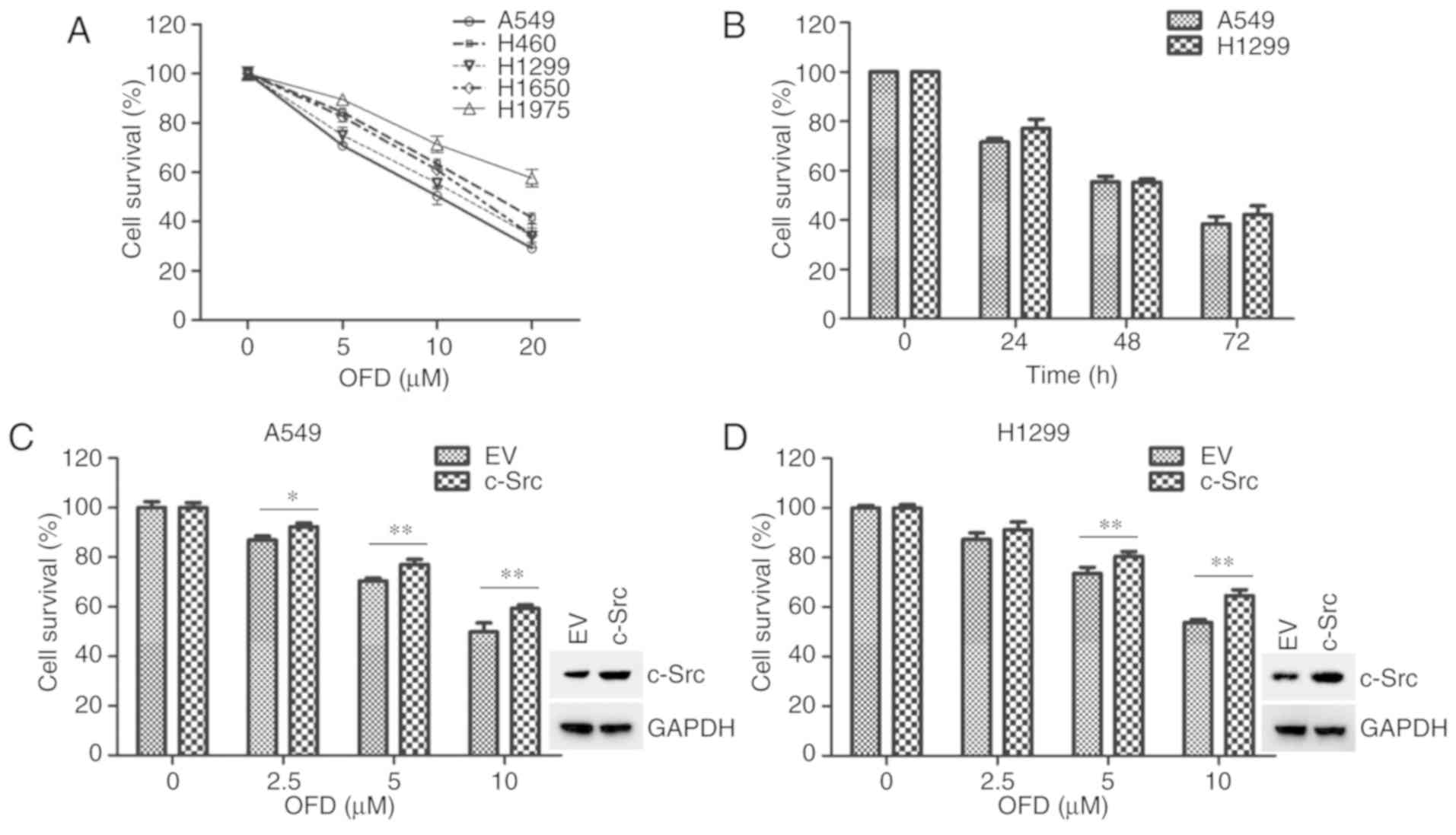 | Figure 2.OFD inhibits cell survival in NSCLC
cells. (A) The NSCLC cell lines A549, H460, H1299, H1650 and H1975
were treated with the indicated concentrations of OFD for 24 h at
37°C, followed by a CCK-8 assay. (B) A549 and H1299 cells were
treated by 5 µM OFD for the indicated times at 37°C, and then cells
were prepared for the CCK-8 assay. (C) A549 and (D) H1299 cells
were transfected with 1 µg/µl EV (pcDNA3.1 vector) or 1 µg/µl c-Src
plasmids for 24 h, and then cells were treated with increasing
concentrations of OFD for 24 h at 37°C, followed by a CCK-8 assay
and immunoblotting. *P<0.05 and **P<0.01, as indicated. EV,
empty vector; NSCLC, non-small cell lung cancer; OFD, oxfendazole;
CCK, Cell Counting Kit. |
Oxfendazole inhibits cell cycle
progression and suppresses CDK signaling in NSCLC cells
It has been previously reported that c-Src
activation regulated the cell growth and cell cycle of tumor cells
(18,19). Therefore, the present study
evaluated whether oxfendazole regulated the cell cycle of NSCLC
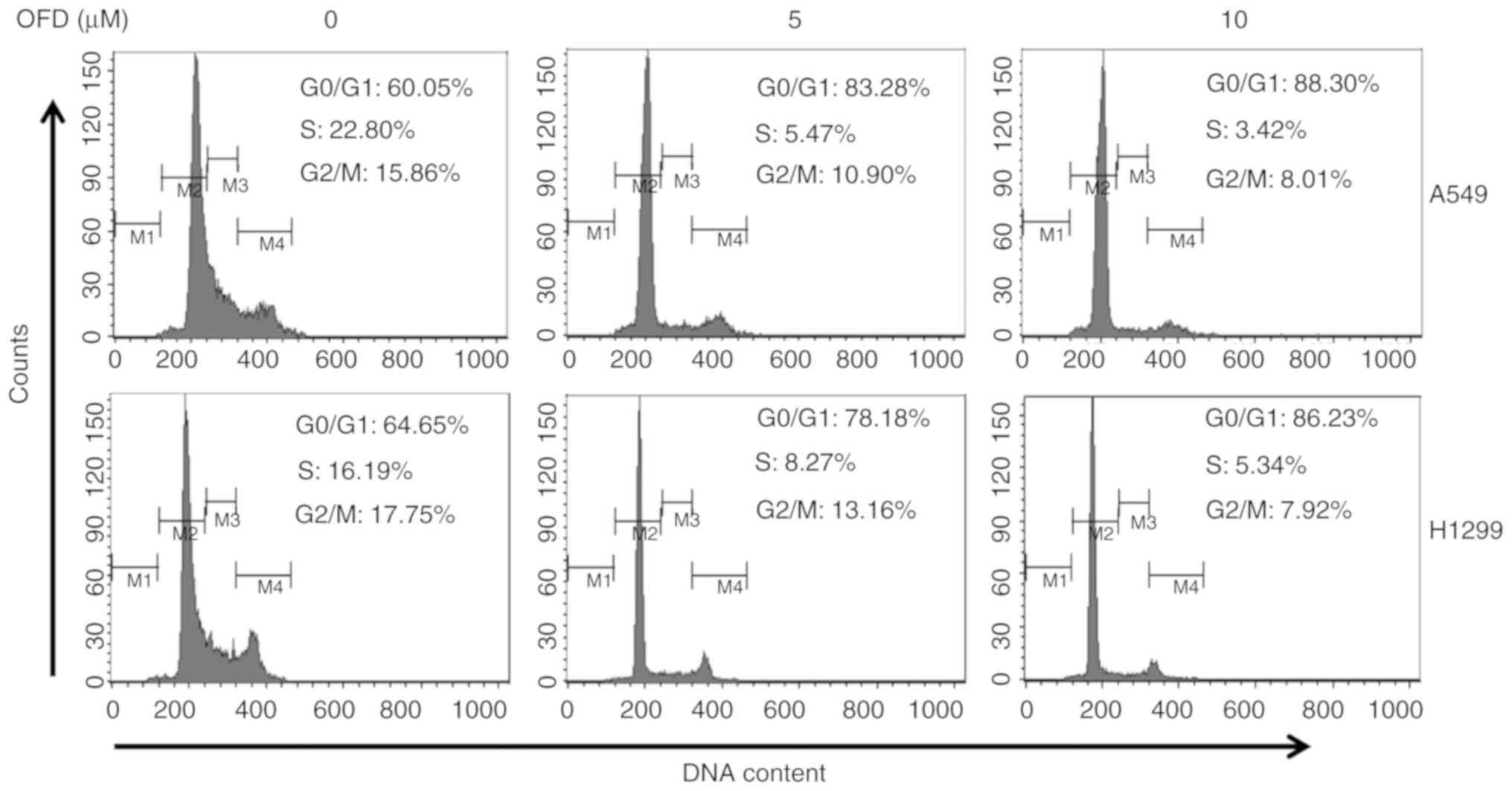
cells. As shown in Fig. 3, flow
cytometry revealed that oxfendazole induced cell cycle arrest at
the G0/G1 phase in A549 and H1299 cells. In
A549 cells, the fraction of the G0/G1 cells
was increased from 60.05% in the control to 88.30% in cells treated
with 10 µM oxfendazole, coupled with a decrease in the fraction of
S phase cells from 22.80 to 3.42% (Fig. 3; upper panel). In H1299 cells, the
percentage of G0/G1 cells was increased from
64.65 to 86.23% following treatment with 10 µM oxfendazole, coupled
with a decrease in the fraction of S phase cells from 16.91 to
5.34% (Fig. 3; lower panel).
D-cyclins combine with CDK4/6 to phosphorylate p-Rb,
allowing for the release of E2F transcription factors, which
activate G1/S-phase gene expression (20). Thus, the present study next
evaluated the effects of oxfendazole on the expression of these
proteins. As shown in Fig. 4A and
B, oxfendazole downregulated the expression levels of CDK4,
CDK6, p-Rb and E2F1 in a concentration-dependent manner.
 | Figure 4.OFD inhibits CDK signaling in
non-small cell lung cancer cells. (A) A549 and H1299 cells were
treated with the indicated concentrations of OFD for 24 h at 37°C,
and then cells were prepared for immunoblotting against CDK4, CDK6
and GAPDH. (B) A549 and H1299 cells were treated with the indicated
concentrations of OFD for 24 h at 37°C, followed by immunoblotting
against p-Rb, E2F1 and GAPDH. (C) Following treatment with the
indicated concentrations of OFD for 24 h at 37°C, A549 and H1299
cells were analyzed by immunoblotting against p53, p21 and GAPDH.
OFD, oxfendazole; CDK, Cyclin-dependent kinase; p-Rb, protein
retinoblastoma; E2F1, E2 transcription factor 1. |
The p53 tumor suppressor protein serves a major role
in arresting cell cycle progression (21). To determine whether p53 was
associated with oxfendazole cytotoxicity in cell survival, the
present study then examined the expression of p53. As shown in
Fig. 4C, oxfendazole upregulated
p53 expression. The expression of p21 expression was also detected,
which is a potent CDK inhibitor and a target of p53 (22). As shown in Fig. 4C, oxfendazole markedly upregulated
p21 expression.
These results indicated that oxfendazole inhibited
cell cycle progression by suppressing CDK signaling in NSCLC cells,
and its activity in survival inhibition in NSCLC cells was
observed.
Oxfendazole enhances the cytotoxicity
of cisplatin against NSCLC cells
Cisplatin is a common chemotherapeutic drug for
NSCLC therapy, but resistance is frequently observed during the
process of NSCLC treatment in the clinic (23–25).
It has been reported that overactivation of c-Src could result in
drug resistance to NSCLC treatment (10,26);
thus, the present study then evaluated whether oxfendazole could
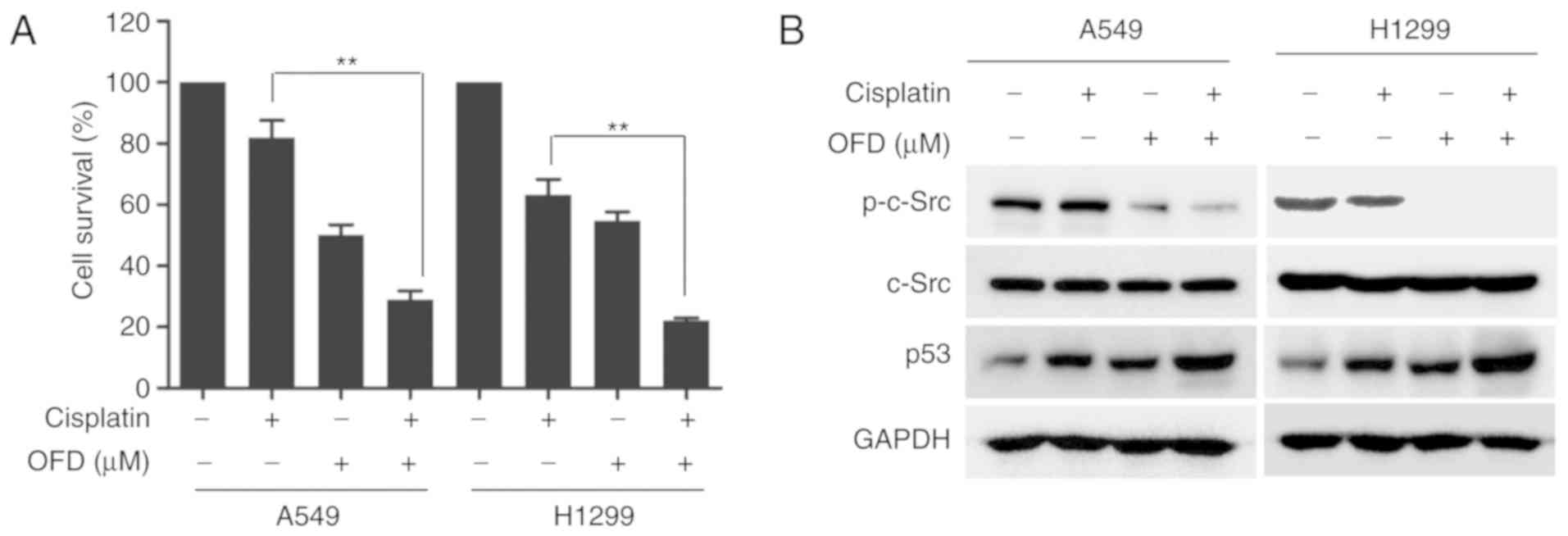
enhance the effect of cisplatin in the treatment of NSCLC cells. As
shown in Fig. 5A, the CCK-8 assay
demonstrated that oxfendazole enhanced the cytotoxicity of
cisplatin against A549 and H1299 cells. In addition, the
immunoblotting analysis revealed that the combination of
oxfendazole and cisplatin could enhance the inhibition of c-Src
activation, as well as the upregulation of p53 (Fig. 5B). Therefore, oxfendazole enhanced
the cytotoxic activity of cisplatin by suppressing c-Src
activation, and oxfendazole could utilized for anti-NSCLC therapy
in the clinic in combination with other antitumor drugs, such as
cisplatin.
Discussion
The current strategies being investigated for NSCLC
treatment have focused on new targeted therapies against epidermal
growth factor receptor, angiogenesis and immune checkpoints.
However, these therapies have exhibited limited benefits for
patients with NSCLC (27–29). Therefore, novel and effective drugs
are urgently required to treat NSCLC, and one possible strategy is
to utilize previously discovered drugs that are currently used to
treat different diseases (14). In
the present study, the anthelmintic agent oxfendazole significantly
displayed antitumor activity in NSCLC cells; thus, the effect of
oxfendazole in vivo will be tested in future work.
In epithelial cancers, including NSCLC, c-Src and
other Src-associated kinases (including Fyn, Yes and Lyn) are
overexpressed and activated, and their levels are closely
associated with tumor progression (30). As expected, suppressing Src family
kinases in these tumors led to the inhibition of cell growth, and
c-Src has been considered to be an ideal drug target for various
cancer treatments (31). For
example, Dasatinib, a small molecule tyrosine kinase inhibitor,
inhibited cell migration and invasion, and induced cell cycle
arrest (blocking the G1-S transition) by suppressing c-Src
activation in head and neck squamous cell carcinoma and NSCLC cells
(9). In the present study,
oxfendazole inhibited the activation of c-Src in different NSCLC
cell lines, and overexpression of c-Src decreased the cytotoxicity
of oxfendazole in A549 and H1299 cells, which suggested that
oxfendazole could be used as a novel c-Src inhibitor.
Signaling through c-Src has been reported to be
involved in tumor progression, including cell cycle regulation,
angiogenesis, cell survival, cell invasion and metastasis (32). Therefore, the present study
analyzed the cell cycle of NSCLC cells following treatment with
oxfendazole via flow cytometry. The results revealed that
oxfendazole induced cell cycle arrest at the
G0/G1 phase in A549 and H1299 cells, and
further immunoblotting demonstrated that oxfendazole inhibited CDK
signaling, which is the downstream signaling pathway of c-Src.
Cisplatin is a common chemotherapeutic drug in the
treatment of lung cancer, but patients frequently develop
resistance to it partly due to the overactivation or overexpression
of c-Src (10). As described
above, oxfendazole inhibited the activation of c-Src, so the
present study next investigated whether oxfendazole could enhance
the cytotoxicity of cisplatin in NSCLC cells. The results
demonstrated that oxfendazole enhanced the cytotoxic activity of
cisplatin against NSCLC cells, which suggested that oxfendazole may
be effective in NSCLC therapy in the clinic in combination with
other drugs, such as cisplatin.
In conclusion, the present study demonstrated that
the anthelmintic agent oxfendazole exerted its antitumor action by
suppressing c-Src activation in NSCLC cells. The results suggests
that oxfendazole may be effective as a novel type of NSCLC
treatment in the clinic in the future.
Acknowledgements
The authors would like to thank Dr Jerry Xu
(Department of Medicine, Soochow University, Suzhou, China) for his
discussion and assisting with the design of this project.
Funding
The present study was supported by the General
Project of Science and Technology Development Fund of Nanjing
Medical University (grant no. 2013NJMU225).
Availability of data and materials
All data generated or analyzed during this study are
included in this published article.
Authors' contributions
DX, WT and CJ performed the experiments. DX and SZ
wrote and edited the manuscript. ZH and SZ designed the research
project. All authors read and approved the final manuscript.
Ethics approval and consent to
participate
Not applicable.
Patient consent for publication
Not applicable.
Competing interests
All authors declare that they have no competing
interests.
References
|
1
|
Ling C, Chen G, Chen G, Zhang Z, Cao B,
Han K, Yin J, Chu A, Zhao Y and Mao X: A Deuterated analog of
dasatinib disrupts cell cycle progression and displays
anti-non-small cell lung cancer activity in vitro and in vivo. Int
J Cancer. 131:2411–2419. 2012. View Article : Google Scholar : PubMed/NCBI
|
|
2
|
Pasquini G and Giaccone G: C-MET
inhibitors for advanced non-small cell lung cancer. Expert Opin
Investig Drugs. 27:363–375. 2018. View Article : Google Scholar : PubMed/NCBI
|
|
3
|
Mazzarella L, Guida A and Curigliano G:
Cetuximab for treating non-small cell lung cancer. Expert Opin Biol
Ther. 18:483–493. 2018. View Article : Google Scholar : PubMed/NCBI
|
|
4
|
Sun YW, Xu J, Zhou J and Liu WJ: Targeted
drugs for systemic therapy of lung cancer with brain metastases.
Oncotarget. 9:5459–5472. 2018. View Article : Google Scholar : PubMed/NCBI
|
|
5
|
Thomas SM and Brugge JS: Cellular
functions regulated by Src family kinases. Annu Rev Cell Dev Biol.
13:513–609. 1997. View Article : Google Scholar : PubMed/NCBI
|
|
6
|
Koppikar P, Choi SH, Egloff AM, Cai Q,
Suzuki S, Freilino M, Nozawa H, Thomas SM, Gooding WE, Siegfried JM
and Grandis JR: Combined inhibition of c-Src and epidermal growth
factor receptor abrogates growth and invasion of head and neck
squamous cell carcinoma. Clin Cancer Res. 14:4284–4291. 2008.
View Article : Google Scholar : PubMed/NCBI
|
|
7
|
Nan Y, Du J, Ma L, Jiang H, Jin F and Yang
S: Early Candidate biomarkers of non-small cell lung cancer are
screened and identified in premalignant lung lesions. Technol
Cancer Res Treat. 16:66–74. 2017. View Article : Google Scholar : PubMed/NCBI
|
|
8
|
Zhang J, Kalyankrishna S, Wislez M,
Thilaganathan N, Saigal B, Wei W, Ma L, Wistuba II, Johnson FM and
Kurie JM: SRC-family kinases are activated in non-small cell lung
cancer and promote the survival of epidermal growth factor
receptor-dependent cell lines. Am J Pathol. 170:366–376. 2007.
View Article : Google Scholar : PubMed/NCBI
|
|
9
|
Johnson FM, Saigal B, Talpaz M and Donato
NJ: Dasatinib (BMS-354825) tyrosine kinase inhibitor suppresses
invasion and induces cell cycle arrest and apoptosis of head and
neck squamous cell carcinoma and non-small cell lung cancer cells.
Clin Cancer Res. 11:6924–6932. 2005. View Article : Google Scholar : PubMed/NCBI
|
|
10
|
Ceppi P, Papotti M, Monica V, Lo Iacono M,
Saviozzi S, Pautasso M, Novello S, Mussino S, Bracco E, Volante M
and Scagliotti GV: Effects of Src kinase inhibition induced by
dasatinib in non-small cell lung cancer cell lines treated with
cisplatin. Mol Cancer Ther. 8:3066–3074. 2009. View Article : Google Scholar : PubMed/NCBI
|
|
11
|
Kiefer PE, Wegmann B, Bacher M, Erbil C,
Heidtmann H and Havemann K: Different pattern of expression of
cellular oncogenes in human non-small-cell lung cancer cell lines.
J Cancer Res Clin Oncol. 116:29–37. 1990. View Article : Google Scholar : PubMed/NCBI
|
|
12
|
Xu X, Han K, Zhu J, Mao H, Lin X, Zhang Z,
Cao B, Zeng Y and Mao X: An inhibitor of cholesterol absorption
displays anti-myeloma activity by targeting the JAK2-STAT3
signaling pathway. Oncotarget. 7:75539–75550. 2016. View Article : Google Scholar : PubMed/NCBI
|
|
13
|
Han K, Xu X, Chen G, Zeng Y, Zhu J, Du X,
Zhang Z, Cao B, Liu Z and Mao X: Identification of a promising PI3K
inhibitor for the treatment of multiple myeloma through the
structural optimization. J Hematol Oncol. 7:92014. View Article : Google Scholar : PubMed/NCBI
|
|
14
|
Xu X, Wang J, Han K, Li S, Xu F and Yang
Y: Antimalarial drug mefloquine inhibits nuclear factor kappa B
signaling and induces apoptosis in colorectal cancer cells. Cancer
Sci. 109:1220–1229. 2018. View Article : Google Scholar : PubMed/NCBI
|
|
15
|
Xu X, Han K, Tang X, Zeng Y, Lin X, Zhao
Y, Zhang Z, Cao B, Wu D and Mao X: The ring finger protein RNF6
induces leukemia cell proliferation as a direct target of
pre-B-cell leukemia homeobox 1. J Biol Chem. 291:9617–9628. 2016.
View Article : Google Scholar : PubMed/NCBI
|
|
16
|
Chen G, Xu X, Tong J, Han K, Zhang Z, Tang
J, Li S, Yang C, Li J, Cao B, et al: Ubiquitination of the
transcription factor c-MAF is mediated by multiple lysine residues.
Int J Biochem Cell Biol. 57:157–166. 2014. View Article : Google Scholar : PubMed/NCBI
|
|
17
|
Xu X, Zhang J, Han K, Zhang Z, Chen G,
Zhang J, Mao X and Cao B: Natural pesticide dihydrorotenone arrests
human plasma cancer cells at the G0/G1 phase of the cell cycle. J
Biochem Mol Toxicol. 28:232–238. 2014. View Article : Google Scholar : PubMed/NCBI
|
|
18
|
Kohlmaier A, Fassnacht C, Jin Y, Reuter H,
Begum J, Dutta D and Edgar BA: Src kinase function controls
progenitor cell pools during regeneration and tumor onset in the
Drosophila intestine. Oncogene. 34:2371–2384. 2015.
View Article : Google Scholar : PubMed/NCBI
|
|
19
|
Chan CM, Jing X, Pike LA, Zhou Q, Lim DJ,
Sams SB, Lund GS, Sharma V, Haugen BR and Schweppe RE: Targeted
inhibition of Src kinase with dasatinib blocks thyroid cancer
growth and metastasis. Clin Cancer Res. 18:3580–3591. 2012.
View Article : Google Scholar : PubMed/NCBI
|
|
20
|
Alinari L, Prince CJ, Edwards RB, Towns
WH, Mani R, Lehman A, Zhang X, Jarjoura D, Pan L, Kinghorn AD, et
al: Dual targeting of the Cyclin/Rb/E2F and mitochondrial pathways
in mantle cell lymphoma with the translation inhibitor silvestrol.
Clin Cancer Res. 18:4600–4611. 2012. View Article : Google Scholar : PubMed/NCBI
|
|
21
|
O'Connor PM, Jackman J, Jondle D, Bhatia
K, Magrath I and Kohn KW: Role of the p53 tumor suppressor gene in
cell cycle arrest and radiosensitivity of Burkitt's lymphoma cell
lines. Cancer Res. 53:4776–4780. 1993.PubMed/NCBI
|
|
22
|
Matsuoka S, Edwards MC, Bai C, Parker S,
Zhang P, Baldini A, Harper JW and Elledge SJ: p57KIP2, a
structurally distinct member of the p21CIP1 Cdk inhibitor family,
is a candidate tumor suppressor gene. Genes Dev. 9:650–662. 1995.
View Article : Google Scholar : PubMed/NCBI
|
|
23
|
Sarin N, Engel F, Kalayda GV, Mannewitz M,
Cinatl J Jr, Rothweiler F, Michaelis M, Saafan H, Ritter CA, Jaehde
U and Frötschl R: Cisplatin resistance in non-small cell lung
cancer cells is associated with an abrogation of cisplatin-induced
G2/M cell cycle arrest. PLoS One. 12:e01810812017. View Article : Google Scholar : PubMed/NCBI
|
|
24
|
Qin X, Qiu F and Zou Z: TRIM25 is
associated with cisplatin resistance in non-small-cell lung
carcinoma A549 cell line via downregulation of 14-3-3sigma. Biochem
Biophys Res Commun. 493:568–572. 2017. View Article : Google Scholar : PubMed/NCBI
|
|
25
|
Feng X, Liu H, Zhang Z, Gu Y, Qiu H and He
Z: Annexin A2 contributes to cisplatin resistance by activation of
JNK-p53 pathway in non-small cell lung cancer cells. J Exp Clin
Cancer Res. 36:1232017. View Article : Google Scholar : PubMed/NCBI
|
|
26
|
Ochi N, Takigawa N, Harada D, Yasugi M,
Ichihara E, Hotta K, Tabata M, Tanimoto M and Kiura K: Src mediates
ERK reactivation in gefitinib resistance in non-small cell lung
cancer. Exp Cell Res. 322:168–177. 2014. View Article : Google Scholar : PubMed/NCBI
|
|
27
|
Remon J, Vilariño N and Reguart N: Immune
checkpoint inhibitors in non-small cell lung cancer (NSCLC):
Approaches on special subgroups and unresolved burning questions.
Cancer Treat Rev. 64:21–29. 2018. View Article : Google Scholar : PubMed/NCBI
|
|
28
|
Janning M and Loges S: Anti-angiogenics:
Their value in lung cancer therapy. Oncol Res Treat. 41:172–180.
2018. View Article : Google Scholar : PubMed/NCBI
|
|
29
|
Han B, Yang L, Wang X and Yao L: Efficacy
of pemetrexed-based regimens in advanced non-small cell lung cancer
patients with activating epidermal growth factor receptor mutations
after tyrosine kinase inhibitor failure: a systematic review. Onco
Targets Ther. 11:2121–2129. 2018. View Article : Google Scholar : PubMed/NCBI
|
|
30
|
Rho O, Kim DJ, Kiguchi K and Digiovanni J:
Growth factor signaling pathways as targets for prevention of
epithelial carcinogenesis. Mol Carcinog. 50:264–279. 2011.
View Article : Google Scholar : PubMed/NCBI
|
|
31
|
Elsberger B1, Stewart B, Tatarov O and
Edwards J: Is Src a viable target for treating solid tumours? Curr
Cancer Drug Targets. 10:683–694. 2010. View Article : Google Scholar : PubMed/NCBI
|
|
32
|
Gu Z, Fang X, Li C, Chen C, Liang G, Zheng
X and Fan Q: Increased PTPRA expression leads to poor prognosis
through c-Src activation and G1 phase progression in squamous cell
lung cancer. Int J Oncol. 51:489–497. 2017. View Article : Google Scholar : PubMed/NCBI
|