Introduction
Despite recent improvements in diagnosis, lung
cancer is a major cause of mortality from malignant diseases, due
to its high incidence, malignant behavior and the lack of major
advancements in treatment strategy (1). Lung cancer was the leading indication
for respiratory surgery (42.2%) in 1998 in Japan (2). More than 15,000 patients underwent
surgery at Japanese institutions in 1998 (2). The clinical behavior of lung cancer
is largely associated with its stage. The cure of the disease by
surgery is only achieved in cases presenting with an early stage of
lung cancer (3).
Nuclear factor (erythroid-derived 2)-like 2 (NRF2)
is a transcription factor belonging to the cap ‘n’ collar subfamily
of the basic-leucine zipper (bZIP) family of transcription factors,
which plays a significant role in adaptive responses to oxidative
stress (4). At the expression
level, NRF2 is expressed widely in various human tissues (5), including lung cancer (6). It has been indicated that the
overexpression of NRF2 in premalignant cells may enable the cancer
cells to survive in an oxidizing tumor environment. Subsequently,
the cancer cells alter their metabolic processes, mitochondrial
dysfunction and activation of oncogenic signals. It has been shown
that patients with lung tumors containing the NRF2 gene
(NFE2L2) mutation display a poorer prognosis than patients
with non-mutant tumors (7,8). It has been reported that mutations of
the NRF2 gene have been associated with primary lung cancer
(6–9). NRF2 gene somatic mutation is
more common in lung squamous cell carcinomas (7). Recently, NRF2 overexpression
was investigated in lung cancer (10–12),
and the NRF protein has also been shown to be highly expressed in
squamous cell carcinomas of the lung (6).
Although we have previously reported the status of
the NRF2 gene (NFE2L2) mutations in lung cancers
(7), the association of
NRF2 gene copy number status and Japanese lung cancer has
not been previously reported. Therefore, in the present study, in
order to determine the NRF2 gene copy number status in
Japanese lung squamous cell carcinomas, we investigated the copy
number by real-time polymerase chain reaction (real-time-PCR)
amplifications. The findings were compared to the
clinicopathological features of lung squamous cell carcinomas.
Patients and methods
Patients
The study group included 90 lung squamous cell
carcinoma patients who had undergone surgery at the Department of
Surgery, Nagoya City University Hospital, Nagoya, Japan. All tumor
samples were immediately frozen and stored at −80°C until
assayed.
The clinical and pathological characteristics of the
90 lung squamous cell carcinoma patients were as follows: 43 cases
at stage I, 20 at stage II and 27 at stage III. The mean age was
66.7 years (range, 36–85). Among the 90 lung cancer patients, 35
had lymph node metastasis, 83 were male and 16 had NRF2 gene
mutations. The samples from these patients had previously been
sequenced for the NRF2 gene (NFE2L2) (7).
PCR assays for NRF2
Genomic DNA was extracted from lung cancer tissues
using the Wizard SV Genomic DNA Purification System (Promega,
Madison, WI, USA) according to the manufacturer’s instructions. DNA
concentration was determined by a NanoDrop spectrophotometer
(NanoDrop Technologies, Inc. Rockland, DE, USA) and adjusted to a
concentration of 2.5 ng/ml. We then used 5 μl of each DNA for PCR
assays. NRF2 copy number was analyzed by quantitative
real-time PCR, performed using a 7500 Real-Time PCR System (Applied
Biosystems, Foster City, CA, USA) by using the QuantiTect
SYBR-Green kit (Qiagen Inc., Valencia, CA, USA) (13–15).
NRF2 primers used for amplification were:
5′GGTTTCTTCGGCTACGTTT-3′ and 5′TAACTCAGGAAT GGATAATAGCTC-3′. Total
DNA content was estimated by assaying Line-1 elements for
each sample using the primers, 5′-AAAGCCGCTCAACTACATGG-3′ and
5′-TGCTTTG AATGCGTCCCAGAG-3′. The cycling conditions were as
follows: initial denaturation at 95°C for 15 min, followed by 40
cycles at 94°C for 15 sec, 56°C for 30 sec and 72°C for 34 sec.
Copy numbers >3 were considered as increased, according to
previous reports (13,16,17).
Statistical analysis
Statistical analyses were performed using the
Mann-Whitney U-test for unpaired samples and Wilcoxon’s signed rank
test for paired samples. Linear relationships between variables
were determined by means of a simple linear regression. Correlation
co-efficients were determined by rank correlation using the
Spearman’s test and χ2 test. The overall survival of the
lung cancer patients was examined by the Kaplan-Meier method, and
differences were examined by the Log-rank test. All analyses were
performed using the Stat-View software package (Abacus Concepts
Inc., Berkeley, CA, USA), and a p-value <0.05 was considered to
indicate a statistically significant difference.
Results
NRF2 gene mutation in Japanese lung
cancer
We investigated the NRF2 gene (NFE2L2)
mutation status in the N-terminal domain by direct sequencing as
previously described (7). In
total, 13 out of 109 squamous cell carcinoma patients had
NRF2 gene mutations. In addition, we analyzed 39 squamous
cell carcinoma patients and 3 had NRF2 gene mutations. These
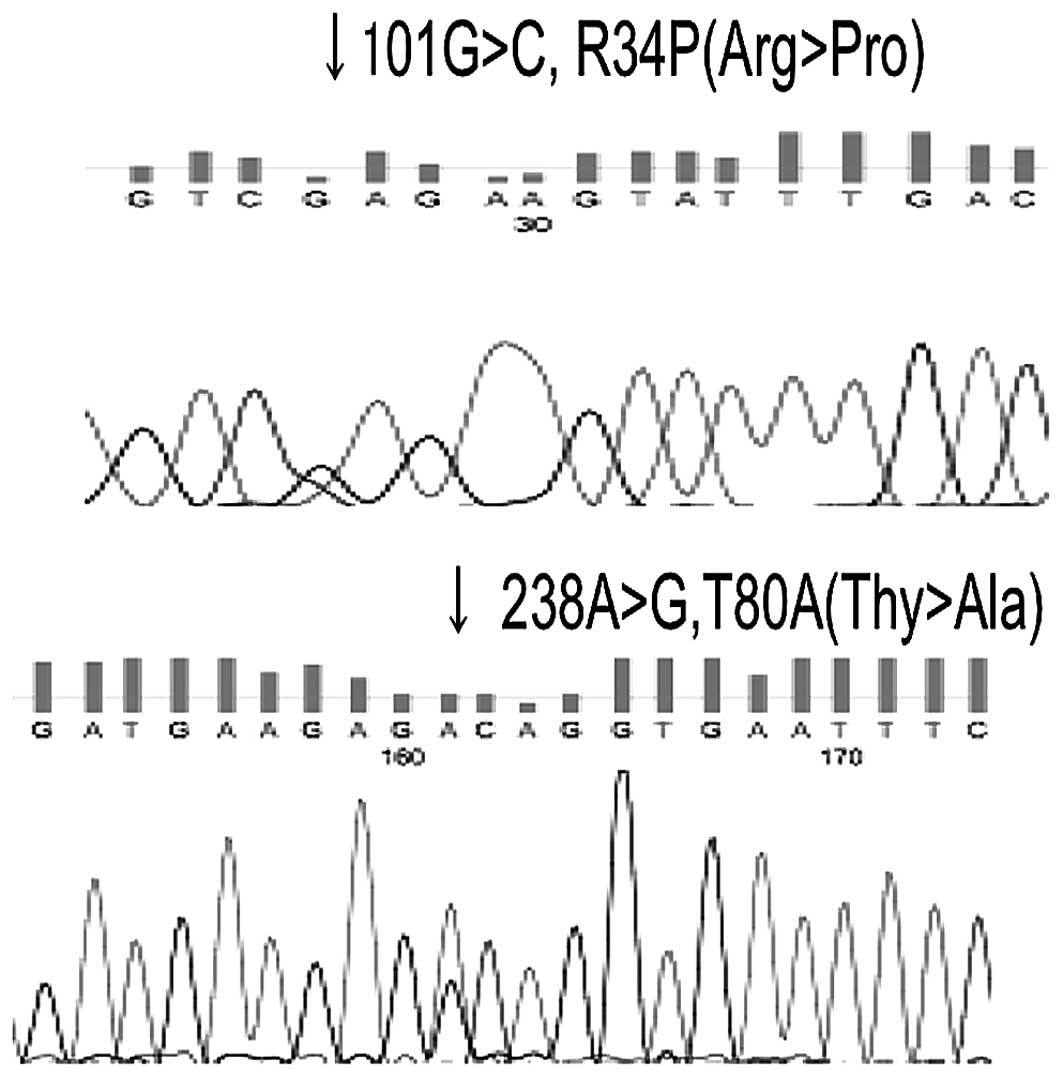
3 were known mutations (T80A, W24C, R34Q). In total, 16 out of 148
(10.8%) had NRF2 gene mutations (Fig. 1). All of the mutations were found
in squamous cell carcinomas. The NRF2 gene mutations were
clustered on exon 2 and resulted in amino acid changes in either
the DLG or the ETGE motif of the regulatory Neh2 domain (7).
NRF2 gene status in Japanese lung cancer
patients
Using the primer sets for the NRF2 gene, from
90 lung cancer patients, 7 patients had more than 3 copies of the
NRF2 gene and the clinicopathological background is shown in
Table I. NRF2 gene copy
number status significantly correlated with gene mutations (mutant,
31.25% vs. wild-type, 2.7%; p=0.0017). However, the copy number
status did not correlate with smoking status (Brinkman index
<400 vs. ≥400; p=0.4443), pathological stage (stage I vs. stage
II and III, p=0.4375), lymph node metastasis (positive vs.
negative, p=0.4242) or age (<65 vs. ≥65, p=0.9999). NRF2
gene copy number significantly correlated with gene mutations
(mutant, 2.478±0.668 vs. wild-type, 1.917±0.737; p=0.0048).
However, the mean NRF2 copy number did not correlate with
smoking status (Brinkman index <400, 2.239±0.499 vs. ≥400,
1.998±0.593; p=0.3741), lymph node metastasis (negative,
2.074±0.567 vs. positive, 1.926±0.980; p=0.1695), age (≥65,
2.083±0.782 vs. <65, 1.96±0.732; p=0.1237) or pathological
stage.
 | Table IClinicopathological data of the 90
lung squamous cell carcinoma patients. |
Table I
Clinicopathological data of the 90
lung squamous cell carcinoma patients.
| NRF2 gene status | |
|---|
|
| |
|---|
| Factors | Number of
patients | Copy number | P-value |
|---|
| Mean age (years) | 66.7±8.4 | 90 | |
| Pathological
stage | | | NS |
| I | 43 (47.8%) | 2.035±0.490 | |
| II | 20 (22.2%) | 2.165±1.033 | |
| III | 27 (30.0%) | 1.877±0.859 | |
| Lymph node
metastasis | | | 0.1695 |
| N0 | 55 (61.1%) | 2.074±0.567 | |
| N+ | 35 (38.9%) | 1.926±0.980 | |
| BI status | | | 0.3741 |
| <400 | 7 (7.8%) | 2.239±0.499 | |
| ≥400 | 83 (92.2%) | 1.998±0.593 | |
| Differentiation | | | |
| Well | 27 (30.0%) | 1.955±0.817 | 0.8671 |
| Moderate/poor or
other | 63 (70.0%) | 2.042±0.729 | |
| NRF2
mutations | | | 0.0048 |
| Mutant | 16 (17.8%) | 2.478±0.668 | |
| Wild-type | 74 (82.2%) | 1.917±0.737 | |
| Age, years | | | 0.1237 |
| ≥65 | 41 (45.6%) | 2.083±0.782 | |
| <65 | 49 (54.4%) | 1.960±0.732 | |
| Gender | | | 0.1545 |
| Male | 3 (92.2%) | 1.984±0.751 | |
| Female | 7 (7.8%) | 2.404±0.720 | |
The overall survival of the 90 lung squamous cell
carcinoma patients, with follow-up through to December 31, 2010,
was studied in reference to the NRF2 gene status. The
survival of the patient with an increased copy number of the
NRF2 gene (n=7) and the patient with a normal copy number of
NRF2 (n=83) was not significantly different (Log-rank test,
p=0.6582).
Discussion
In our analysis, an increased NRF2 gene copy
number was found in 7.8% of Japanese lung squamous cell carcinomas.
The NRF2 gene statuses correlated with NRF2
mutations, indicating that the mutations were activating
mutations.
NRF2 (NFE2L2) is a master
transcriptional activator of genes encoding many cytoprotective
enzymes that are induced in response to environmental and
endogenously derived oxidative/electrophilic agents (18–20).
A previous report showed that the RNAi-mediated silencing of
NRF2 gene expression in non-small cell lung cancer inhibited
tumor growth (21). A NRF2
gene promoter polymorphism has been identified and has been
suggested to correlate with carcinogenesis (22). The association of NRF2
mutation and increased copy number in lung squamous cell carcinomas
suggests a role of NRF2 in tumorigenesis. The constitutive
expression of NRF2 may provide a survival advantage to
invasive and metastatic cancer cells, by adaptation to the
microenvironment and evolution of chemoresistance in cancer cells
under hypoxic conditions (23,24).
A previous study showed that the degree of cisplatin (CDDP)-induced
DNA crosslinking and the number of cells undergoing apoptosis were
increased significantly in A549 cells transfected with
NRF2-siRNA (25). The
expression of multidrug resistance-associated proteins, the drug
efflux proteins, has also been shown to be significantly reduced in
NRF2-silenced A549 cells (25). Another study also showed that the
inhibition of NRF2 function restored CDDP sensitivity in human
ovarian cancer cells (26).
However, in our analysis, more than half of
NRF2 gene mutations did not have an increased NRF2
gene copy number. The prognosis analysis between NRF2 gene
copy number statuses was not significantly different, which
suggests that another mechanism may exist for the activation of
NRF2 mutations in cancer. As previously reported, in
vitro, wild-type NRF2 was efficiency polyubiqitinated while
mutant NRF2 proteins were only weakly polyubiquitinated after
treatment with MG132 (8).
Wild-type NRF2 protein decreased rapidly, whereas mutant NRF2
proteins were degraded more slowly, having half-lives of
approximately twice that of wild-type (8). In addition, mutant NRF2 proteins were
significantly more active than wild-type NRF2 by analyzing
luciferase activity (8). In
addition, the prognostic value of NRF2 expression in lung cancers
was controversial. Merikallio et al showed that NRF2 protein
expression was correlated with poor prognosis using multi-variate
analysis (10). Kim et al
showed that high NRF2 expression was not correlated with poor
prognosis in stage I lung cancers (27). Interaction between other genes,
such as Keap1, would be also important for control of NRF2
expression in NSCLC (28).
Acknowledgements
The authors would like to thank Mrs. Miki Mochizuki
for her excellent technical assistance. This study was supported by
Grants-in-Aid for Scientific Research, Japan Society for the
Promotion of Science (JSPS) (Nos. 23659674, 24592097 and 21591820)
and a grant for cancer research of the Program for developing the
supporting system for upgrading education and research (2009) from
the Ministry of Education, Culture, Sports, Science and Technology
of Japan.
References
|
1
|
Ginsberg RJ, Kris MK and Armstrong JG:
Cancer of the lung. Principles and Practice of Oncology. 4th
edition. Lippincott; Philadelphia, PA: pp. 673–682. 1993
|
|
2
|
Yasuda K, Ayabe H, Ide H and Uchida Y:
Thoracic and cardiovascular surgery in Japan during 1998. Annual
report by the Japanese Association for Thoracic Surgery Committee
of Science. Jpn J Thorac Cardiovasc Surg. 48:401–415. 1998.
View Article : Google Scholar : PubMed/NCBI
|
|
3
|
Postmus PE: Chemotherapy for non-small
cell lung cancer: the experience of the Lung Cancer Cooperative
Group of the European Organization for Research and Treatment of
Cancer. Chest. 113(Suppl 1): 28S–31S. 1998. View Article : Google Scholar : PubMed/NCBI
|
|
4
|
Kensler TW and Wakabayashi N: Nrf2, friend
or foe for chemoprevention? Carcinogenesis. 31:90–99. 2010.
View Article : Google Scholar : PubMed/NCBI
|
|
5
|
Moi P, Chank K, Asunis I, et al: Isolation
of NF-E2-related factor 2 (Nrf2), a NF-E2-like basic leucine zipper
transcriptional activator that binds to the tandem NF-E2/AP1 repeat
of the beta-globin locus control region. Proc Natl Acad Sci USA.
91:9926–9930. 1994. View Article : Google Scholar : PubMed/NCBI
|
|
6
|
Solis LM, Behrens C, Dong W, et al: Nrf2
and Keap1 abnormalities in non-small cell lung carcinoma and
association with clinicopathologic features. Clin Cancer Res.
16:3743–3753. 2010. View Article : Google Scholar : PubMed/NCBI
|
|
7
|
Sasaki H, Hikosaka Y, Okuda K, et al:
NFE2L2 gene mutation in male Japanese squamous cell carcinoma of
the lung. J Thorac Oncol. 5:786–789. 2010. View Article : Google Scholar : PubMed/NCBI
|
|
8
|
Shibata T, Ohta T, Tong KI, et al: Cancer
related mutations in Nrf2 impair its recognition by Keap1-Clu3 E3
ligase and promote malignancy. Proc Natl Acad Sci USA.
105:13568–13573. 2008. View Article : Google Scholar : PubMed/NCBI
|
|
9
|
Hu Y, Ju Y, Lin D, et al: Mutation of the
Nrf2 gene in non-small cell lung cancer. Mol Biol Rep.
39:4743–4747. 2012. View Article : Google Scholar : PubMed/NCBI
|
|
10
|
Merikallio H, Paakko P, Kinnula VL, et al:
Nuclear factor erythroid-derived 2-like 2 (Nrf2) and DJ1 are
prognostic factors in lung cancer. Hum Pathol. 43:577–584. 2012.
View Article : Google Scholar : PubMed/NCBI
|
|
11
|
Yang H, Wang W, Zhang Y, et al: The role
of NF-E2-related factor 2 in predicting chemoresistance and
prognosis in advanced non-small cell lung carcinomas. Clin Lung
Cancer. 12:166–171. 2011. View Article : Google Scholar : PubMed/NCBI
|
|
12
|
Mahaffey CM, Mahaffey NC, Holland W, et
al: Aberrant regulation of the MRP3 gene in non-small cell lung
carcinoma. J Thorac Oncol. 7:34–39. 2012. View Article : Google Scholar : PubMed/NCBI
|
|
13
|
Endo K, Sasaki H, Yano M, et al:
Evaluation of the epidermal growth factor receptor gene mutation
and copy number in non-small cell lung cancer with gefitinib
therapy. Oncol Rep. 16:533–541. 2006.PubMed/NCBI
|
|
14
|
Wang TL, Maierhofer C, Speicher MR, et al:
Digital karyotyping. Proc Natl Acad Sci USA. 99:16156–16161. 2002.
View Article : Google Scholar : PubMed/NCBI
|
|
15
|
Zhao X, Weir BA, LaFramboise T, et al:
Homozygous deletions and chromosome amplifications in human lung
carcinomas revealed by single nucleotide polymorphism array
analysis. Cancer Res. 65:5561–5570. 2005. View Article : Google Scholar : PubMed/NCBI
|
|
16
|
Okuda K, Sasaki H, Yukiue H, et al: Met
gene copy number predicts the prognosis for completely resected
non-small cell lung cancer. Cancer Sci. 99:2280–2285. 2008.
View Article : Google Scholar : PubMed/NCBI
|
|
17
|
Takano T, Ohe Y, Sakamoto H, et al:
Epidermal growth factor receptor gene mutations and increased copy
numbers predict gefitinib sensitivity in patients with recurrent
non-small-cell lung cancer. J Clin Oncol. 23:6829–6837. 2005.
View Article : Google Scholar : PubMed/NCBI
|
|
18
|
Itoh K, Chiba T, Takahashi S, et al: An
Nef2/small Maf heterodimer mediates the induction of phase II
detoxifying enzyme genes through antioxidant response elements.
Biochem Biophys Res Commun. 236:313–322. 1997. View Article : Google Scholar : PubMed/NCBI
|
|
19
|
Rushmore TH and Kong AN: Pharmacogenomics,
regulation and signaling pathways of phase I and II detoxifying
enzymes. Curr Drug Metab. 3:481–490. 2002. View Article : Google Scholar : PubMed/NCBI
|
|
20
|
Ngyyen T, Yang CS and Pickett CB: The
pathways and molecular mechanisms regulating Nrf2 activation in
response to chemical stress. Free Radic Biol Med. 37:433–441. 2004.
View Article : Google Scholar : PubMed/NCBI
|
|
21
|
Singh A, Boldin-Adamsky S, Thimmulappa RK,
et al: RNAi-mediated silencing of nuclear factor
erythroid-2-related factor 2 gene expression in non-small cell lung
cancer inhibits tumor growth and increases efficacy of
chemotherapy. Cancer Res. 68:7975–7984. 2008. View Article : Google Scholar : PubMed/NCBI
|
|
22
|
Arisawa T, Tahara T, Shibata T, et al:
Nrf2 gene promoter polymorphism and gastric carcinogenesis.
Hepatogastroenterology. 55:750–754. 2008.PubMed/NCBI
|
|
23
|
Semenza GL: HIF-1 for cancer therapy. Nat
Rev Cancer. 3:721–732. 2003. View
Article : Google Scholar
|
|
24
|
Zhou J, Scmid T, Schnitzer S, et al: Tumor
hypoxia and cancer progression. Cancer Lett. 237:10–21. 2006.
View Article : Google Scholar
|
|
25
|
Homma S, Ishii Y, Morishima Y, et al: Nrf2
enhances cell proliferation and resistance to anticancer drugs in
human lung cancer. Clin Cancer Res. 15:3423–3432. 2009. View Article : Google Scholar : PubMed/NCBI
|
|
26
|
Cho JM, Manandhar S, Lee HR, et al: Role
of Nrf2-antioxidant system in cytotoxicity mediated by anticancer
cisplatin: implication to tumor biology. Cancer Lett. 260:96–108.
2008. View Article : Google Scholar : PubMed/NCBI
|
|
27
|
Kim J-H, Bongner PN, Ramnath N, et al:
Elevated peroxiredoxin 1, but not NF-E2-related factor 2, is an
independent prognostic factor for disease recurrence and reduced
survival in stage I non-small cell lung cancer. Clin Cancer Res.
13:3875–3882. 2007. View Article : Google Scholar : PubMed/NCBI
|
|
28
|
Ohta T, Iijima K, Miyamoto M, et al: Loss
of Keap1 function activates Nrf2 and provides advantages for lung
cancer cell growth. Cancer Res. 68:1303–1309. 2008. View Article : Google Scholar : PubMed/NCBI
|