Introduction
With over 12.5 million new cases and 7.5 million
mortalities annually, cancer is becoming one of the most malignant
diseases worldwide. Among the various cancer types, breast cancer
contributes to more than 1.2 new cases and 0.5 million mortalities
annually, making it the most malignant form of cancer among women
(1). Due to this high incidence,
the identification of novel compounds that inhibit cancer
development has become a crucial objective for scientists. Of the
hundreds of chemicals that have been and are being evaluated for
their anti-cancer activities, natural products derived from
medicinal plants rank among the most promising.
In an effort to identify novel agents that may
inhibit cancer development, we have focused our investigations on
discovering bioactive compounds from plants commonly consumed by
primates. Due to the high degree of physiological similarity
between primates and humans, primate disease often exhibits
similarities to human disease, and certain human diseases are known
to have originated from primates. Notably, since primate survival
largely depends on daily food intake, the food consumed by primates
is considered a promising source of products applicable for human
disease management.
In our previous study, we found that the leaves of
Schima wallichii Korth., a primate-consumed plant,
demonstrated anti-tumor and anti-mutagenic properties (2,3). These
preliminary studies suggest that Schima wallichii Korth. may
be further developed as a source of anti-cancer agents. Thus, in
this study, we investigated and characterized the pro-apoptotic
activities of Schima wallichii Korth. leaf extracts.
Materials and methods
Plant materials
Schima wallichii Korth. leaves were collected
from Lembang, West Java, Indonesia. The plant species was
identified by the Department of Biology, Faculty of Mathematics and
Natural Sciences, University of Padjadjaran, Indonesia.
Extraction and isolation
The dried leaves of Schima wallichii Korth.
(5 kg) were extracted with 70% ethanol (3×24 h) at room
temperature. The solvent was subsequently evaporated under reduced
pressure at 50°C to yield a concentrated extract. The ethanol
extract (506.05 g) was fractionated between n-hexane and water to
obtain an n-hexane extract (43.90 g) and a water layer. The water
layer was then extracted with ethyl acetate to obtain an ethyl
acetate fraction (47.35 g) and a water fraction (104.20 g). The
cytotoxicity of the fractions was assessed on MCF-7 breast cancer
cells using the methyl thiazolyl tetrazolium (MTT) assay. The ethyl
acetate fraction, which was the most active fraction, was
chromatographed on Wakogel C-200 (Wako Pure Chemical, Japan) with a
mixture of n-hexane, ethyl acetate and methanol with increased
polarity. The major compound was then isolated and purified using
silica G-60 with sulfuric acid-ethanol (1:9) and identified by
spectroscopy methods including ultra violet and infrared
spectrometry (UV-IR), nuclear magnetic resonance (NMR) and liquid
chromatography mass spectrometry (LC-MS) (4).
Cell culture and treatment
The MCF-7 human breast cancer cell line (ATCC,
Manassas, VA, USA) and HC-04 human hepatocytes (Siam Life Science
Ltd., Thailand) used in this study were cultured in RPMI-1640
medium (Sigma, St. Louis, MO, USA) supplemented with 10% fetal
bovine serum and antibiotics (100 U/ml penicillin and 100 μg/ml
streptomycin). For cell treatments, various concentrations of the
sample were added to the cell culture medium. After 24 h, the cells
were released from treatment, the medium was replaced, and cells
were subsequently collected at the indicated times.
Drug sensitivity assay
A cell proliferation analysis was performed in the
presence of various concentrations of broccoli sprout extracts
using a colorimetric MTT assay, as described in a previous study
(5). Briefly, the cells were plated
in 96-well plates (2×10⁴ in 50 μl/well). Following the
initial cell seeding, the indicated concentrations of extracts were
applied and incubated for 24 h. WST-8 assay cell-counting solution
(10 μl) (Dojindo Lab., Tokyo, Japan) was added to each well and
incubated at 37°C for 3 h. After the addition of 1N HCl (100
μl/well), the cell proliferation rates were determined by measuring
the absorbance at a wavelength of 450 nm with a reference
wavelength of 650 nm using a microtiter plate reader
(Becton-Dickinson, Franklin Lakes, NJ, USA). The results were
derived from triplicate experiments.
Cell extraction and western blot
analysis
Protein concentrations were determined using a BCA
protein assay kit (Pierce, Rockford, IL, USA). Proteins (40 μg)
were electrophoresed on 5–20% Tris-Tricine ReadyGel (Bio-Rad,
Tokyo, Japan) and electro-transferred to a Hybond enhanced
chemiluminescence membrane (Amersham, Buckinghamshire, UK).
Apoptosis-related proteins were analyzed by immunoblot analysis
using caspase-3, caspase-9 and PARP antibodies at a 1:1000 dilution
(Cell Signaling Technology, Beverly, MA, USA). β-actin (Sigma)
served as the loading control.
Results
Ethyl acetate fraction of Schima
wallichii Korth. leaves inhibits MCF-7 cell proliferation
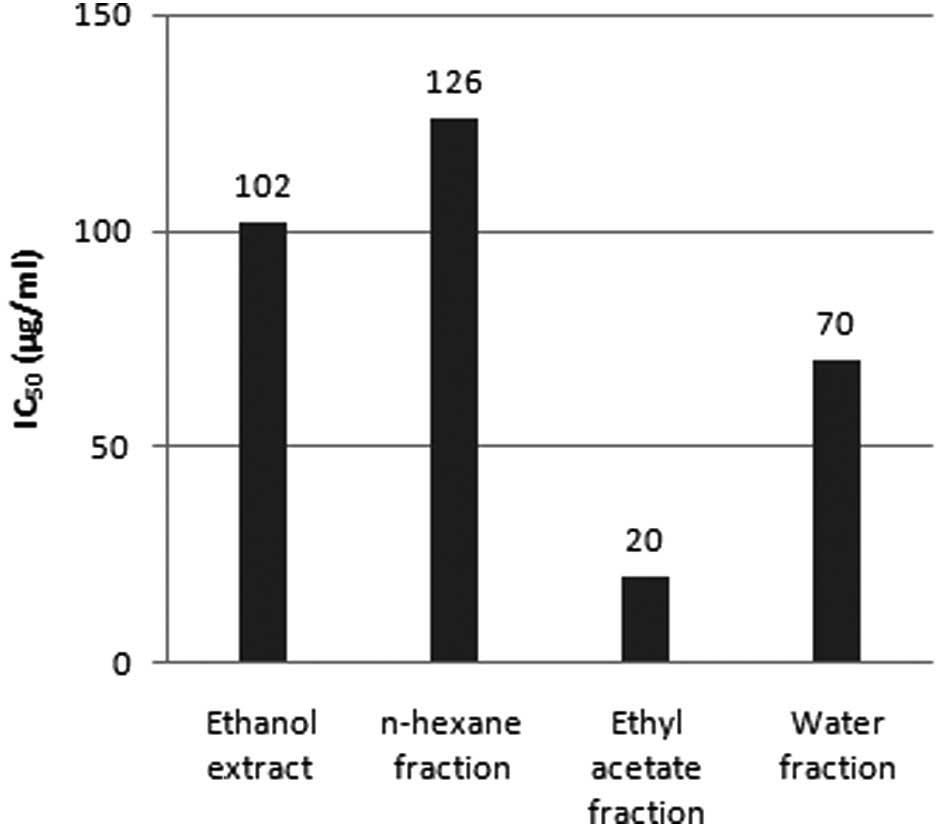
Treatment with the Schima wallichii Korth.
extract was found to inhibit the proliferation of MCF-7 human
breast cancer cells (IC50, 102 μg/ml) (Fig. 1). The extract was fractionated based
on polarity, using n-hexane, ethyl acetate and water. The fractions
were then individually applied to MCF-7 cells and were found to
inhibit cell proliferation with an IC50 value of 126
μg/ml for the n-hexane fraction, 20 μg/ml for the ethyl acetate
fraction and 70 μg/ml for the water fraction. Due to its low
IC50 value, we then explored the ethyl acetate fraction
for its anti-cancer potential.
Kaempferol-3-O-rhamnoside is the major
compound of the ethyl acetate fraction
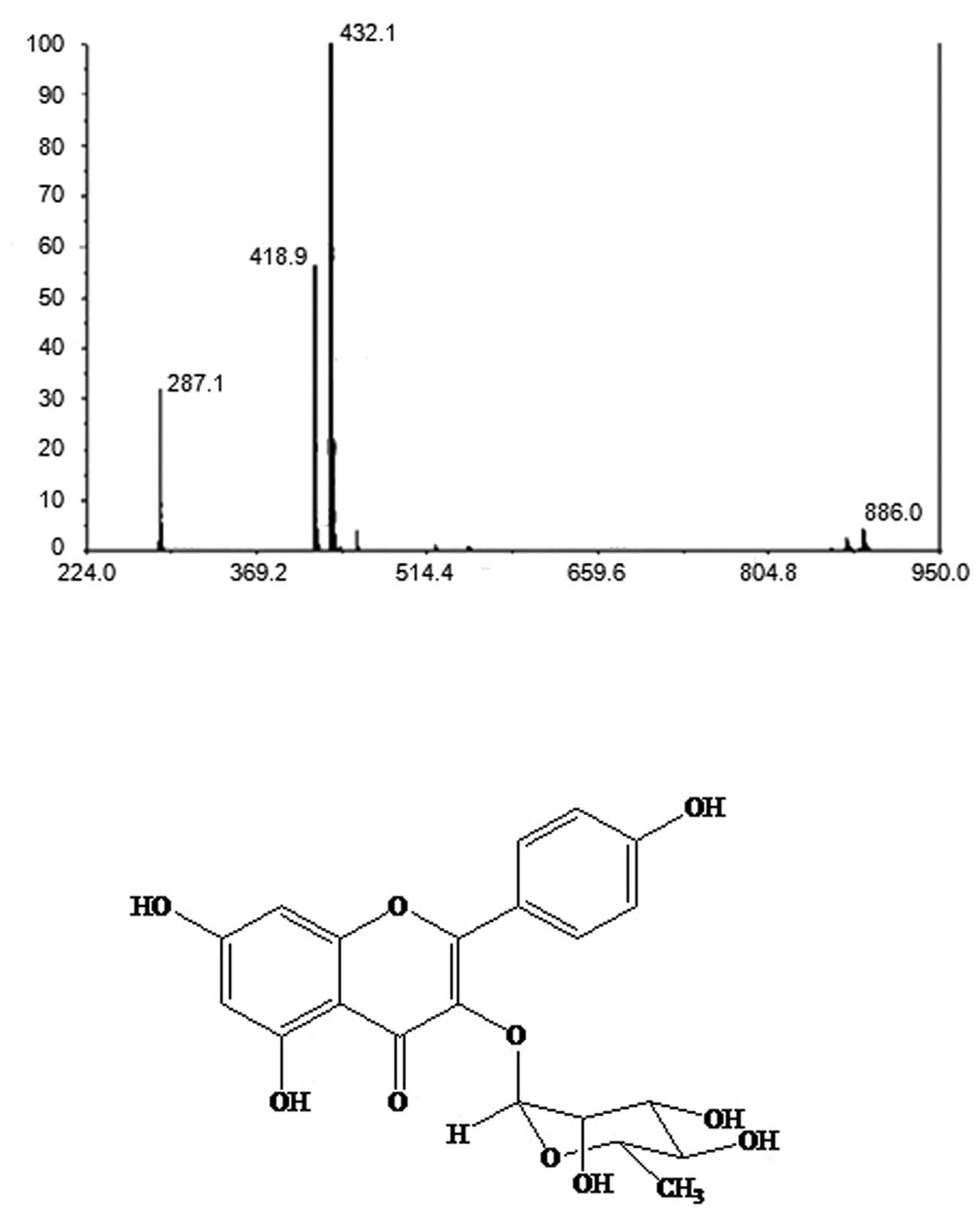
The principle active compound of the ethyl acetate
fraction of Schima wallichii Korth. extract was isolated and
purified. The compound exhibited a melting point of 152.7–153°C and
a molecular ion peak at m/z 432 in the LC-MS spectrum. Based
on hydrogen and carbon content, the molecular ion peak and
1H and 13C NMR profiles indicated that the
compound had a molecular formula of
C21H20O10. The UV spectrum
produced maximal absorbance peaks at λmax 265 and 342 nm, which
were characteristic of a flavonoid with a flavone skeleton. The
addition of NaOH produced a bathochromic shift in the absorption
bands, indicating the presence of hydroxyl groups in the skeleton,
one of which was attached to C-5, as indicated by a further
bathochromic shift following the addition of
H3BO3. Absorption bands at 1,675 and 3,197 nm
of the IR spectrum indicated where the molecule harbors conjugated
carbonyl and hydroxyl groups, respectively.
The 1H NMR spectrum of the compound
showed two aromatic hydrogen signals with ‘meta coupling’ at δ 6.35
(1H, d, J= 2.2 Hz) and 6.18 (1H, d, J=2.2 Hz), which
was predicted by the hydrogens at C-6 and C-8 of the A ring of the
flavone skeleton. Accordingly, this compound was suggested to have
a hydroxyl group at C-5 and C-7. Furthermore, its 1H NMR
spectrum revealed two signals with ‘ortho coupling’ at δ 6.92 (2H,
d, J=6.7 Hz) and 7.74 (2H, d, J=6.7 Hz), the signals
of which were approximated from the hydrogens at C-2′, C-3′, C-5′
and C-6′ of the B ring. The absence of a specific signal for an
olefinic hydrogen at C-3 and the presence of an anomeric hydrogen
signal at δ 5.37 (1H, d, J=7.2 Hz) suggested that the
compound was a flavonol glycoside. The appearance of an anomeric
carbon signal at δ 94.9 in the 13C NMR spectrum indicated the
presence of a sugar moiety. Due to a correlation between the
anomeric hydrogen signal (δ 5.37) and the anomeric carbon signal (δ
94.9) that was revealed by analysis of the HMBC spectral data, the
position of the sugar moiety was assigned to the C-3 hydroxyl
group. The methyl signal observed at δ 0.93 (3H, s) in the
1H NMR spectrum and at δ 17.7 in the 13C NMR
spectrum indicated that the sugar moiety was rhamnose. Based on the
accumulated data above, the compound was identified as
kaempferol-3-O-rhamnoside (Fig.
2B).
Kaempferol-3-O-rhamnoside inhibits MCF-7
cell proliferation in a dose-dependent manner
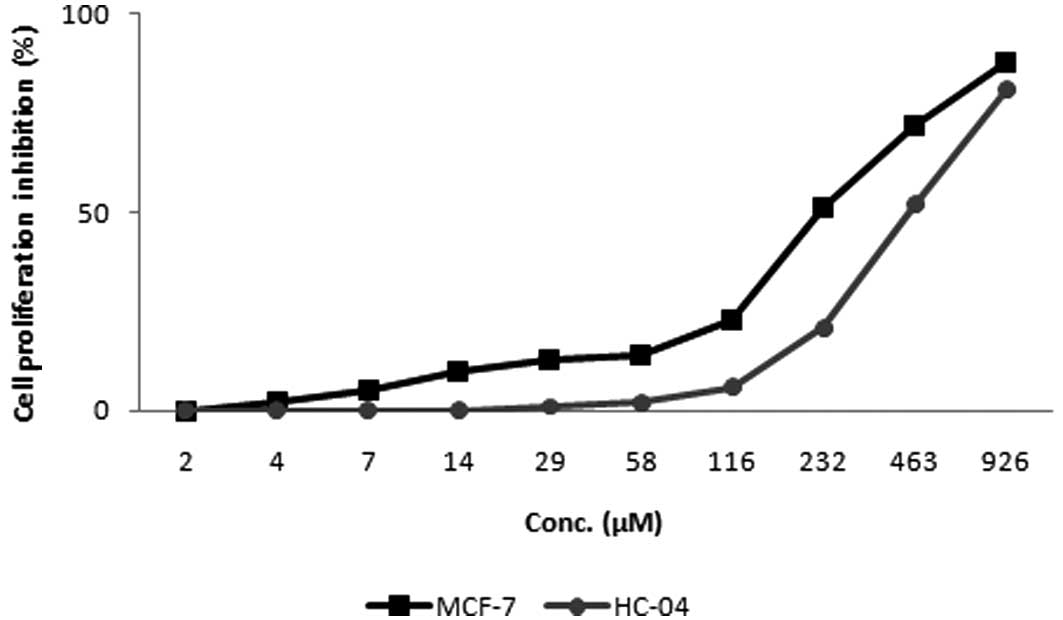
The effect of kaempferol-3-O-rhamnoside on
the viability of MCF-7 and HC-04 cells was evaluated. The treatment
of cancer (MCF-7) and non-cancer (HC-04) cell lines with
kaempferol-3-O-rhamnoside resulted in a dose-dependent
inhibition of cell growth, as demonstrated by the MTT assay
(Fig. 3). Twenty-four hours of
treatment with kaempferol-3-O-rhamnoside inhibited the
proliferation of MCF-7 cells with an IC50 value of 227
μM. By contrast, the inhibition of proliferation in HC-04 cells
with kaempferol-3-O-rhamnoside demonstrated an
IC50 of 448 μM, ~2-fold higher than that with
MCF-7 cells, suggesting that kaempferol-3-O-rhamnoside may
exhibit fewer cytotoxic effects on non-cancer cells. Subsequent
immunoblot-based investigation applying the IC50 dose of
227 μM kaempferol-3-O-rhamnoside was performed on MCF-7
cells.
Kaempferol-3-O-rhamnoside induces caspase
cascade protein expression in MCF-7 cells
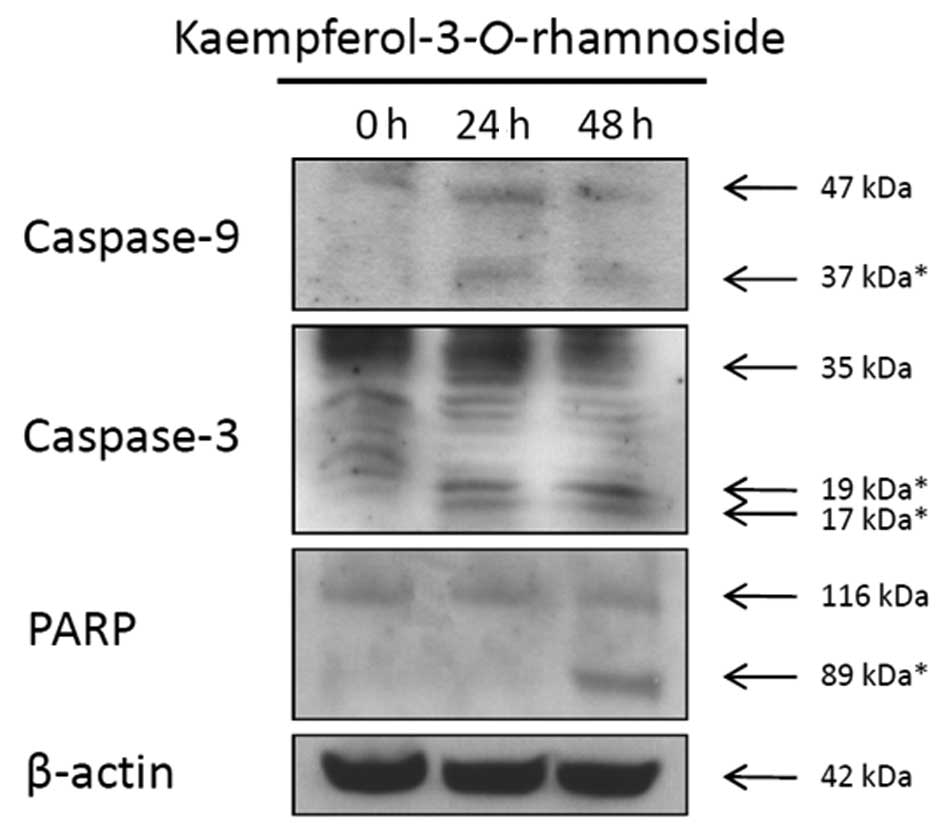
The caspase-inducing activity of
kaempferol-3-O-rhamnoside was assessed in MCF-7 cells.
During kaempferol-3-O-rhamnoside treatment, caspase-9 and
caspase-3 were upregulated in a time-dependent manner (Fig. 4). The changes in the expression
levels of poly (ADP-ribose) polymerase (PARP), a hallmark biomarker
of apoptosis, suggested that kaempferol-3-O-rhamnoside
induced apoptosis through the activation of caspase-dependent
signaling pathways as early as 24 h after treatment.
Discussion
Plants consumed by primates are sources of drugs
with a potential for application in the treatment and management of
human disease. In a 1999 review, Milton established foods routinely
consumed by primates as good sources of hexoses, cellulose,
hemicellulose, pectic substances, vitamin C, minerals, essential
fatty acids and protein, suggesting that non-human primate diets
may be an important research area for human health (6). In this study, we evaluated this
hypothesis using Schima wallichii Korth. as an example of a
primate-consumed plant that exhibits anti-cancer properties by
activating the caspase cascade pathway.
Schima wallichii Korth. is a tree of 5–30 m
in height and is widely found in the tropical areas of Nepal,
Sikkim, Assam, Myanmar, South China, the Malay Peninsula, Indonesia
and the Philippines (7). It is
predominantly found in primate conservation areas (8,9), where
it is consumed by non-human primates. Schima wallichii
Korth. was identified as a food commonly consumed by primates in
our previous study on primate-consumed plants in the Pangandaran
Conservation Area of West Java, Indonesia (2).
In this study, we isolated
kaempferol-3-O-rhamnoside, the major active compound in
Schima wallichii Korth. extracts, of which the ethyl acetate
fractions exhibited the most activity against MCF-7 human breast
cancer cells. kaempferol-3-O-rhamnoside is a polyphenol that
was reported by Vareed et al to inhibit lipid peroxidation
and cyclooxygenase enzymes (COX-1 and COX-2) (10). Results of the present study have
shown that kaempferol-3-O-rhamnoside is also able to inhibit
the proliferation of MCF-7 cells in a dose-dependent manner.
Additionally, the caspase cascade pathway is involved in the
kaempferol-3-O-rhamnoside-mediated suppression of
proliferation. Our results suggest that
kaempferol-3-O-rhamnoside triggers cell death intrinsically
in MCF-7 cells via the mitochondrial caspase-9 pathway and
activation of PARP, a hallmark biomarker of apoptosis (11). The N-terminal fragment of PARP,
which is generated from the cleavage of full-length PARP (116 kDa),
is an 89-kDa peptide and was detected as early as 24 h after
kaempferol-3-O-rhamnoside treatment. These results suggest
that kaempferol-3-O-rhamnoside induces apoptosis of MCF-7
cells, thus demonstrating inhibitory activity towards cancer
development and progression.
Potential anti-cancer compounds should demonstrate
inhibitory activity and specificity for cancer cells without
causing excessive damage to normal cells, as reported for several
plant products that induce apoptosis in cancer cells with minimal
damage to normal cells (12,13).
In our study, although kaempferol-3-O-rhamnoside affects the
proliferation of non-cancer HC-04 cells, the IC50
concentration required was also significantly higher than that
required for cancer MCF-7 cells, suggesting that
kaempferol-3-O-rhamnoside may be less cytotoxic to
non-cancer cells.
In conclusion, accumulating evidence suggests that
products derived from plants hold potential in the treatment and
prevention of cancer. Therefore, it is important to identify
apoptotic inducers from plants, either as crude extracts or as
active isolated compounds. Furthermore, understanding their exact
mechanisms of action may provide valuable information for their
possible application in cancer therapy and prevention. We report
the active properties of kaempferol-3-O-rhamnoside in the
inhibition of cancer cell proliferation through the induction of
apoptosis. Although further studies are required to evaluate its
toxicity, its detailed mechanism(s) of anti-cancer action, and the
possibility of its structural modification to enhance its
anti-cancer activities, our results emphasize the potential
application of kaempferol-3-O-rhamnoside in the management
and treatment of cancer.
Acknowledgements
This study was supported by Grants-in-Aid from the
Ministry of National Education of Indonesia to A.D. (National
Competitive Research Grant and PAR-C Grant for Academic Recharging)
and to A.S. (Grant for International Collaborations and
Publications).
References
|
1
|
Ferlay J, Shin HR, Bray F, Forman D,
Mathers C and Parkin DM: GLOBOCAN 2008 v12, Cancer Incidence and
Mortality Worldwide. International Agency for Research on Cancer;
2010, Available from: http://globocan.iarc.fr.
Accessed August 27, 2011.
|
|
2
|
Koshimizu K, Murakami A, Hayashi H,
Ohigashi H, Subarnas A, Gurmaya KJ and Ali AM: Biological
activities of edible and medicinal plants from Indonesia and
Malaysia. The Tokyo International Forum on Conservation and
Sustainable Use of Tropical Bioresources. Japan Bioindustry
Association; Tokyo: pp. 203–208. 1998
|
|
3
|
Subarnas A, Hadiansyah C, Gurmaya KJ and
Muhtadi A: Characterization of antimutagenic compound from
primates-consumed plant Schima wallichii. Biotika. 2:7–13.
2003.
|
|
4
|
Silverstein RM, Webster FX and Kiemle DJ:
Spectrometric Identification of Organic Compounds. John Wiley &
Sons. Inc; New Jersey: 2005
|
|
5
|
Abdulah R, Faried A, Kobayashi K, Yamazaki
C, Suradji EW, Ito K, Suzuki K, Murakami M, Kuwano H and Koyama H:
Selenium enrichment of broccoli sprout extract increases
chemosensitivity and apoptosis of LNCaP prostate cancer cells. BMC
Cancer. 9:4142009. View Article : Google Scholar : PubMed/NCBI
|
|
6
|
Milton K: Nutritional characteristics of
wild primate foods: do the diets of our closest living relatives
have lessons for us? Nutrition. 15:488–498. 1999. View Article : Google Scholar : PubMed/NCBI
|
|
7
|
Keng H: Flora malesianae precursores -
LVIII, part four. The genus Schima (Theaceae) in Malesia. Gard Bull
Singapore. 46:77–88. 1994.
|
|
8
|
Chalise MK: Assamese Macaques (Macaca
assamensis) in Nepal. Primate Conservation. 19:99–107.
2003.
|
|
9
|
Swapna N, Gupta A and Radhakrishna S:
Distribution survey of Bengal slow loris Nycticebus Bengalensis in
Tripura, Northeastern India. Asian Primates J. 1:37–40. 2008.
|
|
10
|
Vareed SK, Schutzki RE and Nair MG: Lipid
peroxidation, cyclooxygenase enzyme and tumor cell proliferation
inhibitory compounds in Cornus kousa fruits. Phytomedicine.
14:706–709. 2007. View Article : Google Scholar
|
|
11
|
Konopleva M, Zhao S, Xie Z, Segall H,
Younes A, Claxton DF, Estrov Z, Kornblau SM and Andreeff M:
Apoptosis. Molecules and mechanisms. Adv Exp Med Biol. 457:217–236.
1999.
|
|
12
|
Hirano T, Abe K, Gotoh M and Oka K: Citrus
flavone tangeretin inhibits leukaemic HL-60 cell growth partially
through induction of apoptosis with less cytotoxicity on normal
lymphocytes. Br J Cancer. 72:1380–1388. 1995. View Article : Google Scholar
|
|
13
|
Chiao C, Carothers AM, Grunberger D,
Solomon G, Preston GA and Barrett JC: Apoptosis and altered redox
state induced by caffeic acid phenethyl ester (CAPE) in transformed
rat fibroblast cells. Cancer Res. 55:3576–3583. 1995.PubMed/NCBI
|