Spandidos Publications Logo
  • About
    • About Spandidos
    • Aims and Scopes
    • Abstracting and Indexing
    • Editorial Policies
    • Reprints and Permissions
    • Job Opportunities
    • Terms and Conditions
    • Contact
  • Journals
    • All Journals
    • Oncology Letters
      • Oncology Letters
      • Information for Authors
      • Editorial Policies
      • Editorial Board
      • Aims and Scope
      • Abstracting and Indexing
      • Bibliographic Information
      • Archive
    • International Journal of Oncology
      • International Journal of Oncology
      • Information for Authors
      • Editorial Policies
      • Editorial Board
      • Aims and Scope
      • Abstracting and Indexing
      • Bibliographic Information
      • Archive
    • Molecular and Clinical Oncology
      • Molecular and Clinical Oncology
      • Information for Authors
      • Editorial Policies
      • Editorial Board
      • Aims and Scope
      • Abstracting and Indexing
      • Bibliographic Information
      • Archive
    • Experimental and Therapeutic Medicine
      • Experimental and Therapeutic Medicine
      • Information for Authors
      • Editorial Policies
      • Editorial Board
      • Aims and Scope
      • Abstracting and Indexing
      • Bibliographic Information
      • Archive
    • International Journal of Molecular Medicine
      • International Journal of Molecular Medicine
      • Information for Authors
      • Editorial Policies
      • Editorial Board
      • Aims and Scope
      • Abstracting and Indexing
      • Bibliographic Information
      • Archive
    • Biomedical Reports
      • Biomedical Reports
      • Information for Authors
      • Editorial Policies
      • Editorial Board
      • Aims and Scope
      • Abstracting and Indexing
      • Bibliographic Information
      • Archive
    • Oncology Reports
      • Oncology Reports
      • Information for Authors
      • Editorial Policies
      • Editorial Board
      • Aims and Scope
      • Abstracting and Indexing
      • Bibliographic Information
      • Archive
    • Molecular Medicine Reports
      • Molecular Medicine Reports
      • Information for Authors
      • Editorial Policies
      • Editorial Board
      • Aims and Scope
      • Abstracting and Indexing
      • Bibliographic Information
      • Archive
    • World Academy of Sciences Journal
      • World Academy of Sciences Journal
      • Information for Authors
      • Editorial Policies
      • Editorial Board
      • Aims and Scope
      • Abstracting and Indexing
      • Bibliographic Information
      • Archive
    • International Journal of Functional Nutrition
      • International Journal of Functional Nutrition
      • Information for Authors
      • Editorial Policies
      • Editorial Board
      • Aims and Scope
      • Abstracting and Indexing
      • Bibliographic Information
      • Archive
    • International Journal of Epigenetics
      • International Journal of Epigenetics
      • Information for Authors
      • Editorial Policies
      • Editorial Board
      • Aims and Scope
      • Abstracting and Indexing
      • Bibliographic Information
      • Archive
    • Medicine International
      • Medicine International
      • Information for Authors
      • Editorial Policies
      • Editorial Board
      • Aims and Scope
      • Abstracting and Indexing
      • Bibliographic Information
      • Archive
  • Articles
  • Information
    • Information for Authors
    • Information for Reviewers
    • Information for Librarians
    • Information for Advertisers
    • Conferences
  • Language Editing
Spandidos Publications Logo
  • About
    • About Spandidos
    • Aims and Scopes
    • Abstracting and Indexing
    • Editorial Policies
    • Reprints and Permissions
    • Job Opportunities
    • Terms and Conditions
    • Contact
  • Journals
    • All Journals
    • Biomedical Reports
      • Information for Authors
      • Editorial Policies
      • Editorial Board
      • Aims and Scope
      • Abstracting and Indexing
      • Bibliographic Information
      • Archive
    • Experimental and Therapeutic Medicine
      • Information for Authors
      • Editorial Policies
      • Editorial Board
      • Aims and Scope
      • Abstracting and Indexing
      • Bibliographic Information
      • Archive
    • International Journal of Epigenetics
      • Information for Authors
      • Editorial Policies
      • Editorial Board
      • Aims and Scope
      • Abstracting and Indexing
      • Bibliographic Information
      • Archive
    • International Journal of Functional Nutrition
      • Information for Authors
      • Editorial Policies
      • Editorial Board
      • Aims and Scope
      • Abstracting and Indexing
      • Bibliographic Information
      • Archive
    • International Journal of Molecular Medicine
      • Information for Authors
      • Editorial Policies
      • Editorial Board
      • Aims and Scope
      • Abstracting and Indexing
      • Bibliographic Information
      • Archive
    • International Journal of Oncology
      • Information for Authors
      • Editorial Policies
      • Editorial Board
      • Aims and Scope
      • Abstracting and Indexing
      • Bibliographic Information
      • Archive
    • Medicine International
      • Information for Authors
      • Editorial Policies
      • Editorial Board
      • Aims and Scope
      • Abstracting and Indexing
      • Bibliographic Information
      • Archive
    • Molecular and Clinical Oncology
      • Information for Authors
      • Editorial Policies
      • Editorial Board
      • Aims and Scope
      • Abstracting and Indexing
      • Bibliographic Information
      • Archive
    • Molecular Medicine Reports
      • Information for Authors
      • Editorial Policies
      • Editorial Board
      • Aims and Scope
      • Abstracting and Indexing
      • Bibliographic Information
      • Archive
    • Oncology Letters
      • Information for Authors
      • Editorial Policies
      • Editorial Board
      • Aims and Scope
      • Abstracting and Indexing
      • Bibliographic Information
      • Archive
    • Oncology Reports
      • Information for Authors
      • Editorial Policies
      • Editorial Board
      • Aims and Scope
      • Abstracting and Indexing
      • Bibliographic Information
      • Archive
    • World Academy of Sciences Journal
      • Information for Authors
      • Editorial Policies
      • Editorial Board
      • Aims and Scope
      • Abstracting and Indexing
      • Bibliographic Information
      • Archive
  • Articles
  • Information
    • For Authors
    • For Reviewers
    • For Librarians
    • For Advertisers
    • Conferences
  • Language Editing
Login Register Submit
  • This site uses cookies
  • You can change your cookie settings at any time by following the instructions in our Cookie Policy. To find out more, you may read our Privacy Policy.

    I agree
Search articles by DOI, keyword, author or affiliation
Search
Advanced Search
presentation
Oncology Letters
Join Editorial Board Propose a Special Issue
Print ISSN: 1792-1074 Online ISSN: 1792-1082
Journal Cover
May 2013 Volume 5 Issue 5

Full Size Image

Sign up for eToc alerts
Recommend to Library

Journals

International Journal of Molecular Medicine

International Journal of Molecular Medicine

International Journal of Molecular Medicine is an international journal devoted to molecular mechanisms of human disease.

International Journal of Oncology

International Journal of Oncology

International Journal of Oncology is an international journal devoted to oncology research and cancer treatment.

Molecular Medicine Reports

Molecular Medicine Reports

Covers molecular medicine topics such as pharmacology, pathology, genetics, neuroscience, infectious diseases, molecular cardiology, and molecular surgery.

Oncology Reports

Oncology Reports

Oncology Reports is an international journal devoted to fundamental and applied research in Oncology.

Experimental and Therapeutic Medicine

Experimental and Therapeutic Medicine

Experimental and Therapeutic Medicine is an international journal devoted to laboratory and clinical medicine.

Oncology Letters

Oncology Letters

Oncology Letters is an international journal devoted to Experimental and Clinical Oncology.

Biomedical Reports

Biomedical Reports

Explores a wide range of biological and medical fields, including pharmacology, genetics, microbiology, neuroscience, and molecular cardiology.

Molecular and Clinical Oncology

Molecular and Clinical Oncology

International journal addressing all aspects of oncology research, from tumorigenesis and oncogenes to chemotherapy and metastasis.

World Academy of Sciences Journal

World Academy of Sciences Journal

Multidisciplinary open-access journal spanning biochemistry, genetics, neuroscience, environmental health, and synthetic biology.

International Journal of Functional Nutrition

International Journal of Functional Nutrition

Open-access journal combining biochemistry, pharmacology, immunology, and genetics to advance health through functional nutrition.

International Journal of Epigenetics

International Journal of Epigenetics

Publishes open-access research on using epigenetics to advance understanding and treatment of human disease.

Medicine International

Medicine International

An International Open Access Journal Devoted to General Medicine.

Journal Cover
May 2013 Volume 5 Issue 5

Full Size Image

Sign up for eToc alerts
Recommend to Library

  • Article
  • Citations
    • Cite This Article
    • Download Citation
    • Create Citation Alert
    • Remove Citation Alert
    • Cited By
  • Similar Articles
    • Related Articles (in Spandidos Publications)
    • Similar Articles (Google Scholar)
    • Similar Articles (PubMed)
  • Download PDF
  • Download XML
  • View XML
Article

Differences between images of large adenoma and protruding type of gallbladder carcinoma

  • Authors:
    • Wangxun Jin
    • Chengwu Zhang
    • Xiaodong He
    • Yuyun Xu
    • Li Wang
    • Zhongsheng Zhao
  • View Affiliations / Copyright

    Affiliations: Department of Hepatology and Biliary Surgery, Zhejiang Provincial People's Hospital, Hangzhou 310000, P.R China, Department of Radiology, Zhejiang Provincial People's Hospital, Hangzhou 310000, P.R China, Department of Abdominal Tumor Surgery, Zhejiang Cancer Hospital, Hangzhou 310000, P.R China, Department of Sonography, Zhejiang Provincial People's Hospital, Hangzhou 310000, P.R China, Department of Pathology Zhejiang Provincial People's Hospital, Hangzhou 310000, P.R China
  • Pages: 1629-1632
    |
    Published online on: March 12, 2013
       https://doi.org/10.3892/ol.2013.1248
  • Expand metrics +
Metrics: Total Views: 0 (Spandidos Publications: | PMC Statistics: )
Metrics: Total PDF Downloads: 0 (Spandidos Publications: | PMC Statistics: )
Cited By (CrossRef): 0 citations Loading Articles...

This article is mentioned in:


Abstract

The aim of this study was to investigate the differences between images of large adenoma of the gallbladder and the protruding type carcinoma of the gallbladder. A retrospective study was performed on 130 patients who underwent cholecystectomy or biopsy for gallbladder polypoid lesions larger than 10 mm; among them, 20 patients were malignant and 110 patients were benign. Patients' details including ultrasonography (US), computed tomography (CT) and magnetic resonance (MR) findings were analyzed. All patients whose lesions were >15 mm by US, had CT or MR scans to further determine the nature of the lesion; two patients who were suspected to have a malignant lesion due to their large tumor size were benign by histological examination. Distinct differences were found between large adenoma and protruding type of gallbladder carcinoma. There were distinct differences between adenomas and the protruding type gallbladder cancers, and there was a pathological basis for the differences. Benign tumors had a more homogeneous texture, had spaces between the tumor and the gallbladder wall and a relatively normal configuration of the gallbladder wall. Based on these findings, certain lesions could be definitively diagnosed as benign adenomas and could help in treatment strategy.

Introduction

The detection of polypoid lesions of the gallbladder (PLGs) has increased significantly due to the widespread use of ultrasonography (US) imaging techniques (1–3). US is the first choice in the diagnosis of this disease and enhanced computed tomography (CT) and magnetic resonance imaging (MRI) confirm its nature (4–8). Many studies have indicated that the size of tumor is vital for diagnosis. A diameter >10 mm is regarded as the threshold for malignancy (3,9–11). In this study, a large tumor size did not necessarily mean that the lesion was malignant; the configuration of the tumor and the gallbladder wall and the existence of space between the two were the main indicators of the nature of the lesion. This knowledge will enable optimal management of this type of patient. In this article, a retrospective analysis of clinical data of PLG patients over a 5-year time period was performed.

Materials and methods

Patients

The study was approved by the Ethics Committee of Zhejiang Provincial People’s Hospital, Hangzhou, China. The study was retrospective so consent was not required. Two qualified radiologists reviewed images from 130 patients from 2005 to 2011 with PLGs larger than 10 mm who consented to the removal of the gallbladder or biopsy. All patients were pathologically diagnosed by routine postoperative examination; the age of patients ranged from 28 to 82 years old.

CT, MR and US protocol

Patients fasted for at least 8 h before examination; no oral contrast medium or water was administered. CT examinations were performed using Phlilips Brilliance 16 (Philips Medical Systems, Best, Netherlands). Each patient received 100 ml of a nonionic contrast material (iopromide; Ultravist 370, Bayer HealthCare, Berlin, Germany) through an 18-gauge angiographic catheter inserted into a forearm vein. CT scans were routinely obtained with the patient in a supine position. The contrast material was injected at a rate of 3 ml/sec with an automatic power injector. Magnetic resonance cholangiopancreatography was taken using a Siemens 3.0 Tesla MR magnet (Megnetom Trio; Siemens AG, Erlangen, Germany); sonography was performed using Esaote MyLab 70 (Esaote SPA, Genova, Italy) with 1–8 MHz linear array probes or a Toshiba (Applio XG 790; Toshiba, Tokyo, Japan) with 3–6 MHz 6C1 probes. Specific attention was given to the size and the base of the lesion, the space between the lesion and the wall, and the configuration of the wall to elucidate the differences between benign and malignant lesions.

Results

Patient characteristics

Twenty-two patients were diagnosed as malignant by CT and 20 of them were confirmed by biopsy or postoperative pathological examination. Two patients with lesions larger than 50 mm were suspected to be malignant preoperatively but were benign on histological examination. One patient had two polypoid lesions. On pathological examination one was benign and the other was malignant (Table I).

Table I

Patients’ clinical data.

Table I

Patients’ clinical data.

CharacteristicsNo.Percentage
Total (n=130)
  Benign110/13085
  Malignant20/13015
Malignant (n=20)
  Platform13/2065
  Protruding lesions7/2035
  Female16/2080
  Male4/2020
Benign (n=110)
  Lesion >20 mm8/1107
  Lesion >50 mm2/1101.8
  Laparoscopic cholecystectomy102/11093
  Open cholecystectomy8/1107
Differences in morphology between large adenoma and protruding type cancer

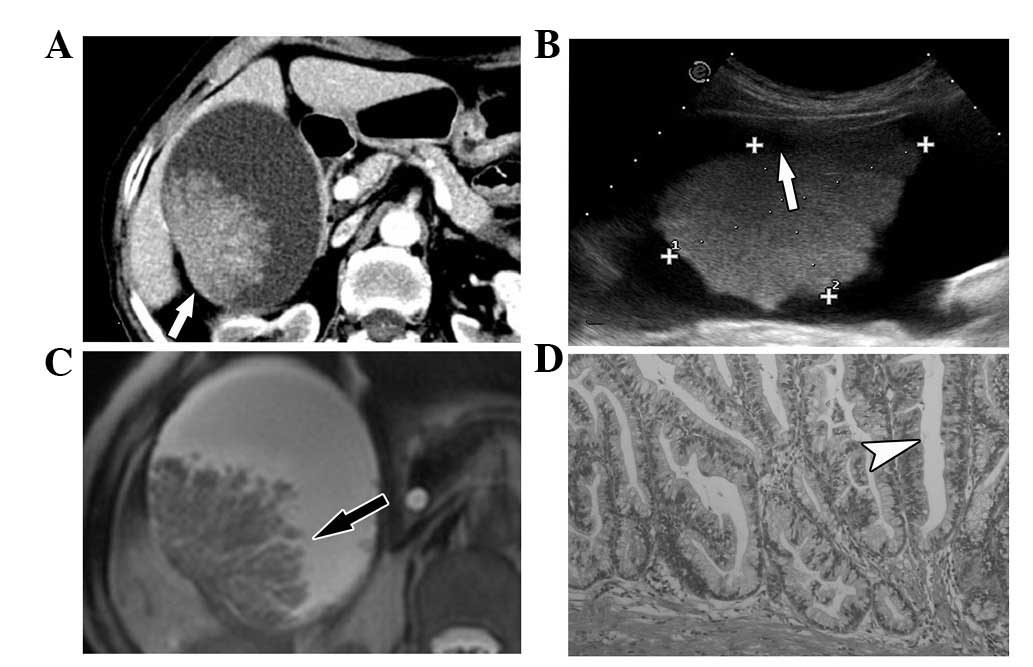
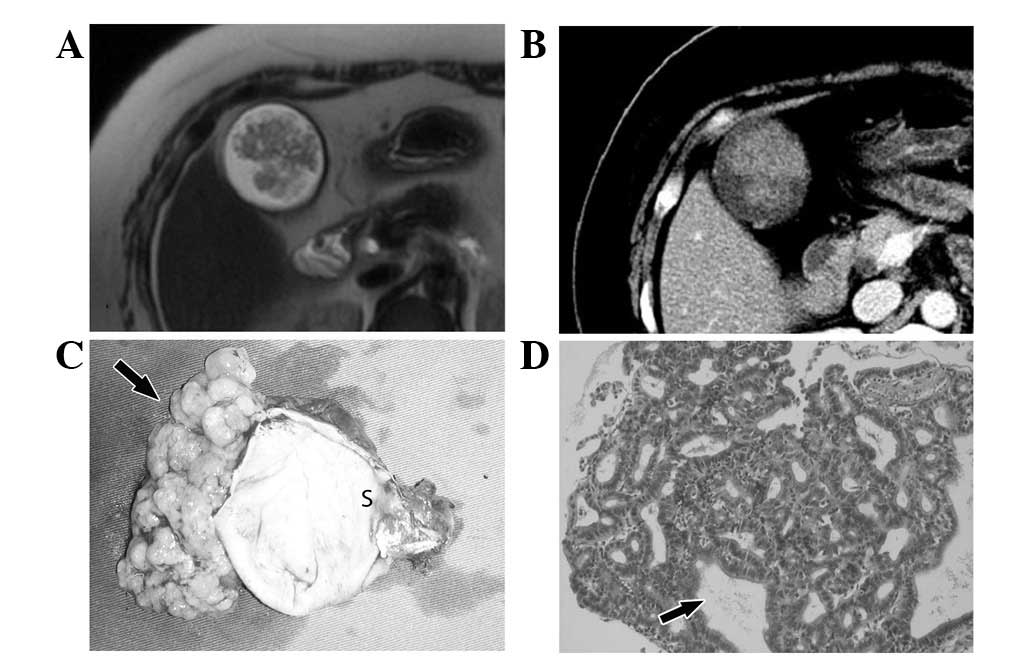
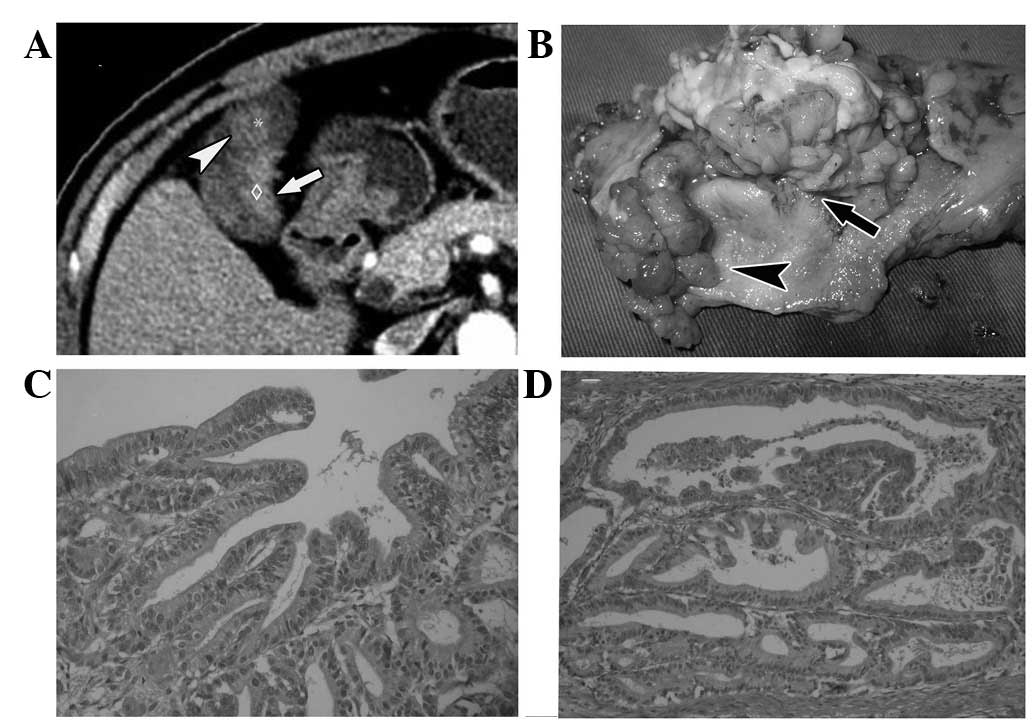
Before the operation, 2 patients were diagnosed with gallbladder cancer due to the large size of their tumors but these were revealed to be adenoma. One was tubular adenoma and the other was rare villious adenoma. Following CT scans, the villious adenoma turned out to be akin to dendritic processes; there were spaces within the mass, the surface had no contraction and the whole shape appeared to be natural like dendritic processes in the MRI scan (Fig. 1). The CT and MRI image of the tubular adenoma was different from that of villious adenoma, the appearance was similar to a congregation of mulberries (Fig. 2). In contrast, the surface of the malignant tumor was uneven, the enhancement of the solid entity of the tumor seemed to be inhomogenous and grew in a solid mass (Fig. 3). In Fig. 4, where a benign and malignant tumor grew together in the same gallbladder, the malignant tumor became more enhanced than the benign one (Fig. 4).

Figure 1

Images from a 69-year-old female with a ten-year history of systemic lupus erythematosus (SLE). (A) The computed tomography (CT) scans show the gallbladder wall running smoothly and naturally (white arrow). (B) Ultrasonography (US) scans show a huge mass, with narrow base and space between the wall and the mass (white arrow). (C) Magnetic resonance (MR) shows the mass resembled a dendritic process with narrow spaces between the processes (black arrow). (D) Villous adenoma; the white arrowhead indicates the narrow space between the villis; H&E staining; magnification, ×100.

Figure 2

Images from a 50-year-old female. (A) Magnetic resonance (MR) imaging reveals a mass with irregular spaces which appears to float in the gallbladder with a smooth and thin wall. (B) Computed tomography (CT) scans of the same patient. (C) The resected gallbladder (black arrow, mass has an appearance similar to a congregation of mulberries. S, stone obstructs the cyst duct). (D) Tubular adenoma; the black arrow indicates the irregular space between the glands; H&E staining; magnification, ×100.

Figure 3

Computed tomography (CT) images of gallbladder cancer. In all cases the tumors were solid, the base of the tumor was wide and the demarcation between the tumor and wall was obscure. (A) Arrowhead and arrow show multiple tumors with wide base; the white arrow shows the tumor-infiltrated and contracted wall. (B) Gallbladder cancer which infiltrated the neighboring tissue (white arrowhead). The pathological diagnosis was obtained by biopsy. (C) White arrow indicates the infiltrated wall and the disappearance of the space between the wall and liver. (D) Arrowhead indicates the metastasis in the liver parenchyma.

Figure 4

Images from a 67-year-old male whose blood CA19-9 was 139.7 U/ml. (A) Computed tomography (CT) shows there were two tumors in the gallbladder, one had less contact with the gallbladder wall (white arrowhead); another had a wide base with a thickened wall (white arrow; Housefield unit value: *, 50; ⋄, 80). (B) Resected gallbladder, benign tumor (black arrowhead) and malignant tumor with thickened and rigid wall (black arrow). (C) Histological result of the benign tumor, tubular adenoma and mild dysplasia (H&E, ×100). (D) Pathological examination of the malignant tumor: moderate differentiated adenocarcinoma (H&E staining; magnification, ×100).

Difference in the base size of the tumor, and the space between the tumor and the gallbladder wall

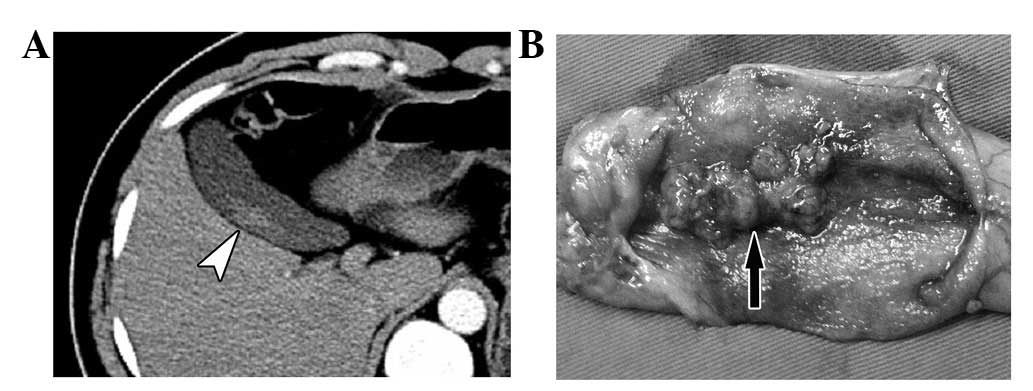
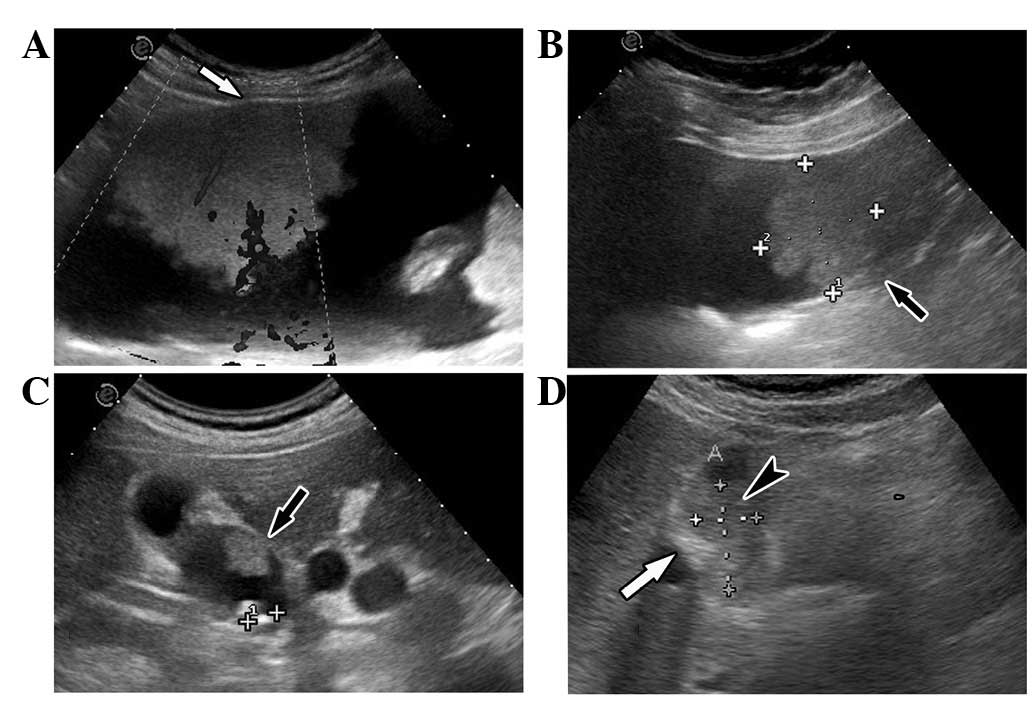
The base of the benign polypus was smaller than the malignant one and there was space between the tumor and the gallbladder wall. In the case of tubular adenoma, the CT and MR images showed that the mass had almost no contact with the gallbladder wall and the whole mass appeared to be floating in the water. Macroscopically, the mass was connected to the wall of the gallbladder with small and slender fibers and could easily be removed from the wall of the gallbladder, while the gallbladder wall remained smooth with integrity (Fig. 2). In the case where benign and malignant tumors coexisted, there was a space between the wall and the tumor, while the space disappeared between the malignant tumors and the wall (Fig. 4). In the case where the lesion was a polypoid with a slender pedicel, the CT scan showed a strip parallel with the wall resembling a trailing plant, and was separated from the wall by a narrow space (Fig. 5). In contrast, the base of the protruding carcinoma was wide, the space between the polypus and the gallbladder wall disappeared and the enhancement became more evident close to the base of the tumor (Figs. 4 and 6).

Figure 5

Tubular adenoma from a 28-year-old male. (A) Computed tomography (CT) image shows a lesion parallel with the wall of the gallbladder. There is space between the mass and wall and clear space between the gallbladder and the liver (white arrowhead). (B) Gallbladder removed by laparoscopy (black arrow, narrow polyp with a tiny base).

Figure 6

Ultrasonography (US) of adenomas of the gallbladder. The arrows show the wall of the gallbladders were thin and ran smoothly, and the demarcation between the wall and mass was clear. The black arrow in image (C) shows the mass had a narrow base and there was space between the mass and wall. (D) US of gallbladder carcinoma. The white arrow indicates the thickened wall and dotted lines indicate the size of the mass. The base was wide and the demarcation between the wall was obscure.

Shape of the gallbladder wall

The gallbladder wall with the benign tumor was smooth and soft, had the normal thickness and normal extent of enhancement, with the normal space between the wall and the liver. The wall of malignant lesions, however, became thicker and stiff and the space became obscure. In some cases it disappeared. In certain cases, the wall had broken and the lesion had infiltrated the liver parenchyma, which was a sign of a malignant lesion.

Discussion

Polypoid lesions of the gallbladder are an imaging feature, which indicate a wide variety of pathology. They affect ∼5% of the adult population (3,12,13). Although most of these lesions are benign, some early carcinomas of the gallbladder present as polypoid lesions; malignant transformation is always a concern. The differentiation of benign and malignant lesions can be challenging. Several features, including patient age, tumor size and the speed of growth of the lesions, are important discriminating features between benign and malignant polyps. Many studies have shown that age >50 years and a polyp size >1 cm are the two most important factors predicting malignancy in polypoid lesions of the gallbladder (3,9–11).

Microscopically, malignant tumors no longer possess the normal structure of the original tissue. There is frequent necrosis and subsequent repair within the tumor; the surface of a malignant tumor is often uneven and the whole configuration is unnatural and becomes stiff (14). Growing in an infiltrative way, the malignant tumors invade neighboring tissue; thus, the demarcation between the tumor and the normal tissue is obscure. Benign tumors do not grow uncontrollably; most benign tumors have a similar structure to the tissue they originate from and do not invade neighboring tissues and spread throughout the body. Since adenoma has the structure of gland tube, which is characterized by short fibrovascular stalks that are covered by dysplastic or neoplastic cells, the CT and MR images of large adenoma have the similar shapes, akin to float grass. In contrast, gallbladder cancer infiltrates the base and there is necrosis on the inside of the tumor and the image appears to be inhomogenous without a natural texture. Macroscopically, the gallbladder tumors are classified into the protruding, flat or infiltrative type (15). US, CT and MR images are used to classify these types (8,16–20).

In this study, pathological differences in the shape and texture of the mass, the base of the mass, the space between the tumor and gallbladder wall, and the changes of the gallbladder wall were used to determine whether the lesion was benign or malignant. The results support the differences between large adenoma and protruding type carcinoma. In gallbladder adenoma, even though the lesions were very large there were still spaces within the tumor, indicating that the tumor was not a solid mass; in the villous adenoma, the spaces were narrow and resembled dendritic processes; in the tubular adenoma, the spaces were irregular. Microscopically, this kind of spaces exist between the fibrovascular stalks that are covered with gland. Since the malignant tumor grows in an infiltrative way and always has a wide base, there is no space between the tumor and the gallbladder wall and the gallbladder walls are always thickened and contracted; the spaces between the gall-bladder wall and the liver disappear when the tumors break the gallbladder wall and invade the liver parenchyma.

Many studies have demonstrated that lesion size and patient age are strong indicators of a malignant tumor. In this study, the large size of polypoid lesions of the gallbladder did not necessarily mean the tumor was malignant. A possible reason for this may be that the cancerous change needs time and the speed of this change is relatively slow. Conversely, small adenoma does not always mean benign. According to a study conducted by Roa et al(21), adenomas associated with cancer may measure <5 mm. Using polyp size to decide surgical behavior may, therefore, be misleading. Adenoma is a precancerous disease which could transform to adenocarcinoma in an adenoma-dysplasia-cancer manner (22,23). A protruding type of gallbladder was likely the result of adenoma under continuing stimuli such as gallstones or chronic inflammation. In this study, the co-existence of a benign and malignant tumor in one patient was evidence of this theory.

Although it is difficult to discriminate between large adenoma and cancer, removing the gallbladder by open laparotomy is usually the first choice of treatment for these two diseases. However, in an era of minimally invasive surgery, both doctors and patients prefer to choose laparoscopic cholecystectomy. Size may not be the key indicator to discriminate benign from malignant lesions, or the indication for a laparoscopic or open procedure. Preoperative images indicate that the feasibility of laparoscopic cholecystectomy mainly depends on the lesion’s configuration; they should be confined to the lumen of the gallbladder, the wall of the gallbladder should be smooth and thin and the space between the wall and liver should be clear; this indicates that the separation of the gallbladder from the liver should be relatively simple. Many articles have reported that even PLGs with a diameter >1.5 mm, a potential early-stage cancer, could still be resected by laparoscopic cholecystectomy with full-thickness dissection (24–26). The key issue with such surgery is to maintain the integrity of the gallbladder and protect the Trocar port in order to avoid the dissemination of the cancer in case the lesion is malignant (27,28).

References

1 

Ozdemir A, Ozenc A, Bozoklu S and Cosķun T: Ultrasonography in the diagnosis of gallbladder polyps. Br J Surg. 80:3451993. View Article : Google Scholar

2 

Kratzer W, Haenle MM, Voegtle A, et al: Ultrasonographically detected gallbladder polyps: a reason for concern? A seven-year follow-up study. BMC Gastroenterol. 8:412008.PubMed/NCBI

3 

Myers RP, Shaffer EA and Beck PL: Gallbladder polyps: epidemiology, natural history and management. Can J Gastroenterol. 16:187–194. 2002.PubMed/NCBI

4 

Park KW, Kim SH, Choi SH and Lee WJ: Differentiation of nonneoplastic and neoplastic gallbladder polyps 1 cm or bigger with multi-detector row computed tomography. J Comput Assist Tomogr. 34:135–139. 2010. View Article : Google Scholar : PubMed/NCBI

5 

Kim SJ, Lee JM, Lee JY, et al: Accuracy of preoperative T-staging of gallbladder carcinoma using MDCT. AJR Am J Roentgenol. 190:74–80. 2008. View Article : Google Scholar : PubMed/NCBI

6 

Kalra N, Suri S, Gupta R, et al: MDCT in the staging of gall-bladder carcinoma. AJR Am J Roentgenol. 186:758–762. 2006. View Article : Google Scholar : PubMed/NCBI

7 

Yoshimitsu K, Honda H, Shinozaki K, et al: Helical CT of the local spread of carcinoma of the gallbladder: evaluation according to the TNM system in patients who underwent surgical resection. AJR Am J Roentgenol. 179:423–428. 2002. View Article : Google Scholar : PubMed/NCBI

8 

Kumar A and Aggarwal S: Carcinoma of the gallbladder: CT findings in 50 cases. Abdom Imaging. 19:304–308. 1994. View Article : Google Scholar : PubMed/NCBI

9 

Lee KF, Wong J, Li JC and Lai PB: Polypoid lesions of the gall-bladder. Am J Surg. 188:186–190. 2004. View Article : Google Scholar

10 

Terzi C, Sökmen S, Seçkin S, Albayrak L and Uğurlu M: Polypoid lesions of the gallbladder: report of 100 cases with special reference to operative indications. Surgery. 127:622–627. 2000. View Article : Google Scholar : PubMed/NCBI

11 

Csendes A, Burgos AM, Csendes P, Smok G and Rojas J: Late follow-up of polypoid lesions of the gallbladder smaller than 10 mm. Ann Surg. 234:657–660. 2001. View Article : Google Scholar : PubMed/NCBI

12 

Chen CY, Lu CL, Chang FY and Lee SD: Risk factors for gall-bladder polyps in the Chinese population. Am J Gastroenterol. 92:2066–2068. 1997.

13 

Ozmen MM, Patankar RV, Hengirmen S and Terzi MC: Epidemiology of gallbladder polyps. Scand J Gastroenterol. 29:4801994. View Article : Google Scholar

14 

Hamilton SR: Pathology and genetics of tumours of the digestive system. IARC; Lyon: pp. 201–213. 2000

15 

Sumiyoshi K, Nagai E, Chijiiwa K and Nakayama F: Pathology of carcinoma of the gallbladder. World J Surg. 15:315–321. 1991. View Article : Google Scholar : PubMed/NCBI

16 

Kim BS, Ha HK, Lee IJ, et al: Accuracy of CT in local staging of gallbladder carcinoma. Acta Radiol. 43:71–76. 2002. View Article : Google Scholar : PubMed/NCBI

17 

Tsuchiya Y: Early carcinoma of the gallbladder: macroscopic features and US findings. Radiology. 179:171–175. 1991. View Article : Google Scholar : PubMed/NCBI

18 

Sadamoto Y, Kubo H, Harada N, Tanaka M, Eguchi T and Nawata H: Preoperative diagnosis and staging of gallbladder carcinoma by EUS. Gastrointest Endosc. 58:536–541. 2003. View Article : Google Scholar : PubMed/NCBI

19 

Schwartz LH, Black J, Fong Y, et al: Gallbladder carcinoma: findings at MR imaging with MR cholangiopancreatography. J Comput Assist Tomogr. 26:405–410. 2002. View Article : Google Scholar : PubMed/NCBI

20 

Tseng JH, Wan YL, Hung CF, et al: Diagnosis and staging of gallbladder carcinoma. Evaluation with dynamic MR imaging. Clin Imaging. 26:177–182. 2002. View Article : Google Scholar : PubMed/NCBI

21 

Roa I, de Aretxabala X, Morgan R, et al: Clinicopathological features of gallbladder polyps and adenomas. Rev Med Chil. 132:673–679. 2004.(In Spanish).

22 

Chang HJ, Jee CD and Kim WH: Mutation and altered expression of beta-catenin during gallbladder carcinogenesis. Am J Surg Pathol. 26:758–766. 2002. View Article : Google Scholar : PubMed/NCBI

23 

Yanagisawa N, Mikami T, Saegusa M and Okayasu I: More frequent beta-catenin exon 3 mutations in gallbladder adenomas than in carcinomas indicate different lineages. Cancer Res. 61:19–22. 2001.PubMed/NCBI

24 

Kubota K, Bandai Y, Noie T, Ishizaki Y, Teruya M and Makuuchi M: How should polypoid lesions of the gallbladder be treated in the era of laparoscopic cholecystectomy? Surgery. 117:481–487. 1995. View Article : Google Scholar : PubMed/NCBI

25 

Wolf P, Bhargava P, Pellegrini C and Peter C: Management of unsuspected gallbladder cancerin the era of minimally invasive surgery. J Cancer Ther. 1:152–159. 2010. View Article : Google Scholar

26 

de Aretxabala X, Leon J, Hepp J, Maluenda F and Roa I: Gallbladder cancer: role of laparoscopy in the management of potentially resectable tumors. Surg Endosc. 24:2192–2196. 2010.PubMed/NCBI

27 

Paolucci V, Schaeff B, Schneider M and Gutt C: Tumor seeding following laparoscopy: international survey. World J Surg. 23:989–995; discussion 996–997. 1999. View Article : Google Scholar : PubMed/NCBI

28 

Paolucci V: Port site recurrences after laparoscopic cholecystectomy. J Hepatobiliary Pancreat Surg. 8:535–543. 2001. View Article : Google Scholar : PubMed/NCBI

Related Articles

  • Abstract
  • View
  • Download
  • Twitter
Copy and paste a formatted citation
Spandidos Publications style
Jin W, Zhang C, He X, Xu Y, Wang L and Zhao Z: Differences between images of large adenoma and protruding type of gallbladder carcinoma. Oncol Lett 5: 1629-1632, 2013.
APA
Jin, W., Zhang, C., He, X., Xu, Y., Wang, L., & Zhao, Z. (2013). Differences between images of large adenoma and protruding type of gallbladder carcinoma. Oncology Letters, 5, 1629-1632. https://doi.org/10.3892/ol.2013.1248
MLA
Jin, W., Zhang, C., He, X., Xu, Y., Wang, L., Zhao, Z."Differences between images of large adenoma and protruding type of gallbladder carcinoma". Oncology Letters 5.5 (2013): 1629-1632.
Chicago
Jin, W., Zhang, C., He, X., Xu, Y., Wang, L., Zhao, Z."Differences between images of large adenoma and protruding type of gallbladder carcinoma". Oncology Letters 5, no. 5 (2013): 1629-1632. https://doi.org/10.3892/ol.2013.1248
Copy and paste a formatted citation
x
Spandidos Publications style
Jin W, Zhang C, He X, Xu Y, Wang L and Zhao Z: Differences between images of large adenoma and protruding type of gallbladder carcinoma. Oncol Lett 5: 1629-1632, 2013.
APA
Jin, W., Zhang, C., He, X., Xu, Y., Wang, L., & Zhao, Z. (2013). Differences between images of large adenoma and protruding type of gallbladder carcinoma. Oncology Letters, 5, 1629-1632. https://doi.org/10.3892/ol.2013.1248
MLA
Jin, W., Zhang, C., He, X., Xu, Y., Wang, L., Zhao, Z."Differences between images of large adenoma and protruding type of gallbladder carcinoma". Oncology Letters 5.5 (2013): 1629-1632.
Chicago
Jin, W., Zhang, C., He, X., Xu, Y., Wang, L., Zhao, Z."Differences between images of large adenoma and protruding type of gallbladder carcinoma". Oncology Letters 5, no. 5 (2013): 1629-1632. https://doi.org/10.3892/ol.2013.1248
Follow us
  • Twitter
  • LinkedIn
  • Facebook
About
  • Spandidos Publications
  • Careers
  • Cookie Policy
  • Privacy Policy
How can we help?
  • Help
  • Live Chat
  • Contact
  • Email to our Support Team