Spandidos Publications Logo
  • About
    • About Spandidos
    • Aims and Scopes
    • Abstracting and Indexing
    • Editorial Policies
    • Reprints and Permissions
    • Job Opportunities
    • Terms and Conditions
    • Contact
  • Journals
    • All Journals
    • Oncology Letters
      • Oncology Letters
      • Information for Authors
      • Editorial Policies
      • Editorial Board
      • Aims and Scope
      • Abstracting and Indexing
      • Bibliographic Information
      • Archive
    • International Journal of Oncology
      • International Journal of Oncology
      • Information for Authors
      • Editorial Policies
      • Editorial Board
      • Aims and Scope
      • Abstracting and Indexing
      • Bibliographic Information
      • Archive
    • Molecular and Clinical Oncology
      • Molecular and Clinical Oncology
      • Information for Authors
      • Editorial Policies
      • Editorial Board
      • Aims and Scope
      • Abstracting and Indexing
      • Bibliographic Information
      • Archive
    • Experimental and Therapeutic Medicine
      • Experimental and Therapeutic Medicine
      • Information for Authors
      • Editorial Policies
      • Editorial Board
      • Aims and Scope
      • Abstracting and Indexing
      • Bibliographic Information
      • Archive
    • International Journal of Molecular Medicine
      • International Journal of Molecular Medicine
      • Information for Authors
      • Editorial Policies
      • Editorial Board
      • Aims and Scope
      • Abstracting and Indexing
      • Bibliographic Information
      • Archive
    • Biomedical Reports
      • Biomedical Reports
      • Information for Authors
      • Editorial Policies
      • Editorial Board
      • Aims and Scope
      • Abstracting and Indexing
      • Bibliographic Information
      • Archive
    • Oncology Reports
      • Oncology Reports
      • Information for Authors
      • Editorial Policies
      • Editorial Board
      • Aims and Scope
      • Abstracting and Indexing
      • Bibliographic Information
      • Archive
    • Molecular Medicine Reports
      • Molecular Medicine Reports
      • Information for Authors
      • Editorial Policies
      • Editorial Board
      • Aims and Scope
      • Abstracting and Indexing
      • Bibliographic Information
      • Archive
    • World Academy of Sciences Journal
      • World Academy of Sciences Journal
      • Information for Authors
      • Editorial Policies
      • Editorial Board
      • Aims and Scope
      • Abstracting and Indexing
      • Bibliographic Information
      • Archive
    • International Journal of Functional Nutrition
      • International Journal of Functional Nutrition
      • Information for Authors
      • Editorial Policies
      • Editorial Board
      • Aims and Scope
      • Abstracting and Indexing
      • Bibliographic Information
      • Archive
    • International Journal of Epigenetics
      • International Journal of Epigenetics
      • Information for Authors
      • Editorial Policies
      • Editorial Board
      • Aims and Scope
      • Abstracting and Indexing
      • Bibliographic Information
      • Archive
    • Medicine International
      • Medicine International
      • Information for Authors
      • Editorial Policies
      • Editorial Board
      • Aims and Scope
      • Abstracting and Indexing
      • Bibliographic Information
      • Archive
  • Articles
  • Information
    • Information for Authors
    • Information for Reviewers
    • Information for Librarians
    • Information for Advertisers
    • Conferences
  • Language Editing
Spandidos Publications Logo
  • About
    • About Spandidos
    • Aims and Scopes
    • Abstracting and Indexing
    • Editorial Policies
    • Reprints and Permissions
    • Job Opportunities
    • Terms and Conditions
    • Contact
  • Journals
    • All Journals
    • Biomedical Reports
      • Information for Authors
      • Editorial Policies
      • Editorial Board
      • Aims and Scope
      • Abstracting and Indexing
      • Bibliographic Information
      • Archive
    • Experimental and Therapeutic Medicine
      • Information for Authors
      • Editorial Policies
      • Editorial Board
      • Aims and Scope
      • Abstracting and Indexing
      • Bibliographic Information
      • Archive
    • International Journal of Epigenetics
      • Information for Authors
      • Editorial Policies
      • Editorial Board
      • Aims and Scope
      • Abstracting and Indexing
      • Bibliographic Information
      • Archive
    • International Journal of Functional Nutrition
      • Information for Authors
      • Editorial Policies
      • Editorial Board
      • Aims and Scope
      • Abstracting and Indexing
      • Bibliographic Information
      • Archive
    • International Journal of Molecular Medicine
      • Information for Authors
      • Editorial Policies
      • Editorial Board
      • Aims and Scope
      • Abstracting and Indexing
      • Bibliographic Information
      • Archive
    • International Journal of Oncology
      • Information for Authors
      • Editorial Policies
      • Editorial Board
      • Aims and Scope
      • Abstracting and Indexing
      • Bibliographic Information
      • Archive
    • Medicine International
      • Information for Authors
      • Editorial Policies
      • Editorial Board
      • Aims and Scope
      • Abstracting and Indexing
      • Bibliographic Information
      • Archive
    • Molecular and Clinical Oncology
      • Information for Authors
      • Editorial Policies
      • Editorial Board
      • Aims and Scope
      • Abstracting and Indexing
      • Bibliographic Information
      • Archive
    • Molecular Medicine Reports
      • Information for Authors
      • Editorial Policies
      • Editorial Board
      • Aims and Scope
      • Abstracting and Indexing
      • Bibliographic Information
      • Archive
    • Oncology Letters
      • Information for Authors
      • Editorial Policies
      • Editorial Board
      • Aims and Scope
      • Abstracting and Indexing
      • Bibliographic Information
      • Archive
    • Oncology Reports
      • Information for Authors
      • Editorial Policies
      • Editorial Board
      • Aims and Scope
      • Abstracting and Indexing
      • Bibliographic Information
      • Archive
    • World Academy of Sciences Journal
      • Information for Authors
      • Editorial Policies
      • Editorial Board
      • Aims and Scope
      • Abstracting and Indexing
      • Bibliographic Information
      • Archive
  • Articles
  • Information
    • For Authors
    • For Reviewers
    • For Librarians
    • For Advertisers
    • Conferences
  • Language Editing
Login Register Submit
  • This site uses cookies
  • You can change your cookie settings at any time by following the instructions in our Cookie Policy. To find out more, you may read our Privacy Policy.

    I agree
Search articles by DOI, keyword, author or affiliation
Search
Advanced Search
presentation
Oncology Letters
Join Editorial Board Propose a Special Issue
Print ISSN: 1792-1074 Online ISSN: 1792-1082
Journal Cover
2014-February Volume 7 Issue 2

Full Size Image

Sign up for eToc alerts
Recommend to Library

Journals

International Journal of Molecular Medicine

International Journal of Molecular Medicine

International Journal of Molecular Medicine is an international journal devoted to molecular mechanisms of human disease.

International Journal of Oncology

International Journal of Oncology

International Journal of Oncology is an international journal devoted to oncology research and cancer treatment.

Molecular Medicine Reports

Molecular Medicine Reports

Covers molecular medicine topics such as pharmacology, pathology, genetics, neuroscience, infectious diseases, molecular cardiology, and molecular surgery.

Oncology Reports

Oncology Reports

Oncology Reports is an international journal devoted to fundamental and applied research in Oncology.

Experimental and Therapeutic Medicine

Experimental and Therapeutic Medicine

Experimental and Therapeutic Medicine is an international journal devoted to laboratory and clinical medicine.

Oncology Letters

Oncology Letters

Oncology Letters is an international journal devoted to Experimental and Clinical Oncology.

Biomedical Reports

Biomedical Reports

Explores a wide range of biological and medical fields, including pharmacology, genetics, microbiology, neuroscience, and molecular cardiology.

Molecular and Clinical Oncology

Molecular and Clinical Oncology

International journal addressing all aspects of oncology research, from tumorigenesis and oncogenes to chemotherapy and metastasis.

World Academy of Sciences Journal

World Academy of Sciences Journal

Multidisciplinary open-access journal spanning biochemistry, genetics, neuroscience, environmental health, and synthetic biology.

International Journal of Functional Nutrition

International Journal of Functional Nutrition

Open-access journal combining biochemistry, pharmacology, immunology, and genetics to advance health through functional nutrition.

International Journal of Epigenetics

International Journal of Epigenetics

Publishes open-access research on using epigenetics to advance understanding and treatment of human disease.

Medicine International

Medicine International

An International Open Access Journal Devoted to General Medicine.

Journal Cover
2014-February Volume 7 Issue 2

Full Size Image

Sign up for eToc alerts
Recommend to Library

  • Article
  • Citations
    • Cite This Article
    • Download Citation
    • Create Citation Alert
    • Remove Citation Alert
    • Cited By
  • Similar Articles
    • Related Articles (in Spandidos Publications)
    • Similar Articles (Google Scholar)
    • Similar Articles (PubMed)
  • Download PDF
  • Download XML
  • View XML
Article

Expression and anti-apoptotic function of TRAF4 in human breast cancer MCF‑7 cells

  • Authors:
    • Xiaoli Zhang
    • Zhifeng Wen
    • Xiaoyi Mi
  • View Affiliations / Copyright

    Affiliations: Department of Pathology, The First Affiliated Hospital and College of Basic Medical Sciences of China Medical University, Shenyang, Liaoning 110001, P.R. China, Department of Neurosurgery, The First Affiliated Hospital, China Medical University, Shenyang, Liaoning 110001, P.R. China
  • Pages: 411-414
    |
    Published online on: November 25, 2013
       https://doi.org/10.3892/ol.2013.1703
  • Expand metrics +
Metrics: Total Views: 0 (Spandidos Publications: | PMC Statistics: )
Metrics: Total PDF Downloads: 0 (Spandidos Publications: | PMC Statistics: )
Cited By (CrossRef): 0 citations Loading Articles...

This article is mentioned in:


Abstract

Tumor necrosis factor (TNF) receptor‑associated factor 4 (TRAF4) was initially identified as a gene amplified and overexpressed in breast carcinoma. The present study investigated the expression and anti-apoptotic function of TRAF4 in human breast cancer MCF‑7 cells. TRAF4 was found to be localized in the cytoplasm and nuclei of MCF‑7 cells by immunofluorescence staining and western blotting. The expression of TRAF4 in normal MCF‑10A breast cells was found to be lower than in MCF‑7 and MDA‑MB‑231 breast cancer cells. Following TNF‑α treatment, TRAF4 depletion by siRNA in the MCF‑7 cells was observed to suppress cell proliferation and the nuclear expression of nuclear factor κB was significantly reduced. The percentage of early apoptotic cells in the MCF‑7 cells was augmented upon TRAF4‑knockdown, and an increase in G1 phase cells and a decrease in S phase cells was detected. These results indicate that TRAF4 has anti-apoptotic effects on apoptosis induced by TNF‑α in MCF‑7 cells.

Introduction

Tumor necrosis factor (TNF) receptor-associated factors (TRAFs) have emerged as the major signal transducers for the TNF receptor (TNFR) superfamily and the interleukin-1 receptor/Toll-like receptor superfamily. TRAFs interact directly or indirectly with TNFRs to regulate signaling events, including the activation of nuclear factor κB (NF-κB) and c-Jun N-terminal kinase (JNK) (1,2). TRAFs collectively play important roles, including actions in adaptive and innate immunity, embryonic development, the stress response and bone metabolism. These functions are mediated by TRAFs through the induction of cell survival, proliferation, differentiation and death (3–8).

TRAF4 shares most sequence similarity with Drosophila TRAF1, an adapter molecule critical for JNK activation and eye development in the fruit fly (9). Originally identified as a protein localized in the nuclei of breast carcinoma cells, TRAF4 has also been previously detected in the cytoplasm (10–12). Although in vivo studies have shown that TRAF4 is involved in important biological functions (4,8,10), how it functions at the molecular level remains elusive.

Our previous study detected the expression of TRAF4 in normal and cancerous breast tissues. The results demonstrated that the TRAF4 nuclei positive rate in normal breast tissue is significantly higher than in non-invasive (P<0.01) and invasive (P<0.05) ductal carcinomas (13).

The present study investigated the expression and location of TRAF4 in breast cancer cells and the biological function of TRAF4 in MCF-7 cells.

Materials and methods

Cell culture and treatment

The human normal MCF-10A breast cell line and the human MCF-7 and MDA-MB-231 breast cancer cell lines were obtained from the American Type Culture Collection (Manassas, VA, USA). Normal MCF-10A breast cells were cultured in Dulbecco’s modified Eagle’s medium (DMEM)/F12 (1:1) supplemented with 5% equine serum, 10 μg/ml insulin and 20 ng/ml epidermal growth factor. MDA-MB-231 breast cancer cells were cultured in L15 supplemented with 10% fetal bovine serum (FBS) and 100 units penicillin-streptomycin. MCF-7 was routinely cultured in DMEM supplemented with 10% FBS and 100 units penicillin-streptomycin. All the cells were cultured at 37°C with 5% CO2 in a humidified incubator.

Western blot analysis

Samples (50 μg) were separated by SDS-PAGE and transferred to a polyvinylidene fluoride membrane. The membrane was blocked with 5% skimmed milk and incubated overnight at 4°C with the primary antibodies. Next, the membranes were incubated in the secondary antibodies for 2 h at room temperature with slight agitation. The ECL western blotting detection system (Amersham Pharmacia Biotech, Amersham, UK) was used for their detection.

Antibodies

The membranes for western blotting were incubated with mouse anti-human monoclonal antibodies against TRAF4 (1:1,000; BD Biosciences, Franklin Lakes, NJ, USA), NF-κB p65 (1:1,000; Beyotime Institute of Biotechnology, Haimen, China), lamin B1 (1:500; Santa Cruz Biotechnology, Inc., Santa Cruz, CA, USA) and β-actin (1:1,000; Santa Cruz Biotechnology Inc.), followed by horseradish peroxidase-conjugated secondary antibody (Santa Cruz Biotechnology Inc.).

Immunofluorescence staining

Cells grown on glass coverslips were fixed with ice-cold 4% paraformaldehyde for 15 min at −20°C, followed by permeabilization with 0.2% Triton X-100. The cells were incubated with anti-TRAF4 (1:100; Santa Cruz Biotechnology) antibodies at 4°C overnight, followed by incubation with a secondary antibody conjugated to rhodamine. The nuclei were counterstained with 4′6-diamidino-2-phenylindole and observations were performed with a confocal microscope (Leica SP1 and SP2 UV; Leica, Mannheim, Germany).

Plasmid and transfection

TRAF4 siRNA sequences (Santa Cruz Biotechnology Inc.) were transfected with HiPerFect transfection reagent (Qiagen, Hilden, Germany) into cells to accomplish the transient transfection according to the manufacturer’s instructions. Control siRNA-A (Santa Cruz Biotechnology Inc.) was used as a negative control.

Flow cytometry

Flow cytometry was performed using an apoptosis detection kit (KeyGen Biotech, Nanjing, China), according to the manufacturer’s instructions, on a BD FACSCalibur™ (BD Biosciences) flow cytometer. The percentages of cells in the various cell cycle phases were determined using the FACSCalibur flow cytometer with CellQuest 3.0 software (BD Biosciences). All experiments were performed in triplicate.

Cell proliferation assay

The MCF-7 cells (1×10³) were grown in 96-well plates. Following various treatments, the cells were further incubated with MTT (0.5 mg/ml) at 37°C for 4 h, followed by the addition of 150 μl DMSO. The absorbance values were measured at 550 nm using a microplate reader (Bio-Rad, Hercules, CA, USA).

Statistic analysis

All values are expressed as the mean ± SD. Student’s t-test was used to analyze all results using the statistical software package, SPSS 13.0 (SPSS, Inc., Chicago, IL, USA). For all the tests, P<0.05 was considered to indicate a statistically significant difference.

Results

Expression and location of TRAF4 in breast cancer cells

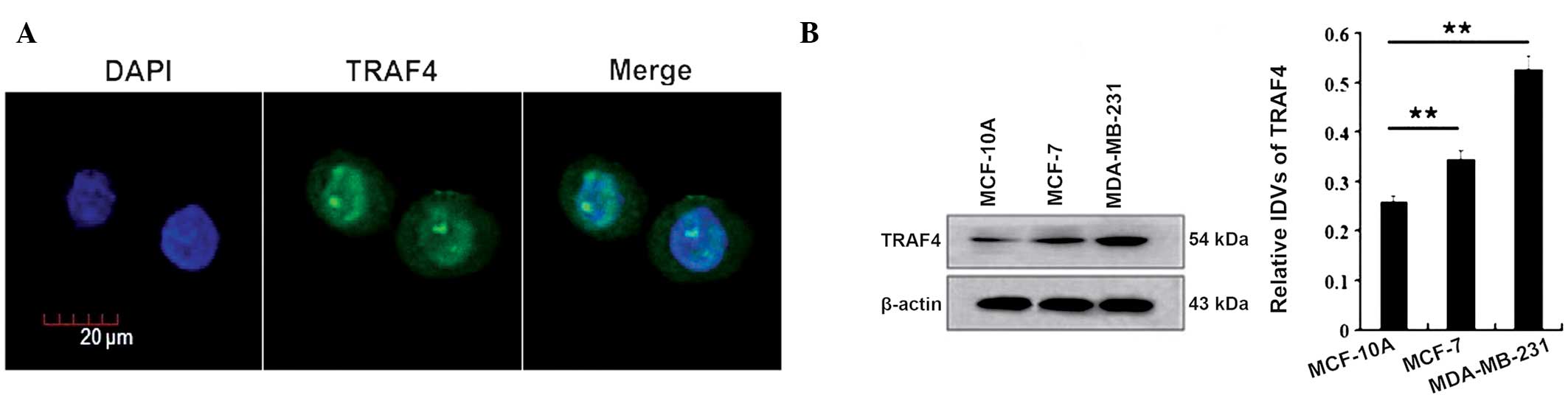
Firstly, the cellular localization of TRAF4 was confirmed in the breast cancer MCF-7 cells through immunofluorescence staining. The results showed that TRAF4 was localized in the cytoplasm and nuclei of the MCF-7 cells, with its nuclear expression stronger than its cytoplasmic expression (Fig. 1A).

Figure 1

Expression and location of TRAF4 in breast cancer cells. (A) Results of immunofluorescence staining showing TRAF4 (green fluorescence) localized in the cytoplasm and nuclei (scale bar, 20 μm). (B) MCF-10A, MCF-7 and MDA-MB-231 cells were lysed and the lysates were subjected to western blot analyses of TRAF4 and β-actin. Results showed that the total expression of TRAF4 in the MCF-10A cells was lower than in the MCF-7 and MDA-MB-231 cells (**P=0.002 and P=0.001, respectively). TRAF4, tumor necrosis factor receptor-associated factor 4; IDV, integated optical density value.

Next, the expression of TRAF4 was examined in normal MCF-10A breast cells and the estrogen receptor-positive and -negative breast cancer cell lines, MCF-7 and MDA-MB-231, respectively, by western blotting. TRAF4 was found to be expressed in all the cells, while the total expression of TRAF4 was lower in the MCF-10A cells than in the MCF-7 and MDA-MB-231 cells (P=0.002 and P=0.001, respectively; Fig. 1B).

TRAF4 suppresses the activation of NF-κB in MCF-7 cells

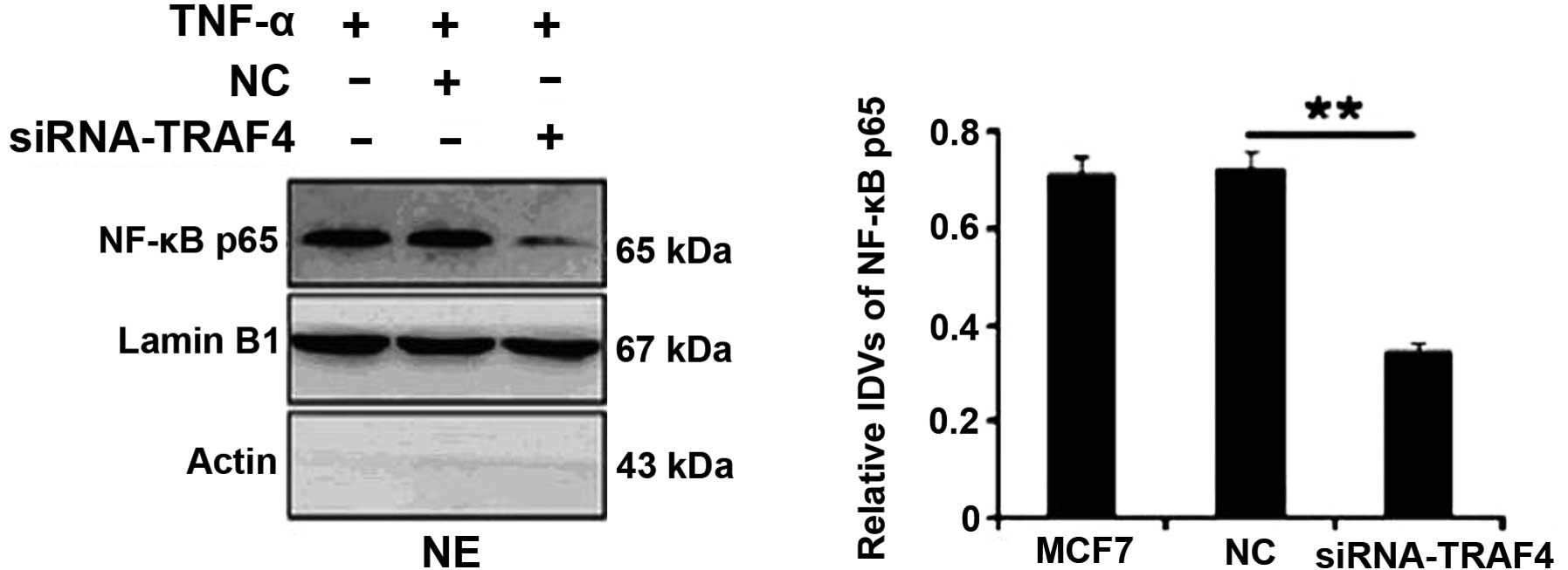
The nuclear expression of NF-κB was examined in the estrogen receptor-positive MCF-7 breast cancer cell line by western blotting. Following TNF-α treatment, TRAF4 depletion by siRNA in the MCF-7 cells significantly suppressed the nuclear expression of NF-κB (P=0.002; Fig. 2). However, no significant differences were identified in the MCF-10A cells (data not shown).

Figure 2

TRAF4 suppresses the activation of NF-κB in MCF-7 Cells. The MCF-7 cells were lysed and the lysates were subjected to western blot analyses of NF-κB, β-actin and lamin B1. Following TNF-α treatment (10 ng/ml; 15 min), the nuclear expression of NF-κB was significantly downregulated when TRAF4 was knocked down in the MCF-7 cells (**P=0.002). TRAF4, tumor necrosis factor receptor-associated factor 4; NF-κB, nuclear factor κB.

TRAF4 may promote cell proliferation and suppress cell apoptosis in MCF-7 cells

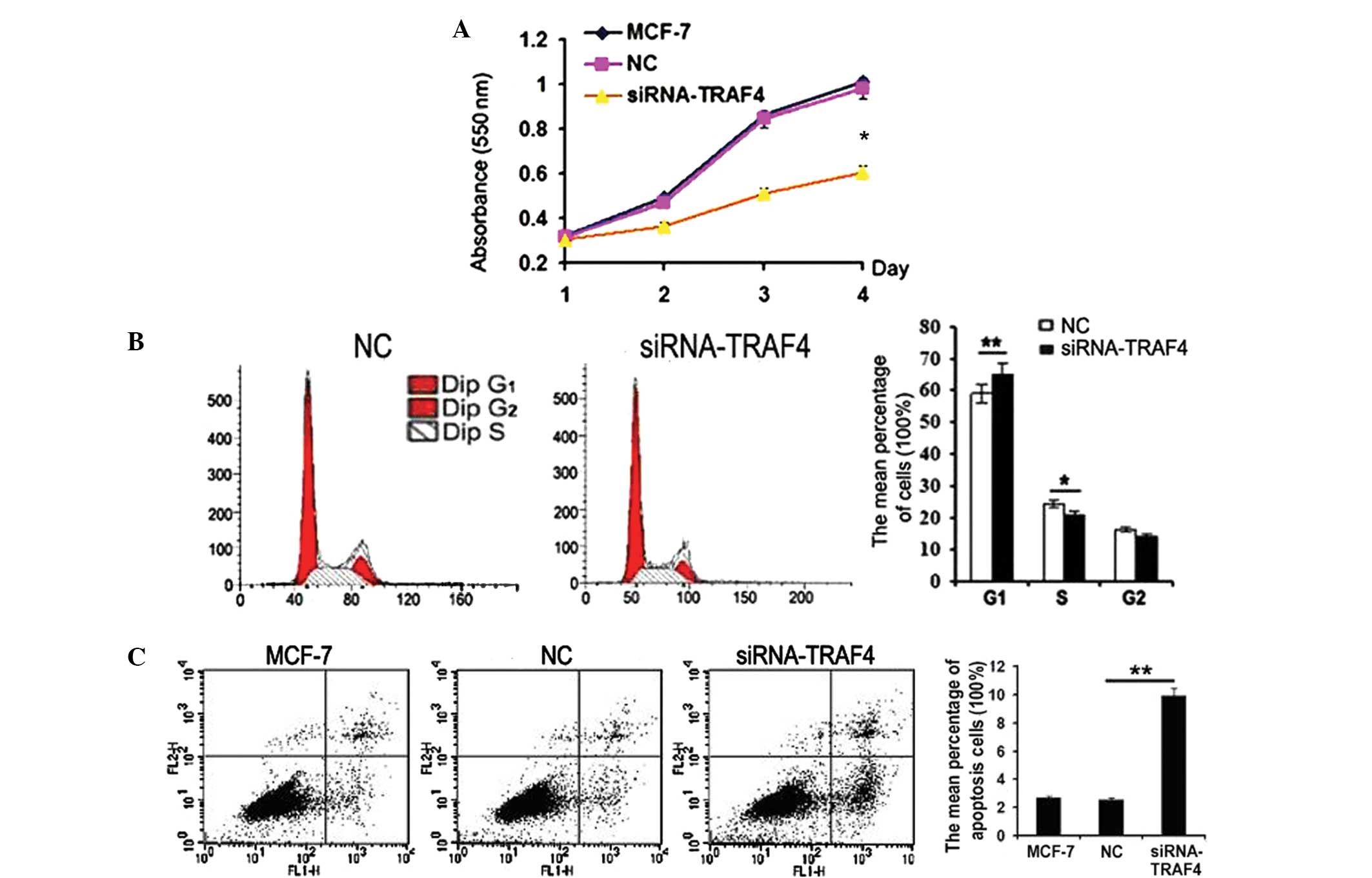
The biological function of TRAF4 was examined in the MCF-7 cells. When TRAF4 was inhibited by siRNA in the MCF-7 cells, the cell proliferation was effectively suppressed compared with the negative control (P=0.02; Fig. 3A). An increase in G1 phase cells (P=0.009) and a decrease in S phase cells (P=0.04) was detected when TRAF4 was knocked down (Fig. 3B). In addition, TRAF4 depletion by siRNA in the MCF-7 cells was found to markedly promote early apoptosis (P=0.001; Fig. 3C).

Figure 3

Biological function of TRAF4 in MCF-7 cells. (A) MTT results showing that cell proliferation was significantly suppressed following the knockdown of TRAF4 (*P=0.02). Results of flow cytometry showed that TRAF4 ablation resulted in (B) significant increase of G1 phase cells (**P=0.009) and reduction of S phase cells (*P=0.04) and (C) significant increase in the early apoptotic cells (**P=0.001). All comparisons were made between the groups of MCF-7 cells or cells transfected with negative control alone. TRAF4, tumor necrosis factor receptor-associated factor 4.

Discussion

Camilleri-Broët et al previously demonstrated that TRAF4 overexpression is a common characteristic of human carcinomas, including lung cancer and breast, ovary, prostatic and pancreatic adenocarcinomas (14). The study indicated that one of the mechanisms responsible for TRAF4 protein overexpression in human cancer was TRAF4 gene amplification. TRAF4 is located in a region of amplification that is devoid of known oncogenes on chromosome 17q11.2, and is commonly overexpressed in cancer. The results of the present study showed that, in vitro, TRAF4 exhibits higher expression in breast cancer cells than in normal breast cells. In addition, TRAF4 expression in the estrogen receptor-positive breast cancer cell lines was higher than in the estrogen receptor-negative breast cancer cell lines. This is consistent with the expression of TRAF4 in breast cancer tissues reported in our previous study (13). The results of the present study in breast cancer cells and human breast tissues may indicate that TRAF4 has an important role in breast cancer.

Numerous TRAF family members negatively regulate apoptotic pathways by increasing the expression of genes that promote cell survival (15,16). Several previous studies have hypothesized that TRAF4 may also be involved in apoptosis. However, depending on the study, the role of TRAF4 in apoptosis is controversial. On the one hand, Sax et al previously demonstrated that TRAF4 may play a role in p53-mediated proapoptotic signaling in response to cellular stress (17). Furthermore, TRAF4 has been previously shown to suppress the ability of the common neurotrophin receptor, p75NTR, dimers to block cell death induced by p75NTR monomers, also indicating a proapoptotic role for TRAF4 (18). On the other hand, Fleckenstein et al hypothesized an anti-apoptotic function for TRAF4 when the study found that the anti-Fas antibody, CH-11, induces apoptosis in HEK293 cells, but not when these cells are stably transfected with TRAF4 (19). Although seemingly paradoxical, these results may all be correct depending on the cells examined. In the current study, following TNF-α treatment in breast cancer MCF-7 cells, the expression of TRAF4 suppressed the activation of NF-κB and promoted early cell apoptosis. In addition, it was demonstrated that TRAF4 ablation resulted in a significant increase in G1 phase cells and a reduction in S phase cells. These results indicate that TRAF4 may promote the activation of NF-κB induced by TNF-α in MCF-7 cells. Future studies must clarify the roles of TRAF4 in apoptotic reactions and may contribute to the development of a new strategy against breast cancer.

References

1 

Reinhard C, Shamoon B, Shyamala V and Williams LT: Tumor necrosis factor alpha-induced activation of c-jun Nterminal kinase is mediated by TRAF2. EMBO J. 16:1080–1092. 1997. View Article : Google Scholar : PubMed/NCBI

2 

Rothe M, Sarma V, Dixit VM and Goeddel DV: TARF2-mediated activation of NF-kappa B by TNF receptor 2 and CD40. Science. 269:1424–1427. 1995. View Article : Google Scholar : PubMed/NCBI

3 

Chung YJ, Park YC, Ye H and Wu H: All TRAFs are not created equal common and distinct molecular mechanisms of TRAF-mediated signal transduction. J Cell Sci. 115:679–688. 2002.

4 

Kalkan T, Iwasaki Y, Park CY and Thomsen GH: Tumor necrosis factor-receptor-associated factor-4 is a positive regulator of transforming growth factor-beta signaling that affects neural crest formation. Mol Biol Cell. 20:3436–3450. 2009. View Article : Google Scholar

5 

Kedinger V, Alpy F, Tomasetto C, et al: Spatial and temporal distribution of the traf4 genes during zebrafish development. Gene Expr Patterns. 5:545–552. 2005. View Article : Google Scholar : PubMed/NCBI

6 

Mathew SJ, Kerridge M and Leptin M: A small genomic region containing several loci required for gastrulation in Drosophila. PLoS One. 4:e74372009. View Article : Google Scholar : PubMed/NCBI

7 

Mathew SJ, Rembold M and Leptin M: Role for Traf4 in polarizing adherens junctions as a prerequisite for efficient cell shape changes. Mol Cell Biol. 31:4978–4993. 2011. View Article : Google Scholar : PubMed/NCBI

8 

Wajant H, Henkler F and Scheurich P: The TNF-receptor-associated factor family: scaffold molecules for cytokine receptors, kinases and their regulators. Cell Signal. 13:389–340. 2001. View Article : Google Scholar : PubMed/NCBI

9 

Cha GH, Cho KS, Lee JH, et al: Discrete functions of TRAF1 and TRAF2 in Drosophila melanogaster mediated by c-Jun N-terminal kinase and NF-kappaB-dependent signaling pathways. Mol Cell Biol. 23:7982–7991. 2003. View Article : Google Scholar : PubMed/NCBI

10 

Glauner H, Siegmund D, Motejadded H, et al: Intracellular localization and transcriptional regulation of tumor necrosis factor (TNF) receptor-associated factor 4 (TRAF4). Eur J Biochem. 269:4819–4829. 2002. View Article : Google Scholar : PubMed/NCBI

11 

Krajewska M, Krajewski S, Zapata JM, et al: TRAF-4 expression in epithelial progenitor cells. Analysis in normal adult, fetal, and tumor tissues. Am J Pathol. 152:1549–1561. 1998.PubMed/NCBI

12 

Régnier CH, Tomasetto C, Moog-Lutz C, et al: Presence of a new conserved domain in CART1, a novel member of the tumor necrosis factor receptor-associated protein family, which is expressed in breast carcinoma. J Biol Chem. 27:25715–25721. 1995.

13 

Dai WB, Zheng YW, Mi XY, et al: Expression and significance of TRAF4 protein in breast carcinoma. Ai Zheng. 26:1095–1098. 2007.(In Chinese).

14 

Camilleri-Broët S, Cremer I, Marmey B, et al: TRAF4 overexpression is a common characteristic of human carcinomas. Oncogene. 26:142–147. 2007.PubMed/NCBI

15 

Arch RH, Gedrich RW and Thompson CB: Tumor necrosis factor receptor-associated factors (TRAFs) -a family of adapter proteins that regulates life and death. Genes Dev. 12:2821–2830. 1998. View Article : Google Scholar

16 

Dempsey PW, Doyle SE, He JQ and Cheng G: The signaling adaptors and pathways activated by TNF superfamily. Cytokine Growth Factor Rev. 14:193–209. 2003. View Article : Google Scholar : PubMed/NCBI

17 

Sax JK and El-Deiry WS: Identification and characterization of the cytoplasmic protein TRAF4 as a p53-regulated proapoptotic gene. J Biol Chem. 278:36435–36444. 2003. View Article : Google Scholar : PubMed/NCBI

18 

Ye X, Mehlen P, Rabizadeh S, et al: TRAF family proteins interact with the common neurotrophin receptor and modulate apoptosis induction. J Biol Chem. 274:30202–30208. 1999. View Article : Google Scholar : PubMed/NCBI

19 

Fleckenstein DS, Dirks WG, Drexler HG and Quentmeier H: Tumor necrosis factor receptor-associated factor (TRAF) 4 is a new binding partner for the p70S6 serine/threonine kinase. Leuk Res. 27:687–694. 2003. View Article : Google Scholar

Related Articles

  • Abstract
  • View
  • Download
  • Twitter
Copy and paste a formatted citation
Spandidos Publications style
Zhang X, Wen Z and Mi X: Expression and anti-apoptotic function of TRAF4 in human breast cancer MCF‑7 cells. Oncol Lett 7: 411-414, 2014.
APA
Zhang, X., Wen, Z., & Mi, X. (2014). Expression and anti-apoptotic function of TRAF4 in human breast cancer MCF‑7 cells. Oncology Letters, 7, 411-414. https://doi.org/10.3892/ol.2013.1703
MLA
Zhang, X., Wen, Z., Mi, X."Expression and anti-apoptotic function of TRAF4 in human breast cancer MCF‑7 cells". Oncology Letters 7.2 (2014): 411-414.
Chicago
Zhang, X., Wen, Z., Mi, X."Expression and anti-apoptotic function of TRAF4 in human breast cancer MCF‑7 cells". Oncology Letters 7, no. 2 (2014): 411-414. https://doi.org/10.3892/ol.2013.1703
Copy and paste a formatted citation
x
Spandidos Publications style
Zhang X, Wen Z and Mi X: Expression and anti-apoptotic function of TRAF4 in human breast cancer MCF‑7 cells. Oncol Lett 7: 411-414, 2014.
APA
Zhang, X., Wen, Z., & Mi, X. (2014). Expression and anti-apoptotic function of TRAF4 in human breast cancer MCF‑7 cells. Oncology Letters, 7, 411-414. https://doi.org/10.3892/ol.2013.1703
MLA
Zhang, X., Wen, Z., Mi, X."Expression and anti-apoptotic function of TRAF4 in human breast cancer MCF‑7 cells". Oncology Letters 7.2 (2014): 411-414.
Chicago
Zhang, X., Wen, Z., Mi, X."Expression and anti-apoptotic function of TRAF4 in human breast cancer MCF‑7 cells". Oncology Letters 7, no. 2 (2014): 411-414. https://doi.org/10.3892/ol.2013.1703
Follow us
  • Twitter
  • LinkedIn
  • Facebook
About
  • Spandidos Publications
  • Careers
  • Cookie Policy
  • Privacy Policy
How can we help?
  • Help
  • Live Chat
  • Contact
  • Email to our Support Team