Spandidos Publications Logo
  • About
    • About Spandidos
    • Aims and Scopes
    • Abstracting and Indexing
    • Editorial Policies
    • Reprints and Permissions
    • Job Opportunities
    • Terms and Conditions
    • Contact
  • Journals
    • All Journals
    • Oncology Letters
      • Oncology Letters
      • Information for Authors
      • Editorial Policies
      • Editorial Board
      • Aims and Scope
      • Abstracting and Indexing
      • Bibliographic Information
      • Archive
    • International Journal of Oncology
      • International Journal of Oncology
      • Information for Authors
      • Editorial Policies
      • Editorial Board
      • Aims and Scope
      • Abstracting and Indexing
      • Bibliographic Information
      • Archive
    • Molecular and Clinical Oncology
      • Molecular and Clinical Oncology
      • Information for Authors
      • Editorial Policies
      • Editorial Board
      • Aims and Scope
      • Abstracting and Indexing
      • Bibliographic Information
      • Archive
    • Experimental and Therapeutic Medicine
      • Experimental and Therapeutic Medicine
      • Information for Authors
      • Editorial Policies
      • Editorial Board
      • Aims and Scope
      • Abstracting and Indexing
      • Bibliographic Information
      • Archive
    • International Journal of Molecular Medicine
      • International Journal of Molecular Medicine
      • Information for Authors
      • Editorial Policies
      • Editorial Board
      • Aims and Scope
      • Abstracting and Indexing
      • Bibliographic Information
      • Archive
    • Biomedical Reports
      • Biomedical Reports
      • Information for Authors
      • Editorial Policies
      • Editorial Board
      • Aims and Scope
      • Abstracting and Indexing
      • Bibliographic Information
      • Archive
    • Oncology Reports
      • Oncology Reports
      • Information for Authors
      • Editorial Policies
      • Editorial Board
      • Aims and Scope
      • Abstracting and Indexing
      • Bibliographic Information
      • Archive
    • Molecular Medicine Reports
      • Molecular Medicine Reports
      • Information for Authors
      • Editorial Policies
      • Editorial Board
      • Aims and Scope
      • Abstracting and Indexing
      • Bibliographic Information
      • Archive
    • World Academy of Sciences Journal
      • World Academy of Sciences Journal
      • Information for Authors
      • Editorial Policies
      • Editorial Board
      • Aims and Scope
      • Abstracting and Indexing
      • Bibliographic Information
      • Archive
    • International Journal of Functional Nutrition
      • International Journal of Functional Nutrition
      • Information for Authors
      • Editorial Policies
      • Editorial Board
      • Aims and Scope
      • Abstracting and Indexing
      • Bibliographic Information
      • Archive
    • International Journal of Epigenetics
      • International Journal of Epigenetics
      • Information for Authors
      • Editorial Policies
      • Editorial Board
      • Aims and Scope
      • Abstracting and Indexing
      • Bibliographic Information
      • Archive
    • Medicine International
      • Medicine International
      • Information for Authors
      • Editorial Policies
      • Editorial Board
      • Aims and Scope
      • Abstracting and Indexing
      • Bibliographic Information
      • Archive
  • Articles
  • Information
    • Information for Authors
    • Information for Reviewers
    • Information for Librarians
    • Information for Advertisers
    • Conferences
  • Language Editing
Spandidos Publications Logo
  • About
    • About Spandidos
    • Aims and Scopes
    • Abstracting and Indexing
    • Editorial Policies
    • Reprints and Permissions
    • Job Opportunities
    • Terms and Conditions
    • Contact
  • Journals
    • All Journals
    • Biomedical Reports
      • Information for Authors
      • Editorial Policies
      • Editorial Board
      • Aims and Scope
      • Abstracting and Indexing
      • Bibliographic Information
      • Archive
    • Experimental and Therapeutic Medicine
      • Information for Authors
      • Editorial Policies
      • Editorial Board
      • Aims and Scope
      • Abstracting and Indexing
      • Bibliographic Information
      • Archive
    • International Journal of Epigenetics
      • Information for Authors
      • Editorial Policies
      • Editorial Board
      • Aims and Scope
      • Abstracting and Indexing
      • Bibliographic Information
      • Archive
    • International Journal of Functional Nutrition
      • Information for Authors
      • Editorial Policies
      • Editorial Board
      • Aims and Scope
      • Abstracting and Indexing
      • Bibliographic Information
      • Archive
    • International Journal of Molecular Medicine
      • Information for Authors
      • Editorial Policies
      • Editorial Board
      • Aims and Scope
      • Abstracting and Indexing
      • Bibliographic Information
      • Archive
    • International Journal of Oncology
      • Information for Authors
      • Editorial Policies
      • Editorial Board
      • Aims and Scope
      • Abstracting and Indexing
      • Bibliographic Information
      • Archive
    • Medicine International
      • Information for Authors
      • Editorial Policies
      • Editorial Board
      • Aims and Scope
      • Abstracting and Indexing
      • Bibliographic Information
      • Archive
    • Molecular and Clinical Oncology
      • Information for Authors
      • Editorial Policies
      • Editorial Board
      • Aims and Scope
      • Abstracting and Indexing
      • Bibliographic Information
      • Archive
    • Molecular Medicine Reports
      • Information for Authors
      • Editorial Policies
      • Editorial Board
      • Aims and Scope
      • Abstracting and Indexing
      • Bibliographic Information
      • Archive
    • Oncology Letters
      • Information for Authors
      • Editorial Policies
      • Editorial Board
      • Aims and Scope
      • Abstracting and Indexing
      • Bibliographic Information
      • Archive
    • Oncology Reports
      • Information for Authors
      • Editorial Policies
      • Editorial Board
      • Aims and Scope
      • Abstracting and Indexing
      • Bibliographic Information
      • Archive
    • World Academy of Sciences Journal
      • Information for Authors
      • Editorial Policies
      • Editorial Board
      • Aims and Scope
      • Abstracting and Indexing
      • Bibliographic Information
      • Archive
  • Articles
  • Information
    • For Authors
    • For Reviewers
    • For Librarians
    • For Advertisers
    • Conferences
  • Language Editing
Login Register Submit
  • This site uses cookies
  • You can change your cookie settings at any time by following the instructions in our Cookie Policy. To find out more, you may read our Privacy Policy.

    I agree
Search articles by DOI, keyword, author or affiliation
Search
Advanced Search
presentation
Biomedical Reports
Join Editorial Board Propose a Special Issue
Print ISSN: 2049-9434 Online ISSN: 2049-9442
Journal Cover
January-February 2013 Volume 1 Issue 1

Full Size Image

Sign up for eToc alerts
Recommend to Library

Journals

International Journal of Molecular Medicine

International Journal of Molecular Medicine

International Journal of Molecular Medicine is an international journal devoted to molecular mechanisms of human disease.

International Journal of Oncology

International Journal of Oncology

International Journal of Oncology is an international journal devoted to oncology research and cancer treatment.

Molecular Medicine Reports

Molecular Medicine Reports

Covers molecular medicine topics such as pharmacology, pathology, genetics, neuroscience, infectious diseases, molecular cardiology, and molecular surgery.

Oncology Reports

Oncology Reports

Oncology Reports is an international journal devoted to fundamental and applied research in Oncology.

Experimental and Therapeutic Medicine

Experimental and Therapeutic Medicine

Experimental and Therapeutic Medicine is an international journal devoted to laboratory and clinical medicine.

Oncology Letters

Oncology Letters

Oncology Letters is an international journal devoted to Experimental and Clinical Oncology.

Biomedical Reports

Biomedical Reports

Explores a wide range of biological and medical fields, including pharmacology, genetics, microbiology, neuroscience, and molecular cardiology.

Molecular and Clinical Oncology

Molecular and Clinical Oncology

International journal addressing all aspects of oncology research, from tumorigenesis and oncogenes to chemotherapy and metastasis.

World Academy of Sciences Journal

World Academy of Sciences Journal

Multidisciplinary open-access journal spanning biochemistry, genetics, neuroscience, environmental health, and synthetic biology.

International Journal of Functional Nutrition

International Journal of Functional Nutrition

Open-access journal combining biochemistry, pharmacology, immunology, and genetics to advance health through functional nutrition.

International Journal of Epigenetics

International Journal of Epigenetics

Publishes open-access research on using epigenetics to advance understanding and treatment of human disease.

Medicine International

Medicine International

An International Open Access Journal Devoted to General Medicine.

Journal Cover
January-February 2013 Volume 1 Issue 1

Full Size Image

Sign up for eToc alerts
Recommend to Library

  • Article
  • Citations
    • Cite This Article
    • Download Citation
    • Create Citation Alert
    • Remove Citation Alert
    • Cited By
  • Similar Articles
    • Related Articles (in Spandidos Publications)
    • Similar Articles (Google Scholar)
    • Similar Articles (PubMed)
  • Download PDF
  • Download XML
  • View XML
Article

Effect of dexamethasone on extracellular secretion of cystatin C in cancer cell lines

  • Authors:
    • Chika Yamawaki
    • Minoru Takahashi
    • Kohji Takara
    • Manabu Kume
    • Midori Hirai
    • Hiroyuki Yasui
    • Tsutomu Nakamura
  • View Affiliations / Copyright

    Affiliations: Department of Pharmaceutical Health Care, Faculty of Pharmaceutical Sciences, Himeji Dokkyo University, Himeji, Hyogo 670-8524, Japan, Department of Pharmacy, Kobe University Hospital, Kobe, Hyogo 650-0017, Japan, Department of Analytical and Bioinorganic Chemistry, Kyoto Pharmaceutical University, Kyoto 607-8414, Japan
  • Pages: 111-114
    |
    Published online on: October 12, 2012
       https://doi.org/10.3892/br.2012.21
  • Expand metrics +
Metrics: Total Views: 0 (Spandidos Publications: | PMC Statistics: )
Metrics: Total PDF Downloads: 0 (Spandidos Publications: | PMC Statistics: )
Cited By (CrossRef): 0 citations Loading Articles...

This article is mentioned in:


Abstract

The aim of the present study was to investigate dexamethasone (DEX)-induced secretion of cystatin C (Cys C) and the effect of cisplatin (CDDP) and 5-fluorouracil (5‑FU) on Cys C secretion in human cancer cell lines. KYSE150, A549 and Caki‑2 human cancer cell lines were cultured on plastic dishes and treated with DEX (100 nM) for 24, 48 and 72 h. KYSE150 cells were co‑treated with DEX, CDDP (10 µM), and 5‑FU (2 µM). The effects of DEX, CDDP and 5‑FU on cell viability were evaluated. Results showed Cys C secretion levels in the culture medium of DEX-treated KYSE150 cells to be 1.8- to 2.3‑fold higher compared to those in the culture medium of control cells. A similar tendency was observed in A549 cells at all the time points, whereas a significant increase in the Cys C secretion by Caki‑2 cells was observed only 24 h after DEX treatment. Regarding KYSE150 cells, the secretion of Cys C was also enhanced by co‑treatment of CDDP or 5‑FU with DEX, although it was not affected by the co‑administration of DEX and mifepristone, a glucocorticoid receptor antagonist. At concentrations that are typically used in esophageal cancer chemotherapy, CDDP and 5‑FU demonstrated a moderate level of cytotoxicity in KYSE150 cells in contrast to DEX. These findings suggested that DEX has the potential to enhance the extracellular secretion of Cys C in esophageal cancer cells, possibly due to the transcriptional regulation mediated by glucocorticoid receptor activity.

Introduction

Immunoglobulin (Ig) and T-cell receptor (TCR) gene rearrangement (GR) studies have been successfully employed to investigate the clonality and cell lineage of various lymphoid malignancies (1). By being simple, highly efficient, cost-effective with wide fitness, polymerase chain reaction (PCR)-based techniques have been extensively used in the detection of GRs.

According to the numbers of PCR primer pairs, PCR-based methods of detecting B-cell clonality may be divided into two groups: the one using one or two pairs of primers in the PCR amplification, potentially termed the ‘classical method’ (2,3) and the other using multiple primers in one PCR tube, designated as the ‘BIOMED-2 method’ (4,5). However, oligoclonality (more than two homoduplex and heteroduplex bands in a PCR product) sometimes appears in the routine detection using either the classical or the BIOMED-2 methods. In previous studies (6), we found that the DG75 cell line, used as one of the positive control cells in GR detection, exhibited biclonality in the assay. To further explore their characteristics, we purified, cloned and sequenced these bands, and analyzed them using DNA software.

Materials and methods

Cell lines and DNA extraction

DG75, BJAB, RAJI, L428, and Jurkat cell lines (kindly provided by Dr Ren Song, Department of Molecular and Medical Pharmacology, the David Geffen School of Medicine at the University of California, LA, USA) were employed in our study. The cell lines were maintained in a humidified 37°C atmosphere containing 5% CO2. Of these, DG75 cell lines were established from the pleural effusion of a 10-year-old boy with Burkitt’s lymphoma in 1975 (7). The Germany DSMZ cell bank sequence number of the DG75 cell line is ACC83. Cell DNA was extracted using the DNAzol reagent, according to the manufacturer’s protocol.

PCR conditions and DNA sequencing

In the classical method of immunoglobulin heavy (IgH) GR assay, two pairs of FR3 region primers were used, as previously reported (6). In the BIOMED-2 assay method, however, Tube C primers were used (4) (Table I). The PCR program was performed using rTaq (Takara, Dalian, China), beginning with initial denaturation at 94°C for 5 min, followed by 35 cycles (94°C for 30 sec, 55°C for 40 sec and 72°C for 60 sec) of amplification, with a final extension at 72°C for 10 min. Products were visualized and photographed with GeneSnap (Gene Co, Chicago, IL, USA) after electrophoresis in 2.0% agarose. PCR products were purified, cloned into the pGEM-T vector, and sequenced at the Invitrogen Biotech Co., Ltd. (Shanghai, China). DNA sequences were analyzed using the ClustalW 2.1 multiple sequence alignment software, accessed at http://www.ebi.ac.uk/Tools/msa/clustalw2/.

Table I.

Primers used in the detection of immunoglobulin heavy gene rearrangement.

Table I.

Primers used in the detection of immunoglobulin heavy gene rearrangement.

RegionsPrimer namesPrimers (5′-3′)
FR3FR3 (up)ACGGC (C/T) GTGTATTACTGTGC
Classical methodFR33 (up) CTGTCGACACGGCCGTGTATTACTG
JH1 (down) ACCTGAGGAGAC(G/A)GTGACC
FR3VH1-FR3 TGGAGCTGAGCAGCCTGAGATCTGA
BIOMED-2 methodVH2-FR3 CAATGACCAACATGGACCCTGTGGA
VH3-FR3 TCTGCAAATGAACAGCCTGAGAGCC
VH4-FR3 GAGCTCTGTGACCGCCGCGGACACG
VH5-FR3 CAGCACCGCCTACCTGCAGTGGAGC
VH6-FR3 GTTCTCCCTGCAGCTGAACTCTGTG
VH7-FR3 CAGCACGGCATATCTGCAGATCAG
JH2 (down) CTTACCTGAGGAGACGGTGACC

Results

PCR amplification of DG75 cell DNA by the primer of IgH GR

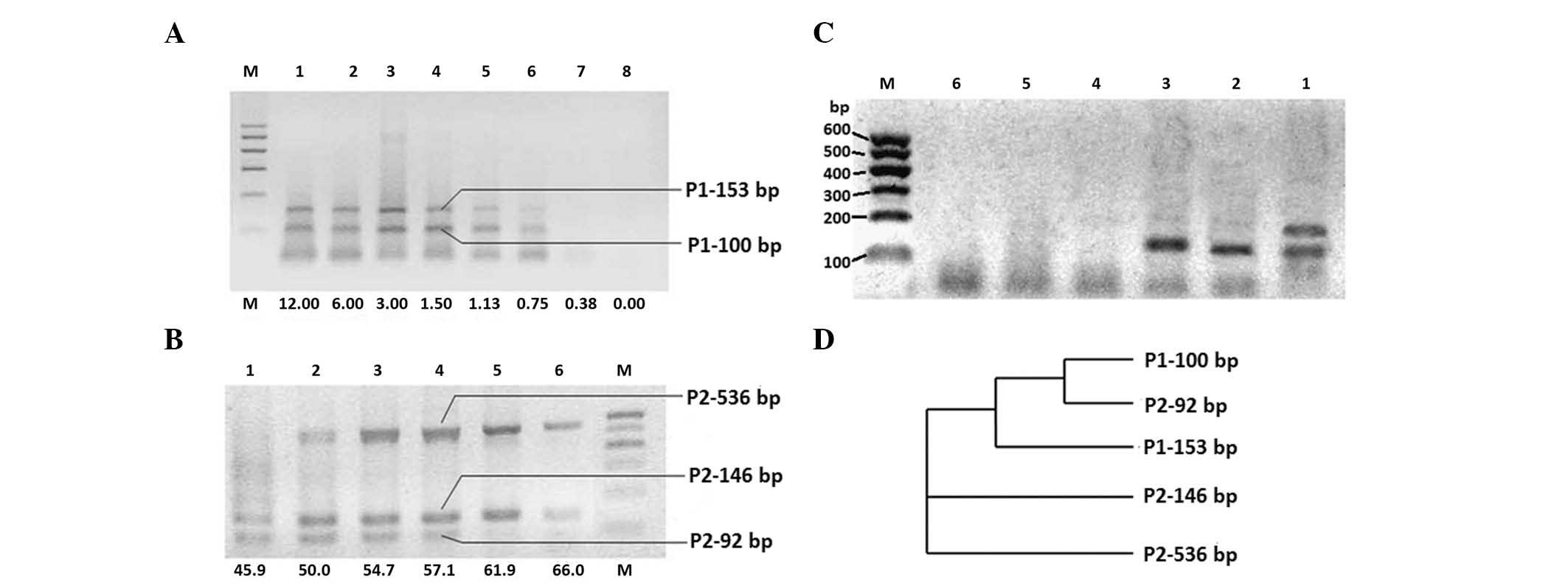
PCR conditions were initially optimized using various concentrations of MgCl2, without modifying any other parameters. The results showed two clear bands in the first primer pair (IgH FR3-JH1) PCR products. One band was ∼100 base pair (designated as the P1–100 bp band after DNA sequencing), while the other was ∼150 bp size (designated as P1–153 bp) (Fig. 1A).

Figure 1.

PCR products by the primers of immunoglobulin heavy (IgH) gene rearrangement with the DNA of DG75 cell lines are shown. (M: 100–600 bp ladder marker). (A) Electrophoresis of 2% agarose gel with the primer of IgH (classical primer pair FR3-JH1) primer on different Mg2+ concentration (μM). (B) Electrophoresis of 2% agarose gel with the primer of IgH (classical primer pair FR33-JH1) primer at different annealing temperatures (°C). (C) Electrophoresis of 2% agarose gel with the primer of BIOMED-2 Tube C (VH1-VH7 -FR3-JH2) detected five lymphoma cell lines. M, marker; lane 1, DG-75 cell line; lane 2, BJAB cell line; lane 3, Raji cell line; lane 4, Jurkat cell line; lane 5, L428 cell line and lane 6, the negative control. (D) The phylogram results of DNA sequences of five bands (showed in Fig. 1A and B) using the ClustalW2 software.

The results also showed that there were three clear bands in the second PCR primer pair amplifications, of ∼100 (designated as P2–92 bp), 150 (designated as P2–146 bp) and 500 bp (designated as P2–536 bp) size, respectively (Fig 1B).

The IgH GR statuses of five lymphoma cell lines were also assayed using the primer of Tube C of the BiOMED-2 method. Of these five lines, only DG-75 cell lines exhibited two clear bands in the detection (Fig. 1C). The DNA sequence resulting from the two bands was almost identical to that resulting from the FR3-JH1 primer pair. We also used seven single primer pairs from the multiple PCR of Tube C. The results demonstrated that there were two pairs of primers that demonstrated clear bands: the VH3-JH and VH4 -JH primer pairs (data not shown).

DNA sequences

DNA sequences of these bands were analyzed using the ClustalW2 software. The alignment results are shown in Table II, while the phylogram results are shown in Fig 1D. These results demonstrated that the P1–100 bp and P2–92 bp bands were derived from the same form of GR, while the P1–153 bp, P2–146 bp and P2–536 bp from another form of GR.

Table II.

Result of ClustalW 2.1 multiple sequence alignment (abbreviated).

Table II.

Result of ClustalW 2.1 multiple sequence alignment (abbreviated).

Name - Size (bp)Primer sequenceSequence no.
P2–146 ------ACGGCTGTGTATTACTGTGCGAGAGACTTTCCATATTGTGGTGGTGACTGCTAC54
P2–536 ------ACGGGTGTGTATTACTGTGCGACAGACTTTCCATATTGTGGTGGTGACTGCTAC54
P1–153 GTCGACACGGCCGTGTATTACTGTGCGAGAGACTTTCCATATTGTGGTGGTGACTGCTAC60
P1–100 GTCGACACGGCCGTGTATTACTGTGCGAC------------TTG-GATTATGACTACCAT47
P2–92 -------CGGCTGTGTATTACTGTGCGAC------------TTG-GATTATGACTACCAT40
    ***  ****************        *** * *  ***** * *
P2–146 TCCGCGATGGATTACTATGATAGTAGTGGTTATCACTCCCTTATTAGTTTGACTAGTGGG114
P2–536 TCCGCGATGGATTACTATGATAGTAGTGGTTATCACTCCCTTATTAGTTTGACTAGTGGG114
P1–153 TCCGCGATGGATTACTATGATAGTAGTGGTTATCACTCCCTTATTAGTTTGACTAGTGGG120
P1–100 ----------------------------------ACGCCCTT------TTGACTACTGGG67
P2–92 ----------------------------------ACGCCCTT------TTGACTACTGGG60
            ** *****   ******* ****
P2–146 GCCAGGGAACCCTGGTCACCGTCTCCTCAGGT----------------------------146
P2–536 GCCAGGGAACCCTGGTCACCGTCTCCTCAGGTGAGTCCTCAGAACGTCTCTCCTGCTTTA174
P1–153 GCCAGGGAACCCTGGTCACCGTCTCCTCTGGAG---------------------------153
P1–100 GCCAGGGAACCCTGGTCACCGTCTCCTCTGCAG---------------------------100
P2–92 GCCAGGGAACCCTGGTCACCGTCTCCTCAGGT----------------------------92
**************************** *
P2–146 ------------------------------------------------------------
P2–536 ACTCTGAAGGGTTTTGCTGCATTTTTGGGGGGAAATAAGGGTGCTGGGTCTCCTGCCAAG234
P1–153 ------------------------------------------------------------
P1–100 ------------------------------------------------------------
P2–92 ------------------------------------------------------------
P2–146 ------------------------------------------------------------
P2–536 AGAGCCCCGGAGCAGCCTGGGGGGCTCAGGAGGAT-------------------------536
P1–153 ------------------------------------------------------------
P1–100 ------------------------------------------------------------
P2–92 ------------------------------------------------------------

[i] (*), same bases in the columns;

[ii] (-), different bases in the columns.

Discussion

By definition, the bi/oligoclonal pattern indicates the presence of two or more bands, following PCR and electrophoretic resolution. The explanation for the difference in oligoclonality findings may be due to the somatic mutation of the VH genes (8,9). Another explanation for bi/oligoclonality may be the presence of two cell populations in the bone marrow, due to two separate events or the formation of sub-clones (10,11).

In general, the tumor cell line is a stable cell population that is relatively homogeneous in cell morphology, proliferation and biological traits. There are several B-cell lymphoma cell lines potentially employed as the positive control in detecting GR, such as Raji, Nam, Daudi, BJAB and DG75 cell lines. Of the B-cell lymphoma cell lines we used, the DG75 cell line demonstrated two clear bands in the PCR amplifications. DNA sequencing results showed that these two bands are distinct in the N region of amino sequence, showing at least two different forms of IgH GR. One form is the sequences of P2–92 bp or P1–100 bp, which are almost identical to the form of VH3-JH2 of the primer in the BIOMED-2 primer sets. Another form is the P2–146 bp or P1–153 bp, identical to the form of VH4-JH2 of the primer in the BIOMED-2 primer sets.

Of note, the agarose electrophoresis results also showed that there was a clear band in ∼500 bp (P2–536 bp) in the PCR amplification of the classical primer pair FR33-JH1 (P2) of IgH primer (Table I). Based on their location, the DNA sequencing of P2–536 bp may be divided into two parts: the one almost overlapped with the sequence of P2–146 bp fragment, while the latter part is also associated with the sequence of Ig sequences. Thus, we hypothesize that the P2–536 bp DNA fragments, amplified by the P2 PCR primer pair, are also the non-specific amplification of P2–146 fragment of Ig sequences.

In conclusion, we occasionally found that the DG75 cell line, a B-cell lymphoma cell line with the potential to be used as a positive control in the detection of Ig heavy chain GR, was a bioclonal in GR, reported for the first time in the present study.

References

1. 

Segal GH: Assessment of B-cell clonality by the polymerase chain reaction: a pragmatic overview. Adv Anat Pathol. 3:195–203. 1996. View Article : Google Scholar

2. 

Trainor KJ, Brisco MJ, Wan JH, Neoh S, Grist S and Morley AA: Gene rearrangement in B- and T-lymphoproliferative disease detected by the polymerase chain reaction. Blood. 78:192–196. 1991.PubMed/NCBI

3. 

Aubin J, Davi F, Nguyen-Salomon F, et al: Description of a novel FR1 IgH PCR strategy and its comparison with three other strategies of clonality in B cell malignancies. Leukemia. 9:471–479. 1995.PubMed/NCBI

4. 

Van Dongen J J, Langerak AW, Brüggemann M, et al: Design and standardization of PCR primers and protocols for detection of clonal immunoglobulin and T-cell receptor gene recombinations in suspect lymphoproliferations: report of the BIOMED-2 Concerted Action BMH4-CT98-3936. Leukemia. 17:2257–2317. 2003.PubMed/NCBI

5. 

van Krieken JH, Langerak AW, Macintyre EA, et al: Improved reliability of lymphoma diagnostics via PCR-based clonality testing: report of the BIOMED-2 Concerted Action BHM4-CT98-3936. Leukemia. 21:201–206. 2007.PubMed/NCBI

6. 

Qi ZL, Zhang B, Han XQ, Zhu MG and Zhao T: Primers for detecting gene rearrangement in different regions of immunoglobulin heavy chain genes and their application in diagnosis of paraffin-embedded lymphoma tissues. Nan Fang Yi Ke Da Xue Xue Bao. 28:1964–1967. 2008.(In Chinese).

7. 

Ben-Bassat H, Goldblum N, Mitrani S, et al: Establishment in continuous culture of a new type of lymphocyte from a ‘Burkitt like’ malignant lymphoma (line DG-75). Int J Cancer. 19:27–33. 1977.PubMed/NCBI

8. 

Scrideli CA, Defavery R, Bernardes JE and Tone LG: Prognostic significance of bi/oligoclonality in childhood acute lymphoblastic leukemia as determined by polymerase chain reaction. Sao Paulo Med J. 119:175–180. 2001. View Article : Google Scholar : PubMed/NCBI

9. 

Szczepañski T, Willemse MJ, van Wering ER, van Weerden JF, Kamps WA and van Dongen JJ: Precursor-B-ALL with D(H)-J(H) gene rearrangements have an immature immunogenotype with a high frequency of oligoclonality and hyperdiploidy of chromosome 14. Leukemia. 15:1415–1423. 2001.PubMed/NCBI

10. 

Choi Y, Greenberg SJ, Du TL, et al: Clonal evolution in B-lineage acute lymphoblastic leukemia by contemporaneous VH-VH gene replacements and VH-DJH gene rearrangements. Blood. 87:2506–2512. 1996.PubMed/NCBI

11. 

Bagg A: Immunoglobulin and T-cell receptor gene rearrangements: minding your B’s and T’s in assessing lineage and clonality in neoplastic lymphoproliferative disorders. J Mol Diagn. 8:426–429. 2006.PubMed/NCBI

Related Articles

  • Abstract
  • View
  • Download
  • Twitter
Copy and paste a formatted citation
Spandidos Publications style
Yamawaki C, Takahashi M, Takara K, Kume M, Hirai M, Yasui H and Nakamura T: Effect of dexamethasone on extracellular secretion of cystatin C in cancer cell lines. Biomed Rep 1: 111-114, 2013.
APA
Yamawaki, C., Takahashi, M., Takara, K., Kume, M., Hirai, M., Yasui, H., & Nakamura, T. (2013). Effect of dexamethasone on extracellular secretion of cystatin C in cancer cell lines. Biomedical Reports, 1, 111-114. https://doi.org/10.3892/br.2012.21
MLA
Yamawaki, C., Takahashi, M., Takara, K., Kume, M., Hirai, M., Yasui, H., Nakamura, T."Effect of dexamethasone on extracellular secretion of cystatin C in cancer cell lines". Biomedical Reports 1.1 (2013): 111-114.
Chicago
Yamawaki, C., Takahashi, M., Takara, K., Kume, M., Hirai, M., Yasui, H., Nakamura, T."Effect of dexamethasone on extracellular secretion of cystatin C in cancer cell lines". Biomedical Reports 1, no. 1 (2013): 111-114. https://doi.org/10.3892/br.2012.21
Copy and paste a formatted citation
x
Spandidos Publications style
Yamawaki C, Takahashi M, Takara K, Kume M, Hirai M, Yasui H and Nakamura T: Effect of dexamethasone on extracellular secretion of cystatin C in cancer cell lines. Biomed Rep 1: 111-114, 2013.
APA
Yamawaki, C., Takahashi, M., Takara, K., Kume, M., Hirai, M., Yasui, H., & Nakamura, T. (2013). Effect of dexamethasone on extracellular secretion of cystatin C in cancer cell lines. Biomedical Reports, 1, 111-114. https://doi.org/10.3892/br.2012.21
MLA
Yamawaki, C., Takahashi, M., Takara, K., Kume, M., Hirai, M., Yasui, H., Nakamura, T."Effect of dexamethasone on extracellular secretion of cystatin C in cancer cell lines". Biomedical Reports 1.1 (2013): 111-114.
Chicago
Yamawaki, C., Takahashi, M., Takara, K., Kume, M., Hirai, M., Yasui, H., Nakamura, T."Effect of dexamethasone on extracellular secretion of cystatin C in cancer cell lines". Biomedical Reports 1, no. 1 (2013): 111-114. https://doi.org/10.3892/br.2012.21
Follow us
  • Twitter
  • LinkedIn
  • Facebook
About
  • Spandidos Publications
  • Careers
  • Cookie Policy
  • Privacy Policy
How can we help?
  • Help
  • Live Chat
  • Contact
  • Email to our Support Team