Spandidos Publications Logo
  • About
    • About Spandidos
    • Aims and Scopes
    • Abstracting and Indexing
    • Editorial Policies
    • Reprints and Permissions
    • Job Opportunities
    • Terms and Conditions
    • Contact
  • Journals
    • All Journals
    • Oncology Letters
      • Oncology Letters
      • Information for Authors
      • Editorial Policies
      • Editorial Board
      • Aims and Scope
      • Abstracting and Indexing
      • Bibliographic Information
      • Archive
    • International Journal of Oncology
      • International Journal of Oncology
      • Information for Authors
      • Editorial Policies
      • Editorial Board
      • Aims and Scope
      • Abstracting and Indexing
      • Bibliographic Information
      • Archive
    • Molecular and Clinical Oncology
      • Molecular and Clinical Oncology
      • Information for Authors
      • Editorial Policies
      • Editorial Board
      • Aims and Scope
      • Abstracting and Indexing
      • Bibliographic Information
      • Archive
    • Experimental and Therapeutic Medicine
      • Experimental and Therapeutic Medicine
      • Information for Authors
      • Editorial Policies
      • Editorial Board
      • Aims and Scope
      • Abstracting and Indexing
      • Bibliographic Information
      • Archive
    • International Journal of Molecular Medicine
      • International Journal of Molecular Medicine
      • Information for Authors
      • Editorial Policies
      • Editorial Board
      • Aims and Scope
      • Abstracting and Indexing
      • Bibliographic Information
      • Archive
    • Biomedical Reports
      • Biomedical Reports
      • Information for Authors
      • Editorial Policies
      • Editorial Board
      • Aims and Scope
      • Abstracting and Indexing
      • Bibliographic Information
      • Archive
    • Oncology Reports
      • Oncology Reports
      • Information for Authors
      • Editorial Policies
      • Editorial Board
      • Aims and Scope
      • Abstracting and Indexing
      • Bibliographic Information
      • Archive
    • Molecular Medicine Reports
      • Molecular Medicine Reports
      • Information for Authors
      • Editorial Policies
      • Editorial Board
      • Aims and Scope
      • Abstracting and Indexing
      • Bibliographic Information
      • Archive
    • World Academy of Sciences Journal
      • World Academy of Sciences Journal
      • Information for Authors
      • Editorial Policies
      • Editorial Board
      • Aims and Scope
      • Abstracting and Indexing
      • Bibliographic Information
      • Archive
    • International Journal of Functional Nutrition
      • International Journal of Functional Nutrition
      • Information for Authors
      • Editorial Policies
      • Editorial Board
      • Aims and Scope
      • Abstracting and Indexing
      • Bibliographic Information
      • Archive
    • International Journal of Epigenetics
      • International Journal of Epigenetics
      • Information for Authors
      • Editorial Policies
      • Editorial Board
      • Aims and Scope
      • Abstracting and Indexing
      • Bibliographic Information
      • Archive
    • Medicine International
      • Medicine International
      • Information for Authors
      • Editorial Policies
      • Editorial Board
      • Aims and Scope
      • Abstracting and Indexing
      • Bibliographic Information
      • Archive
  • Articles
  • Information
    • Information for Authors
    • Information for Reviewers
    • Information for Librarians
    • Information for Advertisers
    • Conferences
  • Language Editing
Spandidos Publications Logo
  • About
    • About Spandidos
    • Aims and Scopes
    • Abstracting and Indexing
    • Editorial Policies
    • Reprints and Permissions
    • Job Opportunities
    • Terms and Conditions
    • Contact
  • Journals
    • All Journals
    • Biomedical Reports
      • Information for Authors
      • Editorial Policies
      • Editorial Board
      • Aims and Scope
      • Abstracting and Indexing
      • Bibliographic Information
      • Archive
    • Experimental and Therapeutic Medicine
      • Information for Authors
      • Editorial Policies
      • Editorial Board
      • Aims and Scope
      • Abstracting and Indexing
      • Bibliographic Information
      • Archive
    • International Journal of Epigenetics
      • Information for Authors
      • Editorial Policies
      • Editorial Board
      • Aims and Scope
      • Abstracting and Indexing
      • Bibliographic Information
      • Archive
    • International Journal of Functional Nutrition
      • Information for Authors
      • Editorial Policies
      • Editorial Board
      • Aims and Scope
      • Abstracting and Indexing
      • Bibliographic Information
      • Archive
    • International Journal of Molecular Medicine
      • Information for Authors
      • Editorial Policies
      • Editorial Board
      • Aims and Scope
      • Abstracting and Indexing
      • Bibliographic Information
      • Archive
    • International Journal of Oncology
      • Information for Authors
      • Editorial Policies
      • Editorial Board
      • Aims and Scope
      • Abstracting and Indexing
      • Bibliographic Information
      • Archive
    • Medicine International
      • Information for Authors
      • Editorial Policies
      • Editorial Board
      • Aims and Scope
      • Abstracting and Indexing
      • Bibliographic Information
      • Archive
    • Molecular and Clinical Oncology
      • Information for Authors
      • Editorial Policies
      • Editorial Board
      • Aims and Scope
      • Abstracting and Indexing
      • Bibliographic Information
      • Archive
    • Molecular Medicine Reports
      • Information for Authors
      • Editorial Policies
      • Editorial Board
      • Aims and Scope
      • Abstracting and Indexing
      • Bibliographic Information
      • Archive
    • Oncology Letters
      • Information for Authors
      • Editorial Policies
      • Editorial Board
      • Aims and Scope
      • Abstracting and Indexing
      • Bibliographic Information
      • Archive
    • Oncology Reports
      • Information for Authors
      • Editorial Policies
      • Editorial Board
      • Aims and Scope
      • Abstracting and Indexing
      • Bibliographic Information
      • Archive
    • World Academy of Sciences Journal
      • Information for Authors
      • Editorial Policies
      • Editorial Board
      • Aims and Scope
      • Abstracting and Indexing
      • Bibliographic Information
      • Archive
  • Articles
  • Information
    • For Authors
    • For Reviewers
    • For Librarians
    • For Advertisers
    • Conferences
  • Language Editing
Login Register Submit
  • This site uses cookies
  • You can change your cookie settings at any time by following the instructions in our Cookie Policy. To find out more, you may read our Privacy Policy.

    I agree
Search articles by DOI, keyword, author or affiliation
Search
Advanced Search
presentation
Biomedical Reports
Join Editorial Board Propose a Special Issue
Print ISSN: 2049-9434 Online ISSN: 2049-9442
Journal Cover
March-April 2013 Volume 1 Issue 2

Full Size Image

Sign up for eToc alerts
Recommend to Library

Journals

International Journal of Molecular Medicine

International Journal of Molecular Medicine

International Journal of Molecular Medicine is an international journal devoted to molecular mechanisms of human disease.

International Journal of Oncology

International Journal of Oncology

International Journal of Oncology is an international journal devoted to oncology research and cancer treatment.

Molecular Medicine Reports

Molecular Medicine Reports

Covers molecular medicine topics such as pharmacology, pathology, genetics, neuroscience, infectious diseases, molecular cardiology, and molecular surgery.

Oncology Reports

Oncology Reports

Oncology Reports is an international journal devoted to fundamental and applied research in Oncology.

Experimental and Therapeutic Medicine

Experimental and Therapeutic Medicine

Experimental and Therapeutic Medicine is an international journal devoted to laboratory and clinical medicine.

Oncology Letters

Oncology Letters

Oncology Letters is an international journal devoted to Experimental and Clinical Oncology.

Biomedical Reports

Biomedical Reports

Explores a wide range of biological and medical fields, including pharmacology, genetics, microbiology, neuroscience, and molecular cardiology.

Molecular and Clinical Oncology

Molecular and Clinical Oncology

International journal addressing all aspects of oncology research, from tumorigenesis and oncogenes to chemotherapy and metastasis.

World Academy of Sciences Journal

World Academy of Sciences Journal

Multidisciplinary open-access journal spanning biochemistry, genetics, neuroscience, environmental health, and synthetic biology.

International Journal of Functional Nutrition

International Journal of Functional Nutrition

Open-access journal combining biochemistry, pharmacology, immunology, and genetics to advance health through functional nutrition.

International Journal of Epigenetics

International Journal of Epigenetics

Publishes open-access research on using epigenetics to advance understanding and treatment of human disease.

Medicine International

Medicine International

An International Open Access Journal Devoted to General Medicine.

Journal Cover
March-April 2013 Volume 1 Issue 2

Full Size Image

Sign up for eToc alerts
Recommend to Library

  • Article
  • Citations
    • Cite This Article
    • Download Citation
    • Create Citation Alert
    • Remove Citation Alert
    • Cited By
  • Similar Articles
    • Related Articles (in Spandidos Publications)
    • Similar Articles (Google Scholar)
    • Similar Articles (PubMed)
  • Download PDF
  • Download XML
  • View XML
Article

Peroxiredoxin 3 is a novel marker for cell proliferation in cervical cancer

  • Authors:
    • Jing-Xia Hu
    • Qun Gao
    • Lianqin Li
  • View Affiliations / Copyright

    Affiliations: Department of Pathology, Tsinghua University Second Hospital, Beijing 100049, P.R. China, Department of Obstetrics and Gynecology, Tsinghua University Second Hospital, Beijing 100049, P.R. China
  • Pages: 228-230
    |
    Published online on: November 29, 2012
       https://doi.org/10.3892/br.2012.43
  • Expand metrics +
Metrics: Total Views: 0 (Spandidos Publications: | PMC Statistics: )
Metrics: Total PDF Downloads: 0 (Spandidos Publications: | PMC Statistics: )
Cited By (CrossRef): 0 citations Loading Articles...

This article is mentioned in:


Abstract

Although peroxiredoxin 3 (Prx3) has been reported to be involved in cervical cancer (CC) carcinogenesis, the significance of Prx3 in CC progression remains unclear. The present study was conducted to investigate the expression features of Prx3 to better understand the mechanism of tumor growth and invasion. Sixty‑eight patients with invasive squamous cervical cancer were included in the present study. The status of human papillomavirus (HPV) infection was detected by hybridization and quantitative real-time polymerase chain reaction (qRT‑PCR). Immunohistochemistry was performed on paraffin‑embedded sections using monoclonal antibodies against Prx3 and Ki67. All samples were positive for high‑risk HPV, among which fifty‑six samples were positive for HPV16, seven for HPV18 and five for HPV33. The expression of HPV16 E6/E7 was significantly higher in cancer areas compared to the adjacent normal epithelial tissuses. The positive cells for Prx3 and Ki67 were significantly higher in cancer cells compared to normal epitheliums and the staining pattern of Prx3 was consistent with that of Ki67 (Pearson's correlation coefficient was 0.801, P=0.000). The upregulation of Prx3 might be a protective response to oxidative stress in the cancer microenvironment. The expression consistency of Prx3 and Ki67 suggests Prx3 to be a potential marker for cell proliferation of CC.

Introduction

The development of cervical cancer (CC) has been causally linked to oncogenes E6 and E7 of high-risk human papillomaviruses (HPV). The HPV E6 and E7 oncogenes integrate into the genome of infected cervical cells and inactivate the tumor-suppressor proteins p53 and retinoblastoma, which results in epithelial immortalization and ultimate malignant transformation through a multistage process (1). Due to active and indefinite growth of cancer cells, reactive oxygen species (ROS) production from the mitochondria is accordingly increased (2). Excessive ROS is likely to induce oxidative stress and subsequent cell apoptosis through mitochondria or/and direct injury to protein, DNA and lipid (3–5). In fact, the chemo- or radiotherapy for cancers is through ROS increase and apoptotic induction of cancer cells (6,7).

Organisms have developed multiple antioxidant systems to protect against oxidative damage, among which peroxiredoxin 3 (Prx3) plays an important role in regulating cellular ROS level and apoptosis (8). As a mitochondrial scavenger of ROS, Prx3 has been demonstrated to play an antioxidant role under cellular oxidative conditions (9,10) and the involvement of Prx3 in CC carcinogenesis was previously reported (11). Nevertheless, the significance of Prx3 in CC development and/or progression has not been clear. The present study was conducted to investigate the characteristics of Prx3 expression, and thereby contributing to the understanding of the mechanism of tumor growth and invasion.

Materials and methods

Patients and samples

After the approval of the Institutional Review Boards of Tsinghua University Second Hospital (Beijing, China), we collected invasive squamous cervical cancer (ISCC) samples from patients between August, 2008 and July, 2010. The samples were collected after obtaining informed consent from the patients. The samples were processed into formalin-fixed and paraffin-embedded tissue blocks. At the same time, adjacent normal epithelial tissues were used as the controls.

Examination of HPV infection

HPV-infection status of the samples was examined using HPV gene array test kit (Hybribio Limited, Hong Kong, China). Briefly, DNA was extracted from cervical tissues and amplified by polymerase chain reaction (PCR). The PCR products were then hybridized on HPV genoarray membrane that contained probes corresponding to 21 HPV types. Biotin was used as the positive control and distilled water as the negative control. The membrane was visualized through NBT/BCIP to determine the status of HPV infection.

To detect HPV16 mRNA expression in CCs, we performed quantitative real-time PCR (qRT-P C R) using SYBR®-GreenER™ Two-Step qRT-PCR kits (Invitrogen, Carlsbad, CA, USA). Total RNA was extracted from paraffin-embedded tissue sections. After cDNA synthesis, the qRT-PCR program and the calculation for HPV16 expression were performed as previously described (10). The primer sequences for HPV16 E6/E7 were: forward, 5′-GTTACTGCGACGTGAGGTATATG-3′; reverse, 5′-CATTTATCACATACAGCATATGGATTC-3′. β-actin (forward, 5′-ACGTTGACATCCGAAAGACC-3′; reverse, 5′-CCACCGATCCACACAGAGTA-3′) was used as the internal control.

Immunohistochemistry

To detect Prx3 protein in cervical tissues, we performed immunohistochemistry as previously described with a minor modification (9). Consecutive slides were incubated using mouse monoclonal antibodies against human Prx3 and Ki67 respectively (1:1000 dilution for Prx3 and 1:150 dilution for Ki67; Santa Cruz Biotechnology, Inc., Santa Cruz, CA, USA). Immunohistochemical staining scores were evaluated as the percentage of positive cells and counted by two independent persons not aware of the patient information.

Results

In the present study, we included 68 patients with ISCC (age, 45.96±9.89 years). Thirty patients had FIGO stage I and 38 had stage II, of which 12 were cancer-positive in the lymph nodes. The patients did not receive chemo- or radiotherapy prior to the operation.

Expression of high-risk HPV is higher in cancer cells compared to the adjacent normal epitheliums

As determined by the HPV genoarray test kit, all samples were infected with high-risk HPV. Among these, fifty-six samples were positive for HPV16, seven for HPV18 and five for HPV33. In the fifty-six HPV16-positive samples, the expression of HPV16 E6/E7 mRNA relative to β-actin was significantly higher in cancer samples compared to the adjacent normal epitheliums (8996±409 vs. 198±56, P=0.000 by analysis of variance).

Expression of Prx3 and HPV16 is positively correlated in CC samples

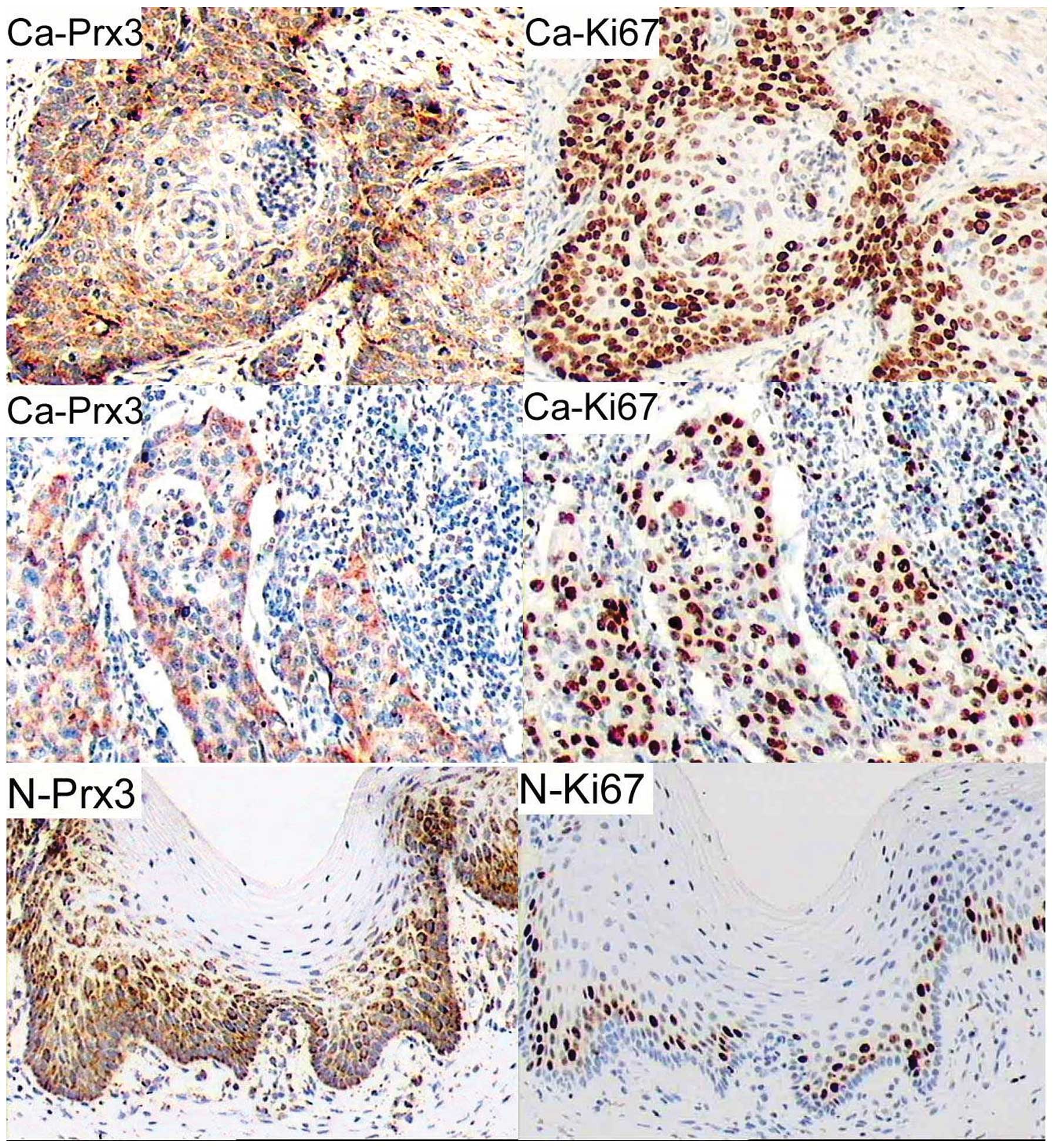
As shown in Fig. 1, we observed strong cytoplasmic staining for Prx3 in the cancer nests and the surrounding cells or in invasive cancerous cells, while Prx3-positive cells in the adjacent epithelium were located mainly in the basal layer. The number of positive cells for Prx3 in cancerous areas was significantly higher compared to that in non-cancerous areas (65.00±21.08 vs. 41.04±13.09%, P=0.000 by Student’s t-test). Of the clinical and pathological characteristics, cell differentiation (grade) was significantly associated with Prx3 expression (Pearson’s correlation coefficient was −0.648, P=0.000). In addition, the positive cells for Prx3 in CCs were correlated with the expression of HPV16 E6/E7 (Pearson’s correlation coefficient was 0.726, P=0.000).

Figure 1

Representative immunohistochemical staining for peroxiredoxin 3 (Prx3) and Ki67 in sections of cervical cancer and adjacent normal epithelium. In cancerous tissues, the positive cells were observed in the cancer nests and surrounding tissues (upper, Ca-Prx3 and Ca-Ki67) or in invaded surrounding areas (middle, Ca-Prx3 and Ca-Ki67). The immunoreactivity was mainly localized in the basal layer of normal epithelium (N-Prx3 and N-Ki67). Original magnification, ×200.

Expression of Prx3 and Ki67 is positively correlated in CC samples

Since Prx3 was predominantly expressed in cells with active proliferation, immunohistochemistry was performed using mouse monoclonal antibody against human Ki67. As shown in Fig. 1, the number of positive cells for Ki67 was significantly higher in cancerous cervices compared to adjacent epitheliums (70.89±21.49 vs. 17.12±10.28%, P=0.000 by Student’s t-test). Notably, the staining pattern of Prx3 was consistent with that of Ki67 (Fig. 1; Pearson’s correlation coefficient was 0.801, P=0.000). In cancerous sections, Ki67-positive cells were located in the cancer nests and the surrounding areas or in invaded cancerous tissues, while Ki67-positive cells in the adjacent normal epitheliums were located mainly in the basal layer.

Discussion

In the present study, we demonstrated increased expression of Prx3 in CC and provided evidence that Prx3 was upregulated in the cells with active proliferation. The pattern of Prx3 expression in CC was consistent with that of Ki67, indicating that Prx3 is a potential marker for cell proliferation.

In their study, Riethdorf et al (12) demonstrated that high-risk HPV oncogenes activated telomerase and played a critical role in human carcinogenesis. High-risk HPV genomes were reported to preferentially integrate near the c-myc gene (13). The latter cooperated with HPV E6/E7 to promote the malignant transformation of cervical epitheliums (14). As a target gene of c-myc, Prx3 played an important role in mitochondrial homeostasis maintenance and neoplastic transformation (15). Our findings showed that the HPV16 E6/E7 expression was increased and was positively associated with the expression of Prx3 in CC. The interaction between HPV, c-myc and Prx3 in CC development or/and progression requires additional investigation.

As an established marker for cell proliferation, Ki67 has been suggested to be a predictor for high-risk HPV infection and an independent prognostic parameter for recurrence-free survival of CC (16,17). Our findings showed that the Ki67-positive cells were mainly located in the surrounding areas of cancer nests or in invaded cancerous tissues, implying active growth of the cells in these areas. Since ROS production was increased in the cells with active proliferation (2), the upregulation of Prx3 in the same areas might be a natural response to oxidative stress in the cancer microenvironment. In their previous study, Nonn et al (18) reported that Prx3 played a protective role against drug-induced oxidative stress and subsequent apoptosis of cancer cells, thus it would be useful to investigate the significance of Prx3 in the prognosis, recurrence and chemo- or radiotherapy-resistance of CC.

References

1 

Scheffner M, Munger K, Byrne JC and Howley PM: The state of the p53 and retinoblastoma genes in human cervical carcinoma cell lines. Proc Natl Acad Sci USA. 88:5523–5527. 1991. View Article : Google Scholar : PubMed/NCBI

2 

Beevi SS, Rasheed MH and Geetha A: Evidence of oxidative and nitrosative stress in patients with cervical squamous cell carcinoma. Clin Chim Acta. 375:119–123. 2007. View Article : Google Scholar : PubMed/NCBI

3 

Cotran RS, Kumar V and Robbins SL: Robbins Pathologic Basis of Disease. 5th edition. W.B. Saunders Company; Philadelphia: 1994

4 

Ding B, Chi SG, Kim SH, et al: Role of p53 in antioxidant defense of HPV-positive cervical carcinoma cells following H2O2 exposure. J Cell Sci. 120:2284–2294. 2007. View Article : Google Scholar : PubMed/NCBI

5 

Singh M, Sharma H and Singh N: Hydrogen peroxide induces apoptosis in HeLa cells through mitochondrial pathway. Mitochondrion. 7:367–373. 2007. View Article : Google Scholar : PubMed/NCBI

6 

Srinivas P, Gopinath G, Banerji A, Dinakar A and Srinivas G: Plumbagin induces reactive oxygen species, which mediate apoptosis in human cervical cancer cells. Mol Carcinog. 40:201–211. 2004. View Article : Google Scholar : PubMed/NCBI

7 

Alexandre J, Batteux F, Nicco C, et al: Accumulation of hydrogen peroxide is an early and crucial step for paclitaxel-induced cancer cell death both in vitro and in vivo. Int J Cancer. 119:41–48. 2006. View Article : Google Scholar : PubMed/NCBI

8 

Chang TS, Cho CS, Park S, Yu S, Kang SW and Rhee SG: Peroxiredoxin III, a mitochondrion-specific peroxidase, regulates apoptotic signaling by mitochondria. J Biol Chem. 279:41975–41984. 2004. View Article : Google Scholar : PubMed/NCBI

9 

Li L, Shoji W, Takano H, et al: Increased susceptibility of MER5 (peroxiredoxin III) knockout mice to LPS-induced oxidative stress. Biochem Biophys Res Commun. 355:715–721. 2007. View Article : Google Scholar : PubMed/NCBI

10 

Li L, Shoji W, Oshima H, Obinata M, Fukumoto M and Kanno N: Crucial role of peroxiredoxin III in placental antioxidant defense of mice. FEBS Lett. 582:2431–2434. 2008. View Article : Google Scholar : PubMed/NCBI

11 

Kim K, Yu M, Han S, et al: Expression of human peroxiredoxin isoforms in response to cervical carcinogenesis. Oncol Rep. 21:1391–1396. 2009.PubMed/NCBI

12 

Riethdorf S, Riethdorf L, Schulz G, et al: Relationship between telomerase activation and HPV 16/18 oncogene expression in squamous intraepithelial lesions and squamous cell carcinomas of the uterine cervix. Int J Gynecol Pathol. 20:177–185. 2001. View Article : Google Scholar

13 

Couturier J, Sastre-Garau X, Schneider-Maunoury S, Labib A and Orth G: Integration of papillomavirus DNA near myc genes in genital carcinomas and its consequences for proto-oncogene expression. J Virol. 65:4534–4538. 1991.PubMed/NCBI

14 

Subramanyam D and Krishna S: c-Myc substitutes for Notch1-CBF1 functions in cooperative transformation with papillomavirus oncogenes. Virology. 347:191–198. 2006. View Article : Google Scholar : PubMed/NCBI

15 

Wonsey DR, Zeller KI and Dang CV: The c-Myc target gene PRDX3 is required for mitochondrial homeostasis and neoplastic transformation. Proc Natl Acad Sci USA. 99:6649–6654. 2002. View Article : Google Scholar : PubMed/NCBI

16 

Mimica M, Tomić S, Kardum G, Hofman ID, Kaliterna V and Pejković L: Ki-67 quantitative evaluation as a marker of cervical intraepithelial neoplasia and human papillomavirus infection. Int J Gynecol Cancer. 20:116–119. 2010. View Article : Google Scholar : PubMed/NCBI

17 

Hanprasertpong J, Tungsinmunkong K, Chichareon S, et al: Correlation of p53 and Ki-67 (MIB-1) expressions with clinicopathological features and prognosis of early stage cervical squamous cell carcinomas. J Obstet Gynaecol Res. 36:572–580. 2010. View Article : Google Scholar : PubMed/NCBI

18 

Nonn L, Berggren M and Powis G: Increased expression of mitochondrial peroxiredoxin-3 (thioredoxin peroxidase-2) protects cancer cells against hypoxia and drug-induced hydrogen peroxide-dependent apoptosis. Mol Cancer Res. 1:682–689. 2003.

Related Articles

  • Abstract
  • View
  • Download
  • Twitter
Copy and paste a formatted citation
Spandidos Publications style
Hu J, Gao Q and Li L: Peroxiredoxin 3 is a novel marker for cell proliferation in cervical cancer. Biomed Rep 1: 228-230, 2013.
APA
Hu, J., Gao, Q., & Li, L. (2013). Peroxiredoxin 3 is a novel marker for cell proliferation in cervical cancer. Biomedical Reports, 1, 228-230. https://doi.org/10.3892/br.2012.43
MLA
Hu, J., Gao, Q., Li, L."Peroxiredoxin 3 is a novel marker for cell proliferation in cervical cancer". Biomedical Reports 1.2 (2013): 228-230.
Chicago
Hu, J., Gao, Q., Li, L."Peroxiredoxin 3 is a novel marker for cell proliferation in cervical cancer". Biomedical Reports 1, no. 2 (2013): 228-230. https://doi.org/10.3892/br.2012.43
Copy and paste a formatted citation
x
Spandidos Publications style
Hu J, Gao Q and Li L: Peroxiredoxin 3 is a novel marker for cell proliferation in cervical cancer. Biomed Rep 1: 228-230, 2013.
APA
Hu, J., Gao, Q., & Li, L. (2013). Peroxiredoxin 3 is a novel marker for cell proliferation in cervical cancer. Biomedical Reports, 1, 228-230. https://doi.org/10.3892/br.2012.43
MLA
Hu, J., Gao, Q., Li, L."Peroxiredoxin 3 is a novel marker for cell proliferation in cervical cancer". Biomedical Reports 1.2 (2013): 228-230.
Chicago
Hu, J., Gao, Q., Li, L."Peroxiredoxin 3 is a novel marker for cell proliferation in cervical cancer". Biomedical Reports 1, no. 2 (2013): 228-230. https://doi.org/10.3892/br.2012.43
Follow us
  • Twitter
  • LinkedIn
  • Facebook
About
  • Spandidos Publications
  • Careers
  • Cookie Policy
  • Privacy Policy
How can we help?
  • Help
  • Live Chat
  • Contact
  • Email to our Support Team