Spandidos Publications Logo
  • About
    • About Spandidos
    • Aims and Scopes
    • Abstracting and Indexing
    • Editorial Policies
    • Reprints and Permissions
    • Job Opportunities
    • Terms and Conditions
    • Contact
  • Journals
    • All Journals
    • Oncology Letters
      • Oncology Letters
      • Information for Authors
      • Editorial Policies
      • Editorial Board
      • Aims and Scope
      • Abstracting and Indexing
      • Bibliographic Information
      • Archive
    • International Journal of Oncology
      • International Journal of Oncology
      • Information for Authors
      • Editorial Policies
      • Editorial Board
      • Aims and Scope
      • Abstracting and Indexing
      • Bibliographic Information
      • Archive
    • Molecular and Clinical Oncology
      • Molecular and Clinical Oncology
      • Information for Authors
      • Editorial Policies
      • Editorial Board
      • Aims and Scope
      • Abstracting and Indexing
      • Bibliographic Information
      • Archive
    • Experimental and Therapeutic Medicine
      • Experimental and Therapeutic Medicine
      • Information for Authors
      • Editorial Policies
      • Editorial Board
      • Aims and Scope
      • Abstracting and Indexing
      • Bibliographic Information
      • Archive
    • International Journal of Molecular Medicine
      • International Journal of Molecular Medicine
      • Information for Authors
      • Editorial Policies
      • Editorial Board
      • Aims and Scope
      • Abstracting and Indexing
      • Bibliographic Information
      • Archive
    • Biomedical Reports
      • Biomedical Reports
      • Information for Authors
      • Editorial Policies
      • Editorial Board
      • Aims and Scope
      • Abstracting and Indexing
      • Bibliographic Information
      • Archive
    • Oncology Reports
      • Oncology Reports
      • Information for Authors
      • Editorial Policies
      • Editorial Board
      • Aims and Scope
      • Abstracting and Indexing
      • Bibliographic Information
      • Archive
    • Molecular Medicine Reports
      • Molecular Medicine Reports
      • Information for Authors
      • Editorial Policies
      • Editorial Board
      • Aims and Scope
      • Abstracting and Indexing
      • Bibliographic Information
      • Archive
    • World Academy of Sciences Journal
      • World Academy of Sciences Journal
      • Information for Authors
      • Editorial Policies
      • Editorial Board
      • Aims and Scope
      • Abstracting and Indexing
      • Bibliographic Information
      • Archive
    • International Journal of Functional Nutrition
      • International Journal of Functional Nutrition
      • Information for Authors
      • Editorial Policies
      • Editorial Board
      • Aims and Scope
      • Abstracting and Indexing
      • Bibliographic Information
      • Archive
    • International Journal of Epigenetics
      • International Journal of Epigenetics
      • Information for Authors
      • Editorial Policies
      • Editorial Board
      • Aims and Scope
      • Abstracting and Indexing
      • Bibliographic Information
      • Archive
    • Medicine International
      • Medicine International
      • Information for Authors
      • Editorial Policies
      • Editorial Board
      • Aims and Scope
      • Abstracting and Indexing
      • Bibliographic Information
      • Archive
  • Articles
  • Information
    • Information for Authors
    • Information for Reviewers
    • Information for Librarians
    • Information for Advertisers
    • Conferences
  • Language Editing
Spandidos Publications Logo
  • About
    • About Spandidos
    • Aims and Scopes
    • Abstracting and Indexing
    • Editorial Policies
    • Reprints and Permissions
    • Job Opportunities
    • Terms and Conditions
    • Contact
  • Journals
    • All Journals
    • Biomedical Reports
      • Information for Authors
      • Editorial Policies
      • Editorial Board
      • Aims and Scope
      • Abstracting and Indexing
      • Bibliographic Information
      • Archive
    • Experimental and Therapeutic Medicine
      • Information for Authors
      • Editorial Policies
      • Editorial Board
      • Aims and Scope
      • Abstracting and Indexing
      • Bibliographic Information
      • Archive
    • International Journal of Epigenetics
      • Information for Authors
      • Editorial Policies
      • Editorial Board
      • Aims and Scope
      • Abstracting and Indexing
      • Bibliographic Information
      • Archive
    • International Journal of Functional Nutrition
      • Information for Authors
      • Editorial Policies
      • Editorial Board
      • Aims and Scope
      • Abstracting and Indexing
      • Bibliographic Information
      • Archive
    • International Journal of Molecular Medicine
      • Information for Authors
      • Editorial Policies
      • Editorial Board
      • Aims and Scope
      • Abstracting and Indexing
      • Bibliographic Information
      • Archive
    • International Journal of Oncology
      • Information for Authors
      • Editorial Policies
      • Editorial Board
      • Aims and Scope
      • Abstracting and Indexing
      • Bibliographic Information
      • Archive
    • Medicine International
      • Information for Authors
      • Editorial Policies
      • Editorial Board
      • Aims and Scope
      • Abstracting and Indexing
      • Bibliographic Information
      • Archive
    • Molecular and Clinical Oncology
      • Information for Authors
      • Editorial Policies
      • Editorial Board
      • Aims and Scope
      • Abstracting and Indexing
      • Bibliographic Information
      • Archive
    • Molecular Medicine Reports
      • Information for Authors
      • Editorial Policies
      • Editorial Board
      • Aims and Scope
      • Abstracting and Indexing
      • Bibliographic Information
      • Archive
    • Oncology Letters
      • Information for Authors
      • Editorial Policies
      • Editorial Board
      • Aims and Scope
      • Abstracting and Indexing
      • Bibliographic Information
      • Archive
    • Oncology Reports
      • Information for Authors
      • Editorial Policies
      • Editorial Board
      • Aims and Scope
      • Abstracting and Indexing
      • Bibliographic Information
      • Archive
    • World Academy of Sciences Journal
      • Information for Authors
      • Editorial Policies
      • Editorial Board
      • Aims and Scope
      • Abstracting and Indexing
      • Bibliographic Information
      • Archive
  • Articles
  • Information
    • For Authors
    • For Reviewers
    • For Librarians
    • For Advertisers
    • Conferences
  • Language Editing
Login Register Submit
  • This site uses cookies
  • You can change your cookie settings at any time by following the instructions in our Cookie Policy. To find out more, you may read our Privacy Policy.

    I agree
Search articles by DOI, keyword, author or affiliation
Search
Advanced Search
presentation
Biomedical Reports
Join Editorial Board Propose a Special Issue
Print ISSN: 2049-9434 Online ISSN: 2049-9442
Journal Cover
July-August 2013 Volume 1 Issue 4

Full Size Image

Sign up for eToc alerts
Recommend to Library

Journals

International Journal of Molecular Medicine

International Journal of Molecular Medicine

International Journal of Molecular Medicine is an international journal devoted to molecular mechanisms of human disease.

International Journal of Oncology

International Journal of Oncology

International Journal of Oncology is an international journal devoted to oncology research and cancer treatment.

Molecular Medicine Reports

Molecular Medicine Reports

Covers molecular medicine topics such as pharmacology, pathology, genetics, neuroscience, infectious diseases, molecular cardiology, and molecular surgery.

Oncology Reports

Oncology Reports

Oncology Reports is an international journal devoted to fundamental and applied research in Oncology.

Experimental and Therapeutic Medicine

Experimental and Therapeutic Medicine

Experimental and Therapeutic Medicine is an international journal devoted to laboratory and clinical medicine.

Oncology Letters

Oncology Letters

Oncology Letters is an international journal devoted to Experimental and Clinical Oncology.

Biomedical Reports

Biomedical Reports

Explores a wide range of biological and medical fields, including pharmacology, genetics, microbiology, neuroscience, and molecular cardiology.

Molecular and Clinical Oncology

Molecular and Clinical Oncology

International journal addressing all aspects of oncology research, from tumorigenesis and oncogenes to chemotherapy and metastasis.

World Academy of Sciences Journal

World Academy of Sciences Journal

Multidisciplinary open-access journal spanning biochemistry, genetics, neuroscience, environmental health, and synthetic biology.

International Journal of Functional Nutrition

International Journal of Functional Nutrition

Open-access journal combining biochemistry, pharmacology, immunology, and genetics to advance health through functional nutrition.

International Journal of Epigenetics

International Journal of Epigenetics

Publishes open-access research on using epigenetics to advance understanding and treatment of human disease.

Medicine International

Medicine International

An International Open Access Journal Devoted to General Medicine.

Journal Cover
July-August 2013 Volume 1 Issue 4

Full Size Image

Sign up for eToc alerts
Recommend to Library

  • Article
  • Citations
    • Cite This Article
    • Download Citation
    • Create Citation Alert
    • Remove Citation Alert
    • Cited By
  • Similar Articles
    • Related Articles (in Spandidos Publications)
    • Similar Articles (Google Scholar)
    • Similar Articles (PubMed)
  • Download PDF
  • Download XML
  • View XML
Article

Antiproliferative effects of protopanaxadiol ginsenosides on human colorectal cancer cells

  • Authors:
    • Yan Zheng
    • Hongmei Nan
    • Miao Hao
    • Chengcheng Song
    • Yifa Zhou
    • Yufei Gao
  • View Affiliations / Copyright

    Affiliations: China‑Japan Union Hospital, Jilin University, Changchun, Jilin 130033, P.R. China, The First Affiliated Hospital to Changchun University of Chinese Medicine, Changchun, Jilin 130021, P.R. China, School of Life Sciences, Northeast Normal University, Changchun, Jilin 130024, P.R. China
  • Pages: 555-558
    |
    Published online on: May 10, 2013
       https://doi.org/10.3892/br.2013.104
  • Expand metrics +
Metrics: Total Views: 0 (Spandidos Publications: | PMC Statistics: )
Metrics: Total PDF Downloads: 0 (Spandidos Publications: | PMC Statistics: )
Cited By (CrossRef): 0 citations Loading Articles...

This article is mentioned in:


Abstract

Ginsenosides are the main biologically active components of ginseng. In this study, seven types of protopanaxadiol ginsenosides were assessed for their antiproliferative activity on the HCT‑116 and HT‑29 human colorectal cancer cell lines using the 3‑(4,5‑dimethylthiazol‑2‑yl)‑2,5‑diphenyltetrazolium bromide (MTT) assay. The experimental results indicated that the native protopanaxadiol ginsenosides Rb1 and Rb2 inhibited the proliferation of the colorectal cancer cells in a dose‑dependent manner. The deglycosylation products F2 and CO (from ginsenosides Rb1 and Rb2, respectively) significantly inhibited the growth of the human colorectal cancer cell lines, whereas product C‑K (from Rb1 and Rb2) exerted no antiproliferative effects on the cancer cell lines assessed in this study. HT‑29 cells were more sensitive to these ginsenosides compared to HCT‑116 cells. In addition, the antiproliferative activity of ginsenosides was found to be correlated with the number and type of sugar residues. The potent growth inhibitory effect of protopanaxadiol ginsenosides on cancer cells may be used in the pharmaceutical industry.

Introduction

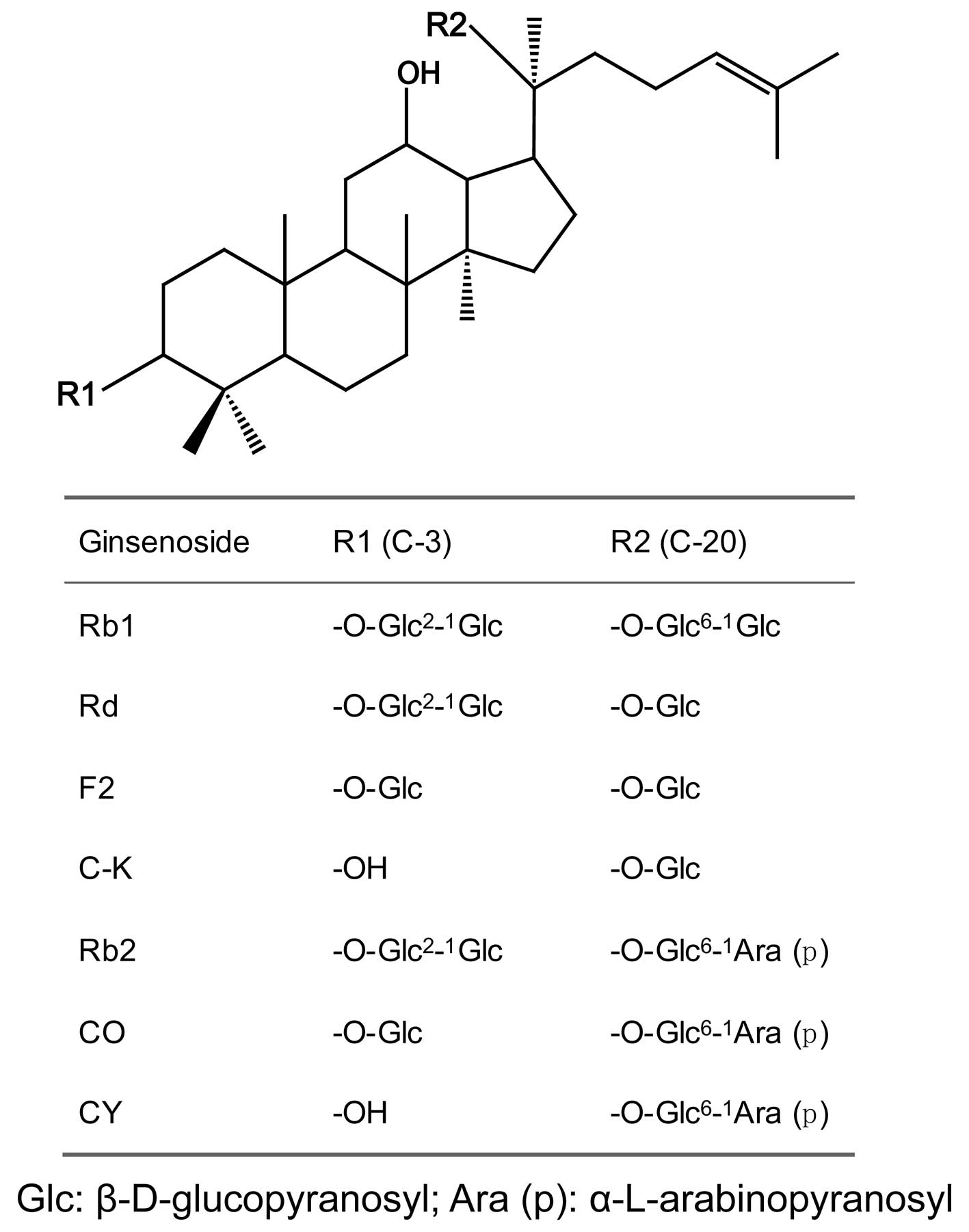
Ginsenosides are the main active components of ginseng and have various pharmaceutical activities, such as antitumor, anti-oxidant and neuroprotective activities (1–4). Protopanaxadiol ginsenosides Rb1 and Rb2 are abundantly found in ginseng. Protopanaxadiol ginsenosides Rd, F2 and compound K (C-K) are the biotransformation products of Rb1, while CO, CY and C-K are the biotransformation products of Rb2. It has been demonstrated that certain biotransformation products of Rb1 and Rb2 have significant pharmacological activities, such as C-K possessing antiallergic and anti-inflammatory activities (5–8). All these protopanaxadiol ginsenosides have the same aglycone (protopanaxadiol); however, the sugar chains are different (Fig. 1). The structure-activity relationship of ginsenosides has been investigated, but not fully elucidated (9,10). Ginsenosides with fewer sugar residues appear to be more active. In this study, we investigated the activities of seven protopanaxadiol ginsenosides on the inhibition of proliferation of the HCT-116 and HT-29 human colorectal cancer lines. The results may provide information on the antiproliferative activity-structure relationship of ginsenosides.

Figure 1.

Structures of related ginsenosides.

Materials and methods

Materials

Standard ginsenosides were purchased from Chengdu Mansite Biotechnology Co., Ltd. (Chengdu, China). The ginsenosides Rb1 and Rb2 and their biotransformation products were prepared as described in our previous study (11). The metabolites were identified by thin layer chromatography, high-performance liquid chromatography and 13C-NMR spectrometry. Dulbecco’s modified Eagle’s medium/Nutrient Mixture F-12 (DMEM/F12), Iscove’s modified Dulbecco’s medium (IMDM) and fetal bovine serum (FBS) were purchased from Gibco-BRL (Carlsbad, CA, USA). Penicillin/streptomycin were purchased from the Tianjin Hao Yang biological manufacture Co., Ltd. (Tianjin, China). 3-(4,5-Dimethylthiazol-2-yl)-2,5-diphenyl tetrazolium bromide (MTT) was purchased from Sigma (St. Louis, MO, USA). The plates used in this study were purchased from Nalge Nunc International (Rochester, NY, USA). Chemicals used were of analytical grade or higher.

Cell culture

The HCT-116 and HT-29 human colorectal cancer cell lines were obtained from the American Type Culture Collection (Manassas, VA, USA). HCT-116 cells were grown in IMDM with 10% heat-inactivated FBS and 100 U/ml penicillin and streptomycin. HT-29 cells were maintained in DMEM/F12 containing 10% heat-inactivated FBS. The cells were maintained in a humidified chamber of 95% air and 5% CO2 at 37°C.

MTT assay

Cells were seeded at a density of 1×10⁴ cells/well in 96-well plates. After 24 h, the cells were treated with each ginsenoside at different concentrations (50, 100, 150, 200 and 250 μM) for 72 h. Control cells were treated similarly without the addition of ginsenosides. Subsequently, the media were removed and MTT solution (0.5 mg/ml) was added to each well. The plate was incubated in a humidified atmosphere at 37°C for 4 h and the media were carefully aspirated. Dimethyl sulfoxide (100 μl) was added and the absorbance was measured at 570 nm by a microplate reader (Bio-Rad, Hercules, CA, USA). The experiments were performed in triplicate.

Statistical analysis

The results were expressed as mean ± standard deviation. Data were analyzed by SPSS software version 17.0 (SPSS Inc., Chicago, IL, USA). Statistical significance was compared between the treatment and the control groups by one-way analysis of variance. The differences were considered statistically significant when P<0.05 and P<0.01 (Fig. 2). The experiments were performed in triplicate.
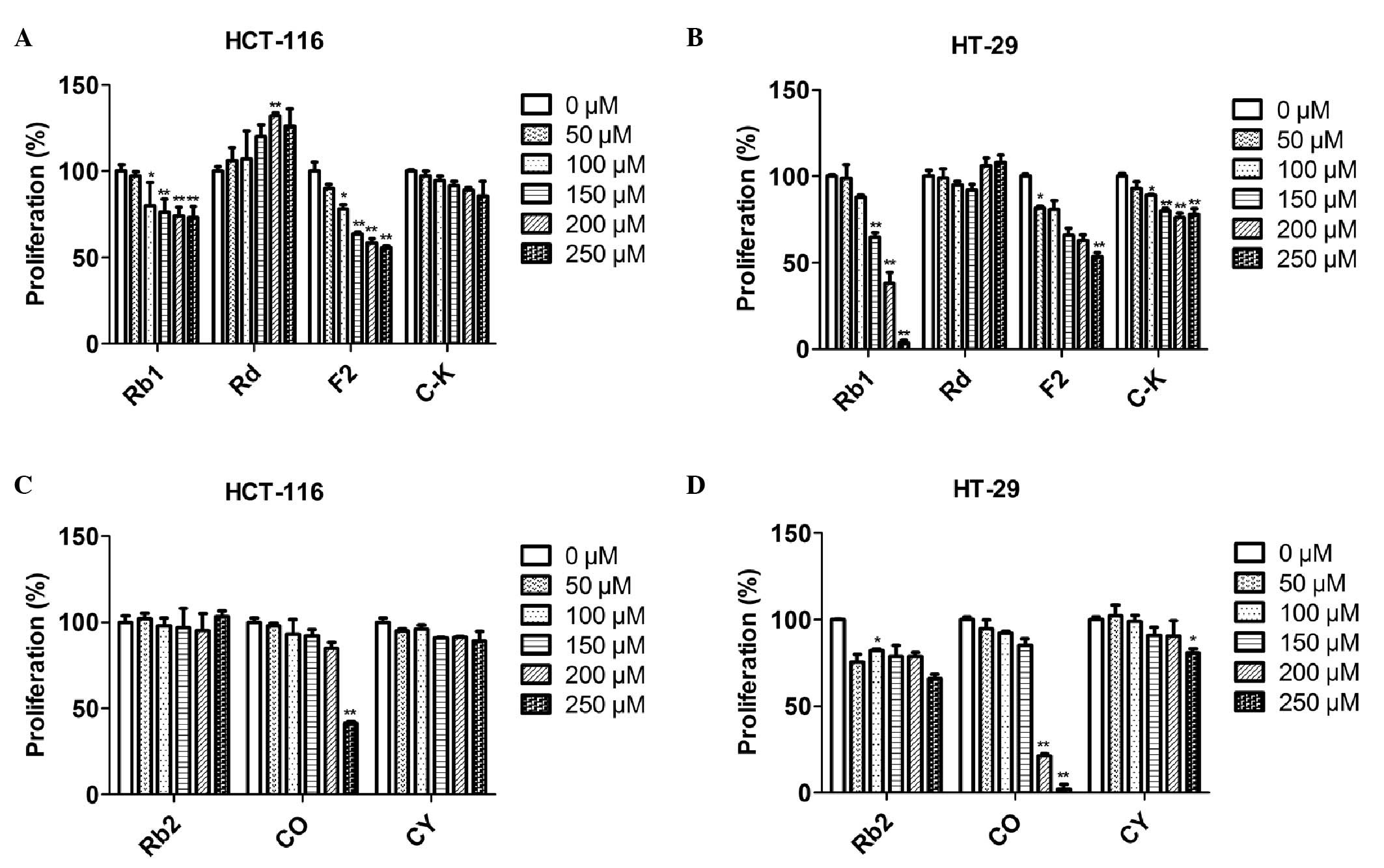
Figure 2.

Effects of ginsenosides on HCT-116 and HT-29 cell proliferation. Cells were treated with seven types of ginsenosides at various concentrations (0, 50, 100, 150, 200 and 250 μM) for 72 h. The antiproliferative effects of the ginsenosides were determined by the MTT assay. (A) Effects of Rb1, Rd, F2 and C-K on HCT-116 cell proliferation. (B) Effects of Rb1, Rd, F2 and C-K on HT-29 cell proliferation. (C) Effects of Rb2, CO and CY on HCT-116 cell proliferation (D) Effects of Rb2, CO and CY on HT-29 cell proliferation. Error bars and all data are expressed as mean ± standard error in triplicate. *P<0.05, **P<0.01.

Results

Effects of Rb1 and its biotransformation products on cell proliferation

Ginsenoside Rb1 and its biotransformation products Rd, F2 and C-K were assessed for their in vitro antiproliferative activity on two human colon cancer cell lines. The MTT assay results demonstrated that Rb1 exhibited no antiproliferative activity on HCT-116 cells at a low concentration (50 μM). Starting from a dose of 100 μM, Rb1 exhibited a marginal dose-dependent inhibitory effect. At a dose of 250 μM, the inhibitory rate of Rb1 was 27.0% (Fig. 2A). The HT-29 cell line was more sensitive to Rb1. Treated with 100 μM or higher concentration of Rb1, the HT-29 cell growth was inhibited in a dose-dependent manner. At the highest dose of 250 μM, the inhibitory rate was 96.4% (Fig. 2B). Ginsenoside Rd significantly increased HCT-116 cell proliferation, whereas it exerted no obvious effect on HT-29 cell growth. Ginsenoside F2 exhibited a moderate antiproliferative activity on HCT-116 cells, with an inhibitory rate of 44.2% at 250 μM of F2. A similar inhibitory effect was observed on HT-29 cells, with an inhibitory rate of 46.4% at 250 μM. Ginsenoside C-K exerted almost no antiproliferative activity on HCT-116 cells and a marginal inhibitory effect on HT-29 cells, with an inhibitory rate of 22.0% at the highest dose of 250 μM.

Effects of Rb2 and its biotransformation products on cell proliferation

Ginsenoside Rb2 and its metabolites CO and CY were assessed for their in vitro antiproliferative activity. As shown in Fig. 2C and D, Rb2 exerted no antiproliferative effect on HCT-116 cells, even at the highest concentration of 250 μM. Rb2 exhibited a marginal inhibitory activity on HT-29 cells. The antiproliferative effect of Rb2 was not significantly altered at low concentrations (50–200 μM). Treatment at the highest dose of 250 μM achieved an inhibitory rate of 34.1%. Ginsenoside CO, the deglycosylation product of Rb2, exerted no inhibitory effect on HCT-116 cell proliferation at low concentrations (50–200 μM), whereas it exerted a significant antiproliferative effect at the highest dose of 250 μM, with an inhibitory rate of 58.7%. HT-29 cells were more sensitive to ginsenoside CO compared to HCT-116 cells. At low doses (50–150 μM), there was no antiproliferative effect on HT-29 cells. However, following treatment with 200 and 250 μM of CO, the inhibitory rate was 78.7 and 98.0%, respectively. The CY hydrolytic product of Rb2 exerted no inhibitory effect on HCT-116 cell proliferation. Similar results were observed on HT-29 cells at the range of 50–200 μM. CY exhibited a marginal antiproliferative effect on HT-29 cells, with an inhibitory rate of 19.1% only at the highest dose of 250 μM. C-K, with one sugar residue at C-20 of protopanaxadiol, is also a hydrolytic product of Rb2 and it exerted no inhibitory effect on HCT-116 or HT-29 cell growth (Fig. 2A and B).

Discussion

Ginsenosides are the major active components of ginseng. It was reported that certain protopanaxadiol ginsenosides, such as Rb1 and Rb2, are transformed into rare bioactive ginsenosides through the hydrolysis of sugar residues, which is usually enabled by glycosidases (11). In this study, ginsenoside Rb1 and Rb2 and their biotransformation products Rd, F2, C-K (from Rb1), CO and CY (from Rb2), were selected for assessment of their antiproliferative activity on human colon cancer cells. It was observed that the seven ginsenosides possessed the same aglycone but different sugar residues. Therefore, the association between the sugar residues in protopanaxadiol ginsenosides and their antiproliferative activity was elucidated in this study.

Our results demonstrated that the number of sugar residues significantly affected the inhibitory activity. As shown in Fig. 1, ginsenoside Rb1 and Rb2 have four sugar residues, Rd and CO have three, F2 and CY have two and C-K has one. Taking Rb1 and its deglycosylation products as an example, when the sugar residues decreased from four to one, the anti-proliferative activity was significantly altered. Similar effects were observed on HCT-116 and HT-29 cells. Moreover, Rb2 and its metabolites also exhibited different inhibitory effects on the two human colon cancer cells tested. Ginsenoside F2, found in ginseng in minute amounts, was produced by deglycosylation of Rb1 with the catalyzing action of glycosidase. Ginsenoside F2 exerted a more potent inhibitory effect compared to that of Rb1. Similar to F2, the minor ginsenoside CO, which was produced by deglycosylation of Rb2, exerted more potent inhibitory effects compared to those of Rb2. These results indicated that the number of sugar residues may affect the antiproliferative activity of ginsenosides. However, the detailed mechanism needs to be further investigated.

In addition, our results demonstrated that the antiproliferative activity of ginsenosides was also correlated with the type of sugar residue. Ginsenoside Rb1 and Rb2 have a similar structure, with two sugar residues substituted at C-3 and C-20, respectively. The only difference between them is the disaccharide substituted at C-20 [glucose-β-(1→6)-glucose- for Rb1 and arabinose (p)-α-(1→6)-glucose-β- for Rb2]. It was observed that ginsenosides at the same dose but with different terminal sugar residues exhibited different antiproliferative activities. Ginsenoside Rb1 exerted a significant inhibitory effect on HT-29 cell growth in a dose-dependent manner. However, the antiproliferative activity of Rb2 was significantly lower compared to that of Rb1, whereas no dose-dependent inhibitory effect was exerted on HT-29 cells by Rb2. These results indicate that the terminal sugar residue at the C-20 site may affect the inhibitory effects of ginsenosides to a certain extent.

In conclusion, we investigated the inhibitory effects of seven protopanaxadiol ginsenosides on HCT-116 and HT-29 human colorectal cancer cell proliferation. Our results indicate that the number and type of sugar residues may affect the antiproliferative activity of ginsenosides, which may provide useful information on the association between ginsenoside structure and antiproliferative activity.

Acknowledgements

This study was supported by the Fundamental Research Funds for the Central Universities.

References

1. 

Saw CL, Yang AY, Cheng DC, et al: Pharmacodynamics of ginsenosides: antioxidant activities, activation of Nrf2, and potential synergistic effects of combinations. Chem Res Toxicol. 25:1574–1580. 2012. View Article : Google Scholar : PubMed/NCBI

2. 

Hashimoto R, Yu J, Koizumi H, Ouchi Y and Okabe T: Ginsenoside Rb1 prevents MPP(+)-induced apoptosis in PC12 cells by stimulating estrogen receptors with consequent activation of ERK1/2, Akt and inhibition of SAPK/JNK, p38 MAPK. Evid Based Complement Alternat Med. 2012:6937172012.PubMed/NCBI

3. 

Lee JS, Song JH, Sohn NW and Shin JW: Inhibitory effects of ginsenoside Rb1 on neuroinflammation following systemic lipopolysaccharide treatment in mice. Phytother Res. Oct 8–2012.(Epub ahead of print).

4. 

Huang X, Liu X and Deng C: Effects of the combination of active component extracts from Astragalus membranaceus and Panax notoginseng on apoptosis, reactive oxygen species and mitochondrial membrane potential of PC12 cells with oxidative injury. J Chin Integr Med. 10:1127–1134. 2012.(In Chinese).

5. 

Lee HU, Bae EA, Han MJ, Kim NJ and Kim DH: Hepatoprotective effect of ginsenoside Rb1 and compound K on tert-butyl hydro-peroxide-induced liver injury. Liver Int. 25:1069–1073. 2005. View Article : Google Scholar : PubMed/NCBI

6. 

Zhou W, Feng MQ, Li JY and Zhou P: Studies on the preparation, crystal structure and bioactivity of ginsenoside compound K. J Asian Nat Prod Res. 8:519–527. 2006. View Article : Google Scholar : PubMed/NCBI

7. 

Choi K, Kim M, Ryu J and Choi C: Ginsenosides compound K and Rh(2) inhibit tumor necrosis factor-alpha-induced activation of the NF-kappaB and JNK pathways in human astroglial cells. Neurosci Lett. 421:37–41. 2007. View Article : Google Scholar : PubMed/NCBI

8. 

Zhou W, Feng M, Li X, et al: X-ray structure investigation of (20S)-20-O-beta-D-glucopyranosyl-protopanaxadiol and antitumor effect on Lewis lung carcinoma in vivo. Chem Biodivers. 6:380–388. 2009. View Article : Google Scholar : PubMed/NCBI

9. 

Kim JH, Hong YH, Lee JH, et al: A role for the carbohydrate portion of ginsenoside Rg3 in Na+channel inhibition. Mol Cells. 19:137–142. 2005.PubMed/NCBI

10. 

Chu SF and Zhang JT: New achievements in ginseng research and its future prospects. Chin J Integr Med. 15:403–408. 2009. View Article : Google Scholar : PubMed/NCBI

11. 

Gao J, Xu W, Fang Q, et al: Efficient biotransformation for preparation of pharmaceutically active ginsenoside compound K by Penicillium oxalicum sp. 68. Ann Microbiol. 63:139–149. 2013. View Article : Google Scholar

Related Articles

  • Abstract
  • View
  • Download
  • Twitter
Copy and paste a formatted citation
Spandidos Publications style
Zheng Y, Nan H, Hao M, Song C, Zhou Y and Gao Y: Antiproliferative effects of protopanaxadiol ginsenosides on human colorectal cancer cells. Biomed Rep 1: 555-558, 2013.
APA
Zheng, Y., Nan, H., Hao, M., Song, C., Zhou, Y., & Gao, Y. (2013). Antiproliferative effects of protopanaxadiol ginsenosides on human colorectal cancer cells. Biomedical Reports, 1, 555-558. https://doi.org/10.3892/br.2013.104
MLA
Zheng, Y., Nan, H., Hao, M., Song, C., Zhou, Y., Gao, Y."Antiproliferative effects of protopanaxadiol ginsenosides on human colorectal cancer cells". Biomedical Reports 1.4 (2013): 555-558.
Chicago
Zheng, Y., Nan, H., Hao, M., Song, C., Zhou, Y., Gao, Y."Antiproliferative effects of protopanaxadiol ginsenosides on human colorectal cancer cells". Biomedical Reports 1, no. 4 (2013): 555-558. https://doi.org/10.3892/br.2013.104
Copy and paste a formatted citation
x
Spandidos Publications style
Zheng Y, Nan H, Hao M, Song C, Zhou Y and Gao Y: Antiproliferative effects of protopanaxadiol ginsenosides on human colorectal cancer cells. Biomed Rep 1: 555-558, 2013.
APA
Zheng, Y., Nan, H., Hao, M., Song, C., Zhou, Y., & Gao, Y. (2013). Antiproliferative effects of protopanaxadiol ginsenosides on human colorectal cancer cells. Biomedical Reports, 1, 555-558. https://doi.org/10.3892/br.2013.104
MLA
Zheng, Y., Nan, H., Hao, M., Song, C., Zhou, Y., Gao, Y."Antiproliferative effects of protopanaxadiol ginsenosides on human colorectal cancer cells". Biomedical Reports 1.4 (2013): 555-558.
Chicago
Zheng, Y., Nan, H., Hao, M., Song, C., Zhou, Y., Gao, Y."Antiproliferative effects of protopanaxadiol ginsenosides on human colorectal cancer cells". Biomedical Reports 1, no. 4 (2013): 555-558. https://doi.org/10.3892/br.2013.104
Follow us
  • Twitter
  • LinkedIn
  • Facebook
About
  • Spandidos Publications
  • Careers
  • Cookie Policy
  • Privacy Policy
How can we help?
  • Help
  • Live Chat
  • Contact
  • Email to our Support Team