Spandidos Publications Logo
  • About
    • About Spandidos
    • Aims and Scopes
    • Abstracting and Indexing
    • Editorial Policies
    • Reprints and Permissions
    • Job Opportunities
    • Terms and Conditions
    • Contact
  • Journals
    • All Journals
    • Oncology Letters
      • Oncology Letters
      • Information for Authors
      • Editorial Policies
      • Editorial Board
      • Aims and Scope
      • Abstracting and Indexing
      • Bibliographic Information
      • Archive
    • International Journal of Oncology
      • International Journal of Oncology
      • Information for Authors
      • Editorial Policies
      • Editorial Board
      • Aims and Scope
      • Abstracting and Indexing
      • Bibliographic Information
      • Archive
    • Molecular and Clinical Oncology
      • Molecular and Clinical Oncology
      • Information for Authors
      • Editorial Policies
      • Editorial Board
      • Aims and Scope
      • Abstracting and Indexing
      • Bibliographic Information
      • Archive
    • Experimental and Therapeutic Medicine
      • Experimental and Therapeutic Medicine
      • Information for Authors
      • Editorial Policies
      • Editorial Board
      • Aims and Scope
      • Abstracting and Indexing
      • Bibliographic Information
      • Archive
    • International Journal of Molecular Medicine
      • International Journal of Molecular Medicine
      • Information for Authors
      • Editorial Policies
      • Editorial Board
      • Aims and Scope
      • Abstracting and Indexing
      • Bibliographic Information
      • Archive
    • Biomedical Reports
      • Biomedical Reports
      • Information for Authors
      • Editorial Policies
      • Editorial Board
      • Aims and Scope
      • Abstracting and Indexing
      • Bibliographic Information
      • Archive
    • Oncology Reports
      • Oncology Reports
      • Information for Authors
      • Editorial Policies
      • Editorial Board
      • Aims and Scope
      • Abstracting and Indexing
      • Bibliographic Information
      • Archive
    • Molecular Medicine Reports
      • Molecular Medicine Reports
      • Information for Authors
      • Editorial Policies
      • Editorial Board
      • Aims and Scope
      • Abstracting and Indexing
      • Bibliographic Information
      • Archive
    • World Academy of Sciences Journal
      • World Academy of Sciences Journal
      • Information for Authors
      • Editorial Policies
      • Editorial Board
      • Aims and Scope
      • Abstracting and Indexing
      • Bibliographic Information
      • Archive
    • International Journal of Functional Nutrition
      • International Journal of Functional Nutrition
      • Information for Authors
      • Editorial Policies
      • Editorial Board
      • Aims and Scope
      • Abstracting and Indexing
      • Bibliographic Information
      • Archive
    • International Journal of Epigenetics
      • International Journal of Epigenetics
      • Information for Authors
      • Editorial Policies
      • Editorial Board
      • Aims and Scope
      • Abstracting and Indexing
      • Bibliographic Information
      • Archive
    • Medicine International
      • Medicine International
      • Information for Authors
      • Editorial Policies
      • Editorial Board
      • Aims and Scope
      • Abstracting and Indexing
      • Bibliographic Information
      • Archive
  • Articles
  • Information
    • Information for Authors
    • Information for Reviewers
    • Information for Librarians
    • Information for Advertisers
    • Conferences
  • Language Editing
Spandidos Publications Logo
  • About
    • About Spandidos
    • Aims and Scopes
    • Abstracting and Indexing
    • Editorial Policies
    • Reprints and Permissions
    • Job Opportunities
    • Terms and Conditions
    • Contact
  • Journals
    • All Journals
    • Biomedical Reports
      • Information for Authors
      • Editorial Policies
      • Editorial Board
      • Aims and Scope
      • Abstracting and Indexing
      • Bibliographic Information
      • Archive
    • Experimental and Therapeutic Medicine
      • Information for Authors
      • Editorial Policies
      • Editorial Board
      • Aims and Scope
      • Abstracting and Indexing
      • Bibliographic Information
      • Archive
    • International Journal of Epigenetics
      • Information for Authors
      • Editorial Policies
      • Editorial Board
      • Aims and Scope
      • Abstracting and Indexing
      • Bibliographic Information
      • Archive
    • International Journal of Functional Nutrition
      • Information for Authors
      • Editorial Policies
      • Editorial Board
      • Aims and Scope
      • Abstracting and Indexing
      • Bibliographic Information
      • Archive
    • International Journal of Molecular Medicine
      • Information for Authors
      • Editorial Policies
      • Editorial Board
      • Aims and Scope
      • Abstracting and Indexing
      • Bibliographic Information
      • Archive
    • International Journal of Oncology
      • Information for Authors
      • Editorial Policies
      • Editorial Board
      • Aims and Scope
      • Abstracting and Indexing
      • Bibliographic Information
      • Archive
    • Medicine International
      • Information for Authors
      • Editorial Policies
      • Editorial Board
      • Aims and Scope
      • Abstracting and Indexing
      • Bibliographic Information
      • Archive
    • Molecular and Clinical Oncology
      • Information for Authors
      • Editorial Policies
      • Editorial Board
      • Aims and Scope
      • Abstracting and Indexing
      • Bibliographic Information
      • Archive
    • Molecular Medicine Reports
      • Information for Authors
      • Editorial Policies
      • Editorial Board
      • Aims and Scope
      • Abstracting and Indexing
      • Bibliographic Information
      • Archive
    • Oncology Letters
      • Information for Authors
      • Editorial Policies
      • Editorial Board
      • Aims and Scope
      • Abstracting and Indexing
      • Bibliographic Information
      • Archive
    • Oncology Reports
      • Information for Authors
      • Editorial Policies
      • Editorial Board
      • Aims and Scope
      • Abstracting and Indexing
      • Bibliographic Information
      • Archive
    • World Academy of Sciences Journal
      • Information for Authors
      • Editorial Policies
      • Editorial Board
      • Aims and Scope
      • Abstracting and Indexing
      • Bibliographic Information
      • Archive
  • Articles
  • Information
    • For Authors
    • For Reviewers
    • For Librarians
    • For Advertisers
    • Conferences
  • Language Editing
Login Register Submit
  • This site uses cookies
  • You can change your cookie settings at any time by following the instructions in our Cookie Policy. To find out more, you may read our Privacy Policy.

    I agree
Search articles by DOI, keyword, author or affiliation
Search
Advanced Search
presentation
Biomedical Reports
Join Editorial Board Propose a Special Issue
Print ISSN: 2049-9434 Online ISSN: 2049-9442
Journal Cover
September-October 2014 Volume 2 Issue 5

Full Size Image

Sign up for eToc alerts
Recommend to Library

Journals

International Journal of Molecular Medicine

International Journal of Molecular Medicine

International Journal of Molecular Medicine is an international journal devoted to molecular mechanisms of human disease.

International Journal of Oncology

International Journal of Oncology

International Journal of Oncology is an international journal devoted to oncology research and cancer treatment.

Molecular Medicine Reports

Molecular Medicine Reports

Covers molecular medicine topics such as pharmacology, pathology, genetics, neuroscience, infectious diseases, molecular cardiology, and molecular surgery.

Oncology Reports

Oncology Reports

Oncology Reports is an international journal devoted to fundamental and applied research in Oncology.

Experimental and Therapeutic Medicine

Experimental and Therapeutic Medicine

Experimental and Therapeutic Medicine is an international journal devoted to laboratory and clinical medicine.

Oncology Letters

Oncology Letters

Oncology Letters is an international journal devoted to Experimental and Clinical Oncology.

Biomedical Reports

Biomedical Reports

Explores a wide range of biological and medical fields, including pharmacology, genetics, microbiology, neuroscience, and molecular cardiology.

Molecular and Clinical Oncology

Molecular and Clinical Oncology

International journal addressing all aspects of oncology research, from tumorigenesis and oncogenes to chemotherapy and metastasis.

World Academy of Sciences Journal

World Academy of Sciences Journal

Multidisciplinary open-access journal spanning biochemistry, genetics, neuroscience, environmental health, and synthetic biology.

International Journal of Functional Nutrition

International Journal of Functional Nutrition

Open-access journal combining biochemistry, pharmacology, immunology, and genetics to advance health through functional nutrition.

International Journal of Epigenetics

International Journal of Epigenetics

Publishes open-access research on using epigenetics to advance understanding and treatment of human disease.

Medicine International

Medicine International

An International Open Access Journal Devoted to General Medicine.

Journal Cover
September-October 2014 Volume 2 Issue 5

Full Size Image

Sign up for eToc alerts
Recommend to Library

  • Article
  • Citations
    • Cite This Article
    • Download Citation
    • Create Citation Alert
    • Remove Citation Alert
    • Cited By
  • Similar Articles
    • Related Articles (in Spandidos Publications)
    • Similar Articles (Google Scholar)
    • Similar Articles (PubMed)
  • Download PDF
  • Download XML
  • View XML
Article

Cell culture of human gingival fibroblasts, oral cancer cells and mesothelioma cells with serum‑free media, STK1 and STK2

  • Authors:
    • Yuta Tsugeno
    • Fuyuki Sato
    • Yasuteru Muragaki
    • Yukio Kato
  • View Affiliations / Copyright

    Affiliations: Department of Pathology and Bioscience, Hirosaki University Graduate School of Medicine, Hirosaki, Aomori 036‑8562, Japan, Department of First Pathology, Wakayama Medical University School of Medicine, Wakayama 641‑0012, Japan, Department of Dental and Medical Biochemistry, Hiroshima University Graduate School of Biomedical Science, Hiroshima 734‑8553, Japan
  • Pages: 644-648
    |
    Published online on: June 27, 2014
       https://doi.org/10.3892/br.2014.306
  • Expand metrics +
Metrics: Total Views: 0 (Spandidos Publications: | PMC Statistics: )
Metrics: Total PDF Downloads: 0 (Spandidos Publications: | PMC Statistics: )
Cited By (CrossRef): 0 citations Loading Articles...

This article is mentioned in:


Abstract

The majority of cells are cultured with Dulbecco's modified Eagle's medium (DMEM) or RPMI supplemented with fetal bovine serum (FBS), which contains numerous factors, including cytokines, nutrients and unknown growth factors. These factors may affect cell growth, apoptosis and differentiation. The serum‑free medium, STK2, has been previously reported as suitable for the cell culture of human mesenchymal stem cells. However, how STK1 or STK2 affect the cell proliferation of normal and cancer cells remains unknown. The present study examined the growth of the human gingival fibroblast (HGF‑1) cell‑line and the HSC‑3, CA9‑22 and MSTO cancer cell‑lines, cultured with STK1 and STK2. STK1 increased the cell proliferation of HGF‑1 compared to DMEM by assessment with the 3‑(4,5‑dimethylthiazol‑2‑yl)‑5‑(3‑carboxymethoxyphenyl)‑2‑(4‑sulfophenyl)‑2H‑tetrazolium (MTS) assay, whereas STK1 and STK2 markedly inhibited the cell proliferation of HSC‑3 and MSTO. The cell proliferation rate of CA9‑22 cultured with STK1 or STK2 for 96 h was ~2‑fold higher than the rate for 24 h culture. The shape of the HSC‑3 cells was also found to have changed to round when cultured with STK2. These results indicate that STK1 increased the cell proliferation of HGF‑1 compared to DMEM, whereas the proliferation of HSC‑3 and MSTO was inhibited by STK1 and STK2. Thus, STK1 and STK2 had different affects on the cell growth of HGF‑1, CA9‑22, HSC‑3 and MSTO.

Introduction

Fetal bovine or calf serum (FBS or FCS, respectively) includes unspecified amounts of growth factors, which may modify the immune response and cell differentiation (1–4). In addition, cell growth and differentiation may be affected in cell culture, depending on the amount of FBS or FCS present.

A previous study demonstrated that FBS inhibited cell growth and increased apoptosis (4). Compared to FBS-supplemented media, serum-free media does not differ between individual batches, and thus, it may be suitable for the cell culture performance. There are several types of serum-free media, specific media is suitable for stem cells and others are acceptable for primary cell culture (5,6). These serum-free media do not affect cell growth and differentiation in cell culture. STK2 is a serum-free medium that has been developed for use with human mesenchymal stem cells (hMSC) (7). STK2 had a minimal effect on the gene expression and morphology of hMSC after 50 days of culture, whereas Dulbecco’s modified Eagle’s medium (DMEM) with 10% FBS significantly changed the expression of ~1,000 genes and the cell morphology (7). Although STK2 is suitable for hMSC culture, it remains unknown whether STK2 can promote the growth of normal and cancer cells.

CA9-22 and HSC-3 are human oral squamous cell carcinoma cell lines that are often used for in vitro assays. CA9-22 highly expresses epidermal growth factor receptor (EGFR), whereas HSC-3 is prone to lymph node metastasis (8,9). Compared to HSC-3, it appears likely that histone deacetylase 2 is highly expressed in CA9-22 (10). MSTO is a human malignant mesothelioma cell-line that highly expresses EGFR (11). These cells have been cultured previously using general medium with 10% FBS (12–14). The present study aimed to examine how STK1 or STK2 affected the cell growth of human gingival fibroblasts (HGF-1), CA9-22, HSC-3 and MSTO by the 3-(4,5-dimethylthiazol-2-yl)-5-(3-carboxy- methoxyphenyl)-2-(4-sulfophenyl)-2H-tetrazolium (MTS) assay. STK1 increased the proliferation of HGF-1 compared to DMEM, whereas STK1 and STK2 inhibited the proliferation of HSC-3 and MSTO. CA9-22 was able to grow with STK, but the proliferation rate of CA9-22 cultured with STK was lower than with DMEM. These results indicate that STK affects cell growth in the different cell lines, HGF-1, CA9-22, HSC-3 and MSTO.

Materials and methods

Cell culture

HGF-1 and MSTO mesothelioma cells were obtained from the American Type Culture Collection (Manassas, VA, USA). CA9-22 and HSC-3 human oral cancer cell lines were obtained from the Japanese Cancer Research Resources Bank (Tokyo, Japan). These cells were cultured with DMEM-high glucose (Sigma-Aldrich, St Louis, MO, USA) supplemented with 10% FBS, STK1 or STK2 serum-free media (DS Pharma Biomedical Co., Ltd., Osaka, Japan) at 37°C in a humidified atmosphere of 95% air and 5% CO2. Images of the cells were captured using a Zeiss microscope (Carl Zeiss, Oberkochen, Germany).

Cell viability assay

The cell viability assay was performed using the MTS assay. The cells were seeded in 96-well plates. After culturing for 24 h, the culture medium was changed to DMEM, STK1 or STK2, and the culture was continued for 96 h. CellTiter 96® AQueous One Solution reagent (Promega Corporation, Madison, WI, USA) was added to each well and the cells were incubated at 37°C for 1 h. The absorbance (OD490 nm) was measured using a 96-well plate reader of iMark Microplate Absorbance Reader (Bio-Rad, Tokyo, Japan).

Statistical analysis

The data are provided as mean ± standard deviation. Student’s t-test was used for statistical analysis (P<0.05).

Results

STK inhibits the cell proliferation of HSC-3 and MSTO

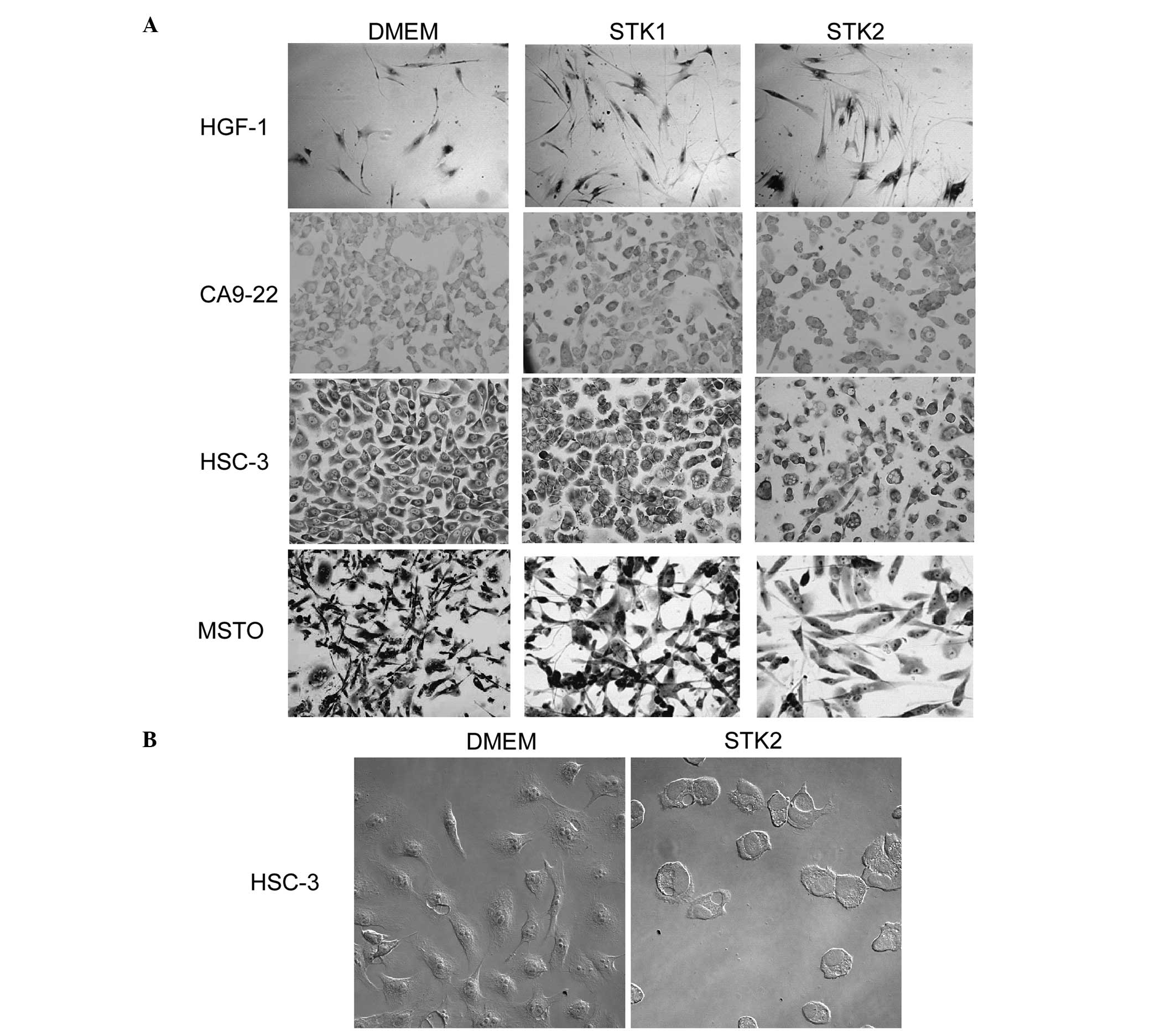
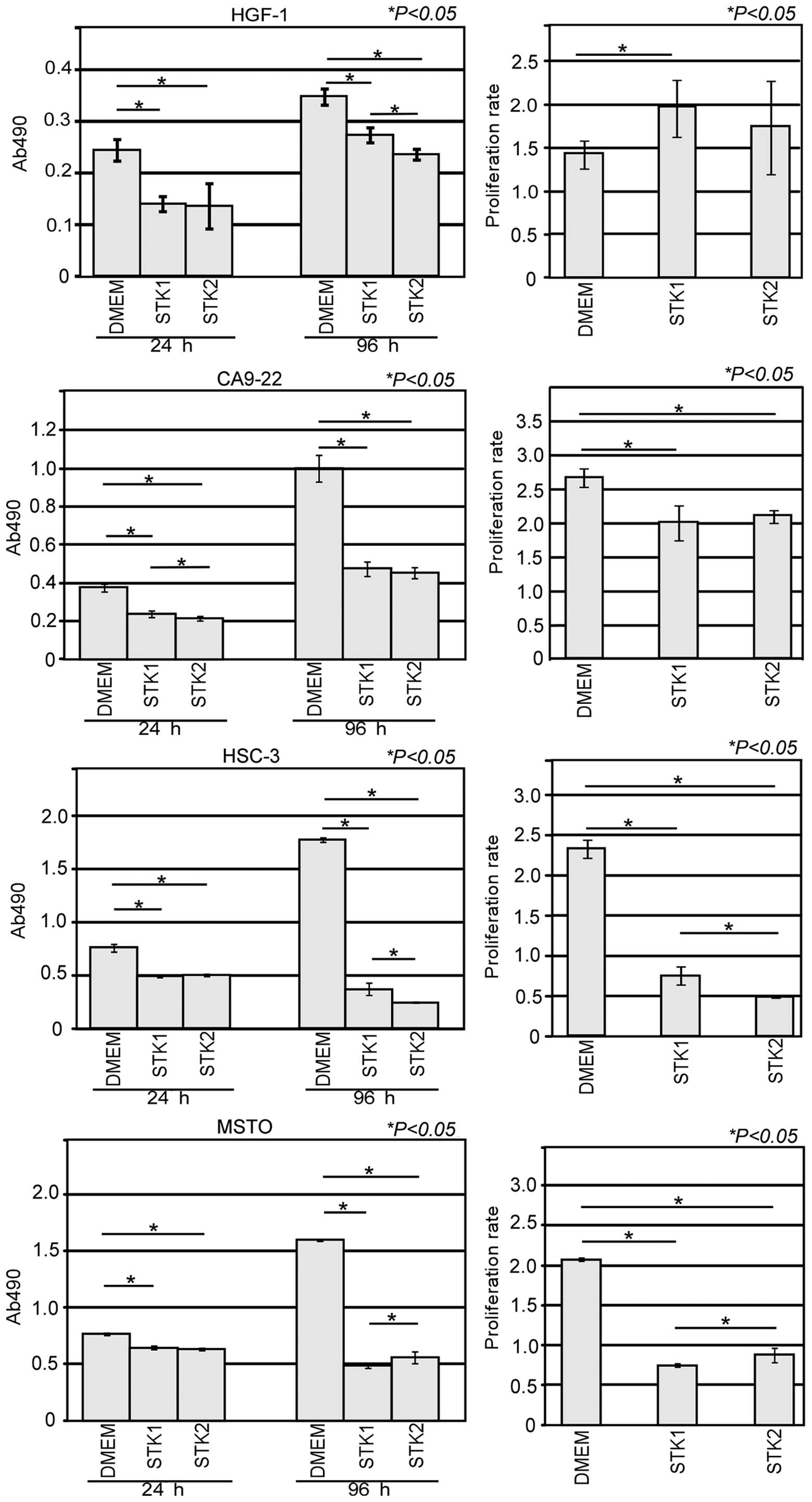
The affect of STK1 or STK2 was examined with regards to the cell growth of normal and cancer cells by the MTS assay. HGF-1, CA9-22, HSC-3 and MSTO cells were cultured with DMEM, STK1, or STK2 for 24–96 h. The cell proliferation of HSC-3 at 96 h after the medium was changed was markedly inhibited by STK1 and STK2. For MSTO, some floating cells were observed when cultured with STK1 (Fig. 1A). STK2 also affected the cell morphology of HSC-3, which changed to a round shape (Fig. 1B). The cell proliferation rates of HGF-1 cultured with DMEM, STK1 and STK2 were 1.4, 2.0 and 1.7-fold, respectively (Fig. 2). There was a significant increase in the cell proliferation rate between DMEM and STK1 (P<0.05), whereas there was no significant difference between DMEM and STK2 or STK1 and STK2. The cell proliferation rates of CA9-22 cultured with DMEM, STK1 and STK2 were 2.7, 2.0 and 2.1-fold, respectively. There was a significant decrease in the cell proliferation rate between DMEM and STK1, or DMEM and STK2 (P<0.05), whereas there was no significant difference in the cell proliferation rate between STK1 and STK2. The cell proliferation rates of HSC-3 cultured with DMEM, STK1 and STK2 were 2.3, 0.8 and 0.5-fold, respectively. There were significant decreases in the cell proliferation rates between DMEM and STK1, between DMEM and STK2 (P<0.05), and between STK1 and STK2 (P<0.05). The cell proliferation rates of MSTO cultured with DMEM, STK1 and STK2 were 2.1, 0.7 and 0.9-fold, respectively. There were significant decreases in the cell proliferation rates between DMEM and STK1, and DMEM and STK2 (P<0.05), and there was also a significant increase in the cell proliferation rate between STK1 and STK2 (P<0.05).

Figure 1

Dulbecco’s modified Eagle’s medium (DMEM), STK1 and STK2 show differential effects on cell proliferation. (A) Human gingival fibroblast (HGF-1), CA9-22, HSC-3 or MSTO cells were cultured in chamber slides. The culture medium was changed to DMEM, STK1, or STK2 after 24 h and the cells were cultured for an additional 96 h before fixation. (B) HSC-3 cells were cultured with DMEM or STK2 and were fixed. Images were captured in bright-field mode.

Figure 2

Quantification of human gingival fibroblast (HGF-1), CA9-22, HSC-3 and MSTO cell proliferation at 24 and 96 h when cultured with Dulbecco’s modified Eagle’s medium (DMEM), STK1 and STK2. The cells were cultured and the MTS-assay was performed. The left panel shows the raw cell proliferation data at 24 and 96 h of cell culture; the right panel shows the cell proliferation rate as determined by Ab490 nm at 96 h, divided by the value at 24 h.

Discussion

Previously, certain studies have performed cell culture without FBS or FCS for pre-clinical data or embryonic stem cells, as the serum affects the cell culture performance (15–17). STK1 and STK2 are serum-free media with unclear roles in the culture of normal and cancer cells. In the present study, the STK media were demonstrated to inhibit the cell proliferation of HSC-3 and MSTO, whereas they increased the cell proliferation of HGF-1 and CA9-22. When cultured with DMEM, these cancer cells grew well compared to STK1 and STK2. There are several possible explanations as to why STK media inhibited HSC-3 and MSTO cell proliferation. First, STK may have induced apoptosis or cell cycle arrest in HSC-3 and MSTO cells, as STK2 was found to induce a round shape in HSC-3. In addition, MTSO cultured with STK1 gave rise to a number of floating or detached cells. Whether this was due to apoptosis or detachment, and the explanation for why STK1 did not induce as many floating cells with HSC-3, could not be elucidated. STK1 may also possibly affect MSTO cell adhesion molecules, including β-catenin, claudins and E-cadherin (18,19).

CA9-22 and MSTO highly express EGFR, which may give rise to different proliferation rates between these two cell types when cultured with STK. Additionally, other factors may regulate cell proliferation, including the clock genes, PER1 and PER3, which are closely associated with cisplatin-induced apoptosis in CA9-22 (8,20). PER1 is highly expressed in CA9-22, whereas it is weakly expressed in HGF-1. Deleted in esophageal cancer 1 (DEC1) regulates cell proliferation under a serum-free condition (21). These molecules are closely associated with the regulation of apoptosis, cell cycle arrest and cell proliferation (20,22,23). Therefore, it can be speculated that PER1, PER3 and DEC1 may be involved in the regulation of cell proliferation by STK. These studies indicate that HSC-3 and MSTO cells may require more nutritional components than HGF-1 and CA9-22. Therefore, future studies should clarify how STK affects apoptosis and the cell cycle.

Acknowledgements

The present study was supported in part by Grants-in-Aid for Science from the Ministry of Education, Culture, Sports, Science and Technology of Japan (to Y.M. and Y.K.).

References

1 

Kading VH, Blalock JE and Gifford GE: Effect of serum on the antiviral and anticellular activities of mouse interferon. Arch Virol. 56:237–242. 1978. View Article : Google Scholar : PubMed/NCBI

2 

Toldbod HE, Agger R, Bolund L and Hokland M: Potent influence of bovine serum proteins in experimental dendritic cell-based vaccination protocols. Scand J Immunol. 58:43–50. 2003. View Article : Google Scholar : PubMed/NCBI

3 

Qin ZL, Ju HP, Liu Y, Gao TT, Wang WB, Aurelian L, Zhao P and Qi ZT: Fetal bovine serum inhibits hepatitis C virus attachment to host cells. J Virol Methods. 193:261–269. 2013. View Article : Google Scholar : PubMed/NCBI

4 

Roberg K, Ceder R, Farnebo L, Norberg-Spaak L and Grafström RC: Multiple genotypic aberrances associate to terminal differentiation-deficiency of an oral squamous cell carcinoma in serum-free culture. Differentiation. 76:868–880. 2008. View Article : Google Scholar : PubMed/NCBI

5 

Liu ZZ, Chen P, Lu ZD, Cui SD and Dong ZM: Enrichment of breast cancer stem cells using a keratinocyte serum-free medium. Chin Med J (Engl). 124:2934–2936. 2011.PubMed/NCBI

6 

Mark P, Kleinsorge M, Gaebel R, Lux CA, Toelk A, Pittermann E, David R, Steinhoff G and Ma N: Human mesenchymal stem cells display reduced expression of CD105 after culture in serum-free medium. Stem Cells Int. 2013:6980762013. View Article : Google Scholar : PubMed/NCBI

7 

Sawada R, Yamada T, Tsuchiya T and Matsuoka A: Microarray analysis of the effects of serum-free medium on gene expression changes in human mesenchymal stem cells during the in vitro culture. Yakugaku Zasshi. 130:1387–1393. 2010.(In Japanese).

8 

Hirai M, Gamou S, Minoshima S and Shimizu N: Two independent mechanisms for escaping epidermal growth factor-mediated growth inhibition in epidermal growth factor receptor-hyperproducing human tumor cells. J Cell Biol. 107:791–799. 1988. View Article : Google Scholar

9 

Matsui T, Ota T, Ueda Y, Tanino M and Odashima S: Isolation of a highly metastatic cell line to lymph node in human oral squamous cell carcinoma by orthotopic implantation in nude mice. Oral Oncol. 34:253–256. 1998. View Article : Google Scholar : PubMed/NCBI

10 

Chang CC, Lin BR, Chen ST, Hsieh TH, Li YJ and Kuo MY: HDAC2 promotes cell migration/invasion abilities through HIF-1α stabilization in human oral squamous cell carcinoma. J Oral Pathol Med. 40:567–575. 2011.PubMed/NCBI

11 

Jänne PA, Taffaro ML, Salgia R and Johnson BE: Inhibition of epidermal growth factor receptor signaling in malignant pleural mesothelioma. Cancer Res. 62:5242–5247. 2002.

12 

Bourguignon LY, Earle C, Wong G, Spevak CC and Krueger K: Stem cell marker (Nanog) and Stat-3 signaling promote MicroRNA-21 expression and chemoresistance in hyaluronan/CD44-activated head and neck squamous cell carcinoma cells. Oncogene. 31:149–160. 2012. View Article : Google Scholar : PubMed/NCBI

13 

Yamamoto K, Tominaga K, Sukedai M, Okinaga T, Iwanaga K, Nishihara T and Fukuda J: Delivery of cytolethal distending toxin B induces cell cycle arrest and apoptosis in gingival squamous cell carcinoma in vitro. Eur J Oral Sci. 112:445–451. 2004. View Article : Google Scholar : PubMed/NCBI

14 

Chiang SL, Jiang SS, Wang YJ, Chiang HC, Chen PH, Tu HP, Ho KY, Tsai YS, Chang IS and Ko YC: Characterization of arecoline-induced effects on cytotoxicity in normal human gingival fibroblasts by global gene expression profiling. Toxicol Sci. 100:66–74. 2007. View Article : Google Scholar : PubMed/NCBI

15 

Kim SJ and Diamond B: Generation and maturation of bone marrow-derived DCs under serum-free conditions. J Immunol Methods. 323:101–108. 2007. View Article : Google Scholar : PubMed/NCBI

16 

Li Y, Yokohama-Tamaki T and Tanaka TS: Short-term serum-free culture reveals that inhibition of Gsk3β induces the tumor-like growth of mouse embryonic stem cells. PLoS One. 6:e213552011.PubMed/NCBI

17 

Millington M, Arndt A, Boyd M, Applegate T and Shen S: Towards a clinically relevant lentiviral transduction protocol for primary human CD34 hematopoietic stem/progenitor cells. PLoS One. 4:e64612009. View Article : Google Scholar : PubMed/NCBI

18 

Fassina A, Cappellesso R, Guzzardo V, Dalla Via L, Piccolo S, Ventura L and Fassan M: Epithelial-mesenchymal transition in malignant mesothelioma. Mod Pathol. 25:86–99. 2012. View Article : Google Scholar

19 

Ikari A, Atomi K, Takiguchi A, Yamazaki Y, Hayashi H, Hirakawa J and Sugatani J: Enhancement of cell-cell contact by claudin-4 in renal epithelial Madin-Darby canine kidney cells. J Cell Biochem. 113:499–507. 2012. View Article : Google Scholar : PubMed/NCBI

20 

Sato F, Wu Y, Bhawal UK, Liu Y, Imaizumi T, Morohashi S, Kato Y and Kijima H: PERIOD1 (PER1) has anti-apoptotic effects, and PER3 has pro-apoptotic effects during cisplatin (CDDP) treatment in human gingival cancer CA9-22 cells. Eur J Cancer. 47:1747–1758. 2011. View Article : Google Scholar : PubMed/NCBI

21 

Li Y, Zhang H, Xie M, Hu M, Ge S, Yang D, Wan Y and Yan B: Abundant expression of Dec1/stra13/sharp2 in colon carcinoma: its antagonizing role in serum deprivation-induced apoptosis and selective inhibition of procaspase activation. Biochem J. 367:413–422. 2002. View Article : Google Scholar : PubMed/NCBI

22 

Bhawal UK, Sato F, Arakawa Y, Fujimoto K, Kawamoto T, Tanimoto K, Ito Y, Sasahira T, Sakurai T, Kobayashi M, et al: Basic helix-loop-helix transcription factor DEC1 negatively regulates cyclin D1. J Pathol. 224:420–429. 2011. View Article : Google Scholar : PubMed/NCBI

23 

Gery S, Komatsu N, Baldjyan L, Yu A, Koo D and Koeffler HP: The circadian gene per1 plays an important role in cell growth and DNA damage control in human cancer cells. Mol Cell. 22:375–382. 2006. View Article : Google Scholar : PubMed/NCBI

Related Articles

  • Abstract
  • View
  • Download
  • Twitter
Copy and paste a formatted citation
Spandidos Publications style
Tsugeno Y, Sato F, Muragaki Y and Kato Y: Cell culture of human gingival fibroblasts, oral cancer cells and mesothelioma cells with serum‑free media, STK1 and STK2. Biomed Rep 2: 644-648, 2014.
APA
Tsugeno, Y., Sato, F., Muragaki, Y., & Kato, Y. (2014). Cell culture of human gingival fibroblasts, oral cancer cells and mesothelioma cells with serum‑free media, STK1 and STK2. Biomedical Reports, 2, 644-648. https://doi.org/10.3892/br.2014.306
MLA
Tsugeno, Y., Sato, F., Muragaki, Y., Kato, Y."Cell culture of human gingival fibroblasts, oral cancer cells and mesothelioma cells with serum‑free media, STK1 and STK2". Biomedical Reports 2.5 (2014): 644-648.
Chicago
Tsugeno, Y., Sato, F., Muragaki, Y., Kato, Y."Cell culture of human gingival fibroblasts, oral cancer cells and mesothelioma cells with serum‑free media, STK1 and STK2". Biomedical Reports 2, no. 5 (2014): 644-648. https://doi.org/10.3892/br.2014.306
Copy and paste a formatted citation
x
Spandidos Publications style
Tsugeno Y, Sato F, Muragaki Y and Kato Y: Cell culture of human gingival fibroblasts, oral cancer cells and mesothelioma cells with serum‑free media, STK1 and STK2. Biomed Rep 2: 644-648, 2014.
APA
Tsugeno, Y., Sato, F., Muragaki, Y., & Kato, Y. (2014). Cell culture of human gingival fibroblasts, oral cancer cells and mesothelioma cells with serum‑free media, STK1 and STK2. Biomedical Reports, 2, 644-648. https://doi.org/10.3892/br.2014.306
MLA
Tsugeno, Y., Sato, F., Muragaki, Y., Kato, Y."Cell culture of human gingival fibroblasts, oral cancer cells and mesothelioma cells with serum‑free media, STK1 and STK2". Biomedical Reports 2.5 (2014): 644-648.
Chicago
Tsugeno, Y., Sato, F., Muragaki, Y., Kato, Y."Cell culture of human gingival fibroblasts, oral cancer cells and mesothelioma cells with serum‑free media, STK1 and STK2". Biomedical Reports 2, no. 5 (2014): 644-648. https://doi.org/10.3892/br.2014.306
Follow us
  • Twitter
  • LinkedIn
  • Facebook
About
  • Spandidos Publications
  • Careers
  • Cookie Policy
  • Privacy Policy
How can we help?
  • Help
  • Live Chat
  • Contact
  • Email to our Support Team