Spandidos Publications Logo
  • About
    • About Spandidos
    • Aims and Scopes
    • Abstracting and Indexing
    • Editorial Policies
    • Reprints and Permissions
    • Job Opportunities
    • Terms and Conditions
    • Contact
  • Journals
    • All Journals
    • Oncology Letters
      • Oncology Letters
      • Information for Authors
      • Editorial Policies
      • Editorial Board
      • Aims and Scope
      • Abstracting and Indexing
      • Bibliographic Information
      • Archive
    • International Journal of Oncology
      • International Journal of Oncology
      • Information for Authors
      • Editorial Policies
      • Editorial Board
      • Aims and Scope
      • Abstracting and Indexing
      • Bibliographic Information
      • Archive
    • Molecular and Clinical Oncology
      • Molecular and Clinical Oncology
      • Information for Authors
      • Editorial Policies
      • Editorial Board
      • Aims and Scope
      • Abstracting and Indexing
      • Bibliographic Information
      • Archive
    • Experimental and Therapeutic Medicine
      • Experimental and Therapeutic Medicine
      • Information for Authors
      • Editorial Policies
      • Editorial Board
      • Aims and Scope
      • Abstracting and Indexing
      • Bibliographic Information
      • Archive
    • International Journal of Molecular Medicine
      • International Journal of Molecular Medicine
      • Information for Authors
      • Editorial Policies
      • Editorial Board
      • Aims and Scope
      • Abstracting and Indexing
      • Bibliographic Information
      • Archive
    • Biomedical Reports
      • Biomedical Reports
      • Information for Authors
      • Editorial Policies
      • Editorial Board
      • Aims and Scope
      • Abstracting and Indexing
      • Bibliographic Information
      • Archive
    • Oncology Reports
      • Oncology Reports
      • Information for Authors
      • Editorial Policies
      • Editorial Board
      • Aims and Scope
      • Abstracting and Indexing
      • Bibliographic Information
      • Archive
    • Molecular Medicine Reports
      • Molecular Medicine Reports
      • Information for Authors
      • Editorial Policies
      • Editorial Board
      • Aims and Scope
      • Abstracting and Indexing
      • Bibliographic Information
      • Archive
    • World Academy of Sciences Journal
      • World Academy of Sciences Journal
      • Information for Authors
      • Editorial Policies
      • Editorial Board
      • Aims and Scope
      • Abstracting and Indexing
      • Bibliographic Information
      • Archive
    • International Journal of Functional Nutrition
      • International Journal of Functional Nutrition
      • Information for Authors
      • Editorial Policies
      • Editorial Board
      • Aims and Scope
      • Abstracting and Indexing
      • Bibliographic Information
      • Archive
    • International Journal of Epigenetics
      • International Journal of Epigenetics
      • Information for Authors
      • Editorial Policies
      • Editorial Board
      • Aims and Scope
      • Abstracting and Indexing
      • Bibliographic Information
      • Archive
    • Medicine International
      • Medicine International
      • Information for Authors
      • Editorial Policies
      • Editorial Board
      • Aims and Scope
      • Abstracting and Indexing
      • Bibliographic Information
      • Archive
  • Articles
  • Information
    • Information for Authors
    • Information for Reviewers
    • Information for Librarians
    • Information for Advertisers
    • Conferences
  • Language Editing
Spandidos Publications Logo
  • About
    • About Spandidos
    • Aims and Scopes
    • Abstracting and Indexing
    • Editorial Policies
    • Reprints and Permissions
    • Job Opportunities
    • Terms and Conditions
    • Contact
  • Journals
    • All Journals
    • Biomedical Reports
      • Information for Authors
      • Editorial Policies
      • Editorial Board
      • Aims and Scope
      • Abstracting and Indexing
      • Bibliographic Information
      • Archive
    • Experimental and Therapeutic Medicine
      • Information for Authors
      • Editorial Policies
      • Editorial Board
      • Aims and Scope
      • Abstracting and Indexing
      • Bibliographic Information
      • Archive
    • International Journal of Epigenetics
      • Information for Authors
      • Editorial Policies
      • Editorial Board
      • Aims and Scope
      • Abstracting and Indexing
      • Bibliographic Information
      • Archive
    • International Journal of Functional Nutrition
      • Information for Authors
      • Editorial Policies
      • Editorial Board
      • Aims and Scope
      • Abstracting and Indexing
      • Bibliographic Information
      • Archive
    • International Journal of Molecular Medicine
      • Information for Authors
      • Editorial Policies
      • Editorial Board
      • Aims and Scope
      • Abstracting and Indexing
      • Bibliographic Information
      • Archive
    • International Journal of Oncology
      • Information for Authors
      • Editorial Policies
      • Editorial Board
      • Aims and Scope
      • Abstracting and Indexing
      • Bibliographic Information
      • Archive
    • Medicine International
      • Information for Authors
      • Editorial Policies
      • Editorial Board
      • Aims and Scope
      • Abstracting and Indexing
      • Bibliographic Information
      • Archive
    • Molecular and Clinical Oncology
      • Information for Authors
      • Editorial Policies
      • Editorial Board
      • Aims and Scope
      • Abstracting and Indexing
      • Bibliographic Information
      • Archive
    • Molecular Medicine Reports
      • Information for Authors
      • Editorial Policies
      • Editorial Board
      • Aims and Scope
      • Abstracting and Indexing
      • Bibliographic Information
      • Archive
    • Oncology Letters
      • Information for Authors
      • Editorial Policies
      • Editorial Board
      • Aims and Scope
      • Abstracting and Indexing
      • Bibliographic Information
      • Archive
    • Oncology Reports
      • Information for Authors
      • Editorial Policies
      • Editorial Board
      • Aims and Scope
      • Abstracting and Indexing
      • Bibliographic Information
      • Archive
    • World Academy of Sciences Journal
      • Information for Authors
      • Editorial Policies
      • Editorial Board
      • Aims and Scope
      • Abstracting and Indexing
      • Bibliographic Information
      • Archive
  • Articles
  • Information
    • For Authors
    • For Reviewers
    • For Librarians
    • For Advertisers
    • Conferences
  • Language Editing
Login Register Submit
  • This site uses cookies
  • You can change your cookie settings at any time by following the instructions in our Cookie Policy. To find out more, you may read our Privacy Policy.

    I agree
Search articles by DOI, keyword, author or affiliation
Search
Advanced Search
presentation
Biomedical Reports
Join Editorial Board Propose a Special Issue
Print ISSN: 2049-9434 Online ISSN: 2049-9442
Journal Cover
January-February 2015 Volume 3 Issue 1

Full Size Image

Sign up for eToc alerts
Recommend to Library

Journals

International Journal of Molecular Medicine

International Journal of Molecular Medicine

International Journal of Molecular Medicine is an international journal devoted to molecular mechanisms of human disease.

International Journal of Oncology

International Journal of Oncology

International Journal of Oncology is an international journal devoted to oncology research and cancer treatment.

Molecular Medicine Reports

Molecular Medicine Reports

Covers molecular medicine topics such as pharmacology, pathology, genetics, neuroscience, infectious diseases, molecular cardiology, and molecular surgery.

Oncology Reports

Oncology Reports

Oncology Reports is an international journal devoted to fundamental and applied research in Oncology.

Experimental and Therapeutic Medicine

Experimental and Therapeutic Medicine

Experimental and Therapeutic Medicine is an international journal devoted to laboratory and clinical medicine.

Oncology Letters

Oncology Letters

Oncology Letters is an international journal devoted to Experimental and Clinical Oncology.

Biomedical Reports

Biomedical Reports

Explores a wide range of biological and medical fields, including pharmacology, genetics, microbiology, neuroscience, and molecular cardiology.

Molecular and Clinical Oncology

Molecular and Clinical Oncology

International journal addressing all aspects of oncology research, from tumorigenesis and oncogenes to chemotherapy and metastasis.

World Academy of Sciences Journal

World Academy of Sciences Journal

Multidisciplinary open-access journal spanning biochemistry, genetics, neuroscience, environmental health, and synthetic biology.

International Journal of Functional Nutrition

International Journal of Functional Nutrition

Open-access journal combining biochemistry, pharmacology, immunology, and genetics to advance health through functional nutrition.

International Journal of Epigenetics

International Journal of Epigenetics

Publishes open-access research on using epigenetics to advance understanding and treatment of human disease.

Medicine International

Medicine International

An International Open Access Journal Devoted to General Medicine.

Journal Cover
January-February 2015 Volume 3 Issue 1

Full Size Image

Sign up for eToc alerts
Recommend to Library

  • Article
  • Citations
    • Cite This Article
    • Download Citation
    • Create Citation Alert
    • Remove Citation Alert
    • Cited By
  • Similar Articles
    • Related Articles (in Spandidos Publications)
    • Similar Articles (Google Scholar)
    • Similar Articles (PubMed)
  • Download PDF
  • Download XML
  • View XML
Article

First pathological study of canine primary breast lymphoma and the description of its clinicopathological characteristics as an animal model for human primary breast lymphoma

  • Authors:
    • Sanaz Rismanchi
    • Samad Muhammadnejad
    • Saeid Amanpour
    • Ahad Muhammadnejad
  • View Affiliations / Copyright

    Affiliations: Cancer Models Research Center, Cancer Institute of Iran, Tehran University of Medical Sciences, Imam-Khomeini Hospital Complex, Tehran 1419733141, Iran, Research Center for Molecular and Cellular Imaging, Tehran University of Medical Sciences, Imam-Khomeini Hospital Complex, Tehran 1419733141, Iran, Cancer Models Research Center, Cancer Institute of Iran, Tehran University of Medical Sciences, Imam-Khomeini Hospital Complex, Tehran 1419733141, Iran, Cancer Research Center, Cancer Institute of Iran, Tehran University of Medical Sciences, Imam-Khomeini Hospital Complex, Tehran 1419733141, Iran
  • Pages: 75-77
    |
    Published online on: October 9, 2014
       https://doi.org/10.3892/br.2014.369
  • Expand metrics +
Metrics: Total Views: 0 (Spandidos Publications: | PMC Statistics: )
Metrics: Total PDF Downloads: 0 (Spandidos Publications: | PMC Statistics: )
Cited By (CrossRef): 0 citations Loading Articles...

This article is mentioned in:


Abstract

Canine breast cancer (BC) and human BC are the most prevalent tumors in female dogs and humans, respectively. Several studies have indicated that canine BC is a good model for human BC. Unlike breast carcinomas, human primary breast lymphoma (PBL) is a rare tumor, but no case of canine PBL has been reported thus far. The current study presents a case of canine MC of the primary non‑Hodgkin lymphoma (NHL) type for the first time and subsequently questions the theory of considering it as a model for human PBL. A 2‑cm tumor was surgically removed from the left caudal abdominal mammary gland of a 6‑year‑old female dog of the terrier breed. Microscopic examination did not show any sign for the epithelial origin of the tumor. By contrast, histomorphological view and molecular pathological evaluation by immunohistochemistry showed that the tumor was of the diffuse large B‑cell lymphoma (DLBCL) type [cluster of differentiation 19+ (CD19+), CD20+, CD10+, B-cell lymphoma 6+, CD3‑, CD15‑]. According to the World Health Organization classification, DLBCL is considered to be an NHL. Canine NHL is common in dogs and certain investigators believe that the biological behavior and clinical course is extremely similar to human NHL, and therefore, consider it as a model of human NHL. To the best of our knowledge, the current study is the first report of canine PBL. As the most significantly reported human PBL histotype is the DLBCL type, the histomorphological and immunophenotyping characteristics of canine PBL in the study considerably match with human PBL and raise the hypothesis that it can be a model for human PBL.

Introduction

Canine breast cancer (BC) is the most significant tumor in female dogs, whereas human BC is the most prevalent type of cancer in females worldwide (1–2). There is much evidence indicating that canine BC mimics the characteristics of human BC with regards to incidence, histomorphological characteristics, gene profiles, molecular signaling pathways and clinical course (3). Numerous experts believe that canine BC can be a powerful translation research model for human BC (4). Carcinomas account for the majority of histological classifications of canine BC and sarcomas are less frequent (5). However, to the best of our knowledge no case of canine primary lymphoma of the breast has been reported. However, human primary breast lymphoma (PBL) is a rare malignancy and statistics show that <0.5% of human BCs and 2% of all extranodal non-Hodgkin lymphomas (NHLs) are PBL (6).

The current study presents a case of canine BC of the primary NHL type for the first time and subsequently the theory of considering it as a model for human PBL is raised.

Materials and methods

A 6-year-old female terrier with a history of ovariohysterectomy at the age of 1 was referred to a veterinary clinic with a lump in the left caudal abdominal mammary gland. The primary diagnosis of the veterinary surgeon was canine BC. Thoracic imaging and abdominal ultrasonography (according to the diagnostic guidelines of metastatic canine BC) were performed to check for metastasis, but no symptom was observed (7). Finally, simple mastectomy was performed and a sample of the 2-cm tumor was sent to the pathology laboratory of cancer institute of Iran.

The tumor section was fixed by 4% formaldehyde in 0.1 M phosphate-buffered saline (PBS) solution. The fixed tissue was dehydrated by graded concentrations of ethanol and embedded in paraffin wax, and subsequently stained with hematoxylin and eosin (H&E). The slides were reviewed by a pathologist. For immunohistochemical examination, paraffin-embedded blocks were cooled in an ice-water mixture for 30 min before sectioning. A total of 4 µm sections were cut and placed on slides. After a brief drying period of ~15 min, the sections were heat-fixed to the slide at 37°C. The sections were deparaffinized and rehydrated in graded ethanol concentrations. The prepared slides were stained immunohistochemically by cytokeratin 7 (CK7), CK5/6, cluster of differentiation 3 (CD3), CD10, CD15, CD19, CD20, and Bcl-6 according to the manufacturer's instructions for the kits (Dako Denmark A/S, Glostrup, Denmark).

Results

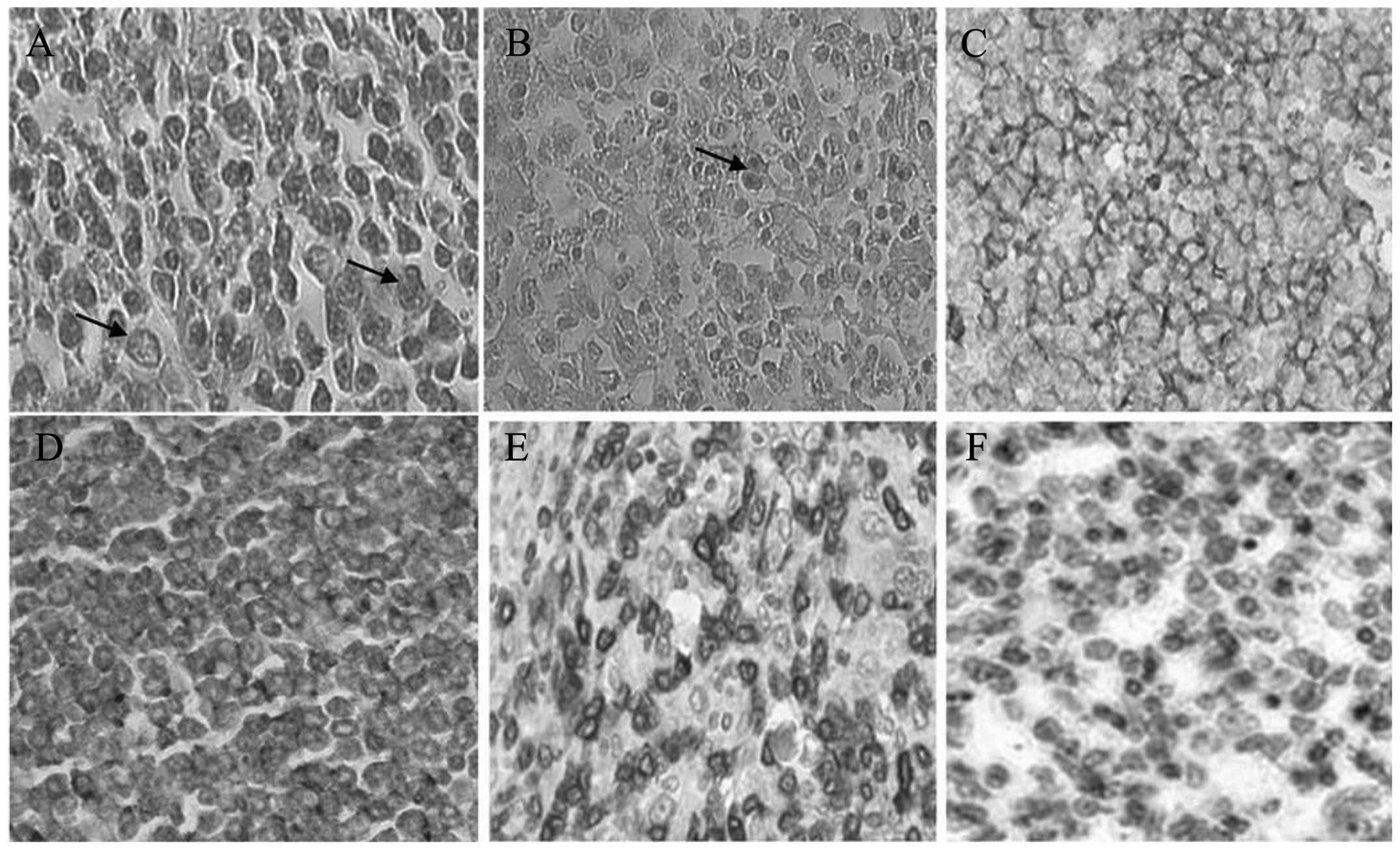
No cytology or histology assessments were performed prior to the surgery. No evidence of carcinoma was observed during the microscopic study of H&E slides, and the arrangement of malignant cells indicated lymphoproliferative neoplasms. Immunohistochemistry (IHC) staining with CK7 and CK5/6 markers confirmed that the tumor did not have an epithelial nature. Prominent histomorphological characteristics of the malignant cells are described as follows: Cell sizes were larger than normal lymphocytes and they had round and elliptical vesicular nuclei. Nucleoli were often isolated and they were observed near the nuclear membrane (Fig. 1). The cytoplasm of the cells was often basophilic and certain anaplastic cells appeared to be multinucleate and showed the pathological view of Reed-Sternberg-like cells (Fig. 1). According to histomorphological characteristics, the pattern of malignant cells showed diffuse large B-cell lymphoma (DLBCL), however, the Reed-Sternberg-like cells view was misleading and could show a Hodgkin's lymphoma (HL) pattern. In order to determine the immunophenotype of tumor cells, slides were prepared from paraffin blocks and subsequently stained with the IHC method using CD3, CD10, CD15, CD19, CD20 and B-cell lymphoma 6 markers (Fig. 1). IHC results are observed in Table I. In addition, Ki-67 marker staining showed that cell cycle activity was ~50% and could reject the possibility of Burkitt's lymphoma (starry sky pattern was not observed with regards to histomorphology).

Figure 1

Micrographs prepared from canine primary breast lymphoma. (A and B) Micrographs show hematoxylin and eosin-stained slides. Large lymphocyte cells with vesicular nuclei were observed. The tip of the arrow in micrograph (B) shows Reed-Sternberg-like cells. (C-F) Micrographs show immunohistochemistry staining. (C) Marker CD10 was positive, (D and E) CD19 and CD20 were positive, respectively, and (F) shows the surface marker of Bcl-6 in the form of scatter. CD, cluster of differentiation, Bcl-6, B-cell lymphoma 6.

Table I

Immunohistochemistry (IHC) test results assessed by CD markers.

Table I

Immunohistochemistry (IHC) test results assessed by CD markers.

IHC stainingCD marker result
CD3Negative
CD10Positive
CD15Negative
CD19Positive
CD20Positive
Bcl-6Scatter

[i] CD, cluster of differentiation; Bcl-6, B-cell lymphoma 6.

With regard to the histomorphological findings and IHC, the final diagnosis was extranodal-NHL of the DLBCL type and considering the clinical findings that showed no evidence of a primary lymphoma having invaded the breast area, the final diagnosis for this case was canine PBL.

Discussion

As it was indicated, the animal had canine BC of the primary NHL type. Canine NHL is a common malignancy (8). However, this disease comprises a heterogeneous group of canine malignancies and has an extremely varied prognosis (9). The major cause is attributed to various NHL subtypes. Canine NHL subtypes were examined with immunophenotyping assessments, and considering their immunophenotyping similarities and adaptations with human NHL, canine NHL was classified according to World Health Organization guidelines (10). DLBCL comprises the most significant group of canine NHL, as statistics show that 48% of all canine lymphomas belong to this category (11). Extensive evidence suggests canine NHL to be a model for human NHL. Following the separation of canine lymphoma cells, the study by Ito et al (8) cultured and passaged them and developed a xenograft model. Subsequently, their molecular profile was examined and it was concluded that not only is canine NHL morphologically and behaviorally similar to human NHL, but its molecular changes also mimic human lymphoma. Pawlak et al (10) had previously addressed this theory.

In human DLBCL it is known that tumor growth is rapid and prognosis is poor (12,13). Bienzle and Vernau (9) stated that the survival time of canine DLBCL is short, and that similar to human DLBCL, its prognosis is bad. Using molecular techniques, Richards et al (11) divided canine DLBCL into two subcategories. After assessing their survival time, the study concluded that the course of the disease is similar to human DLBCL and its prognosis is poor.

Human PBL is a relatively rare form of human BC and the majority of its types are DLBCL (6). No previous study of canine breast lymphoma can be found in the databases of PubMed and Google scholar. However, the histomorphological characteristics, molecular pathology and clinical data of the present case confirmed breast lymphoma. Observation of Reed-Sternberg-like cells may be suggestive of canine HL, but the surface marker of CD15 was negative. Such a microscopic view appears to be due to the presence of large inclusion-like nucleoli in highly anaplastic cells, whereas this surface marker is positive in >90% of typical Reed-Sternberg cells (14). The results of the present case report indicate that canine NHL in the mammary gland area can mimic the properties of HBL.

In general, modeling in the area of oncology research requires reliable evidence showing that the model is powerful regarding translational research, as the results of the pre-clinical phase require extension to the clinical phase (15). Although reliable scientific communities have suggested xenograft for the pre-clinical phase of the tumor, the canine model has received increasing attention in oncology research during recent years (3,10). Three main causes have been cited for this: Firstly, these tumors are spontaneous, as they were not experimentally induced; secondly, the life of dogs are so that the clinical course of the disease is extremely well shown and the disease shifts from early to advance stage. As a result, invasion and metastasis can be followed in this model. Thirdly, with regard to the fact that dogs live alongside humans, they are exposed to the same risk factors and so the course of molecular changes and genetic mutations can also be studied (4,8,15).

Although no studies of canine breast lymphoma have been reported thus far, and to the best of our knowledge, this is the first report of canine NHL in the mammary area of dog, when considering previous evidence emphasizing the similarities in histomorphology, immunophenotyping and clinical course of canine and human NHL, the theory can be raised that canine PBL can also be a model for research on human PBL. Performing case series studies in this area in the future is required. Not only can canine cancer models be considered a study phase in pre-clinical research, but they can also be useful for afflicted dogs, as they may be helpful in developing novel (ethical) treatments and also reduce the suffering caused by canine cancer.

Acknowledgements

The present study had no financial sponsor and all the costs of pathology tests were paid by the authors. The authors would like to express their gratitude to Dr Taghizadeh-jahed, veterinary surgeon, for surgically removing the tumor. They would also like to thank Ms. Morsali and the Pathobiology Laboratory of Dr E'temad Moghaddam for helping prepare the pathological slides.

References

1 

Sleeckx N, de Rooster H, Veldhuis Kroeze EJ, Van Ginneken C and Van Brantegem L: Canine mammary tumours, an overview. Reprod Domest Anim. 46:1112–1131. 2011. View Article : Google Scholar : PubMed/NCBI

2 

Redig AJ and McAllister SS: Breast cancer as a systemic disease: a view of metastasis. J Intern Med. 274:113–126. 2013. View Article : Google Scholar : PubMed/NCBI

3 

Pinho SS, Carvalho S, Cabral J, Reis CA and Gartner F: Canine tumors: a spontaneous animal model of human carcinogenesis. Transl Res. 159:165–172. 2012. View Article : Google Scholar : PubMed/NCBI

4 

Rivera P and von Euler H: Molecular biological aspects on canine and human mammary tumors. Vet Pathol. 48:132–146. 2011. View Article : Google Scholar : PubMed/NCBI

5 

Goldschmidt M, Peña L, Rasotto R and Zappulli V: Classification and grading of canine mammary tumors. Vet Pathol. 48:117–131. 2011. View Article : Google Scholar : PubMed/NCBI

6 

Cheah CY, Campbell BA and Seymour JF: Primary breast lymphoma. Cancer Treat Rev. 40:900–908. 2014. View Article : Google Scholar

7 

Cassali GD, Lavalle GE, De Nardi AB, et al: Consensus for the diagnosis, prognosis and treatment of canine mammary tumors. Braz J Vet Pathol. 4:153–180. 2011.

8 

Ito D, Frantz AM and Modiano JF: Canine lymphoma as a comparative model for human non-Hodgkin lymphoma: recent progress and applications. Vet Immunol Immunopathol. 159:192–201. 2014. View Article : Google Scholar : PubMed/NCBI

9 

Bienzle D and Vernau W: The diagnostic assessment of canine lymphoma: implications for treatment. Clin Lab Med. 31:21–39. 2011. View Article : Google Scholar : PubMed/NCBI

10 

Pawlak A, Obminska-Mrukowicz B and Rapak A: The dog as a model for comparative studies of lymphoma and leukemia in humans. Postepy Hig Med Dosw (Online). 67:471–480. 2013.(In Polish).

11 

Richards KL, Motsinger-Reif AA, Chen HW, et al: Gene profiling of canine B-cell lymphoma reveals germinal center and postgerminal center subtypes with different survival times, modeling human DLBCL. Cancer Res. 73:5029–5039. 2013. View Article : Google Scholar

12 

Aviv A, Tadmor T and Polliack A: Primary diffuse large B-cell lymphoma of the breast: looking at pathogenesis, clinical issues and therapeutic options. Ann Oncol. 24:2236–2244. 2013. View Article : Google Scholar : PubMed/NCBI

13 

Roschewski M, Dunleavy K and Wilson WH: Diffuse large B cell lymphoma: molecular targeted therapy. Int J Hematol. 96:552–561. 2012. View Article : Google Scholar : PubMed/NCBI

14 

Hansmann ML and Willenbrock K: WHO classification of Hodgkin's lymphoma and its molecular pathological relevance. Pathologe. 23:207–218. 2002.(In German).

15 

Vail DM and MacEwen EG: Spontaneously occurring tumors of companion animals as models for human cancer. Cancer Invest. 18:781–792. 2000. View Article : Google Scholar : PubMed/NCBI

Related Articles

  • Abstract
  • View
  • Download
  • Twitter
Copy and paste a formatted citation
Spandidos Publications style
Rismanchi S, Muhammadnejad S, Amanpour S and Muhammadnejad A: First pathological study of canine primary breast lymphoma and the description of its clinicopathological characteristics as an animal model for human primary breast lymphoma. Biomed Rep 3: 75-77, 2015.
APA
Rismanchi, S., Muhammadnejad, S., Amanpour, S., & Muhammadnejad, A. (2015). First pathological study of canine primary breast lymphoma and the description of its clinicopathological characteristics as an animal model for human primary breast lymphoma. Biomedical Reports, 3, 75-77. https://doi.org/10.3892/br.2014.369
MLA
Rismanchi, S., Muhammadnejad, S., Amanpour, S., Muhammadnejad, A."First pathological study of canine primary breast lymphoma and the description of its clinicopathological characteristics as an animal model for human primary breast lymphoma". Biomedical Reports 3.1 (2015): 75-77.
Chicago
Rismanchi, S., Muhammadnejad, S., Amanpour, S., Muhammadnejad, A."First pathological study of canine primary breast lymphoma and the description of its clinicopathological characteristics as an animal model for human primary breast lymphoma". Biomedical Reports 3, no. 1 (2015): 75-77. https://doi.org/10.3892/br.2014.369
Copy and paste a formatted citation
x
Spandidos Publications style
Rismanchi S, Muhammadnejad S, Amanpour S and Muhammadnejad A: First pathological study of canine primary breast lymphoma and the description of its clinicopathological characteristics as an animal model for human primary breast lymphoma. Biomed Rep 3: 75-77, 2015.
APA
Rismanchi, S., Muhammadnejad, S., Amanpour, S., & Muhammadnejad, A. (2015). First pathological study of canine primary breast lymphoma and the description of its clinicopathological characteristics as an animal model for human primary breast lymphoma. Biomedical Reports, 3, 75-77. https://doi.org/10.3892/br.2014.369
MLA
Rismanchi, S., Muhammadnejad, S., Amanpour, S., Muhammadnejad, A."First pathological study of canine primary breast lymphoma and the description of its clinicopathological characteristics as an animal model for human primary breast lymphoma". Biomedical Reports 3.1 (2015): 75-77.
Chicago
Rismanchi, S., Muhammadnejad, S., Amanpour, S., Muhammadnejad, A."First pathological study of canine primary breast lymphoma and the description of its clinicopathological characteristics as an animal model for human primary breast lymphoma". Biomedical Reports 3, no. 1 (2015): 75-77. https://doi.org/10.3892/br.2014.369
Follow us
  • Twitter
  • LinkedIn
  • Facebook
About
  • Spandidos Publications
  • Careers
  • Cookie Policy
  • Privacy Policy
How can we help?
  • Help
  • Live Chat
  • Contact
  • Email to our Support Team